Alice Springs Vegie Garden Companion 
A handbook for growing food in 
arid Australia
1 
We acknowledge the traditional owners and people of this land. 
Big Thanks 
This revised second edition of the Alice 
Springs Vegie Garden Companion would 
not have been possible without the efforts 
of all those who contributed to the first edi-tion. 
Thank you. 
Editor, Katrina Patton, has gone way 
beyond the call of duty to share her love of 
gardening and commitment to local food 
growing. Katrina has edited, written sec-tions, 
designed and produced this version. 
Her vision and skills have taken it to a new 
level. 
Geoff Miers has generously contributed 
years of experience to these pages, hours 
to the editing process and ongoing support 
for the project. Thanks also to Chris Brock 
for his dedication to the cause and tireless 
contributions, and to Tim Collins for his 
help on the Bush Foods section. 
Big love to Fiona Rogers, Lucy Scott and 
Grace Pullen for the beautiful artwork. 
Finally ALEC acknowledges the support 
of the Northern Territory Government. In 
2009, ALEC Coordinator Jimmy Cocking, 
applied successfully for an Environment 
Grant towards a Gardens For Food project 
as a practical community adaptation to 
climate change. 
This precious resource, the Alice Springs 
Vegie Garden Companion, has been created 
through a community effort. It will assist 
local food production throughout arid Aus-tralia 
for many years to come. 
Ruth Apelt 
Arid Lands Environment Centre 
Spring 2010 
Contents 
3 Getting Started 
10 Water 
14 Soils 
17 Compost 
22 Chickens 
24 Pests 
29 Integrated Pest Management 
& Companion planting 
32 Seedsaving 
35 Planting by the Moon 
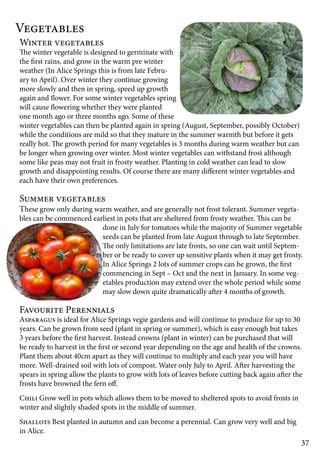
37 Vegetables 
42 Fruit: the big four 
46 Other Fruit 
50 Herbs 
52 Bush Foods 
54 Garden Directory
Getting Started 
A variety of vegetables, fruits and herbs can be grown in and around Alice 
Springs, some are easier than others, and all will do better with a little bit of 
planning and preparation. The following are some general tips for the less 
experienced gardener. 
Planning 
Choosing the location for your garden is the most important factor in ensuring a successful 
and abundant garden with minimal effort. Select a site that gets some sun all year round, par-ticularly 
winter sun, that is when the sun is low to the north. Patchy shade in summer is great 
however if shade is provided by trees, consider that their roots can take water and nutrients 
away from your vegetables. Most trees have extensive root systems, which may or may not 
compete for water and nutrients with your vegetables. An area that doesn’t have shade or trees 
on the northern boundary is great and some shade or trees on the southern boundary is okay. 
Once you have a couple of positions in mind take time to sit in your garden and observe it: 
• Are some areas more exposed to wind? - Areas sheltered from wind are better. 
• What soil types do you have? – Both too sandy and too much clay will need more work to 
build better soil. You can also test soil from your garden with a home pH testing kit or take 
some samples into a nursery for testing. 
• Do some areas stay wet after rain? – Perhaps you could harvest this water and create a pond 
or dig trenches to bring it to your fruit trees and vegetable garden. 
• Do other areas drain better? - Generally vegetables appreciate good drainage. 
• Which areas get more sun throughout the day? – (Bearing in mind this will change season-ally). 
If you find you have a garden that receives more sun at one end than the other, you could 
plan for winter crops in full sun and summer crops with more shade. You can also put up 
shade cloth if the summer sun is too strong. 
Paths and compaction 
Compaction occurs when the garden soil is walked upon. It is bad as it prevents water, air and 
essential nutrients from penetrating the soil. Include paths and stepping stones in your plan to 
avoid it. 
Soil preparation 
It is very important to prepare the soil, as rarely in arid conditions will it be deliciously rich 
and ready to be planted into. See the Soils section for information on how to identify your soil 
type and prepare it for growing food. 
Welcome to the second edition of the Alice Springs Vegie Garden 
Companion: A handbook for growing food in arid Australia. This 
edition has been produced as part of our Gardens For Food Project 
- to inspire, encourage and assist people to grow their own food. 
Today, the home vegie patch is making a comeback as people adapt to climate 
change and the environmental impacts of how food is produced. There are hundreds of 
bountiful back yards in and around Alice Springs, and plenty of space for more. 
The 2006-2007 Alice Springs Vegie Garden Companion has indeed become a companion 
for many gardeners in Alice Springs. The community has celebrated this resource as peo-ple 
have continued to photocopy and distribute it long after the last official copy was sold. 
In this revised and expanded edition we have added sections on fruit trees, bush foods, 
chickens, more on compost, a section for people with less experience and more. 
Before colonisation, Arrernte people sustained themselves for thousands of years, gather-ing 
food and medicine from this arid landscape. In the early colonial days people culti-vated 
the land here and grew most of the food they needed to sustain themselves. 
Until the 1970’s Alice Springs grew most of its own veggies. Since then, the complexities 
and conveniences of modern life have taken over. But these days the language of climate 
change includes concerns for food security, community resilience, and the need to reduce 
food miles and carbon footprints. 
Growing food is an empowering action that individuals and communities can take to 
address ALL these challenges! And the taste of freshly picked produce is always beyond 
compare, without the need for pesticides and packaging. The higher nutritional value is 
confirmed by research. 
In a nutshell, home grown is cheap, good for you and good for the environment. And it’s 
fun. It is our hope that this little book can accompany you along the journey that is grow-ing 
food in arid Australia. 
Feeling inspired? 
There is lots happening in and around Alice Springs. You might want to… 
• Get involved with the Alice Springs Community Garden. 
• Join the Alice Permablitz group. Check out www.permablitz.net for more info or find 
them on facebook. 
• Join the Alice Springs Seedsavers group. Learn more about saving seed and the benefits of 
sharing seed and knowledge locally. 
•Keep an eye out for gardening workshops. Check 
notice boards at nurseries or ask around the com-munity 
garden and DesertSMART COOLMob 
networks. 
Email gardensforfood@gmail.com for more infor-mation 
2 3
Pots and Container Gardens 
You also might consider gardening in pots, 
tubs and boxes if you have limited space, 
sunlight or really bad soil. Generally the 
bigger the tub/pot the better. Large con-tainers 
retain moisture longer, heat up and 
cool down more slowly and can require less 
frequent watering. 
Foam boxes, big pots, old baths or tubs can 
be used to grow vegetables successfully. 
Fill them with a mix of good soil, slow 
release fertiliser, potting mix, compost, sand, 
worm castings or composted manure. Mulch 
as you would any other garden bed. Renew 
with compost and fertiliser between each 
major crop. 
Pots may need to be watered daily in sum-mer 
and less in winter. Placing a deep tray 
of water beneath the pot allows the plant to 
suck up water as it requires. Put some twigs 
or gravel in the bottom for drainage. Keep 
an eye on the water level here, if the tray 
stays full for days then there is perhaps too 
much water or the roots of the plant are too 
shallow. Change the water every few days if 
it starts to attract mosquitoes. 
Some things will just grow better than oth-ers 
in pots. Herbs and salad greens are great 
places to start but experiment and see what 
works for you. 
Getting rid of weeds & Couch 
Most grasses and weeds around Alice 
Springs can be easily pulled from your 
garden. If you are making a no-dig raised 
garden bed you may not need to remove 
most weeds, simply cut it and leave it on the 
ground, to get smothered by your garden. 
Couch grass however is a different story. It 
will grow right through. Couch grass is hard 
to take out of a growing garden so it is best 
to eradicate it and take measures to prevent 
it re-entering before creating your new 
garden. 
Couch spreads by put-ting 
out runners so it is 
essential that all roots 
must be dug up and 
removed from your 
garden. 
If the runner breaks up, 
try to find all pieces, 
ideally sift the soil, as 
each piece can sprout 
into new grass. 
If you do this well, it is much easier to keep 
couch from re-entering your garden by 
digging a trench around your garden bed 
and burying a short fence corrugated iron 
to prevent runners. If your soil is too heavy, 
following and pulling up roots may not be 
an option. 
A spray of Glyphosate works well on couch 
grass as a one off application then protect 
the borders to prevent re-infestation. Get-ting 
rid of it while the vegie garden is in 
progress is very difficult but you keep it to 
a minimum by regular pulling, and then 
serious pulling and sifting or spraying before 
replanting. 
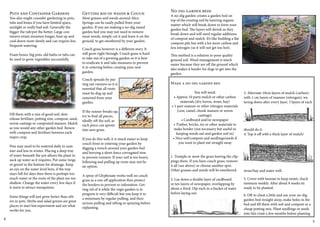
No-dig garden beds 
A no-dig garden creates a garden bed on 
top of the existing soil by layering organic 
matter which will break down to form your 
garden bed. The layers will shrink as they 
break down and will need regular additions 
of compost and mulch. It’s like building a flat 
compost pile but with a lot more carbon and 
less nitrogen (so it will not get too hot). 
This method is a solution to poor quality 
ground soil. Weed management is much 
easier because they are off the ground which 
also makes it harder for dogs to get into the 
garden. 
Make a no-dig garden bed 
You will need: 
• Approx 10 parts mulch or other carbon 
materials (dry leaves, straw, hay) 
• 1 part manure or other nitrogen materials 
(cow, camel, chook manure or worm 
castings) 
• Cardboard and/or newspaper 
• Timber, bricks, tin or other materials to 
make border (not necessary but useful in 
keeping weeds out and garden soil in) 
• Nice soil/compost and seedlings/seeds if 
you want to plant out straight away 
1. Trample or mow the grass leaving the clip-pings 
there. If you have couch grass, remove 
it all (see above) or choose another spot. 
Other grasses and weeds will be smothered. 
2. Lay down a double layer of cardboard 
or ten layers of newspaper, overlapping by 
about a third. Dip each in a bucket of water 
before laying out. 
3. Alternate 10cm layers of mulch (carbon) 
with 1 cm layers of manure (nitrogen), wa-tering 
down after every layer. 5 layers of each 
should do it. 
4. Top it off with a thick layer of mulch/ 
straw/hay and water well. 
5. Cover with hessian to keep moist, check 
moisture weekly. After about 8 weeks its 
ready to be planted. 
6. OR to cheat a little and use your no-dig 
garden bed straight away, make holes in the 
bed and fill them with soil and compost or a 
cheap potting mix. Plant seedlings or seeds 
into this (wait a few months before planting 
4 5
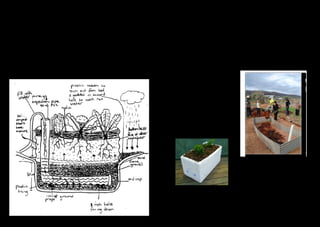
Wicking Garden Beds 
A wicking bed is a garden bed that is sealed underneath and uses capillary action to ‘wick’ 
water up into the roots of the plants. It is possible for water to ‘wick’ 30 cm up through the 
soil. 
Simple but effective, they are very suited to arid conditions and areas with erratic rainfall. In 
this regard they are considered an adaptation tool for the impacts of climate change on food 
production. 
Why a wicking bed? 
• Saves water- No evaporation or loss of unused water through soil 
• Requires watering less often and can be left unattended 
• Plants have access to a large store of water, reducing stress 
Wicking Garden Beds Need: 
1. Space for water to be stored. Wicking 
garden beds are built inside a plastic liner 
or water proof container. Water can also be 
trapped in recycled cut open drink bottles 
buried under the soil or amongst gravel/sand 
at the bottom of the liner/container. 
2. An overflow point 20-30cms below the 
top of the soil to prevent waterlogging. Often 
a pipe with holes in is used to distribute the 
water underneath the soil. 
To learn a lot more about the wicking garden 
principles go to 
www.waterright.com.au 
Understanding the basic principals of a 
wicking garden bed enables us to go on and 
experiment with all kinds of variations. 
You may choose to use the wicking bed 
principles on a small and cheap scale, using 
recycled materials. 
For garden bed ideas and how to make a 
polystyrene box garden with wicking princi-ples 
see www.easygrowvegetables.com 
You may choose to make a large wicking 
garden bed (see drawing opposite for one 
design). It might have timber or corrugated 
iron sides or might just be mounded up a lit-tle. 
It might be dug into the ground or built 
up above it entirely. 
These larger garden beds can often extend 
the plastic out around the bed to catch more 
rain (see drawing). You could also direct 
water run-off into the wicking bed. 
Big wicking garden beds work extremely 
well with a worm farm situated inside them. 
A bucket with several inch-holes drilled in it 
is enough. 
6 7
Seeds and seedlings 
Getting the little ones to sprout can be a difficult task during summer, and they need special 
care once they’re up. Just a few unguarded hours in the sun is enough to frazzle a whole tray 
of tender shoots. You may choose to sow seeds in pots in a sheltered area or nursery that gets 
daily water. If you decide to buy punnets from the nursery, make sure they are not too old 
and root-bound otherwise they will fail. If planting punnets straight into the garden, you will 
need to water daily, so another strategy is to plant these into large pots in your nursery area 
until their roots have reached the bottom of the pots. 
Hardening off is the process of slowly introducing young seedlings to the harsh realities 
of garden bed life. Going straight from the protected nursery to the garden can be a bit of 
shock, so about a week before you want to plant your seedlings out, start hardening them off. 
Gradually restrict the amount and frequency of water. Move seedlings outside to expose them 
to sunlight, start with just an hour or two and gradually increase this time every day over the 
hardening off week. 
Transplanting the seedlings to the garden is best done in the late afternoon or 
evening. Prepare the soil and water the area thoroughly. Water seedlings a couple 
of hours before planting them out in prepared garden beds. If planting out 
in hot weather, seedlings can be covered for a few days with shade cloth. Be 
gentle! Try to handle them as little as possible and do them one at a time 
so they aren’t lying around exposed. Don’t plant the stem deeper than it 
originally was, it may rot. 
Pruning fruit trees is important to have healthy trees and increasing the quality and quan-tity 
of fruit. Prune in winter. Prune young trees to promote growth by being a little ruthless 
and removing at least half of last seasons growth. Cut right back to an outward facing bud 
to encourage the tree to grow out from the centre, not into itself. For trees over 3 years old, 
prune trees to encourage fruiting. Remove old, dead or diseased wood. Light thinning may be 
necessary, the tree will now put its energy into fewer bigger and better fruit instead of many 
not so good fruit. For more information, see the pruning section under the specific fruit tree 
(Fruit pp.42-25). 
Root pruning may be necessary if they have become root bound from be-ing 
in a pot for too long. When planting out root bound plants trim roots 
just enough that they can be gently teased out a little with your hands. Cut 
foliage a little too to balance it out. 
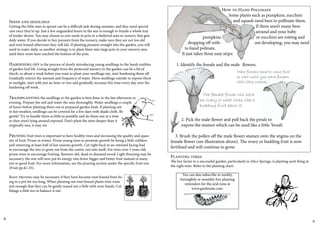
How to Hand Pollinate 
Some plants such as pumpkins, zucchini 
and squash need bees to pollinate them. 
If there aren’t many bees 
around and your baby 
pumpkins or zucchini are rotting and 
dropping off with- out developing, you may need 
to hand polinate. 
It just takes three easy steps: 
1. Identify the female and the male flowers. 
Male flowers tend to come first 
so wait until you have flowers 
with little ovaries. 
The female flower will have 
an ovary or what looks like a 
budding fruit below it. 
2. Pick the male flower and pull back the petals to 
expose the stamen which can be used like a little ‘brush’. 
3. Brush the pollen off the male flower stamen onto the stigma on the 
female flower (see illustration above). The ovary or budding fruit is now 
fertilised and will continue to grow. 
Planting times 
The key factor to a successful garden, particularly in Alice Springs, is planting each thing at 
the right time. Refer to the planting chart. 
You can also subscribe to weekly, 
fortnightly or monthly free planting 
reminders for the arid zone at 
www.gardenate.com. 
8 9
Water 
Alice Springs’ main water supply is ground water. More than two thirds of water 
in Alice Springs goes on our gardens, and much of that is due to unnecessary 
over-watering. It is essential that over watering is reduced, not only to preserve 
our precious resource but also to reduce potential build up of salts in the soil 
and an increase in pH, producing alkaline soils. Water efficient gardens are easy, 

it simply takes careful planning, soil building, efficient watering systems and 
mulch. 
The key to effective watering is in the soil. Sandy soils hold little water and 
require small amounts of water frequently while soils with more clay hold and 
spread more water, requiring more water less frequently. Introducing lots of 
organic matter into the soil and applying mulch will drastically reduce water-consumption 
in sandy soils particularly. 
Watering systems 
A watering system is essential to grow food at home in Alice Springs as rainfall is unreliable. 
There are a range of irrigation systems that are best suited for differing situations and garden 
types. 
When planning your gardens try to place plants with similar water needs together. Vegetable 
gardens, citrus and fruit tree orchards, exotic gardens and native gardens have very different 
water requirements. Each section of the garden should have its own separate watering system so 
that volumes and durations can be tailored to meet the plant needs. 
Whatever system you do decide on, consider running a separate line to each bed. This way you 
can turn off sections that don’t need watering avoiding unnecessary waste of water. 
References and more information 
Water Wise by DesertSMART COOLmob & Power 
and Water is a new free booklet on how to save water 
in your home and garden, packed with detailed 
information and lots of helpful tips. 
www.desertsmartcoolmob.org 
The Alice Springs Library has lots of books with tips 
for water efficient gardening including Good Gardens 
With Less Water by Kevin Handreck 
Summer vegetable watering 
With adequate mulch and well developed organic soil, established gardens should be able to 
cope with 3 waterings a week. This infrequent heavy watering encourages plants to develop 
deep roots while mulch reduces evaporation. Watering time will vary with your type of sys-tem 
and soil type but you will want the water to penetrate deep into the root zone. You may 
dig a hole to see how far water is penetrating. New plants and seedlings will still need daily 
watering until their root systems develop. Daily light watering encourages shallow rooting 
and is mostly unnecessary for summer crops, except in really sandy soils where water drains 
too quickly. In the peak of summer, a supplementary daily watering may be necessary if plants 
seem to be drying up and not coping with the heat. 
Winter vegetable watering 
Winter gardens require much less water but you should still irrigate at a similar frequency 
(2-3 times a week). Our southeast winter winds cause the evaporation of moisture from plants 
and the soil. You will need to observe how long you need to water and how fast your soil dries 
out. Seedlings will still need daily watering in sunny weather but otherwise may cope with a 
twice-weekly regime. 
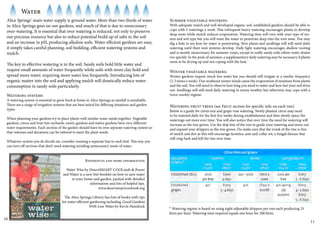
Watering fruit trees (see Fruit section for specific info on each tree) 
Below is a guide for citrus tree and grape vine watering. Newly planted citrus may need 
to be watered daily for the first few weeks during establishment and then slowly space the 
waterings out more over time. You will also notice that over time the need for watering will 
increase as the tree grows. Use the drip line of the tree to guide your watering and move out 
and expand your drippers as the tree grows. Do make sure that the trunk of the tree is free 
of mulch and dirt as this will encourage termites, ants and collar rot, a fungal disease that 
will ring-bark and kill the tree over time. 
* Watering regime is based on using eight adjustable drippers per tree each producing 25 
litres per hour. Watering time required equals one hour for 200 litres. 
10 11
Automated timers 
Timers are great. They automatically apply 
water throughout the week at a specified time 
of day and for a specified length of time. They 
allow you to moderate and experiment to see 
the most effective combinations of watering 
times and amounts. They also let you go away 
for a while knowing your garden will get wa-tered. 
Automatic controllers ideally need to 
be reprogrammed four times a year reflecting 
the seasonal variations. Many timers have a 
pause or off button which you can use after 
rain has fallen to save water. 
Drippers 
Drippers are the most ef-ficient 
watering method 
if planned and installed 
well. They can be posi-tioned 
at appropriate distances 
along poly pipe and vegetables 
can be planted next to them, so the water is 
only supplied where it is needed ensuring 
good root growth. Individual drippers of cer-tain 
types can be turned off so only the parts 
of your garden that are planted out get wa-tered 
and the flow rate can also be adjusted 
according to plant needs. Installing an irriga-tion 
system with drippers requires a commit-ment 
in installation time and set up costs but 
will save time and water in the long run. 
Bury pipes under soil or mulch as exposure 
to sun causes quite rapid pipe deterioration. 
Drippers and other emitters should be con-nected 
to 4mm feeder line that connects with 
the main irrigation line. This allows for the 
emitters to be moved away from the base of 
the plant as it grows. Extra emitters may need 
to be added as the plant grows. Installing and 
regularly cleaning an inline filter is essential 
to keep it free from blockages. 
Octaflow, Shrublers, 
Octamitters 
Whatever you call them, they 
are essentially just emitters which 
let out a greater volume of water to 
meet plant needs. These are great un-der 
fruit trees where a large volume 
of water is required in a short period 
of time. These high volume emitters 
should not be installed on lines that 
have fixed volume drippers, it’s difficult to 
manage plant water needs. 
Dripper tube/ Weeping hose / Sub-surface 
dripline 
This method has slightly different names for 
slightly different products but essentially a 
length of hose or poly 
pipe that has holes 
in it which slowly 
release water that 
lies slightly under 
ground or under 
mulch in your garden. 
Dripper tube with inline emitters can be pur-chased 
with differing spacings, or in the case 
of weeping hose the entire length is porous 
and slowly releases water. These methods are 
ideal for vegetable gardens as watage and loss 
through evaporation is significantly reduced. 
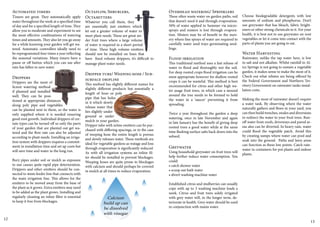
As with all irrigation systems an inline fil-ter 
should be installed to prevent blockages. 
Weeping hoses are quite prone to blockages 
with calcium and should perhaps be covered 
in mulch at all times to reduce evaporation. 
Calcium 
build up can 
be dissolved 
with vinegar 
Overhead watering/ Sprinklers 
These often waste water on garden paths, soil 
that doesn’t need it and through evaporation. 
50% of water applied in Summer via micro-sprays 
and misters is lost through evapora-tion. 
Misters may be of benefit in the nurs-ery 
where fine sprays of water are required to 
carefully water seed trays germinating seed-lings. 
Flood irrigation 
This traditional method uses a fast release of 
water to flood and thoroughly wet the soil. 
For deep rooted crops flood irrigation can be 
most appropriate however for shallow rooted 
crops it can be wasteful. This method is best 
recommended for citrus and other high wa-ter 
usage fruit trees, in which case a mound 
around the tree needs to be formed to hold 
the water in a ‘saucer’ preventing it from 
spreading. 
Twice a year throughout the garden a deep 
watering, once in late November and again 
in late January has the benefit of giving deep 
rooted trees a good water while at the same 
time flushing surface salts back down into the 
subsoil. 
Greywater 
Using household greywater on fruit trees will 
help further reduce water consumption. You 
could: 
• catch shower water 
• scoop out bath water 
• divert washing machine water 
Established citrus and mulberries can usually 
cope with up to 3 washing machine loads a 
week. Citrus and fruit trees solely irrigated 
with grey water will, in the longer term, de-teriorate 
in health. Grey water should be used 
in conjunction with mains water. 
Choose biodegradable detergents with low 
amounts of sodium and phosphorus. Don’t 
use greywater that has bleach, fabric bright-eners 
or other strong chemicals in it. For your 
health, it is best not to use greywater on root 
vegetables or let it come into contact with the 
parts of plants you are going to eat. 
Water Harvesting 
Rainwater, unlike the tap water here, is low 
in salt and not alkaline. Whilst rainfall in Al-ice 
Springs is not going to sustain a vegetable 
garden, it makes sense to make the most of it. 
Check out what rebates are being offered by 
the Federal Government and Northern Ter-ritory 
Government on rainwater tanks instal-lation 
costs. 
Making the most of rainwater doesn’t require 
a water tank. By observing where the water 
naturally gathers and flows in your yard, you 
can then build trenches, swales and diversions 
to redirect the water to your fruit trees. Run-off 
water from roofs, driveways and paved ar-eas 
also can be diverted. In heavy rain, water 
could flood the vegetable patch. Avoid this 
by creating sumps where water can pool and 
soak into the ground. Paths and lawn areas 
can function as these low points. Catch rain-water 
in containers for pot plants and indoor 
plants. 
12 13
Soils 
Working organic matter into Central Australian soils is your basic challenge. Soils in Alice 
Springs are typically low in organic content and nutrients due to the arid climate, past high 
rates of erosion and their ancient age. Part of any vegetable gardener’s seasonal routine 
should include regular work on replacing nutrients used by the past crops, adding compost 
material and mulching. Over time, vegie gardeners become familiar with the characteristics 
of their patch and can quickly recognise when soils are low in organic matter, waterlogged 
or dry, or full of life ready to bear a bumper crop. Increasing the water holding capacity of 
sandy soils is a matter of increasing and consistently adding organic matter. Clay and sandy 
soils will benefit from the addition of organic matter particularly humus (the product of 
composting), worm castings and aged manure. Clay soils benefit from gypsum, coarse sand 
and organic matter being incorporated into the soil. 
Soil Type 
A general appreciation of the soil characteristics of your vegie patch will greatly assist in the 
management and improvement of the soil. You can determine your soil type by feeling its 
texture and observing its clay content. Soil textures in Alice Springs vary widely. 
Soil type test 
Start by moistening a handful of soil with 
just enough water so it’s possible to squeeze 
one or two drops out as you clench it tightly 
in your fist. Once you have the soil mois-tened 
properly, squeeze the bolus (blob) 
with your thumb to push the soil over the 
index finger and out of your hand in a thin 
ribbon. As the ribbon lengthens, continue 
squeezing and try and form a longer ribbon 
of moist soil. Sand grains can be felt easily 
amongst the smooth and slippery silt and 
clay. 
Watch how long your ribbons are: 
Ribbon length = Type of soil 
5mm to 25mm = Sandy soils: low fertility. 
Organic matter rapidly breaks down and 
leaches away. Quick draining. 
25mm to 38mm = loamy soils: a medium 
point between extremes, favoured by gar-deners. 
40mm to 80mm= clay soils: hold water and 
nutrients but prone to water logging. 
Soil pH 
The pH of a soil is a measure of the degree of acidity or alkalinity of the soil. Measured over 
a scale of fourteen points with pH 7 being neutral, less than 7 is acid and more than 7 is 
alkaline. Most vegetables prefer a slightly acid soil, pH 6.5. Alice Springs town water supply 
is slightly alkaline and is high in dissolved calcium salts. Over time, irrigated soils tend to 
increase in alkalinity (pH goes up) as the dissolved calcium salts are deposited by evaporat-ing 
water. When the pH rises above 8.5 many soil nutrients become chemically unavailable 
to the plant roots and nutrient deficiencies may become apparent, with yellowing of leaves 
or stunting a common symptom. Cheap pH test kits can be purchased from nurseries to 
determine what the pH of your soil is; some nurseries will even check a sample for you. 
Prevention of alkalinity can be achieved by regular applications of compost and sulphur and 
by avoiding excessive irrigation, over-fertilising and any use of lime or dolomite. 
Salt 
When sodium salts accumulate near the root zone of plants, water becomes less available and 
plants become more drought sensitive. In some areas of Alice Springs irrigation water has 
raised the water table bringing naturally occurring salts from deep in the soil to the root-zone 
of plants. The soil’s surface develops a crust and 
the white salt deposits are visible. Rainfall helps 
reduce salinity problems by flushing salt deposits 
deeper into the soil, away from the plant root-zone. 
Gardeners in Alice can reduce salinity prob-lems 
by managed watering and heavy mulching. 
All vegetable gardens in 
Alice Springs could improve 
with the addition of organic mat-ter; 
compost, humus, worm cast-ings, 
aged manure. 
Preparing Soil 
Organic manures and fertilisers are preferred as they add nutrients as well as much needed 
humus, which increases water-holding capacity, and improves soil structure. Preparing soil 
properly takes time and beds should be prepared well in advance to planting. 
Before attempting soil preparations on heavy clay soils, gypsum often referred to as “Clay 
Breaker” should be added at the recommended rates to help break up the clay clods. On high 
pH soils sulphur should be added. 
Quick safe method 
Clear the site and dig in a commercial organic fertiliser with a good blend of well-composted 
organic matter. A blend of compost and potting mix will give you a soil condition you can 
plant straight into. Gromor, Dynamic Lifter or Blood and Bone are suitable organic fertilisers. 
Rare animal manures can sometimes be hot or too concentrated and cause root burn. If using 
fresh animal or bird manures you need to blend into the soil and irrigated weekly for up to 
10-12 weeks before planting. 
Slower Method 
Gradually building up the soil with good compost is best. Worm castings and properly made 
compost are the best soil improvers available and can be made in 2- 4 months (see Compost 
p.17). Composted animal manures and com-posted 
kitchen scraps are the most common 
Introducing more organic 
matter, such as compost can 
help reduce alkalinity and 
salinity problems in soils. 
materials used to increase the organic content 
of vegetable garden beds. Adding compost to 
soil improves the soil nutrition, structure and 
water holding and drainage capabilities. To 
achieve optimum growth compost needs to be 
added to the soil for at least every second crop. There are heavy feeding crops such as toma-toes, 
corn, cauliflower, cabbage, and broccoli that require more nutrients and these can be fol-lowed 
by light feeders such as carrots, beetroots, swedes, radish, turnips, parsnips, and rocket. 
14 15
16 
Green Manure crops are planted for the sole purpose of being dug back into the 
ground in order to increase the amount of organic matter in the soil. Examples include:- 
clover, beans, oats, wheat, sorghum and mustard. They are fast growing and should be dug 
into the soil just prior to flowering (at this stage the balance of nutrients is perfect for rapid 
composting). Green manures are vigorous and keep down weeds as well as fixing nitrogen 
in the soil in the case of legumes. 
Liquid Fertilisers/ Soil Conditioners 
Liquid fertilisers can provide a useful adjunct to other sources of nutrients in the garden. 
They can be commercial mixtures such as Fish emulsion, Nitrosol or seaweed extracts, 
or can be homemade. Homemade fertilisers can be made using various manures, worm 
castings,weeds or even prawn heads. Whether your preference is for organic or inorganic 
sources of plant nutrients, or a combination of both, regular application of fertiliser is 
necessary to replace the nutrients used by the previous crop. Make sure the recommended 
rates are not exceeded. Although they do encourage fast growth there are also downsides to 
consider. You may be force-feeding plants rather than letting them take the nutrients they 
need from compost. 
Seaweed extracts, unlike other fertilisers, are low on nutrients and can be given to plants at 
all stages of growth. They are biostimulants containing various growth promoting substanc-es. 
Benefits include longer flowering, increased root growth, increased yields, increased 
microbacterial activity, increased nutrient content in foods and increased drought and frost 
resistance. All are particularly relevant to Central Australia. Compost teas that are sprayed 
onto plants leaves have also proven to be beneficial due to their bacterial content which ap-parently 
enables nutrients to be taken up. 
Worm Farms and Vermicomposting 
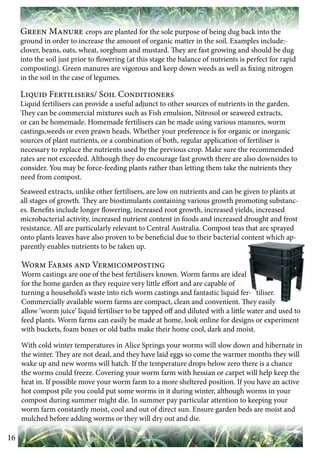
Worm castings are one of the best fertilisers known. Worm farms are ideal 
for the home garden as they require very little effort and are capable of 
turning a household’s waste into rich worm castings and fantastic liquid fer- tiliser. 
Commercially available worm farms are compact, clean and convenient. They easily 
allow ‘worm juice’ liquid fertiliser to be tapped off and diluted with a little water and used to 
feed plants. Worm farms can easily be made at home, look online for designs or experiment 
with buckets, foam boxes or old baths make their home cool, dark and moist. 
With cold winter temperatures in Alice Springs your worms will slow down and hibernate in 
the winter. They are not dead, and they have laid eggs so come the warmer months they will 
wake up and new worms will hatch. If the temperature drops below zero there is a chance 
the worms could freeze. Covering your worm farm with hessian or carpet will help keep the 
heat in. If possible move your worm farm to a more sheltered position. If you have an active 
hot compost pile you could put some worms in it during winter, although worms in your 
compost during summer might die. In summer pay particular attention to keeping your 
worm farm constantly moist, cool and out of direct sun. Ensure garden beds are moist and 
mulched before adding worms or they will dry out and die.
17 
Compost 
Good compost is essential to sustainable food production in arid conditions. Composting 
at home is also a great way to reduce the amount of household waste sent to landfill whilst 
creating nutrient-rich fertiliser that will greatly benefit your garden, costing only your time 
and energy. Soils that receive regular doses of healthy compost can generally hold oxygen, 
nutrients and water better, have good drainage and encourage an environment of helpful 
micro-organisms. Making good compost takes persistence, patience and observation of trials 
and errors. Effective compost making also requires a bit of time, energy and attention. If you 
don’t have plenty of space, time and energy, perhaps a worm farm is a better option. 
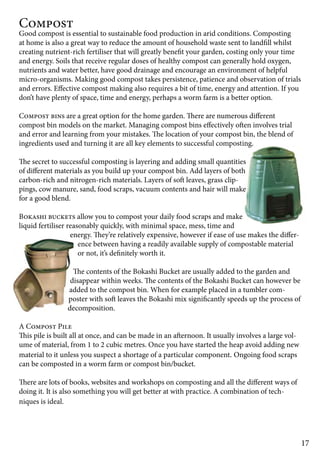
Compost bins are a great option for the home garden. There are numerous different 
compost bin models on the market. Managing compost bins effectively often involves trial 
and error and learning from your mistakes. The location of your compost bin, the blend of 
ingredients used and turning it are all key elements to successful composting. 
The secret to successful composting is layering and adding small quantities 
of different materials as you build up your compost bin. Add layers of both 
carbon-rich and nitrogen-rich materials. Layers of soft leaves, grass clip-pings, 
cow manure, sand, food scraps, vacuum contents and hair will make 
for a good blend. 
Bokashi buckets allow you to compost your daily food scraps and make 
liquid fertiliser reasonably quickly, with minimal space, mess, time and 
energy. They’re relatively expensive, however if ease of use makes the differ-ence 
between having a readily available supply of compostable material 
or not, it’s definitely worth it. 
The contents of the Bokashi Bucket are usually added to the garden and 
disappear within weeks. The contents of the Bokashi Bucket can however be 
added to the compost bin. When for example placed in a tumbler com-poster 
with soft leaves the Bokashi mix significantly speeds up the process of 
decomposition. 
A Compost Pile 
This pile is built all at once, and can be made in an afternoon. It usually involves a large vol-ume 
of material, from 1 to 2 cubic metres. Once you have started the heap avoid adding new 
material to it unless you suspect a shortage of a particular component. Ongoing food scraps 
can be composted in a worm farm or compost bin/bucket. 
There are lots of books, websites and workshops on composting and all the different ways of 
doing it. It is also something you will get better at with practice. A combination of tech-niques 
is ideal.
How to Make a Healthy Compost Pile 
Select a shady, well-draining posistion for the pile, you may want to build a three-sided box 
to stop contain it a little. 
You will need lots of brown (carbon rich) and 
green (nitrogen-rich) organic material. 
A diverse mix of ingredients will help get the de-sired 
Putting your compost pile inside your 
chicken coop means when you turn it 
the chickens will go crazy eating all the 
bugs that will be uncovered. 
Carbon – Woody, brown, dry 
• Leaves, small dry branches (chopped up) 
• Wood chips and sawdust 
• Hay or straw, dry grass 
• Shredded cardboard and newspaper 
Nitrogen- Fresh, green, wet 
• Cow, chicken, horse, camel manure 
(chicken manure is very high in nitrogen) 
• Grass clippings, green shrub prunings 
• Food scraps (including fruit, vegetable, 
coffee grounds, tea) 
It takes careful observation and practice to 
get the carbon, nitrogen, oxygen and water 
in the right proportions so keep at it!! 
Don’t put meat, fish, bones, dairy, 
pet faeces or oils in your compost. 
Meat, fish and dairy may be com-posted 
in a Bokashi bucket. Also 
try to limit the amount of bread 
you put in or just give it to the 
chickens or worms. 
Aeration –Turning 
Turning compost is hard work, but vitally important to the aerobic process. Turning your 
compost pile every few days is great, once a week is essential. If you don’t turn it, you might 
have to wait a year or more for your compost. Check moisture levels and add water whilst 
turning. 
Moisture 
Especially in Central Australia it is important to keep an eye on your compost moisture 
levels. You want your compost moist but not saturated. Cover with moist hessian sacks to 
keep the pile from drying out. 
Temperature 
The centre of the pile should heat up after a couple of days. This heat is essential to the com-posting 
process and will kill pathogens and weed seeds. If the pile doesn’t heat up, it might 
be too small or might need turning or watering. 
The end result - Humus 
Compost should take between 6 weeks to 4 months to mature, the length of time taken is 
dependant on the method used and how vigilant you are in turning the pile. Its ready to put 
on the garden when it is dark brown and crumbly but still moist, and most of the original 
material is unrecognisable. This earthy smelling material is called humus and is full of ben-eficial 
nutrients and micro-organisms for your garden. 
amounts of approximately 3 parts carbon to 
1 part nitrogen. This is not the only ratio to follow for success, but both are needed as micro-organisms 
need nitrogen to break down carbon. 
You will also need water and a garden fork. 
Start with coarse twigs or straw to allow for some breathing, then add a layer of green/nitro-gen 
materials a thin layer of soil (optional) followed by a thick layer of brown/carbon materi-als. 
The soil adds micro-organisms to get the heap started quicker but is not essential. Water 
each layer as you go. Example quantities are given in the illustration below. 
Finish up with shredded newspaper on top or cover with a tarp or someother material to 
keep the pile from drying out. 
Protecting your compost pile from larger animals such as dogs can be done by fencing off the 
compost pile with an simple chicken wire and star-picket fence. 
Soil layer 
(1cm) 
Nitrogen layer 
(5cm) 
Carbon layer 
(15cm) 
Sticks & carbon for 
drainage (30cm) 
18 19
20 
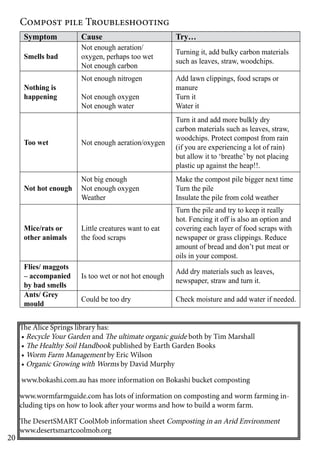
Compost pile Troubleshooting 
Symptom Cause Try… 
Smells bad 
Not enough aeration/ 
oxygen, perhaps too wet 
Not enough carbon 
Turning it, add bulky carbon materials 
such as leaves, straw, woodchips. 
Nothing is 
happening 
Not enough nitrogen 
Not enough oxygen 
Not enough water 
Add lawn clippings, food scraps or 
manure 
Turn it 
Water it 
Too wet Not enough aeration/oxygen 
Turn it and add more bulkly dry 
carbon materials such as leaves, straw, 
woodchips. Protect compost from rain 
(if you are experiencing a lot of rain) 
but allow it to ‘breathe’ by not placing 
plastic up against the heap!!. 
Not hot enough 
Not big enough 
Not enough oxygen 
Weather 
Make the compost pile bigger next time 
Turn the pile 
Insulate the pile from cold weather 
Mice/rats or 
other animals 
Little creatures want to eat 
the food scraps 
Turn the pile and try to keep it really 
hot. Fencing it off is also an option and 
covering each layer of food scraps with 
newspaper or grass clippings. Reduce 
amount of bread and don’t put meat or 
oils in your compost. 
Flies/ maggots 
– accompanied 
by bad smells 
Is too wet or not hot enough Add dry materials such as leaves, 
newspaper, straw and turn it. 
Ants/ Grey 
mould Could be too dry Check moisture and add water if needed. 
The Alice Springs library has: 
• Recycle Your Garden and The ultimate organic guide both by Tim Marshall 
• The Healthy Soil Handbook published by Earth Garden Books 
• Worm Farm Management by Eric Wilson 
• Organic Growing with Worms by David Murphy 
www.bokashi.com.au has more information on Bokashi bucket composting 
www.wormfarmguide.com has lots of information on composting and worm farming in-cluding 
tips on how to look after your worms and how to build a worm farm. 
The DesertSMART CoolMob information sheet Composting in an Arid Environment 
www.desertsmartcoolmob.org
21 
Mulch is an essential part of any arid garden as it drastically reduces the amount of water 
wasted whilst protecting plants and soil from weeds and extremes in soil temperature. 
Mulching: 
• Reduces the need for watering by reducing 
evaporation 
• Adds nutrients to the soil as the mulch 
slowly breaks down 
• Reduces weed growth 
• Stops soil splash and therefore some fun-gal 
soil borne diseases 
• Stabilizes the soil temperature, keeping it 
warm when it’s cold and cool when it’s hot 
reducing stress for plants 
• Enhances water penetration into the soil 
by reducing runoff 
• Allows for heavy and infrequent watering, 
encouraging deep rooting in plants 
• Stops surface evaporation reducing salt 
build up (salinity problems) and pH or 
alkalinity problems 
More on Mulch: 
Avoid putting mulch right up to the plant 
stems and tree trunks to prevent ‘collar rot’ 
damage. Loosen regularly if it gets com-pacted 
to ensure free movement of water 
and air. 
Mulch should be applied thickly at a depth 
of at least 7-10cm. 
Organic mulch can be made of straw, hay, 
dry grass, woodchips, sawdust, native 
grasses, even shredded paper. You can col-lect 
it yourself or purchase mulches (such 
as pea-straw) by the bale from nurseries 
and garden supplies. For best results apply 
a slow release nitrogen fertiliser prior to 
spreading the mulch as raw organic material 
will draw nitrogen from the soil away from 
the plants. 
Different types of 
beneficial invertebrates 
will also benefit from 
a protective layer of 
mulch. These bugs aer-ate 
the soil and convert 
mulch and compost into 
organic material plants 
Buffel grass grows wild around Alice Springs. It consti- can use. 
tutes a serious fire hazard and needs to be cut regularly. 
In conjunction with LandCare, local gardeners have had 
great success collecting cut Buffel grass and using it as 
mulch. Try cutting it yourself using a whipper snipper 
with a metal blade. 
More Information 
The Alice Springs Library 
has The Magic of Mulch by 
Michael J. Roads and The 
Miracle of Mulch by Mary 
Horsfall. 
Mulch
Chickens 
Chickens make a valuable contribution to any home garden – especially one with 
a vegie garden. They provide chicken manure, recycle kitchen scraps, lay eggs and 
can provide hours of entertainment for old and young alike. There are also wider 
benefits to the community- with scraps going to chickens instead of landfill you are 
reducing the production of tonnes of 
methane, a potent greenhouse gas. 
Chooks make a great family pet 
In summer, ensure chickens always have 
ample water to avoid dehydration and 
death. Water feeders are available that 
ensure constant water supply and are often 
designed to be heavy or hard for them 
to knock over. Alternatively, make the 
container large enough to be too heavy to 
move when it is full. You may also want to 
hook the chickens’ water into the irrigation 
system as a back up, so that whenever the garden gets water – so do the chooks. Keep water 
in the shade to minimise evaporation. When chickens pant like a dog with their wings held 
out from their body, they are hot but should be fine as long as they have water and shade 
throughout the day. It is also normal for your chickens to eat less during summer because 
they are not burning energy to keep warm. 
In winter, as the days get shorter chickens may lay less and eat slightly more. They are hardy 
to most winter conditions, although winter rain may test them so see if you can provide 
some shelter from this. Make sure all perches are wooden and not metal. Keeping the coop 
insulated with hay bales or boards will help prevent drafts and will also help to keep the 
chooks warm in winter. The coop should be situated so that they get some direct sunny spots 
some time during the day. They also need a dry spot with dirt so they can dust bathe. During 
the first year of laying they may lay well all through the winter. 
“Everyone I know has times when their chooks go off the lay 
but it never seems to be the same time for everyone.” 
- Bron Grieves 
When building a chook coop consider: 
• Covering pens with chicken wire to keep feral pigeons, galahs, eagles and kites 
out 
• Chickens can cause quite a bit of damage to the roots of fruit trees. 
Protect them with a layer of brick, rocks or tiles. 
• A grape vine crawling over your chook house is a good choice 
as they are deciduous providing shade in summer and warm 
sun in the winter 
• Alice Springs Town Council currently requires chicken coops to be a minimum 
of 12 meters from a house 
Chook health 
Prevention is the best medicine for chook health. If your chooks get regular green 
feed, clean food and water then you are most of the way there. You could also plant a 
‘chook garden’ near the chook pen where you can grow herbs such as comfrey, net-tle, 
tansy, wormwood and kale which all have medicinal properties to keep chooks 
healthy. 
Green feed can be weeds from your garden or specially grown for the chooks, various 
types of kale, chicory or raddicio are good. Local weeds growing on the streets and 
parks like Sow thistle, Dandelion, wild lettuce and clover are all common in Alice Springs, 
especially during the winter and they are full of good stuff that will make the chickens’ eggs 
dark orange, taste great and be healthier for you. Chickens like many animals are a pretty 
good judge of what is good from them – if they eat things ravenously then it is likely that 
they need more of that item. 
Chicken Manure 
Fresh chicken manure is too ‘hot’ for young plants and can burn them, 
due to its high nitrogen content. An easy way round this is just to wait 
until you clean out the whole coop and add the manure and hay to your 
compost which will break it down quickly. Keeping the compost pile in 
the chook pen also attracts bugs for the chickens to eat, however if you 
have lots of chickens they may spread the pile out too much; allowing 
them access some of the time (e.g. when turning) is a nice compromise. 
If you have the space and the time you could also add manure to the soil 
and allow it to break down over 10-12 weeks before planting into that 
soil. Alternatively you can bury lines of chook poo 30cm away from your seedlings when 
you plant them and by the time the roots reach it, it will no longer be “hot”. 
www.poultryone. 
com has lots of great 
articles (unfortunately 
with advertising boxes 
dispersed throughout) 
about raising chick-ens, 
building coops, 
tips on feed, wing 
clipping and general 
care for chickens. 
Varieties 
There are a variety of chicken breeds to choose from, some 
are better with children and don’t mind being held, others 
are great layers and they all have their own personalities. 
Ask around for what other people have and then look 
in the classified section in the local newspapers and 
check notice boards to find some. As most people are 
looking for egg layers - Isabrown chickens are easy to 
get for this purpose. They lay very well and have lovely 
big eggs but only for a couple of years. As they begin to 
decline in laying you may start to get soft shelled and 
misshapen eggs. Heritage breeds will lay longer and 
live longer but are harder to source. Silkies (a type of 
Bantam) are especially good with children. 
22 23
Pests 
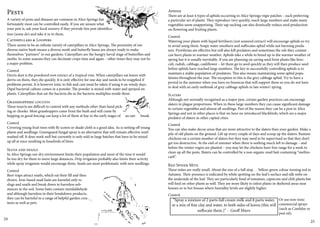
A variety of pests and diseases are common in Alice Springs but 
fortunately most can be controlled easily. If you are unsure what 
your pest is, ask your local nursery if they provide free pest identifica-tion 
(some do) and take it in to them. 
Caterpillars & Loopers 
There seems to be an infinite variety of caterpillars in Alice Springs. The proximity of our 
diverse native bush means a diverse moth and butterfly fauna are always ready to make 
themselves “partners” in our gardens. Caterpillars are the hungry larval stage of butterflies and 
moths. In some seasons they can decimate crops time and again – other times they may not be 
a major problem. 
Control 
Derris dust is the powdered root extract of a tropical vine. When caterpillars eat leaves with 
derris on them, they die quickly. It is only effective for one day and needs to be reapplied if 
problems persist. It is however toxic to fish and care must be taken if using it on windy days. 
Dipel bacterial culture comes in a powder. The powder is mixed with water and sprayed on 
plants. Caterpillars that eat the bacteria die as the bacteria multiplies inside them. 
Grasshoppers/ locusts 
These insects are difficult to control with any methods other than hand pick-ing 
or chooks. Most grasshoppers come from the bush and will come by 
hopping so good fencing can keep a lot of them at bay in the early stages of an out- break. 
Control 
Covering young fruit trees with fly screen or shade cloth is a good idea. As is netting off young 
plants and seedlings. Greenguard fungal spray is an alternative that will remain effective until 
washed off. It does work well but currently is only sold in large batches that have to be mixed 
up all at once resulting in hundreds of litres. 
Slugs and snails 
In Alice Springs our dry environment limits their population and most of the time it would 
be too dry for them to move large distances. Drip irrigation probably also limits their activity 
while spray irrigation would encourage them. Snails are most problematic with new seedlings. 
Control 
Beer traps attract snails, which eat their fill and then 
drown. Iron-based snail baits are harmful only to 
slugs and snails and break down to harmless sub-stances 
in the soil. Some baits contain metalaldehyde 
and although harmless in their breakdown products, 
they can be harmful to a range of helpful garden crea-tures 
as well as pets. 
Aphids 
There are at least 4 types of aphids occurring in Alice Springs vegie patches – each preferring 
a particular set of plants. They reproduce very quickly, reach large numbers and make many 
vegetables seem unappetising. Their sap sucking can also drastically reduce seed production 
on flowering and fruiting plants. 
Control 
Watering your plants with liquid fertilisers (not seaweed extract) will encourage aphids so try 
to avoid using them. Soapy water smothers and suffocates aphid while not harming preda-tors. 
Pyrethrins are effective but will also kill predators and sometimes the oils they contain 
can burn plants in warmer weather. Aphids take a while to breed up in the warmer weather of 
spring but it is usually inevitable. If you are planning on saving seed from plants like broc-coli, 
radish, cabbage, cauliflower – let them go to seed quickly as they will then produce seed 
before aphids have reached large numbers. The key to successfully controlling aphids is to 
maintain a stable population of predators. This also means maintaining some aphid popu-lations 
throughout the year. The exception to this is the grey cabbage aphid. Try to have a 
period in the summer when you have no brassicas that will support these so you do not have 
to deal with an early outbreak of grey cabbage aphids in late winter/ spring. 
Slaters 
Although not normally recognised as a major pest, certain garden practices can encourage 
slaters in plague proportions. When in these large numbers they can cause significant damage 
to certain vegetables and almost all seedlings. Part of the reason they can be a pest in Alice 
Springs and not in other places is that we have no introduced blackbirds, which are a major 
predator of slaters in other capital cities. 
Control 
You can also make decoy areas that are more attractive to the slaters than your garden. Make a 
pile of old plants on the ground. Lift up every couple of days and scoop up the slaters. Bantam 
chickens eat a certain number of slaters but they may need to be supervised so that they don’t 
get too destructive. At the end of summer when there is nothing much left to damage – and 
before the winter vegies are planted – you may let the chickens have free range for a week to 
clean up all the pests. Slaters can be controlled by a non organic snail bait containing “methio-carb”. 
Red Spider Mite 
These mites are really small. About the size of a full stop. . . Yellow-green colour turning red in 
Autumn. Their presence is indicated by white spotting on the leaf ’s surface and silk webs on 
the underside of the leaf. They are particularly fond of tomatoes, capsicum and chili plants but 
will feed on other plants as well. They are more likely to infest plants in sheltered areas near 
houses or in hot houses where humidity levels are slightly higher. 
Control 
Or use non-toxic 
commercial sprays 
(such as Confidor or 
pest oil). 
“Spray a mixture of 2 parts full cream milk and 8 parts water, 
or a mix of fine clay and water, to both sides of leaves (this will 
suffocate them.)” - Geoff Miers 
24 25
Fruit fly 
Fruit fly affects many fruit trees but also tomatoes, capsicums, chillies and eggplants. These 
flies breed up over the summer months using successive fruit crops. They pupate in the 
ground beneath fruit trees so cleaning up and disposing of fallen fruit breaks their life cycle. 
Unfortunately fruit fly are very mobile so their numbers will depend on your neighbourhood’s 
cleanliness practices. Stung fruit can be drowned for a week in water or placed in a plastic bag 
in the sun for the same period. If you live in the rural area, you may be isolated enough for 
frut fly to be less of a problem. 
Control 
Home made fruit fly traps only catch male flies but importantly they indicate when fruit flies 
are present in your garden. On noting their presence you need to initiate other actions. Sticky 
traps also indicate the presence of fruit fly attracting both male and female flies. You may want 
to use fine netting to keep fruit fly off your fruit trees and tomatoes, or put a cloth or netting 
bag around each fruit. Be careful you aren’t unintentionally breeding fruit fly in your compost 
bin. Another method is to spot spray a commercially available protein bait (product called 
“Econaturale”) on something (the tree, a piece of cardboard, the fence) and they will come eat 
it and die. This product may work better in more humid climates where it is less likely to dry 
out. It can also be used as a bait to put in traps. 
Certain fruit trees are more likely to be affected by fruit fly due to the fruiting time. Anything 
that fruits in mid to late summer may be quite susceptible such as late fruiting citrus, decidu-ous 
fruiting trees and some exotic fruits. 
White Cabbage Caterpillars and Moths 
It’s the blue-green caterpillar of the white winged moth that does the damage by 
eating large holes in leaves. They like other vegetables such as broccoli, brussel 
sprouts and salad greens as well as cabbage. 
Control 
Scatter washed half white egg shells or place white golf balls around your garden to deter 
them. Pick them off when you have them. See pp.29-31 for companions and integrated pest 
management ideas. Spray weekly with Dipel, a safe environmentally-friendly biological con-trol, 
it only affects caterpillars and grubs. For severe outbreaks spray with pyrethrum for an 
instant kill. 
Mealy Bug 
These funny little creatures are commonly seen on branches and fruits of citrus. 
They are sap sucking and protect themselves with a waxy layer and are often at-tended 
by ants which harvest nectar that is excreted. 
Control 
Physically squash them with your fingers, pick them off, cut-off small branches severely af-fected, 
spray with an oil or soap spray covering the insects to smother them. A soap spray with 
garlic/chili can be most effective. Confidor is an environmentally sound systemic spray that is 
absorbed into the plants sap stream and is consumed by insects that feeds on the plant. 
Nematodes or Eelworms 
These microscopic unsegmented worms feed on the roots of a wide range of plant species, 
which in turn reduces the amount of nutrients taken up by the plant. Affected plants appear 
to have large knots or nodes or have variously deformed root systems with few fine roots. 
As a consequence the growth of plants is retarded and their growth can be drastically af-fected. 
The most favoured soils for nematodes are moist, warm, sandy soils. Most gardens 
with nematodes have had them introduced from contaminated soil, which can occur on 
tools, boots, in manure (particularly horse) and pot plants. 
Control 
There are various ways to minimise the impact nematodes have. Some plants are more sus-ceptible 
to nematodes than others. The worst effected include tomatoes, okra, cucumbers, 
and zucchinis. Nematodes are largely active in warm weather so although some of the cold 
weather vegetables may be affected, they will still do quite well. 
Soil solarisation: Use a large sheet of black plastic ensuring you secure the edges. The tem-perature 
build up under the plastic simply cooks the soil killing the nematodes in the top 
6 – 8 inches of soil. Leave in place for 6-8 weeks before planting. 
Green manure: It is most desirable to grow a green manure crop that is totally resistant to 
nematodes, such as Velvet Bean, French marigold, sorghum, some crotolaria species, white 
mustard, oats, wheat and others. Each crop adds rich organic matter to the soil and it is 
known that nematodes dislike organic matter in the soil so by adding compost and manure, 
populations will also fall. A well composted organic soil will reduce the nematode popula-tion 
by up to 90% 
Beware mulberries and figs: They are very popular with nematodes. If these tree roots 
invade your vegetable garden, your efforts to reduce nematode populations may be nullified 
as their roots can support a constant population and allow crops to be re-infested. 
Shift the garden: Nematodes are not very mobile so it is possible that you only have an 
isolated occurrence. Moving your vegetable garden can be a solution. 
Resistant crops: These following vegies may still have nematodes but they can produce a 
reasonable crop despite this: 
Asparagus 
Sage 
Chives 
Mustard 
Broccoli 
Basil 
Cress 
Onion 
Brussel sprouts 
Chinese greens 
Garlic 
Radish 
Cabbage 
Cape gooseberry 
Globe artichoke 
Rhubarb 
Sweet corn 
Chicory/Raddiccio 
Horseradish 
Shallots 
Parsley 
Celery 
Jerusalem artichoke 
Snake beans 
Coriander 
Chillies 
Leek 
Sweet potato 
26 27
28 
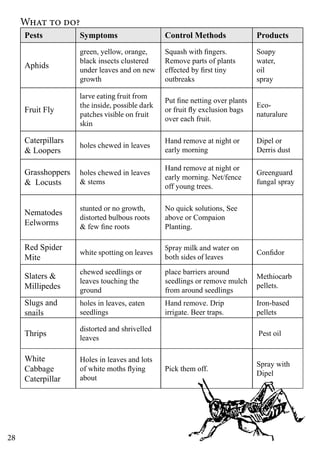
Pests Symptoms Control Methods Products 
Aphids 
green, yellow, orange, 
black insects clustered 
under leaves and on new 
growth 
Squash with fingers. 
Remove parts of plants 
effected by first tiny 
outbreaks 
Soapy 
water, 
oil 
spray 
Fruit Fly 
larve eating fruit from 
the inside, possible dark 
patches visible on fruit 
skin 
Put fine netting over plants 
or fruit fly exclusion bags 
over each fruit. 
Eco-naturalure 
Caterpillars 
& Loopers holes chewed in leaves Hand remove at night or 
early morning 
Dipel or 
Derris dust 
Grasshoppers 
& Locusts 
holes chewed in leaves 
& stems 
Hand remove at night or 
early morning. Net/fence 
off young trees. 
Greenguard 
fungal spray 
Nematodes 
Eelworms 
stunted or no growth, 
distorted bulbous roots 
& few fine roots 
No quick solutions, See 
above or Compaion 
Planting. 
Red Spider 
Mite white spotting on leaves Spray milk and water on 
both sides of leaves Confidor 
Slaters & 
Millipedes 
chewed seedlings or 
leaves touching the 
ground 
place barriers around 
seedlings or remove mulch 
from around seedlings 
Methiocarb 
pellets. 
Slugs and 
snails 
holes in leaves, eaten 
seedlings 
Hand remove. Drip 
irrigate. Beer traps. 
Iron-based 
pellets 
Thrips distorted and shrivelled 
leaves Pest oil 
White 
Cabbage 
Caterpillar 
Holes in leaves and lots 
of white moths flying 
about 
Pick them off. Spray with 
Dipel 
What to do?
Integrated Pest Management & Companion Planting 
Integrated Pest Management (IPM) is a holistic approach to reducing our reliance on 
using chemicals in the garden by utilising a range of tools including observation, ben-eficial 
29 
predators, companion planting, crop rotation and good garden hygiene. IPM is 
about managing pest’s numbers, not eliminating them. Does it really matter that a lettuce leaf 
has a hole or two? It will still taste the same. IPM is about working towards creating a more 
diverse, balanced garden ecology where nature introduces its own control tools such 
as predators like the ladybird that will feed on pesty aphids. The most 
important thing to consider during pest outbreaks is to look closely before spraying 
– are predators already on the job? If so select a control 
method that will preserve the predators. 
Observation 
A lot can be learnt from experimenting and observing what happens in your garden. Keeping 
a record of your observations is good practice and can prepare you in advance to likely major 
outbreaks giving you time to plan and initiate preventative measures such as building physical 
barriers to stop grasshoppers. If you have the space, plant a couple more – if you lose a couple 
to pests it’s ok. Share your observations with your friends, neighbours, community garden-ers 
so everybody can learn from each other. Planting at just the right time also encourages 
healthy plants which are more resistant; keeping notes of when you planted last year can help 
with this too. 
Garden hygiene 
Prune fruit trees to open up and allow air flow as well as promptly removing dead and dis-eased 
parts. Remove diseased plants and infested fruit from the garden immediately. Break 
the fruit fly cycle by placing infected fruit in a sealed bag 
in the sun or submerged in a bucket of water for a weeks 
or so. 
Beneficial predators 
There are a host of tiny garden predators in all gardens. 
These are the good guys. They might be small, but their 
effect can be profound. The aim of organic gardening is to increase the populations and 
varieties of beneficial predators so that they are present throughout the year. There are many 
flowering plants that are recommended to assist in maintaining predator populations. These 
plants flower early in the spring or throughout winter and so keep predators around ready for 
when pests begin to build up in spring. Letting your vegetables go to seed is also a great way 
to attract and breed up predators, especially coriander, carrots, Chinese greens and broccoli. 
Chinese greens are especially good as they will readily flower during the winter if they are up 
to that stage in their growth. Mulch can also provide a habitat for beneficial predators. 
Planting natives and adding ponds, 
water features, rocks and logs will 
provide habitat and attract birds and 
wildlife into your garden that will 
help eat a range of insects, grasshop-pers 
and pests. 
Healthy soil full of organic mat-ter 
grows healthy plants which are 
naturally more resistant to pests and 
diseases.
Companion Planting 
Companion planting is about growing plants that benefit from each other when 
planted together. They either repel or confuse pests, attract predators, provide 
beneficial growing conditions, attract pollinators and can improve the quality and flavour 
of other plants in the same garden bed. Some plants also seem to ‘dislike’ each other and do 
not grow as well when planted near 
one another. 
Some popular companions: 
• Mix flowers in with the vegie 
patch. Daisy flowers attract predators (try sunflowers and calendula). Nasturtiums secrete a 
desirable oil that will attract or detract many pests depending on where it is planted 
• Parsley attracts and provides a home for lady birds which eat aphids 
• Marigolds deter nematodes by exuding a gas from their roots; planted near beans mari-golds 
You can download a beautiful free companion planting 
chart from the IDEP foundation at http://www.idep-foundation. 
org and find more information at Sustain-able 
Gardening Australia www.sgaonline.org.au 
will deter spider mites and white fly on tomatoes 
• Marjoram & oregano planted near brassicas will confuse white cabbage butterflies 
• Basil is great to grow all over the vegetable garden as a general insect repellent, especially 
near cabbages, beans and tomatoes 
• Sage will attract bees so plant around vegetables that need fertilising and will protect bras-sicas 
• Rosemary masks the scent of brassicas and is another general pest repellent 
• Mint also deters white cabbage butterfly from tomatoes and cabbages 
Example rotations for one garden bed 
1 - First plant a legume (bean or pea)- fix 
nitrogen into the soil 
2 - Follow this with a leafy (lettuce, spinach, 
cabbage) - good winter crop in Alice 
3 - then a fruiting crop (capsicum, tomato, 
corn ) - summer crop 
And finally a root (turnip, swede, beetroot, 
carrot ) 
It’s good to have as many beds as possible. 
If you have space for four beds, rotate four 
crops maybe one can be a green manure 
crop . 
“A sensible system of crop rotation will 
reduce diseases and pests, produce 
healthy plants giving maximum returns 
and importantly, make full use of the 
nutritional value of the soil.” – Geoff 
from white cabbage butterflies 
Crop Rotation 
Crop rotation can get quite complex (analys-ing 
the nutritional requirements of each 
plant) but can be as simple as rotating your 
crops, you probably do it already! Following 
simple principles of crop rotation of annual 
vegetables will improve the effectiveness of 
your crop rotations. 
These include: 
• Not planting the same crop in the same 
place season after season as they will have 
the same nutrient demands 
• Not planting nightshades (chilli, potato, 
capsicum, tomato) in the same patch for 2-3 
years 
• Plant deep rooted crops after shallow 
rooted crops (e.g. tomatoes after lettuce) 
• Plant root crops after leafy crops (potato 
after silverbeet) 
• Plants of the same family don’t like to be 
planted after each other (it helps to rotate 
family groups together) 
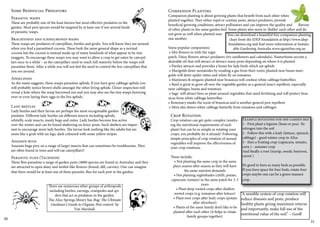
Some Beneficial Predators 
Parasitic wasps 
These are probably one of the least known but most effective predators in the 
garden. Most pest species would be targeted by at least one if not several kinds 
of parasitic wasps. 
Brachyonid and ichneumonid wasps 
These wasps are predators of caterpillars, beetles and grubs. You will know they are around 
when you find a parasitised cocoon. These look the same general shape as a normal 
cocoon but the cocoon is instead made up of many hundreds of what appear to be tiny 
maggots. To encourage these wasps you may want to allow a crop to get eaten by caterpil-lars 
once in a while – as the caterpillars need to reach full maturity before the wasps will 
parasitise them. After a while you will not feel the need to control the few caterpillars that 
you see around. 
Aphelinids 
As the name suggests, these wasps parasitise aphids. If you have grey cabbage aphids you 
will probably notice brown shells amongst the other living aphids. Closer inspection will 
reveal a hole where the wasp burrowed out and you may also see the tiny wasps hovering 
over or even laying their eggs in the live aphids. 
Lady beetles 
Lady beetles and their larvae are perhaps the most recognisable garden 
predator. Different lady beetles eat different insects including aphids, 
whitefly, scale insects, mealy bugs and mites. Lady beetles become less active 
over the winter and can be found sheltering on fence posts. Such shelters are impor-tant 
to encourage more lady beetles. The larvae look nothing like the adults but are 
more like a grub with six legs, dark coloured with some yellow stripes. 
Assassin bugs 
Assassin bugs prey on a range of larger insects that can sometimes be troublesome. They 
are often found in trees and will eat caterpillars!! 
Parasitic flies (Tachnids) 
These flies parasitise a range of garden pests (4000 species are found in Australia) and they 
are attracted to open daisy and umbel-like flowers (fennel, dill, carrots). One can imagine 
that there would be at least one of these parasitic flies for each pest in the garden. 
There are numerous other groups of arthropods 
including beetles, earwigs, centipedes and spi-ders 
that act as predators in the garden. 
The Alice Springs library has Bug: The Ultimate 
Gardener's Guide to Organic Pest control by 
Tim Marshall. 
30 31
Seedsaving 
Saving the seeds of your crops has many ben-efits 
to both the gardener and the community. 
Firstly it is much cheaper to save your own 
seeds than to buy new seeds all the time. Also 
when seed is saved and grown year after year, you 
begin to adapt the vegetable variety to your local 
area. These plants will perform better. 
Conserving biodiversity 
Around the world thousands of vegetable varieties are being 
lost due to the domination of corporate agribusiness. These 
organisations are often working to reduce varieties to a few 
“dependable” types that suit their needs. You are helping to 
conserve our genetic and cultural diversity by growing, 
eating and saving seed from open pollinated varieties. 
Saving seeds in Alice Springs is somewhat easier than other 
places due to the dry climate. Seeds may stay on plants in the 
garden without breaking up and there seems to be little preda-tion 
on seeds. The low humidity means seeds are easy to dry 
and to keep dry, and dry seed lasts much longer when stored. 
Pollination is the process that allows seeds to be 
produced and understanding how this takes place in different 
plants can help when you’re trying to save seeds that will be “true to 
type”. 
Open pollinated 
These are seeds that have been produced in natural outdoor situations 
where pollen is exchanged between plants via insects or the wind. This exchange of genes im-proves 
a vegetable’s chances of adapting to changing conditions whether that be soil, weather 
or pests. In some vegetables saving seed from one plant year after year can result in a loss of 
genetic diversity and a loss of vigour in that variety. 
Cross-pollinating 
Many vegetables need pollen from another flower and sometimes another plant in order to 
produce seeds. Insects are the main way plants are able to cross-pollinate and plants have 
various means of attracting them – flowers most notably! 
Self-pollination 
Self-pollinated plants don’t need insects to exchange pollen between flowers. They can be 
pollinated from within their own flower and genetic exchange doesn’t take place – although 
genetic recombination can still occur, meaning that you can still get different looking plants 
coming from the one seed pod. Although these plants can produce seed without insect help, 
they may also be cross pollinated by insects. 
Saving seed 
Save seed from plants which have shown tolerance to pests or diseases, large and productive 
fruit, leaf size, or flavour. A great advantage of locally saved seed is that you can be sure these 
seeds came from a plant that enjoyed living in Alice Springs! A friend of ours, Gwynne in 
Darwin, has selected a variety of wilt-free tomatoes from one original plant. She now grows 
thousands of fruits each year. 
It is often easier for beginners to save seed from self-pollinating vegetables, as there is less 
chance that there has been hybridisation. However if a few simple rules are followed this 
need not be the case. 
Isolation 
For some varieties of vegetables, isolation from each other is required. In the home garden 
this usually means only growing one variety or only letting one variety flower at the same 
time. 
Very mobile pollinators like Blue Banded Bees can travel large distances between plants like 
tomatoes and capsicums so caging might be appropriate. 
Caging 
One potential solution to saving multiple varieties is netting off one of your varieties. For 
some vegetables you may have to alternate the days because they need to be insect pollinated 
– and this all can become complicated. Netting off self-pollinating varieties to prevent pollen 
exchange is much simpler. Generally, the more plants you save seed from, the higher the 
chance of preserving the genetic heritage of the plant. 
Some vegetables like corn will very quickly lose genetic traits if seed is saved from too few 
plants, whereas dwarf beans do not seem to lose any vigour when seed is saved from a single 
(self-pollinating) plant. Some brassicas need at least 2 plants flowering at once otherwise 
they won’t pollinate successfully. In Alice Springs weeds such as wild lettuce and wild radish 
can cross with certain vegetables, so try and reduce the weeds in your vicinity if you are sav-ing 
seed. 
Sorting and processing seed 
Seed can be dried on the plant or harvested and dried in a dry, shady 
place. Once the seed has been taken off the plant and sorted it should 
be dried for another week in a bag or envelope with its name and 
harvest date. Seed that is not completely dry will go mouldy or have a 
much shorter keeping time. 
Once sorted and dried for a week, seed can be placed in the freezer 
overnight to kill any insects and insect eggs. After this the seed can be placed in its final 
storage container. Most seeds don’t last beyond 4 – 5 years of storage while some seeds like 
parsnips are only viable for one year. 
32 33
34 
Local seed networks 
Your local seed network may be a group of friends or neighbours or it may be an organised 
group like Alice Spring Seed Savers. 
Alice Springs Seed Savers have a seed bank of many varieties of vegetables that have been 
growing in town for generations. 
By growing and sharing seed you are continuing an ancient tradition of selection and nur-ture 
which has produced the majority of our vegetable varieties today. 
Difficult to save seeds 
Some seeds are difficult to save. Most of these are biennials, which means they flower and 
produce seed in their second year. This means having to live through a hot summer often 
with significant insect attack. Others are tropical plants which fruit in winter and can be 
subject to damaging frosts. 
If you have success in saving large amounts of the following seeds in Alice – please share 
them around 
Parsnip 
Beetroot 
Turnip 
Silverbeet 
Kale (cavolo nero and others) 
Pigeon pea 
The Seed Savers Handbook by Jude and 
Michel Fanton gives in depth information 
on how to save different vegetable seeds. 
Look up the Australian Seedsavers 
Network website: www.seedsavers.net for 
further information or to purchase The 
Seed Savers Handbook. 
Find the Alice Springs Seedsavers group 
online at http://www.seedsavers.net/lsn/ 
alice-springs-seed-savers
35 
Planting by the Moon 
Planting by the moon is an ancient agricultural method that has been practiced by many 
cultures around the world for thousands of years. The influence of the moon on all living 
things is related to the gravitational interactions of the earth, sun and moon. This influ-ence 
is easily seen by observing the changing of ocean tides; it is the same gravitational 
force that affects plants in your garden. Planting and gardening by the moon has been 
claimed to improve the flavour, nutrition, size, quantity, vigour and storage potential of 
your plants and produce. It is easy to try it for yourself, the extent to which you plant by 
the moon can be as simple or complex as you want. 
Do not plant 12 hours either side of a change in phase. 
The waxing moon is increas-ing 
in light and is a good time to 
plant and transplant and also a 
good time to apply liquid fertilis-ers. 
Good time for above ground 
growth and activity, so plant. 
New crescent 
moon 
- great time to start 
planting 
Towards the 1st 
quarter 
- plant leafy crops, 
cereals and grains 
-transplant seed-lings 
and make 
graftings 
2nd quarter towards full 
moon 
- plant annuals and flowers 
-graft fruit trees just before the 
full moon 
3rd quarter waning moon 
- harvest crops (particularly 
herbs) 
- best time to prune trees and 
take cuttings 
- plant root vegetables 
- plant fruit trees 
- applying solid fertilisers 
4th quarter and new moon 
– best just to weed, mulch, 
make compost and prepare 
garden beds for planting when 
the new crescent moon comes 
out. 
The waning moon is decreasing in light 
and is a good time to plant root crops. 
Best for underground growth and activity.
36 
As well as planting with moon phases, planting by the moon can also take into account 
the moon movements into and through astrological signs: 
For fruit and seed growth FIRE SIGNS: Aries, Leo, Sagittarius 
When you plant in a FIRE sign, the Moon’s influence is channelled into the fruit and seed 
of the plant. Wheat, corn, tomatoes, beans, squash, peas and all fruit. Plant now to get 
quality seeds for next year. Harvest fruit and seed crops as well. The very best seeds are 
obtained from a Fire sign Full Moon. This is an excellent time for any cultivating, tilling 
or ploughing. Plant garlic, leeks, onions, peppers or chicory if you are looking for an 
exceptionally spicy crop. 
For blossom growth AIR SIGNS: Gemini, Libra, Aquarius 
When you plant in an AIR sign, the Moon’s influence is channelled into the blossom 
growth. Plant all flowers and flowering plants (except cauliflower and broccoli which do 
better in a Water sign). Plant now if you want fragrance and beauty. The Moon in Gemini 
is good for flowering herbs, while the Moon in Aquarius is good for planting or harvest-ing 
hybrids (though hybrids don’t respond well to lunar planting methods). This is also 
a good time for cultivation, weeding or eliminating pests. If you can’t plant now, plant in 
Fire. 
For root growth EARTH SIGNS: Taurus, Virgo, Capricorn 
When you plant is an EARTH sign, the energy of the Moon is focused into the roots of 
the plant. Carrots, beets, turnips, potatoes, and all tubers. Plant now to produce strong, 
hardy well-anchored plants. Turn compost heaps. The Moon in Capricorn will produce 
an exceptionally hardy plant which will last through dry weather spells. When the Moon 
is in Virgo, put your garden in order; tie up plants, apply organic fertilizers. The Earth 
signs are considered to be extremely fertile, so if you can’t figure out what sign you should 
be using, or can’t possibly organize your time for a specific sign, then plant in an Earth 
sign or a Water sign. The best day to cut grass is in this sign in the waning moon. 
For leaf growth WATER SIGNS: Cancer, Scorpio, Pisces 
When you plant in a WATER sign, the energy will go into the leaves. Lettuce, spinach, 
grass, cabbage, cress, any leafy growth will thrive planted now. This is considered to be 
the most productive sign, even more so than Earth. Very good for fertilizing and irrigat-ing. 
Start composts heaps. Sow grass. Don’t harvest now, crops will decay too soon. Plant 
melons, grapes, any fruit with high water content will do well at this time. 
See website from the Permaculture Association of South Australia for more detailed informa-tion 
on planting and gardening with the moon in the southern hemisphere. 
www.users.on.net/~arachne/MoonPlanting.html 
Thomas Zimmer’s Astrological Moon Planting Calendars are very popular and are available 
from Afghan Traders, some nurseries and online. Detailed and complex gardening calendars 
and guides for Australia are available online each year.
37 
Vegetables 
Winter vegetables 
The winter vegetable is designed to germinate with 
the first rains, and grow in the warm pre winter 
weather (In Alice Springs this is from late Febru-ary 
to April). Over winter they continue growing 
more slowly and then in spring, speed up growth 
again and flower. For some winter vegetables spring 
will cause flowering whether they were planted 
one month ago or three months ago. Some of these 
winter vegetables can then be planted again in spring (August, September, possibly October) 
while the conditions are mild so that they mature in the summer warmth but before it gets 
really hot. The growth period for many vegetables is 3 months during warm weather but can 
be longer when growing over winter. Most winter vegetables can withstand frost although 
some like peas may not fruit in frosty weather. Planting in cold weather can lead to slow 
growth and disappointing results. Of course there are many different winter vegetables and 
each have their own preferences. 
Summer vegetables 
These grow only during warm weather, and are generally not frost tolerant. Summer vegeta-bles 
can be commenced earliest in pots that are sheltered from frosty weather. This can be 
done in July for tomatoes while the majority of Summer vegetable 
seeds can be planted from late August through to late September. 
The only limitations are late frosts, so one can wait until Septem-ber 
or be ready to cover up sensitive plants when it may get frosty. 
In Alice Springs 2 lots of summer crops can be grown, the first 
commencing in Sept – Oct and the next in January. In some veg-etables 
production may extend over the whole period while some 
may slow down quite dramatically after 4 months of growth. 
Favourite Perennials 
Asparagus is ideal for Alice Springs vegie gardens and will continue to produce for up to 30 
years. Can be grown from seed (plant in spring or summer), which is easy enough but takes 
3 years before the first harvest. Instead crowns (plant in winter) can be purchased that will 
be ready to harvest in the first or second year depending on the age and health of the crowns. 
Plant them about 40cm apart as they will continue to multiply and each year you will have 
more. Well-drained soil with lots of compost. Water only July to April. After harvesting the 
spears in spring allow the plants to grow with lots of leaves before cutting back again after the 
frosts have browned the fern off. 
Chili Grow well in pots which allows them to be moved to sheltered spots to avoid frosts in 
winter and slightly shaded spots in the middle of summer. 
Shallots Best planted in autumn and can become a perennial. Can grow very well and big 
in Alice.
Best Vegetables for the Summer Garden 
Pumpkin 
Shelter from early frosts. May need to hand pollinate in 
order to get pumpkins (see p.9). Some varieties store well (eg 
Queensland blue and butternut) Pumpkins are fairly resistant 
to grasshoppers! Store only with a long stem. 
Cherry tomatoes 
Do better in hot climates than other varieties of tomato. Stake them 
as they grow to prevent them from touching the ground. These will fruit 
throughout the summer while large tomatoes will not once the weather turns 
hot. Fruit fly leave the small tomatoes alone. 
Snake Beans 
Plant in August onwards and provide sturdy stakes as they are quite vigorous. This is the 
only bean that will produce in really hot weather in Alice Springs. Keep picking to encour-age 
fruiting otherwise they will slow down production. Chickens and children love the 
beans that have gone too far. Other bush beans must be planted in very early August before 
the hot weather. 
Sweetcorn 
Plant after last frost. Requires 70-120 days from planting to harvest. They are ready to 
pick when the silks start to get dry. May not set fruit well if they are flowering in very hot 
weather so stick to optimal planting times. Mound soil around stems to help stabilise the 
plants (they produce more roots) and help them resist winds. Plant in blocks to increase 
pollination between plants and plant several crops 6 weeks apart. 
Watermelon 
Give plenty of room and they will benefit from plenty of compost. Plant in full sun away 
from pumpkins as the pumpkins will take over. Ensure deep watering and mulch thickly. 
Zucchini 
Need to be sheltered from early frosts. May need hand pollination to get zucchini (see 
hand pollination p.9) Keep picking fruit frequently (this 
means daily in summer) otherwise they will set large fruits 
and slow down production of any more flowers and fruit. 
Plants will spread more than 1 metre wide. Plant enough 
plants (usually 3) so that you always have some male and 
female flowers for pollination. 
Best Vegetables for the Winter Garden 
Broccoli 
Planting times can vary depending on variety but best planted in March/ April. Sow seeds 
in seed trays and plant out seedlings when 5-10cms tall. Your plants will keep sending out 
smaller heads for as long as you can keep picking them. Do not let any of the shoots flower 
if you want to keep picking them. Aphids may be a problem in early spring. 
Cabbage 
Are heavy feeders, prepare beds well with lots of compost. Harden off and transplant seed-lings 
at 5-10cms. Ensure daily watering in warmer months and mulch around each plant. 
Autumn planted cabbage will taste better and have less pest problems than summer, matur-ing 
cabbage which can get very strong flavoured. Watch out for caterpillars and pick them 
off and use soapy water sprays on aphids. Smaller varieties mature earlier (around 10 weeks 
after transplanting) whilst other varieties can be left until well into summer although the 
flavour gets stronger. Can harvest well into summer. 
Ethiopian cabbage: A loose leaf cabbage that grows well all year round. Pick individual 
leaves as you need them. 
Chinese greens – pak tsoi, tat tsoi, bok choy etc. 
Seeds can be sown close together for lots of small plants or further apart for bigger leaves. 
Watch out for caterpillars on young plants. Tends to produce for much longer than pak tsoi 
and bok choy before going to seed. Can be grown in summer if watered several times a day. 
Lettuce 
The Leaf/bunching, Cos and Butter-head lettuces grow better than the traditional hearting 
or Iceburg variety in arid conditions. The leaves can be picked individually as needed. They 
can be direct sown into the garden and watered frequently until established, shade cloth 
may be required in warm weather. Mulch around and between plants. Late summer sowings 
will need shading after germination. 
Peas 
Like full sun and very fertile soil. Stake well and pick frequently or they will 
slow down production. Observe optimal planting times. 
Silverbeet 
Grows quickly in warmer weather but also survives the frost. Good 
spinach for Alice but is not nematode resistant. 
Fennel 
Easy to grow in good fertile soil. Plant in March/April. 
You can plant directly or in pots for later transplant-ing. 
Likes full sun in winter. 
38 39
Kale is hardy. Many varieties – try cavolo 
nero. Will keep growing over summer but 
can get a hammering from pests. If it sur-vives 
it will grow again through the follow-ing 
winter. 
Kohlrabi Grows well over winter season 
and goes to seed in the second year 
Leeks like very fertile soil and 
mounding. 
Mustard greens grow well but appreci-ate 
filtered sun in summer. 
Okra has an acquired taste but very 
productive in hot summer conditions. Pick 
frequently or they will set fruit and slow 
down production. 
Onion do not like competition from weeds, 
mulch well. Onions will be ready in 5-9 
months (depending on variety), when the 
leaves dry up. 
Parsnip do less well in soils with a high 
pH. Frosts and cold weather can improve 
flavour. 
Potatoes do well if planting times are fol-lowed. 
Don’t plant where other solanums 
have been previously 
Rhubarb requires care and attention to 
grow in Alice, it needs a full protective foli-age 
canopy for mid summer. Try full winter 
sun and summer shade with lots of compost. 
Rocket grows year round, self seeds. 
Rockmelon flourishes with lots of water, 
mulch and sun. 
Rosella fruits in late autumn– can eat 
leaves cooked during summer. Pest resistant. 
Spinach less hardy than Silverbeet as it is 
more prone to heat damage and bolting to 
seed. 
Spring Onions grow very well. Sow in pots 
then separate out and plant (tip) when the 
plants are 15 cm tall in pots, place the pot in 
a bucket of water then tease out the roots. 
This will cause less damage to roots. 
Squash May require hand pollinating to 
achieve fruits. 
Strawberries need an acidic to neutral 
soil for best results. Add lots or organic 
matter to the soil prior to planting. 
When grown in containers the pH can 
be controlled more easily however they 
are hungry feeders need regular feeding. 
Do not plant too deep, Leave crown above 
soil. 
Swedes: Plant in a sunny position with 
plenty of space (40cms) between plants best 
over winter 
Sweet potato: Watch out for sweet potato 
caterpillars (treatment with derris or dipel 
if they are too numerous). Will not produce 
great roots if the soil is too fertile. 
Tomatoes are frost intolerant. Tomatoes 
will not set fruit in hot weather, it’s thus best 
to plant two crops annually one early August 
and another in late January. 
Turnips are sensitive to high pH soil, try 
adding sulphur and compost. 
Tips for Growing Other Vegetables in Central Australia 
Amaranth is an easy to grow, hardy sum-mer 
spinach. Grow it once and you will 
have it forever. Pick the tips and 
cook as for spinach. 
Artichoke Grow very well in 
Alice. 
Brussel sprouts Somewhat diffi-cult 
to successfully get to head in Alice 
Springs, strictly observe planting times. 
Must be planted in early February so it ma-tures 
in the coldest weather of the year. 
Beetroot feed well with worm castings 
or compost but not too much manure, it 
struggles in soils with high pH. try adding 
sulphur to soil. 
Broadbeans are frost tolerant but will not 
fruit in frosty weather, doesn’t mind high 
pH. 
Cape gooseberry will not tolerate hard 
frosts. Fruits late Autumn early Winter. 
Cauliflower Plant so they are not matur-ing 
in hot weather. Allow lots of space and 
fertiliser for these are big hungry plants. 
Capsicum are sensitive to frost. In sum-mer 
plant in a location that provides some 
shade. Not many pest but watch aphids and 
fuit fly. The long thin varieties produce best 
in hot weather while the bell shaped ones 
will produce well as the weather cools in 
Autumn. 
Carrots Stick to optimum 
planting times. Press down 
soil firmly when planting seeds 
to ensure good seed to soil 
contact. Keep soil moist in hot 
weather. When young, water lightly 
a couple of times a day. Thin out as 
soon as real leaves appear to make 
space and prevent competition for 
water. 
Celery Likes lots of water and very fertile 
soil. Can grow summer but more trouble 
free when planted in Autumn. 
Chicory /raddicio grows well, pest toler-ant 
and heat tolerant. Deep rooted and 
does not require as much water as lettuce. 
Chickens love it. Doesn’t mind soils with 
high pH. 
Choko: frost sensitive. 
Cucumber Have sturdy frame or let crawl 
on the ground or through mesh. Susceptible 
to nematodes. Compost well. 
Eggplant fruiting is affected by heat but 
will produce buckets in the Autumn. Thai 
long thin varieties may be more heat toler-ant 
and some African varieties. 
Endive is great over winter but gets chewed 
by pests in summer. 
French Bean Climbing and dwarf. Watch 
out for Red Spider Mite damage. Grow the 
bush varieties and plant in early August or 
again in February so they are not flowering 
in hot weather. Hill for wind hardiness. 
Garlic grows well in Alice. Observe plant-ing 
times and turn water off when mature 
– or they will rot. If planting from cloves 
rather than seed, it ought to be planted 
before the shortest day of the year and har-vested 
before the longest day. 
Ginger prefers acidic soil and needs pro-tection 
from the frost. 
Jicama (Yam Bean) is a crunchy root crop 
for winter. Plant in late spring and wait for 
climber to die in mid winter. Grasshopper 
resistant. 
40 41
Fruit 
The big 4 reliable fruiting plants for the Alice Springs area are citrus, grapes, mulberries and 
figs. They can all handle dry periods but will do better with watering. If you look after them 
you will have more than you can eat! 
Mulberry 
Establishment 
Just about the hardiest of all the fruit trees – they will self seed in some difficult situa-tions 
but may often be sterile (non fruiting). Plant in May- June. 
Variety 
There are several varieties of mulberry. The black is actually the English variety, slower 
growing but perhaps with a superior flavour. Then the white mulberry of which there 
is a dark and light variety. Much faster growing than the black and the fruit are still 
yummy. They are also great shade trees. Weeping Mulberry- lots of reachable fruit. 
Watering 
Mulberries have deep roots and adults will survive without direct water by searching 
out down deep and also outwards with their extensive roots. Drippers in one or several 
rings around the tree will do, but 360° ‘shrubblers’, adjustable and can go into your exist-ing 
irrigation system, will deliver more water than drippers. Decrease water from April 
to August when the tree is dormant and start watering again when new leaves emerge. 
Mulberries are very hardy and may survive and even 
thrive without watering. 
Maintenance 
Prune in May to maintain shape. The canopy must 
be kept low enough unless you are happy to climb 
to get your fruit. The light fruiting white 
mulberry has particularly vigorous straight 
branching and the prunings are great for 
use in the garden although borers get to 
them in year 2. 
Problems 
Nematodes like them but they still grow 
well, grasshoppers will have an impact on 
younger trees. Generally pest free. Some varie-ties 
may flower too early and have their flowers burned 
off by the frost. 
Citrus 
Alice Springs is an ideal place for citrus. The combination of warm temperatures and gener-ally 
mild frosts means we can successfully grow most citrus varieties. 
Soil Preparation 
Choose an area that is warm and sunny, 
somewhere out in the open without com-petition 
from other tree roots and sheltered 
from strong winds. Choose a frost free, 
well-drained site and prepare clay soils well 
(see p.15) Try to plant trees 5-6 meters apart 
and remember that as the tree grows you will 
need to expand watering to beneath its full 
canopy. 
Prepare an area 1.5m in diameter with 
compost or aged manure. Commercially 
available fertilisers can also be used. Try to 
rid your area of couch grass before you plant 
(see p. 4) 
Varieties 
Choose the fruit you like to eat because you 
will have an abundance! If you have the 
space, try to select different varieties that will 
fruit at different times ensuring an extended 
harvest. Multigraft trees that have two differ-ent 
varieties on the same tree extend fruiting 
time with limited space. Generally, varieties 
that fruit in the coldest part of winter will 
have less problems with fruit fly. 
Planting out 
Plant from late March to early May or in 
Spring after the last frosts (late August - early 
October). Place the pot in a container of 
water or seaweed fertiliser overnight before 
planting. Ensure the site is also thoroughly 
watered before planting, and avoid planting 
in the hottest part of the day. 
Watering 
Watering is really important whilst the trees 
are still young and forming and proper care 
when young will ensure big strong healthy 
trees. Citrus have surface feeding roots 
which means the plants grow best when the 
whole surface of the soil is wetted, this is 
sometimes known as flood irrigation. Drip-pers 
aren’t really suitable and you will need 
to find a product that spreads the water, e.g. 
Octaflows, trench irrigate by hand with a 
hose or bucket cooled bath water onto trees. 
After planting out Geoff Miers recommends: 
• 10- 20 litres a day for the first 3 weeks 
• 20 litres every 2 days for the next 3 weeks 
• 30 litres every 3 days extending the water-ing 
regime to every 4 days. 
See p. 11 for suggested watering regime of 
established trees. 
Pruning citrus is required to: 
1) keep the branches at a reachable height 
and prevent fruit from touching the ground 
2) remove old woody/dead branches to en-courage 
fresh new productive ones 
3) remove sap shoots which start growing 
low down on the tree/ below the graft 
4) reduce quantity of fruit to improve qual-ity, 
flavour and size of fruit 
5) open up the interior allowing air flow to 
limit pests and diseases 
6) avoid limb damage from weight of too 
much fruit 
Fertilise twice a year, once in July/August 
which is just before a growth period and 
again in February/March before fruit reach 
maturity and ripen. Cow manure, compost 
or commercial fertilisers all work well. Make 
sure not to touch the trunk of the tree with 
the fertilisers and cover with mulch. Apply a 
small amount of fertiliser to young or strug-gling 
trees monthly between July and April 
is fine. 
Problems 
Fruit fly can be a problem. When trees are 
small you might consider caging the tree 
for the first couple of years to protect from 
grasshoppers. 
42 43
Grapes (fruit Nov – Jan) 
Table grapes are another highly reliable Alice Spring fruit. Use them 
for shade in the summer on a trellis and they let through the winter 
light later in the year. Kids love them but you do have to protect 
them from ring-necked parrots who want your share as well as 
theirs. It is easy to dry your own grapes with the temperatures here 
Establishment 
Grapes can easily be grown from prunings of other grapes – how easy is that? Poke them in 
the ground in winter and keep them watered and you will have more grapes. Later, if need 
be, transplant them to their final spot. An area that is free from shade and competition from 
other trees and shrubs is best. Plant them where you need summer shade and winter sun such 
as against a western facing wall or over a north facing entertaining area – get the Tuscan look 
going. If nematodes in your garden have been a problem only plant grafted nematode resistant 
varieties, cutting grown plants are highly susceptible to attack from nematodes. 
Varieties 
There are lots of varieties that grow well in Alice Springs and are available at most nurseries 
(see Garden Directory). You may want to plant more than one variety to stagger your crop over 
several months. 
Watering 
Twice a week, drippers can be used successfully. See p.11 for suggested watering regime for 
established grapes. Decrease water from April to August when the vine is dormant. 
Maintenance 
Different varieties of grapes require different methods of pruning, be sure to note the variety 
and suggested pruning when you buy your grapes. Yearly pruning of growth back to one to 4 
main leaders. Prune late June to July. Liquid fertilise weekly around October to ensure lots of 
fruit. 
Problems 
Caterpillars are a problem in summer especially when the vines are young keep a close watch as 
one day they seem ok and the next day they are defoliated. Control with Dipel or pick them off. 
Grasshoppers can also a problem. 
“I bag the fruit, and have used Pest Guard 
bags in the past, but it rained heavily last 
year and we lost a lot of our grapes to 
mould. I plan to make bags from fly wire 
mesh this year” - Judy Buckman 
in summer. 
Figs are a luxury which we can enjoy in Alice earlier than 
the rest of the country. So many ways to cook them – you 
can dry them and preserve them for the whole year. 
Fig 
Establishment 
Like grapes figs can be established from planting winter prunings, shoved in the ground 
and watered. Also like grapes they are best planted in winter, around June. Dislike windy 
spots. 
Varieties 
Again there are many types of figs, try local nurseries for available varieties. Deanne and 
Black Genoa are popular. 
Watering 
High delivery drippers may be suitable in a ring around fig trees and a generous layer 
of mulch. They have a shallow and competitive root 
system. 
Maintenance 
Figs are best pruned only lightly in late June to July in 
order to: 
1) attain the desired shape (often vase-shaped) 
2) keep them at a height where fruit can be picked 
3) thin out branches which may result in a battle to pick fruit. 
Do not allow suckers to grow, pinch them out to maintain shape 
“Figs can produce two crops a 
year, the early light crop being 
borne on last year’s old wood, the 
main crop is borne on the current 
season’s wood.”- Geoff Miers 
Problems 
Figs can support nematodes although they don’t seem to be much 
affected by them. Grasshoppers may be a problem to young 
trees. Fruit fly is a menace especially for later fruiting figs. The 
early fruiting figs often miss out on the fruit fly. Rain heat and 
humidity around fruiting time can be detrimental to fruit with 
rotting taking place. Net trees or else birds will get all your 
fruit. 
For figs and 
citrus: Removing all 
fruit from the tree in 
the first year will allow 
it to put all its energy 
into formative 
growth. 
44 45
Other Fruit Trees 
Many fruit trees can be grown in Central Australia, its just a matter of finding the 
right conditions for them. The following is just some tips. Experiment and see 
what happens. 
Almond 
Are grown widely in desert regions in the 
Middle East and in back yards in Alice. 
They are fairly drought tolerant (will sur-vive) 
but production will improve with a 
good water supply. Drippers anywhere un-der 
the canopy provide adequate water for 
almonds, which distribute their own water. 
Like a yearly application of fertiliser and is 
a generally heavy feeder amongst the fruit 
trees. Prune lightly. 
As almonds are one of the earliest flowering 
stone fruits (same genus as the plum) they 
may suffer from late frosts. Almonds need 
some chilling so may not do well north 
of Alice. Bees pollinate them so a lack of 
pollinators may be a problem. Try an ‘All-in- 
one’ variety that is self-fertile and grows 
no more than 3m high. Fruit fly can be a 
problem if the fruit is left on the tree. 
Apples and Pears 
Although apples can generally be quite 
acceptable from the supermarket, there are 
many tasty varieties that will never make it 
to your table because of their appearance or 
keeping qualities. Apples need significant 
chilling so our options here may be limited 
to low chill selections, try tropical varieties 
such as Anna. 
Avocado 
By all accounts Avocados have a wide 
climatic tolerance and should grow well in 
Alice if the young trees are protected from 
frosts. Avocado must not dry out – ever, but 
they won’t survive waterlogging and don’t 
like salty or grey water. Drainage must be 
perfect. Citrus can take an extended period 
of water neglect but not avocados. Regular 
water (rain water if you have it) and mulch 
are a must. 
Banana 
You can grow nice bunches of bananas in 
Alice Springs. They must be protected from 
frost, and need good drainage. Plant on a 
mound. Feed every 6 weeks, and mulch 
well. Use organic manures, compost, grass 
clippings kitchen scraps, the straw from the 
chook shed and anything else you can find. 
You cannot overfeed a banana. Bananas 
love moisture and humidity, and are toler-ant 
of grey water. Must water and mist 
regularly, particularly in dry times. Rain 
water from the hose down over them at 
least once a day during the hotter months. 
Carob 
A hardy desert tree that is often used as a street planting in Alice. Usually 
seed grown and produce edible seed pods. Some varieties are better than others 
to eat and you will need to get one grafted if you want nice fruit. Can take up to seven 
years to produce edible pods. Water if you want your tree to grow fast and produce well. 
Male and female trees are required to produce fruit. 
Date 
Require lots of water to fruit well, but will also stay alive and fruit minimally on minimal 
water supply however they can flourish on relatively poor quality water and are therefore 
perfect for greywater and waste watering. 
Can be grown from seed. You will need a male plant to fertilise the female plants. 
Remove offshoot from base of grown trees, new trees can be grown from planting these off-shoots 
when they are about 15cms in diameter. Largely free from pests and disease although 
there are a few pests that can reduce the crop (although not drastically). Fruit between Febru-ary 
and April. 
Feijoa 
These can fruit in Alice but may be sporadic. They tend to flower during the hotter months. 
Protect from fruit fly. Same watering regime as citrus. 
Guava 
Grow into a nice shady tree, and set fruit well, but are affected by fruit fly. Protect young trees 
from frost. Same watering regime as citrus. 
Passionfruit 
Plant in March. Prepare for good fruiting in September - October by applying a Liquid ferti-lizer 
and pinching out new growth tips to encourage fruit-bearing lateral stems. Protect from 
frost and chooks. Chooks love to eat the leaves. 
Pecan 
Imagine growing a big deciduous shady tree with nuts as well. They grow into big trees and 
most are self fertilising. 
Pecans spend quite a few years sending down roots to get to the water table before they really 
take off. They need regular watering especially when fruit are forming. 
Heavy feeders and will begin producing large nut crops after 7 years. 
Pistachio 
While Pistachios originate and are grown in the middle east, and are grown in the Riverland 
in south east Australia, they have not been as successful here as hoped. 
The small deciduous trees grow well here, and produce some fruit but not huge crops. Male 
and female plants needed. Well worth persevering. 
46 47
Loquat 
Hardy trees. Fruit fly love the fruit, best to net 
the whole tree. 
Mango 
They certainly grow not far north of here; 
and several people have a mango in their 
back yard in Alice that produces fruit in some 
years. Limitations of mangoes in Alice are 
perhaps the flowering time which perhaps co-incides 
with the coldest time of the year. They 
need to be protected from frost. Kerosene 
lanterns under the canopy work well. 
Olive 
Once established, there are not many more 
hardier plants than Olives, and they can 
survive with little water. Depending on your 
location they may be able to tap into a water 
table. However they do produce a bigger and 
higher quality crop with additional water and 
fruit may wrinkle if water is lacking. Give 
them a big drink once a week, bath water is 
fine. Some varieties are better picked green 
or black but most are fine to pick both green 
and black. 
Paw Paw 
Protect from frost, as fruits will develop in 
Autumn and not ripen until spring. Plant 
under the canopy of other trees, or along 
the north facing side of a building to protect 
them. Corrugated roofs and fences will in-crease 
the risk of frost damage if the trees are 
planted close to them. 
Grow well from seed, and can produce in 
their first year. If your supermarket paw paw 
is delicious, save and plant the seeds. Male 
plants produce their flowers on long stalks. 
Female plants produce their flowers close to 
the trunk. One male plant will fertilise 8 or 9 
female plants. The only way of ensuring that 
you are growing a female (ie fruiting) plants 
is to plant the jet black seeds rather than 
those of a paler colour. You can buy bisexual 
red paw paw plants. 
Pineapple 
Needs slightly acidic soil and is best grown 
in 40cm pots. Twist top off pineapple and 
remove outside leaves to expose a 2-3cm stem 
area for roots to form. Leave cutting to cure 
for a day or two. Need a free draining potting 
mix. Two parts of general purpose potting 
mix to two parts washed sand and 1 part 
compost works well. Pineapples don’t like 
alkaline soil, so add a teaspoon of sulphur 
to the potting mix, and water a teaspoon of 
powdered sulphur in around the plant twice 
a year. 
A dripper placed to drip water down into the 
centre of the plant, for a few minutes each 
day (twice a day in summer) will provide 
adequate water. 
Fertilise with chicken manure pellets tossed 
into the lower leaves, or very close to the 
base of the plant. Mulch well with pebbles or 
gravel. Protect from frost. Can’t cope with 
wet roots. 
A fruiting pineapple 
in Alice Springs 
Pomegranate 
Grow well in Alice. Drought tolerant but grows and fruits better with regular watering and 
feeding as for citrus trees. Plant in full sun. Bears fruit at 5-6 years old. Mulch. You can ob-tain 
grafted varieties which will bear larger fruit. Prune growth and suckers that could lead 
to overcrowding in winter. May need to net trees, or bag individual fruits, to protect from 
birds and chickens. 
Stone fruit- Peach/nectarine/plum/apricot 
Look to purchase low chill varieties as they are far more prolific in fruiting particularly if 
mild Winters are experienced. Check with your nursery as some stone fruit require two 
varieties to ensure pollination and fruit set. 
Watering 
Should be regular and continuous as peaches do not like to be dry at any time – but 3 drip-pers 
around a tree are apparently sufficient. Peaches distribute their own water, so water-ing 
points can be anywhere under the canopy. Peaches are heavy feeders and need a good 
application of fertiliser yearly 
Pruning 
Most stone fruit grow fast and need heavy pruning of old lateral growth every year. Also, 
remove half of the side shoots from laterals and all weak or dead branches, bearing in 
mind that fruit develops on last season’s growth. Apricots and Plums do not require prun-ing 
to fruit but to maintain shape and to remove old dead wood. Treat cuts in apricots trees 
with a copper based fungicide to prevent infection entering the tree. 
Problems 
Late frosts may be a problem as peaches are early flowerers. Most stone fruit will attract 
fruit fly, bag each fruit or net the whole tree. Wind may be a problem when the fruits are 
young so plant in a more protected position if possible. At fruiting time fungus may be a 
problem if you have had humid summer rain. Peaches are often grafted onto a nematode 
resistant rootstock, so nematodes may be a significant problem. Gumosis is an issue with 
Apricots so use good hygiene when pruning. 
Varieties 
There are many varieties of stone fruit and new ones being produced all the time. Selecting 
dwarf varieties (trees that will never grow huge but still produce delicious, reachable fruit) 
will allow for easy netting from fruit fly ensuring you actually get to eat the fruit! Ask at 
your local nursery. You can grow them from seed and expect reasonable results. 
48 49
Herbs 
Most herbs are relatively easy and extremely rewarding to grow in arid conditions. 
Can be grown in containers, in herb garden close to the kitchen or amongst the veg-etables 
to help deter pests and attract predators. Most herbs behave similar here as 
they do in other climates. Some, such as rosemary and oregano, prefer more sandy 
soils. 
When harvesting try to resist removing more than a quarter of the plant material 
and allow for some re-growth before repeat harvesting if the plant has been previ-ously 
heavily cropped. 
Basil: The Thai varieties seem to be 
less palatable to grasshoppers. Frost 
tender. Plant September – Feb. Move 
potted planted under shelter 
with full sun to extend your 
crop into winter. Very attrac-tive 
to bees when flower-ing. 
Chives: Plant 
October, Grows 
strongly and self 
seeds. 
Coriander: Plant late 
march to August. Sow 
direct to avoid transplanting 
shock and bolting to seed 
and try to plants some seeds 
every month. Must not be water 
stressed - most importantly in 
warm weather. Can be effected by 
aphids but usually when bolting any-way. 
Retain these plants for hoverfly / 
lady beetle food. 
Dill: Plant august – September, direct 
sowing is good or be very gentle when 
transplanting. Biennial. Plants will 
last longer when grown over 
winter. Loves the warmer 
weather but will seed quickly 
in spring. Some aphid problems 
as per coriander in early 
spring. 
Marjoram: plant 
March, April. Plant Au-gust 
– September. 
Per- ennial and will live 
in the garden for 
many years as 
long as watering is 
adequate. 
Mint: plant August 
–September. Perennial 
– will take off in warm 
weather. Best confined to 
a pot unless you want to all 
over the garden. Some caterpillar 
attack will be experienced. Best 
approach is to trim off, fertilise with 
compost, water and encourage a new 
crop. 
Oregano: plant March, April. 
September. 
Parsley: plant March - April and 
September- October for con-tinuos 
supply. A biennial which 
will last over summer if planted 
in spring. Flat leaved varie-ties 
do well and self seed. 
Popular with hoverflies 
but few pest problems. Very 
good for you! 
Rosemary: take cut-tings 
September – Oc-tober. 
Quite drought 
tolerant when planted 
in the ground. You 
can get upright or 
crawling varieties. Flowers 
popular with bees. Likes 
good drainage but are very 
hardy. 
Sage: Plant August – September. 
Perennial that 
will live 
for years in 
Alice Springs 
gardens. 
Tarragon: 
plant August- 
September. 
Grows well in 
good soil with 
adequate moisture. 
Thyme: Plant August – September. 
Grows very well in Alice and will 
live for years in garden 
soil. Somewhat drought 
tolerant. 
Lemon Grass: Vig-orous 
tropical grass. 
Try to obtain varieties 
which don’t go to 
seed as they 
are better 
quality. 
Native Lemon Grass 
Full sun. Tolerates 
dryness once estab-lished 
but appre-ciates 
occasional 
water. Propagate 
from division or seed. 
50 51
Bush Foods 
Native bushfood plants range from short-lived annuals to long-lived perennials and can be 
herbs, grasses, groundcovers, climbers, shrubs and trees. Those listed below are all perennials 
and once established all are drought resistant and able to survive long periods without water-ing 
or rainfall. 
Most central Australian native plants, and this includes bushfood plants, grow, flower and 
fruit in response to rainfall and may not produce a crop at the same time each year. This 
aspect of their growth can be manipulated by watering the plants to stimulate flowering and 
fruiting. There is very little in the way of published data on the best water cycle for central 
Australian native plants, however, infrequent deep watering is a general practice that will 
mimic the natural cycle of rainfall. Allowing long periods of no watering (drought) helps 
stimulate good flowering when the water is turned on. It is recommended that this should be 
supported by follow-up watering, a few weeks to a month after the start of flowering, to help 
establish fruit-set. 
Central Australian native bushfood plants provide great habitat for wildlife, use comparatively 
little water and provide an insight to one aspect of traditional Aboriginal life. A simple inter-net 
search will provide lots of recipes and tips for cooking with bush foods. 
Bush banana (Marsdenia australis) 
A quick growing woody vine that climbs other trees and shrubs. Produces sweet edible flow-ers 
and fruits which are tastiest when small and tender. Older fruit becomes woody but may 
be cooked or roasted. The leaves are also edible, steamed or raw. 
Planting 
Provide a trellis for the vine to grow up. Can be grown from treated seed but again is often 
easier to buy young plants from nurseries. Plant in full sun in an area free of root competi-tion 
for best results. 
Care & Problems 
Bush Banana is generally regarded as difficult to establish – most tubestock fail to thrive 
despite regular watering and attention. Best results are from plants in 140mm pots, planted 
whilst actively growing and then not allowed to dry out for several months to give time for 
the root system to grow and establish into the soil. 
Quandong (Santalum acuminatum) 
Quandong flower regularly in late spring shortly after they have finished fruiting. They can 
produce good crops which take 9 months to mature and ripen, if they receive summer rain. 
Planting 
They are not naturally found in Alice Springs and can be difficult to establish. Avoid disturb-ing 
the roots at planting and afterwards, plant into areas where other plants are established as 
they need to parasitise the roots of other plants. 
Care & Problems 
Avoid over watering as this can lead to sudden death. Irregular deep watering once a fort-night 
for the first two years should then be discontinued and Quandong should then only 
be watered after extended droughts. Once established they are drought and frost hardy and 
long-lived. 
Bush Potato/ Desert Yam (Ipomoea costata) 
Vine or shrub about a metre high or if unsupported can spread ten-drils 
along the ground. Has impressive bright pink/purple and 
red flowers. The edible tubers are sweet and can be eaten 
raw or cooked, similar to sweet potato. Dig up tubers 
after plant dies back in late summer/ early autumn. 
Planting 
In spring. Grow from tubers, cuttings or purchase young plants from 
a nursery. Prefers a frost free area. 
Care & Problems 
This is an attractive plant but difficult to grow and produce crops. Traditional harvest meth-ods 
target plants growing in red sands and this facilitates easier digging and harvest. The best 
tubers can be over a metre deep making harvesting difficult. 
Bush tomato or Bush Rasin (Solanum centrale) 
A small shrub that spread via suckers and under right conditions will spread. Fruit is eaten 
when yellow or when dried out to a dark brown colour. Do not eat the green unripe fruit- it 
is poisonous. The flavour changes at various stages, from sweet when ripe and yellow to more 
bitter when dried, try them regularly to see what you prefer. Fruits March – June. 
Planting 
Severe frosts will greatly damage the plant although it should recover if looked after. Require 
good drainage and consistent watering to produce fruit. Very drought hardy, they can disap-pear 
from a garden in dry times and then reappear after soaking rains. Can be grown from 
treated seed but young plants are easily obtainable from nurseries. 
Care & Problems 
Fruit is poisonous when green! Flowering and fruiting plants are very attractive to meat 
ants and these aggressive ants can make harvesting tricky. Commercial growers have taken 
to growing Bush Tomato as an annual because the root suckers tend to produce less flowers 
and fruit. It is still not known if there are ways and means of stimulating the root suckers to 
produce higher quantities of fruit. 
Bush Passionfruit (Capparis spinosa) 
Has sweet fruit that ripen in summer. With the exception of susceptibility to frosts native 
passionfruit are hardy shrubs that are easy to grow. 
Planting 
Will grow from seed and germinate within 14 days. Seeds are available from Olive Pink Bo-tanical 
Garden and Nurseries. 
Plant somewhere sheltered and warm to protect from frosts, especially important when 
plants are young. This is a useful plant for growing in the semi-shaded areas under trees and 
are often found growing under the canopy of River Red Gums. 
Care & Problems 
Susceptible to caterpillars eating leaves, but recovers well if treated in time. Plants left un-treated 
for caterpillars will usually recover and the large numbers of black and white but-terflies 
look great. Apply a high potassium fertiliser when flowering to encourage good fruit. 
Make sure that ripening fruit is picked early as it is a keenly sought food source for native 
birds. Small black ants on the buds and fruits will also make this one tricky to harvest. 
52 53
54 
Alice Springs Garden Directory 
Just some of the people and places that can assist you to grow your own food in 
Alice Springs. 
Alice Springs Nursery 
Sells worm farms and a range of food plants 
and composts. Lot 5777 Ross Hwy (2kms 
past roundabout) (08) 8952 5055 
Bloomin Deserts Nursery & Landscaping 
Sells vegetable seedlings, fruit trees and 
seeds. Also has a nice cafe. 14 Hele Crescent 
(08) 8953 0655 
Geoff Miers Garden Solutions 
Will do pH testing and pest identification, 
stocks composting worms, Bokashi buckets, 
food plants and bush foods. 13 Lindsay Ave 
(08) 8953 7477 or 0437659771 
Greening Australia Nursery 
Stocks a variety of bush food plants at 
affordable prices. Behind Charles Darwin 
University. Nursery open Thursdays 9 to 4. 
(08) 8953 2882 
Ilparpa Nursery 
Hydroponic supplies & general garden needs 
Lot 7789 Webb Road, (08) 8952 8725 
Rainbow Reticulation & Centre Land-scaping 
Supplies 
Large range for irrigation and landscaping 
L5776 Ross Highway, (08) 8952 4839 
Laucke Mills 
Stocks a variety of chicken feeds/grains/sup-plements 
and has a notice board with chooks 
for sale. Sell lucerne hay and straw. 
74 Elder St, (08) 8952 8611 
Safe Business Systems NT 
Supplier of Bokashi composting buckets. 
0423840525 
Watershed 
Has everything irrigation (08) 8952 3257 
43 Elder Street, (08) 8952 2344 
Tangentyere Nursery 
For native plants and fruit trees. Lot 1020, 
Len Kittle Drive, (08) 8952 3257 
Afghan Traders 
Stock seeds (local and Eden) and moon 
planting calendars. (08) 8955 5560 
Alice Springs Library 
Has lots of books on gardening for food. 
(08) 8953 0558 
www.alicesprings.nt.gov.au/library 
DesertSmart CoolMob 
Water audits and producing the wonder-ful 
Water Wise Action in Central Australia 
booklet. Office at ALEC. 
www.desertsmartcoolmob.org 
(08) 8952 0299 
Olive Pink Botanic Garden 
Has a bush foods garden and sells some bush 
food plants and seeds. www.opbg.com.au 
(08) 8952 2154 
Seedsavers Alice Springs 
Find their stall at various community events. 
Or see http://www.seedsavers.net/lsn/alice-springs- 
seed-savers 
Arid Lands Environment Centre 
Lindsay ave. cnr Warburton st. Old East 
Side. www.alec.org.au 
(08) 8952 2497 
Land Care 
www.alicespringslandcare.com
Arid Lands Environment Centre 
www.alec.org.au 
(08) 8952 2497 
Lindsay Ave. cnr Warburton St 
Alice Springs 
Printed on 100% post-consumer recycled 
paper using soy based inks.

A Manual for Growing Food in Arid Lands & Summer Droughts

  • 1.
    Alice Springs VegieGarden Companion A handbook for growing food in arid Australia
  • 2.
    1 We acknowledgethe traditional owners and people of this land. Big Thanks This revised second edition of the Alice Springs Vegie Garden Companion would not have been possible without the efforts of all those who contributed to the first edi-tion. Thank you. Editor, Katrina Patton, has gone way beyond the call of duty to share her love of gardening and commitment to local food growing. Katrina has edited, written sec-tions, designed and produced this version. Her vision and skills have taken it to a new level. Geoff Miers has generously contributed years of experience to these pages, hours to the editing process and ongoing support for the project. Thanks also to Chris Brock for his dedication to the cause and tireless contributions, and to Tim Collins for his help on the Bush Foods section. Big love to Fiona Rogers, Lucy Scott and Grace Pullen for the beautiful artwork. Finally ALEC acknowledges the support of the Northern Territory Government. In 2009, ALEC Coordinator Jimmy Cocking, applied successfully for an Environment Grant towards a Gardens For Food project as a practical community adaptation to climate change. This precious resource, the Alice Springs Vegie Garden Companion, has been created through a community effort. It will assist local food production throughout arid Aus-tralia for many years to come. Ruth Apelt Arid Lands Environment Centre Spring 2010 Contents 3 Getting Started 10 Water 14 Soils 17 Compost 22 Chickens 24 Pests 29 Integrated Pest Management & Companion planting 32 Seedsaving 35 Planting by the Moon 37 Vegetables 42 Fruit: the big four 46 Other Fruit 50 Herbs 52 Bush Foods 54 Garden Directory
  • 3.
    Getting Started Avariety of vegetables, fruits and herbs can be grown in and around Alice Springs, some are easier than others, and all will do better with a little bit of planning and preparation. The following are some general tips for the less experienced gardener. Planning Choosing the location for your garden is the most important factor in ensuring a successful and abundant garden with minimal effort. Select a site that gets some sun all year round, par-ticularly winter sun, that is when the sun is low to the north. Patchy shade in summer is great however if shade is provided by trees, consider that their roots can take water and nutrients away from your vegetables. Most trees have extensive root systems, which may or may not compete for water and nutrients with your vegetables. An area that doesn’t have shade or trees on the northern boundary is great and some shade or trees on the southern boundary is okay. Once you have a couple of positions in mind take time to sit in your garden and observe it: • Are some areas more exposed to wind? - Areas sheltered from wind are better. • What soil types do you have? – Both too sandy and too much clay will need more work to build better soil. You can also test soil from your garden with a home pH testing kit or take some samples into a nursery for testing. • Do some areas stay wet after rain? – Perhaps you could harvest this water and create a pond or dig trenches to bring it to your fruit trees and vegetable garden. • Do other areas drain better? - Generally vegetables appreciate good drainage. • Which areas get more sun throughout the day? – (Bearing in mind this will change season-ally). If you find you have a garden that receives more sun at one end than the other, you could plan for winter crops in full sun and summer crops with more shade. You can also put up shade cloth if the summer sun is too strong. Paths and compaction Compaction occurs when the garden soil is walked upon. It is bad as it prevents water, air and essential nutrients from penetrating the soil. Include paths and stepping stones in your plan to avoid it. Soil preparation It is very important to prepare the soil, as rarely in arid conditions will it be deliciously rich and ready to be planted into. See the Soils section for information on how to identify your soil type and prepare it for growing food. Welcome to the second edition of the Alice Springs Vegie Garden Companion: A handbook for growing food in arid Australia. This edition has been produced as part of our Gardens For Food Project - to inspire, encourage and assist people to grow their own food. Today, the home vegie patch is making a comeback as people adapt to climate change and the environmental impacts of how food is produced. There are hundreds of bountiful back yards in and around Alice Springs, and plenty of space for more. The 2006-2007 Alice Springs Vegie Garden Companion has indeed become a companion for many gardeners in Alice Springs. The community has celebrated this resource as peo-ple have continued to photocopy and distribute it long after the last official copy was sold. In this revised and expanded edition we have added sections on fruit trees, bush foods, chickens, more on compost, a section for people with less experience and more. Before colonisation, Arrernte people sustained themselves for thousands of years, gather-ing food and medicine from this arid landscape. In the early colonial days people culti-vated the land here and grew most of the food they needed to sustain themselves. Until the 1970’s Alice Springs grew most of its own veggies. Since then, the complexities and conveniences of modern life have taken over. But these days the language of climate change includes concerns for food security, community resilience, and the need to reduce food miles and carbon footprints. Growing food is an empowering action that individuals and communities can take to address ALL these challenges! And the taste of freshly picked produce is always beyond compare, without the need for pesticides and packaging. The higher nutritional value is confirmed by research. In a nutshell, home grown is cheap, good for you and good for the environment. And it’s fun. It is our hope that this little book can accompany you along the journey that is grow-ing food in arid Australia. Feeling inspired? There is lots happening in and around Alice Springs. You might want to… • Get involved with the Alice Springs Community Garden. • Join the Alice Permablitz group. Check out www.permablitz.net for more info or find them on facebook. • Join the Alice Springs Seedsavers group. Learn more about saving seed and the benefits of sharing seed and knowledge locally. •Keep an eye out for gardening workshops. Check notice boards at nurseries or ask around the com-munity garden and DesertSMART COOLMob networks. Email gardensforfood@gmail.com for more infor-mation 2 3
  • 4.
    Pots and ContainerGardens You also might consider gardening in pots, tubs and boxes if you have limited space, sunlight or really bad soil. Generally the bigger the tub/pot the better. Large con-tainers retain moisture longer, heat up and cool down more slowly and can require less frequent watering. Foam boxes, big pots, old baths or tubs can be used to grow vegetables successfully. Fill them with a mix of good soil, slow release fertiliser, potting mix, compost, sand, worm castings or composted manure. Mulch as you would any other garden bed. Renew with compost and fertiliser between each major crop. Pots may need to be watered daily in sum-mer and less in winter. Placing a deep tray of water beneath the pot allows the plant to suck up water as it requires. Put some twigs or gravel in the bottom for drainage. Keep an eye on the water level here, if the tray stays full for days then there is perhaps too much water or the roots of the plant are too shallow. Change the water every few days if it starts to attract mosquitoes. Some things will just grow better than oth-ers in pots. Herbs and salad greens are great places to start but experiment and see what works for you. Getting rid of weeds & Couch Most grasses and weeds around Alice Springs can be easily pulled from your garden. If you are making a no-dig raised garden bed you may not need to remove most weeds, simply cut it and leave it on the ground, to get smothered by your garden. Couch grass however is a different story. It will grow right through. Couch grass is hard to take out of a growing garden so it is best to eradicate it and take measures to prevent it re-entering before creating your new garden. Couch spreads by put-ting out runners so it is essential that all roots must be dug up and removed from your garden. If the runner breaks up, try to find all pieces, ideally sift the soil, as each piece can sprout into new grass. If you do this well, it is much easier to keep couch from re-entering your garden by digging a trench around your garden bed and burying a short fence corrugated iron to prevent runners. If your soil is too heavy, following and pulling up roots may not be an option. A spray of Glyphosate works well on couch grass as a one off application then protect the borders to prevent re-infestation. Get-ting rid of it while the vegie garden is in progress is very difficult but you keep it to a minimum by regular pulling, and then serious pulling and sifting or spraying before replanting. No-dig garden beds A no-dig garden creates a garden bed on top of the existing soil by layering organic matter which will break down to form your garden bed. The layers will shrink as they break down and will need regular additions of compost and mulch. It’s like building a flat compost pile but with a lot more carbon and less nitrogen (so it will not get too hot). This method is a solution to poor quality ground soil. Weed management is much easier because they are off the ground which also makes it harder for dogs to get into the garden. Make a no-dig garden bed You will need: • Approx 10 parts mulch or other carbon materials (dry leaves, straw, hay) • 1 part manure or other nitrogen materials (cow, camel, chook manure or worm castings) • Cardboard and/or newspaper • Timber, bricks, tin or other materials to make border (not necessary but useful in keeping weeds out and garden soil in) • Nice soil/compost and seedlings/seeds if you want to plant out straight away 1. Trample or mow the grass leaving the clip-pings there. If you have couch grass, remove it all (see above) or choose another spot. Other grasses and weeds will be smothered. 2. Lay down a double layer of cardboard or ten layers of newspaper, overlapping by about a third. Dip each in a bucket of water before laying out. 3. Alternate 10cm layers of mulch (carbon) with 1 cm layers of manure (nitrogen), wa-tering down after every layer. 5 layers of each should do it. 4. Top it off with a thick layer of mulch/ straw/hay and water well. 5. Cover with hessian to keep moist, check moisture weekly. After about 8 weeks its ready to be planted. 6. OR to cheat a little and use your no-dig garden bed straight away, make holes in the bed and fill them with soil and compost or a cheap potting mix. Plant seedlings or seeds into this (wait a few months before planting 4 5
  • 5.
    Wicking Garden Beds A wicking bed is a garden bed that is sealed underneath and uses capillary action to ‘wick’ water up into the roots of the plants. It is possible for water to ‘wick’ 30 cm up through the soil. Simple but effective, they are very suited to arid conditions and areas with erratic rainfall. In this regard they are considered an adaptation tool for the impacts of climate change on food production. Why a wicking bed? • Saves water- No evaporation or loss of unused water through soil • Requires watering less often and can be left unattended • Plants have access to a large store of water, reducing stress Wicking Garden Beds Need: 1. Space for water to be stored. Wicking garden beds are built inside a plastic liner or water proof container. Water can also be trapped in recycled cut open drink bottles buried under the soil or amongst gravel/sand at the bottom of the liner/container. 2. An overflow point 20-30cms below the top of the soil to prevent waterlogging. Often a pipe with holes in is used to distribute the water underneath the soil. To learn a lot more about the wicking garden principles go to www.waterright.com.au Understanding the basic principals of a wicking garden bed enables us to go on and experiment with all kinds of variations. You may choose to use the wicking bed principles on a small and cheap scale, using recycled materials. For garden bed ideas and how to make a polystyrene box garden with wicking princi-ples see www.easygrowvegetables.com You may choose to make a large wicking garden bed (see drawing opposite for one design). It might have timber or corrugated iron sides or might just be mounded up a lit-tle. It might be dug into the ground or built up above it entirely. These larger garden beds can often extend the plastic out around the bed to catch more rain (see drawing). You could also direct water run-off into the wicking bed. Big wicking garden beds work extremely well with a worm farm situated inside them. A bucket with several inch-holes drilled in it is enough. 6 7
  • 6.
    Seeds and seedlings Getting the little ones to sprout can be a difficult task during summer, and they need special care once they’re up. Just a few unguarded hours in the sun is enough to frazzle a whole tray of tender shoots. You may choose to sow seeds in pots in a sheltered area or nursery that gets daily water. If you decide to buy punnets from the nursery, make sure they are not too old and root-bound otherwise they will fail. If planting punnets straight into the garden, you will need to water daily, so another strategy is to plant these into large pots in your nursery area until their roots have reached the bottom of the pots. Hardening off is the process of slowly introducing young seedlings to the harsh realities of garden bed life. Going straight from the protected nursery to the garden can be a bit of shock, so about a week before you want to plant your seedlings out, start hardening them off. Gradually restrict the amount and frequency of water. Move seedlings outside to expose them to sunlight, start with just an hour or two and gradually increase this time every day over the hardening off week. Transplanting the seedlings to the garden is best done in the late afternoon or evening. Prepare the soil and water the area thoroughly. Water seedlings a couple of hours before planting them out in prepared garden beds. If planting out in hot weather, seedlings can be covered for a few days with shade cloth. Be gentle! Try to handle them as little as possible and do them one at a time so they aren’t lying around exposed. Don’t plant the stem deeper than it originally was, it may rot. Pruning fruit trees is important to have healthy trees and increasing the quality and quan-tity of fruit. Prune in winter. Prune young trees to promote growth by being a little ruthless and removing at least half of last seasons growth. Cut right back to an outward facing bud to encourage the tree to grow out from the centre, not into itself. For trees over 3 years old, prune trees to encourage fruiting. Remove old, dead or diseased wood. Light thinning may be necessary, the tree will now put its energy into fewer bigger and better fruit instead of many not so good fruit. For more information, see the pruning section under the specific fruit tree (Fruit pp.42-25). Root pruning may be necessary if they have become root bound from be-ing in a pot for too long. When planting out root bound plants trim roots just enough that they can be gently teased out a little with your hands. Cut foliage a little too to balance it out. How to Hand Pollinate Some plants such as pumpkins, zucchini and squash need bees to pollinate them. If there aren’t many bees around and your baby pumpkins or zucchini are rotting and dropping off with- out developing, you may need to hand polinate. It just takes three easy steps: 1. Identify the female and the male flowers. Male flowers tend to come first so wait until you have flowers with little ovaries. The female flower will have an ovary or what looks like a budding fruit below it. 2. Pick the male flower and pull back the petals to expose the stamen which can be used like a little ‘brush’. 3. Brush the pollen off the male flower stamen onto the stigma on the female flower (see illustration above). The ovary or budding fruit is now fertilised and will continue to grow. Planting times The key factor to a successful garden, particularly in Alice Springs, is planting each thing at the right time. Refer to the planting chart. You can also subscribe to weekly, fortnightly or monthly free planting reminders for the arid zone at www.gardenate.com. 8 9
  • 7.
    Water Alice Springs’main water supply is ground water. More than two thirds of water in Alice Springs goes on our gardens, and much of that is due to unnecessary over-watering. It is essential that over watering is reduced, not only to preserve our precious resource but also to reduce potential build up of salts in the soil and an increase in pH, producing alkaline soils. Water efficient gardens are easy, it simply takes careful planning, soil building, efficient watering systems and mulch. The key to effective watering is in the soil. Sandy soils hold little water and require small amounts of water frequently while soils with more clay hold and spread more water, requiring more water less frequently. Introducing lots of organic matter into the soil and applying mulch will drastically reduce water-consumption in sandy soils particularly. Watering systems A watering system is essential to grow food at home in Alice Springs as rainfall is unreliable. There are a range of irrigation systems that are best suited for differing situations and garden types. When planning your gardens try to place plants with similar water needs together. Vegetable gardens, citrus and fruit tree orchards, exotic gardens and native gardens have very different water requirements. Each section of the garden should have its own separate watering system so that volumes and durations can be tailored to meet the plant needs. Whatever system you do decide on, consider running a separate line to each bed. This way you can turn off sections that don’t need watering avoiding unnecessary waste of water. References and more information Water Wise by DesertSMART COOLmob & Power and Water is a new free booklet on how to save water in your home and garden, packed with detailed information and lots of helpful tips. www.desertsmartcoolmob.org The Alice Springs Library has lots of books with tips for water efficient gardening including Good Gardens With Less Water by Kevin Handreck Summer vegetable watering With adequate mulch and well developed organic soil, established gardens should be able to cope with 3 waterings a week. This infrequent heavy watering encourages plants to develop deep roots while mulch reduces evaporation. Watering time will vary with your type of sys-tem and soil type but you will want the water to penetrate deep into the root zone. You may dig a hole to see how far water is penetrating. New plants and seedlings will still need daily watering until their root systems develop. Daily light watering encourages shallow rooting and is mostly unnecessary for summer crops, except in really sandy soils where water drains too quickly. In the peak of summer, a supplementary daily watering may be necessary if plants seem to be drying up and not coping with the heat. Winter vegetable watering Winter gardens require much less water but you should still irrigate at a similar frequency (2-3 times a week). Our southeast winter winds cause the evaporation of moisture from plants and the soil. You will need to observe how long you need to water and how fast your soil dries out. Seedlings will still need daily watering in sunny weather but otherwise may cope with a twice-weekly regime. Watering fruit trees (see Fruit section for specific info on each tree) Below is a guide for citrus tree and grape vine watering. Newly planted citrus may need to be watered daily for the first few weeks during establishment and then slowly space the waterings out more over time. You will also notice that over time the need for watering will increase as the tree grows. Use the drip line of the tree to guide your watering and move out and expand your drippers as the tree grows. Do make sure that the trunk of the tree is free of mulch and dirt as this will encourage termites, ants and collar rot, a fungal disease that will ring-bark and kill the tree over time. * Watering regime is based on using eight adjustable drippers per tree each producing 25 litres per hour. Watering time required equals one hour for 200 litres. 10 11
  • 8.
    Automated timers Timersare great. They automatically apply water throughout the week at a specified time of day and for a specified length of time. They allow you to moderate and experiment to see the most effective combinations of watering times and amounts. They also let you go away for a while knowing your garden will get wa-tered. Automatic controllers ideally need to be reprogrammed four times a year reflecting the seasonal variations. Many timers have a pause or off button which you can use after rain has fallen to save water. Drippers Drippers are the most ef-ficient watering method if planned and installed well. They can be posi-tioned at appropriate distances along poly pipe and vegetables can be planted next to them, so the water is only supplied where it is needed ensuring good root growth. Individual drippers of cer-tain types can be turned off so only the parts of your garden that are planted out get wa-tered and the flow rate can also be adjusted according to plant needs. Installing an irriga-tion system with drippers requires a commit-ment in installation time and set up costs but will save time and water in the long run. Bury pipes under soil or mulch as exposure to sun causes quite rapid pipe deterioration. Drippers and other emitters should be con-nected to 4mm feeder line that connects with the main irrigation line. This allows for the emitters to be moved away from the base of the plant as it grows. Extra emitters may need to be added as the plant grows. Installing and regularly cleaning an inline filter is essential to keep it free from blockages. Octaflow, Shrublers, Octamitters Whatever you call them, they are essentially just emitters which let out a greater volume of water to meet plant needs. These are great un-der fruit trees where a large volume of water is required in a short period of time. These high volume emitters should not be installed on lines that have fixed volume drippers, it’s difficult to manage plant water needs. Dripper tube/ Weeping hose / Sub-surface dripline This method has slightly different names for slightly different products but essentially a length of hose or poly pipe that has holes in it which slowly release water that lies slightly under ground or under mulch in your garden. Dripper tube with inline emitters can be pur-chased with differing spacings, or in the case of weeping hose the entire length is porous and slowly releases water. These methods are ideal for vegetable gardens as watage and loss through evaporation is significantly reduced. As with all irrigation systems an inline fil-ter should be installed to prevent blockages. Weeping hoses are quite prone to blockages with calcium and should perhaps be covered in mulch at all times to reduce evaporation. Calcium build up can be dissolved with vinegar Overhead watering/ Sprinklers These often waste water on garden paths, soil that doesn’t need it and through evaporation. 50% of water applied in Summer via micro-sprays and misters is lost through evapora-tion. Misters may be of benefit in the nurs-ery where fine sprays of water are required to carefully water seed trays germinating seed-lings. Flood irrigation This traditional method uses a fast release of water to flood and thoroughly wet the soil. For deep rooted crops flood irrigation can be most appropriate however for shallow rooted crops it can be wasteful. This method is best recommended for citrus and other high wa-ter usage fruit trees, in which case a mound around the tree needs to be formed to hold the water in a ‘saucer’ preventing it from spreading. Twice a year throughout the garden a deep watering, once in late November and again in late January has the benefit of giving deep rooted trees a good water while at the same time flushing surface salts back down into the subsoil. Greywater Using household greywater on fruit trees will help further reduce water consumption. You could: • catch shower water • scoop out bath water • divert washing machine water Established citrus and mulberries can usually cope with up to 3 washing machine loads a week. Citrus and fruit trees solely irrigated with grey water will, in the longer term, de-teriorate in health. Grey water should be used in conjunction with mains water. Choose biodegradable detergents with low amounts of sodium and phosphorus. Don’t use greywater that has bleach, fabric bright-eners or other strong chemicals in it. For your health, it is best not to use greywater on root vegetables or let it come into contact with the parts of plants you are going to eat. Water Harvesting Rainwater, unlike the tap water here, is low in salt and not alkaline. Whilst rainfall in Al-ice Springs is not going to sustain a vegetable garden, it makes sense to make the most of it. Check out what rebates are being offered by the Federal Government and Northern Ter-ritory Government on rainwater tanks instal-lation costs. Making the most of rainwater doesn’t require a water tank. By observing where the water naturally gathers and flows in your yard, you can then build trenches, swales and diversions to redirect the water to your fruit trees. Run-off water from roofs, driveways and paved ar-eas also can be diverted. In heavy rain, water could flood the vegetable patch. Avoid this by creating sumps where water can pool and soak into the ground. Paths and lawn areas can function as these low points. Catch rain-water in containers for pot plants and indoor plants. 12 13
  • 9.
    Soils Working organicmatter into Central Australian soils is your basic challenge. Soils in Alice Springs are typically low in organic content and nutrients due to the arid climate, past high rates of erosion and their ancient age. Part of any vegetable gardener’s seasonal routine should include regular work on replacing nutrients used by the past crops, adding compost material and mulching. Over time, vegie gardeners become familiar with the characteristics of their patch and can quickly recognise when soils are low in organic matter, waterlogged or dry, or full of life ready to bear a bumper crop. Increasing the water holding capacity of sandy soils is a matter of increasing and consistently adding organic matter. Clay and sandy soils will benefit from the addition of organic matter particularly humus (the product of composting), worm castings and aged manure. Clay soils benefit from gypsum, coarse sand and organic matter being incorporated into the soil. Soil Type A general appreciation of the soil characteristics of your vegie patch will greatly assist in the management and improvement of the soil. You can determine your soil type by feeling its texture and observing its clay content. Soil textures in Alice Springs vary widely. Soil type test Start by moistening a handful of soil with just enough water so it’s possible to squeeze one or two drops out as you clench it tightly in your fist. Once you have the soil mois-tened properly, squeeze the bolus (blob) with your thumb to push the soil over the index finger and out of your hand in a thin ribbon. As the ribbon lengthens, continue squeezing and try and form a longer ribbon of moist soil. Sand grains can be felt easily amongst the smooth and slippery silt and clay. Watch how long your ribbons are: Ribbon length = Type of soil 5mm to 25mm = Sandy soils: low fertility. Organic matter rapidly breaks down and leaches away. Quick draining. 25mm to 38mm = loamy soils: a medium point between extremes, favoured by gar-deners. 40mm to 80mm= clay soils: hold water and nutrients but prone to water logging. Soil pH The pH of a soil is a measure of the degree of acidity or alkalinity of the soil. Measured over a scale of fourteen points with pH 7 being neutral, less than 7 is acid and more than 7 is alkaline. Most vegetables prefer a slightly acid soil, pH 6.5. Alice Springs town water supply is slightly alkaline and is high in dissolved calcium salts. Over time, irrigated soils tend to increase in alkalinity (pH goes up) as the dissolved calcium salts are deposited by evaporat-ing water. When the pH rises above 8.5 many soil nutrients become chemically unavailable to the plant roots and nutrient deficiencies may become apparent, with yellowing of leaves or stunting a common symptom. Cheap pH test kits can be purchased from nurseries to determine what the pH of your soil is; some nurseries will even check a sample for you. Prevention of alkalinity can be achieved by regular applications of compost and sulphur and by avoiding excessive irrigation, over-fertilising and any use of lime or dolomite. Salt When sodium salts accumulate near the root zone of plants, water becomes less available and plants become more drought sensitive. In some areas of Alice Springs irrigation water has raised the water table bringing naturally occurring salts from deep in the soil to the root-zone of plants. The soil’s surface develops a crust and the white salt deposits are visible. Rainfall helps reduce salinity problems by flushing salt deposits deeper into the soil, away from the plant root-zone. Gardeners in Alice can reduce salinity prob-lems by managed watering and heavy mulching. All vegetable gardens in Alice Springs could improve with the addition of organic mat-ter; compost, humus, worm cast-ings, aged manure. Preparing Soil Organic manures and fertilisers are preferred as they add nutrients as well as much needed humus, which increases water-holding capacity, and improves soil structure. Preparing soil properly takes time and beds should be prepared well in advance to planting. Before attempting soil preparations on heavy clay soils, gypsum often referred to as “Clay Breaker” should be added at the recommended rates to help break up the clay clods. On high pH soils sulphur should be added. Quick safe method Clear the site and dig in a commercial organic fertiliser with a good blend of well-composted organic matter. A blend of compost and potting mix will give you a soil condition you can plant straight into. Gromor, Dynamic Lifter or Blood and Bone are suitable organic fertilisers. Rare animal manures can sometimes be hot or too concentrated and cause root burn. If using fresh animal or bird manures you need to blend into the soil and irrigated weekly for up to 10-12 weeks before planting. Slower Method Gradually building up the soil with good compost is best. Worm castings and properly made compost are the best soil improvers available and can be made in 2- 4 months (see Compost p.17). Composted animal manures and com-posted kitchen scraps are the most common Introducing more organic matter, such as compost can help reduce alkalinity and salinity problems in soils. materials used to increase the organic content of vegetable garden beds. Adding compost to soil improves the soil nutrition, structure and water holding and drainage capabilities. To achieve optimum growth compost needs to be added to the soil for at least every second crop. There are heavy feeding crops such as toma-toes, corn, cauliflower, cabbage, and broccoli that require more nutrients and these can be fol-lowed by light feeders such as carrots, beetroots, swedes, radish, turnips, parsnips, and rocket. 14 15
  • 10.
    16 Green Manurecrops are planted for the sole purpose of being dug back into the ground in order to increase the amount of organic matter in the soil. Examples include:- clover, beans, oats, wheat, sorghum and mustard. They are fast growing and should be dug into the soil just prior to flowering (at this stage the balance of nutrients is perfect for rapid composting). Green manures are vigorous and keep down weeds as well as fixing nitrogen in the soil in the case of legumes. Liquid Fertilisers/ Soil Conditioners Liquid fertilisers can provide a useful adjunct to other sources of nutrients in the garden. They can be commercial mixtures such as Fish emulsion, Nitrosol or seaweed extracts, or can be homemade. Homemade fertilisers can be made using various manures, worm castings,weeds or even prawn heads. Whether your preference is for organic or inorganic sources of plant nutrients, or a combination of both, regular application of fertiliser is necessary to replace the nutrients used by the previous crop. Make sure the recommended rates are not exceeded. Although they do encourage fast growth there are also downsides to consider. You may be force-feeding plants rather than letting them take the nutrients they need from compost. Seaweed extracts, unlike other fertilisers, are low on nutrients and can be given to plants at all stages of growth. They are biostimulants containing various growth promoting substanc-es. Benefits include longer flowering, increased root growth, increased yields, increased microbacterial activity, increased nutrient content in foods and increased drought and frost resistance. All are particularly relevant to Central Australia. Compost teas that are sprayed onto plants leaves have also proven to be beneficial due to their bacterial content which ap-parently enables nutrients to be taken up. Worm Farms and Vermicomposting Worm castings are one of the best fertilisers known. Worm farms are ideal for the home garden as they require very little effort and are capable of turning a household’s waste into rich worm castings and fantastic liquid fer- tiliser. Commercially available worm farms are compact, clean and convenient. They easily allow ‘worm juice’ liquid fertiliser to be tapped off and diluted with a little water and used to feed plants. Worm farms can easily be made at home, look online for designs or experiment with buckets, foam boxes or old baths make their home cool, dark and moist. With cold winter temperatures in Alice Springs your worms will slow down and hibernate in the winter. They are not dead, and they have laid eggs so come the warmer months they will wake up and new worms will hatch. If the temperature drops below zero there is a chance the worms could freeze. Covering your worm farm with hessian or carpet will help keep the heat in. If possible move your worm farm to a more sheltered position. If you have an active hot compost pile you could put some worms in it during winter, although worms in your compost during summer might die. In summer pay particular attention to keeping your worm farm constantly moist, cool and out of direct sun. Ensure garden beds are moist and mulched before adding worms or they will dry out and die.
  • 11.
    17 Compost Goodcompost is essential to sustainable food production in arid conditions. Composting at home is also a great way to reduce the amount of household waste sent to landfill whilst creating nutrient-rich fertiliser that will greatly benefit your garden, costing only your time and energy. Soils that receive regular doses of healthy compost can generally hold oxygen, nutrients and water better, have good drainage and encourage an environment of helpful micro-organisms. Making good compost takes persistence, patience and observation of trials and errors. Effective compost making also requires a bit of time, energy and attention. If you don’t have plenty of space, time and energy, perhaps a worm farm is a better option. Compost bins are a great option for the home garden. There are numerous different compost bin models on the market. Managing compost bins effectively often involves trial and error and learning from your mistakes. The location of your compost bin, the blend of ingredients used and turning it are all key elements to successful composting. The secret to successful composting is layering and adding small quantities of different materials as you build up your compost bin. Add layers of both carbon-rich and nitrogen-rich materials. Layers of soft leaves, grass clip-pings, cow manure, sand, food scraps, vacuum contents and hair will make for a good blend. Bokashi buckets allow you to compost your daily food scraps and make liquid fertiliser reasonably quickly, with minimal space, mess, time and energy. They’re relatively expensive, however if ease of use makes the differ-ence between having a readily available supply of compostable material or not, it’s definitely worth it. The contents of the Bokashi Bucket are usually added to the garden and disappear within weeks. The contents of the Bokashi Bucket can however be added to the compost bin. When for example placed in a tumbler com-poster with soft leaves the Bokashi mix significantly speeds up the process of decomposition. A Compost Pile This pile is built all at once, and can be made in an afternoon. It usually involves a large vol-ume of material, from 1 to 2 cubic metres. Once you have started the heap avoid adding new material to it unless you suspect a shortage of a particular component. Ongoing food scraps can be composted in a worm farm or compost bin/bucket. There are lots of books, websites and workshops on composting and all the different ways of doing it. It is also something you will get better at with practice. A combination of tech-niques is ideal.
  • 12.
    How to Makea Healthy Compost Pile Select a shady, well-draining posistion for the pile, you may want to build a three-sided box to stop contain it a little. You will need lots of brown (carbon rich) and green (nitrogen-rich) organic material. A diverse mix of ingredients will help get the de-sired Putting your compost pile inside your chicken coop means when you turn it the chickens will go crazy eating all the bugs that will be uncovered. Carbon – Woody, brown, dry • Leaves, small dry branches (chopped up) • Wood chips and sawdust • Hay or straw, dry grass • Shredded cardboard and newspaper Nitrogen- Fresh, green, wet • Cow, chicken, horse, camel manure (chicken manure is very high in nitrogen) • Grass clippings, green shrub prunings • Food scraps (including fruit, vegetable, coffee grounds, tea) It takes careful observation and practice to get the carbon, nitrogen, oxygen and water in the right proportions so keep at it!! Don’t put meat, fish, bones, dairy, pet faeces or oils in your compost. Meat, fish and dairy may be com-posted in a Bokashi bucket. Also try to limit the amount of bread you put in or just give it to the chickens or worms. Aeration –Turning Turning compost is hard work, but vitally important to the aerobic process. Turning your compost pile every few days is great, once a week is essential. If you don’t turn it, you might have to wait a year or more for your compost. Check moisture levels and add water whilst turning. Moisture Especially in Central Australia it is important to keep an eye on your compost moisture levels. You want your compost moist but not saturated. Cover with moist hessian sacks to keep the pile from drying out. Temperature The centre of the pile should heat up after a couple of days. This heat is essential to the com-posting process and will kill pathogens and weed seeds. If the pile doesn’t heat up, it might be too small or might need turning or watering. The end result - Humus Compost should take between 6 weeks to 4 months to mature, the length of time taken is dependant on the method used and how vigilant you are in turning the pile. Its ready to put on the garden when it is dark brown and crumbly but still moist, and most of the original material is unrecognisable. This earthy smelling material is called humus and is full of ben-eficial nutrients and micro-organisms for your garden. amounts of approximately 3 parts carbon to 1 part nitrogen. This is not the only ratio to follow for success, but both are needed as micro-organisms need nitrogen to break down carbon. You will also need water and a garden fork. Start with coarse twigs or straw to allow for some breathing, then add a layer of green/nitro-gen materials a thin layer of soil (optional) followed by a thick layer of brown/carbon materi-als. The soil adds micro-organisms to get the heap started quicker but is not essential. Water each layer as you go. Example quantities are given in the illustration below. Finish up with shredded newspaper on top or cover with a tarp or someother material to keep the pile from drying out. Protecting your compost pile from larger animals such as dogs can be done by fencing off the compost pile with an simple chicken wire and star-picket fence. Soil layer (1cm) Nitrogen layer (5cm) Carbon layer (15cm) Sticks & carbon for drainage (30cm) 18 19
  • 13.
    20 Compost pileTroubleshooting Symptom Cause Try… Smells bad Not enough aeration/ oxygen, perhaps too wet Not enough carbon Turning it, add bulky carbon materials such as leaves, straw, woodchips. Nothing is happening Not enough nitrogen Not enough oxygen Not enough water Add lawn clippings, food scraps or manure Turn it Water it Too wet Not enough aeration/oxygen Turn it and add more bulkly dry carbon materials such as leaves, straw, woodchips. Protect compost from rain (if you are experiencing a lot of rain) but allow it to ‘breathe’ by not placing plastic up against the heap!!. Not hot enough Not big enough Not enough oxygen Weather Make the compost pile bigger next time Turn the pile Insulate the pile from cold weather Mice/rats or other animals Little creatures want to eat the food scraps Turn the pile and try to keep it really hot. Fencing it off is also an option and covering each layer of food scraps with newspaper or grass clippings. Reduce amount of bread and don’t put meat or oils in your compost. Flies/ maggots – accompanied by bad smells Is too wet or not hot enough Add dry materials such as leaves, newspaper, straw and turn it. Ants/ Grey mould Could be too dry Check moisture and add water if needed. The Alice Springs library has: • Recycle Your Garden and The ultimate organic guide both by Tim Marshall • The Healthy Soil Handbook published by Earth Garden Books • Worm Farm Management by Eric Wilson • Organic Growing with Worms by David Murphy www.bokashi.com.au has more information on Bokashi bucket composting www.wormfarmguide.com has lots of information on composting and worm farming in-cluding tips on how to look after your worms and how to build a worm farm. The DesertSMART CoolMob information sheet Composting in an Arid Environment www.desertsmartcoolmob.org
  • 14.
    21 Mulch isan essential part of any arid garden as it drastically reduces the amount of water wasted whilst protecting plants and soil from weeds and extremes in soil temperature. Mulching: • Reduces the need for watering by reducing evaporation • Adds nutrients to the soil as the mulch slowly breaks down • Reduces weed growth • Stops soil splash and therefore some fun-gal soil borne diseases • Stabilizes the soil temperature, keeping it warm when it’s cold and cool when it’s hot reducing stress for plants • Enhances water penetration into the soil by reducing runoff • Allows for heavy and infrequent watering, encouraging deep rooting in plants • Stops surface evaporation reducing salt build up (salinity problems) and pH or alkalinity problems More on Mulch: Avoid putting mulch right up to the plant stems and tree trunks to prevent ‘collar rot’ damage. Loosen regularly if it gets com-pacted to ensure free movement of water and air. Mulch should be applied thickly at a depth of at least 7-10cm. Organic mulch can be made of straw, hay, dry grass, woodchips, sawdust, native grasses, even shredded paper. You can col-lect it yourself or purchase mulches (such as pea-straw) by the bale from nurseries and garden supplies. For best results apply a slow release nitrogen fertiliser prior to spreading the mulch as raw organic material will draw nitrogen from the soil away from the plants. Different types of beneficial invertebrates will also benefit from a protective layer of mulch. These bugs aer-ate the soil and convert mulch and compost into organic material plants Buffel grass grows wild around Alice Springs. It consti- can use. tutes a serious fire hazard and needs to be cut regularly. In conjunction with LandCare, local gardeners have had great success collecting cut Buffel grass and using it as mulch. Try cutting it yourself using a whipper snipper with a metal blade. More Information The Alice Springs Library has The Magic of Mulch by Michael J. Roads and The Miracle of Mulch by Mary Horsfall. Mulch
  • 15.
    Chickens Chickens makea valuable contribution to any home garden – especially one with a vegie garden. They provide chicken manure, recycle kitchen scraps, lay eggs and can provide hours of entertainment for old and young alike. There are also wider benefits to the community- with scraps going to chickens instead of landfill you are reducing the production of tonnes of methane, a potent greenhouse gas. Chooks make a great family pet In summer, ensure chickens always have ample water to avoid dehydration and death. Water feeders are available that ensure constant water supply and are often designed to be heavy or hard for them to knock over. Alternatively, make the container large enough to be too heavy to move when it is full. You may also want to hook the chickens’ water into the irrigation system as a back up, so that whenever the garden gets water – so do the chooks. Keep water in the shade to minimise evaporation. When chickens pant like a dog with their wings held out from their body, they are hot but should be fine as long as they have water and shade throughout the day. It is also normal for your chickens to eat less during summer because they are not burning energy to keep warm. In winter, as the days get shorter chickens may lay less and eat slightly more. They are hardy to most winter conditions, although winter rain may test them so see if you can provide some shelter from this. Make sure all perches are wooden and not metal. Keeping the coop insulated with hay bales or boards will help prevent drafts and will also help to keep the chooks warm in winter. The coop should be situated so that they get some direct sunny spots some time during the day. They also need a dry spot with dirt so they can dust bathe. During the first year of laying they may lay well all through the winter. “Everyone I know has times when their chooks go off the lay but it never seems to be the same time for everyone.” - Bron Grieves When building a chook coop consider: • Covering pens with chicken wire to keep feral pigeons, galahs, eagles and kites out • Chickens can cause quite a bit of damage to the roots of fruit trees. Protect them with a layer of brick, rocks or tiles. • A grape vine crawling over your chook house is a good choice as they are deciduous providing shade in summer and warm sun in the winter • Alice Springs Town Council currently requires chicken coops to be a minimum of 12 meters from a house Chook health Prevention is the best medicine for chook health. If your chooks get regular green feed, clean food and water then you are most of the way there. You could also plant a ‘chook garden’ near the chook pen where you can grow herbs such as comfrey, net-tle, tansy, wormwood and kale which all have medicinal properties to keep chooks healthy. Green feed can be weeds from your garden or specially grown for the chooks, various types of kale, chicory or raddicio are good. Local weeds growing on the streets and parks like Sow thistle, Dandelion, wild lettuce and clover are all common in Alice Springs, especially during the winter and they are full of good stuff that will make the chickens’ eggs dark orange, taste great and be healthier for you. Chickens like many animals are a pretty good judge of what is good from them – if they eat things ravenously then it is likely that they need more of that item. Chicken Manure Fresh chicken manure is too ‘hot’ for young plants and can burn them, due to its high nitrogen content. An easy way round this is just to wait until you clean out the whole coop and add the manure and hay to your compost which will break it down quickly. Keeping the compost pile in the chook pen also attracts bugs for the chickens to eat, however if you have lots of chickens they may spread the pile out too much; allowing them access some of the time (e.g. when turning) is a nice compromise. If you have the space and the time you could also add manure to the soil and allow it to break down over 10-12 weeks before planting into that soil. Alternatively you can bury lines of chook poo 30cm away from your seedlings when you plant them and by the time the roots reach it, it will no longer be “hot”. www.poultryone. com has lots of great articles (unfortunately with advertising boxes dispersed throughout) about raising chick-ens, building coops, tips on feed, wing clipping and general care for chickens. Varieties There are a variety of chicken breeds to choose from, some are better with children and don’t mind being held, others are great layers and they all have their own personalities. Ask around for what other people have and then look in the classified section in the local newspapers and check notice boards to find some. As most people are looking for egg layers - Isabrown chickens are easy to get for this purpose. They lay very well and have lovely big eggs but only for a couple of years. As they begin to decline in laying you may start to get soft shelled and misshapen eggs. Heritage breeds will lay longer and live longer but are harder to source. Silkies (a type of Bantam) are especially good with children. 22 23
  • 16.
    Pests A varietyof pests and diseases are common in Alice Springs but fortunately most can be controlled easily. If you are unsure what your pest is, ask your local nursery if they provide free pest identifica-tion (some do) and take it in to them. Caterpillars & Loopers There seems to be an infinite variety of caterpillars in Alice Springs. The proximity of our diverse native bush means a diverse moth and butterfly fauna are always ready to make themselves “partners” in our gardens. Caterpillars are the hungry larval stage of butterflies and moths. In some seasons they can decimate crops time and again – other times they may not be a major problem. Control Derris dust is the powdered root extract of a tropical vine. When caterpillars eat leaves with derris on them, they die quickly. It is only effective for one day and needs to be reapplied if problems persist. It is however toxic to fish and care must be taken if using it on windy days. Dipel bacterial culture comes in a powder. The powder is mixed with water and sprayed on plants. Caterpillars that eat the bacteria die as the bacteria multiplies inside them. Grasshoppers/ locusts These insects are difficult to control with any methods other than hand pick-ing or chooks. Most grasshoppers come from the bush and will come by hopping so good fencing can keep a lot of them at bay in the early stages of an out- break. Control Covering young fruit trees with fly screen or shade cloth is a good idea. As is netting off young plants and seedlings. Greenguard fungal spray is an alternative that will remain effective until washed off. It does work well but currently is only sold in large batches that have to be mixed up all at once resulting in hundreds of litres. Slugs and snails In Alice Springs our dry environment limits their population and most of the time it would be too dry for them to move large distances. Drip irrigation probably also limits their activity while spray irrigation would encourage them. Snails are most problematic with new seedlings. Control Beer traps attract snails, which eat their fill and then drown. Iron-based snail baits are harmful only to slugs and snails and break down to harmless sub-stances in the soil. Some baits contain metalaldehyde and although harmless in their breakdown products, they can be harmful to a range of helpful garden crea-tures as well as pets. Aphids There are at least 4 types of aphids occurring in Alice Springs vegie patches – each preferring a particular set of plants. They reproduce very quickly, reach large numbers and make many vegetables seem unappetising. Their sap sucking can also drastically reduce seed production on flowering and fruiting plants. Control Watering your plants with liquid fertilisers (not seaweed extract) will encourage aphids so try to avoid using them. Soapy water smothers and suffocates aphid while not harming preda-tors. Pyrethrins are effective but will also kill predators and sometimes the oils they contain can burn plants in warmer weather. Aphids take a while to breed up in the warmer weather of spring but it is usually inevitable. If you are planning on saving seed from plants like broc-coli, radish, cabbage, cauliflower – let them go to seed quickly as they will then produce seed before aphids have reached large numbers. The key to successfully controlling aphids is to maintain a stable population of predators. This also means maintaining some aphid popu-lations throughout the year. The exception to this is the grey cabbage aphid. Try to have a period in the summer when you have no brassicas that will support these so you do not have to deal with an early outbreak of grey cabbage aphids in late winter/ spring. Slaters Although not normally recognised as a major pest, certain garden practices can encourage slaters in plague proportions. When in these large numbers they can cause significant damage to certain vegetables and almost all seedlings. Part of the reason they can be a pest in Alice Springs and not in other places is that we have no introduced blackbirds, which are a major predator of slaters in other capital cities. Control You can also make decoy areas that are more attractive to the slaters than your garden. Make a pile of old plants on the ground. Lift up every couple of days and scoop up the slaters. Bantam chickens eat a certain number of slaters but they may need to be supervised so that they don’t get too destructive. At the end of summer when there is nothing much left to damage – and before the winter vegies are planted – you may let the chickens have free range for a week to clean up all the pests. Slaters can be controlled by a non organic snail bait containing “methio-carb”. Red Spider Mite These mites are really small. About the size of a full stop. . . Yellow-green colour turning red in Autumn. Their presence is indicated by white spotting on the leaf ’s surface and silk webs on the underside of the leaf. They are particularly fond of tomatoes, capsicum and chili plants but will feed on other plants as well. They are more likely to infest plants in sheltered areas near houses or in hot houses where humidity levels are slightly higher. Control Or use non-toxic commercial sprays (such as Confidor or pest oil). “Spray a mixture of 2 parts full cream milk and 8 parts water, or a mix of fine clay and water, to both sides of leaves (this will suffocate them.)” - Geoff Miers 24 25
  • 17.
    Fruit fly Fruitfly affects many fruit trees but also tomatoes, capsicums, chillies and eggplants. These flies breed up over the summer months using successive fruit crops. They pupate in the ground beneath fruit trees so cleaning up and disposing of fallen fruit breaks their life cycle. Unfortunately fruit fly are very mobile so their numbers will depend on your neighbourhood’s cleanliness practices. Stung fruit can be drowned for a week in water or placed in a plastic bag in the sun for the same period. If you live in the rural area, you may be isolated enough for frut fly to be less of a problem. Control Home made fruit fly traps only catch male flies but importantly they indicate when fruit flies are present in your garden. On noting their presence you need to initiate other actions. Sticky traps also indicate the presence of fruit fly attracting both male and female flies. You may want to use fine netting to keep fruit fly off your fruit trees and tomatoes, or put a cloth or netting bag around each fruit. Be careful you aren’t unintentionally breeding fruit fly in your compost bin. Another method is to spot spray a commercially available protein bait (product called “Econaturale”) on something (the tree, a piece of cardboard, the fence) and they will come eat it and die. This product may work better in more humid climates where it is less likely to dry out. It can also be used as a bait to put in traps. Certain fruit trees are more likely to be affected by fruit fly due to the fruiting time. Anything that fruits in mid to late summer may be quite susceptible such as late fruiting citrus, decidu-ous fruiting trees and some exotic fruits. White Cabbage Caterpillars and Moths It’s the blue-green caterpillar of the white winged moth that does the damage by eating large holes in leaves. They like other vegetables such as broccoli, brussel sprouts and salad greens as well as cabbage. Control Scatter washed half white egg shells or place white golf balls around your garden to deter them. Pick them off when you have them. See pp.29-31 for companions and integrated pest management ideas. Spray weekly with Dipel, a safe environmentally-friendly biological con-trol, it only affects caterpillars and grubs. For severe outbreaks spray with pyrethrum for an instant kill. Mealy Bug These funny little creatures are commonly seen on branches and fruits of citrus. They are sap sucking and protect themselves with a waxy layer and are often at-tended by ants which harvest nectar that is excreted. Control Physically squash them with your fingers, pick them off, cut-off small branches severely af-fected, spray with an oil or soap spray covering the insects to smother them. A soap spray with garlic/chili can be most effective. Confidor is an environmentally sound systemic spray that is absorbed into the plants sap stream and is consumed by insects that feeds on the plant. Nematodes or Eelworms These microscopic unsegmented worms feed on the roots of a wide range of plant species, which in turn reduces the amount of nutrients taken up by the plant. Affected plants appear to have large knots or nodes or have variously deformed root systems with few fine roots. As a consequence the growth of plants is retarded and their growth can be drastically af-fected. The most favoured soils for nematodes are moist, warm, sandy soils. Most gardens with nematodes have had them introduced from contaminated soil, which can occur on tools, boots, in manure (particularly horse) and pot plants. Control There are various ways to minimise the impact nematodes have. Some plants are more sus-ceptible to nematodes than others. The worst effected include tomatoes, okra, cucumbers, and zucchinis. Nematodes are largely active in warm weather so although some of the cold weather vegetables may be affected, they will still do quite well. Soil solarisation: Use a large sheet of black plastic ensuring you secure the edges. The tem-perature build up under the plastic simply cooks the soil killing the nematodes in the top 6 – 8 inches of soil. Leave in place for 6-8 weeks before planting. Green manure: It is most desirable to grow a green manure crop that is totally resistant to nematodes, such as Velvet Bean, French marigold, sorghum, some crotolaria species, white mustard, oats, wheat and others. Each crop adds rich organic matter to the soil and it is known that nematodes dislike organic matter in the soil so by adding compost and manure, populations will also fall. A well composted organic soil will reduce the nematode popula-tion by up to 90% Beware mulberries and figs: They are very popular with nematodes. If these tree roots invade your vegetable garden, your efforts to reduce nematode populations may be nullified as their roots can support a constant population and allow crops to be re-infested. Shift the garden: Nematodes are not very mobile so it is possible that you only have an isolated occurrence. Moving your vegetable garden can be a solution. Resistant crops: These following vegies may still have nematodes but they can produce a reasonable crop despite this: Asparagus Sage Chives Mustard Broccoli Basil Cress Onion Brussel sprouts Chinese greens Garlic Radish Cabbage Cape gooseberry Globe artichoke Rhubarb Sweet corn Chicory/Raddiccio Horseradish Shallots Parsley Celery Jerusalem artichoke Snake beans Coriander Chillies Leek Sweet potato 26 27
  • 18.
    28 Pests SymptomsControl Methods Products Aphids green, yellow, orange, black insects clustered under leaves and on new growth Squash with fingers. Remove parts of plants effected by first tiny outbreaks Soapy water, oil spray Fruit Fly larve eating fruit from the inside, possible dark patches visible on fruit skin Put fine netting over plants or fruit fly exclusion bags over each fruit. Eco-naturalure Caterpillars & Loopers holes chewed in leaves Hand remove at night or early morning Dipel or Derris dust Grasshoppers & Locusts holes chewed in leaves & stems Hand remove at night or early morning. Net/fence off young trees. Greenguard fungal spray Nematodes Eelworms stunted or no growth, distorted bulbous roots & few fine roots No quick solutions, See above or Compaion Planting. Red Spider Mite white spotting on leaves Spray milk and water on both sides of leaves Confidor Slaters & Millipedes chewed seedlings or leaves touching the ground place barriers around seedlings or remove mulch from around seedlings Methiocarb pellets. Slugs and snails holes in leaves, eaten seedlings Hand remove. Drip irrigate. Beer traps. Iron-based pellets Thrips distorted and shrivelled leaves Pest oil White Cabbage Caterpillar Holes in leaves and lots of white moths flying about Pick them off. Spray with Dipel What to do?
  • 19.
    Integrated Pest Management& Companion Planting Integrated Pest Management (IPM) is a holistic approach to reducing our reliance on using chemicals in the garden by utilising a range of tools including observation, ben-eficial 29 predators, companion planting, crop rotation and good garden hygiene. IPM is about managing pest’s numbers, not eliminating them. Does it really matter that a lettuce leaf has a hole or two? It will still taste the same. IPM is about working towards creating a more diverse, balanced garden ecology where nature introduces its own control tools such as predators like the ladybird that will feed on pesty aphids. The most important thing to consider during pest outbreaks is to look closely before spraying – are predators already on the job? If so select a control method that will preserve the predators. Observation A lot can be learnt from experimenting and observing what happens in your garden. Keeping a record of your observations is good practice and can prepare you in advance to likely major outbreaks giving you time to plan and initiate preventative measures such as building physical barriers to stop grasshoppers. If you have the space, plant a couple more – if you lose a couple to pests it’s ok. Share your observations with your friends, neighbours, community garden-ers so everybody can learn from each other. Planting at just the right time also encourages healthy plants which are more resistant; keeping notes of when you planted last year can help with this too. Garden hygiene Prune fruit trees to open up and allow air flow as well as promptly removing dead and dis-eased parts. Remove diseased plants and infested fruit from the garden immediately. Break the fruit fly cycle by placing infected fruit in a sealed bag in the sun or submerged in a bucket of water for a weeks or so. Beneficial predators There are a host of tiny garden predators in all gardens. These are the good guys. They might be small, but their effect can be profound. The aim of organic gardening is to increase the populations and varieties of beneficial predators so that they are present throughout the year. There are many flowering plants that are recommended to assist in maintaining predator populations. These plants flower early in the spring or throughout winter and so keep predators around ready for when pests begin to build up in spring. Letting your vegetables go to seed is also a great way to attract and breed up predators, especially coriander, carrots, Chinese greens and broccoli. Chinese greens are especially good as they will readily flower during the winter if they are up to that stage in their growth. Mulch can also provide a habitat for beneficial predators. Planting natives and adding ponds, water features, rocks and logs will provide habitat and attract birds and wildlife into your garden that will help eat a range of insects, grasshop-pers and pests. Healthy soil full of organic mat-ter grows healthy plants which are naturally more resistant to pests and diseases.
  • 20.
    Companion Planting Companionplanting is about growing plants that benefit from each other when planted together. They either repel or confuse pests, attract predators, provide beneficial growing conditions, attract pollinators and can improve the quality and flavour of other plants in the same garden bed. Some plants also seem to ‘dislike’ each other and do not grow as well when planted near one another. Some popular companions: • Mix flowers in with the vegie patch. Daisy flowers attract predators (try sunflowers and calendula). Nasturtiums secrete a desirable oil that will attract or detract many pests depending on where it is planted • Parsley attracts and provides a home for lady birds which eat aphids • Marigolds deter nematodes by exuding a gas from their roots; planted near beans mari-golds You can download a beautiful free companion planting chart from the IDEP foundation at http://www.idep-foundation. org and find more information at Sustain-able Gardening Australia www.sgaonline.org.au will deter spider mites and white fly on tomatoes • Marjoram & oregano planted near brassicas will confuse white cabbage butterflies • Basil is great to grow all over the vegetable garden as a general insect repellent, especially near cabbages, beans and tomatoes • Sage will attract bees so plant around vegetables that need fertilising and will protect bras-sicas • Rosemary masks the scent of brassicas and is another general pest repellent • Mint also deters white cabbage butterfly from tomatoes and cabbages Example rotations for one garden bed 1 - First plant a legume (bean or pea)- fix nitrogen into the soil 2 - Follow this with a leafy (lettuce, spinach, cabbage) - good winter crop in Alice 3 - then a fruiting crop (capsicum, tomato, corn ) - summer crop And finally a root (turnip, swede, beetroot, carrot ) It’s good to have as many beds as possible. If you have space for four beds, rotate four crops maybe one can be a green manure crop . “A sensible system of crop rotation will reduce diseases and pests, produce healthy plants giving maximum returns and importantly, make full use of the nutritional value of the soil.” – Geoff from white cabbage butterflies Crop Rotation Crop rotation can get quite complex (analys-ing the nutritional requirements of each plant) but can be as simple as rotating your crops, you probably do it already! Following simple principles of crop rotation of annual vegetables will improve the effectiveness of your crop rotations. These include: • Not planting the same crop in the same place season after season as they will have the same nutrient demands • Not planting nightshades (chilli, potato, capsicum, tomato) in the same patch for 2-3 years • Plant deep rooted crops after shallow rooted crops (e.g. tomatoes after lettuce) • Plant root crops after leafy crops (potato after silverbeet) • Plants of the same family don’t like to be planted after each other (it helps to rotate family groups together) Some Beneficial Predators Parasitic wasps These are probably one of the least known but most effective predators in the garden. Most pest species would be targeted by at least one if not several kinds of parasitic wasps. Brachyonid and ichneumonid wasps These wasps are predators of caterpillars, beetles and grubs. You will know they are around when you find a parasitised cocoon. These look the same general shape as a normal cocoon but the cocoon is instead made up of many hundreds of what appear to be tiny maggots. To encourage these wasps you may want to allow a crop to get eaten by caterpil-lars once in a while – as the caterpillars need to reach full maturity before the wasps will parasitise them. After a while you will not feel the need to control the few caterpillars that you see around. Aphelinids As the name suggests, these wasps parasitise aphids. If you have grey cabbage aphids you will probably notice brown shells amongst the other living aphids. Closer inspection will reveal a hole where the wasp burrowed out and you may also see the tiny wasps hovering over or even laying their eggs in the live aphids. Lady beetles Lady beetles and their larvae are perhaps the most recognisable garden predator. Different lady beetles eat different insects including aphids, whitefly, scale insects, mealy bugs and mites. Lady beetles become less active over the winter and can be found sheltering on fence posts. Such shelters are impor-tant to encourage more lady beetles. The larvae look nothing like the adults but are more like a grub with six legs, dark coloured with some yellow stripes. Assassin bugs Assassin bugs prey on a range of larger insects that can sometimes be troublesome. They are often found in trees and will eat caterpillars!! Parasitic flies (Tachnids) These flies parasitise a range of garden pests (4000 species are found in Australia) and they are attracted to open daisy and umbel-like flowers (fennel, dill, carrots). One can imagine that there would be at least one of these parasitic flies for each pest in the garden. There are numerous other groups of arthropods including beetles, earwigs, centipedes and spi-ders that act as predators in the garden. The Alice Springs library has Bug: The Ultimate Gardener's Guide to Organic Pest control by Tim Marshall. 30 31
  • 21.
    Seedsaving Saving theseeds of your crops has many ben-efits to both the gardener and the community. Firstly it is much cheaper to save your own seeds than to buy new seeds all the time. Also when seed is saved and grown year after year, you begin to adapt the vegetable variety to your local area. These plants will perform better. Conserving biodiversity Around the world thousands of vegetable varieties are being lost due to the domination of corporate agribusiness. These organisations are often working to reduce varieties to a few “dependable” types that suit their needs. You are helping to conserve our genetic and cultural diversity by growing, eating and saving seed from open pollinated varieties. Saving seeds in Alice Springs is somewhat easier than other places due to the dry climate. Seeds may stay on plants in the garden without breaking up and there seems to be little preda-tion on seeds. The low humidity means seeds are easy to dry and to keep dry, and dry seed lasts much longer when stored. Pollination is the process that allows seeds to be produced and understanding how this takes place in different plants can help when you’re trying to save seeds that will be “true to type”. Open pollinated These are seeds that have been produced in natural outdoor situations where pollen is exchanged between plants via insects or the wind. This exchange of genes im-proves a vegetable’s chances of adapting to changing conditions whether that be soil, weather or pests. In some vegetables saving seed from one plant year after year can result in a loss of genetic diversity and a loss of vigour in that variety. Cross-pollinating Many vegetables need pollen from another flower and sometimes another plant in order to produce seeds. Insects are the main way plants are able to cross-pollinate and plants have various means of attracting them – flowers most notably! Self-pollination Self-pollinated plants don’t need insects to exchange pollen between flowers. They can be pollinated from within their own flower and genetic exchange doesn’t take place – although genetic recombination can still occur, meaning that you can still get different looking plants coming from the one seed pod. Although these plants can produce seed without insect help, they may also be cross pollinated by insects. Saving seed Save seed from plants which have shown tolerance to pests or diseases, large and productive fruit, leaf size, or flavour. A great advantage of locally saved seed is that you can be sure these seeds came from a plant that enjoyed living in Alice Springs! A friend of ours, Gwynne in Darwin, has selected a variety of wilt-free tomatoes from one original plant. She now grows thousands of fruits each year. It is often easier for beginners to save seed from self-pollinating vegetables, as there is less chance that there has been hybridisation. However if a few simple rules are followed this need not be the case. Isolation For some varieties of vegetables, isolation from each other is required. In the home garden this usually means only growing one variety or only letting one variety flower at the same time. Very mobile pollinators like Blue Banded Bees can travel large distances between plants like tomatoes and capsicums so caging might be appropriate. Caging One potential solution to saving multiple varieties is netting off one of your varieties. For some vegetables you may have to alternate the days because they need to be insect pollinated – and this all can become complicated. Netting off self-pollinating varieties to prevent pollen exchange is much simpler. Generally, the more plants you save seed from, the higher the chance of preserving the genetic heritage of the plant. Some vegetables like corn will very quickly lose genetic traits if seed is saved from too few plants, whereas dwarf beans do not seem to lose any vigour when seed is saved from a single (self-pollinating) plant. Some brassicas need at least 2 plants flowering at once otherwise they won’t pollinate successfully. In Alice Springs weeds such as wild lettuce and wild radish can cross with certain vegetables, so try and reduce the weeds in your vicinity if you are sav-ing seed. Sorting and processing seed Seed can be dried on the plant or harvested and dried in a dry, shady place. Once the seed has been taken off the plant and sorted it should be dried for another week in a bag or envelope with its name and harvest date. Seed that is not completely dry will go mouldy or have a much shorter keeping time. Once sorted and dried for a week, seed can be placed in the freezer overnight to kill any insects and insect eggs. After this the seed can be placed in its final storage container. Most seeds don’t last beyond 4 – 5 years of storage while some seeds like parsnips are only viable for one year. 32 33
  • 22.
    34 Local seednetworks Your local seed network may be a group of friends or neighbours or it may be an organised group like Alice Spring Seed Savers. Alice Springs Seed Savers have a seed bank of many varieties of vegetables that have been growing in town for generations. By growing and sharing seed you are continuing an ancient tradition of selection and nur-ture which has produced the majority of our vegetable varieties today. Difficult to save seeds Some seeds are difficult to save. Most of these are biennials, which means they flower and produce seed in their second year. This means having to live through a hot summer often with significant insect attack. Others are tropical plants which fruit in winter and can be subject to damaging frosts. If you have success in saving large amounts of the following seeds in Alice – please share them around Parsnip Beetroot Turnip Silverbeet Kale (cavolo nero and others) Pigeon pea The Seed Savers Handbook by Jude and Michel Fanton gives in depth information on how to save different vegetable seeds. Look up the Australian Seedsavers Network website: www.seedsavers.net for further information or to purchase The Seed Savers Handbook. Find the Alice Springs Seedsavers group online at http://www.seedsavers.net/lsn/ alice-springs-seed-savers
  • 23.
    35 Planting bythe Moon Planting by the moon is an ancient agricultural method that has been practiced by many cultures around the world for thousands of years. The influence of the moon on all living things is related to the gravitational interactions of the earth, sun and moon. This influ-ence is easily seen by observing the changing of ocean tides; it is the same gravitational force that affects plants in your garden. Planting and gardening by the moon has been claimed to improve the flavour, nutrition, size, quantity, vigour and storage potential of your plants and produce. It is easy to try it for yourself, the extent to which you plant by the moon can be as simple or complex as you want. Do not plant 12 hours either side of a change in phase. The waxing moon is increas-ing in light and is a good time to plant and transplant and also a good time to apply liquid fertilis-ers. Good time for above ground growth and activity, so plant. New crescent moon - great time to start planting Towards the 1st quarter - plant leafy crops, cereals and grains -transplant seed-lings and make graftings 2nd quarter towards full moon - plant annuals and flowers -graft fruit trees just before the full moon 3rd quarter waning moon - harvest crops (particularly herbs) - best time to prune trees and take cuttings - plant root vegetables - plant fruit trees - applying solid fertilisers 4th quarter and new moon – best just to weed, mulch, make compost and prepare garden beds for planting when the new crescent moon comes out. The waning moon is decreasing in light and is a good time to plant root crops. Best for underground growth and activity.
  • 24.
    36 As wellas planting with moon phases, planting by the moon can also take into account the moon movements into and through astrological signs: For fruit and seed growth FIRE SIGNS: Aries, Leo, Sagittarius When you plant in a FIRE sign, the Moon’s influence is channelled into the fruit and seed of the plant. Wheat, corn, tomatoes, beans, squash, peas and all fruit. Plant now to get quality seeds for next year. Harvest fruit and seed crops as well. The very best seeds are obtained from a Fire sign Full Moon. This is an excellent time for any cultivating, tilling or ploughing. Plant garlic, leeks, onions, peppers or chicory if you are looking for an exceptionally spicy crop. For blossom growth AIR SIGNS: Gemini, Libra, Aquarius When you plant in an AIR sign, the Moon’s influence is channelled into the blossom growth. Plant all flowers and flowering plants (except cauliflower and broccoli which do better in a Water sign). Plant now if you want fragrance and beauty. The Moon in Gemini is good for flowering herbs, while the Moon in Aquarius is good for planting or harvest-ing hybrids (though hybrids don’t respond well to lunar planting methods). This is also a good time for cultivation, weeding or eliminating pests. If you can’t plant now, plant in Fire. For root growth EARTH SIGNS: Taurus, Virgo, Capricorn When you plant is an EARTH sign, the energy of the Moon is focused into the roots of the plant. Carrots, beets, turnips, potatoes, and all tubers. Plant now to produce strong, hardy well-anchored plants. Turn compost heaps. The Moon in Capricorn will produce an exceptionally hardy plant which will last through dry weather spells. When the Moon is in Virgo, put your garden in order; tie up plants, apply organic fertilizers. The Earth signs are considered to be extremely fertile, so if you can’t figure out what sign you should be using, or can’t possibly organize your time for a specific sign, then plant in an Earth sign or a Water sign. The best day to cut grass is in this sign in the waning moon. For leaf growth WATER SIGNS: Cancer, Scorpio, Pisces When you plant in a WATER sign, the energy will go into the leaves. Lettuce, spinach, grass, cabbage, cress, any leafy growth will thrive planted now. This is considered to be the most productive sign, even more so than Earth. Very good for fertilizing and irrigat-ing. Start composts heaps. Sow grass. Don’t harvest now, crops will decay too soon. Plant melons, grapes, any fruit with high water content will do well at this time. See website from the Permaculture Association of South Australia for more detailed informa-tion on planting and gardening with the moon in the southern hemisphere. www.users.on.net/~arachne/MoonPlanting.html Thomas Zimmer’s Astrological Moon Planting Calendars are very popular and are available from Afghan Traders, some nurseries and online. Detailed and complex gardening calendars and guides for Australia are available online each year.
  • 25.
    37 Vegetables Wintervegetables The winter vegetable is designed to germinate with the first rains, and grow in the warm pre winter weather (In Alice Springs this is from late Febru-ary to April). Over winter they continue growing more slowly and then in spring, speed up growth again and flower. For some winter vegetables spring will cause flowering whether they were planted one month ago or three months ago. Some of these winter vegetables can then be planted again in spring (August, September, possibly October) while the conditions are mild so that they mature in the summer warmth but before it gets really hot. The growth period for many vegetables is 3 months during warm weather but can be longer when growing over winter. Most winter vegetables can withstand frost although some like peas may not fruit in frosty weather. Planting in cold weather can lead to slow growth and disappointing results. Of course there are many different winter vegetables and each have their own preferences. Summer vegetables These grow only during warm weather, and are generally not frost tolerant. Summer vegeta-bles can be commenced earliest in pots that are sheltered from frosty weather. This can be done in July for tomatoes while the majority of Summer vegetable seeds can be planted from late August through to late September. The only limitations are late frosts, so one can wait until Septem-ber or be ready to cover up sensitive plants when it may get frosty. In Alice Springs 2 lots of summer crops can be grown, the first commencing in Sept – Oct and the next in January. In some veg-etables production may extend over the whole period while some may slow down quite dramatically after 4 months of growth. Favourite Perennials Asparagus is ideal for Alice Springs vegie gardens and will continue to produce for up to 30 years. Can be grown from seed (plant in spring or summer), which is easy enough but takes 3 years before the first harvest. Instead crowns (plant in winter) can be purchased that will be ready to harvest in the first or second year depending on the age and health of the crowns. Plant them about 40cm apart as they will continue to multiply and each year you will have more. Well-drained soil with lots of compost. Water only July to April. After harvesting the spears in spring allow the plants to grow with lots of leaves before cutting back again after the frosts have browned the fern off. Chili Grow well in pots which allows them to be moved to sheltered spots to avoid frosts in winter and slightly shaded spots in the middle of summer. Shallots Best planted in autumn and can become a perennial. Can grow very well and big in Alice.
  • 26.
    Best Vegetables forthe Summer Garden Pumpkin Shelter from early frosts. May need to hand pollinate in order to get pumpkins (see p.9). Some varieties store well (eg Queensland blue and butternut) Pumpkins are fairly resistant to grasshoppers! Store only with a long stem. Cherry tomatoes Do better in hot climates than other varieties of tomato. Stake them as they grow to prevent them from touching the ground. These will fruit throughout the summer while large tomatoes will not once the weather turns hot. Fruit fly leave the small tomatoes alone. Snake Beans Plant in August onwards and provide sturdy stakes as they are quite vigorous. This is the only bean that will produce in really hot weather in Alice Springs. Keep picking to encour-age fruiting otherwise they will slow down production. Chickens and children love the beans that have gone too far. Other bush beans must be planted in very early August before the hot weather. Sweetcorn Plant after last frost. Requires 70-120 days from planting to harvest. They are ready to pick when the silks start to get dry. May not set fruit well if they are flowering in very hot weather so stick to optimal planting times. Mound soil around stems to help stabilise the plants (they produce more roots) and help them resist winds. Plant in blocks to increase pollination between plants and plant several crops 6 weeks apart. Watermelon Give plenty of room and they will benefit from plenty of compost. Plant in full sun away from pumpkins as the pumpkins will take over. Ensure deep watering and mulch thickly. Zucchini Need to be sheltered from early frosts. May need hand pollination to get zucchini (see hand pollination p.9) Keep picking fruit frequently (this means daily in summer) otherwise they will set large fruits and slow down production of any more flowers and fruit. Plants will spread more than 1 metre wide. Plant enough plants (usually 3) so that you always have some male and female flowers for pollination. Best Vegetables for the Winter Garden Broccoli Planting times can vary depending on variety but best planted in March/ April. Sow seeds in seed trays and plant out seedlings when 5-10cms tall. Your plants will keep sending out smaller heads for as long as you can keep picking them. Do not let any of the shoots flower if you want to keep picking them. Aphids may be a problem in early spring. Cabbage Are heavy feeders, prepare beds well with lots of compost. Harden off and transplant seed-lings at 5-10cms. Ensure daily watering in warmer months and mulch around each plant. Autumn planted cabbage will taste better and have less pest problems than summer, matur-ing cabbage which can get very strong flavoured. Watch out for caterpillars and pick them off and use soapy water sprays on aphids. Smaller varieties mature earlier (around 10 weeks after transplanting) whilst other varieties can be left until well into summer although the flavour gets stronger. Can harvest well into summer. Ethiopian cabbage: A loose leaf cabbage that grows well all year round. Pick individual leaves as you need them. Chinese greens – pak tsoi, tat tsoi, bok choy etc. Seeds can be sown close together for lots of small plants or further apart for bigger leaves. Watch out for caterpillars on young plants. Tends to produce for much longer than pak tsoi and bok choy before going to seed. Can be grown in summer if watered several times a day. Lettuce The Leaf/bunching, Cos and Butter-head lettuces grow better than the traditional hearting or Iceburg variety in arid conditions. The leaves can be picked individually as needed. They can be direct sown into the garden and watered frequently until established, shade cloth may be required in warm weather. Mulch around and between plants. Late summer sowings will need shading after germination. Peas Like full sun and very fertile soil. Stake well and pick frequently or they will slow down production. Observe optimal planting times. Silverbeet Grows quickly in warmer weather but also survives the frost. Good spinach for Alice but is not nematode resistant. Fennel Easy to grow in good fertile soil. Plant in March/April. You can plant directly or in pots for later transplant-ing. Likes full sun in winter. 38 39
  • 27.
    Kale is hardy.Many varieties – try cavolo nero. Will keep growing over summer but can get a hammering from pests. If it sur-vives it will grow again through the follow-ing winter. Kohlrabi Grows well over winter season and goes to seed in the second year Leeks like very fertile soil and mounding. Mustard greens grow well but appreci-ate filtered sun in summer. Okra has an acquired taste but very productive in hot summer conditions. Pick frequently or they will set fruit and slow down production. Onion do not like competition from weeds, mulch well. Onions will be ready in 5-9 months (depending on variety), when the leaves dry up. Parsnip do less well in soils with a high pH. Frosts and cold weather can improve flavour. Potatoes do well if planting times are fol-lowed. Don’t plant where other solanums have been previously Rhubarb requires care and attention to grow in Alice, it needs a full protective foli-age canopy for mid summer. Try full winter sun and summer shade with lots of compost. Rocket grows year round, self seeds. Rockmelon flourishes with lots of water, mulch and sun. Rosella fruits in late autumn– can eat leaves cooked during summer. Pest resistant. Spinach less hardy than Silverbeet as it is more prone to heat damage and bolting to seed. Spring Onions grow very well. Sow in pots then separate out and plant (tip) when the plants are 15 cm tall in pots, place the pot in a bucket of water then tease out the roots. This will cause less damage to roots. Squash May require hand pollinating to achieve fruits. Strawberries need an acidic to neutral soil for best results. Add lots or organic matter to the soil prior to planting. When grown in containers the pH can be controlled more easily however they are hungry feeders need regular feeding. Do not plant too deep, Leave crown above soil. Swedes: Plant in a sunny position with plenty of space (40cms) between plants best over winter Sweet potato: Watch out for sweet potato caterpillars (treatment with derris or dipel if they are too numerous). Will not produce great roots if the soil is too fertile. Tomatoes are frost intolerant. Tomatoes will not set fruit in hot weather, it’s thus best to plant two crops annually one early August and another in late January. Turnips are sensitive to high pH soil, try adding sulphur and compost. Tips for Growing Other Vegetables in Central Australia Amaranth is an easy to grow, hardy sum-mer spinach. Grow it once and you will have it forever. Pick the tips and cook as for spinach. Artichoke Grow very well in Alice. Brussel sprouts Somewhat diffi-cult to successfully get to head in Alice Springs, strictly observe planting times. Must be planted in early February so it ma-tures in the coldest weather of the year. Beetroot feed well with worm castings or compost but not too much manure, it struggles in soils with high pH. try adding sulphur to soil. Broadbeans are frost tolerant but will not fruit in frosty weather, doesn’t mind high pH. Cape gooseberry will not tolerate hard frosts. Fruits late Autumn early Winter. Cauliflower Plant so they are not matur-ing in hot weather. Allow lots of space and fertiliser for these are big hungry plants. Capsicum are sensitive to frost. In sum-mer plant in a location that provides some shade. Not many pest but watch aphids and fuit fly. The long thin varieties produce best in hot weather while the bell shaped ones will produce well as the weather cools in Autumn. Carrots Stick to optimum planting times. Press down soil firmly when planting seeds to ensure good seed to soil contact. Keep soil moist in hot weather. When young, water lightly a couple of times a day. Thin out as soon as real leaves appear to make space and prevent competition for water. Celery Likes lots of water and very fertile soil. Can grow summer but more trouble free when planted in Autumn. Chicory /raddicio grows well, pest toler-ant and heat tolerant. Deep rooted and does not require as much water as lettuce. Chickens love it. Doesn’t mind soils with high pH. Choko: frost sensitive. Cucumber Have sturdy frame or let crawl on the ground or through mesh. Susceptible to nematodes. Compost well. Eggplant fruiting is affected by heat but will produce buckets in the Autumn. Thai long thin varieties may be more heat toler-ant and some African varieties. Endive is great over winter but gets chewed by pests in summer. French Bean Climbing and dwarf. Watch out for Red Spider Mite damage. Grow the bush varieties and plant in early August or again in February so they are not flowering in hot weather. Hill for wind hardiness. Garlic grows well in Alice. Observe plant-ing times and turn water off when mature – or they will rot. If planting from cloves rather than seed, it ought to be planted before the shortest day of the year and har-vested before the longest day. Ginger prefers acidic soil and needs pro-tection from the frost. Jicama (Yam Bean) is a crunchy root crop for winter. Plant in late spring and wait for climber to die in mid winter. Grasshopper resistant. 40 41
  • 28.
    Fruit The big4 reliable fruiting plants for the Alice Springs area are citrus, grapes, mulberries and figs. They can all handle dry periods but will do better with watering. If you look after them you will have more than you can eat! Mulberry Establishment Just about the hardiest of all the fruit trees – they will self seed in some difficult situa-tions but may often be sterile (non fruiting). Plant in May- June. Variety There are several varieties of mulberry. The black is actually the English variety, slower growing but perhaps with a superior flavour. Then the white mulberry of which there is a dark and light variety. Much faster growing than the black and the fruit are still yummy. They are also great shade trees. Weeping Mulberry- lots of reachable fruit. Watering Mulberries have deep roots and adults will survive without direct water by searching out down deep and also outwards with their extensive roots. Drippers in one or several rings around the tree will do, but 360° ‘shrubblers’, adjustable and can go into your exist-ing irrigation system, will deliver more water than drippers. Decrease water from April to August when the tree is dormant and start watering again when new leaves emerge. Mulberries are very hardy and may survive and even thrive without watering. Maintenance Prune in May to maintain shape. The canopy must be kept low enough unless you are happy to climb to get your fruit. The light fruiting white mulberry has particularly vigorous straight branching and the prunings are great for use in the garden although borers get to them in year 2. Problems Nematodes like them but they still grow well, grasshoppers will have an impact on younger trees. Generally pest free. Some varie-ties may flower too early and have their flowers burned off by the frost. Citrus Alice Springs is an ideal place for citrus. The combination of warm temperatures and gener-ally mild frosts means we can successfully grow most citrus varieties. Soil Preparation Choose an area that is warm and sunny, somewhere out in the open without com-petition from other tree roots and sheltered from strong winds. Choose a frost free, well-drained site and prepare clay soils well (see p.15) Try to plant trees 5-6 meters apart and remember that as the tree grows you will need to expand watering to beneath its full canopy. Prepare an area 1.5m in diameter with compost or aged manure. Commercially available fertilisers can also be used. Try to rid your area of couch grass before you plant (see p. 4) Varieties Choose the fruit you like to eat because you will have an abundance! If you have the space, try to select different varieties that will fruit at different times ensuring an extended harvest. Multigraft trees that have two differ-ent varieties on the same tree extend fruiting time with limited space. Generally, varieties that fruit in the coldest part of winter will have less problems with fruit fly. Planting out Plant from late March to early May or in Spring after the last frosts (late August - early October). Place the pot in a container of water or seaweed fertiliser overnight before planting. Ensure the site is also thoroughly watered before planting, and avoid planting in the hottest part of the day. Watering Watering is really important whilst the trees are still young and forming and proper care when young will ensure big strong healthy trees. Citrus have surface feeding roots which means the plants grow best when the whole surface of the soil is wetted, this is sometimes known as flood irrigation. Drip-pers aren’t really suitable and you will need to find a product that spreads the water, e.g. Octaflows, trench irrigate by hand with a hose or bucket cooled bath water onto trees. After planting out Geoff Miers recommends: • 10- 20 litres a day for the first 3 weeks • 20 litres every 2 days for the next 3 weeks • 30 litres every 3 days extending the water-ing regime to every 4 days. See p. 11 for suggested watering regime of established trees. Pruning citrus is required to: 1) keep the branches at a reachable height and prevent fruit from touching the ground 2) remove old woody/dead branches to en-courage fresh new productive ones 3) remove sap shoots which start growing low down on the tree/ below the graft 4) reduce quantity of fruit to improve qual-ity, flavour and size of fruit 5) open up the interior allowing air flow to limit pests and diseases 6) avoid limb damage from weight of too much fruit Fertilise twice a year, once in July/August which is just before a growth period and again in February/March before fruit reach maturity and ripen. Cow manure, compost or commercial fertilisers all work well. Make sure not to touch the trunk of the tree with the fertilisers and cover with mulch. Apply a small amount of fertiliser to young or strug-gling trees monthly between July and April is fine. Problems Fruit fly can be a problem. When trees are small you might consider caging the tree for the first couple of years to protect from grasshoppers. 42 43
  • 29.
    Grapes (fruit Nov– Jan) Table grapes are another highly reliable Alice Spring fruit. Use them for shade in the summer on a trellis and they let through the winter light later in the year. Kids love them but you do have to protect them from ring-necked parrots who want your share as well as theirs. It is easy to dry your own grapes with the temperatures here Establishment Grapes can easily be grown from prunings of other grapes – how easy is that? Poke them in the ground in winter and keep them watered and you will have more grapes. Later, if need be, transplant them to their final spot. An area that is free from shade and competition from other trees and shrubs is best. Plant them where you need summer shade and winter sun such as against a western facing wall or over a north facing entertaining area – get the Tuscan look going. If nematodes in your garden have been a problem only plant grafted nematode resistant varieties, cutting grown plants are highly susceptible to attack from nematodes. Varieties There are lots of varieties that grow well in Alice Springs and are available at most nurseries (see Garden Directory). You may want to plant more than one variety to stagger your crop over several months. Watering Twice a week, drippers can be used successfully. See p.11 for suggested watering regime for established grapes. Decrease water from April to August when the vine is dormant. Maintenance Different varieties of grapes require different methods of pruning, be sure to note the variety and suggested pruning when you buy your grapes. Yearly pruning of growth back to one to 4 main leaders. Prune late June to July. Liquid fertilise weekly around October to ensure lots of fruit. Problems Caterpillars are a problem in summer especially when the vines are young keep a close watch as one day they seem ok and the next day they are defoliated. Control with Dipel or pick them off. Grasshoppers can also a problem. “I bag the fruit, and have used Pest Guard bags in the past, but it rained heavily last year and we lost a lot of our grapes to mould. I plan to make bags from fly wire mesh this year” - Judy Buckman in summer. Figs are a luxury which we can enjoy in Alice earlier than the rest of the country. So many ways to cook them – you can dry them and preserve them for the whole year. Fig Establishment Like grapes figs can be established from planting winter prunings, shoved in the ground and watered. Also like grapes they are best planted in winter, around June. Dislike windy spots. Varieties Again there are many types of figs, try local nurseries for available varieties. Deanne and Black Genoa are popular. Watering High delivery drippers may be suitable in a ring around fig trees and a generous layer of mulch. They have a shallow and competitive root system. Maintenance Figs are best pruned only lightly in late June to July in order to: 1) attain the desired shape (often vase-shaped) 2) keep them at a height where fruit can be picked 3) thin out branches which may result in a battle to pick fruit. Do not allow suckers to grow, pinch them out to maintain shape “Figs can produce two crops a year, the early light crop being borne on last year’s old wood, the main crop is borne on the current season’s wood.”- Geoff Miers Problems Figs can support nematodes although they don’t seem to be much affected by them. Grasshoppers may be a problem to young trees. Fruit fly is a menace especially for later fruiting figs. The early fruiting figs often miss out on the fruit fly. Rain heat and humidity around fruiting time can be detrimental to fruit with rotting taking place. Net trees or else birds will get all your fruit. For figs and citrus: Removing all fruit from the tree in the first year will allow it to put all its energy into formative growth. 44 45
  • 30.
    Other Fruit Trees Many fruit trees can be grown in Central Australia, its just a matter of finding the right conditions for them. The following is just some tips. Experiment and see what happens. Almond Are grown widely in desert regions in the Middle East and in back yards in Alice. They are fairly drought tolerant (will sur-vive) but production will improve with a good water supply. Drippers anywhere un-der the canopy provide adequate water for almonds, which distribute their own water. Like a yearly application of fertiliser and is a generally heavy feeder amongst the fruit trees. Prune lightly. As almonds are one of the earliest flowering stone fruits (same genus as the plum) they may suffer from late frosts. Almonds need some chilling so may not do well north of Alice. Bees pollinate them so a lack of pollinators may be a problem. Try an ‘All-in- one’ variety that is self-fertile and grows no more than 3m high. Fruit fly can be a problem if the fruit is left on the tree. Apples and Pears Although apples can generally be quite acceptable from the supermarket, there are many tasty varieties that will never make it to your table because of their appearance or keeping qualities. Apples need significant chilling so our options here may be limited to low chill selections, try tropical varieties such as Anna. Avocado By all accounts Avocados have a wide climatic tolerance and should grow well in Alice if the young trees are protected from frosts. Avocado must not dry out – ever, but they won’t survive waterlogging and don’t like salty or grey water. Drainage must be perfect. Citrus can take an extended period of water neglect but not avocados. Regular water (rain water if you have it) and mulch are a must. Banana You can grow nice bunches of bananas in Alice Springs. They must be protected from frost, and need good drainage. Plant on a mound. Feed every 6 weeks, and mulch well. Use organic manures, compost, grass clippings kitchen scraps, the straw from the chook shed and anything else you can find. You cannot overfeed a banana. Bananas love moisture and humidity, and are toler-ant of grey water. Must water and mist regularly, particularly in dry times. Rain water from the hose down over them at least once a day during the hotter months. Carob A hardy desert tree that is often used as a street planting in Alice. Usually seed grown and produce edible seed pods. Some varieties are better than others to eat and you will need to get one grafted if you want nice fruit. Can take up to seven years to produce edible pods. Water if you want your tree to grow fast and produce well. Male and female trees are required to produce fruit. Date Require lots of water to fruit well, but will also stay alive and fruit minimally on minimal water supply however they can flourish on relatively poor quality water and are therefore perfect for greywater and waste watering. Can be grown from seed. You will need a male plant to fertilise the female plants. Remove offshoot from base of grown trees, new trees can be grown from planting these off-shoots when they are about 15cms in diameter. Largely free from pests and disease although there are a few pests that can reduce the crop (although not drastically). Fruit between Febru-ary and April. Feijoa These can fruit in Alice but may be sporadic. They tend to flower during the hotter months. Protect from fruit fly. Same watering regime as citrus. Guava Grow into a nice shady tree, and set fruit well, but are affected by fruit fly. Protect young trees from frost. Same watering regime as citrus. Passionfruit Plant in March. Prepare for good fruiting in September - October by applying a Liquid ferti-lizer and pinching out new growth tips to encourage fruit-bearing lateral stems. Protect from frost and chooks. Chooks love to eat the leaves. Pecan Imagine growing a big deciduous shady tree with nuts as well. They grow into big trees and most are self fertilising. Pecans spend quite a few years sending down roots to get to the water table before they really take off. They need regular watering especially when fruit are forming. Heavy feeders and will begin producing large nut crops after 7 years. Pistachio While Pistachios originate and are grown in the middle east, and are grown in the Riverland in south east Australia, they have not been as successful here as hoped. The small deciduous trees grow well here, and produce some fruit but not huge crops. Male and female plants needed. Well worth persevering. 46 47
  • 31.
    Loquat Hardy trees.Fruit fly love the fruit, best to net the whole tree. Mango They certainly grow not far north of here; and several people have a mango in their back yard in Alice that produces fruit in some years. Limitations of mangoes in Alice are perhaps the flowering time which perhaps co-incides with the coldest time of the year. They need to be protected from frost. Kerosene lanterns under the canopy work well. Olive Once established, there are not many more hardier plants than Olives, and they can survive with little water. Depending on your location they may be able to tap into a water table. However they do produce a bigger and higher quality crop with additional water and fruit may wrinkle if water is lacking. Give them a big drink once a week, bath water is fine. Some varieties are better picked green or black but most are fine to pick both green and black. Paw Paw Protect from frost, as fruits will develop in Autumn and not ripen until spring. Plant under the canopy of other trees, or along the north facing side of a building to protect them. Corrugated roofs and fences will in-crease the risk of frost damage if the trees are planted close to them. Grow well from seed, and can produce in their first year. If your supermarket paw paw is delicious, save and plant the seeds. Male plants produce their flowers on long stalks. Female plants produce their flowers close to the trunk. One male plant will fertilise 8 or 9 female plants. The only way of ensuring that you are growing a female (ie fruiting) plants is to plant the jet black seeds rather than those of a paler colour. You can buy bisexual red paw paw plants. Pineapple Needs slightly acidic soil and is best grown in 40cm pots. Twist top off pineapple and remove outside leaves to expose a 2-3cm stem area for roots to form. Leave cutting to cure for a day or two. Need a free draining potting mix. Two parts of general purpose potting mix to two parts washed sand and 1 part compost works well. Pineapples don’t like alkaline soil, so add a teaspoon of sulphur to the potting mix, and water a teaspoon of powdered sulphur in around the plant twice a year. A dripper placed to drip water down into the centre of the plant, for a few minutes each day (twice a day in summer) will provide adequate water. Fertilise with chicken manure pellets tossed into the lower leaves, or very close to the base of the plant. Mulch well with pebbles or gravel. Protect from frost. Can’t cope with wet roots. A fruiting pineapple in Alice Springs Pomegranate Grow well in Alice. Drought tolerant but grows and fruits better with regular watering and feeding as for citrus trees. Plant in full sun. Bears fruit at 5-6 years old. Mulch. You can ob-tain grafted varieties which will bear larger fruit. Prune growth and suckers that could lead to overcrowding in winter. May need to net trees, or bag individual fruits, to protect from birds and chickens. Stone fruit- Peach/nectarine/plum/apricot Look to purchase low chill varieties as they are far more prolific in fruiting particularly if mild Winters are experienced. Check with your nursery as some stone fruit require two varieties to ensure pollination and fruit set. Watering Should be regular and continuous as peaches do not like to be dry at any time – but 3 drip-pers around a tree are apparently sufficient. Peaches distribute their own water, so water-ing points can be anywhere under the canopy. Peaches are heavy feeders and need a good application of fertiliser yearly Pruning Most stone fruit grow fast and need heavy pruning of old lateral growth every year. Also, remove half of the side shoots from laterals and all weak or dead branches, bearing in mind that fruit develops on last season’s growth. Apricots and Plums do not require prun-ing to fruit but to maintain shape and to remove old dead wood. Treat cuts in apricots trees with a copper based fungicide to prevent infection entering the tree. Problems Late frosts may be a problem as peaches are early flowerers. Most stone fruit will attract fruit fly, bag each fruit or net the whole tree. Wind may be a problem when the fruits are young so plant in a more protected position if possible. At fruiting time fungus may be a problem if you have had humid summer rain. Peaches are often grafted onto a nematode resistant rootstock, so nematodes may be a significant problem. Gumosis is an issue with Apricots so use good hygiene when pruning. Varieties There are many varieties of stone fruit and new ones being produced all the time. Selecting dwarf varieties (trees that will never grow huge but still produce delicious, reachable fruit) will allow for easy netting from fruit fly ensuring you actually get to eat the fruit! Ask at your local nursery. You can grow them from seed and expect reasonable results. 48 49
  • 32.
    Herbs Most herbsare relatively easy and extremely rewarding to grow in arid conditions. Can be grown in containers, in herb garden close to the kitchen or amongst the veg-etables to help deter pests and attract predators. Most herbs behave similar here as they do in other climates. Some, such as rosemary and oregano, prefer more sandy soils. When harvesting try to resist removing more than a quarter of the plant material and allow for some re-growth before repeat harvesting if the plant has been previ-ously heavily cropped. Basil: The Thai varieties seem to be less palatable to grasshoppers. Frost tender. Plant September – Feb. Move potted planted under shelter with full sun to extend your crop into winter. Very attrac-tive to bees when flower-ing. Chives: Plant October, Grows strongly and self seeds. Coriander: Plant late march to August. Sow direct to avoid transplanting shock and bolting to seed and try to plants some seeds every month. Must not be water stressed - most importantly in warm weather. Can be effected by aphids but usually when bolting any-way. Retain these plants for hoverfly / lady beetle food. Dill: Plant august – September, direct sowing is good or be very gentle when transplanting. Biennial. Plants will last longer when grown over winter. Loves the warmer weather but will seed quickly in spring. Some aphid problems as per coriander in early spring. Marjoram: plant March, April. Plant Au-gust – September. Per- ennial and will live in the garden for many years as long as watering is adequate. Mint: plant August –September. Perennial – will take off in warm weather. Best confined to a pot unless you want to all over the garden. Some caterpillar attack will be experienced. Best approach is to trim off, fertilise with compost, water and encourage a new crop. Oregano: plant March, April. September. Parsley: plant March - April and September- October for con-tinuos supply. A biennial which will last over summer if planted in spring. Flat leaved varie-ties do well and self seed. Popular with hoverflies but few pest problems. Very good for you! Rosemary: take cut-tings September – Oc-tober. Quite drought tolerant when planted in the ground. You can get upright or crawling varieties. Flowers popular with bees. Likes good drainage but are very hardy. Sage: Plant August – September. Perennial that will live for years in Alice Springs gardens. Tarragon: plant August- September. Grows well in good soil with adequate moisture. Thyme: Plant August – September. Grows very well in Alice and will live for years in garden soil. Somewhat drought tolerant. Lemon Grass: Vig-orous tropical grass. Try to obtain varieties which don’t go to seed as they are better quality. Native Lemon Grass Full sun. Tolerates dryness once estab-lished but appre-ciates occasional water. Propagate from division or seed. 50 51
  • 33.
    Bush Foods Nativebushfood plants range from short-lived annuals to long-lived perennials and can be herbs, grasses, groundcovers, climbers, shrubs and trees. Those listed below are all perennials and once established all are drought resistant and able to survive long periods without water-ing or rainfall. Most central Australian native plants, and this includes bushfood plants, grow, flower and fruit in response to rainfall and may not produce a crop at the same time each year. This aspect of their growth can be manipulated by watering the plants to stimulate flowering and fruiting. There is very little in the way of published data on the best water cycle for central Australian native plants, however, infrequent deep watering is a general practice that will mimic the natural cycle of rainfall. Allowing long periods of no watering (drought) helps stimulate good flowering when the water is turned on. It is recommended that this should be supported by follow-up watering, a few weeks to a month after the start of flowering, to help establish fruit-set. Central Australian native bushfood plants provide great habitat for wildlife, use comparatively little water and provide an insight to one aspect of traditional Aboriginal life. A simple inter-net search will provide lots of recipes and tips for cooking with bush foods. Bush banana (Marsdenia australis) A quick growing woody vine that climbs other trees and shrubs. Produces sweet edible flow-ers and fruits which are tastiest when small and tender. Older fruit becomes woody but may be cooked or roasted. The leaves are also edible, steamed or raw. Planting Provide a trellis for the vine to grow up. Can be grown from treated seed but again is often easier to buy young plants from nurseries. Plant in full sun in an area free of root competi-tion for best results. Care & Problems Bush Banana is generally regarded as difficult to establish – most tubestock fail to thrive despite regular watering and attention. Best results are from plants in 140mm pots, planted whilst actively growing and then not allowed to dry out for several months to give time for the root system to grow and establish into the soil. Quandong (Santalum acuminatum) Quandong flower regularly in late spring shortly after they have finished fruiting. They can produce good crops which take 9 months to mature and ripen, if they receive summer rain. Planting They are not naturally found in Alice Springs and can be difficult to establish. Avoid disturb-ing the roots at planting and afterwards, plant into areas where other plants are established as they need to parasitise the roots of other plants. Care & Problems Avoid over watering as this can lead to sudden death. Irregular deep watering once a fort-night for the first two years should then be discontinued and Quandong should then only be watered after extended droughts. Once established they are drought and frost hardy and long-lived. Bush Potato/ Desert Yam (Ipomoea costata) Vine or shrub about a metre high or if unsupported can spread ten-drils along the ground. Has impressive bright pink/purple and red flowers. The edible tubers are sweet and can be eaten raw or cooked, similar to sweet potato. Dig up tubers after plant dies back in late summer/ early autumn. Planting In spring. Grow from tubers, cuttings or purchase young plants from a nursery. Prefers a frost free area. Care & Problems This is an attractive plant but difficult to grow and produce crops. Traditional harvest meth-ods target plants growing in red sands and this facilitates easier digging and harvest. The best tubers can be over a metre deep making harvesting difficult. Bush tomato or Bush Rasin (Solanum centrale) A small shrub that spread via suckers and under right conditions will spread. Fruit is eaten when yellow or when dried out to a dark brown colour. Do not eat the green unripe fruit- it is poisonous. The flavour changes at various stages, from sweet when ripe and yellow to more bitter when dried, try them regularly to see what you prefer. Fruits March – June. Planting Severe frosts will greatly damage the plant although it should recover if looked after. Require good drainage and consistent watering to produce fruit. Very drought hardy, they can disap-pear from a garden in dry times and then reappear after soaking rains. Can be grown from treated seed but young plants are easily obtainable from nurseries. Care & Problems Fruit is poisonous when green! Flowering and fruiting plants are very attractive to meat ants and these aggressive ants can make harvesting tricky. Commercial growers have taken to growing Bush Tomato as an annual because the root suckers tend to produce less flowers and fruit. It is still not known if there are ways and means of stimulating the root suckers to produce higher quantities of fruit. Bush Passionfruit (Capparis spinosa) Has sweet fruit that ripen in summer. With the exception of susceptibility to frosts native passionfruit are hardy shrubs that are easy to grow. Planting Will grow from seed and germinate within 14 days. Seeds are available from Olive Pink Bo-tanical Garden and Nurseries. Plant somewhere sheltered and warm to protect from frosts, especially important when plants are young. This is a useful plant for growing in the semi-shaded areas under trees and are often found growing under the canopy of River Red Gums. Care & Problems Susceptible to caterpillars eating leaves, but recovers well if treated in time. Plants left un-treated for caterpillars will usually recover and the large numbers of black and white but-terflies look great. Apply a high potassium fertiliser when flowering to encourage good fruit. Make sure that ripening fruit is picked early as it is a keenly sought food source for native birds. Small black ants on the buds and fruits will also make this one tricky to harvest. 52 53
  • 34.
    54 Alice SpringsGarden Directory Just some of the people and places that can assist you to grow your own food in Alice Springs. Alice Springs Nursery Sells worm farms and a range of food plants and composts. Lot 5777 Ross Hwy (2kms past roundabout) (08) 8952 5055 Bloomin Deserts Nursery & Landscaping Sells vegetable seedlings, fruit trees and seeds. Also has a nice cafe. 14 Hele Crescent (08) 8953 0655 Geoff Miers Garden Solutions Will do pH testing and pest identification, stocks composting worms, Bokashi buckets, food plants and bush foods. 13 Lindsay Ave (08) 8953 7477 or 0437659771 Greening Australia Nursery Stocks a variety of bush food plants at affordable prices. Behind Charles Darwin University. Nursery open Thursdays 9 to 4. (08) 8953 2882 Ilparpa Nursery Hydroponic supplies & general garden needs Lot 7789 Webb Road, (08) 8952 8725 Rainbow Reticulation & Centre Land-scaping Supplies Large range for irrigation and landscaping L5776 Ross Highway, (08) 8952 4839 Laucke Mills Stocks a variety of chicken feeds/grains/sup-plements and has a notice board with chooks for sale. Sell lucerne hay and straw. 74 Elder St, (08) 8952 8611 Safe Business Systems NT Supplier of Bokashi composting buckets. 0423840525 Watershed Has everything irrigation (08) 8952 3257 43 Elder Street, (08) 8952 2344 Tangentyere Nursery For native plants and fruit trees. Lot 1020, Len Kittle Drive, (08) 8952 3257 Afghan Traders Stock seeds (local and Eden) and moon planting calendars. (08) 8955 5560 Alice Springs Library Has lots of books on gardening for food. (08) 8953 0558 www.alicesprings.nt.gov.au/library DesertSmart CoolMob Water audits and producing the wonder-ful Water Wise Action in Central Australia booklet. Office at ALEC. www.desertsmartcoolmob.org (08) 8952 0299 Olive Pink Botanic Garden Has a bush foods garden and sells some bush food plants and seeds. www.opbg.com.au (08) 8952 2154 Seedsavers Alice Springs Find their stall at various community events. Or see http://www.seedsavers.net/lsn/alice-springs- seed-savers Arid Lands Environment Centre Lindsay ave. cnr Warburton st. Old East Side. www.alec.org.au (08) 8952 2497 Land Care www.alicespringslandcare.com
  • 35.
    Arid Lands EnvironmentCentre www.alec.org.au (08) 8952 2497 Lindsay Ave. cnr Warburton St Alice Springs Printed on 100% post-consumer recycled paper using soy based inks.