1
2
3
4
5
6
7
8
9
10
11
12
13
14
15
16
17
18
19
20
21
22
23
24
25
Kari McGrath, CCR, RMR, CRR - Court Reporter
kari.mcgrath@yahoo.com
1
UNITED STATES DISTRICT COURT
WESTERN DISTRICT OF WASHINGTON
AT SEATTLE
_____________________________________________________________
J.E.F.M.,
Plaintiff(s),
v.
ERIC H. HOLDER, et al.,
Defendant(s).
)
)
)
)
)
)
)
)
)
)
NO. C14-1026TSZ
SEATTLE, WASHINGTON
09/03/2014
MOTION HEARING
_____________________________________________________________
VERBATIM REPORT OF PROCEEDINGS
BEFORE THE HONORABLE THOMAS S. ZILLY
UNITED STATES DISTRICT JUDGE
_____________________________________________________________
APPEARANCES:
For Plaintiff(s): AHILAN T. ARULANANTHAM
ACLU of Southern California
1313 West 8th Street
Los Angeles, California 90017
MATT ADAMS
NW Immigrant Rights Project
615 2nd Avenue, Suite 400
Seattle, Washington 98104
THEODORE J. ANGELIS
K&L Gates LLP
925 4th Avenue, Suite 2900
Seattle, Washington 98104
KRISTEN JACKSON
Public Counsel
610 South Ardmore Avenue
Los Angeles, California 90005
STEPHEN B. KANG
ACLU of Washington
39 Drumm Street
San Francisco, California 94111
Case 2:14-cv-01026-TSZ Document 113 Filed 04/06/15 Page 1 of 124
1
2
3
4
5
6
7
8
9
10
11
12
13
14
15
16
17
18
19
20
21
22
23
24
25
Kari McGrath, CCR, RMR, CRR - Court Reporter
kari.mcgrath@yahoo.com
2
APPEARANCES: (Con't)
For Defendant(s): LEON FRESCO
U.S. Department of Justice
950 Pennsylvania Avenue Northwest
Room 3129
Washington, DC 20530
WILLIAM C. SILVIS
U.S. Department of Justice
P.O. Box 868
Ben Franklin Station
Washington, DC 20044
JEFF ROSENBLUM
BREA BURGIE
U.S. Department of Justice
Executive Office for Immigration
Review
Skyline Tower
5107 Leesburg Pike, Suite 2600
Falls Church, Virginia 22041
Proceedings recorded by mechanical stenography, transcript
produced by Reporter on computer.
Case 2:14-cv-01026-TSZ Document 113 Filed 04/06/15 Page 2 of 124
1
2
3
4
5
6
7
8
9
10
11
12
13
14
15
16
17
18
19
20
21
22
23
24
25
Kari McGrath, CCR, RMR, CRR - Court Reporter
kari.mcgrath@yahoo.com
3
PROCEEDINGS
_____________________________________________________________
THE COURT: Good morning, ladies and gentlemen.
Please be seated. Would the clerk please call the calendar.
THE CLERK: Thank you, Your Honor. Case No.
CV14-1026Z, J.E.F.M., et al. versus Eric Holder.
Counsel, for the record, will you please stand and make
your appearance.
MR. ARULANANTHAM: Thank you, Your Honor. Ahilan
Arulanantham, for the plaintiffs. Good morning.
THE COURT: Good morning.
MR. ADAMS: Good morning. Matt Adams from Northwest
Immigrant Rights Project, for the plaintiffs.
THE COURT: Good morning, Mr. Adams.
MR. ANGELIS: Good morning, Your Honor. Theodore
Angelis with K&L Gates, for the plaintiffs.
THE COURT: Mr. Angelis, good morning.
MS. JACKSON: Good morning, Your Honor. Kristen
Jackson from Public Counsel, for the plaintiffs.
THE COURT: Good morning, Ms. Jackson.
MR. KANG: Good morning. I'm Stephen Kang from the
ACLU Immigrants' Rights Project, for the plaintiffs.
THE COURT: Mr. Kang, good morning, sir.
MR. FRESCO: Good morning, Your Honor. Leon Fresco
from the Department of Justice, on behalf of defendants.
Case 2:14-cv-01026-TSZ Document 113 Filed 04/06/15 Page 3 of 124
1
2
3
4
5
6
7
8
9
10
11
12
13
14
15
16
17
18
19
20
21
22
23
24
25
Kari McGrath, CCR, RMR, CRR - Court Reporter
kari.mcgrath@yahoo.com
4
THE COURT: Mr. Fresco, welcome, and good morning.
MR. SILVIS: Good morning, Your Honor. William
Silvis with the Department of Justice, on behalf of
defendants.
THE COURT: Mr. Silvis, good morning, sir.
MR. ROSENBLUM: Good morning. Jeff Rosenblum from
the Executive Office for Immigration Review.
THE COURT: Good morning, sir.
MS. BURGIE: Brea Burgie, also from the Executive
Office for Immigration Review.
THE COURT: Good morning.
This matter comes before the court in connection with the
plaintiffs' motion for preliminary injunction, Docket No. 24,
and a motion to certify a class, which was Docket No. 2.
The motion for preliminary injunction has two parts to it.
One is jurisdiction, and one is the merits of whether or not
aliens, juvenile aliens, have a right to appointed counsel at
government expense.
I have entered an electronic filing this weekend that
allocated time. First, I want to hear argument with respect
to the jurisdiction. I have allocated the most time to that
subject, because jurisdiction is a very serious issue and
needs to be addressed first by the court.
Then I would ask the lawyers to address the merits of the
issue of the right to counsel at government expense, and,
Case 2:14-cv-01026-TSZ Document 113 Filed 04/06/15 Page 4 of 124
1
2
3
4
5
6
7
8
9
10
11
12
13
14
15
16
17
18
19
20
21
22
23
24
25
Kari McGrath, CCR, RMR, CRR - Court Reporter
kari.mcgrath@yahoo.com
5
finally, the class certification.
The lawyers know the time. The lawyers don't need to use
all the time that I have allocated. The moving party may
reserve time, if you wish, in connection with each of the
three items. And at some point during the morning, we'll
take a morning recess, at an appropriate time.
So with all of that, unless there are any questions about
timing or order, we'll hear from the moving party.
MR. ARULANANTHAM: Thank you, Your Honor. And in
light of your invitation, I would like to reserve ten
minutes.
THE COURT: All right. Why doesn't one of your
colleagues send you a note.
MR. ARULANANTHAM: Sounds good, Your Honor. And I
assume, Your Honor, that we should discuss jurisdiction
first; then you would like to hear from the government on
that issue?
THE COURT: Yes. I want to deal with jurisdiction in
its entirety. We'll talk about it first from you, then from
the government. Then you can have rebuttal. And we'll close
the book on jurisdiction and move to merits.
MR. ARULANANTHAM: Excellent, Your Honor. And then
as my last preliminary matter, I will discuss, with your
permission, jurisdiction and the preliminary injunction, and
my co-counsel, Mr. Adams, will discuss class certification,
Case 2:14-cv-01026-TSZ Document 113 Filed 04/06/15 Page 5 of 124
1
2
3
4
5
6
7
8
9
10
11
12
13
14
15
16
17
18
19
20
21
22
23
24
25
Kari McGrath, CCR, RMR, CRR - Court Reporter
kari.mcgrath@yahoo.com
6
if that's okay with you.
THE COURT: Yes.
MR. ARULANANTHAM: Your Honor, the cases that you
sent us on Saturday are the first thing I would like to
discuss with respect to jurisdiction, and then after that,
ripeness, and then 1252(g), and then (a)(5) and (b)(9), then
1252(f), which Your Honor also referenced in the order from
Saturday, and, finally, if time permits it, sovereign
immunity.
Your Honor, the cases that you sent to us on Saturday
obviously are not about the same particular statutory
provisions that are at issue here, but they describe rules of
construction, background, principles that I think are highly
relevant to the issue that we have today.
The City of Rialto, which is obviously an environmental
case, so is not, you know, on its own, an immigration case at
all, but it described the principles coming from those cases
as applying more generally to all statutes that bar judicial
review.
So I think there's a few principles that come out of those
that are relevant then to this discussion. The first one is
a question that the court should ask: Is the claim that
we're making here collateral to the substantive issue in the
underlying proceeding, which here is a deportation
proceeding, or is it instead essentially part and parcel of
Case 2:14-cv-01026-TSZ Document 113 Filed 04/06/15 Page 6 of 124
1
2
3
4
5
6
7
8
9
10
11
12
13
14
15
16
17
18
19
20
21
22
23
24
25
Kari McGrath, CCR, RMR, CRR - Court Reporter
kari.mcgrath@yahoo.com
7
that?
And I think the answer to that is clear. We do not
challenge deportation orders in this case. We don't
challenge them now. Of course, none of the plaintiffs in the
class or the named plaintiffs have deportation orders. But
even beyond that, if the court grants the relief that we seek
here, children will be provided representation, but then some
of them will win their cases, and some of them will lose.
And there is no bar, no other claim that we're making that
the government cannot deport children.
So the court's question in the removal hearing, which is,
should the child be allowed to remain in the United States,
or, instead, should that child be deported, is a question
that will continue to be answered in removal hearings even
after the relief is granted, if the court grants it.
I think in that sense it's clearly collateral to, and
arises independently of, the underlying substantive issue.
THE COURT: Well, let me ask you a question, a
fundamental question. What relief do you seek in the pending
motion for preliminary injunction?
MR. ARULANANTHAM: In the preliminary injunction
motion, Your Honor, the only relief that we seek is that the
court require defendants to grant continuances to children if
they do not have lawyers, and are requesting continuances on
the ground that they do not have a lawyer.
Case 2:14-cv-01026-TSZ Document 113 Filed 04/06/15 Page 7 of 124
1
2
3
4
5
6
7
8
9
10
11
12
13
14
15
16
17
18
19
20
21
22
23
24
25
Kari McGrath, CCR, RMR, CRR - Court Reporter
kari.mcgrath@yahoo.com
8
THE COURT: Just so we're clear, you're not asking at
this hearing for this court to enter any type of a
declaratory order or judgment that your clients would be
entitled to counsel at government expense, is that right?
MR. ARULANANTHAM: That is correct, Your Honor. If
we manage to get through today on jurisdiction, we will ask
for that later, Your Honor. But, no, we are not requiring
for that -- requiring that. And the court doesn't have to
find that they are entitled to that, only that there is a
likelihood of success on that claim.
THE COURT: Okay. And do you agree that 8 U.S.C.
Section 1252(f) precludes the court from ever granting
class-wide injunctive relief?
MR. ARULANANTHAM: No, Your Honor, it clearly does
not bar the court from granting it on -- class-wide relief on
statutory grounds. That's the holding of Rodriguez v. Hayes,
which is a case that we cite in other parts, in the class
cert motion, actually, and elsewhere.
It clearly does not bar a claim alleging that the
government has failed to comply with the immigration
statutes, right? It only enjoins the operation of the
immigration statutes.
Beyond that, we actually think that it also would not bar
class-wide relief on a constitutional claim. But we have not
briefed that, and it's irrelevant for today, because as long
Case 2:14-cv-01026-TSZ Document 113 Filed 04/06/15 Page 8 of 124
1
2
3
4
5
6
7
8
9
10
11
12
13
14
15
16
17
18
19
20
21
22
23
24
25
Kari McGrath, CCR, RMR, CRR - Court Reporter
kari.mcgrath@yahoo.com
9
as there's some relief that can be granted, like declaratory
relief, which is the issue, again, that the court makes clear
in Rodriguez v. Hayes, you can certify a class. You can
certify the class as to 1252(f) without concern about 1252(f)
as long as there's some relief available to the class. And
there's clearly declaratory relief available to the class, in
addition to statutory injunctive relief. But again, Your
Honor, all of that is not a question for today. We're not
asking for class-wide relief today at all.
The second principle that arises from the cases that Your
Honor sent us on Saturday concerns the availability of an
alternative forum for review of the constitutional claim that
we are trying to bring here. And this is a critically
important question in this case, Your Honor, because the
government appears to agree, in their surreply, that if there
is no other forum for review of this claim, then it should be
heard here, because they don't sort of contend that the court
should just foreclose all review of the claims anywhere.
THE COURT: Well, let me ask you this: Have you
alleged in your complaint an APA basis for finding waiver of
sovereign immunity? I mean, the government argues sovereign
immunity. Have you alleged something that would get you
around that problem?
MR. ARULANANTHAM: Yes. Two answers to that, Your
Honor. First, we've sued, in their official capacity, the
Case 2:14-cv-01026-TSZ Document 113 Filed 04/06/15 Page 9 of 124
1
2
3
4
5
6
7
8
9
10
11
12
13
14
15
16
17
18
19
20
21
22
23
24
25
Kari McGrath, CCR, RMR, CRR - Court Reporter
kari.mcgrath@yahoo.com
10
individual federal officers. And for, I don't know, 100 or
200 years, I don't know how long, but Dean Chemerinsky -- I
believe we cited that. It's obvious --
THE COURT: Well, for 100 or 200 years you've been
required, have you not, in your complaint, to allege that as
a basis or at least refer to it? In your complaint, that's
not alleged, is it?
MR. ARULANANTHAM: Well, I don't think that you have
to allege it in the complaint. The waiver has to be clear.
The waiver has to be clear. But if you sue federal officers
for official -- in their official capacities for injunctive
relief on statutory and constitutional grounds, it has been
clear, because it has been the practice for a very long time,
that you are not seeking monetary relief.
There's not a shred suggested in the complaint that we're
seeking monetary relief. It is obvious then that we are
invoking the doctrine of Larson and Original Ex Parte Young.
And that's what we're doing.
That being said, Your Honor, if, you know, we need to add
a line in the complaint that says, also, you know, semicolon,
5 U.S.C. 702, we are happy to do that. We -- you know, we'll
probably amend the complaint anyway at some point. And if
that's what we're talking about, we certainly can do that.
But I think the D.C. Circuit, as well as the fact that,
you know, the section, whatever it's called, the Ex Parte
Case 2:14-cv-01026-TSZ Document 113 Filed 04/06/15 Page 10 of 124
1
2
3
4
5
6
7
8
9
10
11
12
13
14
15
16
17
18
19
20
21
22
23
24
25
Kari McGrath, CCR, RMR, CRR - Court Reporter
kari.mcgrath@yahoo.com
11
Young section, which allows you to sue individual officers,
is certainly sufficient for purposes of, you know,
granting -- you know, allowing us to move forward today.
There is -- there -- Congress clearly waived sovereign
immunity in Section 702. That waiver is extremely clear, and
there's a number of cases that hold it.
THE COURT: And the government pretty much concedes
the issue in their reply brief, I believe, surreply brief.
One of their briefs suggests that sovereign immunity is not a
serious impediment here.
MR. ARULANANTHAM: And, Your Honor, it would be a
shame if, you know, in the -- and we could amend the
complaint to, you know, put in 5 U.S.C. 702, in an extremely
short period of time. It would be a shame that, even if that
took a day or two, that the effect of that was that -- and
the court was otherwise inclined to grant relief, that the
effect of that was that, you know, that tomorrow's hearings
go forward and there are problems, you know, on that -- on
that basis.
I don't think that's required. But I also don't think,
because it is clear, I think, from the face of the complaint,
that this is a challenge to official capacity action, seeking
only injunctive relief, but it would also be silly, I think,
in a sense, to bar the relief on that basis.
And if that's -- if the court's otherwise inclined to go
Case 2:14-cv-01026-TSZ Document 113 Filed 04/06/15 Page 11 of 124
1
2
3
4
5
6
7
8
9
10
11
12
13
14
15
16
17
18
19
20
21
22
23
24
25
Kari McGrath, CCR, RMR, CRR - Court Reporter
kari.mcgrath@yahoo.com
12
that way, we will amend the complaint. And, you know, we can
do it today by adding the, you know, line in, and then taking
care of the problem that way.
Your Honor, the other question that I think arises from
the cases that you sent us on Saturday asks the question: Is
there another forum for review of the federal constitutional
question that is presented in the complaint?
And as I said earlier, I think it's a critical question,
because if there is no other way for children to raise this
constitutional claim, then that is a very, very strong reason
why all of the statutes at issue here, 1252 (g) and (b)(9)
and all of them should be construed to allow that claim to be
heard here, if there's no other way to do it.
And we have extremely compelling evidence from experts,
legal service providers who have done this for years, that
they have never seen and never even heard of a child pro se
bringing an appeal to the Board of Immigration Appeals or the
circuit courts.
And David Thronson has done this for about 20 years. This
is in the -- it's Docket 59. It's in the reply brief
declarations. You know, he has supervised and
self-represented children for an extremely long period of
time. And he has never seen it. He has never heard of it.
Similarly, in New York, Ms. Annobil, same thing, never
seen it, never heard of it. Someone in Texas -- I'm blanking
Case 2:14-cv-01026-TSZ Document 113 Filed 04/06/15 Page 12 of 124
1
2
3
4
5
6
7
8
9
10
11
12
13
14
15
16
17
18
19
20
21
22
23
24
25
Kari McGrath, CCR, RMR, CRR - Court Reporter
kari.mcgrath@yahoo.com
13
out his name now, but another very experienced legal service
provider there also, same thing, never, ever seen a child pro
se file an appeal to the Board of Immigration Appeals or a
circuit court petition for review.
THE COURT: Well, petition for review. But the
circuit court, you could. You could bring that issue up,
couldn't you?
MR. ARULANANTHAM: Well, I actually don't think it's
possible to bring it up, because it has to be exhausted. In
fact, even the case that the government cites -- the
government cites a case, Biwot v. Gonzales, which says all
the child has to do -- or it's not about a child. But, you
know, the government's argument based on this case is, you
know, all the person has to do is ask for a continuance, and
if it's denied, then the claim is preserved. But if you read
the case, the other thing that they have to do is they have
to raise that in their notice of appeal to the Board of
Immigration Appeals.
So 15-year-old F.L.B., right, who's alone, in the sense
that, you know, he doesn't have parents, doesn't have a
lawyer, and he doesn't actually speak English, really, very
much, how is he supposed to file an appeal to the Board of
Immigration Appeals and then file a petition for review for
that? How is that supposed to happen?
And that may be why, Your Honor --
Case 2:14-cv-01026-TSZ Document 113 Filed 04/06/15 Page 13 of 124
1
2
3
4
5
6
7
8
9
10
11
12
13
14
15
16
17
18
19
20
21
22
23
24
25
Kari McGrath, CCR, RMR, CRR - Court Reporter
kari.mcgrath@yahoo.com
14
THE COURT: Well, we're getting ahead of ourselves.
The only issue that you've raised is whether or not I should
enjoin the immigration court from denying a motion to
continue. That motion hasn't even been brought, has it?
MR. ARULANANTHAM: No, Your Honor, but --
THE COURT: Don't you have to exhaust -- don't you
have to ask the immigration court, at least as a preliminary
matter, to grant the continuance?
MR. ARULANANTHAM: Well, let me answer that in just
one moment. But let me just --
THE COURT: Well, why don't you answer it now? I
mean, we can go on.
MR. ARULANANTHAM: Okay, Your Honor. I do think that
we do not have to exhaust that claim, in the sense that the
government, I mean, they could ask, right, they could ask for
continuances tomorrow, right, if they are able to do it. And
we have compelling examples of situations where even when the
child is there in court, bad things can happen at that first
hearing, okay. They can be asked to plead to the charges.
They can be asked to take voluntary departures. They can --
THE COURT: And they can ask for a continuance.
MR. ARULANANTHAM: Well, if the --
THE COURT: And if the immigration judge failed to
give a continuance, would that be a violation of due process?
MR. ARULANANTHAM: Yes, Your Honor.
Case 2:14-cv-01026-TSZ Document 113 Filed 04/06/15 Page 14 of 124
1
2
3
4
5
6
7
8
9
10
11
12
13
14
15
16
17
18
19
20
21
22
23
24
25
Kari McGrath, CCR, RMR, CRR - Court Reporter
kari.mcgrath@yahoo.com
15
THE COURT: And would that violation of due process
allow that juvenile to then, at a later date, challenge the
ruling because there was a failure to give a fair hearing,
because there was a failure to give a continuance?
MR. ARULANANTHAM: Well, in theory, yes, Your Honor.
But that goes to the other point that I was going to make.
That presupposes that they are able to raise that claim. So
if, for example, an adult -- all right. We have cases in the
circuit court involving adults who challenge denial of
continuances. And then there is case law about that. And
that's the case law that the court -- that the government is
citing.
But there are no cases involving children. In fact,
there's no case at all anywhere in the circuit court about a
child's right to counsel other than Jie Lin, which is about a
child who actually had counsel. Why is that? And Jie Lin is
in 2004, Your Honor. And there's strong language in it,
suggesting that there's an appointed counsel right for
children.
Since that time there's been about 29,000 pro se child
deportation cases. And about 77 percent of those children
have lost and have been ordered removed. So that's about
22,000 children in ten years, Your Honor. And not a single
one of them has filed a petition for review. Why would that
be?
Case 2:14-cv-01026-TSZ Document 113 Filed 04/06/15 Page 15 of 124
1
2
3
4
5
6
7
8
9
10
11
12
13
14
15
16
17
18
19
20
21
22
23
24
25
Kari McGrath, CCR, RMR, CRR - Court Reporter
kari.mcgrath@yahoo.com
16
And so our claim, Your Honor, is that's because, in fact,
they are not able to access judicial review. So even in the
scenario you described, Your Honor, most of those children,
or at least many of them, are actually probably not capable
of asking for a continuance, at least insofar as to be able
to preserve the claim.
The judge -- for instance, the judges in Seattle, it
appears that at least one of them is giving about three-week
continuances. And it's certainly possible that tomorrow,
when the children go to court, maybe the judge will give them
a three-week continuance.
Then they'll come back again -- and what we're seeing in
Seattle, just, you know, since that's where three of the
plaintiffs that are appearing tomorrow are, right, what we're
seeing in Seattle is the judges are giving out asylum
applications, and they're saying, go fill these out and come
back with them filled out.
So, you know, we could come back in three weeks and do all
this again, you know. But the government has a policy and a
practice of proceeding against children pro se. They have
that policy and practice.
There are already all around the country proceedings going
forward against children pro se. In Dallas, children have
been ordered removed in absentia and taken voluntary
departures, also in Charlotte, in Los Angeles, in
Case 2:14-cv-01026-TSZ Document 113 Filed 04/06/15 Page 16 of 124
1
2
3
4
5
6
7
8
9
10
11
12
13
14
15
16
17
18
19
20
21
22
23
24
25
Kari McGrath, CCR, RMR, CRR - Court Reporter
kari.mcgrath@yahoo.com
17
San Francisco.
I think the claim is ripe, isn't it? I mean, what more --
the law doesn't require the harm to have happened. It just
requires it to be imminent.
THE COURT: Well, doesn't McNary, in the policy and
practice, one of the cases that follows McNary, also require
ripeness and exhaustion?
MR. ARULANANTHAM: It does require ripeness. It
doesn't always require exhaustion. It turns on whether
there's another forum for review of the claim, right.
THE COURT: And isn't there another forum for review
of the claim here?
MR. ARULANANTHAM: Right. I would say it doesn't
require -- there isn't another forum available in practice
here because, in fact, children cannot raise and be heard in
the Board of Immigration Appeals or in the Court of Appeals
on the counsel claim. It is not actually possible.
And as we said, there's declarations from a number of
legal service providers saying that does not actually happen.
There are -- there are -- there's no empirical evidence to
support it, despite years in which it should have happened.
And it just, in fact, has not occurred.
And, Your Honor, McNary, there, what the court says is
that they find it -- they find the claim cognizable in
district court, right. In McNary, the court allows the
Case 2:14-cv-01026-TSZ Document 113 Filed 04/06/15 Page 17 of 124
1
2
3
4
5
6
7
8
9
10
11
12
13
14
15
16
17
18
19
20
21
22
23
24
25
Kari McGrath, CCR, RMR, CRR - Court Reporter
kari.mcgrath@yahoo.com
18
claims to proceed in district court. And they find it
cognizable because "for most" -- that's the phrase they use,
"for most," you know, "illegal aliens," is the phrase they
use in that case, there is no day in court for the claim
that's being alleged there.
And, here, Your Honor, it is undoubtedly true, you know,
even if, you know, a 1 in 20,000 chance -- 20,000 cases in a
decade, right, maybe there's a case that will come up at some
point and a child will get those claim presented.
You know, overwhelming -- it's never happened, though.
It's never happened. For the overwhelming majority of the
children in the putative class, as well as the named
plaintiff, they will never get their day in court. This
claim will never be heard. And that is the reason why there
has to be jurisdiction in this court, because there has to be
review somewhere of that claim.
THE COURT: Are we skipping ahead? You say it's
never happened. But it happens routinely that immigration
judges give continuances when continuances are requested, is
that right?
MR. ARULANANTHAM: Yes, although they're also being
--
THE COURT: Isn't that the only thing you're asking
me to do now, is to enjoin the immigration judge from
granting -- from not granting a continuance, which are
Case 2:14-cv-01026-TSZ Document 113 Filed 04/06/15 Page 18 of 124
1
2
3
4
5
6
7
8
9
10
11
12
13
14
15
16
17
18
19
20
21
22
23
24
25
Kari McGrath, CCR, RMR, CRR - Court Reporter
kari.mcgrath@yahoo.com
19
routinely given, are they not?
MR. ARULANANTHAM: Well, Your Honor, they are given
for a time, and then they are not given anymore, right.
THE COURT: Well, but they haven't -- you haven't
asked at this point, and there's been no continuance of any
kind given at this juncture in the case, isn't that right?
MR. ARULANANTHAM: Well, no, Your Honor. We're
seeking class certification, right. Children are being
denied continuances in other parts of the country. That has
already happened. In Dallas and in Seattle, children are
being given I-589s and told, fill them out and come back.
In Los Angeles, the judge told a set of children, I think
it's last week, that, when you come back, if you do not have
a lawyer, we will go forward, and in particular said to the
guardian, to the parents who were there, and you will
represent the child.
So they are being denied. This is happening. Children
are going forward. Children are also being removed in
absentia because they are failing to appear. That is much
more likely to happen when they are unrepresented. It's only
-- and 95 percent of the children appear when they are
represented. In contrast, when they're unrepresented, the
failure-to-appear rate is much higher.
Those children are being ordered removed, so that's -- and
the cases are going forward, Your Honor. They're not being
Case 2:14-cv-01026-TSZ Document 113 Filed 04/06/15 Page 19 of 124
1
2
3
4
5
6
7
8
9
10
11
12
13
14
15
16
17
18
19
20
21
22
23
24
25
Kari McGrath, CCR, RMR, CRR - Court Reporter
kari.mcgrath@yahoo.com
20
continued. They are going forward. And we have -- it's in
the declarations. There's, you know, about 20 children
ordered removed in absentia. I think more than that in
Charlotte, North Carolina, and also in Dallas.
So in that sense, the claim is ripe. Now, we also
outlined various harms that can happen to a child even in
that first hearing, when the child, if they're able to do it,
can request a continuance. As I said earlier, they can be
forced to plead. They can make concessions.
Ten-year-old J.E.F.M., the named -- the lead plaintiff,
and his brother, who is 13, both of them, on the face of
their documents, appear to have defects in the service,
because they are served directly on these children, and they
are under 14. When they go to court, they can waive the
service defect.
So that is a harm that already happens to defendants.
They lose, even at that very first hearing. So I think it is
possible that they could also not have the harm happen to
them, because there could be a continuance. But, again, in
other parts of the country, it is already happening. The
cases are moving forward. It is just simply not true that
judges are granting continuances in all the cases.
THE COURT: Well, we've got -- I know that you have
got a motion for class certification. And we'll deal with
that later this morning. But with respect to the named
Case 2:14-cv-01026-TSZ Document 113 Filed 04/06/15 Page 20 of 124
1
2
3
4
5
6
7
8
9
10
11
12
13
14
15
16
17
18
19
20
21
22
23
24
25
Kari McGrath, CCR, RMR, CRR - Court Reporter
kari.mcgrath@yahoo.com
21
plaintiffs which are at issue here, before we deal with class
certification, they've not had any hearings, they've not been
denied anything. Is that where we are?
MR. ARULANANTHAM: That's correct, Your Honor, they
have not had hearings yet. The plaintiffs seeking relief
under the preliminary injunction have not had hearings yet,
that's correct.
Just sort of a related point, Your Honor. The
government's jurisdictional argument, as I understand it, is
an argument against the complaint, right. It's an argument
against all the relief. And I know, because the way the
briefing was structured, it came in the response to the
motion for preliminary injunction, right.
But it should be -- on the theory that Your Honor is
describing, that you have to be denied a continuance before
you have a ripe claim, I think it is definitely true that
it's the government's policy to eventually deny continuances
and go forward against children who don't have counsel,
right.
That definitely happens at some point, because you can see
in the numbers, about half the children -- even before this
most recent increase, about half the children were
unrepresented, right. I'm sure they didn't all want that
outcome, right.
So the government does proceed against children. So
Case 2:14-cv-01026-TSZ Document 113 Filed 04/06/15 Page 21 of 124
1
2
3
4
5
6
7
8
9
10
11
12
13
14
15
16
17
18
19
20
21
22
23
24
25
Kari McGrath, CCR, RMR, CRR - Court Reporter
kari.mcgrath@yahoo.com
22
there's no way that this ripeness problem is a problem with
respect to the complaint. It may be a problem, as Your Honor
describes, with respect to the motion for preliminary
injunction, because the relief that we're seeking is more
limited, right, just the rescheduling.
And if that's -- if that's so, then, again, I would just
make the same point that I've -- I don't think that's true.
The Ninth Circuit requires imminent harm. It doesn't require
that the harm has already occurred, right. And we're going
to be back here then with this motion for preliminary
injunction in about three weeks, or however long it takes for
these children's cases to come up. And then it will just be
on a tighter schedule, and we'll do the same thing over
again. It doesn't -- it doesn't really serve a purpose.
THE COURT: Well, the government hasn't even answered
or moved to dismiss. And I suspect that motion is in the
works. We're going to be here dealing with that subject at
some point in the near future, are we not?
MR. ARULANANTHAM: Perhaps, Your Honor. Their motion
to dismiss may look a lot like their opposition to the
preliminary injunction and on jurisdiction, so...
THE COURT: I'm sure the same issues will be raised.
MR. ARULANANTHAM: Right. But I think the idea that
the child has to go into court alone and face the possibility
of harm that can happen in that proceeding, even if the
Case 2:14-cv-01026-TSZ Document 113 Filed 04/06/15 Page 22 of 124
1
2
3
4
5
6
7
8
9
10
11
12
13
14
15
16
17
18
19
20
21
22
23
24
25
Kari McGrath, CCR, RMR, CRR - Court Reporter
kari.mcgrath@yahoo.com
23
continuance is granted, and that they have to actually ask,
the ten-year-old still has to make the request, the
13-year-old still has to make the request, that, itself, is
harm, because there's no guarantee that it will be granted.
And there is certainly no guarantee that it would be granted
with respect to other people as well, Your Honor.
THE COURT: Well, my problem is this: You are faced
with a statute, 8 U.S.C. Section 1252(b)(9), which strongly
suggests that all of these issues need to be addressed, if at
all, at the circuit level, in challenging an order of
deportation.
You wish to proceed based on the pattern and practice type
of claim under McNary. McNary requires that that claim be
ripe. And McNary, I think, also suggests, strongly, that you
need to go ask for the relief you're seeking before you can,
even under McNary, come in and say this court has
jurisdiction.
MR. ARULANANTHAM: Your Honor --
THE COURT: How do I -- how do I get around the --
the only authority you've really given me is this pattern and
practice doorway, if you will, to overcome the statutory
language, which is quite clear and very broad, is it not?
MR. ARULANANTHAM: Right. Well, there is another
answer with respect to (b)(9), which is that it only bars
review of claims challenging final orders of removal. And
Case 2:14-cv-01026-TSZ Document 113 Filed 04/06/15 Page 23 of 124
1
2
3
4
5
6
7
8
9
10
11
12
13
14
15
16
17
18
19
20
21
22
23
24
25
Kari McGrath, CCR, RMR, CRR - Court Reporter
kari.mcgrath@yahoo.com
24
there are two Ninth Circuit cases, Nadarajah v. Gonzales and
Singh -- I think it's v. Ashcroft. I can't remember.
And both of those cases make very clear that when you are
not challenging a final order, you are outside the scope of
(b)(9). So in Nadarajah -- Nadarajah is very similar to our
plaintiffs here.
THE COURT: But if you followed that logic -- those
cases, I think, can be distinguished. But if you follow that
language, any due process claim that you might have, you
could bring here in a habeas, because under your theory,
(b)(9) doesn't really exist.
MR. ARULANANTHAM: Well, it's true that those cases
narrow (b)(9) substantially. But, Your Honor --
THE COURT: Isn't that the logical conclusion of your
argument, that, Judge, you have jurisdiction to consider any
due process claim in a habeas petition? Isn't that where we
are?
MR. ARULANANTHAM: No, Your Honor, but --
THE COURT: So why not?
MR. ARULANANTHAM: So one point I want to make about
that is, the claim in Nadarajah is that a detention arising
from a removal, right, they are in removal proceedings, and
they detain him, and the government says that is barred by
(b)(9), because it's arising from an action taken or a
proceeding brought to remove an alien. And they lose.
Case 2:14-cv-01026-TSZ Document 113 Filed 04/06/15 Page 24 of 124
1
2
3
4
5
6
7
8
9
10
11
12
13
14
15
16
17
18
19
20
21
22
23
24
25
Kari McGrath, CCR, RMR, CRR - Court Reporter
kari.mcgrath@yahoo.com
25
So (b)(9) cannot be read literally as broadly as that.
And the court says, you know, it is a channeling provision.
And the purpose of the provision is to bring claims that
should be raised in a petition for review.
And as I have said earlier, I think it does collapse into
the same issue that we discussed earlier, Your Honor. There
is no other way for this claim to be heard. And because --
because, in fact, children cannot get, you know, their claim
heard in the circuit court. It's never happened, because
they are unable to do it.
And that is the reason why we are outside of (b)(9). And
even the First Circuit's very broad decision in Aguilar,
which the government relies on, which is broader than the
interpretation here, but even so, it says claims that cannot
be handled effectively through the administrative system are
outside of (b)(9).
THE COURT: Well, the Aguilar case -- I think that's
a First Circuit case -- they even reference the fact that
motions for continuances are part of the garden variety
motions that occur. And doesn't the First Circuit case
essentially say that there is no jurisdiction here?
MR. ARULANANTHAM: Well, yes, as to adults, right.
Yes, as to the adults, under the First Circuit theory, which
is broader than the Ninth Circuit theory, right, but yes, as
to adults. But children are not able to actually challenge
Case 2:14-cv-01026-TSZ Document 113 Filed 04/06/15 Page 25 of 124
1
2
3
4
5
6
7
8
9
10
11
12
13
14
15
16
17
18
19
20
21
22
23
24
25
Kari McGrath, CCR, RMR, CRR - Court Reporter
kari.mcgrath@yahoo.com
26
continuance denials in the Board or the circuit court. And
it really all comes back to that.
Now I'll get back to, the claim that is outside that
cannot be handled effectively through the administrative
machinery, then can be heard in district court. And that's
really the issue in McNary as well. The court is saying in
McNary, is there a meaningful opportunity for this claim to
be heard through the normal channels?
And so you have to ask yourself, if the judge denies the
claim, the immigration judge denies the continuance, you
know, either tomorrow or three weeks from tomorrow, is there
going to be review, ultimately, in a federal court? That's
what requires, right, a federal court to review the validity
of that continuance denial. And it's just never happened.
So that strongly suggests that, in fact, it's not available.
And we have declarations as well from people that say that
children can't do that.
THE COURT: Well, it's never happened that a court
has said that juveniles are entitled to government expense
for lawyers either. There's a lot of things that have never
happened.
MR. ARULANANTHAM: Right.
THE COURT: Your relief that you are seeking here is
very narrow. I suspect that is purposefully so. I suspect
your request is crafted in a manner because you agree that
Case 2:14-cv-01026-TSZ Document 113 Filed 04/06/15 Page 26 of 124
1
2
3
4
5
6
7
8
9
10
11
12
13
14
15
16
17
18
19
20
21
22
23
24
25
Kari McGrath, CCR, RMR, CRR - Court Reporter
kari.mcgrath@yahoo.com
27
1252(g) precludes me from staying or enjoining removal
proceedings. You would agree with that, would you not?
MR. ARULANANTHAM: I would agree that it forecloses a
stay or an injunction. It doesn't foreclose an order
requiring counsel in those cases. And if that's the -- if
that's the difference, Your Honor -- that's the relief that
the court ultimately granted in Franco -- we will -- if --
and I actually thought that the relief we were seeking was
more modest than the relief we're seeking in the complaint.
And it seemed easier to me to say it wasn't precluded,
because the Supreme Court in AADC, you know, American Act
Discrimination Committee, said that rescheduling hearings is
outside of the scope of 1252(g).
But, Your Honor, if the court is more inclined -- inclined
-- particularly inclined about either of them -- if the court
believes that there's less of a jurisdictional problem with
granting relief requiring the government to provide counsel,
you know, once there's a continuance denial, if that -- if
you think that claim is more -- you know, is less of a
jurisdiction problem than just the request that the relief be
-- that the hearing be postponed, then, you know, that's
certainly included in the relief that we seek in the
complaint. And we could, you know, ask for that request for
preliminary injunction as well.
And I think the point is, though, that I think that claim
Case 2:14-cv-01026-TSZ Document 113 Filed 04/06/15 Page 27 of 124
1
2
3
4
5
6
7
8
9
10
11
12
13
14
15
16
17
18
19
20
21
22
23
24
25
Kari McGrath, CCR, RMR, CRR - Court Reporter
kari.mcgrath@yahoo.com
28
that there's a rescheduling -- you know, just reschedule the
hearing while we litigate the counsel issue, to me, seems
like a more modest request and one that is equally incapable
of resolution from the child on its own, because the child is
equally incapable from appealing a denial of the continuance
as they are incapable of, you know, appealing all the rest of
their case.
Your Honor, I would like one minute. Why don't I just
preserve my one minute in the event that -- thank you, Your
Honor.
THE COURT: Thank you.
MR. FRESCO: Good morning, Your Honor.
THE COURT: Good morning.
MR. FRESCO: Leon Fresco with the Department of
Justice today. I'm more interested, obviously, in answering
Your Honor's questions. So I will keep my comments short.
But let me start with -- let me proceed in the order that
plaintiffs' counsel proceeded with, and start with this issue
of sovereign immunity for a second.
And the reason the sovereign immunity issue actually is
important, Your Honor, is because -- and we didn't get to
this in the briefing because they didn't actually plead
sovereign immunity. But once you plead sovereign immunity
under the APA, then what happens is, is 5 U.S.C. 704 actually
says that the only agency action that can be reviewable is
Case 2:14-cv-01026-TSZ Document 113 Filed 04/06/15 Page 28 of 124
1
2
3
4
5
6
7
8
9
10
11
12
13
14
15
16
17
18
19
20
21
22
23
24
25
Kari McGrath, CCR, RMR, CRR - Court Reporter
kari.mcgrath@yahoo.com
29
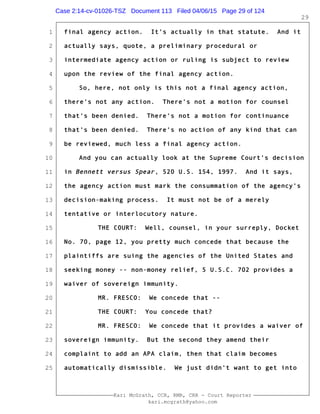
final agency action. It's actually in that statute. And it
actually says, quote, a preliminary procedural or
intermediate agency action or ruling is subject to review
upon the review of the final agency action.
So, here, not only is this not a final agency action,
there's not any action. There's not a motion for counsel
that's been denied. There's not a motion for continuance
that's been denied. There's no action of any kind that can
be reviewed, much less a final agency action.
And you can actually look at the Supreme Court's decision
in Bennett versus Spear, 520 U.S. 154, 1997. And it says,
the agency action must mark the consummation of the agency's
decision-making process. It must not be of a merely
tentative or interlocutory nature.
THE COURT: Well, counsel, in your surreply, Docket
No. 70, page 12, you pretty much concede that because the
plaintiffs are suing the agencies of the United States and
seeking money -- non-money relief, 5 U.S.C. 702 provides a
waiver of sovereign immunity.
MR. FRESCO: We concede that --
THE COURT: You concede that?
MR. FRESCO: We concede that it provides a waiver of
sovereign immunity. But the second they amend their
complaint to add an APA claim, then that claim becomes
automatically dismissible. We just didn't want to get into
Case 2:14-cv-01026-TSZ Document 113 Filed 04/06/15 Page 29 of 124
1
2
3
4
5
6
7
8
9
10
11
12
13
14
15
16
17
18
19
20
21
22
23
24
25
Kari McGrath, CCR, RMR, CRR - Court Reporter
kari.mcgrath@yahoo.com
30
it, because, one, we get a limited amount of pages --
THE COURT: Well, can we move the case along slightly
by assuming that they've made an oral motion to amend their
complaint?
MR. FRESCO: We do not oppose their oral motion to
amend their complaint.
THE COURT: That motion will be granted.
MR. FRESCO: Yes.
THE COURT: And the complaint will be amended to so
reference --
MR. FRESCO: But, Your Honor, then I would --
THE COURT: I know. I'm not ruling on the merits.
MR. FRESCO: Sorry. Yes. Yes.
THE COURT: I'm just trying to get the sovereign
immunity --
MR. FRESCO: Yes, but, Your Honor --
THE COURT: -- issue before the court.
MR. FRESCO: Yes. But, Your Honor, now, if you're
about to grant any kind of injunctive relief, you lack the
ability to do that under the APA. So now that you've amended
it, that issue of the APA is ripe for the court, and I will
now present my motion, which says that you have no
jurisdiction under the APA to grant temporary relief for
these plaintiffs, because it has to be a final agency action.
It cannot be a temporary action that's being -- that's being
Case 2:14-cv-01026-TSZ Document 113 Filed 04/06/15 Page 30 of 124
1
2
3
4
5
6
7
8
9
10
11
12
13
14
15
16
17
18
19
20
21
22
23
24
25
Kari McGrath, CCR, RMR, CRR - Court Reporter
kari.mcgrath@yahoo.com
31
challenged, so...
THE COURT: Well, and you're absolutely right. That
issue has not been briefed, because the plaintiffs did not
present that in their complaint.
MR. FRESCO: Correct, Your Honor.
THE COURT: It's there now. So I guess we'll have to
await that briefing.
MR. FRESCO: Yes, Your Honor. I'm just saying that
--
THE COURT: There's plenty of good issues --
MR. FRESCO: There are plenty of other good issues.
The --
COURT REPORTER: I'm sorry.
MR. FRESCO: I'm sorry. Am I going too fast?
COURT REPORTER: Let Your Honor speak.
MR. FRESCO: Oh, sorry. Sorry, Your Honor. I
apologize. So I just wanted to raise that, to address that
question.
Now, you're right, Your Honor, there are other
jurisdictional statutes at play here that also prevent the
court from considering the merits of the plaintiffs' claim.
And, again, the key point here, Your Honor, is we're not
saying that this court -- we're not saying that there is
never a way to listen to the plaintiffs' claims. We're just
saying that this court lacks jurisdiction in this case to
Case 2:14-cv-01026-TSZ Document 113 Filed 04/06/15 Page 31 of 124
1
2
3
4
5
6
7
8
9
10
11
12
13
14
15
16
17
18
19
20
21
22
23
24
25
Kari McGrath, CCR, RMR, CRR - Court Reporter
kari.mcgrath@yahoo.com
32
listen to the plaintiffs' -- the merits of plaintiffs'
claims.
Congress has set forth a clear and specific statutory
scheme outlining the manner in which these claims must be
raised. And that scheme specifically says that, any and all
questions of law or fact arising from any action taken or
proceeding brought. But it's not just proceeding brought.
It's action taken to remove a non-citizen from the United
States --
THE COURT: A little slower. A little slower,
counsel.
MR. FRESCO: Sorry. -- shall be available only in
judicial review of a final order of removal in the Ninth
Circuit. And that, which Your Honor has pointed out, is 12
U.S.C. 52(b)(9) (sic).
Plaintiff makes the point that the -- you can challenge
anything that's not an actual order of removal in district
court. But as Your Honor said, that can be anything. So
today we can be here on the issue of counsel for the
children. Tomorrow we can be here on a complaint saying that
in children's cases immigration judges need 50 hours of due
process -- sorry -- of training to handle kids' cases. In
the next -- in the next day, we can have a case saying
immigration judges have to have training with translators.
THE COURT: You're going to have to move to Seattle.
Case 2:14-cv-01026-TSZ Document 113 Filed 04/06/15 Page 32 of 124
1
2
3
4
5
6
7
8
9
10
11
12
13
14
15
16
17
18
19
20
21
22
23
24
25
Kari McGrath, CCR, RMR, CRR - Court Reporter
kari.mcgrath@yahoo.com
33
MR. FRESCO: Yes, exactly. There can be claim after
claim after claim after claim, because none of those are
technically challenging the final order of removal. But what
Congress made clear is, that's no way to be using judicial
resources.
THE COURT: Slow it down.
MR. FRESCO: Sorry. What Congress made clear is,
that's no way to be using judicial resources. You're
supposed to consolidate these claims into a challenge, into a
final order of -- a final order of removal.
And so what you have is 1252(a)(5) is the statute that
does what plaintiffs are talking about, which says, if you're
challenging a final order of removal, you have to challenge
it in the Ninth Circuit.
THE COURT: Well, do you agree that 1252(5) (sic)
does not -- does the court -- does not exclude the court from
having jurisdiction --
MR. FRESCO: Correct, but what --
THE COURT: -- under Ninth Circuit law?
MR. FRESCO: Correct, but what --
THE COURT: So you are relying on (b)(9)?
MR. FRESCO: Correct. But it's important to read
those two together, because you need them together to refute
what the plaintiffs are saying. They're saying (b)(9) allows
any challenge of any kind, as long as they're not challenging
Case 2:14-cv-01026-TSZ Document 113 Filed 04/06/15 Page 33 of 124
1
2
3
4
5
6
7
8
9
10
11
12
13
14
15
16
17
18
19
20
21
22
23
24
25
Kari McGrath, CCR, RMR, CRR - Court Reporter
kari.mcgrath@yahoo.com
34
the final order of removal.
And that's why (a)(5) is there. It says, challenging the
final order of removal, you do that in the Ninth Circuit.
And what (b)(9) is saying is, challenging any action at all
arising in the removal proceeding context gets done also in a
petition for review. We take all of those claims, and we
consolidate them.
THE COURT: Well, but the plaintiffs argue that there
is a pattern and practice by the government to have these
proceedings proceed on an expedited basis without the benefit
of legal counsel, unless they are retained, which they have
the privilege to do under the statute.
How do you respond to that, that there is no case out
there that has addressed this kind of fundamental issue of
whether or not these -- you'll agree that in immigration
proceedings involving children, as well as adults, they are
entitled to a fair hearing?
MR. FRESCO: Correct, Your Honor.
THE COURT: And you agree, I assume, that the
immigration judge could not prevent them from having retained
counsel?
MR. FRESCO: Correct, Your Honor.
THE COURT: So the question then remains, if they
can't get retained counsel, for whatever reason, whether it's
going to be a fair hearing if they don't have a right to have
Case 2:14-cv-01026-TSZ Document 113 Filed 04/06/15 Page 34 of 124
1
2
3
4
5
6
7
8
9
10
11
12
13
14
15
16
17
18
19
20
21
22
23
24
25
Kari McGrath, CCR, RMR, CRR - Court Reporter
kari.mcgrath@yahoo.com
35
appointed counsel.
MR. FRESCO: Yes, Your Honor. And so the question
is, what is an immigration hearing like, and how does it
operate? And I want to make -- there are three or four
things I want to say, so I want to try to say them in an
order.
First, there's a lot of --
THE COURT: I won't interrupt you for three or
four minutes now.
MR. FRESCO: Yes, yes. No, no, no.
THE COURT: You go ahead now.
MR. FRESCO: No, no. Sorry, Your Honor, please
interrupt.
The first thing is, we've got a lot of affidavits from
plaintiffs' counsel. And I don't want to belabor this point
too much, other than to say I'd love an opportunity to
cross-examine those folks and everything.
And so to the extent that these are just affidavits that
we have no ability to test the reliability of, it's very hard
for us to say these are the patterns and practices that are
occurring. But we can table that issue for now.
The second point, Your Honor, is to say each and every one
of these proceedings is the same whether they are an adult or
a child who proceeds without counsel. The immigration judge
has a duty under the law to develop the record and to
Case 2:14-cv-01026-TSZ Document 113 Filed 04/06/15 Page 35 of 124
1
2
3
4
5
6
7
8
9
10
11
12
13
14
15
16
17
18
19
20
21
22
23
24
25
Kari McGrath, CCR, RMR, CRR - Court Reporter
kari.mcgrath@yahoo.com
36
determine if there are claims for relief from removal.
So what the immigration judge does is they ask the
individual, non-citizen, who's there, the questions: Are you
afraid to go back home to your country? If they say yes, why
are you afraid to go back home to your country? I'm afraid
I'm going to be beaten or --
THE COURT: Counsel --
MR. FRESCO: Yes.
THE COURT: -- I guess I have to interrupt you.
MR. FRESCO: Yes, yes, yes, Your Honor.
THE COURT: Hasn't the law, and even Congress,
recognized that children are different and they have perhaps
different rights? Hasn't Congress afforded children under
various scenarios in the immigration proceedings rights that
adults don't have?
MR. FRESCO: Well, Your Honor, Congress has certainly
put forward statutory protections for children. And we
believe those statutory protections are what make the hearing
fairer in that situation, where, for instance, plaintiffs'
counsel talks about tomorrow the children can concede
removability. That's, in fact, not the case.
In your first -- if you are a child appearing pro se, you
are not allowed to concede removability. That's not --
THE COURT: And what if you're not pro se? What if
you've got a guardian?
Case 2:14-cv-01026-TSZ Document 113 Filed 04/06/15 Page 36 of 124
1
2
3
4
5
6
7
8
9
10
11
12
13
14
15
16
17
18
19
20
21
22
23
24
25
Kari McGrath, CCR, RMR, CRR - Court Reporter
kari.mcgrath@yahoo.com
37
MR. FRESCO: If you have a guardian, the guardian can
concede the removability for you, I believe. That's my
understanding. But if you are -- if you are appearing pro
se, which is what they are saying these children are
appearing, they are -- they are unable to concede their
removability. So that cannot happen.
Secondly, at a first --
THE COURT: But we don't know whether that's going to
happen or not. They may or may not be accompanied by a
guardian or a parent, isn't that true?
MR. FRESCO: That is true, Your Honor. But that is
an answer to a question of what we do about these cases if
there are due process deprivations. What we do about them is
we appeal those determinations. And then if the Board of
Immigration doesn't help us, then we appeal to the Ninth
Circuit. That's the scheme that Congress wants it in that
situation.
And, Your Honor, one of the points that's raised is, well,
this has never happened before. But, Your Honor, it's
actually incredibly easy for this to happen in this context.
There's never been a lawsuit for kids saying that they have a
Fifth Amendment right to counsel before. I mean, there was
one in 2002, but this is just the second one. But it
happens.
And what could happen in this case, if the plaintiffs
Case 2:14-cv-01026-TSZ Document 113 Filed 04/06/15 Page 37 of 124
1
2
3
4
5
6
7
8
9
10
11
12
13
14
15
16
17
18
19
20
21
22
23
24
25
Kari McGrath, CCR, RMR, CRR - Court Reporter
kari.mcgrath@yahoo.com
38
wanted it to happen, if the plaintiffs' counsel here want it
to happen, is they could literally make a one-page paper that
all you have to do is fill out your name, if you were the
alien, and you could submit that to the Board of Immigration
Appeals, saying, I am appealing that I did not get counsel in
this case. That would be enough.
And then in the Ninth Circuit they'd do the same thing, a
one-page paper where they just fill in their name and they
send it in. And the Ninth Circuit actually has a pro bono
program that says, for a case like this, a constitutional
claim raised by a minor, we will find the counsel for that
child.
So that's not going to be -- the reason you don't see kids
appearing pro se in the Ninth Circuit is because the Ninth
Circuit takes the issue very seriously, and they try to find
counsel when they can for those -- for those children.
And so that is -- that is -- these things aren't happening
in a vacuum, where we just say the only time they have
counsel is today, and they'll never have counsel ever again.
That -- it is not actually a very difficult claim to make, if
you were to make a one-page fill-in sheet where the child
literally only has to put in their name and that claim was
made for them, and they could -- and they could raise it in
the courts.
And so if the Ninth Circuit were to say that that child's
Case 2:14-cv-01026-TSZ Document 113 Filed 04/06/15 Page 38 of 124
1
2
3
4
5
6
7
8
9
10
11
12
13
14
15
16
17
18
19
20
21
22
23
24
25
Kari McGrath, CCR, RMR, CRR - Court Reporter
kari.mcgrath@yahoo.com
39
due process claim -- that this child's due process rights
were violated because they didn't have a lawyer, that would
be the governing law of the Ninth Circuit. And it would
apply in future cases that had children going up before the
Ninth Circuit.
And so that's why the relief asked for in this court is
the same as the relief that would happen in the petition for
review, Your Honor, except that Congress didn't want the
district courts doing this case, the translator case, the
cultural sensitivity training case, all these kind of cases.
They want --
THE COURT: But isn't this type of challenge more
fundamental than the translator or some of these other
procedural cases? Because is it not a certainty that if the
court takes no action today, that many children without legal
representation will be processed through these, essentially,
fast-track immigration hearings, and they may be given short
continuances, but, ultimately, many of them are going to be
deported, and many of them would have rights that they could
present if they had legal representation? Isn't that fair?
MR. FRESCO: I think I want to say -- I'm inclined to
say yes, Your Honor, but there are a lot of facts that you
presuppose in this, so I need to take you through them. But
I never like to say no to the judge.
So here is the -- here is the -- here are the facts that
Case 2:14-cv-01026-TSZ Document 113 Filed 04/06/15 Page 39 of 124
1
2
3
4
5
6
7
8
9
10
11
12
13
14
15
16
17
18
19
20
21
22
23
24
25
Kari McGrath, CCR, RMR, CRR - Court Reporter
kari.mcgrath@yahoo.com
40
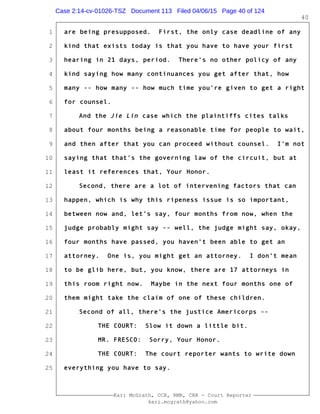
are being presupposed. First, the only case deadline of any
kind that exists today is that you have to have your first
hearing in 21 days, period. There's no other policy of any
kind saying how many continuances you get after that, how
many -- how many -- how much time you're given to get a right
for counsel.
And the Jie Lin case which the plaintiffs cites talks
about four months being a reasonable time for people to wait,
and then after that you can proceed without counsel. I'm not
saying that that's the governing law of the circuit, but at
least it references that, Your Honor.
Second, there are a lot of intervening factors that can
happen, which is why this ripeness issue is so important,
between now and, let's say, four months from now, when the
judge probably might say -- well, the judge might say, okay,
four months have passed, you haven't been able to get an
attorney. One is, you might get an attorney. I don't mean
to be glib here, but, you know, there are 17 attorneys in
this room right now. Maybe in the next four months one of
them might take the claim of one of these children.
Second of all, there's the justice Americorps --
THE COURT: Slow it down a little bit.
MR. FRESCO: Sorry, Your Honor.
THE COURT: The court reporter wants to write down
everything you have to say.
Case 2:14-cv-01026-TSZ Document 113 Filed 04/06/15 Page 40 of 124
1
2
3
4
5
6
7
8
9
10
11
12
13
14
15
16
17
18
19
20
21
22
23
24
25
Kari McGrath, CCR, RMR, CRR - Court Reporter
kari.mcgrath@yahoo.com
41
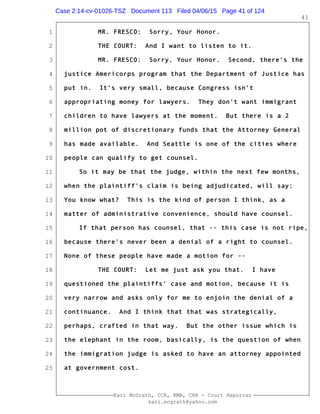
MR. FRESCO: Sorry, Your Honor.
THE COURT: And I want to listen to it.
MR. FRESCO: Sorry, Your Honor. Second, there's the
justice Americorps program that the Department of Justice has
put in. It's very small, because Congress isn't
appropriating money for lawyers. They don't want immigrant
children to have lawyers at the moment. But there is a 2
million pot of discretionary funds that the Attorney General
has made available. And Seattle is one of the cities where
people can qualify to get counsel.
So it may be that the judge, within the next few months,
when the plaintiff's claim is being adjudicated, will say:
You know what? This is the kind of person I think, as a
matter of administrative convenience, should have counsel.
If that person has counsel, that -- this case is not ripe,
because there's never been a denial of a right to counsel.
None of these people have made a motion for --
THE COURT: Let me just ask you that. I have
questioned the plaintiffs' case and motion, because it is
very narrow and asks only for me to enjoin the denial of a
continuance. And I think that that was strategically,
perhaps, crafted in that way. But the other issue which is
the elephant in the room, basically, is the question of when
the immigration judge is asked to have an attorney appointed
at government cost.
Case 2:14-cv-01026-TSZ Document 113 Filed 04/06/15 Page 41 of 124
1
2
3
4
5
6
7
8
9
10
11
12
13
14
15
16
17
18
19
20
21
22
23
24
25
Kari McGrath, CCR, RMR, CRR - Court Reporter
kari.mcgrath@yahoo.com
42
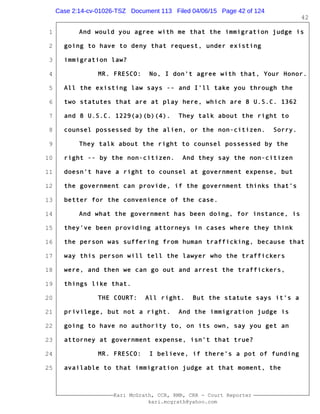
And would you agree with me that the immigration judge is
going to have to deny that request, under existing
immigration law?
MR. FRESCO: No, I don't agree with that, Your Honor.
All the existing law says -- and I'll take you through the
two statutes that are at play here, which are 8 U.S.C. 1362
and 8 U.S.C. 1229(a)(b)(4). They talk about the right to
counsel possessed by the alien, or the non-citizen. Sorry.
They talk about the right to counsel possessed by the
right -- by the non-citizen. And they say the non-citizen
doesn't have a right to counsel at government expense, but
the government can provide, if the government thinks that's
better for the convenience of the case.
And what the government has been doing, for instance, is
they've been providing attorneys in cases where they think
the person was suffering from human trafficking, because that
way this person will tell the lawyer who the traffickers
were, and then we can go out and arrest the traffickers,
things like that.
THE COURT: All right. But the statute says it's a
privilege, but not a right. And the immigration judge is
going to have no authority to, on its own, say you get an
attorney at government expense, isn't that true?
MR. FRESCO: I believe, if there's a pot of funding
available to that immigration judge at that moment, the
Case 2:14-cv-01026-TSZ Document 113 Filed 04/06/15 Page 42 of 124
1
2
3
4
5
6
7
8
9
10
11
12
13
14
15
16
17
18
19
20
21
22
23
24
25
Kari McGrath, CCR, RMR, CRR - Court Reporter
kari.mcgrath@yahoo.com
43
immigration judge could. But I think, more largely so, you
are correct, that the immigration judge, you know --
THE COURT: Well, isn't that -- whereas, having never
asked for a continuance -- and the ripeness there is
troubling to the court -- can't we conclude that a request
for counsel is going to be denied and that it would be futile
to -- the ripeness perhaps is different on that issue than it
is on asking for a continuance?
MR. FRESCO: I agree. Except, Your Honor, the
inevitability of them not finding counsel is too difficult of
a concept for the way these formalities of these proceedings
have to occur. Why -- if four months are going to be passing
from tomorrow's first hearing to a potential time where they
might be removed, why is it --
THE COURT: What is that timing?
MR. FRESCO: The timing -- well, here's what happens.
THE COURT: How quickly could the named plaintiffs
here be deported?
MR. FRESCO: We cannot control any individual
immigration judge's determination. But here's what we know
are the facts. The first fact is, yes, there is a policy
that says 21 days after they are served their notice to
appear, which is their indictment, that's their first
hearing.
After that, we know that it's not permitted by law for the
Case 2:14-cv-01026-TSZ Document 113 Filed 04/06/15 Page 43 of 124
1
2
3
4
5
6
7
8
9
10
11
12
13
14
15
16
17
18
19
20
21
22
23
24
25
Kari McGrath, CCR, RMR, CRR - Court Reporter
kari.mcgrath@yahoo.com
44
judge to not grant the first continuance. They have to grant
the first continuance. We don't know how long that
continuance is going to be. Plaintiffs have in some
affidavits three weeks. My colleagues -- my clients from the
Executive Office for Immigration Review -- they're the
immigration court -- they are telling me that many of these
cases are being continued for six months.
And so that's why I dispute the plaintiffs' affidavit.
But we're not here on a fact-finding mission right this -- at
this particular moment. But the point is, we don't know what
a specific immigration judge would do. What we do know is
that there's very good case law that says, if the immigration
judge denies a continuance in a situation where the person
can credibly show that a lawyer was on the horizon, that
person -- that immigration judge's decision is going to be
reversed. That -- that is going to be considered a due
process violation. And that's not going to be permitted.
Jie Lin talks about four months as a reasonable amount of
time. I can't sit here today and tell you what would happen,
how much time -- how much time is going to happen in an
individual case. But if some are being rescheduled six
months out, it's going to be -- it depends.
So, but the point is, after that, the immigration judge
can grant as many continuances as they want. There's one
plaintiff in this case that I believe has been granted four
Case 2:14-cv-01026-TSZ Document 113 Filed 04/06/15 Page 44 of 124
1
2
3
4
5
6
7
8
9
10
11
12
13
14
15
16
17
18
19
20
21
22
23
24
25
Kari McGrath, CCR, RMR, CRR - Court Reporter
kari.mcgrath@yahoo.com
45
years' worth of continuances. And so that plaintiff has had
four years' worth. That's the one piece of evidence we have
in this case.
THE COURT: Which plaintiff is that?
MR. FRESCO: I believe that is -- hold on. I believe
that is N.A.M. Or two years. Two years. Sorry. Two years'
worth of continuances. Is that M.A.M., though? Yes.
MS. BURGIE: Yes.
MR. FRESCO: It's M.A.M., Your Honor. So that's the
one piece of evidence we have in this case, is the one
plaintiff we have who's asked for continuances has been given
two years' worth of continuances. So to say that we're going
to have in three weeks a deportation, I think, is an
unreasonable finding of fact to be made on this particular
record.
Second of all, the assumption that we're going to have a
hearing even without an attorney that does not comport with
due process is actually not what's happening on the ground,
Your Honor. If you were to go to any of these immigration
proceedings where there's families, or you have kids of ages
15, 16, 17, and then parents, the kids are the ones
explaining everything to their parents. They're the ones who
have better cultural sensitivity. They can adapt quicker.
They understand everything. They learned English. They're
here. They're the ones telling their parents, hey, this is
Case 2:14-cv-01026-TSZ Document 113 Filed 04/06/15 Page 45 of 124
1
2
3
4
5
6
7
8
9
10
11
12
13
14
15
16
17
18
19
20
21
22
23
24
25
Kari McGrath, CCR, RMR, CRR - Court Reporter
kari.mcgrath@yahoo.com
46
what we have to do, this is what the judge is asking us, this
is what -- it's not the parents.
It is true that the immigration law is complex. But the
immigration law is complex for everybody. The issue of what
happened to you, which are the questions you have to answer
if you're pro se, are the same for the children or for the
adults. They have to answer the same questions, Your Honor.
And it's based on those answers to the questions in these
informal hearings that the determination is made whether to
grant relief or not.
But the courts have said there's nothing about these
proceedings that require a right to counsel, even though the
immigration law is complex, because it's civil and because
there isn't a liberty -- and we'll talk about that later,
obviously, if we have time.
But because there isn't a penalty where you're going to be
imprisoned at the end of this, because the deportation is
considered a civil sanction, we don't actually have a right
to counsel in that particular -- so that's -- that would be
my answer to Your Honor's point of what will happen to these
children, is what will happen to these children will be the
same that would happen to these adults.
They'd be asked fact-based questions, in a setting,
though, that's more narrowly tailored for them. The judge
doesn't wear a robe. It's less adversarial. The judge takes
Case 2:14-cv-01026-TSZ Document 113 Filed 04/06/15 Page 46 of 124
1
2
3
4
5
6
7
8
9
10
11
12
13
14
15
16
17
18
19
20
21
22
23
24
25
Kari McGrath, CCR, RMR, CRR - Court Reporter
kari.mcgrath@yahoo.com
47
more of a fact-finding point of view. The judge -- the kid
gets a tour of the courtroom beforehand. Things like this
are the things that makes them more comfortable. The
questions are asked in one- or two-syllable words instead
of three-, four-syllable words, things of that nature. And
then the judge can determine if the child gets relief or not,
based on -- based on that situation.
THE COURT: Take a moment and give me an advance
view, if you will, of this sovereign immunity issue that
really has not been briefed and which you contend will be a
basis for a motion to dismiss. I need to understand my
jurisdiction --
MR. FRESCO: Yes, Your Honor.
THE COURT: -- if possible, at this time.
MR. FRESCO: Yes. The plaintiffs are in a bit of a
jurisdictional dilemma, where they say the only way we can be
here today is if we're not challenging a final order of
removal, if we're challenging something that is collateral,
interlocutory, not part of the order of removal. But then
the only way they can be here today is under the APA, because
they don't have another basis of a waiver of sovereign
immunity.
So what the APA says, in Section 5 U.S.C. 704, is that
agency action made reviewable by statute and final agency
action for which there is no adequate remedy is what is
Case 2:14-cv-01026-TSZ Document 113 Filed 04/06/15 Page 47 of 124
1
2
3
4
5
6
7
8
9
10
11
12
13
14
15
16
17
18
19
20
21
22
23
24
25
Kari McGrath, CCR, RMR, CRR - Court Reporter
kari.mcgrath@yahoo.com
48
reviewable. And they say a preliminary, procedural, or
intermediate agency action or ruling not directly reviewable
is subject to review on the review of the final agency
action.
So that's when they can bring their agency APA claim, is
at the final agency action. And the better sort of plain
English reading of that statute, like I said, is in Bennett
versus Spear, from the Supreme Court, 520 U.S. 154, that said
--
THE COURT: Give me the cite again.
MR. FRESCO: Yes. Sorry. 520 U.S. 154. And it's
actually at 178, the -- the line. And it says, the action
must mark the consummation of the agency's decision-making
process. It must not be of a merely tentative or
interlocutory nature.
So they're-- they're stuck in a little bit of a position
where they are between a rock and a hard place, because if
they're saying (b)(9) doesn't apply because we're not here on
a final order, this is more of a collateral interlocutory
type thing, then the problem is 5 U.S.C. 704 is not a basis
for them to move forward. They can only move forward on a
final order.
But even if they said, well, they're being denied their
right to counsel, they're not even being denied -- there's no
order to remove here. Nobody moved for a right to counsel.
Case 2:14-cv-01026-TSZ Document 113 Filed 04/06/15 Page 48 of 124
1
2
3
4
5
6
7
8
9
10
11
12
13
14
15
16
17
18
19
20
21
22
23
24
25
Kari McGrath, CCR, RMR, CRR - Court Reporter
kari.mcgrath@yahoo.com
49
Nobody moved for a continuance. I think you actually have to
move for appointed counsel. I don't even think you have to
move for a continuance before this case becomes ripe, because
that's what they're ultimately saying, is they have a right
to counsel. And that right to counsel hasn't been denied
yet.
But once those things happen, and then once -- once, you
know, they're in that position, maybe then they can bring
this APA claim in the final order. But they can't bring it
at this point, where absolutely nothing has been done to move
this case forward, Your Honor.
If Your Honor doesn't have any further questions, I won't
keep using my time for no reason, but --
THE COURT: Thank you. I have no further questions.
MR. ARULANANTHAM: A few brief points on
jurisdiction, if I can, Your Honor. First, on this question
about the APA, counsel is confusing the waiver under the APA
with the need to bring a claim, a challenge to agency action
under the APA.
Section 702 is a waiver. It applies not just to claims
brought under the APA, but also to other federal and
statutory and constitutional claims. The Ninth Circuit held
that in Presbyterian Church, one of the cases we cite.
And if they were right, then none of the cases that either
party -- I mean, I'm sorry, excuse me -- either -- the court
Case 2:14-cv-01026-TSZ Document 113 Filed 04/06/15 Page 49 of 124
1
2
3
4
5
6
7
8
9
10
11
12
13
14
15
16
17
18
19
20
21
22
23
24
25
Kari McGrath, CCR, RMR, CRR - Court Reporter
kari.mcgrath@yahoo.com
50
cited in the order on Saturday that find jurisdiction, right,
or a host of other Ninth Circuit cases could have been
brought.
McNary is a district court action challenging agency
action. How is that possible if in fact you can only bring
it after challenge to a final order? Same with Rodriguez v.
Hayes, Proyecto San Pablo, Walters, Barahona-Gomez, none of
those cases would make any sense as district court cases if
their theory were correct. We don't have to bring a claim
under the APA. We will not do that. The APA waives the
government's sovereign immunity, right.
And as a separate matter, as I said earlier, suits against
officials in their official capacity are an exception to the
sovereign rule that predates the APA. So if that's going to
be -- not going to be a problem with respect to jurisdiction,
you know, whether or not we -- or even after we have
constructively amended the complaint.
THE COURT: Well, that is a problem, isn't it? I
mean, those cases predate the Real ID Act and Congress'
attempt to channel all of these issues to the Court of
Appeals, challenging a final order of deportation.
MR. ARULANANTHAM: Well, right. I'm talking about
the sovereign immunity question. They solved the sovereign
immunity question, right.
Now, on that question, the channeling point in (b)(9),
Case 2:14-cv-01026-TSZ Document 113 Filed 04/06/15 Page 50 of 124
1
2
3
4
5
6
7
8
9
10
11
12
13
14
15
16
17
18
19
20
21
22
23
24
25
Kari McGrath, CCR, RMR, CRR - Court Reporter
kari.mcgrath@yahoo.com
51
Your Honor, what Mr. Fresco is describing, essentially, is
like unauthorized practice of law, right. We would give a
bunch of forms that children would have to then fill out.
And maybe this wasn't clear enough, right. We cannot
bring the counsel claim at all through the individual
immigration process, because those claims would be moot,
right. And there are 17 of us, but there are several hundred
thousand, you know, pending cases. And that is a problem.
You know, capacity has run out. There are not enough lawyers
to handle the children's cases, right.
But we have no ability to bring this claim any other way,
because if we are representing a child, then that child has
no claim for appointed counsel. And that is true of all the
legal service providers. That's the genesis of our -- of the
whole jurisdictional problem that we have here. It's the
reason why the counsel claim actually will always moot out
and never can actually be heard in the Court of Appeals.
Children who have counsel, it's moot, because they have
counsel. Children who don't have counsel don't have the
ability to file a Board of Immigration Appeals or Ninth
Circuit petition or any circuit petition and raise the claim.
And that is the reason why the claim has actually never
been heard. It's not because the Ninth Circuit appoints
counsel. The problem arises with the Board as well, right.
The child has to file an appeal to the Board and raise a
Case 2:14-cv-01026-TSZ Document 113 Filed 04/06/15 Page 51 of 124
1
2
3
4
5
6
7
8
9
10
11
12
13
14
15
16
17
18
19
20
21
22
23
24
25
Kari McGrath, CCR, RMR, CRR - Court Reporter
kari.mcgrath@yahoo.com
52
counsel claim in order for the Ninth Circuit to then take the
petition for review of that denied claim. So, you know, with
respect to the -- his idea of, like, there's an alternative
mechanism for doing this, that is not actually possible.
Now, I understand -- take Your Honor's point, that the
rescheduling problem, you know, that may have a more -- more
of a ripeness problem than the actual counsel claim, and
whether we can amend it or, you know, tell you orally or
whatever, if the court is inclined to find jurisdiction or a
ripe claim to enjoin proceeding against children who don't
have counsel, I mean, you know, just for this time, while we
litigate this claim.
THE COURT: I can't enjoin the immigration court from
proceeding, can I?
MR. ARULANANTHAM: You can enjoin from proceeding
without counsel. You can enjoin -- that's exactly the order
in Franco. That is exactly the order in the Franco
litigation, is the government has 60 days to appoint -- to
ensure legal representation, whether paid or pro bono.
"Qualified representative" is the word the court used, right.
And they cannot proceed unless there is a qualified
representative in those cases.
And you absolutely have authority to do that, Your Honor,
because you have authority --
THE COURT: I'm sorry. You said that was the -- that
Case 2:14-cv-01026-TSZ Document 113 Filed 04/06/15 Page 52 of 124
1
2
3
4
5
6
7
8
9
10
11
12
13
14
15
16
17
18
19
20
21
22
23
24
25
Kari McGrath, CCR, RMR, CRR - Court Reporter
kari.mcgrath@yahoo.com
53
was the --
MR. ARULANANTHAM: The order in the Franco --
THE COURT: Fronto?
MR. ARULANANTHAM: Franco. Excuse me. F-R-A-N-C-O,
Franco. That's the litigation establishing a right to legal
representation for people with serious mental disorders. And
we have this -- basically this whole same jurisdictional
fight, except for sovereign immunity, in that litigation.
And, you know, we won, and they appeal. And it was all
the same issues, you know. And, basically, the claim -- the
injunction there requires, for the government to proceed
against the person with a serious mental disorder who is not
competent to represent themselves, they have to provide
counsel.
So this court clearly has authority to do that, because
you have authority if there's no other way for that claim to
be heard, and you have authority to ensure that there is a
fair hearing so that people can get their day in court on the
underlying issues that are, you know, at issue in the
deportation case.
The third thing I wanted to say, McNary is also interested
in meaningful review of the claim, not just will it be heard,
like, as a mechanical matter, but is the review meaningful.
So let's say that some child filled out a form that someone
provides, and then they fill it out again, and they end up in
Case 2:14-cv-01026-TSZ Document 113 Filed 04/06/15 Page 53 of 124
1
2
3
4
5
6
7
8
9
10
11
12
13
14
15
16
17
18
19
20
21
22
23
24
25
Kari McGrath, CCR, RMR, CRR - Court Reporter
kari.mcgrath@yahoo.com
54
the Ninth Circuit, right. What is the Ninth Circuit or any
circuit court going to have to decide that case? Are they
going to have, for example, evidence about the children's
capacity?
Now, you heard Mr. Fresco say, oh, children actually are
totally capable, they know more than their parents. You
know, we have experts who will come say, no, children are
deferential to authority, they don't argue with adults, which
is what you have to do to represent yourself, right.
So we're going to have that rich factual record here. The
Ninth Circuit, in a petition for review on a one-page piece
of paper, will not have that. We have grant rate data,
right. We say that the grant rate differential for children
with counsel and children without is massive. You know, we
think it's 77 or something percent, which is 10 percent, you
know, different numbers, different years. It's huge, right.
How is the Ninth Circuit going to have that information?
It's entirely relevant to a Mathews v. Eldridge analysis of
whether or not appointed counsel is required by the due
process laws. And how is this one piece of paper going to
somehow present that evidence to the court? And, similarly,
just to paint the picture of what happens in immigration
court, I don't see, you know, how that's going to happen.
The next thing --
THE COURT: Your minute is almost up.
Case 2:14-cv-01026-TSZ Document 113 Filed 04/06/15 Page 54 of 124
1
2
3
4
5
6
7
8
9
10
11
12
13
14
15
16
17
18
19
20
21
22
23
24
25
Kari McGrath, CCR, RMR, CRR - Court Reporter
kari.mcgrath@yahoo.com
55
MR. ARULANANTHAM: I'm sure it is, Your Honor. Two
other very quick things I'll say. You know, we have
declarations from experienced legal service providers saying
continuances are not going on for four months. It's like,
you know, three weeks, three days in Dallas.
And you can't just discount that evidence on the basis
of one child who is not on the rocket docket, who is one of
our plaintiffs in the case. M.A.M. is not on it.
And then the very last thing I would say on jurisdiction,
before the book is closed, is, McNary and all of those cases,
they are most fundamentally different because those people
are not in removal proceedings. The government has not
charged them with being deportable. They are seeking
advantage under the legalization program.
And front desk plaintiffs in McNary -- I mean in CSS, the
government says their claim is ripe because their claim has
been denied already, right. So they're ripe. Other people
are not ripe, because they still haven't been enforced
against.
But everyone in our class is in removal proceedings. They
are under the threat of deportation already. They've had the
charging document issued against them. So the notion -- and
as you said, Your Honor, they can't get counsel appointed for
that.
The immigration judge -- you know, no judge -- immigration
Case 2:14-cv-01026-TSZ Document 113 Filed 04/06/15 Page 55 of 124
1
2
3
4
5
6
7
8
9
10
11
12
13
14
15
16
17
18
19
20
21
22
23
24
25
Kari McGrath, CCR, RMR, CRR - Court Reporter
kari.mcgrath@yahoo.com
56
judge has ever appointed counsel for anyone, except under the
injunction in the Franco case, you know, under a court's
order, right.
So the idea that they need more to make that claim ripe
just seems fundamentally wrong, because the government is
charging them, saying you have to appear in court, if not
tomorrow, then a few weeks later, maybe a month later.
You're going to have to proceed without a lawyer. We know
there are not enough lawyers. We know that. We know there
are not enough lawyers. And the government's policy is that
they don't provide lawyers to children. So I don't know what
more is needed to make that claim ripe.
THE COURT: Thank you, counsel.
All right. We're going to take about a ten-minute recess.
And then we'll come back and address the merits of the issues
presented.
We'll be in recess.
(Brief recess.)
THE COURT: Please be seated, ladies and gentlemen.
I want -- before we proceed to the merits issue, I want to
see if we can clarify plaintiffs' motion to amend their
complaint to allege an APA -- to reference APA. I think we
need to have something filed by the plaintiff that would
reflect the language so that the government can respond to
it.
Case 2:14-cv-01026-TSZ Document 113 Filed 04/06/15 Page 56 of 124
1
2
3
4
5
6
7
8
9
10
11
12
13
14
15
16
17
18
19
20
21
22
23
24
25
Kari McGrath, CCR, RMR, CRR - Court Reporter
kari.mcgrath@yahoo.com
57
So what I think we should do is, the minutes should
reflect I've granted your oral motion to amend the complaint
to make reference to the APA in an appropriate pleading that
you would file. And I think you should file it as soon as
possible.
I'm not entirely clear whether that will affect the clock
that's running on the government to either answer or move to
dismiss.
MR. FRESCO: Your Honor, we can stay on the same
clock, Your Honor, yes.
THE COURT: All right. Wonderful.
MR. FRESCO: Yes.
THE COURT: But I think you should file something so
we have definitively exactly what you're alleging so the
government can respond to it.
All right. I indicated we would have, I think, 20 minutes
for this. Maybe we should reduce it to 15 minutes a side so
we -- in any event, 15 to 20 minutes, so that we can get to
the class certification as well.
Let me hear from the plaintiff first.
MR. ARULANANTHAM: Thank you, Your Honor. And we can
amend our complaint today to resolve that issue.
With respect to the merits, Your Honor, I just want to
briefly touch on the equitable factors before turning to the
heart of the issue, which is the likelihood of success.
Case 2:14-cv-01026-TSZ Document 113 Filed 04/06/15 Page 57 of 124
1
2
3
4
5
6
7
8
9
10
11
12
13
14
15
16
17
18
19
20
21
22
23
24
25
Kari McGrath, CCR, RMR, CRR - Court Reporter
kari.mcgrath@yahoo.com
58
They're -- I think the government has a strong interest in
assuring that there is counsel for children in immigration
proceedings, and the public has a strong interest in that, to
ensure the integrity of those proceedings.
And I refer again to the failure-to-appear rate
differential and the fact that children are being ordered
removed in absentia now. That is happening because, at least
in part, you know, likely because they do not have counsel in
many cases, you know, as the statistical evidence shows.
Immigration Judge Marks has stated something in an
interview that we cite, that there's a huge increase in the
efficiency and, you know, smooth operating of the system.
Attorney General Holder actually has said also, you know,
said that he thinks that there should be counsel for
children.
And, of course, the harm to the children themselves, if we
get it wrong, because it's not adequately presented, their
lives are definitely at stake. I think there's a very strong
public interest in favor of our position here.
Your Honor, turning to the likelihood of success on the
merits. In their surreply brief, and then again here today,
I think the government is at least strongly suggesting that
due process requires a case-by-case analysis to determine
whether counsel is required for at least some of these cases.
And I don't want to put words in their mouth. You hear
Case 2:14-cv-01026-TSZ Document 113 Filed 04/06/15 Page 58 of 124
1
2
3
4
5
6
7
8
9
10
11
12
13
14
15
16
17
18
19
20
21
22
23
24
25
Kari McGrath, CCR, RMR, CRR - Court Reporter
kari.mcgrath@yahoo.com
59
what they say. But I thought I heard a suggestion that an
immigration judge should have the power to appoint counsel in
some cases. And they say the due process analysis should
occur on a case-by-case basis, in their surreply brief.
But right now there is no appointment by immigration
judges happening in the system. That never happens for cases
involving children. So if an immigration judge has a child
in front of them who is four years old or seven years old or
ten years old, like, you know, J.E.F.M., even if the
government says -- the immigration judge thinks that that
proceeding cannot happen in a fair way without counsel, the
judges do not, in fact, have power to appoint counsel.
And there are programs that the government runs in certain
parts of the country to appoint counsel -- or to provide for
legal representation. But it's not as though judges actually
do a case-by-case analysis and decide in given cases whether
counsel is required.
So, you know, our view is that, categorically, all
children require appointed counsel. But if, you know, that's
not the case, and instead it's only some children that
require appointed counsel, I think Your Honor still should
grant the injunction, because at the moment, there is no
analysis like this taking place.
So we know then that there are -- if this is the
government's view, then even on their view, there are
Case 2:14-cv-01026-TSZ Document 113 Filed 04/06/15 Page 59 of 124
1
2
3
4
5
6
7
8
9
10
11
12
13
14
15
16
17
18
19
20
21
22
23
24
25
Kari McGrath, CCR, RMR, CRR - Court Reporter
kari.mcgrath@yahoo.com
60
unconstitutional removal hearings which are taking place,
because there are children who cannot get a fair hearing.
And the immigration judge has no power to remedy that by
appointing them a lawyer.
THE COURT: So help me understand. The one case
that's been cited -- I think the lawyers have cited me lots
of cases -- but is the Marcos Gonzalez-Machado case out of
the Eastern District of Washington, Judge Van Sickle. And he
goes through, I think, a very thoughtful analysis of the
issues which are very similar to the ones presented here on
the right to counsel.
How is what he said different today than it was in 2002,
when he held that there was not a right to counsel?
MR. ARULANANTHAM: Several things have changed since
the Gonzalez-Machado decision, Your Honor. The first is,
Gonzalez-Machado held that Gault and Mathews, the sort of
standard due process doctrine cases, do not apply, and said,
actually, they thought -- suggested that the analysis might
have been different if those cases had -- those cases did
apply. But since that time the Ninth Circuit has repeatedly
applied standard due process doctrine.
THE COURT: Well, Gault doesn't stand for the
proposition that minors are entitled to attorneys, a right to
an attorney in a civil proceeding, does it?
MR. ARULANANTHAM: No, only in juvenile delinquency
Case 2:14-cv-01026-TSZ Document 113 Filed 04/06/15 Page 60 of 124
1
2
3
4
5
6
7
8
9
10
11
12
13
14
15
16
17
18
19
20
21
22
23
24
25
Kari McGrath, CCR, RMR, CRR - Court Reporter
kari.mcgrath@yahoo.com
61
proceedings. That's --
THE COURT: And that's because they're going to be --
they may be incarcerated.
MR. ARULANANTHAM: Well, that's one --
THE COURT: That's certainly a key distinction, is it
not?
MR. ARULANANTHAM: Well, it's a key distinction in
the sense that that is one of the factors, and certainly an
important one, that the court relies on in Gault. But the
court doesn't say that that's a criminal process, right, not
on the counsel part of the holding.
And you have subsequent cases, clearly civil context, like
parental termination, you know, termination of parental
rights, in Lassiter, or Turner v. Rogers, which is civil
contempt, where the court is citing Gault.
So, you know, Gault certainly doesn't resolve the question
here, because that's a juvenile delinquency proceeding. But
the court thought that the incarceration was important
because the liberty interests are important.
And, here, we don't have incarceration, but, you know,
J.E.F.M. and his brother and sister, their father was killed
by a gang. You know, gangs are threatening them, too.
S.R.I.C. is 17. He was attacked by a gang, physically,
before he left the country. So these children can be killed
upon their return. It's not the same as incarceration, but
Case 2:14-cv-01026-TSZ Document 113 Filed 04/06/15 Page 61 of 124
1
2
3
4
5
6
7
8
9
10
11
12
13
14
15
16
17
18
19
20
21
22
23
24
25
Kari McGrath, CCR, RMR, CRR - Court Reporter
kari.mcgrath@yahoo.com
62
it is a very important interest.
You know, deportation is the equivalent of banishment or
exile, which is well recognized in Supreme Court cases.
THE COURT: But you are asking for legal counsel for
these children at government expense in every case. It
sounds like this would be a very small subset of the class
that you are being -- that you are proposing, which we'll
talk about in a little while, I guess.
But, I mean, if there was evidence that someone is going
to be killed if they are returned, that's different. That
gets closer, doesn't it, perhaps, to the incarceration
problem and the distinction the courts have made in that
regard.
MR. ARULANANTHAM: So, first -- a few thoughts on
that, Your Honor. First, to go back to the point I made in
the beginning, if that is correct, if that child has a
counsel claim even if other child don't, still grant the
injunction today, because nobody is doing a case-by-case
analysis. And we can have a -- we can litigate this
question. Should it be all children? Should it be only some
children? If it's only some, what should the process be for
appointed counsel, what other criteria? That is not
happening now. So, you know, that -- that, you know, is my
first point.
My second point, even for other children -- my second
Case 2:14-cv-01026-TSZ Document 113 Filed 04/06/15 Page 62 of 124
1
2
3
4
5
6
7
8
9
10
11
12
13
14
15
16
17
18
19
20
21
22
23
24
25
Kari McGrath, CCR, RMR, CRR - Court Reporter
kari.mcgrath@yahoo.com
63
point would be, in the current situation, Your Honor, a lot
of children have fear of persecution asylum claims, because a
lot of the total of children who we're talking about in the
class are Central American children who have fled, you know,
in the relatively recent past.
THE COURT: That issue would be the same for adults
as well, would it not, the fear of prosecution, the fear of
imminent death, if they are --
MR. ARULANANTHAM: Yes, Your Honor. Yes, Your Honor.
THE COURT: The courts have not allowed even adults
to have counsel because of that reason, have they?
MR. ARULANANTHAM: Yes, Your Honor. And that's
another difference, I think, in Gonzalez-Machado, and what we
have today. You know, there, the court said, hey, the
liberty interest is the same for adults and children.
And I think it's, you know, largely true. I think family
separation is perhaps different, to some degree. But it's
largely true. But the child's capacity to represent
themselves is different, right.
And that is also a fundamental central question in the due
process analysis, is what is the risk of error and the
likelihood, the probable value of the additional safeguard of
having counsel? And children -- you know, children are
taught not to argue with adults.
You know, Eve Stotland, who's the legal services director
Case 2:14-cv-01026-TSZ Document 113 Filed 04/06/15 Page 63 of 124
1
2
3
4
5
6
7
8
9
10
11
12
13
14
15
16
17
18
19
20
21
22
23
24
25
Kari McGrath, CCR, RMR, CRR - Court Reporter
kari.mcgrath@yahoo.com
64
at The Door, in New York, has represented hundreds of
children, you know, she says children routinely waive relief
that's available to them. They go along with what's being
suggested.
And they're more likely to do that because, you know, what
you're doing, if you're a pro se immigrant, is arguing with
the adult, the ICE prosecutor, on the other side. And, of
course, the government pays for a prosecutor in every
immigration case that's at issue in this class. And children
are less capable of doing that than adults are.
THE COURT: That was -- Judge Van Sickle rejected
that very argument, did he not?
MR. ARULANANTHAM: Well, as I said, Your Honor, I
think his -- as I read the opinion, his -- he rejected the
claim, obviously, right. But his focus was on the interests
being the same for both. And my point is, even if the
interests are the same for both, the capacity to represent
yourself may be different.
So let me go back to several things that are separate, but
have happened since Gonzalez-Machado, right. Your Honor,
first, Turner v. Rogers, 2010, appointed counsel in a civil
context, civil contempt context case, the Supreme Court fixes
a lot of emphasis on this asymmetry point, the asymmetry of
representation. One side has representation, and the other
doesn't.
Case 2:14-cv-01026-TSZ Document 113 Filed 04/06/15 Page 64 of 124
1
2
3
4
5
6
7
8
9
10
11
12
13
14
15
16
17
18
19
20
21
22
23
24
25
Kari McGrath, CCR, RMR, CRR - Court Reporter
kari.mcgrath@yahoo.com
65
In that case, the state is unrepresented, and therefore,
the court said, we're not going to find a categorical right
to appointed counsel, because the state is not represented.
Fundamentally different here. The state is represented,
right. That's new. That's post-Gonzalez-Machado.
THE COURT: Slow it down a little bit.
MR. ARULANANTHAM: Okay, Your Honor. Second, Your
Honor, there are a number of Ninth Circuit cases applying
Mathews v. Eldridge and the framework that the court found
inapplicable in Gonzalez-Machado since that decision came
down.
And we cite a footnote with a whole load of them. There's
a case called Oshodi. There's a case v. Singh. They are
there in the footnotes in the reply brief, Your Honor. But a
number of Ninth Circuit cases since that decision came down
apply the framework that the court there, in
Gonzalez-Machado, found inapplicable.
And then the third thing, very important thing which has
changed, Your Honor, very, very important thing, the
government's reading of the statute, the language that says
that counsel is available at no expense to the government,
their reading has changed.
So in December of 2010, the government, the DHS general
counsel, David Martin, issued a memo. That is, I think,
Exhibit Q to the Stephen Kang declaration. He issued a memo
Case 2:14-cv-01026-TSZ Document 113 Filed 04/06/15 Page 65 of 124
1
2
3
4
5
6
7
8
9
10
11
12
13
14
15
16
17
18
19
20
21
22
23
24
25
Kari McGrath, CCR, RMR, CRR - Court Reporter
kari.mcgrath@yahoo.com
66
that said, it is not our view that this statute bars the
appointment of counsel. Counsel can be appointed if there is
some statutory authority for it.
And I think, as the memo makes clear, this provision, that
counsel is a privilege, to be provided at no expense to the
government, doesn't itself require appointed counsel,
obviously. But it doesn't foreclose that from happening if
it's based on a different statutory provision.
And then in the Franco litigation, the case about people
with mental disorders, the court ordered the appointment of
counsel or legal representation under a different statute,
the Rehabilitation Act. That is a funda -- and then since
then, Your Honor, the government itself started programs to
pay for counsel. They're small. They don't cover all
children. But they pay for programs.
So those are all changes in the legal landscape that have
happened after Gonzalez-Machado that really fundamentally
shift the analysis.
THE COURT: The Franco case, you point out, the basis
for that was the Rehabilitation Act itself, as opposed to any
fundamental constitutional right, isn't that right?
MR. ARULANANTHAM: That's correct, Your Honor.
THE COURT: So --
MR. ARULANANTHAM: We raised the claim. The court
didn't reach it, because the Rehabilitation Act allowed it.
Case 2:14-cv-01026-TSZ Document 113 Filed 04/06/15 Page 66 of 124
1
2
3
4
5
6
7
8
9
10
11
12
13
14
15
16
17
18
19
20
21
22
23
24
25
Kari McGrath, CCR, RMR, CRR - Court Reporter
kari.mcgrath@yahoo.com
67
But for purposes of when -- has Congress made a judgment that
no counsel can be appointed for anyone in immigration court,
right? That, I think, was sort of a basic premise at the
time of Gonzalez-Machado, and, actually, a lot of preexisting
law. That premise cannot possibly be correct now, because
the DHS general counsel has rejected it.
It's filtered that everyone doesn't get counsel. But the
idea that some vulnerable groups may be entitled to counsel
because they are particularly, you know, situated
differently, that is definitely an open question in a way
that it was not, you know, at the time of -- at the time that
that decision was made.
And, Your Honor, every circuit to address that question,
to ask the question, could there be individual immigrants,
who, because of their unique circumstances, need counsel to
have a fair hearing, all of the courts that have said that,
that have considered that, have answered the question, at
least tentatively, by saying yes.
And we cite those cases. The Sixth Circuit. There's
dicta in the Ninth Circuit cases, not controlling, for sure,
but the Ninth Circuit also said that.
THE COURT: And the Ninth Circuit case is which one?
MR. ARULANANTHAM: Escobar Ruiz. And it's not good
law for -- you know, it's about equal access to the Justice
Act. And, you know, that goes away in a Supreme Court case
Case 2:14-cv-01026-TSZ Document 113 Filed 04/06/15 Page 67 of 124
1
2
3
4
5
6
7
8
9
10
11
12
13
14
15
16
17
18
19
20
21
22
23
24
25
Kari McGrath, CCR, RMR, CRR - Court Reporter
kari.mcgrath@yahoo.com
68
later. But this question, right, this question -- the reason
I say that, Your Honor, is, obviously, you're not bound by
that.
THE COURT: Well, has any case held what you are
asking this court to hold?
MR. ARULANANTHAM: Well, close. Aguilera-Espinoza
(sic), a Sixth Circuit case, holds that there may be
situations where particular individuals require appointed
counsel. And, in addition, the Fifth Circuit said the same
thing in a case called Campos-Asencio.
So, yes, those courts have said that there may be some
individuals for whom a fair hearing requires appointed
counsel. Of course, no court has said that, you know, that's
true with respect to children. I mean, but as I said at the
beginning, I think that's because the question hasn't been
raised, because children aren't able to present it, you know.
THE COURT: Well, how do you -- assuming that you
apply the Mathews v. Eldridge analysis to try and determine
whether or not, in this case, under the circumstances that we
have, that due process would require this, how would you
evaluate the three factors?
MR. ARULANANTHAM: Sure, Your Honor. The liberty
interest in the child, I think we've already talked about.
It's profound, even in cases which are not involving asylum
seekers. We're talking about separation of families, things
Case 2:14-cv-01026-TSZ Document 113 Filed 04/06/15 Page 68 of 124
1
2
3
4
5
6
7
8
9
10
11
12
13
14
15
16
17
18
19
20
21
22
23
24
25
Kari McGrath, CCR, RMR, CRR - Court Reporter
kari.mcgrath@yahoo.com
69
like that.
And the government's interests, the government doesn't
argue that this is a significant burden. Counsel increases
the efficiency of the courts. And they already pay for
counsel, for themselves, in every case. So I think they're
hard-pressed to say, well, we can afford counsel to prosecute
the child, but we can't afford counsel to defend the child,
right. And then --
THE COURT: Well, Congress has refused to provide the
money, has it not?
MR. ARULANANTHAM: Well, they haven't provided the
money.
THE COURT: They have not provided the money.
MR. ARULANANTHAM: That's -- that's true, they
haven't provided the money. There's actually a very odd line
in the appropriations legislation we cited in the complaint
which suggested that if there were a court order requiring
this, then, you know, money would be appropriated. But for
this, money could be used, existing money could be used for
this if there were a court order requiring it. And it's
cited in the complaint. I'll get you that line.
But I think the third factor, what is the probable
additional value of having a lawyer, that's the -- that's the
sort of fundamental heart of it. And, there, I think we see
it's overwhelming in our favor. I mean, how is 15-year-old
Case 2:14-cv-01026-TSZ Document 113 Filed 04/06/15 Page 69 of 124
1
2
3
4
5
6
7
8
9
10
11
12
13
14
15
16
17
18
19
20
21
22
23
24
25
Kari McGrath, CCR, RMR, CRR - Court Reporter
kari.mcgrath@yahoo.com
70
F.L.B. supposed to go and get a special immigrant juvenile
application for relief?
You know, Eve Stotland, who I mentioned earlier, an
experienced legal service provider, says pro se children
cannot get that access to relief. The state attorney general
from the state of Washington said this is an important part
of our system. We care about this. There is no way for a
child to get that unless they have a lawyer.
You know, how is this ten-year-old J.E.F.M. supposed to
explain the law governing when gangs -- you know, persecution
does give rise to asylum and when it doesn't? It's
complicated and abstract law. And it's completely
implausible to believe that ten-year-old children, who don't
even believe they should argue against the other side or
assert their rights, are going to be in a position to have
accurate determinations made in their cases.
Your Honor, why don't I, in the interest of trying to keep
the time, unless you're going to have other questions about
--
THE COURT: No, I have no further questions.
MR. ARULANANTHAM: -- the issue, I'll stay within the
time. Thank you, Your Honor.
MR. FRESCO: Does Your Honor have any immediate
questions?
THE COURT: No.
Case 2:14-cv-01026-TSZ Document 113 Filed 04/06/15 Page 70 of 124
1
2
3
4
5
6
7
8
9
10
11
12
13
14
15
16
17
18
19
20
21
22
23
24
25
Kari McGrath, CCR, RMR, CRR - Court Reporter
kari.mcgrath@yahoo.com
71
MR. FRESCO: Your Honor, just getting one thing, just
to frame this general issue in the first place, and then I'll
go into specific arguments.
If the preliminary injunction were to be granted that the
plaintiffs seek, that would have to be based on a finding
that there is a Fifth Amendment right to counsel for
immigrant -- or non-citizen minors in a removal proceeding.
No court in America has ever found that. There has been no
decisions of any kind that have reached that determination.
And if such a decision were to be made, the impact of that
isn't what the plaintiffs are saying today. It isn't that
suddenly these kids will be provided counsel. Congress has
to provide money for the 150,000 kids in this -- in this
group to be given the counsel.
That's probably not going to happen. And I can go into
the debates on why Congress can't do that. And what that
means is the court will essentially be issuing an injunction
saying that no minor can be deported from the United States.
All minors will have to wait until they're 18.
THE COURT: Didn't the government have that same
problem when the courts decided that people charged with a
felony would be entitled to an attorney at government
expense?
MR. FRESCO: The difference between a felony, Your
Honor, and the deportation, is the nature of the liberty
Case 2:14-cv-01026-TSZ Document 113 Filed 04/06/15 Page 71 of 124
1
2
3
4
5
6
7
8
9
10
11
12
13
14
15
16
17
18
19
20
21
22
23
24
25
Kari McGrath, CCR, RMR, CRR - Court Reporter
kari.mcgrath@yahoo.com
72
issue at stake. And that is exactly what was decided in the
Machado case, which is, the nature of the liberty interest at
stake is imprisonment. And imprisonment is the very synonym
-- or antonym of the word "liberty."
So when you have imprisonment at stake, that is a
different -- that is a different finding. And I'll give you
the -- we talk about -- a lot about Turner and its progeny.
The key line in the Turner case is the quote that says, "The
preeminent generalization that emerges from this court's
precedence on an indigent's right to appointed counsel is
that such a right has been recognized to exist only where the
litigant may lose his physical liberty if he loses the
litigation."
No one in this case, no one, no plaintiff in this case,
their physical liberty is at stake if they lose the
litigation. And so the liberty interest that the court cites
is not the same. The lines that come after that talk about
that there's a presumption that you don't get appointed
counsel in civil cases when physical liberty is not at stake.
And so that is the case law. That is why we've never had
a holding of any kind under the Fifth Amendment that says
that a person in removal proceedings has a right to counsel,
because the liberty interest, whether you're an adult or a
child, as the Machado court recognized in 2002, is exactly
the same.
Case 2:14-cv-01026-TSZ Document 113 Filed 04/06/15 Page 72 of 124
1
2
3
4
5
6
7
8
9
10
11
12
13
14
15
16
17
18
19
20
21
22
23
24
25
Kari McGrath, CCR, RMR, CRR - Court Reporter
kari.mcgrath@yahoo.com
73
With regard to the third factor, which was the government
interests, the government interests is exactly what I told
you, Your Honor. The government cannot stop the removal
proceedings of every immigrant youth in the United States.
That's not possible. That will create a magnet effect that
the United States is not prepared to handle, which is that,
if a person knows, if I'm a minor, I come to the United
States, I cannot be removed because there's no money for
counsel, that is free education for all those children being
funded by localities and by the states, that is whatever
medical claims that those children need, plus an insecure
border, because you've now sent a message internationally
that no one here is going to be removed.
And that is what is at stake with a preliminary injunction
that was going to say that these -- that these children have
a constitutional right to counsel in this case.
THE COURT: So how do the other Mathews v. Eldridge
factors play into the issue?
MR. FRESCO: So those are -- I mentioned two of the
--
THE COURT: It's the government's interests.
MR. FRESCO: Yes, I mentioned the government's
interests.
THE COURT: But understand, you --
MR. FRESCO: Yes.
Case 2:14-cv-01026-TSZ Document 113 Filed 04/06/15 Page 73 of 124
1
2
3
4
5
6
7
8
9
10
11
12
13
14
15
16
17
18
19
20
21
22
23
24
25
Kari McGrath, CCR, RMR, CRR - Court Reporter
kari.mcgrath@yahoo.com
74
THE COURT: That's your role, to tell me the
government interest.
MR. FRESCO: Yes.
THE COURT: But tell me the other interests as well.
MR. FRESCO: Yes. And I've mentioned the liberty
interest, which is the first interest. The -- the -- the --
the liberty interest that the plaintiff has is an interest
not to be removed. But removal is not -- I want to take you
to their exact claim, which is, all individuals under the age
of 18 who are or will be in immigration proceedings.
Removal is not the same for everyone, Your Honor. Removal
has different contexts for different people. And so to say
that removal is dead is an incorrect statement. For a
17-year-old foreign exchange student from Denmark, who we're
removing because they were selling drugs at their school,
that person, removal is not dead for them. They have no
liberty interests there of any kind. And that person is
covered by this class.
And so that -- from that -- but the plaintiffs would want
you to find a right to counsel for that individual in that
case, because they are saying the deprivation is the same.
And the deprivation isn't the same.
Secondly, and this may be a little too in the weeds, but
it's an important factor, Your Honor, is that there is a
difference between aliens who have been admitted into the
Case 2:14-cv-01026-TSZ Document 113 Filed 04/06/15 Page 74 of 124
1
2
3
4
5
6
7
8
9
10
11
12
13
14
15
16
17
18
19
20
21
22
23
24
25
Kari McGrath, CCR, RMR, CRR - Court Reporter
kari.mcgrath@yahoo.com
75
United States and aliens who haven't been admitted into the
United States.
Many of the people in this case haven't been admitted into
the United States. They're being charged as inadmissible,
meaning they've never had permission to come here in the
first place.
THE COURT: Well, I think what -- I don't want to
interrupt you --
MR. FRESCO: Yes, Your Honor.
THE COURT: -- but I guess I am. It sounds like this
is more a discussion that we would have in the class motion
for class certification and whether there are subclasses,
whether there are entire areas or groups of people who would
not be eligible on commonality or typicality or other issues.
But this is -- I want you to try and focus, stay focused,
on the right to counsel --
MR. FRESCO: Yes, Your Honor. The reason it matters
for these --
THE COURT: -- under due process.
MR. FRESCO: The reason it matters for these
plaintiffs, Your Honor -- I'll take you through the sheet
that I have of the plaintiffs. There are J.E.F.M., J.F.M.,
D.G.F.M., F.L.B., S.R.I.C., and J -- and G.M.G.C., are all
people who are being treated as inadmissible to the United
States. They never entered the United States, did not come
Case 2:14-cv-01026-TSZ Document 113 Filed 04/06/15 Page 75 of 124
1
2
3
4
5
6
7
8
9
10
11
12
13
14
15
16
17
18
19
20
21
22
23
24
25
Kari McGrath, CCR, RMR, CRR - Court Reporter
kari.mcgrath@yahoo.com
76
here with our permission.
What the law says, for those individuals who have not come
here with our permission, is that they don't get the Mathews
v. Eldridge test. The Mathews v. Eldridge test comes for the
people who have entered here with our permission. And I'll
take you through the cases that they cite to show you that
all the cases that they cite in their brief are people who
entered with permission.
So, for instance, in the Oshodi case, which was actually
my client, back when I was a private immigration lawyer,
Mr. Oshodi entered in a -- entered in under a student visa
and under a visitor visa, and so he was able to enter here
with -- well, he was admitted into the United States. So he
has rights that the other folks in the case did not have
rights for.
There were -- I had a list of the other folks. But I
can't -- I don't know where I -- where I placed that list.
But in any case, all of them -- I'll find this list in one
second. All of them were admitted -- oh, yes, in Singh,
Singh was a lawful, permanent resident.
In Diouf, D-I-O-U-F, Diouf entered on a student visa. In
Jie Lin, this was not a Mathews v. Eldridge due process case.
This was a case proceeding under the ineffective assistance
of counsel regulations that the Board of Immigration already
had. In fact, that's what we say, is if you are -- sorry.
Case 2:14-cv-01026-TSZ Document 113 Filed 04/06/15 Page 76 of 124
1
2
3
4
5
6
7
8
9
10
11
12
13
14
15
16
17
18
19
20
21
22
23
24
25
Kari McGrath, CCR, RMR, CRR - Court Reporter
kari.mcgrath@yahoo.com
77
If you are someone who wasn't admitted, you get what Congress
gives you as your process, not what the Constitution does.
So that's why Jie Lin is the way it is.
And in Walters, the court talks about them in deportation
proceedings at a time when these were different from
exclusion proceedings, meaning they had been admitted into
the United States.
So all of the -- all of the cases they cite that even get
you to a Mathews v. Eldridge analysis don't apply to six of
the plaintiffs in this case, and so -- and to many of the
people -- the people tomorrow who have a hearing, they don't
apply to these people, because they have not come here with
our permission. They have not entered here. They have not
been admitted here into the United States. So that's a very
key point.
THE COURT: All right.
MR. FRESCO: Now, back to Mathews v. Eldridge --
THE COURT: No, no. Let's --
MR. FRESCO: Oh.
THE COURT: -- talk about the people who have been
admitted here, and now the government is trying to deport,
and they are minors.
MR. FRESCO: Yes. So let's take the final -- the
final couple of plaintiffs that were admitted. One of them,
G.D.S., is not in removal proceedings right now.
Case 2:14-cv-01026-TSZ Document 113 Filed 04/06/15 Page 77 of 124
1
2
3
4
5
6
7
8
9
10
11
12
13
14
15
16
17
18
19
20
21
22
23
24
25
Kari McGrath, CCR, RMR, CRR - Court Reporter
kari.mcgrath@yahoo.com
78
THE COURT: Right. He's in -- he's in juvenile
custody.
MR. FRESCO: Yes, exactly. So he's not anyone who
needs an order issued for him right now.
THE COURT: And the other one is the one that's going
to turn 18?
MR. FRESCO: Yes. Well, one of -- no. That person
is the one that hasn't been admitted.
THE COURT: Okay.
MR. FRESCO: But G.M.G.C. doesn't have a hearing yet
scheduled either. And M.A.M., their next hearing is on
November 20, 2014. They've been given a continuance. I
don't know -- you know, if the court were inclined to wait,
the court would need to issue an order for that case.
But even in that case, Your Honor, the point is, there's
not a Fifth Amendment right to counsel. And I'll take you
through now why there wouldn't be a Fifth Amendment right to
counsel for this one person that the Fifth Amendment Mathews
v. Eldridge analysis would apply for.
And the reason there isn't, Your Honor, is because, one,
we've talked about that the liberty interest is not the
physical -- is a physical imprisonment of the person. That's
the first prong of the test.
In the second prong of the test, which is the risk of
erroneous deprivation, that is, again, the same for adults
Case 2:14-cv-01026-TSZ Document 113 Filed 04/06/15 Page 78 of 124
1
2
3
4
5
6
7
8
9
10
11
12
13
14
15
16
17
18
19
20
21
22
23
24
25
Kari McGrath, CCR, RMR, CRR - Court Reporter
kari.mcgrath@yahoo.com
79
and for children, which is that, what happens in a pro se
proceeding is the immigration judge is asking questions to
determine if you have a claim or not.
And those questions, they are entered truthfully. Then
relief from removal happens for the people who deserve relief
from removal. If they are -- if you don't deserve relief
from removal, either because you don't answer the questions
truthfully or because you don't qualify under the law, then
you don't -- then you don't get relief from removal. But
there's no --
THE COURT: Counsel, has anyone told you you talk
very quickly?
MR. FRESCO: Yes. I apologize. I'm very sorry.
THE COURT: The court reporter needs to take it down.
MR. FRESCO: Yes.
THE COURT: So slow it down.
MR. FRESCO: Yes, Your Honor. I apologize.
The relief for removal -- sorry. So for the risk of
erroneous deprivation, just like in the Machado case, with
the judge who considered this in 2002, again, there's no
difference between what's happening with a child and an
adult. You're asked the question, what happened to you? You
answer the question, what happened to you? And if you answer
them in a way that gets you relief, you get relief in
immigration court. That's the process that the Congress
Case 2:14-cv-01026-TSZ Document 113 Filed 04/06/15 Page 79 of 124
1
2
3
4
5
6
7
8
9
10
11
12
13
14
15
16
17
18
19
20
21
22
23
24
25
Kari McGrath, CCR, RMR, CRR - Court Reporter
kari.mcgrath@yahoo.com
80
designed for all people following removal proceedings.
The attorney -- the attorney is -- the risk of erroneous
deprivation is the same for the attorney for the adult or for
the children. And so this analysis that's been done under
the Fifth Amendment, where no court has ever held that there
is a Fifth Amendment constitutional right, doesn't change for
kids.
I do want to make clear that there are many procedural
safeguards in place for minors that exist already, which are
that minors, if you ask for asylum, unlike adults, the
minor's case is moved to a non-adversarial proceeding, which
is USCIS, the U.S. Citizenship and Immigration Services. And
that minor's case can be made there. So they actually get
two bites of the apple, Your Honor. The adults --
THE COURT: Well, how do they know that if they don't
have a lawyer?
MR. FRESCO: All that happens is this, Your Honor --
THE COURT: How do they know that if they don't have
a lawyer?
MR. FRESCO: By law, the immigration judge asks: Are
you afraid to go home? Yes. What do you think will happen
if you go home? I will be hurt. Okay. Then you can make a
claim with the USCIS. And those proceedings are
administratively closed, Your Honor, to allow the child to
make the claim with USCIS.
Case 2:14-cv-01026-TSZ Document 113 Filed 04/06/15 Page 80 of 124
1
2
3
4
5
6
7
8
9
10
11
12
13
14
15
16
17
18
19
20
21
22
23
24
25
Kari McGrath, CCR, RMR, CRR - Court Reporter
kari.mcgrath@yahoo.com
81
The child gets two bites of the apple. If they lose with
USCIS, they can go back to the same court and make the case
to the court. The adult does not get two bites of the apple.
The adult gets one bite of the apple. So the child actually
gets more process than the adult in that situation.
For special immigrant juvenile status, it's the same. The
child can make the claim with USCIS and can make the claim
with the -- with the court as well. So they get two bites of
the apple at that claim as well, Your Honor.
Also, unaccompanied alien children actually have better
law that's applied to them. If you're an adult, you have to
apply for asylum within one year of arriving here. That does
not exist for kids. They can apply --
THE COURT: Is that under the Trafficking Victims
Protection Act?
MR. FRESCO: Yes, Your Honor, that's correct.
THE COURT: That's only for contiguous Canadian and
children from Mexico?
MR. FRESCO: It's for everyone else, so the --
THE COURT: For everyone else?
MR. FRESCO: Yes, for everyone else. So the Mexican
and the Canadian children do not get these protections. But
all of the plaintiffs in this case would get these
protections, because they are not from the contiguous
countries.
Case 2:14-cv-01026-TSZ Document 113 Filed 04/06/15 Page 81 of 124
1
2
3
4
5
6
7
8
9
10
11
12
13
14
15
16
17
18
19
20
21
22
23
24
25
Kari McGrath, CCR, RMR, CRR - Court Reporter
kari.mcgrath@yahoo.com
82
Also, there is a rule in asylum which says that if I
crossed some other country where I was safe, I had to stay
there, I couldn't keep coming to the United States. That
does not apply for kids. Kids can actually get all the way
to the United States and ask for asylum there. That's a very
important due process protection, because many people will
lose on their "Why didn't you just stay in Mexico?" doctrine,
where that's not -- that's not the case for kids. So kids
get, again, this extra, extra protection.
THE COURT: And how do they know that?
MR. FRESCO: How do they -- how do they know that
they could have stayed in Mexico, you're saying?
THE COURT: How do they know that they have any of
these special protections that you're telling me are
available?
MR. FRESCO: The immigration judge is required to
enforce the law, apply the law, develop the record in these
cases. They have procedures. They have, actually, a book
that they look at as they process these claims. And they do
step by step what's in this book.
So it's pretty rote machinations of the questions they ask
for these kids. And they have to develop this record. If
they don't, that is a due process violation, which can be
raised at a higher proceeding, which, by the way, I want to
make something clear here, Your Honor.
Case 2:14-cv-01026-TSZ Document 113 Filed 04/06/15 Page 82 of 124
1
2
3
4
5
6
7
8
9
10
11
12
13
14
15
16
17
18
19
20
21
22
23
24
25
Kari McGrath, CCR, RMR, CRR - Court Reporter
kari.mcgrath@yahoo.com
83
They don't get mooted out of their class if they get a
lawyer in the appellate court or they get a lawyer in the
administrative appeal. They can make that claim. And so
what we're saying is, if they go through their immigration
proceeding and they lose, because they don't have a counsel,
of course an attorney can raise that, or if you go on the BIA
website, which any lawyer can do, and hand them that piece of
paper, they can just put their name and write, "I didn't have
a lawyer," and mail that. And that's their BIA appeal.
Same thing for the petition for review. You go. Any of
the lawyers here can print out the one page you have to file
to get an appeal in the Ninth Circuit. And they can just
write their name and say, "I didn't have a lawyer." And then
that can be developed in the court.
There's not -- there's -- they're asking you today to make
that decision about the constitutionality of not having a
lawyer as a minor. The Ninth Circuit can make that
determination. And as we talked about in the jurisdictional
component, it's required to be the court that makes that
determination under 1252(b)(9). So that is another important
-- that's another important point.
And then we talked about the case management system.
Adults actually have a case management system, where there
are concerns for case completion deadlines and administrative
deadlines. This does not exist -- there's not a policy the
Case 2:14-cv-01026-TSZ Document 113 Filed 04/06/15 Page 83 of 124
1
2
3
4
5
6
7
8
9
10
11
12
13
14
15
16
17
18
19
20
21
22
23
24
25
Kari McGrath, CCR, RMR, CRR - Court Reporter
kari.mcgrath@yahoo.com
84
plaintiffs can show, because there isn't one that exists.
I looked into this very carefully, because I don't want to
be representing a client who doesn't have -- who has sort of
rocket dockets. There are no rocket dockets, Your Honor,
from the standard of any policies of any kind that say you've
got to speed the cases up for these kids.
What there is is one policy that says that the first
hearing for the kids has to happen in 21 days after -- after
-- after the notice to appear is served, which is the
indictment. But after that, if the kid cannot find a lawyer,
the immigration judge can continue the case as many times as
the immigration judge wants, without penalty to the
immigration judge. Nobody in the EOIR establishment is going
to say: Why are you continuing these cases? You're not
meeting your case completion goal. There are no case
completion goals for minors in that situation.
So with that, Your Honor, if you don't have questions, I
will just -- I will just end by saying, first of all,
plaintiffs have conceded that there's no Fifth Amendment
right to counsel. The law is very, very clear there.
On the statutory basis, we have two statutes that are
plainly on point. Very rarely -- we usually don't even have
one. We're trying to interpret one statute. What does this
mean? Here, you have two statutes that are very plainly on
point that the Congress says, for the rights of the alien,
Case 2:14-cv-01026-TSZ Document 113 Filed 04/06/15 Page 84 of 124
1
2
3
4
5
6
7
8
9
10
11
12
13
14
15
16
17
18
19
20
21
22
23
24
25
Kari McGrath, CCR, RMR, CRR - Court Reporter
kari.mcgrath@yahoo.com
85
when we're talking about what are the alien's rights, they do
not have counsel at government's expense. It couldn't be
clearer. And the fact that they said it twice --
THE COURT: Well, but they can say it ten times. If
it violates the Constitution, it would be struck down.
MR. FRESCO: Yes, Your Honor. I'm just saying that,
for Your Honor to find a statutory -- sorry.
THE COURT: I mean, I think even Judge Van Sickle
dealt with that same argument and said, you know, the fact
that the statute says it doesn't necessarily answer the
constitutional question.
MR. FRESCO: Yes, Your Honor. My point was simply to
suggest plaintiffs make an alternative claim of
constitutional avoidance, which is that, if you don't want to
say it's unconstitutional to provide -- or to conduct a
removal proceeding without counsel, you could say that the
statute requires it. I'm just saying that that argument --
THE COURT: The statute doesn't require it.
MR. FRESCO: Correct. I'm saying that argument is
very difficult to make here.
THE COURT: And so that's the problem, isn't it? The
immigration judge knows what the statute says, and it's
clear.
MR. FRESCO: Yes.
THE COURT: They don't have a right under the statute
Case 2:14-cv-01026-TSZ Document 113 Filed 04/06/15 Page 85 of 124
1
2
3
4
5
6
7
8
9
10
11
12
13
14
15
16
17
18
19
20
21
22
23
24
25
Kari McGrath, CCR, RMR, CRR - Court Reporter
kari.mcgrath@yahoo.com
86
to an attorney at government expense.
MR. FRESCO: Yes, Your Honor. So that all we're left
with is the Fifth Amendment. And then we talked about no
physical liberty is at issue here. All the cases about civil
counsel are about physical liberty. And that's what the
judge says in Machado. The minute physical liberty is not at
issue, you don't get counsel in a civil case. That's why
that case was decided the way it was.
But even if you were to move beyond that, we look at the
fact that the liberty interest is no different between adults
and children. The procedural case happens the same way,
except that the procedure given to children gives them two
bites at the apple instead of one, to make their claims.
And then, finally, the government interest is incredibly
important here in that a preliminary injunction which says
there is a constitutional right to counsel would mean,
without an appropriation from Congress, which I believe is
unlikely, that you could not remove 18-year -- any child
under the age of 18 years old from the United States, meaning
that the border is completely open for children under 18.
And so because of that very serious, very serious
consequence from Your Honor's decision, I believe he should
heed that consequence, and he should deny the motion for
preliminary injunction.
THE COURT: Well, Congress has mandated the Secretary
Case 2:14-cv-01026-TSZ Document 113 Filed 04/06/15 Page 86 of 124
1
2
3
4
5
6
7
8
9
10
11
12
13
14
15
16
17
18
19
20
21
22
23
24
25
Kari McGrath, CCR, RMR, CRR - Court Reporter
kari.mcgrath@yahoo.com
87
of Health and Human Services to ensure that unaccompanied
minors governed by the victims of trafficking and persecution
to have representation at legal proceedings, have they not?
MR. FRESCO: What it is is a best efforts clause, is
the best way to describe that.
THE COURT: They've mandated it. They just haven't
funded it.
MR. FRESCO: Correct. Well, what they -- it's not
mandated in the sense of saying, if they don't get counsel,
they have a way they can sue. What they're saying is, you,
the Secretary of Health and Human Services, have to conduct
your best possible effort, is what it says. It says
something like that. Your best possible effort to give
counsel to these kids, wherever it's possible.
And so what they've done is they've entered into a
contract with what's called the Vera Institute of Justice,
V-E-R-A. And with the amount of money that Health and Human
Services gets, Vera does screenings of every single child in
the custody of Health and Human Services, if there's time,
which many cases there are, some there are not.
And they tell them, this is what you can do, you can file
for asylum, you can file for special immigrant juvenile
status. In about 5 percent of the cases, they can actually
get direct representation, because that's how much money is
available from this grant.
Case 2:14-cv-01026-TSZ Document 113 Filed 04/06/15 Page 87 of 124
1
2
3
4
5
6
7
8
9
10
11
12
13
14
15
16
17
18
19
20
21
22
23
24
25
Kari McGrath, CCR, RMR, CRR - Court Reporter
kari.mcgrath@yahoo.com
88
But it's not -- and I don't think plaintiffs would say
that there's an actual statutory ability to sue if you don't
get counsel based on that statute.
THE COURT: Thank you, counsel.
MR. FRESCO: Thank you, Your Honor.
MR. ARULANANTHAM: A few points, Your Honor. I think
it's striking that in Mr. Fresco's description of a typical
immigration court hearing, he doesn't describe what role the
prosecutor plays. And if it's really just a simple matter of
an inquiry between a judge and a child, then why is the
government paying for a prosecutor to be there? And why did
Turner v. Rogers make that the fundamental distinction, the
asymmetry of representation, as being situations where one
side is represented and the other is not?
You know, he described also a situation where the child
can go in front of USCIS, a non-adversarial hearing. And he
says the administrative proceeding in the immigration board
is closed. But that's not true, Your Honor.
The judge can close the administrative proceeding, but
they -- administratively close the proceeding, but they don't
have to. And, in fact, they often do not. That's the reason
why there are these declarations that you find in the reply
to the preliminary injunction describing immigration telling
children to come to court and have their asylum applications
filled out and to be heard in court, not in some other
Case 2:14-cv-01026-TSZ Document 113 Filed 04/06/15 Page 88 of 124
1
2
3
4
5
6
7
8
9
10
11
12
13
14
15
16
17
18
19
20
21
22
23
24
25
Kari McGrath, CCR, RMR, CRR - Court Reporter
kari.mcgrath@yahoo.com
89
adversarial process.
Similarly, with people with special immigrant juvenile
status, Your Honor, they have to go to state court and get an
order in order to win their special immigrant juvenile claim.
They have to get a dependency order from the state court in
order to win it.
His account of, you know, this sort of kind and friendly
immigration court system for children, it doesn't explain how
children are going to be able -- going to be able to do that.
And, to me, at the end of the day, look at the grant rate.
You know, if it's really so wonderful that you don't really
need a lawyer, why is there like a 60 percent differential on
the success rate between those children who have lawyers and
those children who do not? And that's clearly highly
relevant evidence under Mathews v. Eldridge.
The second thing, Your Honor, I think I heard the
government say that there is no liberty interest in a
deportation case, you know, involving a student who is
dealing drugs or something like that. You know, that is --
that is, you know, wrong. It's contrary to a whole lot of
Supreme Court law.
And the fact is that Congress chose to create a procedure
under Section 240 or 1229(a), which is a removal hearing.
You know, Congress decided that you were entitled to a fair
hearing in that procedure. You know, I think that's at least
Case 2:14-cv-01026-TSZ Document 113 Filed 04/06/15 Page 89 of 124
1
2
3
4
5
6
7
8
9
10
11
12
13
14
15
16
17
18
19
20
21
22
23
24
25
Kari McGrath, CCR, RMR, CRR - Court Reporter
kari.mcgrath@yahoo.com
90
strong evidence that those people do have a liberty interest.
You know, contrary to what the government counsel has
said, there are cases. Jie Lin, as I said, a critical case
citing the Due Process Clause. It's citing the Due Process
Clause. It is citing law governing how children are not able
to represent themselves in federal court by analogy to
immigration court. That is a child who has not entered the
U.S. He's arrested in an airport. He has no legal authority
to be here. And the Ninth Circuit applies the Due Process
Clause in analyzing his claims.
I mean, there are other cases we've got as well, Marincas
v. Lewis, Augustin v. Sava. These are cases involving people
who have not entered. And they, too, are entitled to fair
hearings.
A few other points, Your Honor. The government says it's
only where imprisonment is at stake, even in the civil
context where there's appointed counsel, right. Lassiter v.
Department of Social Services, a Supreme Court case involving
parental termination rights, zero possibility of
incarceration. And the court said counsel is available in
some of these, on a case-by-case basis, not in all of them,
but in some of them.
And that is the same reason why the courts that have
addressed the question have said that deportation generally
is the same way. Some people are entitled to counsel in
Case 2:14-cv-01026-TSZ Document 113 Filed 04/06/15 Page 90 of 124
1
2
3
4
5
6
7
8
9
10
11
12
13
14
15
16
17
18
19
20
21
22
23
24
25
Kari McGrath, CCR, RMR, CRR - Court Reporter
kari.mcgrath@yahoo.com
91
deportation cases, and some are not. But the government has
not implemented that by allowing deportation -- counsel in
deportation cases for anybody, you know. And our claim
squarely fits under that aspect of the Fifth Amendment
appointed counsel right.
THE COURT: You've cited the Jie Lin case several
times. And it's out of the Ninth Circuit. And it's -- but,
there, there was counsel appointed. It was an ineffective
assistance, was it not?
MR. ARULANANTHAM: Not appointed. It's retained.
THE COURT: Retained. I'm sorry. That's what I
intended to say.
MR. ARULANANTHAM: Yes, Your Honor.
THE COURT: So quite different than our situation.
There, they are talking about whether you have a right to an
effective assistance of counsel in an immigration proceeding.
MR. ARULANANTHAM: What the court says in Jie Lin,
Your Honor --
THE COURT: So how does that get you to where you
want to be?
MR. ARULANANTHAM: In two ways, Your Honor. First,
they're analyzing the due process there. It's a due process
claim about ineffective assistance of counsel, right, under
the Constitution's Due Process Clause. And they are citing
law, in particular, a Ninth Circuit case called Johns,
Case 2:14-cv-01026-TSZ Document 113 Filed 04/06/15 Page 91 of 124
1
2
3
4
5
6
7
8
9
10
11
12
13
14
15
16
17
18
19
20
21
22
23
24
25
Kari McGrath, CCR, RMR, CRR - Court Reporter
kari.mcgrath@yahoo.com
92
J-O-H-N-S, which is a due process case about the treatment of
children in, you know, regular -- you know, it's not
immigration.
And so when the government says the Due Process Clause
does not apply to these people, they do not have a right to a
fair hearing because they are sort of outside the
Constitution's protections because they haven't entered or
been admitted -- they conflate those two, which is wrong, but
that's a separate matter, right -- that is obviously
incorrect, because the Ninth Circuit is applying due process
law, and garden variety, non-immigration due process law in
this case involving a child, right.
The second reason why I think it's relevant is because,
although there are some differences, right, between effective
counsel and a right to counsel as such, what the court is
saying there is that, here, the fact that the lawyer didn't
have time to prepare, essentially, right, meant that this
child did not get a fair hearing, because they effectively
were denied the opportunity to be represented.
And there's a whole lot of language in that opinion which
we cite which strongly suggests -- the line that says the
immigration judge had to do more, had to take steps to ensure
that that child had counsel, which obviously doesn't -- you
know, would apply equally to a child who didn't have the
money to hire a lawyer.
Case 2:14-cv-01026-TSZ Document 113 Filed 04/06/15 Page 92 of 124
1
2
3
4
5
6
7
8
9
10
11
12
13
14
15
16
17
18
19
20
21
22
23
24
25
Kari McGrath, CCR, RMR, CRR - Court Reporter
kari.mcgrath@yahoo.com
93
I think the last thing I want to say, yes, he says they're
going to be sort of stopping all deportations if you grant
the injunction. And that's really quite overblown. Already
it is true -- if what he says is true, that you can grant
continuances until counsel is, you know, provided, there's a
pro bono network -- they're just overstretched, because the
rocket docket has created a massively fast, you know, system,
and there are lawyers who are going to be there to take a
large number of the cases that are at issue here.
I'd also promised you that language from the House report.
It's on page 14 of our complaint. And it says -- you know,
there's language about pilot programs. And it says, "And
provided that such pilots shall not require the U.S.
government to bear any expense for legal representation for
any alien in removal proceedings except to the extent
required by federal court order." That's a House of
Representatives report from two-thousand -- from earlier this
year.
And then the last thing I wanted to say was, this
question, to come back to it, oh, these children, they can
just, like, file a piece of paper with the Board and, you
know, file a piece of paper with the Ninth Circuit or check a
box or something like that, right, leaving aside the fact
that that is not a meaningful opportunity for the court to
review this claim, because that is the entire record they are
Case 2:14-cv-01026-TSZ Document 113 Filed 04/06/15 Page 93 of 124
1
2
3
4
5
6
7
8
9
10
11
12
13
14
15
16
17
18
19
20
21
22
23
24
25
Kari McGrath, CCR, RMR, CRR - Court Reporter
kari.mcgrath@yahoo.com
94
going to have, is some box or some piece of paper, right?
We actually -- or we and other people who represent
mentally ill people actually tried this in the Franco
litigation. And there were people who took up cases at the
Board of Immigration Appeals, not the circuit court. They
tried it at the Board of Immigration Appeals.
They actually took up cases, and the Board remanded those
cases, saying, oh, you have a lawyer. And that happened on a
number of occasions, actually, that the Board mooted out the
claim that the person was entitled to a lawyer in the
immigration court because they had counsel at the Board of
Immigration Appeals, the administrative level. And what
ended up happening, we filed a federal class action to
actually get appointed counsel for people, because it's a
fundamentally different thing.
You know, in this case, what we're doing here is really
just exactly the same, from a jurisdictional standpoint, as
what we did -- as what we did there, Your Honor.
THE COURT: All right. Thank you.
I think we'll take another ten minutes. We're moving
along, and we have the time. So let's take a ten-minute
recess, and then we'll come back and hear about class
certification.
We'll be in recess. Please take your leave.
(Brief recess.)
Case 2:14-cv-01026-TSZ Document 113 Filed 04/06/15 Page 94 of 124
1
2
3
4
5
6
7
8
9
10
11
12
13
14
15
16
17
18
19
20
21
22
23
24
25
Kari McGrath, CCR, RMR, CRR - Court Reporter
kari.mcgrath@yahoo.com
95
THE COURT: Please be seated, ladies and gentlemen.
All right. Let's have our argument on the class
certification. 15 minutes per side.
MR. ADAMS: May it please the court. I'm Matt Adams
with Northwest Immigrant Rights Project, on behalf of the
plaintiffs.
All plaintiffs, just like all putative class members,
share core common facts. They are all children under 18
facing removal proceedings before an immigration judge. And
every single one of them is without legal representation,
confronting an attorney from the Department of Homeland --
Department of Homeland Security in an indisputably complex
and adversarial legal system.
Now, defendants are attempting to paint a picture of a
proposed class that splintered into groups with factual
differences that could create, ultimately, adverse outcomes
for some of the class members. But the differences they
point to do not go to the fundamental issue that's presented,
because every plaintiff and every class member, proposed
class member, presents the same fundamental issue, whether
the failure of the government to provide them with legal
representation denies them a fair hearing in violation of
both their constitutional and statutory rights.
In looking at this, the government -- the government
points to fragmented outcomes. But, again, with our class
Case 2:14-cv-01026-TSZ Document 113 Filed 04/06/15 Page 95 of 124
1
2
3
4
5
6
7
8
9
10
11
12
13
14
15
16
17
18
19
20
21
22
23
24
25
Kari McGrath, CCR, RMR, CRR - Court Reporter
kari.mcgrath@yahoo.com
96
and our complaint, we're clear, we're not seeking automatic
continuances. We're not seeking indefinite delays. We're
seeking legal representation.
And, in fact, legal representation renders the system more
efficient. It renders the process quicker. Now, there is --
we certainly dispute the government's label that there is no
rocket dockets going on. But our opposition is not to their
scheduling process. It's the fact that they are going to
have these expedited hearings without affording them a fair
opportunity to present their claims.
Now, they pointed to the -- one other point I would like
to make is the government contends that inadmissible children
are in a different category than those who are charged as
deportable. This is just a flat misstatement of the
immigration law.
You can be a person who has lived here for 50 years and
still be charged as inadmissible. You can be a lawful
permanent resident who is returning from a trip abroad and
being charged as inadmissible.
The fact is that Congress has decided that every plaintiff
and every proposed class member is going to be placed through
the same process before an immigration judge in removal
proceedings under 1229(a) that require that they be provided
the opportunity to present evidence, to cross-examine
witnesses, basic concepts of fundamental fairness of which
Case 2:14-cv-01026-TSZ Document 113 Filed 04/06/15 Page 96 of 124
1
2
3
4
5
6
7
8
9
10
11
12
13
14
15
16
17
18
19
20
21
22
23
24
25
Kari McGrath, CCR, RMR, CRR - Court Reporter
kari.mcgrath@yahoo.com
97
they are not able to take advantage of as children who are
unrepresented.
THE COURT: Well, but has not the law and the courts
made different rulings based on whether you were subject to
exclusion, as opposed to deportation?
MR. ADAMS: There -- the government cites, for
example, to Landon v. Plasencia, about not having the right
to be admitted, there's no constitutional right to be
admitted. But to be clear --
THE COURT: That's a constitutional right. There are
less rights, are there not?
MR. ADAMS: There -- no, I don't think there are. I
think any child placed in an immigration proceeding has the
same rights regardless of whether they were --
THE COURT: Have access to a fair hearing.
MR. ADAMS: To a fair hearing.
THE COURT: And your view of a fair hearing requires
an attorney?
MR. ADAMS: That is precisely the case. And any
child who's stopped at the border and then placed in
immigration proceedings has those same rights under the
Constitution and the statute.
Now, we're not here to argue -- for example, there are
children that are given voluntary returns without an
opportunity to appear before an immigration judge. And there
Case 2:14-cv-01026-TSZ Document 113 Filed 04/06/15 Page 97 of 124
1
2
3
4
5
6
7
8
9
10
11
12
13
14
15
16
17
18
19
20
21
22
23
24
25
Kari McGrath, CCR, RMR, CRR - Court Reporter
kari.mcgrath@yahoo.com
98
are screenings that go on before children are divided up by
who goes to court and who doesn't. Our claim here today is
only for those children that Congress has decided will have
that opportunity to go in front of an immigration judge.
Now, the defendants try to speculate about many
differences among the client -- among both our plaintiffs and
the putative class members. But none of those goes to the
fundamental question.
For example, the TVPRA we were talking about before has a
provision that says, quote, to the extent practicable, end
quote, that they should try to secure legal representation.
And it's encouraging that they've taken some efforts to for,
like they say, 5 percent of the kids, to get an attorney.
But these little pilot projects and limited programs that
they have don't at all analyze the cases or provide that
relief for other individuals.
By definition, every class member is on the outside,
looking in. Every single one of these are children that
aren't among the 5 percent or that are able to retain
attorneys or fortunate enough to have a non-profit that's
working with them.
At this time, it's undisputed that there's thousands of
kids who are moved through this process, who are already
deported without ever having an attorney. So they can talk
about some protections that exist, but those protections are
Case 2:14-cv-01026-TSZ Document 113 Filed 04/06/15 Page 98 of 124
1
2
3
4
5
6
7
8
9
10
11
12
13
14
15
16
17
18
19
20
21
22
23
24
25
Kari McGrath, CCR, RMR, CRR - Court Reporter
kari.mcgrath@yahoo.com
99
not for our class members.
Here, we have a system where Congress has guaranteed that
every one of these class members is going to have a chance to
go before an immigration judge, and that they should have the
opportunity to identify the forms of relief for which they
qualify, to present the legal theory under which they
qualify, the facts that are necessary. And yet, without
legal representation, it's an empty promise. There is no way
for them to present this. And we've talked about the
disparities of the numbers for those who are represented and
those who aren't.
And when we're talking about a couple of the other points
that the government has mentioned in their opposition to
class certification, they address, for example, that there
are some child advocates. Since 2003 there have been 500
child advocates assigned. We're talking about over 30,000
cases where you have 500 advocates.
And just as importantly, even in those cases, the child
advocates are not legal representatives. They don't stand
beside them in court. They don't present their applications
for relief. In fact, the statute says that they can't be
compelled to present evidence or to testify regarding their
findings and their work in dealing with the child's best
interests.
They talk about other procedural protections, that some
Case 2:14-cv-01026-TSZ Document 113 Filed 04/06/15 Page 99 of 124
1
2
3
4
5
6
7
8
9
10
11
12
13
14
15
16
17
18
19
20
21
22
23
24
25
Kari McGrath, CCR, RMR, CRR - Court Reporter
kari.mcgrath@yahoo.com
100
children have an opportunity to go in front of USCIS. But
those same procedural niceties create additional hurdles.
The child has to figure out how to get his application to
USCIS. The child has to then figure out how to appear at
that separate interview, and then after that interview come
back to court and demonstrate to the court either that, one,
the child has prevailed, or, two, then defend their claim in
that adversarial setting.
An SIJS claim, whether a child has the opportunity to
remain here under the statute, where Congress has found that
kids who are dependents of the state, or where juvenile
courts have otherwise determined that it's not in their best
interests to return to their home country, the child first
has to go to another court with a prerequisite order, bring
that order back, then file a separate application to USCIS,
and then again come back and ask for an adjustment before the
immigration judge to move to terminate the proceeding. It
is, as a practical matter, impossible for a child on their
own to present that case.
And whether you have a child like J.E.F.M., the
ten-year-old who was stopped at the point of entry, asking
for asylum, or you have a child like G.D.S., who has lived
here since he was one year old and faces permanent separation
from his mother, who has lawful status here, they are all in
the same boat now. Every single one of them is in the same
Case 2:14-cv-01026-TSZ Document 113 Filed 04/06/15 Page 100 of 124
1
2
3
4
5
6
7
8
9
10
11
12
13
14
15
16
17
18
19
20
21
22
23
24
25
Kari McGrath, CCR, RMR, CRR - Court Reporter
kari.mcgrath@yahoo.com
101
proceeding before the immigration judge, and every single one
of them is moving forward without a legal representative.
And we have the declaration saying, yes, they get that
initial continuance. But what happens after the second or
third continuance? In fact, we already have cases in Dallas
where, at the second continuance, the judge would only give
them three days, or, here, in Seattle, the second continuance
is only two weeks.
The bottom line is, eventually you can't kick the can down
the road any farther, and the judge requires the child to
proceed forward. If that were not the case, the government
would be able to come back and say, well, it's a difficult
process, but eventually we get it sorted out, and we get
these kids representation.
But it's undisputed -- the government in this case didn't
contest numerosity -- that there's thousands of children each
year who are deported, ordered removed, without legal
representation.
THE COURT: Well, let me ask you this: If I were to
certify a class, is the only class-wide relief that I could
grant would be a declaratory judgment concerning the right to
counsel?
MR. ADAMS: No. In addition, this court would also
have the authority to provide class-wide injunctive relief.
Now, 1252(f) has language saying that there shall be no court
Case 2:14-cv-01026-TSZ Document 113 Filed 04/06/15 Page 101 of 124
1
2
3
4
5
6
7
8
9
10
11
12
13
14
15
16
17
18
19
20
21
22
23
24
25
Kari McGrath, CCR, RMR, CRR - Court Reporter
kari.mcgrath@yahoo.com
102
on a class basis enjoining the statute. But as several cases
make clear, including most recently Rodriguez versus Hayes,
that that only enjoins the court from -- that only prohibits
the court from providing an injunction of the operation of
the statute.
Our claim is that the government is violating the statute
by forcing these kids to move through the process without
legal representation. We don't seek to enjoin that
operation.
THE COURT: If I were to certify a class and grant a
declaratory judgment, as you wish, wouldn't the enforcement
of that decree be on a case-by-case basis?
MR. ADAMS: I don't -- our position is no. Of
course, that's something that we will have to move forward
with the litigation. We believe that categorically children
are in a position --
THE COURT: There would be -- in all these different
immigration proceedings, would I show up at each immigration
proceeding and say, read my order? I mean, basically, it
would have to be on an individual, case-by-case basis, would
it not?
MR. ADAMS: I'm sorry. I think I misunderstood your
question. Yes, as far as the declaratory relief --
THE COURT: Well, what's the class going to get you
if I'm only going to declare something that's up here in the
Case 2:14-cv-01026-TSZ Document 113 Filed 04/06/15 Page 102 of 124
1
2
3
4
5
6
7
8
9
10
11
12
13
14
15
16
17
18
19
20
21
22
23
24
25
Kari McGrath, CCR, RMR, CRR - Court Reporter
kari.mcgrath@yahoo.com
103
atmosphere someplace, and on a case-by-case basis you've got
to -- they've got to ask that those rights be enforced?
MR. ADAMS: Well, as a practical matter, we just
resolved a class action here, in Khoury, in the Western
District, where the judge granted declaratory relief and
asked the parties whether an injunction was needed. And the
parties agreed that they would -- that they would abide by
the declaratory relief.
But more importantly, this court does have the authority
to provide injunctive relief as well, because the court -- if
we're right, then what we're asserting is that the government
is violating the statute. We're not asking the court to stop
removal proceedings. We're asking that the court require
that defendants provide legal representation for those who
are without.
And so this court can enjoin the government from violating
the statute by not providing counsel to the people who are in
removal proceedings. And that is why 1252(f) does not bar
this court --
THE COURT: Well, I understand I can maybe declare a
right. But aren't I precluded by statute from enjoining the
immigration courts from proceeding?
MR. ADAMS: No. Under Rodriguez versus Hayes, and
many other cases, the court has the authority to enjoin the
-- to enjoin the government from violating the statute. And
Case 2:14-cv-01026-TSZ Document 113 Filed 04/06/15 Page 103 of 124
1
2
3
4
5
6
7
8
9
10
11
12
13
14
15
16
17
18
19
20
21
22
23
24
25
Kari McGrath, CCR, RMR, CRR - Court Reporter
kari.mcgrath@yahoo.com
104
if we prevail, our argument is that the government is
violating the statute by not providing counsel. And so all
the court would be enjoining the government from doing is
from violating -- from operations that violate the statute.
That brings me back to one other point that I would like
to make on this. The government earlier asked the court to
engage in their speculation that any injunction would provide
this magnet effect, this parade of horribles where no longer
would they be able to operate the system.
We heard those same arguments in Franco-Gonzales, where
the government said there's no money out there in order to
pay for counsel for those people with severe mental
disabilities. But lo and behold, once they were ordered to
do it, they found that money.
This is -- right now, there's already a system in place
where the government is providing counsel to a very limited
portion. But, certainly, if the court orders them to do so,
and their choice is do they want to carry forward with the
system, or do they want to, on their own, stop all removal
proceedings, that's a very different question.
We are not asking this court to enjoin the operation of
the removal proceedings. We don't in any fashion expect that
the removal proceedings would even be slowed down. And, in
fact, if the government is so intent on sending this message,
the -- we've cited in our case Immigration Judge Marks
Case 2:14-cv-01026-TSZ Document 113 Filed 04/06/15 Page 104 of 124
1
2
3
4
5
6
7
8
9
10
11
12
13
14
15
16
17
18
19
20
21
22
23
24
25
Kari McGrath, CCR, RMR, CRR - Court Reporter
kari.mcgrath@yahoo.com
105
talking about how this system is so much more efficient when
you do have -- when you do have attorneys there to represent
the otherwise unrepresented parties.
We're not asking this court to slow down, and we're
certainly not requesting the automatic continuance, which is
what the government speculated would lead to fragmented
outcomes. The solution here is for the government to ensure
a fair hearing by providing for legal representation for
every individual there.
THE COURT: Aren't there differences between a class
of minors who are unaccompanied when they appear for an
immigration hearing or children who are alleging parental
abuse and neglect? I mean, aren't there different groups of
children --
MR. ADAMS: There's --
THE COURT: -- who may have different rights here?
MR. ADAMS: Not with respect to the fundamental
question that we're talking about, with a right to a fair
hearing by having legal representation.
Yes, there's factual differences that may lead to some
children applying for separate forms of relief. And, yes,
there's differences that have an impact on which types of
applications or how our process moves forward. But whether a
child has a parent or not, they're still left in that same
position when they appear before the immigration judge, of
Case 2:14-cv-01026-TSZ Document 113 Filed 04/06/15 Page 105 of 124
1
2
3
4
5
6
7
8
9
10
11
12
13
14
15
16
17
18
19
20
21
22
23
24
25
Kari McGrath, CCR, RMR, CRR - Court Reporter
kari.mcgrath@yahoo.com
106
not having legal representation.
And if you go back to the Supreme Court case law that
we've relied on, which talks about the fundamental
differences of children, their cognitive abilities, their
psychological and emotional capacity, that's irrespective of
whether there is a parent by their side.
And, in fact, in In re Gault, the court rejected the
government's claim that the plaintiff, the petitioner, had
waived his right to counsel because he had his mother by his
side to argue and to try to assert his protections or --
THE COURT: Well, haven't the courts -- I mean, that
case, again, involves a child who ultimately is going to go
through the prison system, because of the nature of the case.
Isn't that different?
MR. ADAMS: It's not different in that the child is
in no better position to address the legal issues that are
presented before him. And we've seen that in different
contexts. In J.D.B., it was within the Miranda warnings. In
cases like Roper v. Simmons, you're looking at sentencing
contexts. No matter the context, the child's mind lacks the
capacity to deal with the legal issues, as you have for an
adult.
And now we've heard the government almost try to play it
the other way and say, well, actually, the child knows better
than the adult what's happening in the proceeding. So in
Case 2:14-cv-01026-TSZ Document 113 Filed 04/06/15 Page 106 of 124
1
2
3
4
5
6
7
8
9
10
11
12
13
14
15
16
17
18
19
20
21
22
23
24
25
Kari McGrath, CCR, RMR, CRR - Court Reporter
kari.mcgrath@yahoo.com
107
their brief, they were saying the adults and the protection
for the child. But, here, it's that the child understands
even more clearly what's happening in the process.
THE COURT: Well, Judge Van Sickle didn't agree with
that analysis, did he, in the Gonzalez-Machado case? What's
different? Have children changed in the last ten years?
MR. ADAMS: What Judge Van Sickle said was that if he
had engaged in the process of the Mathews v. Eldridge
analysis, which then would have looked at the risk of
erroneous deprivation, the outcome might very well have been
different.
But he said we don't even get there, because what we have
is a strict civil and criminal divide. And to the extent he
relied on that, I would say, one, I respectfully disagree
with his analysis, because I think Lassiter already
distinguished that. But that's been subsequently reaffirmed
in Turner v. Rogers, and made clear that, yes, an individual
outside the context of the civil/criminal divide may still
present that Mathews v. Eldridge analysis.
Mr. Arulanantham has already cited to several cases in the
immigration context as well where the same Mathews v.
Eldridge analysis is applicable. And that's what must govern
what we're doing here.
One other point. And we made this in our brief with
respect to those -- to a couple of the groups. We believe
Case 2:14-cv-01026-TSZ Document 113 Filed 04/06/15 Page 107 of 124
1
2
3
4
5
6
7
8
9
10
11
12
13
14
15
16
17
18
19
20
21
22
23
24
25
Kari McGrath, CCR, RMR, CRR - Court Reporter
kari.mcgrath@yahoo.com
108
that the distinctions the government points to are
distractions, that they don't change the fundamental issue
that's presented.
But to the extent the court had concerns about any
category or subcategory of our proposed class, of course, the
court has broad discretion to modify the class at any point.
And we would be amenable to creating a subclass, because we
have plaintiffs who live with parents, plaintiffs who don't,
plaintiffs who were apprehended at the border, plaintiffs who
have been living here for most of their life.
And if a concrete concern at all, certainly we are
amenable to providing a subclass for those groups. But we
believe that it's clear that the same statute, 1229(a), which
guarantees the right to a fair hearing, and the same process
that Congress has decided all these kids must now go through
requires the same result, that all of them, in order to have
a fair hearing -- it divides any -- any sense of a fair
hearing that these children would be pushed though that
process without legal representation. They're simply not in
a position to assert their defenses.
And I would go back to one of the questions that I already
attempted to address. But what about the child with a parent
there by their side? So in our -- in our supporting
exhibits, I would point to 59. So we're -- you know, we're
dealing with this emerging all around the country, and that's
Case 2:14-cv-01026-TSZ Document 113 Filed 04/06/15 Page 108 of 124
1
2
3
4
5
6
7
8
9
10
11
12
13
14
15
16
17
18
19
20
21
22
23
24
25
Kari McGrath, CCR, RMR, CRR - Court Reporter
kari.mcgrath@yahoo.com
109
the -- I'm sorry, 58, the declaration of Cheryl Pollman.
And she talks about one child who is there with the
mother, and it was on August 14th. And, there, the
unrepresented child asked for more time. The judge said no,
and required the mother to move forward, and ultimately
informing the mother that the child did not qualify for
relief, and asking the mother to chose between voluntary
departure and an order of removal. The mother is in no
better position to identify the legal argument, to then
marshal the legal theory and present the factual evidence
that's necessary to support these claims.
And with all due respect to opposing counsel, it's a gross
misstatement of immigration proceedings to make this some
simple response-and-answer session, where the judge asks if
someone has been hurt, and therefore determines whether the
individual is eligible, for example, for political asylum.
THE COURT: So how big would the class be or the
subclass of children who are here lawfully and are in
deportation proceedings, as opposed to those who have never
been legally admitted? Do we know what that breakdown is?
MR. ADAMS: We don't. We've done a lot of work in
trying to get the numbers, as far as the absolute numbers of
children who are in removal proceedings, and get the numbers
of how many of those -- and we can't even get the absolute
numbers.
Case 2:14-cv-01026-TSZ Document 113 Filed 04/06/15 Page 109 of 124
1
2
3
4
5
6
7
8
9
10
11
12
13
14
15
16
17
18
19
20
21
22
23
24
25
Kari McGrath, CCR, RMR, CRR - Court Reporter
kari.mcgrath@yahoo.com
110
We've been able to use the -- from the University of
Syracuse, the track system that they've accumulated numbers
from the government. The government has referred to those in
their footnote, but is not necessarily standing by them.
But we don't have any further breakdown as far as who is
here with status and who is not here with status.
THE COURT: Thank you. Your time is up, counsel.
MR. ADAMS: Thank you.
MR. SILVIS: Thank you, Your Honor. William Silvis
for the Department of Justice. Plaintiffs are basically
asking the court to certify a class on a common issue that,
as Your Honor has recognized today, and we've discussed at
length, that no court has yet to decide, that a minor in
immigration proceedings has a right to counsel. And that's
an issue I think we should leave for --
THE COURT: It's a common issue, isn't it?
MR. SILVIS: It's a common issue, but --
THE COURT: And it doesn't matter whether they show
up with their parent or whether they were excluded or whether
they are in exclusion or whether they are going to be
deported. It's the same issue, is whether they are entitled
to legal counsel, isn't that right?
MR. SILVIS: I think if you look at the issue that
way, on the front, Your Honor --
THE COURT: Pardon?
Case 2:14-cv-01026-TSZ Document 113 Filed 04/06/15 Page 110 of 124
1
2
3
4
5
6
7
8
9
10
11
12
13
14
15
16
17
18
19
20
21
22
23
24
25
Kari McGrath, CCR, RMR, CRR - Court Reporter
kari.mcgrath@yahoo.com
111
MR. SILVIS: -- that's certainly true.
THE COURT: Well, then, isn't that kind of just the
very kind of case that you ought to have a class action so
that you get it decided one way or another?
MR. SILVIS: If Congress had not created the scheme
that it has with how it wants issues that were resulting from
removal proceedings or arising from removal proceedings to be
addressed. Congress has specifically spoken on how it wants
these issues raised. And we've talked a lot today about
(b)(9).
THE COURT: Well, no, we're not talking about
jurisdiction. I can't grant anything if I don't have
jurisdiction. But if I have jurisdiction, isn't the issue
whether or not minors are entitled to legal counsel? Isn't
that -- that's a pure legal issue. Why shouldn't the court
grant the motion for class certification, if, in fact, I have
jurisdiction?
MR. SILVIS: Respectfully, Your Honor, I think that's
putting the cart before the horse. In this aspect, to
determine that issue, you have to go back to the statutory
claim, which, you know, that's one point. But there's also
the due process claim. And you can't show a due process
violation.
Assuming -- and we've talked about the different
permutations of classes here. But even assuming that the
Case 2:14-cv-01026-TSZ Document 113 Filed 04/06/15 Page 111 of 124
1
2
3
4
5
6
7
8
9
10
11
12
13
14
15
16
17
18
19
20
21
22
23
24
25
Kari McGrath, CCR, RMR, CRR - Court Reporter
kari.mcgrath@yahoo.com
112
alien or the minor we're talking about has the full due
process rights as someone who has been admitted, you would
still have to go to -- to show some sort of prejudice that
resulted from a hearing before we even get to that question.
And to do that -- and the court -- for that proposition,
we cite to Jie Lin, which we've discussed a lot today, which
is 377 F.3d --
THE COURT: I have it right here.
MR. SILVIS: Okay. So the showing of prejudice is an
important part of that analysis. Without showing the
prejudice, we don't even know if there is a violation of
constitutional rights.
THE COURT: Well, don't these numbers that the
plaintiffs have come up with demonstrate that the people --
the children without an attorney, the removal rate is much
higher?
MR. SILVIS: Respectfully, no, Your Honor. I think
if you looked at those numbers -- I mean, like all numbers,
the interpretation matters and the context matters. We know
in --
THE COURT: Well, you're not prepared to tell me that
children without attorneys do as well as children with
attorneys, are you?
MR. SILVIS: No, I wouldn't say that, Your Honor.
But I also think that those numbers are greatly skewed, to
Case 2:14-cv-01026-TSZ Document 113 Filed 04/06/15 Page 112 of 124
1
2
3
4
5
6
7
8
9
10
11
12
13
14
15
16
17
18
19
20
21
22
23
24
25
Kari McGrath, CCR, RMR, CRR - Court Reporter
kari.mcgrath@yahoo.com
113
the extent that any group that comes through and screens
cases are taking cases like triage, cases where you're most
likely to be able to save, you know, the individual or a
child who is most likely to get relief in front of an
immigration court.
So you're also seeing, you know, the numbers of the most
meritorious cases getting counsel. And I think that's why
you see those success rates as well. I think that just makes
common sense.
Also, you're talking about in absentia orders. It's
probably true, when you do have court, an attorney who is
representing an individual, they can remind that individual
that, you know, to show up for your proceedings or not. But,
you know, whether that means, you know, per se, that the
child -- that that leads to a due process right, that's --
you know, we contest that.
But, in any event, like I said, it's putting the cart
before the horse, because Congress created a scheme for
issues quite like this. And this class action mechanism is
sort of disfavored, to the extent that the circuit courts
have different views on jurisdiction. Aguilar is different
than what the Ninth Circuit has said about sort of these
jurisdictional statutes.
And as the court acknowledged, and I think all the parties
have acknowledged here, or maybe we wouldn't be standing here
Case 2:14-cv-01026-TSZ Document 113 Filed 04/06/15 Page 113 of 124
1
2
3
4
5
6
7
8
9
10
11
12
13
14
15
16
17
18
19
20
21
22
23
24
25
Kari McGrath, CCR, RMR, CRR - Court Reporter
kari.mcgrath@yahoo.com
114
today, that no court has really decided this issue. So far
better to let the different circuits sort of develop it and
allow the issue to get before a court of appeals -- or the
Supreme Court on a cert petition than have one court sitting
here in the Western District decide the issue, you know, for
the whole country.
So, respectfully, Your Honor, I don't think it really is
that simple of a common question, the way that it's been --
THE COURT: Well, why isn't it a common question?
What's not common about the issue?
MR. SILVIS: To get to the decision of whether there
is this due process right, I think you have to have a showing
of prejudice. Every individual would have to show that they
went through the hearing and that it wasn't fair.
Now, you may get some decision where, you know, an
individual takes their court -- their decision to the -- to
-- their PFR to the Ninth Circuit. The Ninth Circuit
decides, you know what, in this circumstance, he was denied
due process because this minor did not have an attorney at
their hearing. At that point, you know, depending on the
factual, and I'm sure the lawyers would try to distinguish
it, that becomes the law of the circuit at that point. So --
THE COURT: If a minor is entitled to a lawyer and he
doesn't get a lawyer, hasn't he been prejudiced, as a matter
of law? He hasn't got a fair hearing, has he?
Case 2:14-cv-01026-TSZ Document 113 Filed 04/06/15 Page 114 of 124
1
2
3
4
5
6
7
8
9
10
11
12
13
14
15
16
17
18
19
20
21
22
23
24
25
Kari McGrath, CCR, RMR, CRR - Court Reporter
kari.mcgrath@yahoo.com
115
MR. SILVIS: A lawyer is not required to provide a
fair hearing. I mean, that's sort of the fundamental
question here. He certainly isn't required under a statutory
claim. Whether it's required by due process --
THE COURT: Well, that's what we're talking about,
due process. That's what we've been talking about all
morning.
MR. SILVIS: So how do you get to the Mathews
analysis -- how do you get to the Mathews sort of due process
analysis without getting to, you know, that issue? I mean,
first, the issue, you have to show some sort of prejudice. I
mean, say you don't have a lawyer and you go through
immigration proceedings and you get relief --
THE COURT: Well, let's back up.
MR. SILVIS: -- is that a per se violation?
THE COURT: Let's back up a little bit. If someone
shows up with a lawyer, a minor shows up with a lawyer,
retained, and the immigration judge says, "I don't want to
hear from the lawyer. The lawyer can't participate," that
person's due process rights have been violated; you would
agree?
MR. SILVIS: I would, Your Honor. I think there's a
case pretty similar to that.
THE COURT: If they are entitled to a lawyer, and
they are not -- and they don't receive that lawyer, why isn't
Case 2:14-cv-01026-TSZ Document 113 Filed 04/06/15 Page 115 of 124
1
2
3
4
5
6
7
8
9
10
11
12
13
14
15
16
17
18
19
20
21
22
23
24
25
Kari McGrath, CCR, RMR, CRR - Court Reporter
kari.mcgrath@yahoo.com
116
there a due process violation as a matter of law? In other
words, I'm just -- without getting to decide the merits,
because we're not going to do that today, because the
plaintiffs haven't raised that issue directly in the motions
here, but if we ever -- if we get -- if I have jurisdiction
and we get to that issue, it seems to me that it makes a lot
of sense to decide a common issue of law, that is, is a minor
entitled to an attorney in an immigration proceeding?
MR. SILVIS: And I think the only thing, the way I --
the position that it's not an issue that's well suited for
class action or class certification is that, I think that
determination, to whether there is a right or not, depends on
the rights that you have in the proceeding, and it also
depends on how -- whether there was any prejudice as a result
and whether there would be a finding of that.
So I don't think it's -- you wouldn't be able to show it
on a class-wide basis that --
THE COURT: I asked plaintiffs' counsel, Mr. Adams,
this question. I'll ask you. If I were to certify a class,
do you believe that the only class-wide relief that I could
give would be a declaratory judgment concerning the right of
counsel?
MR. SILVIS: That would be the most, I would say,
that declaratory -- if you look at the Rodriguez case that
was cited, I think there's distinctions.
Case 2:14-cv-01026-TSZ Document 113 Filed 04/06/15 Page 116 of 124
1
2
3
4
5
6
7
8
9
10
11
12
13
14
15
16
17
18
19
20
21
22
23
24
25
Kari McGrath, CCR, RMR, CRR - Court Reporter
kari.mcgrath@yahoo.com
117
THE COURT: Wouldn't the enforcement of any such
decree then be on a case-by-case basis?
MR. SILVIS: The enforcement --
THE COURT: Your co-counsel is shaking his head yes,
so we'll take the lead from there.
MR. SILVIS: Yes.
THE COURT: If that's the case -- and I'm not
agreeing or disagreeing; I'm just trying to sort through this
minefield -- why would a class vehicle be superior to other
means of resolving the issue?
MR. SILVIS: Well, I don't think it would be, Your
Honor. I mean, that would be something that you would want
to address. And that also gets sort of to the commonality of
the -- commonality and sort of typicality of the individual
classes of groups, you know, or individual minors, the
different groups that you would have that would be covered by
this broad proposed class by the plaintiffs.
We talked a lot about, you know, unaccompanied minors
versus minors who are accompanied, that might have a parent
here. And that would be one distinction, because if you're
-- as UAC is defined under the law, then you have the
protections of the TVPRA, which we discussed a bit earlier.
That puts you in a different group in terms of, you know,
statutory protections that you're given. And I think we've
just addressed many of those in detail. But one of the most
Case 2:14-cv-01026-TSZ Document 113 Filed 04/06/15 Page 117 of 124
1
2
3
4
5
6
7
8
9
10
11
12
13
14
15
16
17
18
19
20
21
22
23
24
25
Kari McGrath, CCR, RMR, CRR - Court Reporter
kari.mcgrath@yahoo.com
118
important of those being that if you are an unaccompanied
child and you are in removal proceedings and you raised a
claim, an asylum claim, at that point, you go from a
non-adversarial proceeding. You go in front of a USCIS
officer, who then adjudicates it.
So all of the interests we're talking about, about, you
know, having a prosecutor stand up and a child standing
alone, those are -- those are eviscerated by that process.
You know, you're taken out of it. So that would require sort
of a case-by-case adjudication, as Your Honor suggests. So
that suggests that the class vehicle, you know, isn't
adequate.
We also talked a little bit today about the different
groups, whether you've been admitted to the United States or
whether you haven't, and the different levels of protection
you're --
THE COURT: Why -- if the issue is a fair hearing, if
that's what's required, why would it make a difference
whether you have your parent there or not, whether you were
lawfully admitted or not? Why does it make a difference?
MR. SILVIS: Because, one, the law requires that they
make -- what a fair hearing is is different based on your --
THE COURT: Do you think it's different for someone
who was never lawfully admitted versus one that is?
MR. SILVIS: Absolutely, Your Honor. I think --
Case 2:14-cv-01026-TSZ Document 113 Filed 04/06/15 Page 118 of 124
1
2
3
4
5
6
7
8
9
10
11
12
13
14
15
16
17
18
19
20
21
22
23
24
25
Kari McGrath, CCR, RMR, CRR - Court Reporter
kari.mcgrath@yahoo.com
119
THE COURT: What case says that, in determining the
due process rights of a person in an immigration proceeding,
that what's fair means different things to different people?
MR. SILVIS: I'll cite to you, Your Honor, US v.
Barajas-Alvarado.
THE COURT: Give me the cite, please.
MR. SILVIS: 655 F.3d 1077.
THE COURT: And what do you think that case --
MR. SILVIS: That stands for the proposition -- I'm
sorry.
THE COURT: What does that case tell us?
MR. SILVIS: It stands for the proposition that, if
you were -- if you haven't been admitted into the United
States, the due process you're entitled to is what Congress
provides, which is very different than -- the statutory claim
is what you have. You don't have the constitutional claim.
Your due process claim is limited to the procedures that
Congress laid out in 1229, 8 U.S.C. 1229, for a removal
proceeding. Very different than someone who, say --
THE COURT: Well, isn't that the same issue that we
were discussing before? I mean, what's -- that's maybe what
Congress has provided. But the question is whether, based on
the Constitution, a fair hearing means a fair hearing. And
whether you have been lawfully admitted or you are being
excluded, you've still got to go through the same process.
Case 2:14-cv-01026-TSZ Document 113 Filed 04/06/15 Page 119 of 124
1
2
3
4
5
6
7
8
9
10
11
12
13
14
15
16
17
18
19
20
21
22
23
24
25
Kari McGrath, CCR, RMR, CRR - Court Reporter
kari.mcgrath@yahoo.com
120
MR. SILVIS: Your Honor --
THE COURT: I'm having trouble believing that that
case would require me to say that, for people who are -- have
never been lawfully admitted, a fair hearing means something
-- "fair" means something different than if you have been
lawfully admitted. Perhaps I've got it backwards. But fair
is fair, is it not?
MR. SILVIS: And I think that some confusion might be
stemming from the fact that this is a statutory claim, which
in the statute makes some reference to a fair hearing versus
a constitutional claim under the Fifth Amendment. And under
the statutory basis, there is fair hearing language there.
And that's, I think, more of a statutory construction sort of
argument. I think we can leave that to one side.
THE COURT: Yes.
MR. SILVIS: Now, when we're talking about the
constitutional argument, for aliens that are not admitted to
the United States, you are still limited to what Congress has
provided as their process. All right. That's it. It's a
limitation on what you get. Now --
THE COURT: But hasn't Congress and the REAL ID Act
kind of joined this together? The immigration procedures
that these minors will go through is the same, is it not,
regardless of whether you've been lawfully admitted or not?
MR. SILVIS: Do you mean the exclusion versus
Case 2:14-cv-01026-TSZ Document 113 Filed 04/06/15 Page 120 of 124
1
2
3
4
5
6
7
8
9
10
11
12
13
14
15
16
17
18
19
20
21
22
23
24
25
Kari McGrath, CCR, RMR, CRR - Court Reporter
kari.mcgrath@yahoo.com
121
removal?
THE COURT: Yes.
MR. SILVIS: I think that's largely right, in terms
of just the functional on that. But when we're talking about
a pure constitutional right, a Fifth Amendment right, the law
-- case law has recognized that there are greater protections
once you've established equities.
If you've been admitted into the United States, and
inspected and admitted into the United States, you do have
more constitutional rights as to your immigration status than
somebody who has never been admitted. I mean, it's sort of a
doctrine of being able to protect your borders. I mean, it's
a sovereignty issue.
But once you've been admitted to the United States, then,
you know, your rights are greater to the extent. And, you
know, the due process analysis is necessarily a case-by-case
analysis. I mean, you do have to look at the nature of the
right. You know, it's sort of the Mathews thing. But it's
very different from someone who has been admitted.
And that's where I think the difference in, you know, the
claims are between those who have been admitted and have not.
And that's why the analysis is different just on the
constitutional claim itself.
On the statutory side of it, I think it applies the same
to everybody. But on the constitutional claim, you do have
Case 2:14-cv-01026-TSZ Document 113 Filed 04/06/15 Page 121 of 124
1
2
3
4
5
6
7
8
9
10
11
12
13
14
15
16
17
18
19
20
21
22
23
24
25
Kari McGrath, CCR, RMR, CRR - Court Reporter
kari.mcgrath@yahoo.com
122
these two very different groups who have very different
rights for that purpose. And, you know, at the very least,
it's a case-by-case analysis.
But we would say, for that group who, you know, has never
been admitted, you know, the statute is basically it. You
get these protections. Now --
THE COURT: Why do we have to have a hearing then?
Why not just take them to the border and exclude them? You
wouldn't suggest that, would you?
MR. SILVIS: I mean, there are different procedures
for --
THE COURT: So what kind of rights do they have?
MR. SILVIS: They have the rights that Congress
provides, which is --
THE COURT: Well, don't they have the rights the
Constitution allows?
MR. SILVIS: I'm sorry?
THE COURT: Wouldn't they also have any
constitutional rights that would apply?
MR. SILVIS: Again, under the cases spoken, the -- if
you've never been admitted into the United States, the
limitation is on -- your due process is limited to the
process that Congress has provided. You stand on very
different footing than someone who has actually been
admitted.
Case 2:14-cv-01026-TSZ Document 113 Filed 04/06/15 Page 122 of 124
1
2
3
4
5
6
7
8
9
10
11
12
13
14
15
16
17
18
19
20
21
22
23
24
25
Kari McGrath, CCR, RMR, CRR - Court Reporter
kari.mcgrath@yahoo.com
123
And, again, that goes back to the principle of, we would
lose control of our borders were we not allowed, permitted to
have that kind of differentiation on it. And --
THE COURT: All right. I think I understand your
position. I think I've heard enough on the issue. Thank
you.
The court has allowed extensive argument this morning,
because of the importance of the issues. I think it's fair
to say the immigration laws are some of the most complex
statutes in existence. Perhaps only the IRS statute provides
more lawyer argument and uncertainty.
The issue presented, whether minors are entitled to a
lawyer to be paid for by the government, is a very important
issue. No court has so decided it. And the issue of
jurisdiction is complex, as we sorted out earlier in the
hearing.
I compliment the lawyers for all of the excellent briefs
that I have received and the arguments today. I'm obviously
not going to make a ruling from the bench today. I am going
to take the matter under advisement. And we'll issue an
order as soon as we are able to do so.
But thank you again for your excellent presentations and
outstanding briefing that I have received. And the matter is
deemed submitted.
We will be in recess. Have a nice day, folks.
Case 2:14-cv-01026-TSZ Document 113 Filed 04/06/15 Page 123 of 124
1
2
3
4
5
6
7
8
9
10
11
12
13
14
15
16
17
18
19
20
21
22
23
24
25
Kari McGrath, CCR, RMR, CRR - Court Reporter
kari.mcgrath@yahoo.com
124
(Proceedings adjourned.)
* * * * * * * * * *
C E R T I F I C A T E
I certify that the foregoing is a correct transcript
from the record of proceedings in the above-entitled matter.
/S/ KARI McGRATH
Kari McGrath, CCR, CRR, RMR
Court Reporter
Case 2:14-cv-01026-TSZ Document 113 Filed 04/06/15 Page 124 of 124

Zilley

  • 1.
    1 2 3 4 5 6 7 8 9 10 11 12 13 14 15 16 17 18 19 20 21 22 23 24 25 Kari McGrath, CCR,RMR, CRR - Court Reporter kari.mcgrath@yahoo.com 1 UNITED STATES DISTRICT COURT WESTERN DISTRICT OF WASHINGTON AT SEATTLE _____________________________________________________________ J.E.F.M., Plaintiff(s), v. ERIC H. HOLDER, et al., Defendant(s). ) ) ) ) ) ) ) ) ) ) NO. C14-1026TSZ SEATTLE, WASHINGTON 09/03/2014 MOTION HEARING _____________________________________________________________ VERBATIM REPORT OF PROCEEDINGS BEFORE THE HONORABLE THOMAS S. ZILLY UNITED STATES DISTRICT JUDGE _____________________________________________________________ APPEARANCES: For Plaintiff(s): AHILAN T. ARULANANTHAM ACLU of Southern California 1313 West 8th Street Los Angeles, California 90017 MATT ADAMS NW Immigrant Rights Project 615 2nd Avenue, Suite 400 Seattle, Washington 98104 THEODORE J. ANGELIS K&L Gates LLP 925 4th Avenue, Suite 2900 Seattle, Washington 98104 KRISTEN JACKSON Public Counsel 610 South Ardmore Avenue Los Angeles, California 90005 STEPHEN B. KANG ACLU of Washington 39 Drumm Street San Francisco, California 94111 Case 2:14-cv-01026-TSZ Document 113 Filed 04/06/15 Page 1 of 124
  • 2.
    1 2 3 4 5 6 7 8 9 10 11 12 13 14 15 16 17 18 19 20 21 22 23 24 25 Kari McGrath, CCR,RMR, CRR - Court Reporter kari.mcgrath@yahoo.com 2 APPEARANCES: (Con't) For Defendant(s): LEON FRESCO U.S. Department of Justice 950 Pennsylvania Avenue Northwest Room 3129 Washington, DC 20530 WILLIAM C. SILVIS U.S. Department of Justice P.O. Box 868 Ben Franklin Station Washington, DC 20044 JEFF ROSENBLUM BREA BURGIE U.S. Department of Justice Executive Office for Immigration Review Skyline Tower 5107 Leesburg Pike, Suite 2600 Falls Church, Virginia 22041 Proceedings recorded by mechanical stenography, transcript produced by Reporter on computer. Case 2:14-cv-01026-TSZ Document 113 Filed 04/06/15 Page 2 of 124
  • 3.
    1 2 3 4 5 6 7 8 9 10 11 12 13 14 15 16 17 18 19 20 21 22 23 24 25 Kari McGrath, CCR,RMR, CRR - Court Reporter kari.mcgrath@yahoo.com 3 PROCEEDINGS _____________________________________________________________ THE COURT: Good morning, ladies and gentlemen. Please be seated. Would the clerk please call the calendar. THE CLERK: Thank you, Your Honor. Case No. CV14-1026Z, J.E.F.M., et al. versus Eric Holder. Counsel, for the record, will you please stand and make your appearance. MR. ARULANANTHAM: Thank you, Your Honor. Ahilan Arulanantham, for the plaintiffs. Good morning. THE COURT: Good morning. MR. ADAMS: Good morning. Matt Adams from Northwest Immigrant Rights Project, for the plaintiffs. THE COURT: Good morning, Mr. Adams. MR. ANGELIS: Good morning, Your Honor. Theodore Angelis with K&L Gates, for the plaintiffs. THE COURT: Mr. Angelis, good morning. MS. JACKSON: Good morning, Your Honor. Kristen Jackson from Public Counsel, for the plaintiffs. THE COURT: Good morning, Ms. Jackson. MR. KANG: Good morning. I'm Stephen Kang from the ACLU Immigrants' Rights Project, for the plaintiffs. THE COURT: Mr. Kang, good morning, sir. MR. FRESCO: Good morning, Your Honor. Leon Fresco from the Department of Justice, on behalf of defendants. Case 2:14-cv-01026-TSZ Document 113 Filed 04/06/15 Page 3 of 124
  • 4.
    1 2 3 4 5 6 7 8 9 10 11 12 13 14 15 16 17 18 19 20 21 22 23 24 25 Kari McGrath, CCR,RMR, CRR - Court Reporter kari.mcgrath@yahoo.com 4 THE COURT: Mr. Fresco, welcome, and good morning. MR. SILVIS: Good morning, Your Honor. William Silvis with the Department of Justice, on behalf of defendants. THE COURT: Mr. Silvis, good morning, sir. MR. ROSENBLUM: Good morning. Jeff Rosenblum from the Executive Office for Immigration Review. THE COURT: Good morning, sir. MS. BURGIE: Brea Burgie, also from the Executive Office for Immigration Review. THE COURT: Good morning. This matter comes before the court in connection with the plaintiffs' motion for preliminary injunction, Docket No. 24, and a motion to certify a class, which was Docket No. 2. The motion for preliminary injunction has two parts to it. One is jurisdiction, and one is the merits of whether or not aliens, juvenile aliens, have a right to appointed counsel at government expense. I have entered an electronic filing this weekend that allocated time. First, I want to hear argument with respect to the jurisdiction. I have allocated the most time to that subject, because jurisdiction is a very serious issue and needs to be addressed first by the court. Then I would ask the lawyers to address the merits of the issue of the right to counsel at government expense, and, Case 2:14-cv-01026-TSZ Document 113 Filed 04/06/15 Page 4 of 124
  • 5.
    1 2 3 4 5 6 7 8 9 10 11 12 13 14 15 16 17 18 19 20 21 22 23 24 25 Kari McGrath, CCR,RMR, CRR - Court Reporter kari.mcgrath@yahoo.com 5 finally, the class certification. The lawyers know the time. The lawyers don't need to use all the time that I have allocated. The moving party may reserve time, if you wish, in connection with each of the three items. And at some point during the morning, we'll take a morning recess, at an appropriate time. So with all of that, unless there are any questions about timing or order, we'll hear from the moving party. MR. ARULANANTHAM: Thank you, Your Honor. And in light of your invitation, I would like to reserve ten minutes. THE COURT: All right. Why doesn't one of your colleagues send you a note. MR. ARULANANTHAM: Sounds good, Your Honor. And I assume, Your Honor, that we should discuss jurisdiction first; then you would like to hear from the government on that issue? THE COURT: Yes. I want to deal with jurisdiction in its entirety. We'll talk about it first from you, then from the government. Then you can have rebuttal. And we'll close the book on jurisdiction and move to merits. MR. ARULANANTHAM: Excellent, Your Honor. And then as my last preliminary matter, I will discuss, with your permission, jurisdiction and the preliminary injunction, and my co-counsel, Mr. Adams, will discuss class certification, Case 2:14-cv-01026-TSZ Document 113 Filed 04/06/15 Page 5 of 124
  • 6.
    1 2 3 4 5 6 7 8 9 10 11 12 13 14 15 16 17 18 19 20 21 22 23 24 25 Kari McGrath, CCR,RMR, CRR - Court Reporter kari.mcgrath@yahoo.com 6 if that's okay with you. THE COURT: Yes. MR. ARULANANTHAM: Your Honor, the cases that you sent us on Saturday are the first thing I would like to discuss with respect to jurisdiction, and then after that, ripeness, and then 1252(g), and then (a)(5) and (b)(9), then 1252(f), which Your Honor also referenced in the order from Saturday, and, finally, if time permits it, sovereign immunity. Your Honor, the cases that you sent to us on Saturday obviously are not about the same particular statutory provisions that are at issue here, but they describe rules of construction, background, principles that I think are highly relevant to the issue that we have today. The City of Rialto, which is obviously an environmental case, so is not, you know, on its own, an immigration case at all, but it described the principles coming from those cases as applying more generally to all statutes that bar judicial review. So I think there's a few principles that come out of those that are relevant then to this discussion. The first one is a question that the court should ask: Is the claim that we're making here collateral to the substantive issue in the underlying proceeding, which here is a deportation proceeding, or is it instead essentially part and parcel of Case 2:14-cv-01026-TSZ Document 113 Filed 04/06/15 Page 6 of 124
  • 7.
    1 2 3 4 5 6 7 8 9 10 11 12 13 14 15 16 17 18 19 20 21 22 23 24 25 Kari McGrath, CCR,RMR, CRR - Court Reporter kari.mcgrath@yahoo.com 7 that? And I think the answer to that is clear. We do not challenge deportation orders in this case. We don't challenge them now. Of course, none of the plaintiffs in the class or the named plaintiffs have deportation orders. But even beyond that, if the court grants the relief that we seek here, children will be provided representation, but then some of them will win their cases, and some of them will lose. And there is no bar, no other claim that we're making that the government cannot deport children. So the court's question in the removal hearing, which is, should the child be allowed to remain in the United States, or, instead, should that child be deported, is a question that will continue to be answered in removal hearings even after the relief is granted, if the court grants it. I think in that sense it's clearly collateral to, and arises independently of, the underlying substantive issue. THE COURT: Well, let me ask you a question, a fundamental question. What relief do you seek in the pending motion for preliminary injunction? MR. ARULANANTHAM: In the preliminary injunction motion, Your Honor, the only relief that we seek is that the court require defendants to grant continuances to children if they do not have lawyers, and are requesting continuances on the ground that they do not have a lawyer. Case 2:14-cv-01026-TSZ Document 113 Filed 04/06/15 Page 7 of 124
  • 8.
    1 2 3 4 5 6 7 8 9 10 11 12 13 14 15 16 17 18 19 20 21 22 23 24 25 Kari McGrath, CCR,RMR, CRR - Court Reporter kari.mcgrath@yahoo.com 8 THE COURT: Just so we're clear, you're not asking at this hearing for this court to enter any type of a declaratory order or judgment that your clients would be entitled to counsel at government expense, is that right? MR. ARULANANTHAM: That is correct, Your Honor. If we manage to get through today on jurisdiction, we will ask for that later, Your Honor. But, no, we are not requiring for that -- requiring that. And the court doesn't have to find that they are entitled to that, only that there is a likelihood of success on that claim. THE COURT: Okay. And do you agree that 8 U.S.C. Section 1252(f) precludes the court from ever granting class-wide injunctive relief? MR. ARULANANTHAM: No, Your Honor, it clearly does not bar the court from granting it on -- class-wide relief on statutory grounds. That's the holding of Rodriguez v. Hayes, which is a case that we cite in other parts, in the class cert motion, actually, and elsewhere. It clearly does not bar a claim alleging that the government has failed to comply with the immigration statutes, right? It only enjoins the operation of the immigration statutes. Beyond that, we actually think that it also would not bar class-wide relief on a constitutional claim. But we have not briefed that, and it's irrelevant for today, because as long Case 2:14-cv-01026-TSZ Document 113 Filed 04/06/15 Page 8 of 124
  • 9.
    1 2 3 4 5 6 7 8 9 10 11 12 13 14 15 16 17 18 19 20 21 22 23 24 25 Kari McGrath, CCR,RMR, CRR - Court Reporter kari.mcgrath@yahoo.com 9 as there's some relief that can be granted, like declaratory relief, which is the issue, again, that the court makes clear in Rodriguez v. Hayes, you can certify a class. You can certify the class as to 1252(f) without concern about 1252(f) as long as there's some relief available to the class. And there's clearly declaratory relief available to the class, in addition to statutory injunctive relief. But again, Your Honor, all of that is not a question for today. We're not asking for class-wide relief today at all. The second principle that arises from the cases that Your Honor sent us on Saturday concerns the availability of an alternative forum for review of the constitutional claim that we are trying to bring here. And this is a critically important question in this case, Your Honor, because the government appears to agree, in their surreply, that if there is no other forum for review of this claim, then it should be heard here, because they don't sort of contend that the court should just foreclose all review of the claims anywhere. THE COURT: Well, let me ask you this: Have you alleged in your complaint an APA basis for finding waiver of sovereign immunity? I mean, the government argues sovereign immunity. Have you alleged something that would get you around that problem? MR. ARULANANTHAM: Yes. Two answers to that, Your Honor. First, we've sued, in their official capacity, the Case 2:14-cv-01026-TSZ Document 113 Filed 04/06/15 Page 9 of 124
  • 10.
    1 2 3 4 5 6 7 8 9 10 11 12 13 14 15 16 17 18 19 20 21 22 23 24 25 Kari McGrath, CCR,RMR, CRR - Court Reporter kari.mcgrath@yahoo.com 10 individual federal officers. And for, I don't know, 100 or 200 years, I don't know how long, but Dean Chemerinsky -- I believe we cited that. It's obvious -- THE COURT: Well, for 100 or 200 years you've been required, have you not, in your complaint, to allege that as a basis or at least refer to it? In your complaint, that's not alleged, is it? MR. ARULANANTHAM: Well, I don't think that you have to allege it in the complaint. The waiver has to be clear. The waiver has to be clear. But if you sue federal officers for official -- in their official capacities for injunctive relief on statutory and constitutional grounds, it has been clear, because it has been the practice for a very long time, that you are not seeking monetary relief. There's not a shred suggested in the complaint that we're seeking monetary relief. It is obvious then that we are invoking the doctrine of Larson and Original Ex Parte Young. And that's what we're doing. That being said, Your Honor, if, you know, we need to add a line in the complaint that says, also, you know, semicolon, 5 U.S.C. 702, we are happy to do that. We -- you know, we'll probably amend the complaint anyway at some point. And if that's what we're talking about, we certainly can do that. But I think the D.C. Circuit, as well as the fact that, you know, the section, whatever it's called, the Ex Parte Case 2:14-cv-01026-TSZ Document 113 Filed 04/06/15 Page 10 of 124
  • 11.
    1 2 3 4 5 6 7 8 9 10 11 12 13 14 15 16 17 18 19 20 21 22 23 24 25 Kari McGrath, CCR,RMR, CRR - Court Reporter kari.mcgrath@yahoo.com 11 Young section, which allows you to sue individual officers, is certainly sufficient for purposes of, you know, granting -- you know, allowing us to move forward today. There is -- there -- Congress clearly waived sovereign immunity in Section 702. That waiver is extremely clear, and there's a number of cases that hold it. THE COURT: And the government pretty much concedes the issue in their reply brief, I believe, surreply brief. One of their briefs suggests that sovereign immunity is not a serious impediment here. MR. ARULANANTHAM: And, Your Honor, it would be a shame if, you know, in the -- and we could amend the complaint to, you know, put in 5 U.S.C. 702, in an extremely short period of time. It would be a shame that, even if that took a day or two, that the effect of that was that -- and the court was otherwise inclined to grant relief, that the effect of that was that, you know, that tomorrow's hearings go forward and there are problems, you know, on that -- on that basis. I don't think that's required. But I also don't think, because it is clear, I think, from the face of the complaint, that this is a challenge to official capacity action, seeking only injunctive relief, but it would also be silly, I think, in a sense, to bar the relief on that basis. And if that's -- if the court's otherwise inclined to go Case 2:14-cv-01026-TSZ Document 113 Filed 04/06/15 Page 11 of 124
  • 12.
    1 2 3 4 5 6 7 8 9 10 11 12 13 14 15 16 17 18 19 20 21 22 23 24 25 Kari McGrath, CCR,RMR, CRR - Court Reporter kari.mcgrath@yahoo.com 12 that way, we will amend the complaint. And, you know, we can do it today by adding the, you know, line in, and then taking care of the problem that way. Your Honor, the other question that I think arises from the cases that you sent us on Saturday asks the question: Is there another forum for review of the federal constitutional question that is presented in the complaint? And as I said earlier, I think it's a critical question, because if there is no other way for children to raise this constitutional claim, then that is a very, very strong reason why all of the statutes at issue here, 1252 (g) and (b)(9) and all of them should be construed to allow that claim to be heard here, if there's no other way to do it. And we have extremely compelling evidence from experts, legal service providers who have done this for years, that they have never seen and never even heard of a child pro se bringing an appeal to the Board of Immigration Appeals or the circuit courts. And David Thronson has done this for about 20 years. This is in the -- it's Docket 59. It's in the reply brief declarations. You know, he has supervised and self-represented children for an extremely long period of time. And he has never seen it. He has never heard of it. Similarly, in New York, Ms. Annobil, same thing, never seen it, never heard of it. Someone in Texas -- I'm blanking Case 2:14-cv-01026-TSZ Document 113 Filed 04/06/15 Page 12 of 124
  • 13.
    1 2 3 4 5 6 7 8 9 10 11 12 13 14 15 16 17 18 19 20 21 22 23 24 25 Kari McGrath, CCR,RMR, CRR - Court Reporter kari.mcgrath@yahoo.com 13 out his name now, but another very experienced legal service provider there also, same thing, never, ever seen a child pro se file an appeal to the Board of Immigration Appeals or a circuit court petition for review. THE COURT: Well, petition for review. But the circuit court, you could. You could bring that issue up, couldn't you? MR. ARULANANTHAM: Well, I actually don't think it's possible to bring it up, because it has to be exhausted. In fact, even the case that the government cites -- the government cites a case, Biwot v. Gonzales, which says all the child has to do -- or it's not about a child. But, you know, the government's argument based on this case is, you know, all the person has to do is ask for a continuance, and if it's denied, then the claim is preserved. But if you read the case, the other thing that they have to do is they have to raise that in their notice of appeal to the Board of Immigration Appeals. So 15-year-old F.L.B., right, who's alone, in the sense that, you know, he doesn't have parents, doesn't have a lawyer, and he doesn't actually speak English, really, very much, how is he supposed to file an appeal to the Board of Immigration Appeals and then file a petition for review for that? How is that supposed to happen? And that may be why, Your Honor -- Case 2:14-cv-01026-TSZ Document 113 Filed 04/06/15 Page 13 of 124
  • 14.
    1 2 3 4 5 6 7 8 9 10 11 12 13 14 15 16 17 18 19 20 21 22 23 24 25 Kari McGrath, CCR,RMR, CRR - Court Reporter kari.mcgrath@yahoo.com 14 THE COURT: Well, we're getting ahead of ourselves. The only issue that you've raised is whether or not I should enjoin the immigration court from denying a motion to continue. That motion hasn't even been brought, has it? MR. ARULANANTHAM: No, Your Honor, but -- THE COURT: Don't you have to exhaust -- don't you have to ask the immigration court, at least as a preliminary matter, to grant the continuance? MR. ARULANANTHAM: Well, let me answer that in just one moment. But let me just -- THE COURT: Well, why don't you answer it now? I mean, we can go on. MR. ARULANANTHAM: Okay, Your Honor. I do think that we do not have to exhaust that claim, in the sense that the government, I mean, they could ask, right, they could ask for continuances tomorrow, right, if they are able to do it. And we have compelling examples of situations where even when the child is there in court, bad things can happen at that first hearing, okay. They can be asked to plead to the charges. They can be asked to take voluntary departures. They can -- THE COURT: And they can ask for a continuance. MR. ARULANANTHAM: Well, if the -- THE COURT: And if the immigration judge failed to give a continuance, would that be a violation of due process? MR. ARULANANTHAM: Yes, Your Honor. Case 2:14-cv-01026-TSZ Document 113 Filed 04/06/15 Page 14 of 124
  • 15.
    1 2 3 4 5 6 7 8 9 10 11 12 13 14 15 16 17 18 19 20 21 22 23 24 25 Kari McGrath, CCR,RMR, CRR - Court Reporter kari.mcgrath@yahoo.com 15 THE COURT: And would that violation of due process allow that juvenile to then, at a later date, challenge the ruling because there was a failure to give a fair hearing, because there was a failure to give a continuance? MR. ARULANANTHAM: Well, in theory, yes, Your Honor. But that goes to the other point that I was going to make. That presupposes that they are able to raise that claim. So if, for example, an adult -- all right. We have cases in the circuit court involving adults who challenge denial of continuances. And then there is case law about that. And that's the case law that the court -- that the government is citing. But there are no cases involving children. In fact, there's no case at all anywhere in the circuit court about a child's right to counsel other than Jie Lin, which is about a child who actually had counsel. Why is that? And Jie Lin is in 2004, Your Honor. And there's strong language in it, suggesting that there's an appointed counsel right for children. Since that time there's been about 29,000 pro se child deportation cases. And about 77 percent of those children have lost and have been ordered removed. So that's about 22,000 children in ten years, Your Honor. And not a single one of them has filed a petition for review. Why would that be? Case 2:14-cv-01026-TSZ Document 113 Filed 04/06/15 Page 15 of 124
  • 16.
    1 2 3 4 5 6 7 8 9 10 11 12 13 14 15 16 17 18 19 20 21 22 23 24 25 Kari McGrath, CCR,RMR, CRR - Court Reporter kari.mcgrath@yahoo.com 16 And so our claim, Your Honor, is that's because, in fact, they are not able to access judicial review. So even in the scenario you described, Your Honor, most of those children, or at least many of them, are actually probably not capable of asking for a continuance, at least insofar as to be able to preserve the claim. The judge -- for instance, the judges in Seattle, it appears that at least one of them is giving about three-week continuances. And it's certainly possible that tomorrow, when the children go to court, maybe the judge will give them a three-week continuance. Then they'll come back again -- and what we're seeing in Seattle, just, you know, since that's where three of the plaintiffs that are appearing tomorrow are, right, what we're seeing in Seattle is the judges are giving out asylum applications, and they're saying, go fill these out and come back with them filled out. So, you know, we could come back in three weeks and do all this again, you know. But the government has a policy and a practice of proceeding against children pro se. They have that policy and practice. There are already all around the country proceedings going forward against children pro se. In Dallas, children have been ordered removed in absentia and taken voluntary departures, also in Charlotte, in Los Angeles, in Case 2:14-cv-01026-TSZ Document 113 Filed 04/06/15 Page 16 of 124
  • 17.
    1 2 3 4 5 6 7 8 9 10 11 12 13 14 15 16 17 18 19 20 21 22 23 24 25 Kari McGrath, CCR,RMR, CRR - Court Reporter kari.mcgrath@yahoo.com 17 San Francisco. I think the claim is ripe, isn't it? I mean, what more -- the law doesn't require the harm to have happened. It just requires it to be imminent. THE COURT: Well, doesn't McNary, in the policy and practice, one of the cases that follows McNary, also require ripeness and exhaustion? MR. ARULANANTHAM: It does require ripeness. It doesn't always require exhaustion. It turns on whether there's another forum for review of the claim, right. THE COURT: And isn't there another forum for review of the claim here? MR. ARULANANTHAM: Right. I would say it doesn't require -- there isn't another forum available in practice here because, in fact, children cannot raise and be heard in the Board of Immigration Appeals or in the Court of Appeals on the counsel claim. It is not actually possible. And as we said, there's declarations from a number of legal service providers saying that does not actually happen. There are -- there are -- there's no empirical evidence to support it, despite years in which it should have happened. And it just, in fact, has not occurred. And, Your Honor, McNary, there, what the court says is that they find it -- they find the claim cognizable in district court, right. In McNary, the court allows the Case 2:14-cv-01026-TSZ Document 113 Filed 04/06/15 Page 17 of 124
  • 18.
    1 2 3 4 5 6 7 8 9 10 11 12 13 14 15 16 17 18 19 20 21 22 23 24 25 Kari McGrath, CCR,RMR, CRR - Court Reporter kari.mcgrath@yahoo.com 18 claims to proceed in district court. And they find it cognizable because "for most" -- that's the phrase they use, "for most," you know, "illegal aliens," is the phrase they use in that case, there is no day in court for the claim that's being alleged there. And, here, Your Honor, it is undoubtedly true, you know, even if, you know, a 1 in 20,000 chance -- 20,000 cases in a decade, right, maybe there's a case that will come up at some point and a child will get those claim presented. You know, overwhelming -- it's never happened, though. It's never happened. For the overwhelming majority of the children in the putative class, as well as the named plaintiff, they will never get their day in court. This claim will never be heard. And that is the reason why there has to be jurisdiction in this court, because there has to be review somewhere of that claim. THE COURT: Are we skipping ahead? You say it's never happened. But it happens routinely that immigration judges give continuances when continuances are requested, is that right? MR. ARULANANTHAM: Yes, although they're also being -- THE COURT: Isn't that the only thing you're asking me to do now, is to enjoin the immigration judge from granting -- from not granting a continuance, which are Case 2:14-cv-01026-TSZ Document 113 Filed 04/06/15 Page 18 of 124
  • 19.
    1 2 3 4 5 6 7 8 9 10 11 12 13 14 15 16 17 18 19 20 21 22 23 24 25 Kari McGrath, CCR,RMR, CRR - Court Reporter kari.mcgrath@yahoo.com 19 routinely given, are they not? MR. ARULANANTHAM: Well, Your Honor, they are given for a time, and then they are not given anymore, right. THE COURT: Well, but they haven't -- you haven't asked at this point, and there's been no continuance of any kind given at this juncture in the case, isn't that right? MR. ARULANANTHAM: Well, no, Your Honor. We're seeking class certification, right. Children are being denied continuances in other parts of the country. That has already happened. In Dallas and in Seattle, children are being given I-589s and told, fill them out and come back. In Los Angeles, the judge told a set of children, I think it's last week, that, when you come back, if you do not have a lawyer, we will go forward, and in particular said to the guardian, to the parents who were there, and you will represent the child. So they are being denied. This is happening. Children are going forward. Children are also being removed in absentia because they are failing to appear. That is much more likely to happen when they are unrepresented. It's only -- and 95 percent of the children appear when they are represented. In contrast, when they're unrepresented, the failure-to-appear rate is much higher. Those children are being ordered removed, so that's -- and the cases are going forward, Your Honor. They're not being Case 2:14-cv-01026-TSZ Document 113 Filed 04/06/15 Page 19 of 124
  • 20.
    1 2 3 4 5 6 7 8 9 10 11 12 13 14 15 16 17 18 19 20 21 22 23 24 25 Kari McGrath, CCR,RMR, CRR - Court Reporter kari.mcgrath@yahoo.com 20 continued. They are going forward. And we have -- it's in the declarations. There's, you know, about 20 children ordered removed in absentia. I think more than that in Charlotte, North Carolina, and also in Dallas. So in that sense, the claim is ripe. Now, we also outlined various harms that can happen to a child even in that first hearing, when the child, if they're able to do it, can request a continuance. As I said earlier, they can be forced to plead. They can make concessions. Ten-year-old J.E.F.M., the named -- the lead plaintiff, and his brother, who is 13, both of them, on the face of their documents, appear to have defects in the service, because they are served directly on these children, and they are under 14. When they go to court, they can waive the service defect. So that is a harm that already happens to defendants. They lose, even at that very first hearing. So I think it is possible that they could also not have the harm happen to them, because there could be a continuance. But, again, in other parts of the country, it is already happening. The cases are moving forward. It is just simply not true that judges are granting continuances in all the cases. THE COURT: Well, we've got -- I know that you have got a motion for class certification. And we'll deal with that later this morning. But with respect to the named Case 2:14-cv-01026-TSZ Document 113 Filed 04/06/15 Page 20 of 124
  • 21.
    1 2 3 4 5 6 7 8 9 10 11 12 13 14 15 16 17 18 19 20 21 22 23 24 25 Kari McGrath, CCR,RMR, CRR - Court Reporter kari.mcgrath@yahoo.com 21 plaintiffs which are at issue here, before we deal with class certification, they've not had any hearings, they've not been denied anything. Is that where we are? MR. ARULANANTHAM: That's correct, Your Honor, they have not had hearings yet. The plaintiffs seeking relief under the preliminary injunction have not had hearings yet, that's correct. Just sort of a related point, Your Honor. The government's jurisdictional argument, as I understand it, is an argument against the complaint, right. It's an argument against all the relief. And I know, because the way the briefing was structured, it came in the response to the motion for preliminary injunction, right. But it should be -- on the theory that Your Honor is describing, that you have to be denied a continuance before you have a ripe claim, I think it is definitely true that it's the government's policy to eventually deny continuances and go forward against children who don't have counsel, right. That definitely happens at some point, because you can see in the numbers, about half the children -- even before this most recent increase, about half the children were unrepresented, right. I'm sure they didn't all want that outcome, right. So the government does proceed against children. So Case 2:14-cv-01026-TSZ Document 113 Filed 04/06/15 Page 21 of 124
  • 22.
    1 2 3 4 5 6 7 8 9 10 11 12 13 14 15 16 17 18 19 20 21 22 23 24 25 Kari McGrath, CCR,RMR, CRR - Court Reporter kari.mcgrath@yahoo.com 22 there's no way that this ripeness problem is a problem with respect to the complaint. It may be a problem, as Your Honor describes, with respect to the motion for preliminary injunction, because the relief that we're seeking is more limited, right, just the rescheduling. And if that's -- if that's so, then, again, I would just make the same point that I've -- I don't think that's true. The Ninth Circuit requires imminent harm. It doesn't require that the harm has already occurred, right. And we're going to be back here then with this motion for preliminary injunction in about three weeks, or however long it takes for these children's cases to come up. And then it will just be on a tighter schedule, and we'll do the same thing over again. It doesn't -- it doesn't really serve a purpose. THE COURT: Well, the government hasn't even answered or moved to dismiss. And I suspect that motion is in the works. We're going to be here dealing with that subject at some point in the near future, are we not? MR. ARULANANTHAM: Perhaps, Your Honor. Their motion to dismiss may look a lot like their opposition to the preliminary injunction and on jurisdiction, so... THE COURT: I'm sure the same issues will be raised. MR. ARULANANTHAM: Right. But I think the idea that the child has to go into court alone and face the possibility of harm that can happen in that proceeding, even if the Case 2:14-cv-01026-TSZ Document 113 Filed 04/06/15 Page 22 of 124
  • 23.
    1 2 3 4 5 6 7 8 9 10 11 12 13 14 15 16 17 18 19 20 21 22 23 24 25 Kari McGrath, CCR,RMR, CRR - Court Reporter kari.mcgrath@yahoo.com 23 continuance is granted, and that they have to actually ask, the ten-year-old still has to make the request, the 13-year-old still has to make the request, that, itself, is harm, because there's no guarantee that it will be granted. And there is certainly no guarantee that it would be granted with respect to other people as well, Your Honor. THE COURT: Well, my problem is this: You are faced with a statute, 8 U.S.C. Section 1252(b)(9), which strongly suggests that all of these issues need to be addressed, if at all, at the circuit level, in challenging an order of deportation. You wish to proceed based on the pattern and practice type of claim under McNary. McNary requires that that claim be ripe. And McNary, I think, also suggests, strongly, that you need to go ask for the relief you're seeking before you can, even under McNary, come in and say this court has jurisdiction. MR. ARULANANTHAM: Your Honor -- THE COURT: How do I -- how do I get around the -- the only authority you've really given me is this pattern and practice doorway, if you will, to overcome the statutory language, which is quite clear and very broad, is it not? MR. ARULANANTHAM: Right. Well, there is another answer with respect to (b)(9), which is that it only bars review of claims challenging final orders of removal. And Case 2:14-cv-01026-TSZ Document 113 Filed 04/06/15 Page 23 of 124
  • 24.
    1 2 3 4 5 6 7 8 9 10 11 12 13 14 15 16 17 18 19 20 21 22 23 24 25 Kari McGrath, CCR,RMR, CRR - Court Reporter kari.mcgrath@yahoo.com 24 there are two Ninth Circuit cases, Nadarajah v. Gonzales and Singh -- I think it's v. Ashcroft. I can't remember. And both of those cases make very clear that when you are not challenging a final order, you are outside the scope of (b)(9). So in Nadarajah -- Nadarajah is very similar to our plaintiffs here. THE COURT: But if you followed that logic -- those cases, I think, can be distinguished. But if you follow that language, any due process claim that you might have, you could bring here in a habeas, because under your theory, (b)(9) doesn't really exist. MR. ARULANANTHAM: Well, it's true that those cases narrow (b)(9) substantially. But, Your Honor -- THE COURT: Isn't that the logical conclusion of your argument, that, Judge, you have jurisdiction to consider any due process claim in a habeas petition? Isn't that where we are? MR. ARULANANTHAM: No, Your Honor, but -- THE COURT: So why not? MR. ARULANANTHAM: So one point I want to make about that is, the claim in Nadarajah is that a detention arising from a removal, right, they are in removal proceedings, and they detain him, and the government says that is barred by (b)(9), because it's arising from an action taken or a proceeding brought to remove an alien. And they lose. Case 2:14-cv-01026-TSZ Document 113 Filed 04/06/15 Page 24 of 124
  • 25.
    1 2 3 4 5 6 7 8 9 10 11 12 13 14 15 16 17 18 19 20 21 22 23 24 25 Kari McGrath, CCR,RMR, CRR - Court Reporter kari.mcgrath@yahoo.com 25 So (b)(9) cannot be read literally as broadly as that. And the court says, you know, it is a channeling provision. And the purpose of the provision is to bring claims that should be raised in a petition for review. And as I have said earlier, I think it does collapse into the same issue that we discussed earlier, Your Honor. There is no other way for this claim to be heard. And because -- because, in fact, children cannot get, you know, their claim heard in the circuit court. It's never happened, because they are unable to do it. And that is the reason why we are outside of (b)(9). And even the First Circuit's very broad decision in Aguilar, which the government relies on, which is broader than the interpretation here, but even so, it says claims that cannot be handled effectively through the administrative system are outside of (b)(9). THE COURT: Well, the Aguilar case -- I think that's a First Circuit case -- they even reference the fact that motions for continuances are part of the garden variety motions that occur. And doesn't the First Circuit case essentially say that there is no jurisdiction here? MR. ARULANANTHAM: Well, yes, as to adults, right. Yes, as to the adults, under the First Circuit theory, which is broader than the Ninth Circuit theory, right, but yes, as to adults. But children are not able to actually challenge Case 2:14-cv-01026-TSZ Document 113 Filed 04/06/15 Page 25 of 124
  • 26.
    1 2 3 4 5 6 7 8 9 10 11 12 13 14 15 16 17 18 19 20 21 22 23 24 25 Kari McGrath, CCR,RMR, CRR - Court Reporter kari.mcgrath@yahoo.com 26 continuance denials in the Board or the circuit court. And it really all comes back to that. Now I'll get back to, the claim that is outside that cannot be handled effectively through the administrative machinery, then can be heard in district court. And that's really the issue in McNary as well. The court is saying in McNary, is there a meaningful opportunity for this claim to be heard through the normal channels? And so you have to ask yourself, if the judge denies the claim, the immigration judge denies the continuance, you know, either tomorrow or three weeks from tomorrow, is there going to be review, ultimately, in a federal court? That's what requires, right, a federal court to review the validity of that continuance denial. And it's just never happened. So that strongly suggests that, in fact, it's not available. And we have declarations as well from people that say that children can't do that. THE COURT: Well, it's never happened that a court has said that juveniles are entitled to government expense for lawyers either. There's a lot of things that have never happened. MR. ARULANANTHAM: Right. THE COURT: Your relief that you are seeking here is very narrow. I suspect that is purposefully so. I suspect your request is crafted in a manner because you agree that Case 2:14-cv-01026-TSZ Document 113 Filed 04/06/15 Page 26 of 124
  • 27.
    1 2 3 4 5 6 7 8 9 10 11 12 13 14 15 16 17 18 19 20 21 22 23 24 25 Kari McGrath, CCR,RMR, CRR - Court Reporter kari.mcgrath@yahoo.com 27 1252(g) precludes me from staying or enjoining removal proceedings. You would agree with that, would you not? MR. ARULANANTHAM: I would agree that it forecloses a stay or an injunction. It doesn't foreclose an order requiring counsel in those cases. And if that's the -- if that's the difference, Your Honor -- that's the relief that the court ultimately granted in Franco -- we will -- if -- and I actually thought that the relief we were seeking was more modest than the relief we're seeking in the complaint. And it seemed easier to me to say it wasn't precluded, because the Supreme Court in AADC, you know, American Act Discrimination Committee, said that rescheduling hearings is outside of the scope of 1252(g). But, Your Honor, if the court is more inclined -- inclined -- particularly inclined about either of them -- if the court believes that there's less of a jurisdictional problem with granting relief requiring the government to provide counsel, you know, once there's a continuance denial, if that -- if you think that claim is more -- you know, is less of a jurisdiction problem than just the request that the relief be -- that the hearing be postponed, then, you know, that's certainly included in the relief that we seek in the complaint. And we could, you know, ask for that request for preliminary injunction as well. And I think the point is, though, that I think that claim Case 2:14-cv-01026-TSZ Document 113 Filed 04/06/15 Page 27 of 124
  • 28.
    1 2 3 4 5 6 7 8 9 10 11 12 13 14 15 16 17 18 19 20 21 22 23 24 25 Kari McGrath, CCR,RMR, CRR - Court Reporter kari.mcgrath@yahoo.com 28 that there's a rescheduling -- you know, just reschedule the hearing while we litigate the counsel issue, to me, seems like a more modest request and one that is equally incapable of resolution from the child on its own, because the child is equally incapable from appealing a denial of the continuance as they are incapable of, you know, appealing all the rest of their case. Your Honor, I would like one minute. Why don't I just preserve my one minute in the event that -- thank you, Your Honor. THE COURT: Thank you. MR. FRESCO: Good morning, Your Honor. THE COURT: Good morning. MR. FRESCO: Leon Fresco with the Department of Justice today. I'm more interested, obviously, in answering Your Honor's questions. So I will keep my comments short. But let me start with -- let me proceed in the order that plaintiffs' counsel proceeded with, and start with this issue of sovereign immunity for a second. And the reason the sovereign immunity issue actually is important, Your Honor, is because -- and we didn't get to this in the briefing because they didn't actually plead sovereign immunity. But once you plead sovereign immunity under the APA, then what happens is, is 5 U.S.C. 704 actually says that the only agency action that can be reviewable is Case 2:14-cv-01026-TSZ Document 113 Filed 04/06/15 Page 28 of 124
  • 29.
    1 2 3 4 5 6 7 8 9 10 11 12 13 14 15 16 17 18 19 20 21 22 23 24 25 Kari McGrath, CCR,RMR, CRR - Court Reporter kari.mcgrath@yahoo.com 29 final agency action. It's actually in that statute. And it actually says, quote, a preliminary procedural or intermediate agency action or ruling is subject to review upon the review of the final agency action. So, here, not only is this not a final agency action, there's not any action. There's not a motion for counsel that's been denied. There's not a motion for continuance that's been denied. There's no action of any kind that can be reviewed, much less a final agency action. And you can actually look at the Supreme Court's decision in Bennett versus Spear, 520 U.S. 154, 1997. And it says, the agency action must mark the consummation of the agency's decision-making process. It must not be of a merely tentative or interlocutory nature. THE COURT: Well, counsel, in your surreply, Docket No. 70, page 12, you pretty much concede that because the plaintiffs are suing the agencies of the United States and seeking money -- non-money relief, 5 U.S.C. 702 provides a waiver of sovereign immunity. MR. FRESCO: We concede that -- THE COURT: You concede that? MR. FRESCO: We concede that it provides a waiver of sovereign immunity. But the second they amend their complaint to add an APA claim, then that claim becomes automatically dismissible. We just didn't want to get into Case 2:14-cv-01026-TSZ Document 113 Filed 04/06/15 Page 29 of 124
  • 30.
    1 2 3 4 5 6 7 8 9 10 11 12 13 14 15 16 17 18 19 20 21 22 23 24 25 Kari McGrath, CCR,RMR, CRR - Court Reporter kari.mcgrath@yahoo.com 30 it, because, one, we get a limited amount of pages -- THE COURT: Well, can we move the case along slightly by assuming that they've made an oral motion to amend their complaint? MR. FRESCO: We do not oppose their oral motion to amend their complaint. THE COURT: That motion will be granted. MR. FRESCO: Yes. THE COURT: And the complaint will be amended to so reference -- MR. FRESCO: But, Your Honor, then I would -- THE COURT: I know. I'm not ruling on the merits. MR. FRESCO: Sorry. Yes. Yes. THE COURT: I'm just trying to get the sovereign immunity -- MR. FRESCO: Yes, but, Your Honor -- THE COURT: -- issue before the court. MR. FRESCO: Yes. But, Your Honor, now, if you're about to grant any kind of injunctive relief, you lack the ability to do that under the APA. So now that you've amended it, that issue of the APA is ripe for the court, and I will now present my motion, which says that you have no jurisdiction under the APA to grant temporary relief for these plaintiffs, because it has to be a final agency action. It cannot be a temporary action that's being -- that's being Case 2:14-cv-01026-TSZ Document 113 Filed 04/06/15 Page 30 of 124
  • 31.
    1 2 3 4 5 6 7 8 9 10 11 12 13 14 15 16 17 18 19 20 21 22 23 24 25 Kari McGrath, CCR,RMR, CRR - Court Reporter kari.mcgrath@yahoo.com 31 challenged, so... THE COURT: Well, and you're absolutely right. That issue has not been briefed, because the plaintiffs did not present that in their complaint. MR. FRESCO: Correct, Your Honor. THE COURT: It's there now. So I guess we'll have to await that briefing. MR. FRESCO: Yes, Your Honor. I'm just saying that -- THE COURT: There's plenty of good issues -- MR. FRESCO: There are plenty of other good issues. The -- COURT REPORTER: I'm sorry. MR. FRESCO: I'm sorry. Am I going too fast? COURT REPORTER: Let Your Honor speak. MR. FRESCO: Oh, sorry. Sorry, Your Honor. I apologize. So I just wanted to raise that, to address that question. Now, you're right, Your Honor, there are other jurisdictional statutes at play here that also prevent the court from considering the merits of the plaintiffs' claim. And, again, the key point here, Your Honor, is we're not saying that this court -- we're not saying that there is never a way to listen to the plaintiffs' claims. We're just saying that this court lacks jurisdiction in this case to Case 2:14-cv-01026-TSZ Document 113 Filed 04/06/15 Page 31 of 124
  • 32.
    1 2 3 4 5 6 7 8 9 10 11 12 13 14 15 16 17 18 19 20 21 22 23 24 25 Kari McGrath, CCR,RMR, CRR - Court Reporter kari.mcgrath@yahoo.com 32 listen to the plaintiffs' -- the merits of plaintiffs' claims. Congress has set forth a clear and specific statutory scheme outlining the manner in which these claims must be raised. And that scheme specifically says that, any and all questions of law or fact arising from any action taken or proceeding brought. But it's not just proceeding brought. It's action taken to remove a non-citizen from the United States -- THE COURT: A little slower. A little slower, counsel. MR. FRESCO: Sorry. -- shall be available only in judicial review of a final order of removal in the Ninth Circuit. And that, which Your Honor has pointed out, is 12 U.S.C. 52(b)(9) (sic). Plaintiff makes the point that the -- you can challenge anything that's not an actual order of removal in district court. But as Your Honor said, that can be anything. So today we can be here on the issue of counsel for the children. Tomorrow we can be here on a complaint saying that in children's cases immigration judges need 50 hours of due process -- sorry -- of training to handle kids' cases. In the next -- in the next day, we can have a case saying immigration judges have to have training with translators. THE COURT: You're going to have to move to Seattle. Case 2:14-cv-01026-TSZ Document 113 Filed 04/06/15 Page 32 of 124
  • 33.
    1 2 3 4 5 6 7 8 9 10 11 12 13 14 15 16 17 18 19 20 21 22 23 24 25 Kari McGrath, CCR,RMR, CRR - Court Reporter kari.mcgrath@yahoo.com 33 MR. FRESCO: Yes, exactly. There can be claim after claim after claim after claim, because none of those are technically challenging the final order of removal. But what Congress made clear is, that's no way to be using judicial resources. THE COURT: Slow it down. MR. FRESCO: Sorry. What Congress made clear is, that's no way to be using judicial resources. You're supposed to consolidate these claims into a challenge, into a final order of -- a final order of removal. And so what you have is 1252(a)(5) is the statute that does what plaintiffs are talking about, which says, if you're challenging a final order of removal, you have to challenge it in the Ninth Circuit. THE COURT: Well, do you agree that 1252(5) (sic) does not -- does the court -- does not exclude the court from having jurisdiction -- MR. FRESCO: Correct, but what -- THE COURT: -- under Ninth Circuit law? MR. FRESCO: Correct, but what -- THE COURT: So you are relying on (b)(9)? MR. FRESCO: Correct. But it's important to read those two together, because you need them together to refute what the plaintiffs are saying. They're saying (b)(9) allows any challenge of any kind, as long as they're not challenging Case 2:14-cv-01026-TSZ Document 113 Filed 04/06/15 Page 33 of 124
  • 34.
    1 2 3 4 5 6 7 8 9 10 11 12 13 14 15 16 17 18 19 20 21 22 23 24 25 Kari McGrath, CCR,RMR, CRR - Court Reporter kari.mcgrath@yahoo.com 34 the final order of removal. And that's why (a)(5) is there. It says, challenging the final order of removal, you do that in the Ninth Circuit. And what (b)(9) is saying is, challenging any action at all arising in the removal proceeding context gets done also in a petition for review. We take all of those claims, and we consolidate them. THE COURT: Well, but the plaintiffs argue that there is a pattern and practice by the government to have these proceedings proceed on an expedited basis without the benefit of legal counsel, unless they are retained, which they have the privilege to do under the statute. How do you respond to that, that there is no case out there that has addressed this kind of fundamental issue of whether or not these -- you'll agree that in immigration proceedings involving children, as well as adults, they are entitled to a fair hearing? MR. FRESCO: Correct, Your Honor. THE COURT: And you agree, I assume, that the immigration judge could not prevent them from having retained counsel? MR. FRESCO: Correct, Your Honor. THE COURT: So the question then remains, if they can't get retained counsel, for whatever reason, whether it's going to be a fair hearing if they don't have a right to have Case 2:14-cv-01026-TSZ Document 113 Filed 04/06/15 Page 34 of 124
  • 35.
    1 2 3 4 5 6 7 8 9 10 11 12 13 14 15 16 17 18 19 20 21 22 23 24 25 Kari McGrath, CCR,RMR, CRR - Court Reporter kari.mcgrath@yahoo.com 35 appointed counsel. MR. FRESCO: Yes, Your Honor. And so the question is, what is an immigration hearing like, and how does it operate? And I want to make -- there are three or four things I want to say, so I want to try to say them in an order. First, there's a lot of -- THE COURT: I won't interrupt you for three or four minutes now. MR. FRESCO: Yes, yes. No, no, no. THE COURT: You go ahead now. MR. FRESCO: No, no. Sorry, Your Honor, please interrupt. The first thing is, we've got a lot of affidavits from plaintiffs' counsel. And I don't want to belabor this point too much, other than to say I'd love an opportunity to cross-examine those folks and everything. And so to the extent that these are just affidavits that we have no ability to test the reliability of, it's very hard for us to say these are the patterns and practices that are occurring. But we can table that issue for now. The second point, Your Honor, is to say each and every one of these proceedings is the same whether they are an adult or a child who proceeds without counsel. The immigration judge has a duty under the law to develop the record and to Case 2:14-cv-01026-TSZ Document 113 Filed 04/06/15 Page 35 of 124
  • 36.
    1 2 3 4 5 6 7 8 9 10 11 12 13 14 15 16 17 18 19 20 21 22 23 24 25 Kari McGrath, CCR,RMR, CRR - Court Reporter kari.mcgrath@yahoo.com 36 determine if there are claims for relief from removal. So what the immigration judge does is they ask the individual, non-citizen, who's there, the questions: Are you afraid to go back home to your country? If they say yes, why are you afraid to go back home to your country? I'm afraid I'm going to be beaten or -- THE COURT: Counsel -- MR. FRESCO: Yes. THE COURT: -- I guess I have to interrupt you. MR. FRESCO: Yes, yes, yes, Your Honor. THE COURT: Hasn't the law, and even Congress, recognized that children are different and they have perhaps different rights? Hasn't Congress afforded children under various scenarios in the immigration proceedings rights that adults don't have? MR. FRESCO: Well, Your Honor, Congress has certainly put forward statutory protections for children. And we believe those statutory protections are what make the hearing fairer in that situation, where, for instance, plaintiffs' counsel talks about tomorrow the children can concede removability. That's, in fact, not the case. In your first -- if you are a child appearing pro se, you are not allowed to concede removability. That's not -- THE COURT: And what if you're not pro se? What if you've got a guardian? Case 2:14-cv-01026-TSZ Document 113 Filed 04/06/15 Page 36 of 124
  • 37.
    1 2 3 4 5 6 7 8 9 10 11 12 13 14 15 16 17 18 19 20 21 22 23 24 25 Kari McGrath, CCR,RMR, CRR - Court Reporter kari.mcgrath@yahoo.com 37 MR. FRESCO: If you have a guardian, the guardian can concede the removability for you, I believe. That's my understanding. But if you are -- if you are appearing pro se, which is what they are saying these children are appearing, they are -- they are unable to concede their removability. So that cannot happen. Secondly, at a first -- THE COURT: But we don't know whether that's going to happen or not. They may or may not be accompanied by a guardian or a parent, isn't that true? MR. FRESCO: That is true, Your Honor. But that is an answer to a question of what we do about these cases if there are due process deprivations. What we do about them is we appeal those determinations. And then if the Board of Immigration doesn't help us, then we appeal to the Ninth Circuit. That's the scheme that Congress wants it in that situation. And, Your Honor, one of the points that's raised is, well, this has never happened before. But, Your Honor, it's actually incredibly easy for this to happen in this context. There's never been a lawsuit for kids saying that they have a Fifth Amendment right to counsel before. I mean, there was one in 2002, but this is just the second one. But it happens. And what could happen in this case, if the plaintiffs Case 2:14-cv-01026-TSZ Document 113 Filed 04/06/15 Page 37 of 124
  • 38.
    1 2 3 4 5 6 7 8 9 10 11 12 13 14 15 16 17 18 19 20 21 22 23 24 25 Kari McGrath, CCR,RMR, CRR - Court Reporter kari.mcgrath@yahoo.com 38 wanted it to happen, if the plaintiffs' counsel here want it to happen, is they could literally make a one-page paper that all you have to do is fill out your name, if you were the alien, and you could submit that to the Board of Immigration Appeals, saying, I am appealing that I did not get counsel in this case. That would be enough. And then in the Ninth Circuit they'd do the same thing, a one-page paper where they just fill in their name and they send it in. And the Ninth Circuit actually has a pro bono program that says, for a case like this, a constitutional claim raised by a minor, we will find the counsel for that child. So that's not going to be -- the reason you don't see kids appearing pro se in the Ninth Circuit is because the Ninth Circuit takes the issue very seriously, and they try to find counsel when they can for those -- for those children. And so that is -- that is -- these things aren't happening in a vacuum, where we just say the only time they have counsel is today, and they'll never have counsel ever again. That -- it is not actually a very difficult claim to make, if you were to make a one-page fill-in sheet where the child literally only has to put in their name and that claim was made for them, and they could -- and they could raise it in the courts. And so if the Ninth Circuit were to say that that child's Case 2:14-cv-01026-TSZ Document 113 Filed 04/06/15 Page 38 of 124
  • 39.
    1 2 3 4 5 6 7 8 9 10 11 12 13 14 15 16 17 18 19 20 21 22 23 24 25 Kari McGrath, CCR,RMR, CRR - Court Reporter kari.mcgrath@yahoo.com 39 due process claim -- that this child's due process rights were violated because they didn't have a lawyer, that would be the governing law of the Ninth Circuit. And it would apply in future cases that had children going up before the Ninth Circuit. And so that's why the relief asked for in this court is the same as the relief that would happen in the petition for review, Your Honor, except that Congress didn't want the district courts doing this case, the translator case, the cultural sensitivity training case, all these kind of cases. They want -- THE COURT: But isn't this type of challenge more fundamental than the translator or some of these other procedural cases? Because is it not a certainty that if the court takes no action today, that many children without legal representation will be processed through these, essentially, fast-track immigration hearings, and they may be given short continuances, but, ultimately, many of them are going to be deported, and many of them would have rights that they could present if they had legal representation? Isn't that fair? MR. FRESCO: I think I want to say -- I'm inclined to say yes, Your Honor, but there are a lot of facts that you presuppose in this, so I need to take you through them. But I never like to say no to the judge. So here is the -- here is the -- here are the facts that Case 2:14-cv-01026-TSZ Document 113 Filed 04/06/15 Page 39 of 124
  • 40.
    1 2 3 4 5 6 7 8 9 10 11 12 13 14 15 16 17 18 19 20 21 22 23 24 25 Kari McGrath, CCR,RMR, CRR - Court Reporter kari.mcgrath@yahoo.com 40 are being presupposed. First, the only case deadline of any kind that exists today is that you have to have your first hearing in 21 days, period. There's no other policy of any kind saying how many continuances you get after that, how many -- how many -- how much time you're given to get a right for counsel. And the Jie Lin case which the plaintiffs cites talks about four months being a reasonable time for people to wait, and then after that you can proceed without counsel. I'm not saying that that's the governing law of the circuit, but at least it references that, Your Honor. Second, there are a lot of intervening factors that can happen, which is why this ripeness issue is so important, between now and, let's say, four months from now, when the judge probably might say -- well, the judge might say, okay, four months have passed, you haven't been able to get an attorney. One is, you might get an attorney. I don't mean to be glib here, but, you know, there are 17 attorneys in this room right now. Maybe in the next four months one of them might take the claim of one of these children. Second of all, there's the justice Americorps -- THE COURT: Slow it down a little bit. MR. FRESCO: Sorry, Your Honor. THE COURT: The court reporter wants to write down everything you have to say. Case 2:14-cv-01026-TSZ Document 113 Filed 04/06/15 Page 40 of 124
  • 41.
    1 2 3 4 5 6 7 8 9 10 11 12 13 14 15 16 17 18 19 20 21 22 23 24 25 Kari McGrath, CCR,RMR, CRR - Court Reporter kari.mcgrath@yahoo.com 41 MR. FRESCO: Sorry, Your Honor. THE COURT: And I want to listen to it. MR. FRESCO: Sorry, Your Honor. Second, there's the justice Americorps program that the Department of Justice has put in. It's very small, because Congress isn't appropriating money for lawyers. They don't want immigrant children to have lawyers at the moment. But there is a 2 million pot of discretionary funds that the Attorney General has made available. And Seattle is one of the cities where people can qualify to get counsel. So it may be that the judge, within the next few months, when the plaintiff's claim is being adjudicated, will say: You know what? This is the kind of person I think, as a matter of administrative convenience, should have counsel. If that person has counsel, that -- this case is not ripe, because there's never been a denial of a right to counsel. None of these people have made a motion for -- THE COURT: Let me just ask you that. I have questioned the plaintiffs' case and motion, because it is very narrow and asks only for me to enjoin the denial of a continuance. And I think that that was strategically, perhaps, crafted in that way. But the other issue which is the elephant in the room, basically, is the question of when the immigration judge is asked to have an attorney appointed at government cost. Case 2:14-cv-01026-TSZ Document 113 Filed 04/06/15 Page 41 of 124
  • 42.
    1 2 3 4 5 6 7 8 9 10 11 12 13 14 15 16 17 18 19 20 21 22 23 24 25 Kari McGrath, CCR,RMR, CRR - Court Reporter kari.mcgrath@yahoo.com 42 And would you agree with me that the immigration judge is going to have to deny that request, under existing immigration law? MR. FRESCO: No, I don't agree with that, Your Honor. All the existing law says -- and I'll take you through the two statutes that are at play here, which are 8 U.S.C. 1362 and 8 U.S.C. 1229(a)(b)(4). They talk about the right to counsel possessed by the alien, or the non-citizen. Sorry. They talk about the right to counsel possessed by the right -- by the non-citizen. And they say the non-citizen doesn't have a right to counsel at government expense, but the government can provide, if the government thinks that's better for the convenience of the case. And what the government has been doing, for instance, is they've been providing attorneys in cases where they think the person was suffering from human trafficking, because that way this person will tell the lawyer who the traffickers were, and then we can go out and arrest the traffickers, things like that. THE COURT: All right. But the statute says it's a privilege, but not a right. And the immigration judge is going to have no authority to, on its own, say you get an attorney at government expense, isn't that true? MR. FRESCO: I believe, if there's a pot of funding available to that immigration judge at that moment, the Case 2:14-cv-01026-TSZ Document 113 Filed 04/06/15 Page 42 of 124
  • 43.
    1 2 3 4 5 6 7 8 9 10 11 12 13 14 15 16 17 18 19 20 21 22 23 24 25 Kari McGrath, CCR,RMR, CRR - Court Reporter kari.mcgrath@yahoo.com 43 immigration judge could. But I think, more largely so, you are correct, that the immigration judge, you know -- THE COURT: Well, isn't that -- whereas, having never asked for a continuance -- and the ripeness there is troubling to the court -- can't we conclude that a request for counsel is going to be denied and that it would be futile to -- the ripeness perhaps is different on that issue than it is on asking for a continuance? MR. FRESCO: I agree. Except, Your Honor, the inevitability of them not finding counsel is too difficult of a concept for the way these formalities of these proceedings have to occur. Why -- if four months are going to be passing from tomorrow's first hearing to a potential time where they might be removed, why is it -- THE COURT: What is that timing? MR. FRESCO: The timing -- well, here's what happens. THE COURT: How quickly could the named plaintiffs here be deported? MR. FRESCO: We cannot control any individual immigration judge's determination. But here's what we know are the facts. The first fact is, yes, there is a policy that says 21 days after they are served their notice to appear, which is their indictment, that's their first hearing. After that, we know that it's not permitted by law for the Case 2:14-cv-01026-TSZ Document 113 Filed 04/06/15 Page 43 of 124
  • 44.
    1 2 3 4 5 6 7 8 9 10 11 12 13 14 15 16 17 18 19 20 21 22 23 24 25 Kari McGrath, CCR,RMR, CRR - Court Reporter kari.mcgrath@yahoo.com 44 judge to not grant the first continuance. They have to grant the first continuance. We don't know how long that continuance is going to be. Plaintiffs have in some affidavits three weeks. My colleagues -- my clients from the Executive Office for Immigration Review -- they're the immigration court -- they are telling me that many of these cases are being continued for six months. And so that's why I dispute the plaintiffs' affidavit. But we're not here on a fact-finding mission right this -- at this particular moment. But the point is, we don't know what a specific immigration judge would do. What we do know is that there's very good case law that says, if the immigration judge denies a continuance in a situation where the person can credibly show that a lawyer was on the horizon, that person -- that immigration judge's decision is going to be reversed. That -- that is going to be considered a due process violation. And that's not going to be permitted. Jie Lin talks about four months as a reasonable amount of time. I can't sit here today and tell you what would happen, how much time -- how much time is going to happen in an individual case. But if some are being rescheduled six months out, it's going to be -- it depends. So, but the point is, after that, the immigration judge can grant as many continuances as they want. There's one plaintiff in this case that I believe has been granted four Case 2:14-cv-01026-TSZ Document 113 Filed 04/06/15 Page 44 of 124
  • 45.
    1 2 3 4 5 6 7 8 9 10 11 12 13 14 15 16 17 18 19 20 21 22 23 24 25 Kari McGrath, CCR,RMR, CRR - Court Reporter kari.mcgrath@yahoo.com 45 years' worth of continuances. And so that plaintiff has had four years' worth. That's the one piece of evidence we have in this case. THE COURT: Which plaintiff is that? MR. FRESCO: I believe that is -- hold on. I believe that is N.A.M. Or two years. Two years. Sorry. Two years' worth of continuances. Is that M.A.M., though? Yes. MS. BURGIE: Yes. MR. FRESCO: It's M.A.M., Your Honor. So that's the one piece of evidence we have in this case, is the one plaintiff we have who's asked for continuances has been given two years' worth of continuances. So to say that we're going to have in three weeks a deportation, I think, is an unreasonable finding of fact to be made on this particular record. Second of all, the assumption that we're going to have a hearing even without an attorney that does not comport with due process is actually not what's happening on the ground, Your Honor. If you were to go to any of these immigration proceedings where there's families, or you have kids of ages 15, 16, 17, and then parents, the kids are the ones explaining everything to their parents. They're the ones who have better cultural sensitivity. They can adapt quicker. They understand everything. They learned English. They're here. They're the ones telling their parents, hey, this is Case 2:14-cv-01026-TSZ Document 113 Filed 04/06/15 Page 45 of 124
  • 46.
    1 2 3 4 5 6 7 8 9 10 11 12 13 14 15 16 17 18 19 20 21 22 23 24 25 Kari McGrath, CCR,RMR, CRR - Court Reporter kari.mcgrath@yahoo.com 46 what we have to do, this is what the judge is asking us, this is what -- it's not the parents. It is true that the immigration law is complex. But the immigration law is complex for everybody. The issue of what happened to you, which are the questions you have to answer if you're pro se, are the same for the children or for the adults. They have to answer the same questions, Your Honor. And it's based on those answers to the questions in these informal hearings that the determination is made whether to grant relief or not. But the courts have said there's nothing about these proceedings that require a right to counsel, even though the immigration law is complex, because it's civil and because there isn't a liberty -- and we'll talk about that later, obviously, if we have time. But because there isn't a penalty where you're going to be imprisoned at the end of this, because the deportation is considered a civil sanction, we don't actually have a right to counsel in that particular -- so that's -- that would be my answer to Your Honor's point of what will happen to these children, is what will happen to these children will be the same that would happen to these adults. They'd be asked fact-based questions, in a setting, though, that's more narrowly tailored for them. The judge doesn't wear a robe. It's less adversarial. The judge takes Case 2:14-cv-01026-TSZ Document 113 Filed 04/06/15 Page 46 of 124
  • 47.
    1 2 3 4 5 6 7 8 9 10 11 12 13 14 15 16 17 18 19 20 21 22 23 24 25 Kari McGrath, CCR,RMR, CRR - Court Reporter kari.mcgrath@yahoo.com 47 more of a fact-finding point of view. The judge -- the kid gets a tour of the courtroom beforehand. Things like this are the things that makes them more comfortable. The questions are asked in one- or two-syllable words instead of three-, four-syllable words, things of that nature. And then the judge can determine if the child gets relief or not, based on -- based on that situation. THE COURT: Take a moment and give me an advance view, if you will, of this sovereign immunity issue that really has not been briefed and which you contend will be a basis for a motion to dismiss. I need to understand my jurisdiction -- MR. FRESCO: Yes, Your Honor. THE COURT: -- if possible, at this time. MR. FRESCO: Yes. The plaintiffs are in a bit of a jurisdictional dilemma, where they say the only way we can be here today is if we're not challenging a final order of removal, if we're challenging something that is collateral, interlocutory, not part of the order of removal. But then the only way they can be here today is under the APA, because they don't have another basis of a waiver of sovereign immunity. So what the APA says, in Section 5 U.S.C. 704, is that agency action made reviewable by statute and final agency action for which there is no adequate remedy is what is Case 2:14-cv-01026-TSZ Document 113 Filed 04/06/15 Page 47 of 124
  • 48.
    1 2 3 4 5 6 7 8 9 10 11 12 13 14 15 16 17 18 19 20 21 22 23 24 25 Kari McGrath, CCR,RMR, CRR - Court Reporter kari.mcgrath@yahoo.com 48 reviewable. And they say a preliminary, procedural, or intermediate agency action or ruling not directly reviewable is subject to review on the review of the final agency action. So that's when they can bring their agency APA claim, is at the final agency action. And the better sort of plain English reading of that statute, like I said, is in Bennett versus Spear, from the Supreme Court, 520 U.S. 154, that said -- THE COURT: Give me the cite again. MR. FRESCO: Yes. Sorry. 520 U.S. 154. And it's actually at 178, the -- the line. And it says, the action must mark the consummation of the agency's decision-making process. It must not be of a merely tentative or interlocutory nature. So they're-- they're stuck in a little bit of a position where they are between a rock and a hard place, because if they're saying (b)(9) doesn't apply because we're not here on a final order, this is more of a collateral interlocutory type thing, then the problem is 5 U.S.C. 704 is not a basis for them to move forward. They can only move forward on a final order. But even if they said, well, they're being denied their right to counsel, they're not even being denied -- there's no order to remove here. Nobody moved for a right to counsel. Case 2:14-cv-01026-TSZ Document 113 Filed 04/06/15 Page 48 of 124
  • 49.
    1 2 3 4 5 6 7 8 9 10 11 12 13 14 15 16 17 18 19 20 21 22 23 24 25 Kari McGrath, CCR,RMR, CRR - Court Reporter kari.mcgrath@yahoo.com 49 Nobody moved for a continuance. I think you actually have to move for appointed counsel. I don't even think you have to move for a continuance before this case becomes ripe, because that's what they're ultimately saying, is they have a right to counsel. And that right to counsel hasn't been denied yet. But once those things happen, and then once -- once, you know, they're in that position, maybe then they can bring this APA claim in the final order. But they can't bring it at this point, where absolutely nothing has been done to move this case forward, Your Honor. If Your Honor doesn't have any further questions, I won't keep using my time for no reason, but -- THE COURT: Thank you. I have no further questions. MR. ARULANANTHAM: A few brief points on jurisdiction, if I can, Your Honor. First, on this question about the APA, counsel is confusing the waiver under the APA with the need to bring a claim, a challenge to agency action under the APA. Section 702 is a waiver. It applies not just to claims brought under the APA, but also to other federal and statutory and constitutional claims. The Ninth Circuit held that in Presbyterian Church, one of the cases we cite. And if they were right, then none of the cases that either party -- I mean, I'm sorry, excuse me -- either -- the court Case 2:14-cv-01026-TSZ Document 113 Filed 04/06/15 Page 49 of 124
  • 50.
    1 2 3 4 5 6 7 8 9 10 11 12 13 14 15 16 17 18 19 20 21 22 23 24 25 Kari McGrath, CCR,RMR, CRR - Court Reporter kari.mcgrath@yahoo.com 50 cited in the order on Saturday that find jurisdiction, right, or a host of other Ninth Circuit cases could have been brought. McNary is a district court action challenging agency action. How is that possible if in fact you can only bring it after challenge to a final order? Same with Rodriguez v. Hayes, Proyecto San Pablo, Walters, Barahona-Gomez, none of those cases would make any sense as district court cases if their theory were correct. We don't have to bring a claim under the APA. We will not do that. The APA waives the government's sovereign immunity, right. And as a separate matter, as I said earlier, suits against officials in their official capacity are an exception to the sovereign rule that predates the APA. So if that's going to be -- not going to be a problem with respect to jurisdiction, you know, whether or not we -- or even after we have constructively amended the complaint. THE COURT: Well, that is a problem, isn't it? I mean, those cases predate the Real ID Act and Congress' attempt to channel all of these issues to the Court of Appeals, challenging a final order of deportation. MR. ARULANANTHAM: Well, right. I'm talking about the sovereign immunity question. They solved the sovereign immunity question, right. Now, on that question, the channeling point in (b)(9), Case 2:14-cv-01026-TSZ Document 113 Filed 04/06/15 Page 50 of 124
  • 51.
    1 2 3 4 5 6 7 8 9 10 11 12 13 14 15 16 17 18 19 20 21 22 23 24 25 Kari McGrath, CCR,RMR, CRR - Court Reporter kari.mcgrath@yahoo.com 51 Your Honor, what Mr. Fresco is describing, essentially, is like unauthorized practice of law, right. We would give a bunch of forms that children would have to then fill out. And maybe this wasn't clear enough, right. We cannot bring the counsel claim at all through the individual immigration process, because those claims would be moot, right. And there are 17 of us, but there are several hundred thousand, you know, pending cases. And that is a problem. You know, capacity has run out. There are not enough lawyers to handle the children's cases, right. But we have no ability to bring this claim any other way, because if we are representing a child, then that child has no claim for appointed counsel. And that is true of all the legal service providers. That's the genesis of our -- of the whole jurisdictional problem that we have here. It's the reason why the counsel claim actually will always moot out and never can actually be heard in the Court of Appeals. Children who have counsel, it's moot, because they have counsel. Children who don't have counsel don't have the ability to file a Board of Immigration Appeals or Ninth Circuit petition or any circuit petition and raise the claim. And that is the reason why the claim has actually never been heard. It's not because the Ninth Circuit appoints counsel. The problem arises with the Board as well, right. The child has to file an appeal to the Board and raise a Case 2:14-cv-01026-TSZ Document 113 Filed 04/06/15 Page 51 of 124
  • 52.
    1 2 3 4 5 6 7 8 9 10 11 12 13 14 15 16 17 18 19 20 21 22 23 24 25 Kari McGrath, CCR,RMR, CRR - Court Reporter kari.mcgrath@yahoo.com 52 counsel claim in order for the Ninth Circuit to then take the petition for review of that denied claim. So, you know, with respect to the -- his idea of, like, there's an alternative mechanism for doing this, that is not actually possible. Now, I understand -- take Your Honor's point, that the rescheduling problem, you know, that may have a more -- more of a ripeness problem than the actual counsel claim, and whether we can amend it or, you know, tell you orally or whatever, if the court is inclined to find jurisdiction or a ripe claim to enjoin proceeding against children who don't have counsel, I mean, you know, just for this time, while we litigate this claim. THE COURT: I can't enjoin the immigration court from proceeding, can I? MR. ARULANANTHAM: You can enjoin from proceeding without counsel. You can enjoin -- that's exactly the order in Franco. That is exactly the order in the Franco litigation, is the government has 60 days to appoint -- to ensure legal representation, whether paid or pro bono. "Qualified representative" is the word the court used, right. And they cannot proceed unless there is a qualified representative in those cases. And you absolutely have authority to do that, Your Honor, because you have authority -- THE COURT: I'm sorry. You said that was the -- that Case 2:14-cv-01026-TSZ Document 113 Filed 04/06/15 Page 52 of 124
  • 53.
    1 2 3 4 5 6 7 8 9 10 11 12 13 14 15 16 17 18 19 20 21 22 23 24 25 Kari McGrath, CCR,RMR, CRR - Court Reporter kari.mcgrath@yahoo.com 53 was the -- MR. ARULANANTHAM: The order in the Franco -- THE COURT: Fronto? MR. ARULANANTHAM: Franco. Excuse me. F-R-A-N-C-O, Franco. That's the litigation establishing a right to legal representation for people with serious mental disorders. And we have this -- basically this whole same jurisdictional fight, except for sovereign immunity, in that litigation. And, you know, we won, and they appeal. And it was all the same issues, you know. And, basically, the claim -- the injunction there requires, for the government to proceed against the person with a serious mental disorder who is not competent to represent themselves, they have to provide counsel. So this court clearly has authority to do that, because you have authority if there's no other way for that claim to be heard, and you have authority to ensure that there is a fair hearing so that people can get their day in court on the underlying issues that are, you know, at issue in the deportation case. The third thing I wanted to say, McNary is also interested in meaningful review of the claim, not just will it be heard, like, as a mechanical matter, but is the review meaningful. So let's say that some child filled out a form that someone provides, and then they fill it out again, and they end up in Case 2:14-cv-01026-TSZ Document 113 Filed 04/06/15 Page 53 of 124
  • 54.
    1 2 3 4 5 6 7 8 9 10 11 12 13 14 15 16 17 18 19 20 21 22 23 24 25 Kari McGrath, CCR,RMR, CRR - Court Reporter kari.mcgrath@yahoo.com 54 the Ninth Circuit, right. What is the Ninth Circuit or any circuit court going to have to decide that case? Are they going to have, for example, evidence about the children's capacity? Now, you heard Mr. Fresco say, oh, children actually are totally capable, they know more than their parents. You know, we have experts who will come say, no, children are deferential to authority, they don't argue with adults, which is what you have to do to represent yourself, right. So we're going to have that rich factual record here. The Ninth Circuit, in a petition for review on a one-page piece of paper, will not have that. We have grant rate data, right. We say that the grant rate differential for children with counsel and children without is massive. You know, we think it's 77 or something percent, which is 10 percent, you know, different numbers, different years. It's huge, right. How is the Ninth Circuit going to have that information? It's entirely relevant to a Mathews v. Eldridge analysis of whether or not appointed counsel is required by the due process laws. And how is this one piece of paper going to somehow present that evidence to the court? And, similarly, just to paint the picture of what happens in immigration court, I don't see, you know, how that's going to happen. The next thing -- THE COURT: Your minute is almost up. Case 2:14-cv-01026-TSZ Document 113 Filed 04/06/15 Page 54 of 124
  • 55.
    1 2 3 4 5 6 7 8 9 10 11 12 13 14 15 16 17 18 19 20 21 22 23 24 25 Kari McGrath, CCR,RMR, CRR - Court Reporter kari.mcgrath@yahoo.com 55 MR. ARULANANTHAM: I'm sure it is, Your Honor. Two other very quick things I'll say. You know, we have declarations from experienced legal service providers saying continuances are not going on for four months. It's like, you know, three weeks, three days in Dallas. And you can't just discount that evidence on the basis of one child who is not on the rocket docket, who is one of our plaintiffs in the case. M.A.M. is not on it. And then the very last thing I would say on jurisdiction, before the book is closed, is, McNary and all of those cases, they are most fundamentally different because those people are not in removal proceedings. The government has not charged them with being deportable. They are seeking advantage under the legalization program. And front desk plaintiffs in McNary -- I mean in CSS, the government says their claim is ripe because their claim has been denied already, right. So they're ripe. Other people are not ripe, because they still haven't been enforced against. But everyone in our class is in removal proceedings. They are under the threat of deportation already. They've had the charging document issued against them. So the notion -- and as you said, Your Honor, they can't get counsel appointed for that. The immigration judge -- you know, no judge -- immigration Case 2:14-cv-01026-TSZ Document 113 Filed 04/06/15 Page 55 of 124
  • 56.
    1 2 3 4 5 6 7 8 9 10 11 12 13 14 15 16 17 18 19 20 21 22 23 24 25 Kari McGrath, CCR,RMR, CRR - Court Reporter kari.mcgrath@yahoo.com 56 judge has ever appointed counsel for anyone, except under the injunction in the Franco case, you know, under a court's order, right. So the idea that they need more to make that claim ripe just seems fundamentally wrong, because the government is charging them, saying you have to appear in court, if not tomorrow, then a few weeks later, maybe a month later. You're going to have to proceed without a lawyer. We know there are not enough lawyers. We know that. We know there are not enough lawyers. And the government's policy is that they don't provide lawyers to children. So I don't know what more is needed to make that claim ripe. THE COURT: Thank you, counsel. All right. We're going to take about a ten-minute recess. And then we'll come back and address the merits of the issues presented. We'll be in recess. (Brief recess.) THE COURT: Please be seated, ladies and gentlemen. I want -- before we proceed to the merits issue, I want to see if we can clarify plaintiffs' motion to amend their complaint to allege an APA -- to reference APA. I think we need to have something filed by the plaintiff that would reflect the language so that the government can respond to it. Case 2:14-cv-01026-TSZ Document 113 Filed 04/06/15 Page 56 of 124
  • 57.
    1 2 3 4 5 6 7 8 9 10 11 12 13 14 15 16 17 18 19 20 21 22 23 24 25 Kari McGrath, CCR,RMR, CRR - Court Reporter kari.mcgrath@yahoo.com 57 So what I think we should do is, the minutes should reflect I've granted your oral motion to amend the complaint to make reference to the APA in an appropriate pleading that you would file. And I think you should file it as soon as possible. I'm not entirely clear whether that will affect the clock that's running on the government to either answer or move to dismiss. MR. FRESCO: Your Honor, we can stay on the same clock, Your Honor, yes. THE COURT: All right. Wonderful. MR. FRESCO: Yes. THE COURT: But I think you should file something so we have definitively exactly what you're alleging so the government can respond to it. All right. I indicated we would have, I think, 20 minutes for this. Maybe we should reduce it to 15 minutes a side so we -- in any event, 15 to 20 minutes, so that we can get to the class certification as well. Let me hear from the plaintiff first. MR. ARULANANTHAM: Thank you, Your Honor. And we can amend our complaint today to resolve that issue. With respect to the merits, Your Honor, I just want to briefly touch on the equitable factors before turning to the heart of the issue, which is the likelihood of success. Case 2:14-cv-01026-TSZ Document 113 Filed 04/06/15 Page 57 of 124
  • 58.
    1 2 3 4 5 6 7 8 9 10 11 12 13 14 15 16 17 18 19 20 21 22 23 24 25 Kari McGrath, CCR,RMR, CRR - Court Reporter kari.mcgrath@yahoo.com 58 They're -- I think the government has a strong interest in assuring that there is counsel for children in immigration proceedings, and the public has a strong interest in that, to ensure the integrity of those proceedings. And I refer again to the failure-to-appear rate differential and the fact that children are being ordered removed in absentia now. That is happening because, at least in part, you know, likely because they do not have counsel in many cases, you know, as the statistical evidence shows. Immigration Judge Marks has stated something in an interview that we cite, that there's a huge increase in the efficiency and, you know, smooth operating of the system. Attorney General Holder actually has said also, you know, said that he thinks that there should be counsel for children. And, of course, the harm to the children themselves, if we get it wrong, because it's not adequately presented, their lives are definitely at stake. I think there's a very strong public interest in favor of our position here. Your Honor, turning to the likelihood of success on the merits. In their surreply brief, and then again here today, I think the government is at least strongly suggesting that due process requires a case-by-case analysis to determine whether counsel is required for at least some of these cases. And I don't want to put words in their mouth. You hear Case 2:14-cv-01026-TSZ Document 113 Filed 04/06/15 Page 58 of 124
  • 59.
    1 2 3 4 5 6 7 8 9 10 11 12 13 14 15 16 17 18 19 20 21 22 23 24 25 Kari McGrath, CCR,RMR, CRR - Court Reporter kari.mcgrath@yahoo.com 59 what they say. But I thought I heard a suggestion that an immigration judge should have the power to appoint counsel in some cases. And they say the due process analysis should occur on a case-by-case basis, in their surreply brief. But right now there is no appointment by immigration judges happening in the system. That never happens for cases involving children. So if an immigration judge has a child in front of them who is four years old or seven years old or ten years old, like, you know, J.E.F.M., even if the government says -- the immigration judge thinks that that proceeding cannot happen in a fair way without counsel, the judges do not, in fact, have power to appoint counsel. And there are programs that the government runs in certain parts of the country to appoint counsel -- or to provide for legal representation. But it's not as though judges actually do a case-by-case analysis and decide in given cases whether counsel is required. So, you know, our view is that, categorically, all children require appointed counsel. But if, you know, that's not the case, and instead it's only some children that require appointed counsel, I think Your Honor still should grant the injunction, because at the moment, there is no analysis like this taking place. So we know then that there are -- if this is the government's view, then even on their view, there are Case 2:14-cv-01026-TSZ Document 113 Filed 04/06/15 Page 59 of 124
  • 60.
    1 2 3 4 5 6 7 8 9 10 11 12 13 14 15 16 17 18 19 20 21 22 23 24 25 Kari McGrath, CCR,RMR, CRR - Court Reporter kari.mcgrath@yahoo.com 60 unconstitutional removal hearings which are taking place, because there are children who cannot get a fair hearing. And the immigration judge has no power to remedy that by appointing them a lawyer. THE COURT: So help me understand. The one case that's been cited -- I think the lawyers have cited me lots of cases -- but is the Marcos Gonzalez-Machado case out of the Eastern District of Washington, Judge Van Sickle. And he goes through, I think, a very thoughtful analysis of the issues which are very similar to the ones presented here on the right to counsel. How is what he said different today than it was in 2002, when he held that there was not a right to counsel? MR. ARULANANTHAM: Several things have changed since the Gonzalez-Machado decision, Your Honor. The first is, Gonzalez-Machado held that Gault and Mathews, the sort of standard due process doctrine cases, do not apply, and said, actually, they thought -- suggested that the analysis might have been different if those cases had -- those cases did apply. But since that time the Ninth Circuit has repeatedly applied standard due process doctrine. THE COURT: Well, Gault doesn't stand for the proposition that minors are entitled to attorneys, a right to an attorney in a civil proceeding, does it? MR. ARULANANTHAM: No, only in juvenile delinquency Case 2:14-cv-01026-TSZ Document 113 Filed 04/06/15 Page 60 of 124
  • 61.
    1 2 3 4 5 6 7 8 9 10 11 12 13 14 15 16 17 18 19 20 21 22 23 24 25 Kari McGrath, CCR,RMR, CRR - Court Reporter kari.mcgrath@yahoo.com 61 proceedings. That's -- THE COURT: And that's because they're going to be -- they may be incarcerated. MR. ARULANANTHAM: Well, that's one -- THE COURT: That's certainly a key distinction, is it not? MR. ARULANANTHAM: Well, it's a key distinction in the sense that that is one of the factors, and certainly an important one, that the court relies on in Gault. But the court doesn't say that that's a criminal process, right, not on the counsel part of the holding. And you have subsequent cases, clearly civil context, like parental termination, you know, termination of parental rights, in Lassiter, or Turner v. Rogers, which is civil contempt, where the court is citing Gault. So, you know, Gault certainly doesn't resolve the question here, because that's a juvenile delinquency proceeding. But the court thought that the incarceration was important because the liberty interests are important. And, here, we don't have incarceration, but, you know, J.E.F.M. and his brother and sister, their father was killed by a gang. You know, gangs are threatening them, too. S.R.I.C. is 17. He was attacked by a gang, physically, before he left the country. So these children can be killed upon their return. It's not the same as incarceration, but Case 2:14-cv-01026-TSZ Document 113 Filed 04/06/15 Page 61 of 124
  • 62.
    1 2 3 4 5 6 7 8 9 10 11 12 13 14 15 16 17 18 19 20 21 22 23 24 25 Kari McGrath, CCR,RMR, CRR - Court Reporter kari.mcgrath@yahoo.com 62 it is a very important interest. You know, deportation is the equivalent of banishment or exile, which is well recognized in Supreme Court cases. THE COURT: But you are asking for legal counsel for these children at government expense in every case. It sounds like this would be a very small subset of the class that you are being -- that you are proposing, which we'll talk about in a little while, I guess. But, I mean, if there was evidence that someone is going to be killed if they are returned, that's different. That gets closer, doesn't it, perhaps, to the incarceration problem and the distinction the courts have made in that regard. MR. ARULANANTHAM: So, first -- a few thoughts on that, Your Honor. First, to go back to the point I made in the beginning, if that is correct, if that child has a counsel claim even if other child don't, still grant the injunction today, because nobody is doing a case-by-case analysis. And we can have a -- we can litigate this question. Should it be all children? Should it be only some children? If it's only some, what should the process be for appointed counsel, what other criteria? That is not happening now. So, you know, that -- that, you know, is my first point. My second point, even for other children -- my second Case 2:14-cv-01026-TSZ Document 113 Filed 04/06/15 Page 62 of 124
  • 63.
    1 2 3 4 5 6 7 8 9 10 11 12 13 14 15 16 17 18 19 20 21 22 23 24 25 Kari McGrath, CCR,RMR, CRR - Court Reporter kari.mcgrath@yahoo.com 63 point would be, in the current situation, Your Honor, a lot of children have fear of persecution asylum claims, because a lot of the total of children who we're talking about in the class are Central American children who have fled, you know, in the relatively recent past. THE COURT: That issue would be the same for adults as well, would it not, the fear of prosecution, the fear of imminent death, if they are -- MR. ARULANANTHAM: Yes, Your Honor. Yes, Your Honor. THE COURT: The courts have not allowed even adults to have counsel because of that reason, have they? MR. ARULANANTHAM: Yes, Your Honor. And that's another difference, I think, in Gonzalez-Machado, and what we have today. You know, there, the court said, hey, the liberty interest is the same for adults and children. And I think it's, you know, largely true. I think family separation is perhaps different, to some degree. But it's largely true. But the child's capacity to represent themselves is different, right. And that is also a fundamental central question in the due process analysis, is what is the risk of error and the likelihood, the probable value of the additional safeguard of having counsel? And children -- you know, children are taught not to argue with adults. You know, Eve Stotland, who's the legal services director Case 2:14-cv-01026-TSZ Document 113 Filed 04/06/15 Page 63 of 124
  • 64.
    1 2 3 4 5 6 7 8 9 10 11 12 13 14 15 16 17 18 19 20 21 22 23 24 25 Kari McGrath, CCR,RMR, CRR - Court Reporter kari.mcgrath@yahoo.com 64 at The Door, in New York, has represented hundreds of children, you know, she says children routinely waive relief that's available to them. They go along with what's being suggested. And they're more likely to do that because, you know, what you're doing, if you're a pro se immigrant, is arguing with the adult, the ICE prosecutor, on the other side. And, of course, the government pays for a prosecutor in every immigration case that's at issue in this class. And children are less capable of doing that than adults are. THE COURT: That was -- Judge Van Sickle rejected that very argument, did he not? MR. ARULANANTHAM: Well, as I said, Your Honor, I think his -- as I read the opinion, his -- he rejected the claim, obviously, right. But his focus was on the interests being the same for both. And my point is, even if the interests are the same for both, the capacity to represent yourself may be different. So let me go back to several things that are separate, but have happened since Gonzalez-Machado, right. Your Honor, first, Turner v. Rogers, 2010, appointed counsel in a civil context, civil contempt context case, the Supreme Court fixes a lot of emphasis on this asymmetry point, the asymmetry of representation. One side has representation, and the other doesn't. Case 2:14-cv-01026-TSZ Document 113 Filed 04/06/15 Page 64 of 124
  • 65.
    1 2 3 4 5 6 7 8 9 10 11 12 13 14 15 16 17 18 19 20 21 22 23 24 25 Kari McGrath, CCR,RMR, CRR - Court Reporter kari.mcgrath@yahoo.com 65 In that case, the state is unrepresented, and therefore, the court said, we're not going to find a categorical right to appointed counsel, because the state is not represented. Fundamentally different here. The state is represented, right. That's new. That's post-Gonzalez-Machado. THE COURT: Slow it down a little bit. MR. ARULANANTHAM: Okay, Your Honor. Second, Your Honor, there are a number of Ninth Circuit cases applying Mathews v. Eldridge and the framework that the court found inapplicable in Gonzalez-Machado since that decision came down. And we cite a footnote with a whole load of them. There's a case called Oshodi. There's a case v. Singh. They are there in the footnotes in the reply brief, Your Honor. But a number of Ninth Circuit cases since that decision came down apply the framework that the court there, in Gonzalez-Machado, found inapplicable. And then the third thing, very important thing which has changed, Your Honor, very, very important thing, the government's reading of the statute, the language that says that counsel is available at no expense to the government, their reading has changed. So in December of 2010, the government, the DHS general counsel, David Martin, issued a memo. That is, I think, Exhibit Q to the Stephen Kang declaration. He issued a memo Case 2:14-cv-01026-TSZ Document 113 Filed 04/06/15 Page 65 of 124
  • 66.
    1 2 3 4 5 6 7 8 9 10 11 12 13 14 15 16 17 18 19 20 21 22 23 24 25 Kari McGrath, CCR,RMR, CRR - Court Reporter kari.mcgrath@yahoo.com 66 that said, it is not our view that this statute bars the appointment of counsel. Counsel can be appointed if there is some statutory authority for it. And I think, as the memo makes clear, this provision, that counsel is a privilege, to be provided at no expense to the government, doesn't itself require appointed counsel, obviously. But it doesn't foreclose that from happening if it's based on a different statutory provision. And then in the Franco litigation, the case about people with mental disorders, the court ordered the appointment of counsel or legal representation under a different statute, the Rehabilitation Act. That is a funda -- and then since then, Your Honor, the government itself started programs to pay for counsel. They're small. They don't cover all children. But they pay for programs. So those are all changes in the legal landscape that have happened after Gonzalez-Machado that really fundamentally shift the analysis. THE COURT: The Franco case, you point out, the basis for that was the Rehabilitation Act itself, as opposed to any fundamental constitutional right, isn't that right? MR. ARULANANTHAM: That's correct, Your Honor. THE COURT: So -- MR. ARULANANTHAM: We raised the claim. The court didn't reach it, because the Rehabilitation Act allowed it. Case 2:14-cv-01026-TSZ Document 113 Filed 04/06/15 Page 66 of 124
  • 67.
    1 2 3 4 5 6 7 8 9 10 11 12 13 14 15 16 17 18 19 20 21 22 23 24 25 Kari McGrath, CCR,RMR, CRR - Court Reporter kari.mcgrath@yahoo.com 67 But for purposes of when -- has Congress made a judgment that no counsel can be appointed for anyone in immigration court, right? That, I think, was sort of a basic premise at the time of Gonzalez-Machado, and, actually, a lot of preexisting law. That premise cannot possibly be correct now, because the DHS general counsel has rejected it. It's filtered that everyone doesn't get counsel. But the idea that some vulnerable groups may be entitled to counsel because they are particularly, you know, situated differently, that is definitely an open question in a way that it was not, you know, at the time of -- at the time that that decision was made. And, Your Honor, every circuit to address that question, to ask the question, could there be individual immigrants, who, because of their unique circumstances, need counsel to have a fair hearing, all of the courts that have said that, that have considered that, have answered the question, at least tentatively, by saying yes. And we cite those cases. The Sixth Circuit. There's dicta in the Ninth Circuit cases, not controlling, for sure, but the Ninth Circuit also said that. THE COURT: And the Ninth Circuit case is which one? MR. ARULANANTHAM: Escobar Ruiz. And it's not good law for -- you know, it's about equal access to the Justice Act. And, you know, that goes away in a Supreme Court case Case 2:14-cv-01026-TSZ Document 113 Filed 04/06/15 Page 67 of 124
  • 68.
    1 2 3 4 5 6 7 8 9 10 11 12 13 14 15 16 17 18 19 20 21 22 23 24 25 Kari McGrath, CCR,RMR, CRR - Court Reporter kari.mcgrath@yahoo.com 68 later. But this question, right, this question -- the reason I say that, Your Honor, is, obviously, you're not bound by that. THE COURT: Well, has any case held what you are asking this court to hold? MR. ARULANANTHAM: Well, close. Aguilera-Espinoza (sic), a Sixth Circuit case, holds that there may be situations where particular individuals require appointed counsel. And, in addition, the Fifth Circuit said the same thing in a case called Campos-Asencio. So, yes, those courts have said that there may be some individuals for whom a fair hearing requires appointed counsel. Of course, no court has said that, you know, that's true with respect to children. I mean, but as I said at the beginning, I think that's because the question hasn't been raised, because children aren't able to present it, you know. THE COURT: Well, how do you -- assuming that you apply the Mathews v. Eldridge analysis to try and determine whether or not, in this case, under the circumstances that we have, that due process would require this, how would you evaluate the three factors? MR. ARULANANTHAM: Sure, Your Honor. The liberty interest in the child, I think we've already talked about. It's profound, even in cases which are not involving asylum seekers. We're talking about separation of families, things Case 2:14-cv-01026-TSZ Document 113 Filed 04/06/15 Page 68 of 124
  • 69.
    1 2 3 4 5 6 7 8 9 10 11 12 13 14 15 16 17 18 19 20 21 22 23 24 25 Kari McGrath, CCR,RMR, CRR - Court Reporter kari.mcgrath@yahoo.com 69 like that. And the government's interests, the government doesn't argue that this is a significant burden. Counsel increases the efficiency of the courts. And they already pay for counsel, for themselves, in every case. So I think they're hard-pressed to say, well, we can afford counsel to prosecute the child, but we can't afford counsel to defend the child, right. And then -- THE COURT: Well, Congress has refused to provide the money, has it not? MR. ARULANANTHAM: Well, they haven't provided the money. THE COURT: They have not provided the money. MR. ARULANANTHAM: That's -- that's true, they haven't provided the money. There's actually a very odd line in the appropriations legislation we cited in the complaint which suggested that if there were a court order requiring this, then, you know, money would be appropriated. But for this, money could be used, existing money could be used for this if there were a court order requiring it. And it's cited in the complaint. I'll get you that line. But I think the third factor, what is the probable additional value of having a lawyer, that's the -- that's the sort of fundamental heart of it. And, there, I think we see it's overwhelming in our favor. I mean, how is 15-year-old Case 2:14-cv-01026-TSZ Document 113 Filed 04/06/15 Page 69 of 124
  • 70.
    1 2 3 4 5 6 7 8 9 10 11 12 13 14 15 16 17 18 19 20 21 22 23 24 25 Kari McGrath, CCR,RMR, CRR - Court Reporter kari.mcgrath@yahoo.com 70 F.L.B. supposed to go and get a special immigrant juvenile application for relief? You know, Eve Stotland, who I mentioned earlier, an experienced legal service provider, says pro se children cannot get that access to relief. The state attorney general from the state of Washington said this is an important part of our system. We care about this. There is no way for a child to get that unless they have a lawyer. You know, how is this ten-year-old J.E.F.M. supposed to explain the law governing when gangs -- you know, persecution does give rise to asylum and when it doesn't? It's complicated and abstract law. And it's completely implausible to believe that ten-year-old children, who don't even believe they should argue against the other side or assert their rights, are going to be in a position to have accurate determinations made in their cases. Your Honor, why don't I, in the interest of trying to keep the time, unless you're going to have other questions about -- THE COURT: No, I have no further questions. MR. ARULANANTHAM: -- the issue, I'll stay within the time. Thank you, Your Honor. MR. FRESCO: Does Your Honor have any immediate questions? THE COURT: No. Case 2:14-cv-01026-TSZ Document 113 Filed 04/06/15 Page 70 of 124
  • 71.
    1 2 3 4 5 6 7 8 9 10 11 12 13 14 15 16 17 18 19 20 21 22 23 24 25 Kari McGrath, CCR,RMR, CRR - Court Reporter kari.mcgrath@yahoo.com 71 MR. FRESCO: Your Honor, just getting one thing, just to frame this general issue in the first place, and then I'll go into specific arguments. If the preliminary injunction were to be granted that the plaintiffs seek, that would have to be based on a finding that there is a Fifth Amendment right to counsel for immigrant -- or non-citizen minors in a removal proceeding. No court in America has ever found that. There has been no decisions of any kind that have reached that determination. And if such a decision were to be made, the impact of that isn't what the plaintiffs are saying today. It isn't that suddenly these kids will be provided counsel. Congress has to provide money for the 150,000 kids in this -- in this group to be given the counsel. That's probably not going to happen. And I can go into the debates on why Congress can't do that. And what that means is the court will essentially be issuing an injunction saying that no minor can be deported from the United States. All minors will have to wait until they're 18. THE COURT: Didn't the government have that same problem when the courts decided that people charged with a felony would be entitled to an attorney at government expense? MR. FRESCO: The difference between a felony, Your Honor, and the deportation, is the nature of the liberty Case 2:14-cv-01026-TSZ Document 113 Filed 04/06/15 Page 71 of 124
  • 72.
    1 2 3 4 5 6 7 8 9 10 11 12 13 14 15 16 17 18 19 20 21 22 23 24 25 Kari McGrath, CCR,RMR, CRR - Court Reporter kari.mcgrath@yahoo.com 72 issue at stake. And that is exactly what was decided in the Machado case, which is, the nature of the liberty interest at stake is imprisonment. And imprisonment is the very synonym -- or antonym of the word "liberty." So when you have imprisonment at stake, that is a different -- that is a different finding. And I'll give you the -- we talk about -- a lot about Turner and its progeny. The key line in the Turner case is the quote that says, "The preeminent generalization that emerges from this court's precedence on an indigent's right to appointed counsel is that such a right has been recognized to exist only where the litigant may lose his physical liberty if he loses the litigation." No one in this case, no one, no plaintiff in this case, their physical liberty is at stake if they lose the litigation. And so the liberty interest that the court cites is not the same. The lines that come after that talk about that there's a presumption that you don't get appointed counsel in civil cases when physical liberty is not at stake. And so that is the case law. That is why we've never had a holding of any kind under the Fifth Amendment that says that a person in removal proceedings has a right to counsel, because the liberty interest, whether you're an adult or a child, as the Machado court recognized in 2002, is exactly the same. Case 2:14-cv-01026-TSZ Document 113 Filed 04/06/15 Page 72 of 124
  • 73.
    1 2 3 4 5 6 7 8 9 10 11 12 13 14 15 16 17 18 19 20 21 22 23 24 25 Kari McGrath, CCR,RMR, CRR - Court Reporter kari.mcgrath@yahoo.com 73 With regard to the third factor, which was the government interests, the government interests is exactly what I told you, Your Honor. The government cannot stop the removal proceedings of every immigrant youth in the United States. That's not possible. That will create a magnet effect that the United States is not prepared to handle, which is that, if a person knows, if I'm a minor, I come to the United States, I cannot be removed because there's no money for counsel, that is free education for all those children being funded by localities and by the states, that is whatever medical claims that those children need, plus an insecure border, because you've now sent a message internationally that no one here is going to be removed. And that is what is at stake with a preliminary injunction that was going to say that these -- that these children have a constitutional right to counsel in this case. THE COURT: So how do the other Mathews v. Eldridge factors play into the issue? MR. FRESCO: So those are -- I mentioned two of the -- THE COURT: It's the government's interests. MR. FRESCO: Yes, I mentioned the government's interests. THE COURT: But understand, you -- MR. FRESCO: Yes. Case 2:14-cv-01026-TSZ Document 113 Filed 04/06/15 Page 73 of 124
  • 74.
    1 2 3 4 5 6 7 8 9 10 11 12 13 14 15 16 17 18 19 20 21 22 23 24 25 Kari McGrath, CCR,RMR, CRR - Court Reporter kari.mcgrath@yahoo.com 74 THE COURT: That's your role, to tell me the government interest. MR. FRESCO: Yes. THE COURT: But tell me the other interests as well. MR. FRESCO: Yes. And I've mentioned the liberty interest, which is the first interest. The -- the -- the -- the liberty interest that the plaintiff has is an interest not to be removed. But removal is not -- I want to take you to their exact claim, which is, all individuals under the age of 18 who are or will be in immigration proceedings. Removal is not the same for everyone, Your Honor. Removal has different contexts for different people. And so to say that removal is dead is an incorrect statement. For a 17-year-old foreign exchange student from Denmark, who we're removing because they were selling drugs at their school, that person, removal is not dead for them. They have no liberty interests there of any kind. And that person is covered by this class. And so that -- from that -- but the plaintiffs would want you to find a right to counsel for that individual in that case, because they are saying the deprivation is the same. And the deprivation isn't the same. Secondly, and this may be a little too in the weeds, but it's an important factor, Your Honor, is that there is a difference between aliens who have been admitted into the Case 2:14-cv-01026-TSZ Document 113 Filed 04/06/15 Page 74 of 124
  • 75.
    1 2 3 4 5 6 7 8 9 10 11 12 13 14 15 16 17 18 19 20 21 22 23 24 25 Kari McGrath, CCR,RMR, CRR - Court Reporter kari.mcgrath@yahoo.com 75 United States and aliens who haven't been admitted into the United States. Many of the people in this case haven't been admitted into the United States. They're being charged as inadmissible, meaning they've never had permission to come here in the first place. THE COURT: Well, I think what -- I don't want to interrupt you -- MR. FRESCO: Yes, Your Honor. THE COURT: -- but I guess I am. It sounds like this is more a discussion that we would have in the class motion for class certification and whether there are subclasses, whether there are entire areas or groups of people who would not be eligible on commonality or typicality or other issues. But this is -- I want you to try and focus, stay focused, on the right to counsel -- MR. FRESCO: Yes, Your Honor. The reason it matters for these -- THE COURT: -- under due process. MR. FRESCO: The reason it matters for these plaintiffs, Your Honor -- I'll take you through the sheet that I have of the plaintiffs. There are J.E.F.M., J.F.M., D.G.F.M., F.L.B., S.R.I.C., and J -- and G.M.G.C., are all people who are being treated as inadmissible to the United States. They never entered the United States, did not come Case 2:14-cv-01026-TSZ Document 113 Filed 04/06/15 Page 75 of 124
  • 76.
    1 2 3 4 5 6 7 8 9 10 11 12 13 14 15 16 17 18 19 20 21 22 23 24 25 Kari McGrath, CCR,RMR, CRR - Court Reporter kari.mcgrath@yahoo.com 76 here with our permission. What the law says, for those individuals who have not come here with our permission, is that they don't get the Mathews v. Eldridge test. The Mathews v. Eldridge test comes for the people who have entered here with our permission. And I'll take you through the cases that they cite to show you that all the cases that they cite in their brief are people who entered with permission. So, for instance, in the Oshodi case, which was actually my client, back when I was a private immigration lawyer, Mr. Oshodi entered in a -- entered in under a student visa and under a visitor visa, and so he was able to enter here with -- well, he was admitted into the United States. So he has rights that the other folks in the case did not have rights for. There were -- I had a list of the other folks. But I can't -- I don't know where I -- where I placed that list. But in any case, all of them -- I'll find this list in one second. All of them were admitted -- oh, yes, in Singh, Singh was a lawful, permanent resident. In Diouf, D-I-O-U-F, Diouf entered on a student visa. In Jie Lin, this was not a Mathews v. Eldridge due process case. This was a case proceeding under the ineffective assistance of counsel regulations that the Board of Immigration already had. In fact, that's what we say, is if you are -- sorry. Case 2:14-cv-01026-TSZ Document 113 Filed 04/06/15 Page 76 of 124
  • 77.
    1 2 3 4 5 6 7 8 9 10 11 12 13 14 15 16 17 18 19 20 21 22 23 24 25 Kari McGrath, CCR,RMR, CRR - Court Reporter kari.mcgrath@yahoo.com 77 If you are someone who wasn't admitted, you get what Congress gives you as your process, not what the Constitution does. So that's why Jie Lin is the way it is. And in Walters, the court talks about them in deportation proceedings at a time when these were different from exclusion proceedings, meaning they had been admitted into the United States. So all of the -- all of the cases they cite that even get you to a Mathews v. Eldridge analysis don't apply to six of the plaintiffs in this case, and so -- and to many of the people -- the people tomorrow who have a hearing, they don't apply to these people, because they have not come here with our permission. They have not entered here. They have not been admitted here into the United States. So that's a very key point. THE COURT: All right. MR. FRESCO: Now, back to Mathews v. Eldridge -- THE COURT: No, no. Let's -- MR. FRESCO: Oh. THE COURT: -- talk about the people who have been admitted here, and now the government is trying to deport, and they are minors. MR. FRESCO: Yes. So let's take the final -- the final couple of plaintiffs that were admitted. One of them, G.D.S., is not in removal proceedings right now. Case 2:14-cv-01026-TSZ Document 113 Filed 04/06/15 Page 77 of 124
  • 78.
    1 2 3 4 5 6 7 8 9 10 11 12 13 14 15 16 17 18 19 20 21 22 23 24 25 Kari McGrath, CCR,RMR, CRR - Court Reporter kari.mcgrath@yahoo.com 78 THE COURT: Right. He's in -- he's in juvenile custody. MR. FRESCO: Yes, exactly. So he's not anyone who needs an order issued for him right now. THE COURT: And the other one is the one that's going to turn 18? MR. FRESCO: Yes. Well, one of -- no. That person is the one that hasn't been admitted. THE COURT: Okay. MR. FRESCO: But G.M.G.C. doesn't have a hearing yet scheduled either. And M.A.M., their next hearing is on November 20, 2014. They've been given a continuance. I don't know -- you know, if the court were inclined to wait, the court would need to issue an order for that case. But even in that case, Your Honor, the point is, there's not a Fifth Amendment right to counsel. And I'll take you through now why there wouldn't be a Fifth Amendment right to counsel for this one person that the Fifth Amendment Mathews v. Eldridge analysis would apply for. And the reason there isn't, Your Honor, is because, one, we've talked about that the liberty interest is not the physical -- is a physical imprisonment of the person. That's the first prong of the test. In the second prong of the test, which is the risk of erroneous deprivation, that is, again, the same for adults Case 2:14-cv-01026-TSZ Document 113 Filed 04/06/15 Page 78 of 124
  • 79.
    1 2 3 4 5 6 7 8 9 10 11 12 13 14 15 16 17 18 19 20 21 22 23 24 25 Kari McGrath, CCR,RMR, CRR - Court Reporter kari.mcgrath@yahoo.com 79 and for children, which is that, what happens in a pro se proceeding is the immigration judge is asking questions to determine if you have a claim or not. And those questions, they are entered truthfully. Then relief from removal happens for the people who deserve relief from removal. If they are -- if you don't deserve relief from removal, either because you don't answer the questions truthfully or because you don't qualify under the law, then you don't -- then you don't get relief from removal. But there's no -- THE COURT: Counsel, has anyone told you you talk very quickly? MR. FRESCO: Yes. I apologize. I'm very sorry. THE COURT: The court reporter needs to take it down. MR. FRESCO: Yes. THE COURT: So slow it down. MR. FRESCO: Yes, Your Honor. I apologize. The relief for removal -- sorry. So for the risk of erroneous deprivation, just like in the Machado case, with the judge who considered this in 2002, again, there's no difference between what's happening with a child and an adult. You're asked the question, what happened to you? You answer the question, what happened to you? And if you answer them in a way that gets you relief, you get relief in immigration court. That's the process that the Congress Case 2:14-cv-01026-TSZ Document 113 Filed 04/06/15 Page 79 of 124
  • 80.
    1 2 3 4 5 6 7 8 9 10 11 12 13 14 15 16 17 18 19 20 21 22 23 24 25 Kari McGrath, CCR,RMR, CRR - Court Reporter kari.mcgrath@yahoo.com 80 designed for all people following removal proceedings. The attorney -- the attorney is -- the risk of erroneous deprivation is the same for the attorney for the adult or for the children. And so this analysis that's been done under the Fifth Amendment, where no court has ever held that there is a Fifth Amendment constitutional right, doesn't change for kids. I do want to make clear that there are many procedural safeguards in place for minors that exist already, which are that minors, if you ask for asylum, unlike adults, the minor's case is moved to a non-adversarial proceeding, which is USCIS, the U.S. Citizenship and Immigration Services. And that minor's case can be made there. So they actually get two bites of the apple, Your Honor. The adults -- THE COURT: Well, how do they know that if they don't have a lawyer? MR. FRESCO: All that happens is this, Your Honor -- THE COURT: How do they know that if they don't have a lawyer? MR. FRESCO: By law, the immigration judge asks: Are you afraid to go home? Yes. What do you think will happen if you go home? I will be hurt. Okay. Then you can make a claim with the USCIS. And those proceedings are administratively closed, Your Honor, to allow the child to make the claim with USCIS. Case 2:14-cv-01026-TSZ Document 113 Filed 04/06/15 Page 80 of 124
  • 81.
    1 2 3 4 5 6 7 8 9 10 11 12 13 14 15 16 17 18 19 20 21 22 23 24 25 Kari McGrath, CCR,RMR, CRR - Court Reporter kari.mcgrath@yahoo.com 81 The child gets two bites of the apple. If they lose with USCIS, they can go back to the same court and make the case to the court. The adult does not get two bites of the apple. The adult gets one bite of the apple. So the child actually gets more process than the adult in that situation. For special immigrant juvenile status, it's the same. The child can make the claim with USCIS and can make the claim with the -- with the court as well. So they get two bites of the apple at that claim as well, Your Honor. Also, unaccompanied alien children actually have better law that's applied to them. If you're an adult, you have to apply for asylum within one year of arriving here. That does not exist for kids. They can apply -- THE COURT: Is that under the Trafficking Victims Protection Act? MR. FRESCO: Yes, Your Honor, that's correct. THE COURT: That's only for contiguous Canadian and children from Mexico? MR. FRESCO: It's for everyone else, so the -- THE COURT: For everyone else? MR. FRESCO: Yes, for everyone else. So the Mexican and the Canadian children do not get these protections. But all of the plaintiffs in this case would get these protections, because they are not from the contiguous countries. Case 2:14-cv-01026-TSZ Document 113 Filed 04/06/15 Page 81 of 124
  • 82.
    1 2 3 4 5 6 7 8 9 10 11 12 13 14 15 16 17 18 19 20 21 22 23 24 25 Kari McGrath, CCR,RMR, CRR - Court Reporter kari.mcgrath@yahoo.com 82 Also, there is a rule in asylum which says that if I crossed some other country where I was safe, I had to stay there, I couldn't keep coming to the United States. That does not apply for kids. Kids can actually get all the way to the United States and ask for asylum there. That's a very important due process protection, because many people will lose on their "Why didn't you just stay in Mexico?" doctrine, where that's not -- that's not the case for kids. So kids get, again, this extra, extra protection. THE COURT: And how do they know that? MR. FRESCO: How do they -- how do they know that they could have stayed in Mexico, you're saying? THE COURT: How do they know that they have any of these special protections that you're telling me are available? MR. FRESCO: The immigration judge is required to enforce the law, apply the law, develop the record in these cases. They have procedures. They have, actually, a book that they look at as they process these claims. And they do step by step what's in this book. So it's pretty rote machinations of the questions they ask for these kids. And they have to develop this record. If they don't, that is a due process violation, which can be raised at a higher proceeding, which, by the way, I want to make something clear here, Your Honor. Case 2:14-cv-01026-TSZ Document 113 Filed 04/06/15 Page 82 of 124
  • 83.
    1 2 3 4 5 6 7 8 9 10 11 12 13 14 15 16 17 18 19 20 21 22 23 24 25 Kari McGrath, CCR,RMR, CRR - Court Reporter kari.mcgrath@yahoo.com 83 They don't get mooted out of their class if they get a lawyer in the appellate court or they get a lawyer in the administrative appeal. They can make that claim. And so what we're saying is, if they go through their immigration proceeding and they lose, because they don't have a counsel, of course an attorney can raise that, or if you go on the BIA website, which any lawyer can do, and hand them that piece of paper, they can just put their name and write, "I didn't have a lawyer," and mail that. And that's their BIA appeal. Same thing for the petition for review. You go. Any of the lawyers here can print out the one page you have to file to get an appeal in the Ninth Circuit. And they can just write their name and say, "I didn't have a lawyer." And then that can be developed in the court. There's not -- there's -- they're asking you today to make that decision about the constitutionality of not having a lawyer as a minor. The Ninth Circuit can make that determination. And as we talked about in the jurisdictional component, it's required to be the court that makes that determination under 1252(b)(9). So that is another important -- that's another important point. And then we talked about the case management system. Adults actually have a case management system, where there are concerns for case completion deadlines and administrative deadlines. This does not exist -- there's not a policy the Case 2:14-cv-01026-TSZ Document 113 Filed 04/06/15 Page 83 of 124
  • 84.
    1 2 3 4 5 6 7 8 9 10 11 12 13 14 15 16 17 18 19 20 21 22 23 24 25 Kari McGrath, CCR,RMR, CRR - Court Reporter kari.mcgrath@yahoo.com 84 plaintiffs can show, because there isn't one that exists. I looked into this very carefully, because I don't want to be representing a client who doesn't have -- who has sort of rocket dockets. There are no rocket dockets, Your Honor, from the standard of any policies of any kind that say you've got to speed the cases up for these kids. What there is is one policy that says that the first hearing for the kids has to happen in 21 days after -- after -- after the notice to appear is served, which is the indictment. But after that, if the kid cannot find a lawyer, the immigration judge can continue the case as many times as the immigration judge wants, without penalty to the immigration judge. Nobody in the EOIR establishment is going to say: Why are you continuing these cases? You're not meeting your case completion goal. There are no case completion goals for minors in that situation. So with that, Your Honor, if you don't have questions, I will just -- I will just end by saying, first of all, plaintiffs have conceded that there's no Fifth Amendment right to counsel. The law is very, very clear there. On the statutory basis, we have two statutes that are plainly on point. Very rarely -- we usually don't even have one. We're trying to interpret one statute. What does this mean? Here, you have two statutes that are very plainly on point that the Congress says, for the rights of the alien, Case 2:14-cv-01026-TSZ Document 113 Filed 04/06/15 Page 84 of 124
  • 85.
    1 2 3 4 5 6 7 8 9 10 11 12 13 14 15 16 17 18 19 20 21 22 23 24 25 Kari McGrath, CCR,RMR, CRR - Court Reporter kari.mcgrath@yahoo.com 85 when we're talking about what are the alien's rights, they do not have counsel at government's expense. It couldn't be clearer. And the fact that they said it twice -- THE COURT: Well, but they can say it ten times. If it violates the Constitution, it would be struck down. MR. FRESCO: Yes, Your Honor. I'm just saying that, for Your Honor to find a statutory -- sorry. THE COURT: I mean, I think even Judge Van Sickle dealt with that same argument and said, you know, the fact that the statute says it doesn't necessarily answer the constitutional question. MR. FRESCO: Yes, Your Honor. My point was simply to suggest plaintiffs make an alternative claim of constitutional avoidance, which is that, if you don't want to say it's unconstitutional to provide -- or to conduct a removal proceeding without counsel, you could say that the statute requires it. I'm just saying that that argument -- THE COURT: The statute doesn't require it. MR. FRESCO: Correct. I'm saying that argument is very difficult to make here. THE COURT: And so that's the problem, isn't it? The immigration judge knows what the statute says, and it's clear. MR. FRESCO: Yes. THE COURT: They don't have a right under the statute Case 2:14-cv-01026-TSZ Document 113 Filed 04/06/15 Page 85 of 124
  • 86.
    1 2 3 4 5 6 7 8 9 10 11 12 13 14 15 16 17 18 19 20 21 22 23 24 25 Kari McGrath, CCR,RMR, CRR - Court Reporter kari.mcgrath@yahoo.com 86 to an attorney at government expense. MR. FRESCO: Yes, Your Honor. So that all we're left with is the Fifth Amendment. And then we talked about no physical liberty is at issue here. All the cases about civil counsel are about physical liberty. And that's what the judge says in Machado. The minute physical liberty is not at issue, you don't get counsel in a civil case. That's why that case was decided the way it was. But even if you were to move beyond that, we look at the fact that the liberty interest is no different between adults and children. The procedural case happens the same way, except that the procedure given to children gives them two bites at the apple instead of one, to make their claims. And then, finally, the government interest is incredibly important here in that a preliminary injunction which says there is a constitutional right to counsel would mean, without an appropriation from Congress, which I believe is unlikely, that you could not remove 18-year -- any child under the age of 18 years old from the United States, meaning that the border is completely open for children under 18. And so because of that very serious, very serious consequence from Your Honor's decision, I believe he should heed that consequence, and he should deny the motion for preliminary injunction. THE COURT: Well, Congress has mandated the Secretary Case 2:14-cv-01026-TSZ Document 113 Filed 04/06/15 Page 86 of 124
  • 87.
    1 2 3 4 5 6 7 8 9 10 11 12 13 14 15 16 17 18 19 20 21 22 23 24 25 Kari McGrath, CCR,RMR, CRR - Court Reporter kari.mcgrath@yahoo.com 87 of Health and Human Services to ensure that unaccompanied minors governed by the victims of trafficking and persecution to have representation at legal proceedings, have they not? MR. FRESCO: What it is is a best efforts clause, is the best way to describe that. THE COURT: They've mandated it. They just haven't funded it. MR. FRESCO: Correct. Well, what they -- it's not mandated in the sense of saying, if they don't get counsel, they have a way they can sue. What they're saying is, you, the Secretary of Health and Human Services, have to conduct your best possible effort, is what it says. It says something like that. Your best possible effort to give counsel to these kids, wherever it's possible. And so what they've done is they've entered into a contract with what's called the Vera Institute of Justice, V-E-R-A. And with the amount of money that Health and Human Services gets, Vera does screenings of every single child in the custody of Health and Human Services, if there's time, which many cases there are, some there are not. And they tell them, this is what you can do, you can file for asylum, you can file for special immigrant juvenile status. In about 5 percent of the cases, they can actually get direct representation, because that's how much money is available from this grant. Case 2:14-cv-01026-TSZ Document 113 Filed 04/06/15 Page 87 of 124
  • 88.
    1 2 3 4 5 6 7 8 9 10 11 12 13 14 15 16 17 18 19 20 21 22 23 24 25 Kari McGrath, CCR,RMR, CRR - Court Reporter kari.mcgrath@yahoo.com 88 But it's not -- and I don't think plaintiffs would say that there's an actual statutory ability to sue if you don't get counsel based on that statute. THE COURT: Thank you, counsel. MR. FRESCO: Thank you, Your Honor. MR. ARULANANTHAM: A few points, Your Honor. I think it's striking that in Mr. Fresco's description of a typical immigration court hearing, he doesn't describe what role the prosecutor plays. And if it's really just a simple matter of an inquiry between a judge and a child, then why is the government paying for a prosecutor to be there? And why did Turner v. Rogers make that the fundamental distinction, the asymmetry of representation, as being situations where one side is represented and the other is not? You know, he described also a situation where the child can go in front of USCIS, a non-adversarial hearing. And he says the administrative proceeding in the immigration board is closed. But that's not true, Your Honor. The judge can close the administrative proceeding, but they -- administratively close the proceeding, but they don't have to. And, in fact, they often do not. That's the reason why there are these declarations that you find in the reply to the preliminary injunction describing immigration telling children to come to court and have their asylum applications filled out and to be heard in court, not in some other Case 2:14-cv-01026-TSZ Document 113 Filed 04/06/15 Page 88 of 124
  • 89.
    1 2 3 4 5 6 7 8 9 10 11 12 13 14 15 16 17 18 19 20 21 22 23 24 25 Kari McGrath, CCR,RMR, CRR - Court Reporter kari.mcgrath@yahoo.com 89 adversarial process. Similarly, with people with special immigrant juvenile status, Your Honor, they have to go to state court and get an order in order to win their special immigrant juvenile claim. They have to get a dependency order from the state court in order to win it. His account of, you know, this sort of kind and friendly immigration court system for children, it doesn't explain how children are going to be able -- going to be able to do that. And, to me, at the end of the day, look at the grant rate. You know, if it's really so wonderful that you don't really need a lawyer, why is there like a 60 percent differential on the success rate between those children who have lawyers and those children who do not? And that's clearly highly relevant evidence under Mathews v. Eldridge. The second thing, Your Honor, I think I heard the government say that there is no liberty interest in a deportation case, you know, involving a student who is dealing drugs or something like that. You know, that is -- that is, you know, wrong. It's contrary to a whole lot of Supreme Court law. And the fact is that Congress chose to create a procedure under Section 240 or 1229(a), which is a removal hearing. You know, Congress decided that you were entitled to a fair hearing in that procedure. You know, I think that's at least Case 2:14-cv-01026-TSZ Document 113 Filed 04/06/15 Page 89 of 124
  • 90.
    1 2 3 4 5 6 7 8 9 10 11 12 13 14 15 16 17 18 19 20 21 22 23 24 25 Kari McGrath, CCR,RMR, CRR - Court Reporter kari.mcgrath@yahoo.com 90 strong evidence that those people do have a liberty interest. You know, contrary to what the government counsel has said, there are cases. Jie Lin, as I said, a critical case citing the Due Process Clause. It's citing the Due Process Clause. It is citing law governing how children are not able to represent themselves in federal court by analogy to immigration court. That is a child who has not entered the U.S. He's arrested in an airport. He has no legal authority to be here. And the Ninth Circuit applies the Due Process Clause in analyzing his claims. I mean, there are other cases we've got as well, Marincas v. Lewis, Augustin v. Sava. These are cases involving people who have not entered. And they, too, are entitled to fair hearings. A few other points, Your Honor. The government says it's only where imprisonment is at stake, even in the civil context where there's appointed counsel, right. Lassiter v. Department of Social Services, a Supreme Court case involving parental termination rights, zero possibility of incarceration. And the court said counsel is available in some of these, on a case-by-case basis, not in all of them, but in some of them. And that is the same reason why the courts that have addressed the question have said that deportation generally is the same way. Some people are entitled to counsel in Case 2:14-cv-01026-TSZ Document 113 Filed 04/06/15 Page 90 of 124
  • 91.
    1 2 3 4 5 6 7 8 9 10 11 12 13 14 15 16 17 18 19 20 21 22 23 24 25 Kari McGrath, CCR,RMR, CRR - Court Reporter kari.mcgrath@yahoo.com 91 deportation cases, and some are not. But the government has not implemented that by allowing deportation -- counsel in deportation cases for anybody, you know. And our claim squarely fits under that aspect of the Fifth Amendment appointed counsel right. THE COURT: You've cited the Jie Lin case several times. And it's out of the Ninth Circuit. And it's -- but, there, there was counsel appointed. It was an ineffective assistance, was it not? MR. ARULANANTHAM: Not appointed. It's retained. THE COURT: Retained. I'm sorry. That's what I intended to say. MR. ARULANANTHAM: Yes, Your Honor. THE COURT: So quite different than our situation. There, they are talking about whether you have a right to an effective assistance of counsel in an immigration proceeding. MR. ARULANANTHAM: What the court says in Jie Lin, Your Honor -- THE COURT: So how does that get you to where you want to be? MR. ARULANANTHAM: In two ways, Your Honor. First, they're analyzing the due process there. It's a due process claim about ineffective assistance of counsel, right, under the Constitution's Due Process Clause. And they are citing law, in particular, a Ninth Circuit case called Johns, Case 2:14-cv-01026-TSZ Document 113 Filed 04/06/15 Page 91 of 124
  • 92.
    1 2 3 4 5 6 7 8 9 10 11 12 13 14 15 16 17 18 19 20 21 22 23 24 25 Kari McGrath, CCR,RMR, CRR - Court Reporter kari.mcgrath@yahoo.com 92 J-O-H-N-S, which is a due process case about the treatment of children in, you know, regular -- you know, it's not immigration. And so when the government says the Due Process Clause does not apply to these people, they do not have a right to a fair hearing because they are sort of outside the Constitution's protections because they haven't entered or been admitted -- they conflate those two, which is wrong, but that's a separate matter, right -- that is obviously incorrect, because the Ninth Circuit is applying due process law, and garden variety, non-immigration due process law in this case involving a child, right. The second reason why I think it's relevant is because, although there are some differences, right, between effective counsel and a right to counsel as such, what the court is saying there is that, here, the fact that the lawyer didn't have time to prepare, essentially, right, meant that this child did not get a fair hearing, because they effectively were denied the opportunity to be represented. And there's a whole lot of language in that opinion which we cite which strongly suggests -- the line that says the immigration judge had to do more, had to take steps to ensure that that child had counsel, which obviously doesn't -- you know, would apply equally to a child who didn't have the money to hire a lawyer. Case 2:14-cv-01026-TSZ Document 113 Filed 04/06/15 Page 92 of 124
  • 93.
    1 2 3 4 5 6 7 8 9 10 11 12 13 14 15 16 17 18 19 20 21 22 23 24 25 Kari McGrath, CCR,RMR, CRR - Court Reporter kari.mcgrath@yahoo.com 93 I think the last thing I want to say, yes, he says they're going to be sort of stopping all deportations if you grant the injunction. And that's really quite overblown. Already it is true -- if what he says is true, that you can grant continuances until counsel is, you know, provided, there's a pro bono network -- they're just overstretched, because the rocket docket has created a massively fast, you know, system, and there are lawyers who are going to be there to take a large number of the cases that are at issue here. I'd also promised you that language from the House report. It's on page 14 of our complaint. And it says -- you know, there's language about pilot programs. And it says, "And provided that such pilots shall not require the U.S. government to bear any expense for legal representation for any alien in removal proceedings except to the extent required by federal court order." That's a House of Representatives report from two-thousand -- from earlier this year. And then the last thing I wanted to say was, this question, to come back to it, oh, these children, they can just, like, file a piece of paper with the Board and, you know, file a piece of paper with the Ninth Circuit or check a box or something like that, right, leaving aside the fact that that is not a meaningful opportunity for the court to review this claim, because that is the entire record they are Case 2:14-cv-01026-TSZ Document 113 Filed 04/06/15 Page 93 of 124
  • 94.
    1 2 3 4 5 6 7 8 9 10 11 12 13 14 15 16 17 18 19 20 21 22 23 24 25 Kari McGrath, CCR,RMR, CRR - Court Reporter kari.mcgrath@yahoo.com 94 going to have, is some box or some piece of paper, right? We actually -- or we and other people who represent mentally ill people actually tried this in the Franco litigation. And there were people who took up cases at the Board of Immigration Appeals, not the circuit court. They tried it at the Board of Immigration Appeals. They actually took up cases, and the Board remanded those cases, saying, oh, you have a lawyer. And that happened on a number of occasions, actually, that the Board mooted out the claim that the person was entitled to a lawyer in the immigration court because they had counsel at the Board of Immigration Appeals, the administrative level. And what ended up happening, we filed a federal class action to actually get appointed counsel for people, because it's a fundamentally different thing. You know, in this case, what we're doing here is really just exactly the same, from a jurisdictional standpoint, as what we did -- as what we did there, Your Honor. THE COURT: All right. Thank you. I think we'll take another ten minutes. We're moving along, and we have the time. So let's take a ten-minute recess, and then we'll come back and hear about class certification. We'll be in recess. Please take your leave. (Brief recess.) Case 2:14-cv-01026-TSZ Document 113 Filed 04/06/15 Page 94 of 124
  • 95.
    1 2 3 4 5 6 7 8 9 10 11 12 13 14 15 16 17 18 19 20 21 22 23 24 25 Kari McGrath, CCR,RMR, CRR - Court Reporter kari.mcgrath@yahoo.com 95 THE COURT: Please be seated, ladies and gentlemen. All right. Let's have our argument on the class certification. 15 minutes per side. MR. ADAMS: May it please the court. I'm Matt Adams with Northwest Immigrant Rights Project, on behalf of the plaintiffs. All plaintiffs, just like all putative class members, share core common facts. They are all children under 18 facing removal proceedings before an immigration judge. And every single one of them is without legal representation, confronting an attorney from the Department of Homeland -- Department of Homeland Security in an indisputably complex and adversarial legal system. Now, defendants are attempting to paint a picture of a proposed class that splintered into groups with factual differences that could create, ultimately, adverse outcomes for some of the class members. But the differences they point to do not go to the fundamental issue that's presented, because every plaintiff and every class member, proposed class member, presents the same fundamental issue, whether the failure of the government to provide them with legal representation denies them a fair hearing in violation of both their constitutional and statutory rights. In looking at this, the government -- the government points to fragmented outcomes. But, again, with our class Case 2:14-cv-01026-TSZ Document 113 Filed 04/06/15 Page 95 of 124
  • 96.
    1 2 3 4 5 6 7 8 9 10 11 12 13 14 15 16 17 18 19 20 21 22 23 24 25 Kari McGrath, CCR,RMR, CRR - Court Reporter kari.mcgrath@yahoo.com 96 and our complaint, we're clear, we're not seeking automatic continuances. We're not seeking indefinite delays. We're seeking legal representation. And, in fact, legal representation renders the system more efficient. It renders the process quicker. Now, there is -- we certainly dispute the government's label that there is no rocket dockets going on. But our opposition is not to their scheduling process. It's the fact that they are going to have these expedited hearings without affording them a fair opportunity to present their claims. Now, they pointed to the -- one other point I would like to make is the government contends that inadmissible children are in a different category than those who are charged as deportable. This is just a flat misstatement of the immigration law. You can be a person who has lived here for 50 years and still be charged as inadmissible. You can be a lawful permanent resident who is returning from a trip abroad and being charged as inadmissible. The fact is that Congress has decided that every plaintiff and every proposed class member is going to be placed through the same process before an immigration judge in removal proceedings under 1229(a) that require that they be provided the opportunity to present evidence, to cross-examine witnesses, basic concepts of fundamental fairness of which Case 2:14-cv-01026-TSZ Document 113 Filed 04/06/15 Page 96 of 124
  • 97.
    1 2 3 4 5 6 7 8 9 10 11 12 13 14 15 16 17 18 19 20 21 22 23 24 25 Kari McGrath, CCR,RMR, CRR - Court Reporter kari.mcgrath@yahoo.com 97 they are not able to take advantage of as children who are unrepresented. THE COURT: Well, but has not the law and the courts made different rulings based on whether you were subject to exclusion, as opposed to deportation? MR. ADAMS: There -- the government cites, for example, to Landon v. Plasencia, about not having the right to be admitted, there's no constitutional right to be admitted. But to be clear -- THE COURT: That's a constitutional right. There are less rights, are there not? MR. ADAMS: There -- no, I don't think there are. I think any child placed in an immigration proceeding has the same rights regardless of whether they were -- THE COURT: Have access to a fair hearing. MR. ADAMS: To a fair hearing. THE COURT: And your view of a fair hearing requires an attorney? MR. ADAMS: That is precisely the case. And any child who's stopped at the border and then placed in immigration proceedings has those same rights under the Constitution and the statute. Now, we're not here to argue -- for example, there are children that are given voluntary returns without an opportunity to appear before an immigration judge. And there Case 2:14-cv-01026-TSZ Document 113 Filed 04/06/15 Page 97 of 124
  • 98.
    1 2 3 4 5 6 7 8 9 10 11 12 13 14 15 16 17 18 19 20 21 22 23 24 25 Kari McGrath, CCR,RMR, CRR - Court Reporter kari.mcgrath@yahoo.com 98 are screenings that go on before children are divided up by who goes to court and who doesn't. Our claim here today is only for those children that Congress has decided will have that opportunity to go in front of an immigration judge. Now, the defendants try to speculate about many differences among the client -- among both our plaintiffs and the putative class members. But none of those goes to the fundamental question. For example, the TVPRA we were talking about before has a provision that says, quote, to the extent practicable, end quote, that they should try to secure legal representation. And it's encouraging that they've taken some efforts to for, like they say, 5 percent of the kids, to get an attorney. But these little pilot projects and limited programs that they have don't at all analyze the cases or provide that relief for other individuals. By definition, every class member is on the outside, looking in. Every single one of these are children that aren't among the 5 percent or that are able to retain attorneys or fortunate enough to have a non-profit that's working with them. At this time, it's undisputed that there's thousands of kids who are moved through this process, who are already deported without ever having an attorney. So they can talk about some protections that exist, but those protections are Case 2:14-cv-01026-TSZ Document 113 Filed 04/06/15 Page 98 of 124
  • 99.
    1 2 3 4 5 6 7 8 9 10 11 12 13 14 15 16 17 18 19 20 21 22 23 24 25 Kari McGrath, CCR,RMR, CRR - Court Reporter kari.mcgrath@yahoo.com 99 not for our class members. Here, we have a system where Congress has guaranteed that every one of these class members is going to have a chance to go before an immigration judge, and that they should have the opportunity to identify the forms of relief for which they qualify, to present the legal theory under which they qualify, the facts that are necessary. And yet, without legal representation, it's an empty promise. There is no way for them to present this. And we've talked about the disparities of the numbers for those who are represented and those who aren't. And when we're talking about a couple of the other points that the government has mentioned in their opposition to class certification, they address, for example, that there are some child advocates. Since 2003 there have been 500 child advocates assigned. We're talking about over 30,000 cases where you have 500 advocates. And just as importantly, even in those cases, the child advocates are not legal representatives. They don't stand beside them in court. They don't present their applications for relief. In fact, the statute says that they can't be compelled to present evidence or to testify regarding their findings and their work in dealing with the child's best interests. They talk about other procedural protections, that some Case 2:14-cv-01026-TSZ Document 113 Filed 04/06/15 Page 99 of 124
  • 100.
    1 2 3 4 5 6 7 8 9 10 11 12 13 14 15 16 17 18 19 20 21 22 23 24 25 Kari McGrath, CCR,RMR, CRR - Court Reporter kari.mcgrath@yahoo.com 100 children have an opportunity to go in front of USCIS. But those same procedural niceties create additional hurdles. The child has to figure out how to get his application to USCIS. The child has to then figure out how to appear at that separate interview, and then after that interview come back to court and demonstrate to the court either that, one, the child has prevailed, or, two, then defend their claim in that adversarial setting. An SIJS claim, whether a child has the opportunity to remain here under the statute, where Congress has found that kids who are dependents of the state, or where juvenile courts have otherwise determined that it's not in their best interests to return to their home country, the child first has to go to another court with a prerequisite order, bring that order back, then file a separate application to USCIS, and then again come back and ask for an adjustment before the immigration judge to move to terminate the proceeding. It is, as a practical matter, impossible for a child on their own to present that case. And whether you have a child like J.E.F.M., the ten-year-old who was stopped at the point of entry, asking for asylum, or you have a child like G.D.S., who has lived here since he was one year old and faces permanent separation from his mother, who has lawful status here, they are all in the same boat now. Every single one of them is in the same Case 2:14-cv-01026-TSZ Document 113 Filed 04/06/15 Page 100 of 124
  • 101.
    1 2 3 4 5 6 7 8 9 10 11 12 13 14 15 16 17 18 19 20 21 22 23 24 25 Kari McGrath, CCR,RMR, CRR - Court Reporter kari.mcgrath@yahoo.com 101 proceeding before the immigration judge, and every single one of them is moving forward without a legal representative. And we have the declaration saying, yes, they get that initial continuance. But what happens after the second or third continuance? In fact, we already have cases in Dallas where, at the second continuance, the judge would only give them three days, or, here, in Seattle, the second continuance is only two weeks. The bottom line is, eventually you can't kick the can down the road any farther, and the judge requires the child to proceed forward. If that were not the case, the government would be able to come back and say, well, it's a difficult process, but eventually we get it sorted out, and we get these kids representation. But it's undisputed -- the government in this case didn't contest numerosity -- that there's thousands of children each year who are deported, ordered removed, without legal representation. THE COURT: Well, let me ask you this: If I were to certify a class, is the only class-wide relief that I could grant would be a declaratory judgment concerning the right to counsel? MR. ADAMS: No. In addition, this court would also have the authority to provide class-wide injunctive relief. Now, 1252(f) has language saying that there shall be no court Case 2:14-cv-01026-TSZ Document 113 Filed 04/06/15 Page 101 of 124
  • 102.
    1 2 3 4 5 6 7 8 9 10 11 12 13 14 15 16 17 18 19 20 21 22 23 24 25 Kari McGrath, CCR,RMR, CRR - Court Reporter kari.mcgrath@yahoo.com 102 on a class basis enjoining the statute. But as several cases make clear, including most recently Rodriguez versus Hayes, that that only enjoins the court from -- that only prohibits the court from providing an injunction of the operation of the statute. Our claim is that the government is violating the statute by forcing these kids to move through the process without legal representation. We don't seek to enjoin that operation. THE COURT: If I were to certify a class and grant a declaratory judgment, as you wish, wouldn't the enforcement of that decree be on a case-by-case basis? MR. ADAMS: I don't -- our position is no. Of course, that's something that we will have to move forward with the litigation. We believe that categorically children are in a position -- THE COURT: There would be -- in all these different immigration proceedings, would I show up at each immigration proceeding and say, read my order? I mean, basically, it would have to be on an individual, case-by-case basis, would it not? MR. ADAMS: I'm sorry. I think I misunderstood your question. Yes, as far as the declaratory relief -- THE COURT: Well, what's the class going to get you if I'm only going to declare something that's up here in the Case 2:14-cv-01026-TSZ Document 113 Filed 04/06/15 Page 102 of 124
  • 103.
    1 2 3 4 5 6 7 8 9 10 11 12 13 14 15 16 17 18 19 20 21 22 23 24 25 Kari McGrath, CCR,RMR, CRR - Court Reporter kari.mcgrath@yahoo.com 103 atmosphere someplace, and on a case-by-case basis you've got to -- they've got to ask that those rights be enforced? MR. ADAMS: Well, as a practical matter, we just resolved a class action here, in Khoury, in the Western District, where the judge granted declaratory relief and asked the parties whether an injunction was needed. And the parties agreed that they would -- that they would abide by the declaratory relief. But more importantly, this court does have the authority to provide injunctive relief as well, because the court -- if we're right, then what we're asserting is that the government is violating the statute. We're not asking the court to stop removal proceedings. We're asking that the court require that defendants provide legal representation for those who are without. And so this court can enjoin the government from violating the statute by not providing counsel to the people who are in removal proceedings. And that is why 1252(f) does not bar this court -- THE COURT: Well, I understand I can maybe declare a right. But aren't I precluded by statute from enjoining the immigration courts from proceeding? MR. ADAMS: No. Under Rodriguez versus Hayes, and many other cases, the court has the authority to enjoin the -- to enjoin the government from violating the statute. And Case 2:14-cv-01026-TSZ Document 113 Filed 04/06/15 Page 103 of 124
  • 104.
    1 2 3 4 5 6 7 8 9 10 11 12 13 14 15 16 17 18 19 20 21 22 23 24 25 Kari McGrath, CCR,RMR, CRR - Court Reporter kari.mcgrath@yahoo.com 104 if we prevail, our argument is that the government is violating the statute by not providing counsel. And so all the court would be enjoining the government from doing is from violating -- from operations that violate the statute. That brings me back to one other point that I would like to make on this. The government earlier asked the court to engage in their speculation that any injunction would provide this magnet effect, this parade of horribles where no longer would they be able to operate the system. We heard those same arguments in Franco-Gonzales, where the government said there's no money out there in order to pay for counsel for those people with severe mental disabilities. But lo and behold, once they were ordered to do it, they found that money. This is -- right now, there's already a system in place where the government is providing counsel to a very limited portion. But, certainly, if the court orders them to do so, and their choice is do they want to carry forward with the system, or do they want to, on their own, stop all removal proceedings, that's a very different question. We are not asking this court to enjoin the operation of the removal proceedings. We don't in any fashion expect that the removal proceedings would even be slowed down. And, in fact, if the government is so intent on sending this message, the -- we've cited in our case Immigration Judge Marks Case 2:14-cv-01026-TSZ Document 113 Filed 04/06/15 Page 104 of 124
  • 105.
    1 2 3 4 5 6 7 8 9 10 11 12 13 14 15 16 17 18 19 20 21 22 23 24 25 Kari McGrath, CCR,RMR, CRR - Court Reporter kari.mcgrath@yahoo.com 105 talking about how this system is so much more efficient when you do have -- when you do have attorneys there to represent the otherwise unrepresented parties. We're not asking this court to slow down, and we're certainly not requesting the automatic continuance, which is what the government speculated would lead to fragmented outcomes. The solution here is for the government to ensure a fair hearing by providing for legal representation for every individual there. THE COURT: Aren't there differences between a class of minors who are unaccompanied when they appear for an immigration hearing or children who are alleging parental abuse and neglect? I mean, aren't there different groups of children -- MR. ADAMS: There's -- THE COURT: -- who may have different rights here? MR. ADAMS: Not with respect to the fundamental question that we're talking about, with a right to a fair hearing by having legal representation. Yes, there's factual differences that may lead to some children applying for separate forms of relief. And, yes, there's differences that have an impact on which types of applications or how our process moves forward. But whether a child has a parent or not, they're still left in that same position when they appear before the immigration judge, of Case 2:14-cv-01026-TSZ Document 113 Filed 04/06/15 Page 105 of 124
  • 106.
    1 2 3 4 5 6 7 8 9 10 11 12 13 14 15 16 17 18 19 20 21 22 23 24 25 Kari McGrath, CCR,RMR, CRR - Court Reporter kari.mcgrath@yahoo.com 106 not having legal representation. And if you go back to the Supreme Court case law that we've relied on, which talks about the fundamental differences of children, their cognitive abilities, their psychological and emotional capacity, that's irrespective of whether there is a parent by their side. And, in fact, in In re Gault, the court rejected the government's claim that the plaintiff, the petitioner, had waived his right to counsel because he had his mother by his side to argue and to try to assert his protections or -- THE COURT: Well, haven't the courts -- I mean, that case, again, involves a child who ultimately is going to go through the prison system, because of the nature of the case. Isn't that different? MR. ADAMS: It's not different in that the child is in no better position to address the legal issues that are presented before him. And we've seen that in different contexts. In J.D.B., it was within the Miranda warnings. In cases like Roper v. Simmons, you're looking at sentencing contexts. No matter the context, the child's mind lacks the capacity to deal with the legal issues, as you have for an adult. And now we've heard the government almost try to play it the other way and say, well, actually, the child knows better than the adult what's happening in the proceeding. So in Case 2:14-cv-01026-TSZ Document 113 Filed 04/06/15 Page 106 of 124
  • 107.
    1 2 3 4 5 6 7 8 9 10 11 12 13 14 15 16 17 18 19 20 21 22 23 24 25 Kari McGrath, CCR,RMR, CRR - Court Reporter kari.mcgrath@yahoo.com 107 their brief, they were saying the adults and the protection for the child. But, here, it's that the child understands even more clearly what's happening in the process. THE COURT: Well, Judge Van Sickle didn't agree with that analysis, did he, in the Gonzalez-Machado case? What's different? Have children changed in the last ten years? MR. ADAMS: What Judge Van Sickle said was that if he had engaged in the process of the Mathews v. Eldridge analysis, which then would have looked at the risk of erroneous deprivation, the outcome might very well have been different. But he said we don't even get there, because what we have is a strict civil and criminal divide. And to the extent he relied on that, I would say, one, I respectfully disagree with his analysis, because I think Lassiter already distinguished that. But that's been subsequently reaffirmed in Turner v. Rogers, and made clear that, yes, an individual outside the context of the civil/criminal divide may still present that Mathews v. Eldridge analysis. Mr. Arulanantham has already cited to several cases in the immigration context as well where the same Mathews v. Eldridge analysis is applicable. And that's what must govern what we're doing here. One other point. And we made this in our brief with respect to those -- to a couple of the groups. We believe Case 2:14-cv-01026-TSZ Document 113 Filed 04/06/15 Page 107 of 124
  • 108.
    1 2 3 4 5 6 7 8 9 10 11 12 13 14 15 16 17 18 19 20 21 22 23 24 25 Kari McGrath, CCR,RMR, CRR - Court Reporter kari.mcgrath@yahoo.com 108 that the distinctions the government points to are distractions, that they don't change the fundamental issue that's presented. But to the extent the court had concerns about any category or subcategory of our proposed class, of course, the court has broad discretion to modify the class at any point. And we would be amenable to creating a subclass, because we have plaintiffs who live with parents, plaintiffs who don't, plaintiffs who were apprehended at the border, plaintiffs who have been living here for most of their life. And if a concrete concern at all, certainly we are amenable to providing a subclass for those groups. But we believe that it's clear that the same statute, 1229(a), which guarantees the right to a fair hearing, and the same process that Congress has decided all these kids must now go through requires the same result, that all of them, in order to have a fair hearing -- it divides any -- any sense of a fair hearing that these children would be pushed though that process without legal representation. They're simply not in a position to assert their defenses. And I would go back to one of the questions that I already attempted to address. But what about the child with a parent there by their side? So in our -- in our supporting exhibits, I would point to 59. So we're -- you know, we're dealing with this emerging all around the country, and that's Case 2:14-cv-01026-TSZ Document 113 Filed 04/06/15 Page 108 of 124
  • 109.
    1 2 3 4 5 6 7 8 9 10 11 12 13 14 15 16 17 18 19 20 21 22 23 24 25 Kari McGrath, CCR,RMR, CRR - Court Reporter kari.mcgrath@yahoo.com 109 the -- I'm sorry, 58, the declaration of Cheryl Pollman. And she talks about one child who is there with the mother, and it was on August 14th. And, there, the unrepresented child asked for more time. The judge said no, and required the mother to move forward, and ultimately informing the mother that the child did not qualify for relief, and asking the mother to chose between voluntary departure and an order of removal. The mother is in no better position to identify the legal argument, to then marshal the legal theory and present the factual evidence that's necessary to support these claims. And with all due respect to opposing counsel, it's a gross misstatement of immigration proceedings to make this some simple response-and-answer session, where the judge asks if someone has been hurt, and therefore determines whether the individual is eligible, for example, for political asylum. THE COURT: So how big would the class be or the subclass of children who are here lawfully and are in deportation proceedings, as opposed to those who have never been legally admitted? Do we know what that breakdown is? MR. ADAMS: We don't. We've done a lot of work in trying to get the numbers, as far as the absolute numbers of children who are in removal proceedings, and get the numbers of how many of those -- and we can't even get the absolute numbers. Case 2:14-cv-01026-TSZ Document 113 Filed 04/06/15 Page 109 of 124
  • 110.
    1 2 3 4 5 6 7 8 9 10 11 12 13 14 15 16 17 18 19 20 21 22 23 24 25 Kari McGrath, CCR,RMR, CRR - Court Reporter kari.mcgrath@yahoo.com 110 We've been able to use the -- from the University of Syracuse, the track system that they've accumulated numbers from the government. The government has referred to those in their footnote, but is not necessarily standing by them. But we don't have any further breakdown as far as who is here with status and who is not here with status. THE COURT: Thank you. Your time is up, counsel. MR. ADAMS: Thank you. MR. SILVIS: Thank you, Your Honor. William Silvis for the Department of Justice. Plaintiffs are basically asking the court to certify a class on a common issue that, as Your Honor has recognized today, and we've discussed at length, that no court has yet to decide, that a minor in immigration proceedings has a right to counsel. And that's an issue I think we should leave for -- THE COURT: It's a common issue, isn't it? MR. SILVIS: It's a common issue, but -- THE COURT: And it doesn't matter whether they show up with their parent or whether they were excluded or whether they are in exclusion or whether they are going to be deported. It's the same issue, is whether they are entitled to legal counsel, isn't that right? MR. SILVIS: I think if you look at the issue that way, on the front, Your Honor -- THE COURT: Pardon? Case 2:14-cv-01026-TSZ Document 113 Filed 04/06/15 Page 110 of 124
  • 111.
    1 2 3 4 5 6 7 8 9 10 11 12 13 14 15 16 17 18 19 20 21 22 23 24 25 Kari McGrath, CCR,RMR, CRR - Court Reporter kari.mcgrath@yahoo.com 111 MR. SILVIS: -- that's certainly true. THE COURT: Well, then, isn't that kind of just the very kind of case that you ought to have a class action so that you get it decided one way or another? MR. SILVIS: If Congress had not created the scheme that it has with how it wants issues that were resulting from removal proceedings or arising from removal proceedings to be addressed. Congress has specifically spoken on how it wants these issues raised. And we've talked a lot today about (b)(9). THE COURT: Well, no, we're not talking about jurisdiction. I can't grant anything if I don't have jurisdiction. But if I have jurisdiction, isn't the issue whether or not minors are entitled to legal counsel? Isn't that -- that's a pure legal issue. Why shouldn't the court grant the motion for class certification, if, in fact, I have jurisdiction? MR. SILVIS: Respectfully, Your Honor, I think that's putting the cart before the horse. In this aspect, to determine that issue, you have to go back to the statutory claim, which, you know, that's one point. But there's also the due process claim. And you can't show a due process violation. Assuming -- and we've talked about the different permutations of classes here. But even assuming that the Case 2:14-cv-01026-TSZ Document 113 Filed 04/06/15 Page 111 of 124
  • 112.
    1 2 3 4 5 6 7 8 9 10 11 12 13 14 15 16 17 18 19 20 21 22 23 24 25 Kari McGrath, CCR,RMR, CRR - Court Reporter kari.mcgrath@yahoo.com 112 alien or the minor we're talking about has the full due process rights as someone who has been admitted, you would still have to go to -- to show some sort of prejudice that resulted from a hearing before we even get to that question. And to do that -- and the court -- for that proposition, we cite to Jie Lin, which we've discussed a lot today, which is 377 F.3d -- THE COURT: I have it right here. MR. SILVIS: Okay. So the showing of prejudice is an important part of that analysis. Without showing the prejudice, we don't even know if there is a violation of constitutional rights. THE COURT: Well, don't these numbers that the plaintiffs have come up with demonstrate that the people -- the children without an attorney, the removal rate is much higher? MR. SILVIS: Respectfully, no, Your Honor. I think if you looked at those numbers -- I mean, like all numbers, the interpretation matters and the context matters. We know in -- THE COURT: Well, you're not prepared to tell me that children without attorneys do as well as children with attorneys, are you? MR. SILVIS: No, I wouldn't say that, Your Honor. But I also think that those numbers are greatly skewed, to Case 2:14-cv-01026-TSZ Document 113 Filed 04/06/15 Page 112 of 124
  • 113.
    1 2 3 4 5 6 7 8 9 10 11 12 13 14 15 16 17 18 19 20 21 22 23 24 25 Kari McGrath, CCR,RMR, CRR - Court Reporter kari.mcgrath@yahoo.com 113 the extent that any group that comes through and screens cases are taking cases like triage, cases where you're most likely to be able to save, you know, the individual or a child who is most likely to get relief in front of an immigration court. So you're also seeing, you know, the numbers of the most meritorious cases getting counsel. And I think that's why you see those success rates as well. I think that just makes common sense. Also, you're talking about in absentia orders. It's probably true, when you do have court, an attorney who is representing an individual, they can remind that individual that, you know, to show up for your proceedings or not. But, you know, whether that means, you know, per se, that the child -- that that leads to a due process right, that's -- you know, we contest that. But, in any event, like I said, it's putting the cart before the horse, because Congress created a scheme for issues quite like this. And this class action mechanism is sort of disfavored, to the extent that the circuit courts have different views on jurisdiction. Aguilar is different than what the Ninth Circuit has said about sort of these jurisdictional statutes. And as the court acknowledged, and I think all the parties have acknowledged here, or maybe we wouldn't be standing here Case 2:14-cv-01026-TSZ Document 113 Filed 04/06/15 Page 113 of 124
  • 114.
    1 2 3 4 5 6 7 8 9 10 11 12 13 14 15 16 17 18 19 20 21 22 23 24 25 Kari McGrath, CCR,RMR, CRR - Court Reporter kari.mcgrath@yahoo.com 114 today, that no court has really decided this issue. So far better to let the different circuits sort of develop it and allow the issue to get before a court of appeals -- or the Supreme Court on a cert petition than have one court sitting here in the Western District decide the issue, you know, for the whole country. So, respectfully, Your Honor, I don't think it really is that simple of a common question, the way that it's been -- THE COURT: Well, why isn't it a common question? What's not common about the issue? MR. SILVIS: To get to the decision of whether there is this due process right, I think you have to have a showing of prejudice. Every individual would have to show that they went through the hearing and that it wasn't fair. Now, you may get some decision where, you know, an individual takes their court -- their decision to the -- to -- their PFR to the Ninth Circuit. The Ninth Circuit decides, you know what, in this circumstance, he was denied due process because this minor did not have an attorney at their hearing. At that point, you know, depending on the factual, and I'm sure the lawyers would try to distinguish it, that becomes the law of the circuit at that point. So -- THE COURT: If a minor is entitled to a lawyer and he doesn't get a lawyer, hasn't he been prejudiced, as a matter of law? He hasn't got a fair hearing, has he? Case 2:14-cv-01026-TSZ Document 113 Filed 04/06/15 Page 114 of 124
  • 115.
    1 2 3 4 5 6 7 8 9 10 11 12 13 14 15 16 17 18 19 20 21 22 23 24 25 Kari McGrath, CCR,RMR, CRR - Court Reporter kari.mcgrath@yahoo.com 115 MR. SILVIS: A lawyer is not required to provide a fair hearing. I mean, that's sort of the fundamental question here. He certainly isn't required under a statutory claim. Whether it's required by due process -- THE COURT: Well, that's what we're talking about, due process. That's what we've been talking about all morning. MR. SILVIS: So how do you get to the Mathews analysis -- how do you get to the Mathews sort of due process analysis without getting to, you know, that issue? I mean, first, the issue, you have to show some sort of prejudice. I mean, say you don't have a lawyer and you go through immigration proceedings and you get relief -- THE COURT: Well, let's back up. MR. SILVIS: -- is that a per se violation? THE COURT: Let's back up a little bit. If someone shows up with a lawyer, a minor shows up with a lawyer, retained, and the immigration judge says, "I don't want to hear from the lawyer. The lawyer can't participate," that person's due process rights have been violated; you would agree? MR. SILVIS: I would, Your Honor. I think there's a case pretty similar to that. THE COURT: If they are entitled to a lawyer, and they are not -- and they don't receive that lawyer, why isn't Case 2:14-cv-01026-TSZ Document 113 Filed 04/06/15 Page 115 of 124
  • 116.
    1 2 3 4 5 6 7 8 9 10 11 12 13 14 15 16 17 18 19 20 21 22 23 24 25 Kari McGrath, CCR,RMR, CRR - Court Reporter kari.mcgrath@yahoo.com 116 there a due process violation as a matter of law? In other words, I'm just -- without getting to decide the merits, because we're not going to do that today, because the plaintiffs haven't raised that issue directly in the motions here, but if we ever -- if we get -- if I have jurisdiction and we get to that issue, it seems to me that it makes a lot of sense to decide a common issue of law, that is, is a minor entitled to an attorney in an immigration proceeding? MR. SILVIS: And I think the only thing, the way I -- the position that it's not an issue that's well suited for class action or class certification is that, I think that determination, to whether there is a right or not, depends on the rights that you have in the proceeding, and it also depends on how -- whether there was any prejudice as a result and whether there would be a finding of that. So I don't think it's -- you wouldn't be able to show it on a class-wide basis that -- THE COURT: I asked plaintiffs' counsel, Mr. Adams, this question. I'll ask you. If I were to certify a class, do you believe that the only class-wide relief that I could give would be a declaratory judgment concerning the right of counsel? MR. SILVIS: That would be the most, I would say, that declaratory -- if you look at the Rodriguez case that was cited, I think there's distinctions. Case 2:14-cv-01026-TSZ Document 113 Filed 04/06/15 Page 116 of 124
  • 117.
    1 2 3 4 5 6 7 8 9 10 11 12 13 14 15 16 17 18 19 20 21 22 23 24 25 Kari McGrath, CCR,RMR, CRR - Court Reporter kari.mcgrath@yahoo.com 117 THE COURT: Wouldn't the enforcement of any such decree then be on a case-by-case basis? MR. SILVIS: The enforcement -- THE COURT: Your co-counsel is shaking his head yes, so we'll take the lead from there. MR. SILVIS: Yes. THE COURT: If that's the case -- and I'm not agreeing or disagreeing; I'm just trying to sort through this minefield -- why would a class vehicle be superior to other means of resolving the issue? MR. SILVIS: Well, I don't think it would be, Your Honor. I mean, that would be something that you would want to address. And that also gets sort of to the commonality of the -- commonality and sort of typicality of the individual classes of groups, you know, or individual minors, the different groups that you would have that would be covered by this broad proposed class by the plaintiffs. We talked a lot about, you know, unaccompanied minors versus minors who are accompanied, that might have a parent here. And that would be one distinction, because if you're -- as UAC is defined under the law, then you have the protections of the TVPRA, which we discussed a bit earlier. That puts you in a different group in terms of, you know, statutory protections that you're given. And I think we've just addressed many of those in detail. But one of the most Case 2:14-cv-01026-TSZ Document 113 Filed 04/06/15 Page 117 of 124
  • 118.
    1 2 3 4 5 6 7 8 9 10 11 12 13 14 15 16 17 18 19 20 21 22 23 24 25 Kari McGrath, CCR,RMR, CRR - Court Reporter kari.mcgrath@yahoo.com 118 important of those being that if you are an unaccompanied child and you are in removal proceedings and you raised a claim, an asylum claim, at that point, you go from a non-adversarial proceeding. You go in front of a USCIS officer, who then adjudicates it. So all of the interests we're talking about, about, you know, having a prosecutor stand up and a child standing alone, those are -- those are eviscerated by that process. You know, you're taken out of it. So that would require sort of a case-by-case adjudication, as Your Honor suggests. So that suggests that the class vehicle, you know, isn't adequate. We also talked a little bit today about the different groups, whether you've been admitted to the United States or whether you haven't, and the different levels of protection you're -- THE COURT: Why -- if the issue is a fair hearing, if that's what's required, why would it make a difference whether you have your parent there or not, whether you were lawfully admitted or not? Why does it make a difference? MR. SILVIS: Because, one, the law requires that they make -- what a fair hearing is is different based on your -- THE COURT: Do you think it's different for someone who was never lawfully admitted versus one that is? MR. SILVIS: Absolutely, Your Honor. I think -- Case 2:14-cv-01026-TSZ Document 113 Filed 04/06/15 Page 118 of 124
  • 119.
    1 2 3 4 5 6 7 8 9 10 11 12 13 14 15 16 17 18 19 20 21 22 23 24 25 Kari McGrath, CCR,RMR, CRR - Court Reporter kari.mcgrath@yahoo.com 119 THE COURT: What case says that, in determining the due process rights of a person in an immigration proceeding, that what's fair means different things to different people? MR. SILVIS: I'll cite to you, Your Honor, US v. Barajas-Alvarado. THE COURT: Give me the cite, please. MR. SILVIS: 655 F.3d 1077. THE COURT: And what do you think that case -- MR. SILVIS: That stands for the proposition -- I'm sorry. THE COURT: What does that case tell us? MR. SILVIS: It stands for the proposition that, if you were -- if you haven't been admitted into the United States, the due process you're entitled to is what Congress provides, which is very different than -- the statutory claim is what you have. You don't have the constitutional claim. Your due process claim is limited to the procedures that Congress laid out in 1229, 8 U.S.C. 1229, for a removal proceeding. Very different than someone who, say -- THE COURT: Well, isn't that the same issue that we were discussing before? I mean, what's -- that's maybe what Congress has provided. But the question is whether, based on the Constitution, a fair hearing means a fair hearing. And whether you have been lawfully admitted or you are being excluded, you've still got to go through the same process. Case 2:14-cv-01026-TSZ Document 113 Filed 04/06/15 Page 119 of 124
  • 120.
    1 2 3 4 5 6 7 8 9 10 11 12 13 14 15 16 17 18 19 20 21 22 23 24 25 Kari McGrath, CCR,RMR, CRR - Court Reporter kari.mcgrath@yahoo.com 120 MR. SILVIS: Your Honor -- THE COURT: I'm having trouble believing that that case would require me to say that, for people who are -- have never been lawfully admitted, a fair hearing means something -- "fair" means something different than if you have been lawfully admitted. Perhaps I've got it backwards. But fair is fair, is it not? MR. SILVIS: And I think that some confusion might be stemming from the fact that this is a statutory claim, which in the statute makes some reference to a fair hearing versus a constitutional claim under the Fifth Amendment. And under the statutory basis, there is fair hearing language there. And that's, I think, more of a statutory construction sort of argument. I think we can leave that to one side. THE COURT: Yes. MR. SILVIS: Now, when we're talking about the constitutional argument, for aliens that are not admitted to the United States, you are still limited to what Congress has provided as their process. All right. That's it. It's a limitation on what you get. Now -- THE COURT: But hasn't Congress and the REAL ID Act kind of joined this together? The immigration procedures that these minors will go through is the same, is it not, regardless of whether you've been lawfully admitted or not? MR. SILVIS: Do you mean the exclusion versus Case 2:14-cv-01026-TSZ Document 113 Filed 04/06/15 Page 120 of 124
  • 121.
    1 2 3 4 5 6 7 8 9 10 11 12 13 14 15 16 17 18 19 20 21 22 23 24 25 Kari McGrath, CCR,RMR, CRR - Court Reporter kari.mcgrath@yahoo.com 121 removal? THE COURT: Yes. MR. SILVIS: I think that's largely right, in terms of just the functional on that. But when we're talking about a pure constitutional right, a Fifth Amendment right, the law -- case law has recognized that there are greater protections once you've established equities. If you've been admitted into the United States, and inspected and admitted into the United States, you do have more constitutional rights as to your immigration status than somebody who has never been admitted. I mean, it's sort of a doctrine of being able to protect your borders. I mean, it's a sovereignty issue. But once you've been admitted to the United States, then, you know, your rights are greater to the extent. And, you know, the due process analysis is necessarily a case-by-case analysis. I mean, you do have to look at the nature of the right. You know, it's sort of the Mathews thing. But it's very different from someone who has been admitted. And that's where I think the difference in, you know, the claims are between those who have been admitted and have not. And that's why the analysis is different just on the constitutional claim itself. On the statutory side of it, I think it applies the same to everybody. But on the constitutional claim, you do have Case 2:14-cv-01026-TSZ Document 113 Filed 04/06/15 Page 121 of 124
  • 122.
    1 2 3 4 5 6 7 8 9 10 11 12 13 14 15 16 17 18 19 20 21 22 23 24 25 Kari McGrath, CCR,RMR, CRR - Court Reporter kari.mcgrath@yahoo.com 122 these two very different groups who have very different rights for that purpose. And, you know, at the very least, it's a case-by-case analysis. But we would say, for that group who, you know, has never been admitted, you know, the statute is basically it. You get these protections. Now -- THE COURT: Why do we have to have a hearing then? Why not just take them to the border and exclude them? You wouldn't suggest that, would you? MR. SILVIS: I mean, there are different procedures for -- THE COURT: So what kind of rights do they have? MR. SILVIS: They have the rights that Congress provides, which is -- THE COURT: Well, don't they have the rights the Constitution allows? MR. SILVIS: I'm sorry? THE COURT: Wouldn't they also have any constitutional rights that would apply? MR. SILVIS: Again, under the cases spoken, the -- if you've never been admitted into the United States, the limitation is on -- your due process is limited to the process that Congress has provided. You stand on very different footing than someone who has actually been admitted. Case 2:14-cv-01026-TSZ Document 113 Filed 04/06/15 Page 122 of 124
  • 123.
    1 2 3 4 5 6 7 8 9 10 11 12 13 14 15 16 17 18 19 20 21 22 23 24 25 Kari McGrath, CCR,RMR, CRR - Court Reporter kari.mcgrath@yahoo.com 123 And, again, that goes back to the principle of, we would lose control of our borders were we not allowed, permitted to have that kind of differentiation on it. And -- THE COURT: All right. I think I understand your position. I think I've heard enough on the issue. Thank you. The court has allowed extensive argument this morning, because of the importance of the issues. I think it's fair to say the immigration laws are some of the most complex statutes in existence. Perhaps only the IRS statute provides more lawyer argument and uncertainty. The issue presented, whether minors are entitled to a lawyer to be paid for by the government, is a very important issue. No court has so decided it. And the issue of jurisdiction is complex, as we sorted out earlier in the hearing. I compliment the lawyers for all of the excellent briefs that I have received and the arguments today. I'm obviously not going to make a ruling from the bench today. I am going to take the matter under advisement. And we'll issue an order as soon as we are able to do so. But thank you again for your excellent presentations and outstanding briefing that I have received. And the matter is deemed submitted. We will be in recess. Have a nice day, folks. Case 2:14-cv-01026-TSZ Document 113 Filed 04/06/15 Page 123 of 124
  • 124.
    1 2 3 4 5 6 7 8 9 10 11 12 13 14 15 16 17 18 19 20 21 22 23 24 25 Kari McGrath, CCR,RMR, CRR - Court Reporter kari.mcgrath@yahoo.com 124 (Proceedings adjourned.) * * * * * * * * * * C E R T I F I C A T E I certify that the foregoing is a correct transcript from the record of proceedings in the above-entitled matter. /S/ KARI McGRATH Kari McGrath, CCR, CRR, RMR Court Reporter Case 2:14-cv-01026-TSZ Document 113 Filed 04/06/15 Page 124 of 124