Wake up to the threat of toxic chemicals! For more information, check us out online
www.rhtp.org/fertility/ToxicZombie.asp
Campaign-at-a-Glance
Why You Should Get Hitched with the Toxic Zombie Campaign:
Toxic Chemicals & Reproductive Justice
Who is the Reproductive Health Technologies Project (RHTP)?
 RHTP is a national nonprofit located in Washington DC working to enable each woman to have
access to the safest, most effective, appropriate and acceptable technologies for ensuring her own
health and controlling her fertility.
Why does a reproductive health and rights organization like RHTP care about
toxic chemicals?
 It’s simple. RHTP cares about women’s health and we value each woman’s reproductive decision-
making. When we hear about scientific evidence linking chemicals to infertility, miscarriage, low
sperm count and birth defects, we have to act, right? Right.
What the heck is this Toxic Zombie campaign?
 We have to do something about toxics…now. The Toxic Zombie campaign is an easy way to help
spread the word and inspire you (and campus!) to take action. And guess what? This toolkit has it all
– the education and the action. You supply the fun and energy.
Why should you take action on this issue now?
 We are closer than ever to seeing chemical policy reform in the United States become a reality.
Make sure the policy makers in Washington hear your voice, loud and clear. This toolkit will help you
do just that…and have a blast along the way!
 This is also a matter of justice—reproductive and racial justice. The negative impact that toxic
chemicals have on women’s reproductive health is disproportionately felt by low-income women
and women of color. They are more likely to be directly exposed to toxic chemicals at work, at home
and through the consumer products they can afford. Take action and advocate for what’s right:
regulated chemical production and the protection of all Americans against the harms of toxic
chemicals.
How do you get started?
 Call or email Sara Alcid at 202.530.4401 or salcid@rhtp.org to talk about which toolkit
options are best for you and get your hook up to some cool Toxic Zombie buttons!
Your Very Own Crash Course
Toxic Chemicals, Race & Reproductive Justice 101
What do toxic chemicals have to do with race & reproductive
justice?
 Toxic chemicals that harm reproductive health are found in many of the products
we use every day, from plastic bottles and bath products to fashionable patent
leather purses and blue jeans. However, the harm caused by these toxic
products is not shared equally—women of color and low-income communities
bear an unfair burden.
 Although seemingly unrelated at first glance, toxic chemicals, race and
reproductive justice intersect a great deal. Here’s the skinny:
 It is estimated that between 80,000 and 85,000 chemicals in commerce
today, but only 200 have been tested for safety.
 Of the chemicals that have been tested, they were tested for their health
impacts on adult males in industrial work settings. Wait a minute, aren’t
women exposed too?
 The chemical exposure routes and health impacts on women are different
and have been largely ignored until recently.
 But not every woman is equally exposed. Women of color and low-
income women have greater exposure to a range of toxic chemicals and
are also less likely to have access to health care to address health
problems that may be caused by exposure to toxic chemicals.
Why are low-income communities and communities of color at a
greater risk of harm from toxic chemicals?
 Three words: Work, Home and the Store.
 Work: Women of color are disproportionately represented in professions where
workplace exposure to toxic chemicals is frequent and severe.
 88% of farmworkers in the United States are Latino. Farmworkers and
their families are exposed to pesticides while they work, through the air
they breathe, the water they drink, and the food they eat. Pesticide
exposure can lead to cancer, miscarriage and birth defects.
 40% of nail salon technicians in the United States are Asian Pacific
Islanders. Toxic chemicals found in nail polishes and nail polish removers
are linked to reproductive health issues such as infertility, miscarriage and
cancer.
 A majority of domestic and hospitality workers are women of color and
immigrant women. In these industries, workers are regularly exposed to
industrial strength cleaning supplies with known impacts on reproductive
health.
 Home: Women of color and low-income families are more likely to live in
neighborhoods with polluted air and water and more likely to live in housing that
contains asbestos, lead paint, allergens, and poor ventilation.
 A majority (56%) of people living in neighborhoods within a two mile
radius of hazardous waste facilities are people of color.
 46% of housing units for the low-income families sit within about a mile of
factories that report toxic emission to the Environmental Protection
Agency.
 The Store & Product Consumption: For low-income women, limiting
their own and their family’s exposure to toxic chemicals through buying
“greener” products is not always an option.
 Low-income communities and communities where people of color live
have fewer supermarkets, leaving families with fewer choices when it
comes to buying non-toxic products or healthy, natural foods.
 Many cosmetics marketed to women of color contain toxic chemicals.
For example, the chemicals found in common African-American hair
products are known endocrine-disrupting chemicals (EDCs). EDCs are
linked to a range of reproductive health issues, like premature puberty,
gynecologic cancer, and birth defects.
 What’s more, because the law that regulates chemicals is outdated and
ineffective, companies do not have to disclose what is in their products.
This means many women are not even given the information to make
healthy and informed choices about what they use.
What can be done about this?
 Policy Change:
The law that currently “regulates” chemicals, the Toxic Substances Control Act
(TSCA), has not been updated in almost 40 years and does little to help protect the
public’s health from toxic chemicals and even less to protect communities of color
and low-income communities. The Safe Chemicals Act, a bill that would put
common sense limits on toxic chemicals and better protect low income
communities and communities of color, made it through committee and awaits
action on the floor of the Senate. Stay updated on the status of the bill and learn
about action you can take here.
 Education:
It is important to educate consumers. Educated consumers hold the power – they
can decide what companies to buy from. Did you know that Johnson & Johnson
recently announced plans to eliminate some of the worst toxic offenders in their
products because of consumer pressure?
 Take Action:
Advocate for chemical policy reform, alongside educating your peers and
community on campus about the unjust reality of how low-income communities
and communities of color are exposed to toxic chemicals. Needs to ideas for how to
advocate for change? Check out the Toxic Zombie toolkit or contact Sara Alcid at
salcid@rhtp.org.
-
Further Reading:
Want to learn more about toxic chemicals, race & reproductive
justice? Look no further…
 “Women of Color are at Greater Risk for Toxic Chemical Exposure”—Women’s
Voices for the Earth: http://www.womensvoices.org/about/why-a-womens-organization/
 “Not So Pretty: Toxic Products Marketed to Black Women”—The Campaign for Safe
Cosmetics: http://safecosmetics.org/downloads/SafeCosmetics_BlackWomen_brochure.pdf
 “Reproductive Roulette: Declining Reproductive Health, Dangerous Chemicals, and
a New Way Forward”—Center for American Progress:
http://www.americanprogress.org/wp-content/uploads/issues/2009/07/pdf/reproductive_roulette.pdf
 “In Whose Backyard: Chemical Toxins, Reproductive Health, and Communities of
Color”—Center for American Progress:
http://www.americanprogress.org/issues/race/news/2010/04/27/7573/in-whose-backyard/
 “Fact Sheet: Dangerous Chemicals and Declining Reproductive Health”—Center for
American Progress:
http://www.americanprogress.org/issues/women/news/2009/07/21/6376/fact-sheet-dangerous-
chemicals-and-declining-reproductive-health/
 “Toxic Combination: Fact Sheet on Toxic Chemicals and Reproductive Health”—
Center for American Progress: http://www.americanprogress.org/wp-
content/uploads/issues/2010/04/pdf/toxic_combination.pdf
 “232 Toxic Chemicals in 10 Minority Babies”—Environmental Working Group:
http://www.ewg.org/minoritycordblood/home
 “Chemical Policy Reform”—Physicians for Social Responsibility: http://www.psr-
la.org/issues/environmental-health/chemical-policy-reform/
 “How Toxic is Black Hair Care”—New America Media:
http://newamericamedia.org/2012/02/skin-deep-in-more-ways-than-one.php
 “Toxic Wastes and Race at Twenty: 1987-2007”—United Church of Christ Justice
and Witness Ministries: http://www.ejnet.org/ej/twart.pdf
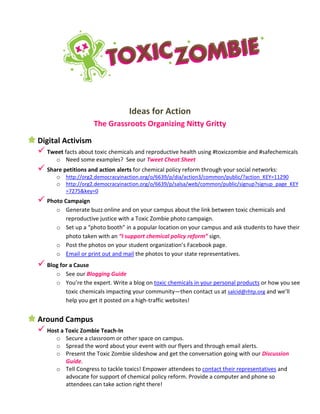
Ideas for Action
The Grassroots Organizing Nitty Gritty
Digital Activism
 Tweet facts about toxic chemicals and reproductive health using #toxiczombie and #safechemicals
o Need some examples? See our Tweet Cheat Sheet
 Share petitions and action alerts for chemical policy reform through your social networks:
o http://org2.democracyinaction.org/o/6639/p/dia/action3/common/public/?action_KEY=11290
o http://org2.democracyinaction.org/o/6639/p/salsa/web/common/public/signup?signup_page_KEY
=7275&key=0
 Photo Campaign
o Generate buzz online and on your campus about the link between toxic chemicals and
reproductive justice with a Toxic Zombie photo campaign.
o Set up a “photo booth” in a popular location on your campus and ask students to have their
photo taken with an “I support chemical policy reform” sign.
o Post the photos on your student organization’s Facebook page.
o Email or print out and mail the photos to your state representatives.
 Blog for a Cause
o See our Blogging Guide
o You’re the expert. Write a blog on toxic chemicals in your personal products or how you see
toxic chemicals impacting your community—then contact us at salcid@rhtp.org and we’ll
help you get it posted on a high-traffic websites!
Around Campus
 Host a Toxic Zombie Teach-In
o Secure a classroom or other space on campus.
o Spread the word about your event with our flyers and through email alerts.
o Present the Toxic Zombie slideshow and get the conversation going with our Discussion
Guide.
o Tell Congress to tackle toxics! Empower attendees to contact their representatives and
advocate for support of chemical policy reform. Provide a computer and phone so
attendees can take action right there!
Wake up to the threat of toxic chemicals! For more information, check us out online
www.rhtp.org/fertility/ToxicZombie.asp
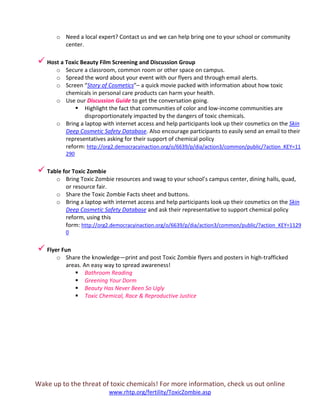
o Need a local expert? Contact us and we can help bring one to your school or community
center.
 Host a Toxic Beauty Film Screening and Discussion Group
o Secure a classroom, common room or other space on campus.
o Spread the word about your event with our flyers and through email alerts.
o Screen “Story of Cosmetics”– a quick movie packed with information about how toxic
chemicals in personal care products can harm your health.
o Use our Discussion Guide to get the conversation going.
 Highlight the fact that communities of color and low-income communities are
disproportionately impacted by the dangers of toxic chemicals.
o Bring a laptop with internet access and help participants look up their cosmetics on the Skin
Deep Cosmetic Safety Database. Also encourage participants to easily send an email to their
representatives asking for their support of chemical policy
reform: http://org2.democracyinaction.org/o/6639/p/dia/action3/common/public/?action_KEY=11
290
 Table for Toxic Zombie
o Bring Toxic Zombie resources and swag to your school’s campus center, dining halls, quad,
or resource fair.
o Share the Toxic Zombie Facts sheet and buttons.
o Bring a laptop with internet access and help participants look up their cosmetics on the Skin
Deep Cosmetic Safety Database and ask their representative to support chemical policy
reform, using this
form: http://org2.democracyinaction.org/o/6639/p/dia/action3/common/public/?action_KEY=1129
0
 Flyer Fun
o Share the knowledge—print and post Toxic Zombie flyers and posters in high-trafficked
areas. An easy way to spread awareness!
 Bathroom Reading
 Greening Your Dorm
 Beauty Has Never Been So Ugly
 Toxic Chemical, Race & Reproductive Justice
Wake up to the threat of toxic chemicals! For more information, check us out online
www.rhtp.org/fertility/ToxicZombie.asp
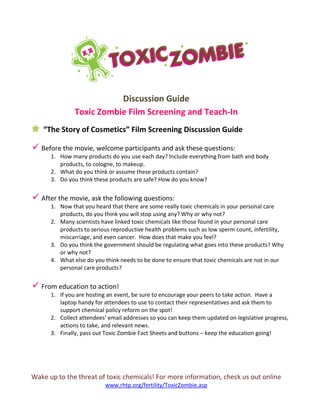
Discussion Guide
Toxic Zombie Film Screening and Teach-In
“The Story of Cosmetics” Film Screening Discussion Guide
 Before the movie, welcome participants and ask these questions:
1. How many products do you use each day? Include everything from bath and body
products, to cologne, to makeup.
2. What do you think or assume these products contain?
3. Do you think these products are safe? How do you know?
 After the movie, ask the following questions:
1. Now that you heard that there are some really toxic chemicals in your personal care
products, do you think you will stop using any? Why or why not?
2. Many scientists have linked toxic chemicals like those found in your personal care
products to serious reproductive health problems such as low sperm count, infertility,
miscarriage, and even cancer. How does that make you feel?
3. Do you think the government should be regulating what goes into these products? Why
or why not?
4. What else do you think needs to be done to ensure that toxic chemicals are not in our
personal care products?
 From education to action!
1. If you are hosting an event, be sure to encourage your peers to take action. Have a
laptop handy for attendees to use to contact their representatives and ask them to
support chemical policy reform on the spot!
2. Collect attendees’ email addresses so you can keep them updated on legislative progress,
actions to take, and relevant news.
3. Finally, pass out Toxic Zombie Fact Sheets and buttons – keep the education going!
Wake up to the threat of toxic chemicals! For more information, check us out online
www.rhtp.org/fertility/ToxicZombie.asp
Teach-In Discussion Guide
 Before the presentation, welcome participants and ask these questions:
1. Do you use any of the following products?:
i. Lipstick
ii. Shampoo
iii. Tupperware
iv. Non-stick pans
v. Cell phone
2. What do you think or assume these products contain?
3. Do you think these products are safe? How do you know?
 After the power point:
1. Now that you heard that there are some really toxic chemicals in products that pretty
much almost everyone uses at least once a day, what changes will you make in your life?
2. Many scientists have linked toxic chemicals like those found in these products to serious
reproductive health problems such as low sperm count, infertility, miscarriage and even
cancer. How does that make you feel?
3. Why do you think chemical companies continue to use toxic ingredients?
4. Do you think the government should be regulating what goes into these products? Why
or why not?
5. What else do you think needs to be done to ensure that our products are safe?
 From education to action!
1. If you are hosting an event, be sure to encourage your peers to take action. Have a
laptop handy for attendees to use to contact their representatives and ask them to
support chemical policy reform on the spot!
2. Collect attendees’ email addresses so you can keep them updated on legislative progress,
actions to take, and relevant news.
3. Finally, pass out Toxic Zombie Fact Sheets and buttons – keep the education going!
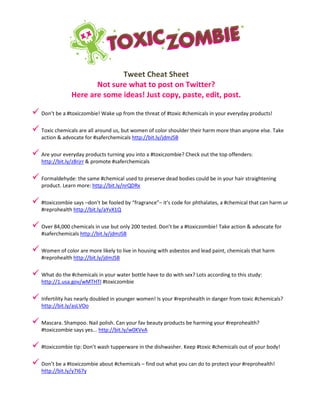
Tweet Cheat Sheet
Not sure what to post on Twitter?
Here are some ideas! Just copy, paste, edit, post.
 Don’t be a #toxiczombie! Wake up from the threat of #toxic #chemicals in your everyday products!
 Toxic chemicals are all around us, but women of color shoulder their harm more than anyone else. Take
action & advocate for #saferchemicals http://bit.ly/jdmJSB
 Are your everyday products turning you into a #toxiczombie? Check out the top offenders:
http://bit.ly/z8rjrr & promote #saferchemicals
 Formaldehyde: the same #chemical used to preserve dead bodies could be in your hair straightening
product. Learn more: http://bit.ly/nrQDRx
 #toxiczombie says –don’t be fooled by “fragrance”– it’s code for phthalates, a #chemical that can harm ur
#reprohealth http://bit.ly/aYvX1Q
 Over 84,000 chemicals in use but only 200 tested. Don’t be a #toxiczombie! Take action & advocate for
#saferchemicals http://bit.ly/jdmJSB
 Women of color are more likely to live in housing with asbestos and lead paint, chemicals that harm
#reprohealth http://bit.ly/jdmJSB
 What do the #chemicals in your water bottle have to do with sex? Lots according to this study:
http://1.usa.gov/wMTHTI #toxiczombie
 Infertility has nearly doubled in younger women! Is your #reprohealth in danger from toxic #chemicals?
http://bit.ly/asLVOo
 Mascara. Shampoo. Nail polish. Can your fav beauty products be harming your #reprohealth?
#toxiczombie says yes... http://bit.ly/w0KVvA
 #toxiczombie tip: Don’t wash tupperware in the dishwasher. Keep #toxic #chemicals out of your body!
 Don’t be a #toxiczombie about #chemicals – find out what you can do to protect your #reprohealth!
http://bit.ly/y7I67y
Wake up to the threat of toxic chemicals! For more information, check us out online
www.rhtp.org/fertility/ToxicZombie.asp
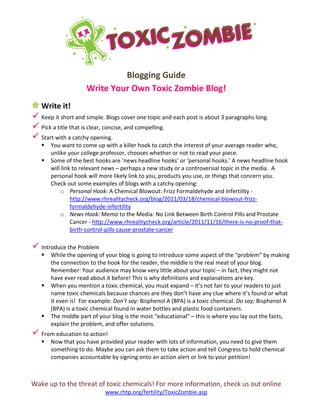
Blogging Guide
Write Your Own Toxic Zombie Blog!
Write it!
 Keep it short and simple. Blogs cover one topic and each post is about 3 paragraphs long.
 Pick a title that is clear, concise, and compelling.
 Start with a catchy opening.
 You want to come up with a killer hook to catch the interest of your average reader who,
unlike your college professor, chooses whether or not to read your piece.
 Some of the best hooks are ‘news headline hooks’ or ‘personal hooks.’ A news headline hook
will link to relevant news – perhaps a new study or a controversial topic in the media. A
personal hook will more likely link to you, products you use, or things that concern you.
Check out some examples of blogs with a catchy opening:
o Personal Hook: A Chemical Blowout: Frizz Formaldehyde and Infertility -
http://www.rhrealitycheck.org/blog/2011/03/18/chemical-blowout-frizz-
formaldehyde-infertility
o News Hook: Memo to the Media: No Link Between Birth Control Pills and Prostate
Cancer - http://www.rhrealitycheck.org/article/2011/11/16/there-is-no-proof-that-
birth-control-pills-cause-prostate-cancer
 Introduce the Problem
 While the opening of your blog is going to introduce some aspect of the “problem” by making
the connection to the hook for the reader, the middle is the real meat of your blog.
Remember: Your audience may know very little about your topic – in fact, they might not
have ever read about it before! This is why definitions and explanations are key.
 When you mention a toxic chemical, you must expand – it’s not fair to your readers to just
name toxic chemicals because chances are they don’t have any clue where it’s found or what
it even is! For example: Don’t say: Bisphenol A (BPA) is a toxic chemical. Do say: Bisphenol A
(BPA) is a toxic chemical found in water bottles and plastic food containers.
 The middle part of your blog is the most “educational” – this is where you lay out the facts,
explain the problem, and offer solutions.
 From education to action!
 Now that you have provided your reader with lots of information, you need to give them
something to do. Maybe you can ask them to take action and tell Congress to hold chemical
companies accountable by signing onto an action alert or link to your petition!
Wake up to the threat of toxic chemicals! For more information, check us out online
www.rhtp.org/fertility/ToxicZombie.asp
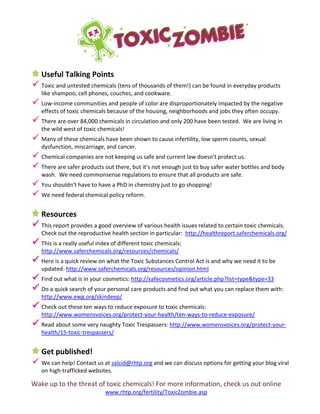
Useful Talking Points
 Toxic and untested chemicals (tens of thousands of them!) can be found in everyday products
like shampoo, cell phones, couches, and cookware.
 Low-income communities and people of color are disproportionately impacted by the negative
effects of toxic chemicals because of the housing, neighborhoods and jobs they often occupy.
 There are over 84,000 chemicals in circulation and only 200 have been tested. We are living in
the wild west of toxic chemicals!
 Many of these chemicals have been shown to cause infertility, low sperm counts, sexual
dysfunction, miscarriage, and cancer.
 Chemical companies are not keeping us safe and current law doesn’t protect us.
 There are safer products out there, but it’s not enough just to buy safer water bottles and body
wash. We need commonsense regulations to ensure that all products are safe.
 You shouldn’t have to have a PhD in chemistry just to go shopping!
 We need federal chemical policy reform.
Resources
 This report provides a good overview of various health issues related to certain toxic chemicals.
Check out the reproductive health section in particular: http://healthreport.saferchemicals.org/
 This is a really useful index of different toxic chemicals:
http://www.saferchemicals.org/resources/chemicals/
 Here is a quick review on what the Toxic Substances Control Act is and why we need it to be
updated: http://www.saferchemicals.org/resources/opinion.html
 Find out what is in your cosmetics: http://safecosmetics.org/article.php?list=type&type=33
 Do a quick search of your personal care products and find out what you can replace them with:
http://www.ewg.org/skindeep/
 Check out these ten ways to reduce exposure to toxic chemicals:
http://www.womensvoices.org/protect-your-health/ten-ways-to-reduce-exposure/
 Read about some very naughty Toxic Trespassers: http://www.womensvoices.org/protect-your-
health/15-toxic-trespassers/
Get published!
 We can help! Contact us at salcid@rhtp.org and we can discuss options for getting your blog viral
on high-trafficked websites.
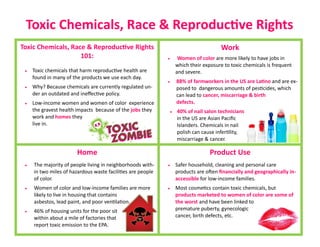
Toxic Chemicals, Race & Reproductive Rights
101:
 Toxic chemicals that harm reproductive health are
found in many of the products we use each day.
 Why? Because chemicals are currently regulated un-
der an outdated and ineffective policy.
 Low-income women and women of color experience
the gravest health impacts because of the jobs they
work and homes they
live in.
Work
 Women of color are more likely to have jobs in
which their exposure to toxic chemicals is frequent
and severe.
 88% of farmworkers in the US are Latino and are ex-
posed to dangerous amounts of pesticides, which
can lead to cancer, miscarriage & birth
defects.
 40% of nail salon technicians
in the US are Asian Pacific
Islanders. Chemicals in nail
polish can cause infertility,
miscarriage & cancer.
Home
 The majority of people living in neighborhoods with-
in two miles of hazardous waste facilities are people
of color.
 Women of color and low-income families are more
likely to live in housing that contains
asbestos, lead paint, and poor ventilation.
 46% of housing units for the poor sit
within about a mile of factories that
report toxic emission to the EPA.
Product Use
 Safer household, cleaning and personal care
products are often financially and geographically in-
accessible for low-income families.
 Most cosmetics contain toxic chemicals, but
products marketed to women of color are some of
the worst and have been linked to
premature puberty, gynecologic
cancer, birth defects, etc.
Toxic Chemicals, Race & Reproductive Rights
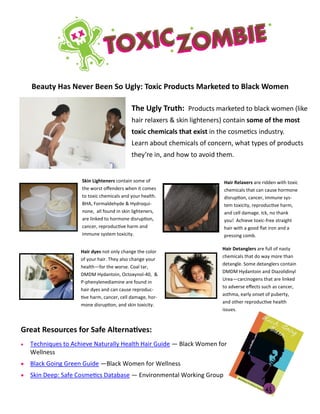
Beauty Has Never Been So Ugly: Toxic Products Marketed to Black Women
The Ugly Truth: Products marketed to black women (like
hair relaxers & skin lighteners) contain some of the most
toxic chemicals that exist in the cosmetics industry.
Learn about chemicals of concern, what types of products
they’re in, and how to avoid them.
Great Resources for Safe Alternatives:
 Techniques to Achieve Naturally Health Hair Guide — Black Women for
Wellness
 Black Going Green Guide —Black Women for Wellness
 Skin Deep: Safe Cosmetics Database — Environmental Working Group
Skin Lighteners contain some of
the worst offenders when it comes
to toxic chemicals and your health.
BHA, Formaldehyde & Hydroqui-
none, all found in skin lighteners,
are linked to hormone disruption,
cancer, reproductive harm and
immune system toxicity.
Hair Relaxers are ridden with toxic
chemicals that can cause hormone
disruption, cancer, immune sys-
tem toxicity, reproductive harm,
and cell damage. Ick, no thank
you! Achieve toxic-free straight
hair with a good flat iron and a
pressing comb.
Hair dyes not only change the color
of your hair. They also change your
health—for the worse. Coal tar,
DMDM Hydantoin, Octoxynol-40, &
P-phenylenediamine are found in
hair dyes and can cause reproduc-
tive harm, cancer, cell damage, hor-
mone disruption, and skin toxicity.
Hair Detanglers are full of nasty
chemicals that do way more than
detangle. Some detanglers contain
DMDM Hydantoin and Diazolidinyl
Urea—carcinogens that are linked
to adverse effects such as cancer,
asthma, early onset of puberty,
and other reproductive health
issues.
For more information, check us out online www.rhtp.org/fertility/ToxicZombie.asp
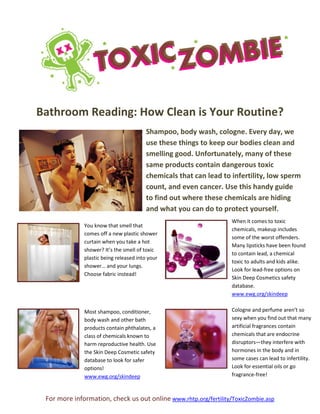
Bathroom Reading: How Clean is Your Routine?
Shampoo, body wash, cologne. Every day, we
use these things to keep our bodies clean and
smelling good. Unfortunately, many of these
same products contain dangerous toxic
chemicals that can lead to infertility, low sperm
count, and even cancer. Use this handy guide
to find out where these chemicals are hiding
and what you can do to protect yourself.
You know that smell that
comes off a new plastic shower
curtain when you take a hot
shower? It’s the smell of toxic
plastic being released into your
shower… and your lungs.
Choose fabric instead!
Most shampoo, conditioner,
body wash and other bath
products contain phthalates, a
class of chemicals known to
harm reproductive health. Use
the Skin Deep Cosmetic safety
database to look for safer
options!
www.ewg.org/skindeep
When it comes to toxic
chemicals, makeup includes
some of the worst offenders.
Many lipsticks have been found
to contain lead, a chemical
toxic to adults and kids alike.
Look for lead-free options on
Skin Deep Cosmetics safety
database.
www.ewg.org/skindeep
Cologne and perfume aren’t so
sexy when you find out that many
artificial fragrances contain
chemicals that are endocrine
disruptors—they interfere with
hormones in the body and in
some cases can lead to infertility.
Look for essential oils or go
fragrance-free!
For more information, check us out online www.rhtp.org/fertility/ToxicZombie.asp
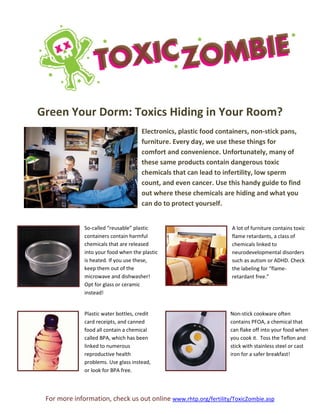
Green Your Dorm: Toxics Hiding in Your Room?
Electronics, plastic food containers, non-stick pans,
furniture. Every day, we use these things for
comfort and convenience. Unfortunately, many of
these same products contain dangerous toxic
chemicals that can lead to infertility, low sperm
count, and even cancer. Use this handy guide to find
out where these chemicals are hiding and what you
can do to protect yourself.
So-called “reusable” plastic
containers contain harmful
chemicals that are released
into your food when the plastic
is heated. If you use these,
keep them out of the
microwave and dishwasher!
Opt for glass or ceramic
instead!
Plastic water bottles, credit
card receipts, and canned
food all contain a chemical
called BPA, which has been
linked to numerous
reproductive health
problems. Use glass instead,
or look for BPA free.
A lot of furniture contains toxic
flame retardants, a class of
chemicals linked to
neurodevelopmental disorders
such as autism or ADHD. Check
the labeling for “flame-
retardant free.”
Non-stick cookware often
contains PFOA, a chemical that
can flake off into your food when
you cook it. Toss the Teflon and
stick with stainless steel or cast
iron for a safer breakfast!
BPA in water bottles? Toxic Teflon? Lead in
lipstick?!? What other nasty chemicals lurk in
your favorite products?
Join us for a teach-in, sponsored by the Toxic Zombie
campaign. Learn how you can de-toxify your life, take
on the chemical companies, and work for change.
DATE & TIME:
LOCATION:
HOSTED BY:
FOR MORE INFO:
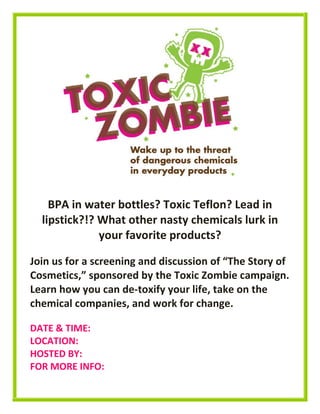
BPA in water bottles? Toxic Teflon? Lead in
lipstick?!? What other nasty chemicals lurk in
your favorite products?
Join us for a screening and discussion of “The Story of
Cosmetics,” sponsored by the Toxic Zombie campaign.
Learn how you can de-toxify your life, take on the
chemical companies, and work for change.
DATE & TIME:
LOCATION:
HOSTED BY:
FOR MORE INFO:
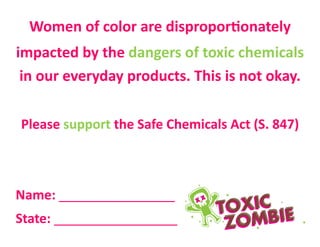
Women of color are disproportionately
impacted by the dangers of toxic chemicals
in our everyday products. This is not okay.
Please support the Safe Chemicals Act (S. 847)
Name: ________________
State: _________________
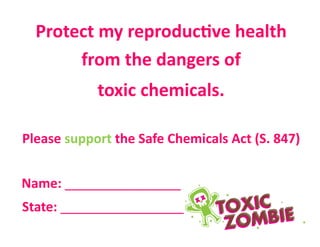
Protect my reproductive health
from the dangers of
toxic chemicals.
Please support the Safe Chemicals Act (S. 847)
Name: ________________
State: _________________
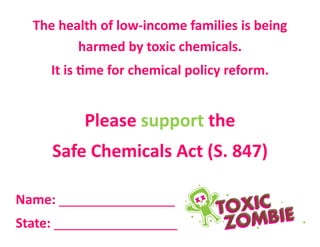
The health of low-income families is being
harmed by toxic chemicals.
It is time for chemical policy reform.
Please support the
Safe Chemicals Act (S. 847)
Name: ________________
State: _________________
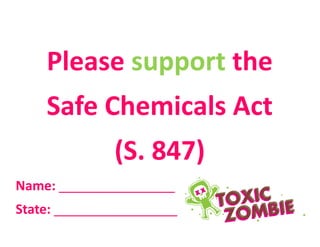
Please support the
Safe Chemicals Act
(S. 847)
Name: ________________
State: _________________

Toxic Zombie - Toxic Chemicals & Reproductive Justice

  • 1.
    Wake up tothe threat of toxic chemicals! For more information, check us out online www.rhtp.org/fertility/ToxicZombie.asp Campaign-at-a-Glance Why You Should Get Hitched with the Toxic Zombie Campaign: Toxic Chemicals & Reproductive Justice Who is the Reproductive Health Technologies Project (RHTP)?  RHTP is a national nonprofit located in Washington DC working to enable each woman to have access to the safest, most effective, appropriate and acceptable technologies for ensuring her own health and controlling her fertility. Why does a reproductive health and rights organization like RHTP care about toxic chemicals?  It’s simple. RHTP cares about women’s health and we value each woman’s reproductive decision- making. When we hear about scientific evidence linking chemicals to infertility, miscarriage, low sperm count and birth defects, we have to act, right? Right. What the heck is this Toxic Zombie campaign?  We have to do something about toxics…now. The Toxic Zombie campaign is an easy way to help spread the word and inspire you (and campus!) to take action. And guess what? This toolkit has it all – the education and the action. You supply the fun and energy. Why should you take action on this issue now?  We are closer than ever to seeing chemical policy reform in the United States become a reality. Make sure the policy makers in Washington hear your voice, loud and clear. This toolkit will help you do just that…and have a blast along the way!  This is also a matter of justice—reproductive and racial justice. The negative impact that toxic chemicals have on women’s reproductive health is disproportionately felt by low-income women and women of color. They are more likely to be directly exposed to toxic chemicals at work, at home and through the consumer products they can afford. Take action and advocate for what’s right: regulated chemical production and the protection of all Americans against the harms of toxic chemicals. How do you get started?  Call or email Sara Alcid at 202.530.4401 or salcid@rhtp.org to talk about which toolkit options are best for you and get your hook up to some cool Toxic Zombie buttons!
  • 2.
    Your Very OwnCrash Course Toxic Chemicals, Race & Reproductive Justice 101 What do toxic chemicals have to do with race & reproductive justice?  Toxic chemicals that harm reproductive health are found in many of the products we use every day, from plastic bottles and bath products to fashionable patent leather purses and blue jeans. However, the harm caused by these toxic products is not shared equally—women of color and low-income communities bear an unfair burden.  Although seemingly unrelated at first glance, toxic chemicals, race and reproductive justice intersect a great deal. Here’s the skinny:  It is estimated that between 80,000 and 85,000 chemicals in commerce today, but only 200 have been tested for safety.  Of the chemicals that have been tested, they were tested for their health impacts on adult males in industrial work settings. Wait a minute, aren’t women exposed too?  The chemical exposure routes and health impacts on women are different and have been largely ignored until recently.  But not every woman is equally exposed. Women of color and low- income women have greater exposure to a range of toxic chemicals and are also less likely to have access to health care to address health problems that may be caused by exposure to toxic chemicals. Why are low-income communities and communities of color at a greater risk of harm from toxic chemicals?  Three words: Work, Home and the Store.
  • 3.
     Work: Womenof color are disproportionately represented in professions where workplace exposure to toxic chemicals is frequent and severe.  88% of farmworkers in the United States are Latino. Farmworkers and their families are exposed to pesticides while they work, through the air they breathe, the water they drink, and the food they eat. Pesticide exposure can lead to cancer, miscarriage and birth defects.  40% of nail salon technicians in the United States are Asian Pacific Islanders. Toxic chemicals found in nail polishes and nail polish removers are linked to reproductive health issues such as infertility, miscarriage and cancer.  A majority of domestic and hospitality workers are women of color and immigrant women. In these industries, workers are regularly exposed to industrial strength cleaning supplies with known impacts on reproductive health.  Home: Women of color and low-income families are more likely to live in neighborhoods with polluted air and water and more likely to live in housing that contains asbestos, lead paint, allergens, and poor ventilation.  A majority (56%) of people living in neighborhoods within a two mile radius of hazardous waste facilities are people of color.  46% of housing units for the low-income families sit within about a mile of factories that report toxic emission to the Environmental Protection Agency.  The Store & Product Consumption: For low-income women, limiting their own and their family’s exposure to toxic chemicals through buying “greener” products is not always an option.  Low-income communities and communities where people of color live have fewer supermarkets, leaving families with fewer choices when it comes to buying non-toxic products or healthy, natural foods.  Many cosmetics marketed to women of color contain toxic chemicals. For example, the chemicals found in common African-American hair products are known endocrine-disrupting chemicals (EDCs). EDCs are linked to a range of reproductive health issues, like premature puberty, gynecologic cancer, and birth defects.
  • 4.
     What’s more,because the law that regulates chemicals is outdated and ineffective, companies do not have to disclose what is in their products. This means many women are not even given the information to make healthy and informed choices about what they use. What can be done about this?  Policy Change: The law that currently “regulates” chemicals, the Toxic Substances Control Act (TSCA), has not been updated in almost 40 years and does little to help protect the public’s health from toxic chemicals and even less to protect communities of color and low-income communities. The Safe Chemicals Act, a bill that would put common sense limits on toxic chemicals and better protect low income communities and communities of color, made it through committee and awaits action on the floor of the Senate. Stay updated on the status of the bill and learn about action you can take here.  Education: It is important to educate consumers. Educated consumers hold the power – they can decide what companies to buy from. Did you know that Johnson & Johnson recently announced plans to eliminate some of the worst toxic offenders in their products because of consumer pressure?  Take Action: Advocate for chemical policy reform, alongside educating your peers and community on campus about the unjust reality of how low-income communities and communities of color are exposed to toxic chemicals. Needs to ideas for how to advocate for change? Check out the Toxic Zombie toolkit or contact Sara Alcid at salcid@rhtp.org. -
  • 5.
    Further Reading: Want tolearn more about toxic chemicals, race & reproductive justice? Look no further…  “Women of Color are at Greater Risk for Toxic Chemical Exposure”—Women’s Voices for the Earth: http://www.womensvoices.org/about/why-a-womens-organization/  “Not So Pretty: Toxic Products Marketed to Black Women”—The Campaign for Safe Cosmetics: http://safecosmetics.org/downloads/SafeCosmetics_BlackWomen_brochure.pdf  “Reproductive Roulette: Declining Reproductive Health, Dangerous Chemicals, and a New Way Forward”—Center for American Progress: http://www.americanprogress.org/wp-content/uploads/issues/2009/07/pdf/reproductive_roulette.pdf  “In Whose Backyard: Chemical Toxins, Reproductive Health, and Communities of Color”—Center for American Progress: http://www.americanprogress.org/issues/race/news/2010/04/27/7573/in-whose-backyard/  “Fact Sheet: Dangerous Chemicals and Declining Reproductive Health”—Center for American Progress: http://www.americanprogress.org/issues/women/news/2009/07/21/6376/fact-sheet-dangerous- chemicals-and-declining-reproductive-health/  “Toxic Combination: Fact Sheet on Toxic Chemicals and Reproductive Health”— Center for American Progress: http://www.americanprogress.org/wp- content/uploads/issues/2010/04/pdf/toxic_combination.pdf  “232 Toxic Chemicals in 10 Minority Babies”—Environmental Working Group: http://www.ewg.org/minoritycordblood/home  “Chemical Policy Reform”—Physicians for Social Responsibility: http://www.psr- la.org/issues/environmental-health/chemical-policy-reform/  “How Toxic is Black Hair Care”—New America Media: http://newamericamedia.org/2012/02/skin-deep-in-more-ways-than-one.php  “Toxic Wastes and Race at Twenty: 1987-2007”—United Church of Christ Justice and Witness Ministries: http://www.ejnet.org/ej/twart.pdf
  • 6.
    Ideas for Action TheGrassroots Organizing Nitty Gritty Digital Activism  Tweet facts about toxic chemicals and reproductive health using #toxiczombie and #safechemicals o Need some examples? See our Tweet Cheat Sheet  Share petitions and action alerts for chemical policy reform through your social networks: o http://org2.democracyinaction.org/o/6639/p/dia/action3/common/public/?action_KEY=11290 o http://org2.democracyinaction.org/o/6639/p/salsa/web/common/public/signup?signup_page_KEY =7275&key=0  Photo Campaign o Generate buzz online and on your campus about the link between toxic chemicals and reproductive justice with a Toxic Zombie photo campaign. o Set up a “photo booth” in a popular location on your campus and ask students to have their photo taken with an “I support chemical policy reform” sign. o Post the photos on your student organization’s Facebook page. o Email or print out and mail the photos to your state representatives.  Blog for a Cause o See our Blogging Guide o You’re the expert. Write a blog on toxic chemicals in your personal products or how you see toxic chemicals impacting your community—then contact us at salcid@rhtp.org and we’ll help you get it posted on a high-traffic websites! Around Campus  Host a Toxic Zombie Teach-In o Secure a classroom or other space on campus. o Spread the word about your event with our flyers and through email alerts. o Present the Toxic Zombie slideshow and get the conversation going with our Discussion Guide. o Tell Congress to tackle toxics! Empower attendees to contact their representatives and advocate for support of chemical policy reform. Provide a computer and phone so attendees can take action right there!
  • 7.
    Wake up tothe threat of toxic chemicals! For more information, check us out online www.rhtp.org/fertility/ToxicZombie.asp o Need a local expert? Contact us and we can help bring one to your school or community center.  Host a Toxic Beauty Film Screening and Discussion Group o Secure a classroom, common room or other space on campus. o Spread the word about your event with our flyers and through email alerts. o Screen “Story of Cosmetics”– a quick movie packed with information about how toxic chemicals in personal care products can harm your health. o Use our Discussion Guide to get the conversation going.  Highlight the fact that communities of color and low-income communities are disproportionately impacted by the dangers of toxic chemicals. o Bring a laptop with internet access and help participants look up their cosmetics on the Skin Deep Cosmetic Safety Database. Also encourage participants to easily send an email to their representatives asking for their support of chemical policy reform: http://org2.democracyinaction.org/o/6639/p/dia/action3/common/public/?action_KEY=11 290  Table for Toxic Zombie o Bring Toxic Zombie resources and swag to your school’s campus center, dining halls, quad, or resource fair. o Share the Toxic Zombie Facts sheet and buttons. o Bring a laptop with internet access and help participants look up their cosmetics on the Skin Deep Cosmetic Safety Database and ask their representative to support chemical policy reform, using this form: http://org2.democracyinaction.org/o/6639/p/dia/action3/common/public/?action_KEY=1129 0  Flyer Fun o Share the knowledge—print and post Toxic Zombie flyers and posters in high-trafficked areas. An easy way to spread awareness!  Bathroom Reading  Greening Your Dorm  Beauty Has Never Been So Ugly  Toxic Chemical, Race & Reproductive Justice
  • 8.
    Wake up tothe threat of toxic chemicals! For more information, check us out online www.rhtp.org/fertility/ToxicZombie.asp Discussion Guide Toxic Zombie Film Screening and Teach-In “The Story of Cosmetics” Film Screening Discussion Guide  Before the movie, welcome participants and ask these questions: 1. How many products do you use each day? Include everything from bath and body products, to cologne, to makeup. 2. What do you think or assume these products contain? 3. Do you think these products are safe? How do you know?  After the movie, ask the following questions: 1. Now that you heard that there are some really toxic chemicals in your personal care products, do you think you will stop using any? Why or why not? 2. Many scientists have linked toxic chemicals like those found in your personal care products to serious reproductive health problems such as low sperm count, infertility, miscarriage, and even cancer. How does that make you feel? 3. Do you think the government should be regulating what goes into these products? Why or why not? 4. What else do you think needs to be done to ensure that toxic chemicals are not in our personal care products?  From education to action! 1. If you are hosting an event, be sure to encourage your peers to take action. Have a laptop handy for attendees to use to contact their representatives and ask them to support chemical policy reform on the spot! 2. Collect attendees’ email addresses so you can keep them updated on legislative progress, actions to take, and relevant news. 3. Finally, pass out Toxic Zombie Fact Sheets and buttons – keep the education going!
  • 9.
    Wake up tothe threat of toxic chemicals! For more information, check us out online www.rhtp.org/fertility/ToxicZombie.asp Teach-In Discussion Guide  Before the presentation, welcome participants and ask these questions: 1. Do you use any of the following products?: i. Lipstick ii. Shampoo iii. Tupperware iv. Non-stick pans v. Cell phone 2. What do you think or assume these products contain? 3. Do you think these products are safe? How do you know?  After the power point: 1. Now that you heard that there are some really toxic chemicals in products that pretty much almost everyone uses at least once a day, what changes will you make in your life? 2. Many scientists have linked toxic chemicals like those found in these products to serious reproductive health problems such as low sperm count, infertility, miscarriage and even cancer. How does that make you feel? 3. Why do you think chemical companies continue to use toxic ingredients? 4. Do you think the government should be regulating what goes into these products? Why or why not? 5. What else do you think needs to be done to ensure that our products are safe?  From education to action! 1. If you are hosting an event, be sure to encourage your peers to take action. Have a laptop handy for attendees to use to contact their representatives and ask them to support chemical policy reform on the spot! 2. Collect attendees’ email addresses so you can keep them updated on legislative progress, actions to take, and relevant news. 3. Finally, pass out Toxic Zombie Fact Sheets and buttons – keep the education going!
  • 10.
    Tweet Cheat Sheet Notsure what to post on Twitter? Here are some ideas! Just copy, paste, edit, post.  Don’t be a #toxiczombie! Wake up from the threat of #toxic #chemicals in your everyday products!  Toxic chemicals are all around us, but women of color shoulder their harm more than anyone else. Take action & advocate for #saferchemicals http://bit.ly/jdmJSB  Are your everyday products turning you into a #toxiczombie? Check out the top offenders: http://bit.ly/z8rjrr & promote #saferchemicals  Formaldehyde: the same #chemical used to preserve dead bodies could be in your hair straightening product. Learn more: http://bit.ly/nrQDRx  #toxiczombie says –don’t be fooled by “fragrance”– it’s code for phthalates, a #chemical that can harm ur #reprohealth http://bit.ly/aYvX1Q  Over 84,000 chemicals in use but only 200 tested. Don’t be a #toxiczombie! Take action & advocate for #saferchemicals http://bit.ly/jdmJSB  Women of color are more likely to live in housing with asbestos and lead paint, chemicals that harm #reprohealth http://bit.ly/jdmJSB  What do the #chemicals in your water bottle have to do with sex? Lots according to this study: http://1.usa.gov/wMTHTI #toxiczombie  Infertility has nearly doubled in younger women! Is your #reprohealth in danger from toxic #chemicals? http://bit.ly/asLVOo  Mascara. Shampoo. Nail polish. Can your fav beauty products be harming your #reprohealth? #toxiczombie says yes... http://bit.ly/w0KVvA  #toxiczombie tip: Don’t wash tupperware in the dishwasher. Keep #toxic #chemicals out of your body!  Don’t be a #toxiczombie about #chemicals – find out what you can do to protect your #reprohealth! http://bit.ly/y7I67y
  • 11.
    Wake up tothe threat of toxic chemicals! For more information, check us out online www.rhtp.org/fertility/ToxicZombie.asp Blogging Guide Write Your Own Toxic Zombie Blog! Write it!  Keep it short and simple. Blogs cover one topic and each post is about 3 paragraphs long.  Pick a title that is clear, concise, and compelling.  Start with a catchy opening.  You want to come up with a killer hook to catch the interest of your average reader who, unlike your college professor, chooses whether or not to read your piece.  Some of the best hooks are ‘news headline hooks’ or ‘personal hooks.’ A news headline hook will link to relevant news – perhaps a new study or a controversial topic in the media. A personal hook will more likely link to you, products you use, or things that concern you. Check out some examples of blogs with a catchy opening: o Personal Hook: A Chemical Blowout: Frizz Formaldehyde and Infertility - http://www.rhrealitycheck.org/blog/2011/03/18/chemical-blowout-frizz- formaldehyde-infertility o News Hook: Memo to the Media: No Link Between Birth Control Pills and Prostate Cancer - http://www.rhrealitycheck.org/article/2011/11/16/there-is-no-proof-that- birth-control-pills-cause-prostate-cancer  Introduce the Problem  While the opening of your blog is going to introduce some aspect of the “problem” by making the connection to the hook for the reader, the middle is the real meat of your blog. Remember: Your audience may know very little about your topic – in fact, they might not have ever read about it before! This is why definitions and explanations are key.  When you mention a toxic chemical, you must expand – it’s not fair to your readers to just name toxic chemicals because chances are they don’t have any clue where it’s found or what it even is! For example: Don’t say: Bisphenol A (BPA) is a toxic chemical. Do say: Bisphenol A (BPA) is a toxic chemical found in water bottles and plastic food containers.  The middle part of your blog is the most “educational” – this is where you lay out the facts, explain the problem, and offer solutions.  From education to action!  Now that you have provided your reader with lots of information, you need to give them something to do. Maybe you can ask them to take action and tell Congress to hold chemical companies accountable by signing onto an action alert or link to your petition!
  • 12.
    Wake up tothe threat of toxic chemicals! For more information, check us out online www.rhtp.org/fertility/ToxicZombie.asp Useful Talking Points  Toxic and untested chemicals (tens of thousands of them!) can be found in everyday products like shampoo, cell phones, couches, and cookware.  Low-income communities and people of color are disproportionately impacted by the negative effects of toxic chemicals because of the housing, neighborhoods and jobs they often occupy.  There are over 84,000 chemicals in circulation and only 200 have been tested. We are living in the wild west of toxic chemicals!  Many of these chemicals have been shown to cause infertility, low sperm counts, sexual dysfunction, miscarriage, and cancer.  Chemical companies are not keeping us safe and current law doesn’t protect us.  There are safer products out there, but it’s not enough just to buy safer water bottles and body wash. We need commonsense regulations to ensure that all products are safe.  You shouldn’t have to have a PhD in chemistry just to go shopping!  We need federal chemical policy reform. Resources  This report provides a good overview of various health issues related to certain toxic chemicals. Check out the reproductive health section in particular: http://healthreport.saferchemicals.org/  This is a really useful index of different toxic chemicals: http://www.saferchemicals.org/resources/chemicals/  Here is a quick review on what the Toxic Substances Control Act is and why we need it to be updated: http://www.saferchemicals.org/resources/opinion.html  Find out what is in your cosmetics: http://safecosmetics.org/article.php?list=type&type=33  Do a quick search of your personal care products and find out what you can replace them with: http://www.ewg.org/skindeep/  Check out these ten ways to reduce exposure to toxic chemicals: http://www.womensvoices.org/protect-your-health/ten-ways-to-reduce-exposure/  Read about some very naughty Toxic Trespassers: http://www.womensvoices.org/protect-your- health/15-toxic-trespassers/ Get published!  We can help! Contact us at salcid@rhtp.org and we can discuss options for getting your blog viral on high-trafficked websites.
  • 13.
    Toxic Chemicals, Race& Reproductive Rights 101:  Toxic chemicals that harm reproductive health are found in many of the products we use each day.  Why? Because chemicals are currently regulated un- der an outdated and ineffective policy.  Low-income women and women of color experience the gravest health impacts because of the jobs they work and homes they live in. Work  Women of color are more likely to have jobs in which their exposure to toxic chemicals is frequent and severe.  88% of farmworkers in the US are Latino and are ex- posed to dangerous amounts of pesticides, which can lead to cancer, miscarriage & birth defects.  40% of nail salon technicians in the US are Asian Pacific Islanders. Chemicals in nail polish can cause infertility, miscarriage & cancer. Home  The majority of people living in neighborhoods with- in two miles of hazardous waste facilities are people of color.  Women of color and low-income families are more likely to live in housing that contains asbestos, lead paint, and poor ventilation.  46% of housing units for the poor sit within about a mile of factories that report toxic emission to the EPA. Product Use  Safer household, cleaning and personal care products are often financially and geographically in- accessible for low-income families.  Most cosmetics contain toxic chemicals, but products marketed to women of color are some of the worst and have been linked to premature puberty, gynecologic cancer, birth defects, etc. Toxic Chemicals, Race & Reproductive Rights
  • 14.
    Beauty Has NeverBeen So Ugly: Toxic Products Marketed to Black Women The Ugly Truth: Products marketed to black women (like hair relaxers & skin lighteners) contain some of the most toxic chemicals that exist in the cosmetics industry. Learn about chemicals of concern, what types of products they’re in, and how to avoid them. Great Resources for Safe Alternatives:  Techniques to Achieve Naturally Health Hair Guide — Black Women for Wellness  Black Going Green Guide —Black Women for Wellness  Skin Deep: Safe Cosmetics Database — Environmental Working Group Skin Lighteners contain some of the worst offenders when it comes to toxic chemicals and your health. BHA, Formaldehyde & Hydroqui- none, all found in skin lighteners, are linked to hormone disruption, cancer, reproductive harm and immune system toxicity. Hair Relaxers are ridden with toxic chemicals that can cause hormone disruption, cancer, immune sys- tem toxicity, reproductive harm, and cell damage. Ick, no thank you! Achieve toxic-free straight hair with a good flat iron and a pressing comb. Hair dyes not only change the color of your hair. They also change your health—for the worse. Coal tar, DMDM Hydantoin, Octoxynol-40, & P-phenylenediamine are found in hair dyes and can cause reproduc- tive harm, cancer, cell damage, hor- mone disruption, and skin toxicity. Hair Detanglers are full of nasty chemicals that do way more than detangle. Some detanglers contain DMDM Hydantoin and Diazolidinyl Urea—carcinogens that are linked to adverse effects such as cancer, asthma, early onset of puberty, and other reproductive health issues.
  • 15.
    For more information,check us out online www.rhtp.org/fertility/ToxicZombie.asp Bathroom Reading: How Clean is Your Routine? Shampoo, body wash, cologne. Every day, we use these things to keep our bodies clean and smelling good. Unfortunately, many of these same products contain dangerous toxic chemicals that can lead to infertility, low sperm count, and even cancer. Use this handy guide to find out where these chemicals are hiding and what you can do to protect yourself. You know that smell that comes off a new plastic shower curtain when you take a hot shower? It’s the smell of toxic plastic being released into your shower… and your lungs. Choose fabric instead! Most shampoo, conditioner, body wash and other bath products contain phthalates, a class of chemicals known to harm reproductive health. Use the Skin Deep Cosmetic safety database to look for safer options! www.ewg.org/skindeep When it comes to toxic chemicals, makeup includes some of the worst offenders. Many lipsticks have been found to contain lead, a chemical toxic to adults and kids alike. Look for lead-free options on Skin Deep Cosmetics safety database. www.ewg.org/skindeep Cologne and perfume aren’t so sexy when you find out that many artificial fragrances contain chemicals that are endocrine disruptors—they interfere with hormones in the body and in some cases can lead to infertility. Look for essential oils or go fragrance-free!
  • 16.
    For more information,check us out online www.rhtp.org/fertility/ToxicZombie.asp Green Your Dorm: Toxics Hiding in Your Room? Electronics, plastic food containers, non-stick pans, furniture. Every day, we use these things for comfort and convenience. Unfortunately, many of these same products contain dangerous toxic chemicals that can lead to infertility, low sperm count, and even cancer. Use this handy guide to find out where these chemicals are hiding and what you can do to protect yourself. So-called “reusable” plastic containers contain harmful chemicals that are released into your food when the plastic is heated. If you use these, keep them out of the microwave and dishwasher! Opt for glass or ceramic instead! Plastic water bottles, credit card receipts, and canned food all contain a chemical called BPA, which has been linked to numerous reproductive health problems. Use glass instead, or look for BPA free. A lot of furniture contains toxic flame retardants, a class of chemicals linked to neurodevelopmental disorders such as autism or ADHD. Check the labeling for “flame- retardant free.” Non-stick cookware often contains PFOA, a chemical that can flake off into your food when you cook it. Toss the Teflon and stick with stainless steel or cast iron for a safer breakfast!
  • 17.
    BPA in waterbottles? Toxic Teflon? Lead in lipstick?!? What other nasty chemicals lurk in your favorite products? Join us for a teach-in, sponsored by the Toxic Zombie campaign. Learn how you can de-toxify your life, take on the chemical companies, and work for change. DATE & TIME: LOCATION: HOSTED BY: FOR MORE INFO:
  • 18.
    BPA in waterbottles? Toxic Teflon? Lead in lipstick?!? What other nasty chemicals lurk in your favorite products? Join us for a screening and discussion of “The Story of Cosmetics,” sponsored by the Toxic Zombie campaign. Learn how you can de-toxify your life, take on the chemical companies, and work for change. DATE & TIME: LOCATION: HOSTED BY: FOR MORE INFO:
  • 19.
    Women of colorare disproportionately impacted by the dangers of toxic chemicals in our everyday products. This is not okay. Please support the Safe Chemicals Act (S. 847) Name: ________________ State: _________________
  • 20.
    Protect my reproductivehealth from the dangers of toxic chemicals. Please support the Safe Chemicals Act (S. 847) Name: ________________ State: _________________
  • 21.
    The health oflow-income families is being harmed by toxic chemicals. It is time for chemical policy reform. Please support the Safe Chemicals Act (S. 847) Name: ________________ State: _________________
  • 22.
    Please support the SafeChemicals Act (S. 847) Name: ________________ State: _________________