YOUR RIGHTS AT WORK
A School of Labour Workshop
                  Maureen Hynes
             416 415 5000 x 2549
         mhynes@georgebrown.ca
Outcomes
(1)   Explain your basic rights in the workplace

(2) Take action if workplace law is broken –
    what to do, where to go, who to call, what
    risks are involved

(3) Analyze the differences between unionized
    and non-unionized workplaces
100 years ago, we didn’t
have….
    Laws that cover hours and minimum wages
    Laws that protect children from working full-time
    More equity in men’s and women’s wages
    Health and Safety legislation
    Unemployment Insurance
    Pensions
    Health insurance (OHIP) since 1966
    Workers’ Compensation since 1917
    Social Assistance
    Unions!
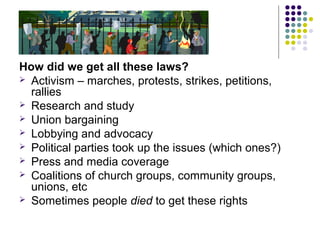
How did we get all these laws?
 Activism – marches, protests, strikes, petitions,
  rallies
 Research and study
 Union bargaining
 Lobbying and advocacy
 Political parties took up the issues (which ones?)
 Press and media coverage
 Coalitions of church groups, community groups,
  unions, etc
 Sometimes people died to get these rights
Similarities: then and now
 Situation of children globally – where is child
  labour still an issue? And why?
 Situation of immigrant workers in Canada –
  “desperate for work, dared not complain,
  would be quickly replaced”
 A systemic problem that doesn’t seem to get
  better – perhaps even for the second
  generation (Stats Can, 2006)
Laws that protect us
   Ontario Human Rights Code: no discrimination on the basis of sex,
    race, religion, sexual orientation, country of origin, disability, etc
   Employment Standards Act: covers minimum wages, hours of work,
    overtime, vacations and holidays, termination, etc
   Occupational Health & Safety Act: gives you the right to know
    about workplace hazards; to participate in decisions about hazards
    (through committees, representatives, safety inspections); and to
    refuse unsafe work
   Workplace Safety & Insurance Act: provides you with insurance
    payments in case of an occupational accident or injury, and some
    access to retraining, under conditions
   Ontario Labour Relations Act: protects workers who want to organize
    or participate in a union; covers how collective agreements must work;
    covers when strikes or lockouts can take place; restricts employers from
    unfair labour practices; makes unions represent their workers fairly)
   Pay Equity Act: ensures people in jobs requiring the same effort, skill,
    responsibilities, and conditions are paid the same
Employment Standards Act
   Minimum wage in Ontario
   Hours of work
   Overtime pay
   Meal breaks
   Public Holidays
   Vacations
   Pregnancy leave
   Parental leave
   Pay information and record keeping
   Termination of employment
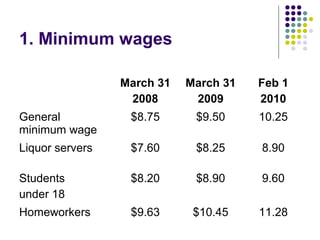
1. Minimum wages

                 March 31   March 31   Feb 1
                  2008       2009      2010
General           $8.75      $9.50     10.25
minimum wage
Liquor servers    $7.60      $8.25     8.90

Students          $8.20      $8.90     9.60
under 18
Homeworkers       $9.63      $10.45    11.28
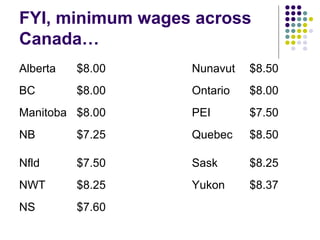
FYI, minimum wages across
Canada…
Alberta   $8.00   Nunavut   $8.50
BC        $8.00   Ontario   $8.00
Manitoba $8.00    PEI       $7.50
NB        $7.25   Quebec    $8.50

Nfld      $7.50   Sask      $8.25
NWT       $8.25   Yukon     $8.37
NS        $7.60
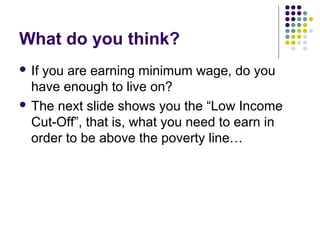
What do you think?
 Ifyou are earning minimum wage, do you
  have enough to live on?
 The next slide shows you the “Low Income
  Cut-Off”, that is, what you need to earn in
  order to be above the poverty line…
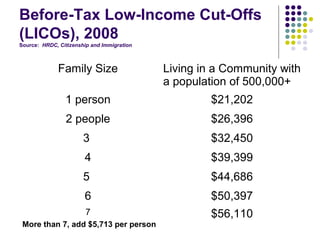
Before-Tax Low-Income Cut-Offs
(LICOs), 2008
Source: HRDC, Citizenship and Immigration


              Family Size                   Living in a Community with
                                            a population of 500,000+
                1 person                             $21,202
                2 people                             $26,396
                       3                             $32,450
                       4                             $39,399
                       5                             $44,686
                       6                             $50,397
                        7                            $56,110
 More than 7, add $5,713 per person
2. Hours of work
   Your employer cannot require you to
    work more than 8 hours in a day
    UNLESS the employer has set a
    longer work week; and in the case of
    accidents & emergencies.

   Not more than 48 hours a week
    UNLESS you give the employer
    permission in writing to work up to 60
    hours a week.

   You have to be free from work:
     11 consecutive hours a day
     8 hours between shifts
     24 consecutive hours a week, or
       48 hours in 2 weeks.

   You can refuse to work on Sundays if
    you work in retail.
3. Overtime pay
 Afterworking 44 hours in a week, you must
  be paid at least time-and-a-half UNLESS:
      unless you have agreed, in writing, to take off one
       and a half hours for each hour worked
      and unless you have agreed, in writing, to
       average your overtime pay over 4 weeks at 44
       hours each week (i.e., no overtime pay until
       you’ve worked 176 hours).
 Ifyou get $8.75 an hour (minimum wage),
  time-and-a-half is $13.13.
4. Coffee breaks
   & meal breaks

 One   half hour meal break after 5 hours of
  work.
 Or, if you agree, two 15-minute breaks
  within the 5 hours
 Paid or unpaid?
5. Hours of work
The “three-hour call-in” rule
 If your employer has you come in for your
  regular shift –
 or if the employer calls you for an extra shift -

 BUT then wants to send you home before
  your shift is over –
 -- then s/he must pay you a minimum of 3
  hours, even if you worked fewer hours than
  that
6. Paid Public Holidays in
Ontario
1.   New Year’s Day
2.   Family Day – new!
3.   Good Friday
4.   Victoria Day
5.   Canada Day
6.   Labour Day
7.   Thanksgiving Day
8.   Christmas Day
9.   Boxing Day
7. Termination of employment
 Ifyour boss lets you go, s/he must give you
  “notice” (warning);
 Or if s/he doesn’t give you notice, s/he must
  give you the same number of weeks of pay
  instead, depending on how long you’ve
  worked there
7. Termination pay
   Less than 3 months 0 weeks notice/pay
   3-12 months  1 week’s notice or pay
   More than 1 year, less than 3 yrs 2 weeks
   More than 3 years, less than 4 3 weeks
   More than 4 years, less than 5 4 weeks
   More than 5 years, less than 6  5 weeks
   More than 6 years, less than 7  6 weeks
   More than 7 years, less than 8  7 weeks
   8 years or more                    8 weeks
9. Pregnancy leave

 Ifa woman has worked 13 weeks before the
  baby’s due date, then she can get 17
  weeks of (EI-funded) pregnancy leave
  (actually this works out to 15 weeks with the
  two-week waiting period for EI).
 The employer doesn’t pay the woman’s
  wages during pregnancy leave –
  Employment Insurance (EI) does.
9. Parental leave

   A new mother or father / other parent can also get
    35 or 37 weeks of PAID, JOB-PROTECTED
    parental leave when the baby is born or adopted –
   -- as long as s/he has had at least 600 hours of work
    in the past year, or since her last claim (e.g., 15
    weeks @ 40 hours – or 30 weeks @ 20 hours).
   The birth mother will get 35 weeks if she’s already
    taken her full 17 weeks pregnancy leave;
   37 weeks for the birth mother if she didn’t take the
    17 weeks, or for the other parent.
10. Vacations

   After 12 months of working in the same job or with the
    same employer, you get 2 weeks of vacation a year.
   Your employer must schedule your vacation in 1 or 2
    week blocks, UNLESS you have agreed, in writing, to
    take shorter blocks, like one day at a time.
   If you leave your job before a year is up, or if are
    working part-time, you will probably get your vacation
    as 4% of your pay
11. Emergency leave
 If
   you work in a workplace with more than
  50 employees, you can have 10 days of
  unpaid, job-protected leave per year to deal
  with family or emergency issues.

 But -- only 50% of Ontarians work in
  companies or organizations with more than
  50 employees
12. Family Medical Leave

   As of September, 2005, you are eligible for up to 8
    job-protected weeks off to care for a parent (step-
    parent/foster parent), spouse (including same sex
    spouse), or child (step-child/foster child) who is at
    risk of dying within 26 weeks. [list expanded Oct /06]
   You need to get a certificate from a “qualified health
    professional”
   You can get 6 weeks of EI “Compassionate Care”
    payments.
13. Pay information and record
keeping
Your boss has to give you this information with
  your pay:
 The pay period

 The amount of any deductions

 Reasons for deductions

 Your gross pay

 Your net pay
12. Resolving a dispute

 If you have a complaint about unpaid wages,
  you must file your complaint with the Ministry
  of Labour within 6 months.
 If your complaint is about another ESA issue,
  you have 2 years to file a complaint

 Get help when filing a complaint – call the
  Workers’ Action Centre 416 531 0778, or a
  legal clinic

Your Rights at Work

  • 1.
    YOUR RIGHTS ATWORK A School of Labour Workshop Maureen Hynes 416 415 5000 x 2549 mhynes@georgebrown.ca
  • 2.
    Outcomes (1) Explain your basic rights in the workplace (2) Take action if workplace law is broken – what to do, where to go, who to call, what risks are involved (3) Analyze the differences between unionized and non-unionized workplaces
  • 3.
    100 years ago,we didn’t have….  Laws that cover hours and minimum wages  Laws that protect children from working full-time  More equity in men’s and women’s wages  Health and Safety legislation  Unemployment Insurance  Pensions  Health insurance (OHIP) since 1966  Workers’ Compensation since 1917  Social Assistance  Unions!
  • 4.
    How did weget all these laws?  Activism – marches, protests, strikes, petitions, rallies  Research and study  Union bargaining  Lobbying and advocacy  Political parties took up the issues (which ones?)  Press and media coverage  Coalitions of church groups, community groups, unions, etc  Sometimes people died to get these rights
  • 5.
    Similarities: then andnow  Situation of children globally – where is child labour still an issue? And why?  Situation of immigrant workers in Canada – “desperate for work, dared not complain, would be quickly replaced”  A systemic problem that doesn’t seem to get better – perhaps even for the second generation (Stats Can, 2006)
  • 6.
    Laws that protectus  Ontario Human Rights Code: no discrimination on the basis of sex, race, religion, sexual orientation, country of origin, disability, etc  Employment Standards Act: covers minimum wages, hours of work, overtime, vacations and holidays, termination, etc  Occupational Health & Safety Act: gives you the right to know about workplace hazards; to participate in decisions about hazards (through committees, representatives, safety inspections); and to refuse unsafe work  Workplace Safety & Insurance Act: provides you with insurance payments in case of an occupational accident or injury, and some access to retraining, under conditions  Ontario Labour Relations Act: protects workers who want to organize or participate in a union; covers how collective agreements must work; covers when strikes or lockouts can take place; restricts employers from unfair labour practices; makes unions represent their workers fairly)  Pay Equity Act: ensures people in jobs requiring the same effort, skill, responsibilities, and conditions are paid the same
  • 7.
    Employment Standards Act  Minimum wage in Ontario  Hours of work  Overtime pay  Meal breaks  Public Holidays  Vacations  Pregnancy leave  Parental leave  Pay information and record keeping  Termination of employment
  • 8.
    1. Minimum wages March 31 March 31 Feb 1 2008 2009 2010 General $8.75 $9.50 10.25 minimum wage Liquor servers $7.60 $8.25 8.90 Students $8.20 $8.90 9.60 under 18 Homeworkers $9.63 $10.45 11.28
  • 9.
    FYI, minimum wagesacross Canada… Alberta $8.00 Nunavut $8.50 BC $8.00 Ontario $8.00 Manitoba $8.00 PEI $7.50 NB $7.25 Quebec $8.50 Nfld $7.50 Sask $8.25 NWT $8.25 Yukon $8.37 NS $7.60
  • 10.
    What do youthink?  Ifyou are earning minimum wage, do you have enough to live on?  The next slide shows you the “Low Income Cut-Off”, that is, what you need to earn in order to be above the poverty line…
  • 11.
    Before-Tax Low-Income Cut-Offs (LICOs),2008 Source: HRDC, Citizenship and Immigration Family Size Living in a Community with a population of 500,000+ 1 person $21,202 2 people $26,396 3 $32,450 4 $39,399 5 $44,686 6 $50,397 7 $56,110 More than 7, add $5,713 per person
  • 12.
    2. Hours ofwork  Your employer cannot require you to work more than 8 hours in a day UNLESS the employer has set a longer work week; and in the case of accidents & emergencies.  Not more than 48 hours a week UNLESS you give the employer permission in writing to work up to 60 hours a week.  You have to be free from work:  11 consecutive hours a day  8 hours between shifts  24 consecutive hours a week, or 48 hours in 2 weeks.  You can refuse to work on Sundays if you work in retail.
  • 13.
    3. Overtime pay Afterworking 44 hours in a week, you must be paid at least time-and-a-half UNLESS:  unless you have agreed, in writing, to take off one and a half hours for each hour worked  and unless you have agreed, in writing, to average your overtime pay over 4 weeks at 44 hours each week (i.e., no overtime pay until you’ve worked 176 hours).  Ifyou get $8.75 an hour (minimum wage), time-and-a-half is $13.13.
  • 14.
    4. Coffee breaks & meal breaks  One half hour meal break after 5 hours of work.  Or, if you agree, two 15-minute breaks within the 5 hours  Paid or unpaid?
  • 15.
    5. Hours ofwork The “three-hour call-in” rule  If your employer has you come in for your regular shift –  or if the employer calls you for an extra shift -  BUT then wants to send you home before your shift is over –  -- then s/he must pay you a minimum of 3 hours, even if you worked fewer hours than that
  • 16.
    6. Paid PublicHolidays in Ontario 1. New Year’s Day 2. Family Day – new! 3. Good Friday 4. Victoria Day 5. Canada Day 6. Labour Day 7. Thanksgiving Day 8. Christmas Day 9. Boxing Day
  • 17.
    7. Termination ofemployment  Ifyour boss lets you go, s/he must give you “notice” (warning);  Or if s/he doesn’t give you notice, s/he must give you the same number of weeks of pay instead, depending on how long you’ve worked there
  • 18.
    7. Termination pay  Less than 3 months 0 weeks notice/pay  3-12 months  1 week’s notice or pay  More than 1 year, less than 3 yrs 2 weeks  More than 3 years, less than 4 3 weeks  More than 4 years, less than 5 4 weeks  More than 5 years, less than 6  5 weeks  More than 6 years, less than 7  6 weeks  More than 7 years, less than 8  7 weeks  8 years or more  8 weeks
  • 19.
    9. Pregnancy leave Ifa woman has worked 13 weeks before the baby’s due date, then she can get 17 weeks of (EI-funded) pregnancy leave (actually this works out to 15 weeks with the two-week waiting period for EI).  The employer doesn’t pay the woman’s wages during pregnancy leave – Employment Insurance (EI) does.
  • 20.
    9. Parental leave  A new mother or father / other parent can also get 35 or 37 weeks of PAID, JOB-PROTECTED parental leave when the baby is born or adopted –  -- as long as s/he has had at least 600 hours of work in the past year, or since her last claim (e.g., 15 weeks @ 40 hours – or 30 weeks @ 20 hours).  The birth mother will get 35 weeks if she’s already taken her full 17 weeks pregnancy leave;  37 weeks for the birth mother if she didn’t take the 17 weeks, or for the other parent.
  • 21.
    10. Vacations  After 12 months of working in the same job or with the same employer, you get 2 weeks of vacation a year.  Your employer must schedule your vacation in 1 or 2 week blocks, UNLESS you have agreed, in writing, to take shorter blocks, like one day at a time.  If you leave your job before a year is up, or if are working part-time, you will probably get your vacation as 4% of your pay
  • 22.
    11. Emergency leave If you work in a workplace with more than 50 employees, you can have 10 days of unpaid, job-protected leave per year to deal with family or emergency issues.  But -- only 50% of Ontarians work in companies or organizations with more than 50 employees
  • 23.
    12. Family MedicalLeave  As of September, 2005, you are eligible for up to 8 job-protected weeks off to care for a parent (step- parent/foster parent), spouse (including same sex spouse), or child (step-child/foster child) who is at risk of dying within 26 weeks. [list expanded Oct /06]  You need to get a certificate from a “qualified health professional”  You can get 6 weeks of EI “Compassionate Care” payments.
  • 24.
    13. Pay informationand record keeping Your boss has to give you this information with your pay:  The pay period  The amount of any deductions  Reasons for deductions  Your gross pay  Your net pay
  • 25.
    12. Resolving adispute  If you have a complaint about unpaid wages, you must file your complaint with the Ministry of Labour within 6 months.  If your complaint is about another ESA issue, you have 2 years to file a complaint  Get help when filing a complaint – call the Workers’ Action Centre 416 531 0778, or a legal clinic