NOvember 3, 2009


         CN I DAR I ANS
                                                               Coral

              n             e           w              s           l            e           t         t              e                r

  Coral can move?

       
            No, coral itself cannot move, but that’s not the type of transportation we’re
  talking about. Actually, it’s the cells inside of the Coral that moves around. Corals have simple
  body systems and are a few cells thick. The tissues in their bodies are what helps them with
  feeding and movement.


  How does it get nutrition?
  	
                                                                                                      http-

  	             Coral like every other animal has to eat. They eat fish and                            _serc.carleton.edu_images_eslabs_corals_brain_coral


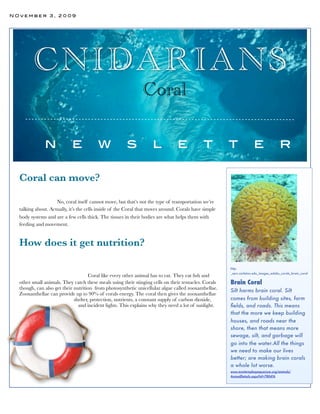
  other small animals. They catch these meals using their stinging cells on their tentacles. Corals   Brain Coral
  though, can also get their nutrition from photosynthetic unicellular algae called zooxanthellae.    Silt harms brain coral. Silt
  Zooxanthellae can provide up to 90% of corals energy. The coral then gives the zooxanthellae
                             shelter, protection, nutrients, a constant supply of carbon dioxide,     comes from building sites, farm
                               and incident lights. This explains why they need a lot of sunlight.    fields, and roads. This means
                                                                                                      that the more we keep building
                                                                                                      houses, and roads near the
                                                                                                      shore, then that means more
                                                                                                      sewage, silt, and garbage will
                                                                                                      go into the water.All the things
                                                                                                      we need to make our lives
                                                                                                      better; are making brain corals
                                                                                                      a whole lot worse.
                                                                                                      www.montereybayaquarium.org/animals/
                                                                                                      AnimalDetails.aspx?id=780416
NOvember 3, 2009


  SA ILI N G
Reproduction
                                         solcomhouse.com_images_coral01a_462.jpg


Asexual or sexual?
              truelovecoral.com

              Coral is
              asexual. Little
               pieces breaks
               off and the
               pieces grows
bigger. Then the same thing
happens. Over and over
again. This process is called
budding. Coral can also be
sexual. This is because they
spawn with the same type of
species, which then release
gametes around a full moon.


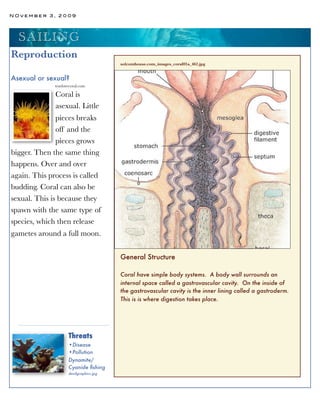
                                         General Structure

                                         Coral have simple body systems. A body wall surrounds an
                                         internal space called a gastrovascular cavity. On the inside of
                                         the gastrovascular cavity is the inner lining called a gastroderm.
                                         This is is where digestion takes place.


                     Threats
                     •Disease
                     •Pollution
                     Dynamite/
                     Cyanide fishing
                     devilgraphics.jpg
NOvember 3, 2009


  SA ILI N G

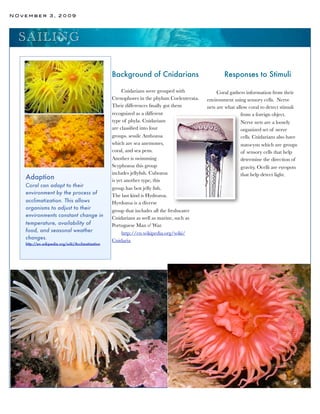
                                                  Background of Cnidarians                          Responses to Stimuli

                                                       Cnidarians were grouped with              Coral gathers information from their
                                                  Ctenophores in the phylum Coelenterata.   environment using sensory cells. Nerve
                                                  Their differences finally got them         nets are what allow coral to detect stimuli
                                                  recognized as a different                                  from a foreign object.
                                                  type of phyla. Cnidarians                                  Nerve nets are a loosely
                                                  are classified into four                                    organized set of nerve
                                                  groups. sessile Anthozoa                                   cells. Cnidarians also have
                                                  which are sea anemones,                                    statocysts which are groups
                                                  coral, and sea pens.                                       of sensory cells that help
                                                  Another is swimming                                        determine the direction of
                                                  Scyphozoa this group                                       gravity. Ocelli are eyespots
                                                  includes jellyfish. Cubozoa                                 that help detect light.
   Adaption                                       is yet another type, this
   Coral can adapt to their                       group has box jelly fish.
   environment by the process of                  The last kind is Hydrozoa.
   acclimatization. This allows                   Hyrdozoa is a diverse
   organisms to adjust to their                   group that includes all the freshwater
   environments constant change in                Cnidarians as well as marine, such as
   temperature, availability of                   Portuguese Man o' War.
   food, and seasonal weather                          http://en.wikipedia.org/wiki/
   changes.                                       Cnidaria
   http://en.wikipedia.org/wiki/Acclimatization
NOvember 3, 2009


  SA ILI N G
  Respiration
      After Coral eats the food is
  transported through the body by diffusion.
  Diffusion is the process by which molecules
  spread from areas of high concentration, to
  areas of low concentration. On the food
  chain, Coral is a secondary consumer.

  Regulation
  Coral helps keep the carbon dioxide levels
  down.
      Also, in the group jelly fish are the odd
  ones out because they are the only
  cnidarians that can move around. All
  cnidarians have bilateral symmetry.


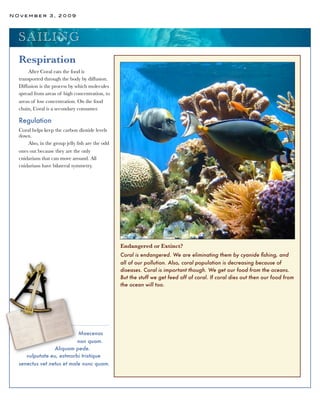
                                                 Endangered or Extinct?
                                                 Coral is endangered. We are eliminating them by cyanide fishing, and
                                                 all of our pollution. Also, coral population is decreasing because of
                                                 diseases. Coral is important though. We get our food from the oceans.
                                                 But the stuff we get feed off of coral. If coral dies out then our food from
                                                 the ocean will too.


                           Maecenas
                           non quam.
                 Aliquam pede.
     vulputate eu, estmorbi tristique
  senectus vet netus et male nunc quam.

Yessir

  • 1.
    NOvember 3, 2009 CN I DAR I ANS Coral n e w s l e t t e r Coral can move? No, coral itself cannot move, but that’s not the type of transportation we’re talking about. Actually, it’s the cells inside of the Coral that moves around. Corals have simple body systems and are a few cells thick. The tissues in their bodies are what helps them with feeding and movement. How does it get nutrition? http- Coral like every other animal has to eat. They eat fish and _serc.carleton.edu_images_eslabs_corals_brain_coral other small animals. They catch these meals using their stinging cells on their tentacles. Corals Brain Coral though, can also get their nutrition from photosynthetic unicellular algae called zooxanthellae. Silt harms brain coral. Silt Zooxanthellae can provide up to 90% of corals energy. The coral then gives the zooxanthellae shelter, protection, nutrients, a constant supply of carbon dioxide, comes from building sites, farm and incident lights. This explains why they need a lot of sunlight. fields, and roads. This means that the more we keep building houses, and roads near the shore, then that means more sewage, silt, and garbage will go into the water.All the things we need to make our lives better; are making brain corals a whole lot worse. www.montereybayaquarium.org/animals/ AnimalDetails.aspx?id=780416
  • 2.
    NOvember 3, 2009 SA ILI N G Reproduction solcomhouse.com_images_coral01a_462.jpg Asexual or sexual? truelovecoral.com Coral is asexual. Little pieces breaks off and the pieces grows bigger. Then the same thing happens. Over and over again. This process is called budding. Coral can also be sexual. This is because they spawn with the same type of species, which then release gametes around a full moon. General Structure Coral have simple body systems. A body wall surrounds an internal space called a gastrovascular cavity. On the inside of the gastrovascular cavity is the inner lining called a gastroderm. This is is where digestion takes place. Threats •Disease •Pollution Dynamite/ Cyanide fishing devilgraphics.jpg
  • 3.
    NOvember 3, 2009 SA ILI N G Background of Cnidarians Responses to Stimuli Cnidarians were grouped with Coral gathers information from their Ctenophores in the phylum Coelenterata. environment using sensory cells. Nerve Their differences finally got them nets are what allow coral to detect stimuli recognized as a different from a foreign object. type of phyla. Cnidarians Nerve nets are a loosely are classified into four organized set of nerve groups. sessile Anthozoa cells. Cnidarians also have which are sea anemones, statocysts which are groups coral, and sea pens. of sensory cells that help Another is swimming determine the direction of Scyphozoa this group gravity. Ocelli are eyespots includes jellyfish. Cubozoa that help detect light. Adaption is yet another type, this Coral can adapt to their group has box jelly fish. environment by the process of The last kind is Hydrozoa. acclimatization. This allows Hyrdozoa is a diverse organisms to adjust to their group that includes all the freshwater environments constant change in Cnidarians as well as marine, such as temperature, availability of Portuguese Man o' War. food, and seasonal weather http://en.wikipedia.org/wiki/ changes. Cnidaria http://en.wikipedia.org/wiki/Acclimatization
  • 4.
    NOvember 3, 2009 SA ILI N G Respiration After Coral eats the food is transported through the body by diffusion. Diffusion is the process by which molecules spread from areas of high concentration, to areas of low concentration. On the food chain, Coral is a secondary consumer. Regulation Coral helps keep the carbon dioxide levels down. Also, in the group jelly fish are the odd ones out because they are the only cnidarians that can move around. All cnidarians have bilateral symmetry. Endangered or Extinct? Coral is endangered. We are eliminating them by cyanide fishing, and all of our pollution. Also, coral population is decreasing because of diseases. Coral is important though. We get our food from the oceans. But the stuff we get feed off of coral. If coral dies out then our food from the ocean will too. Maecenas non quam. Aliquam pede. vulputate eu, estmorbi tristique senectus vet netus et male nunc quam.