Helping You Navigate in an Uncertain Investment World


 Year End 2009 Viewpoint
    Volume 10 Issue 4


  Inside this issue:                                 Year End 2009 Special Addition Viewpoint
Front Seat-Our approach to
investing
                                2              Trying to make sense of the nonsense—These days that’s harder than ever
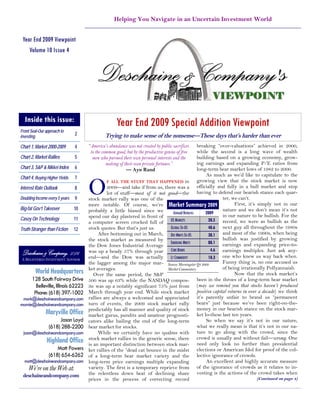
Chart 1, Market 2000-2009       4                                                             breaking “over-valuations” achieved in 2000,
                                      “America’s abundance was not created by public sacrifices
                                                                                              while the second is a long wave of wealth
                                       to the common good, but by the productive genius of free
Chart 2, Market Rallies         5       men who pursued their own personal interests and the  building based on a growing economy, grow-
                                                making of their own private fortunes.”        ing earnings and expanding P/E ratios from
Chart 3, S&P & Nikkei Index     6                          — Ayn Rand                         long-term bear market lows of 1982 to 2000.
                                                                                                  As much as we’d like to capitulate to the


                                      O
Chart 4, Buying Higher Yields   7
                                                F ALL THE STUFF THAT HAPPENED in              growing view that the stock market is now
Interest Rate Outlook           8               2009—and take if from us, there was a officially and fully in a bull market and stop
                                                lot of stuff—most of it not good—the having to defend our bearish stance each quar-
Doubling Income every 5 years   9     stock market rally was one of the                                   ter, we can’t.
                                      more notable. Of course, we’re Market Summary 2009                        First, it’s simply not in our
Big-fat Gov’t Takeover          10    probably a little biased since we                                   nature and we don’t mean it’s not
                                                                               Annual Returns     2009
                                      spend our day plastered in front of                                 in our nature to be bullish. For the
Casey On Technology             11                                            US MARKETS           28.5 record, we were as bullish as the
                                      a computer screen crocked full of
Truth-Stranger than Fiction     12    stock quotes. But that’s just us.       GLOBAL EX-US         40.6 next guy all throughout the 1980s
                                           After bottoming out in March, DEV MRKTS EX-US           38.1 and most of the 1990s, when being
                                      the stock market as measured by                                     bullish was justified by growing
                                                                              EMERGING MRKTS       88.1 earnings and expanding price-to-
                                      the Dow Jones Industrial Average
 Deschaine & Company, L.L.C.          was up a heady 57% through year CORE BONDS                    4.6 earnings multiples. Just ask any-
 A REGISTERED INVESTMENT ADVISOR
                                      end—and the Dow was actually LT COMMODITY                    18.3 one who knew us way back when.
                                      the lagger among the major mar- Source: Morningstar Q4 2009         Funny thing is, no one accused us
                                      ket averages.                                                       of being irrationally Pollyannaish.
         World Headquarters              Over the same period, the S&P
                                                                            Market Commentary
                                                                                                                Now that the stock market’s
       128 South Fairway Drive        500 was up 63% while the NASDAQ compos- been in the throes of a long-term bear market
         Belleville, Illinois 62223   ite was up a notably significant 75% just from (may we remind you that stocks haven’t produced
        Phone: (618) 397-1002         March through year end. While stock market positive capital returns in over a decade) we think
 mark@deschaineandcompany.com         rallies are always a welcomed and appreciated it’s patently unfair to brand us “permanent
marnie@deschaineandcompany.com        turn of events, the 2009 stock market rally bears” just because we’ve been right-on-the-
                                      predictably has all manner and quality of stock money in our bearish stance on the stock mar-
               Maryville Office       market gurus, pundits and amateur prognosti- ket lo-these last ten years.
                      Jason Loyd      cators alike hailing the end of the long-term               So when we say it’s not in our nature,
                 (618) 288-2200       bear market for stocks.                                 what we really mean is that it’s not in our na-
 jason@deschaineandcompany.com             While we certainly have no qualms with ture to go along with the crowd, since the
               Highland Office        stock market rallies in the generic sense, there crowd is usually and without fail—wrong. One
                                      is an important distinction between stock mar- need only look no further than presidential
                     Matt Powers      ket rallies of the “dead cat bounce in the midst elections or American Idol for proof of the col-
                 (618) 654-6262       of a long-term bear market variety and the lective ignorance of crowds.
  matt@deschaineandcompany.com        long-term price earnings multiple expanding                 An excellent and highly accurate measure
    We’re on the Web at:              variety. The first is a temporary reprieve from of the ignorance of crowds as it relates to in-
 deschaineandcompany.com              the relentless down beat of declining share vesting is the actions of the crowd takes when
                                      prices in the process of correcting record                                            (Continued on page 4)
Page 2                                                                                                                                                  Year End 2009 Viewpoint


 VIEW FROM THE FRONT SEAT by Mark J. Deschaine
 We Take a Different Approach to Investing, Here’s Just a Few Examples


 I     ’M SURE YOU REALIZE THAT THE END OF DECEMBER marks the
       end of the first decade of the new Millennium. What you may not
       know is that is also marks the end of the first decade for Deschaine &
 Company as a registered investment advisor.
        Technically, the firm was registered as an investment advisor in
                                                                                                  stocks. If stock prices never fluctuated, we’d never
                                                                                                  have the opportunity to buy shares at cheap prices,
                                                                                                  or as we prefer to say it: at “higher yields.”
                                                                                                        Maybe the best way to understand our unique
                                                                                                  approach is to compare and contrast it to some con-
 April of 1997, but only so we could provide consulting services to other                         ventional views held by investors.
 investment advisors. We actually didn’t take our first investment advisory
 client until December 1999. On that date, assets under management were                            What’s my account’s current value? vs. How much income can my portfolio
 a whopping $240,000 for two clients. A short ten years later, we’re re-                           generate? I know from personal experience that most investors focus on
 sponsible for managing about $65 million for 120 clients. Going from                              one benchmark, and that is: “what’s my account’s current market value?”
 $240,000 to $65 million, works out to an annual compounded growth rate                            Each month they open their account statement and immediately look at
 in assets under management of about 75% a year. Not bad when you con-                             their portfolio market value, hoping, I suppose, to find that it’s gone up
 sider the stock market is down about 20% over the same period. Needless                           each month, an unrealistic goal for sure. Not only that, but managing a
 to say, we’re pleased with the firm’s growth.                                                     stock portfolio for monthly capital returns is completely beyond any in-
        Without wallowing too deep into the usual year-end sentimentali-                           vestor’s control. Further, the volatile nature of the stock market guaran-
 ties, our growth as a firm is a direct reflection of the confidence our clients                   tees an emotional rollercoaster ride as your portfolio market value fluctu-
 have in us, and for that we                                                                                                                                ates—sometimes dra-
 are eternally grateful. Mar-       CONVENTIONAL THOUGHT PROCESS                                    D&C’S INVESTMENT THOUGHT PROCESS matically—even in the
 nie and I started Deschaine                                                                                                                                best of economic times.
 & Company with one sim- What’s my account’s market value?                                        How much safe income can your portfolio generate?
                                                                                                                                                                Over the last 129
 ple goal: manage client How much is my account up / down this year?                              How much did your income grow this year?                  years, for example, the
 assets the way we manage                                                                                                                                   monthly returns for the
 our own. And that, I can say Where is the stock market going this year?                          We don’t predict short-term swings in the market.
                                                                                                                                                            S&P 500 show that 45%
 without any equivocation, is I bought XYZ at $20 hoping to sell it at $30                        We buy XYZ stock at    $20 for its 5% current yield.      of the time the stock mar-
 exactly what we’ve done                                                                                                                                    ket was down the previ-
 over the last ten years.        XYZ is down to $10, I see no alternative but to sell             XYZ is down to $10, but the dividend is intact, so we can ous month. Even the
                                       it at a loss.                                              buy more shares at $10 locking in a nice 10% yield.
                                                                                                                                                            most emotionally fit in-
 Dividends or Bust?                    I need to grow my portfolio value to X, convert it to      We invest your portfolio for income and income growth     vestor is likely to get
 Given our dividend fo- income producing assets to live off of the income.                        from the start, so you can retire and live off growing    shaken psychological by
 cused approach to equity                                                                         income. Not the uncertainties of capital returns.         the “normal” volatility of
 investing we’re often                                                                                                                                      the stock market.
 asked, “is managing stocks for dividends all you do?” Our response is: “we                              In long-term bear markets, like the one we’re in now, they’re sure to
 manage equity portfolios for dividend yield and dividend growth because                           get emotionally whip-sawed into making investment decisions that are
 we happen to believe this is the best way to make money in the current                            detrimental to achieving their long-term investment objectives. Followed
 economic and financial environment.” That is to say, a stock market still                         closely behind monitoring their portfolio value is the question:
 fraught with considerable downside price risk (even more so now after stock
 prices are up 60% since March 2009) and interest rates that are at unprece-                      “How much was my account up/down this year? vs. How much did your
 dented lows.(1) (See Chart 5. on page 8). With interest rates near zero, obvi-                   investment income grow this year? We’re convinced we can safely grow
 ously there’s little room for them to drop further, making bonds an espe-                        dividend income between 6-12% a year, and even greater when we’re able
 cially risky investment when interest rates begin to reverse course and                          to reinvest a sizable chunk of the dividends every year into more shares;
 head higher, which they’ll have to do—sooner or later.                                           maximizing the power of compounding to grow portfolio income at dou-
       We also happen to think that a portfolio that provides a steady and                        ble digit annual rates. Consider that since 2000 we’ve been able to grow
 growing stream of dividend income is the best way to finance a financially                       portfolio income at better than 16% annually from growing dividends and
 secure retirement for the ever increasing number of folks at or nearing                          dividend reinvestment. As I’ve pointed out on many times in these pages,
 retirement, without having to sweat the disconcerting daily fluctuations in                      declining stock prices work to help us achieve the goal of growing income
 stock prices—by the way. If you have a portfolio that’s invested in a diver-                     because every drop in stock prices allows us to capture higher and higher
 sified group of strong companies that have the ability to grow their divi-                       dividends for the same dollar of investment. Frankly, after seeing this play
 dends, and here is the important point—come hell or high water—why                               out over the last ten years, we’re surprised how few investors appreciate
 would you ever be concerned about the short-term price fluctuations that                         the power of such a simple strategy, and that includes some of the most
 are part and parcel to owning stocks. In fact, (and I’ve said this a million                     sophisticated investors in the world, as well as yours truly, for the first 20
 times) price volatility works to the benefit of investors looking to buy
                                                                                                                                                                       (Continued on page 3)


1) We believe today’s bond market is just the latest “bubble” in a decade of financial bubbles. Investing in long bonds or long-term bond funds at today’s interest rates is, in our opinion, the
riskiest move an investor can make. See feature article on page 8, for our reasoning. At some point, stocks will reach a point where they are dirt cheap on a P/E and a price-to-dividend basis. At
that point, we expect to have gobs of excess dividend income to throw at cheap growth stocks to capture the next long-term bull market. During bull markets, capital returns replace dividend
income as the primary source of investors returns. In bull markets, stock prices rise from growing earnings and expanding price/earnings multiples like they did from 1982 to 2000.
Deschaine & Company, L.L.C.                                                                                                                                                                                                          Page 3

(Continued from page 2)                                                                 XYZ is down to $10, I see no alternative but to sell                                     enough interest rate to provide sufficient inter-
                                                                                        at a loss. vs. XYZ is down to $10, but the divi-                                         est income to fund a reasonable lifestyle. It’s
years of my investing career.                                                           dend’s intact, so we’ll buy more shares at $10                                           difficult to live on the income when your assets
      Probably the leading proponents of maxi-                                          locking in a healthy 10% yield. This might just be                                       are yielding 1 to 3% unless you’ve accumulated
mizing the power of money to compound are                                               the most important advantage to our dividend                                             a sizable pile of money.
Warren Buffett and his venerable side-kick                                              strategy over a capital return focused strategy.                                               Second, life expectancies have increased
Charlie Munger. It’s funny that even after years                                        Individual investors are quite prone to selling in                                       dramatically over the last 50 years. In 1950, the
of espousing the magic of money to compound                                             an emotional panic when a stock they own gets                                            average person barely made it to retirement
over long periods of time (and repeatedly noting                                        hammered. The reality of the stock market is                                             much less lived after the age of 65. Today the
the inability of the average investor to grasp the                                      that even the best stocks are going to drop                                              average life expectancy in almost 80. If we com-
concept), their investment success is often attrib-                                     precipitously for no particular reason other than                                        bine a much longer life expectancy with a more
uted more to the ability to buy “cheap stocks”                                          the economy or the stock market hits a rough                                             folks retiring in their 50s, many retirees today
than to any other factor.                                                               patch. Warren Buffett says that if you are not                                           face a retirement of 30 or even 40 years. With
      Obviously, the ability to buy stocks cheap                                        willing to suffer through a 50% drop in the price of                                     interests rates at 2-3%, and a longer retirement
helps the process of compounding. However,                                              a stock, you shouldn’t be in the stock market at all.                                    period it’s likely that many retirees face the
Buffett has often noted repeatedly that a cheap                                               From our perspective, as long as the com-                                          possibility of outliving their retirement assets.
price is just part of the process and the smallest                                      pany has the ability and intention to continue to                                              Our equity strategy is to designed to build
part at that. Buffett believes what really turbo-                                       make its current dividend payment—never                                                  a growing stream of income from the start so
charges investment returns is buying a com-                                             mind any increases—and the stock gets cut in                                             that at retirement the income already covers
pany with growing cash flow that he can con-                                            half in price, we jump at the chance to buy or                                           retirement expenses with cash to spare. Not
tinually redeploy at the highest available return                                       add to our position at twice the dividend yield.                                         only that, but income continues to grow in
to maximize compounding. Our interpretation                                             Again, as long as the company has the ability to                                         retirement at a healthy annual rate so that you
of Warren’s rule is to buy stocks with a history                                        pay its dividend, we’ll hold the stock. If the price                                     can retire knowing that there’s the least amount
of growing dividends. We expect to add to                                               gets whacked, we’ll use that opportunity to add                                          of chance you’ll outlive your income. Even if a
client returns by taking redeploying a growing                                          to our position to capture hefty yields.                                                 retiree needs most (or all) of the income leaving
dividend as the stock market’s volatility dishes                                              Again, share price volatility is the friend to                                     little after living expenses to reinvest, we still
up juicy dividend yields when it periodically,                                          a dividend stock buyer.                                                                  expect dividend income to grow 6, 8, 10 percent
and often indiscriminately whacks share prices.                                                                                                                                  a year—well in excess of inflation—to provide
                                                                                        I need to grow my portfolio to X, convert it to                                          growing income—for life.
Where is the stock market going this year? vs. We                                       income producing assets and live off of the in-                                                Having a growing income for life is an
don't try to predict short-term swings in the mar-                                      come. vs. We invest for income and income                                                ambitious goal to be sure. However, our experi-
ket. Believe it or not, we don’t try to predict                                         growth from the start so you can retire and live off                                     ence over the last ten years and the history of
short-term changes in the stock market. That is                                         a growing income. The conventional strategy in                                           the stock market leads us to believe we’ll be able
to say what the stock market will do over the                                           portfolio management, going back as long as                                              to achieve our goal of growing dividend income
next 12 to 18 months. Obviously, veteran read-                                          I’ve been in the business (which seems to get a                                          for our clients. The sooner you begin the proc-
ers of VIEWPOINT know we do believe that                                                little longer with each passing year), is to save and                                    ess of investing for dividend growth and rein-
long-term bull and bear market cycles are iden-                                         invest for growth to accumulate as big a pile of                                         vestment and the longer you have to allow the
tifiable and should to be heeded. At the same                                           assets as possible while you’re working and can                                          magic of high yields and double compounding
time, within the long-term market cycles are                                            afford to take risks. In other words, “growth is                                         from dividend growth and reinvestment to
some pretty volatile short-term swings—like                                             the name of the game.” The conventional wis-                                             work their magic, the bigger your annual in-
the 60% jump in stock prices since last March,                                          dom being that growth stocks while riskier                                               come will be when it comes time to retire. And,
as an example. But rather than shy away from                                            than dividend stocks yet offer investors more                                            may I suggest, the happier you’ll be sitting on
stocks when prices fluctuate, we see price vola-                                        growth potential in order to accumulate a large                                          your favorite beach collecting more dividend
tility as an opportunity to buy stocks when they                                        a pile of assets as possible for retirement.                                             income than you can spend in a year.
go on sale at unusually steep discounts.                                                        If you’re successful, then, as you began to                                            Last, what value the stock market ulti-
                                                                                        approach retirement, you’d begin the process of                                          mately puts on the stocks we accumulate over
I bought XYZ at $20 hoping to sell it at $30 vs. We                                     converting your (hopefully) sizable pool of                                              the next decade is anyone’s guess. We suspect
buy XYZ stock at $20 for its 5% current yield. In a                                     “growth assets” into income producing assets.                                            though, that the stock market will place a value
bear market cycle, buying stocks for capital                                            Presumably, you’ll be able to sell your growth                                           them at least as well as any portfolio of growth
appreciation is especially tricky. One problem                                          stocks, and buy bonds at a high enough interest                                          stocks we could buy.
with trying to capture capital returns is you’re                                        rate to provide income to live on in retirement.                                                When it comes to capita appreciation, way
never sure when they’ll appear—if ever. A stock                                         It’s safe to say that over the last 10 or 15 year                                        we look at it, any capital gains over the next ten
can remain undervalued for years. With a divi-                                          that strategy has been repudiated for a couple of                                        years be will like a nice thick layer of gravy on
dend stock, we’re pretty sure the dividend                                              reasons.                                                                                 top of our growing big pile of dividend income.
check’s going to arrive in the mail every quar-                                                 For one, such a strategy is not functional                                             Ok, so not the greatest of metaphors, but
ter. Occasionally, we even expect to get a bump                                         now because with interest rates at an all time                                           hey, by now you get the idea.
in our dividend payments, too.                                                          low, it’s simply not possible to lock in a high

PUBLISHER: MARK J. DESCHAINE EDITOR: JOHN H. DESCHAINE CONTRIBUTING EDITOR: TOM O’HARA STAFF CONTRIBUTORS: MATT POWERS, JASON LOYD COPY EDITOR: MARNIE E. DESCHAINE TECHNICAL ADVISOR: Joseph M. Deschaine. VIEWPOINT is a comple-
mentary publication of Deschaine & Company, L.L.C. a registered investment advisor in Belleville, Illinois. This information has been prepared from sources deemed reliable, but its accuracy is not guaranteed. It should not be assumed that any securities
discussed will be profitable or will equal past performance, or is it an offer to buy or sell any security mentioned. Deschaine & Company and/or one or more of its clients, employees, family or friends may have a position in the securities discussed herein. ©
2010. All rights reserved. Reproduction of this publication is strictly forbidden without written consent from Deschaine & Company. This issue was published on January 30, 2009. If you would like to receive a complementary copy each quarterly, simply send
us your address and the preferred method of delivery: snail-mail or email, to: 128 South Fairway Drive, Belleville, IL 62223 Or email us at mdeschaine@charter.net and we would be happy to add you to one of our mailing lists.
Page 4                                                                                                                                       Year End 2009 Viewpoint


                                  Chart 1: Does      the 2009 Stock Market Rally Signal the End of the Bear Market?
                                         (The Dow Jones, S&P 500 Index and The NASDQ Composite Index from December 31, 1999 to December 31, 2009)

$1.30
                                         Stock Market Returns Since 1999
$1.20                                       Dow Jones           - 9.30
$1.10                                       S&P 500              - 24.10
$1.00
                                            NASDAQ               - 44.24

$0.90


$0.80


$0.70


$0.60


$0.50


$0.40


$0.30


$0.20
     Dec‐99           Dec‐00           Dec‐01           Dec‐02             Dec‐03         Dec‐04            Dec‐05           Dec‐06           Dec‐07             Dec‐08       Dec‐09


 Dow                        - 34.52                                                            87.20                                                   - 52.98            57.36
 S&P                        - 45.51                                                            95.08                                                   - 56.24            63.17
 NQ                         - 71.99                                                            146.13                                                  - 53.88            75.38

 (Continued from page 1)                                          Of course, it’s one thing to get                             How good is the good news? We firmly
                                                             swept up in an emotional moment when                         believe that we’ll be able to lock in 7, 8, 9,
 picking and choosing equity mutual                          voting for a president or for your favor-                    and even 10% dividend yields over the next
 funds. Consider that in 2009, mutual                        ite American Idol, it’s quite another to                     ten years as stock prices continue to adjust.
 fund investors overwhelmingly put their                     let emotion influence decisions about
 money in foreign and emerging market                        money. When it comes to our own
 equity funds while at the same time tak-                    money (or our client’s money certainly) we
                                                                                                                          But, Is the Bear Market Over?
 ing out huge chunks from our domestic                                                                                    In order to make our case that we’ll be
                                                             like to think we base our investment
 brethren. A quick look at the returns for                                                                                able to grab double
                                                             decisions, as Dragnet Detective Joe Fri-
 the mutual fund categories of 2009, we                                                                                   digit dividend yields “Stock market
                                                             day used to say: “on the facts mama, and
                                                                                                                          over the next ten
 could assume investors made the right                       just the facts.”
                                                                                                                          years, we first have
                                                                                                                                                 volatility is bad
 choice as international equity funds in                          At the same time, we’ll acknowl-
 general—and emerging market funds in                                                                                     to debunk the view for the nerves
                                                             edge we’re not exempt from an occa-
 particular—earned three to four times                                                                                    that the stock mar- for those unprepared
                                                             sional fit of cursing at an incompetent
 the average return of US equity markets                                                                                  ket rally of 2009 for it. If you’ve done
                                                             CEO or slamming a fist on our com-
 for the year.                                                                                                            signals the end of your homework,
                                                             puter keyboard at the announcement of
                                                                                                                          the current bear
      However, as history and last year’s                    a dividend cut. Nevertheless, we soon
                                                                                                                          market cycle.          volatility is how you
 mutual fund cash flows confirm, the                         regain our composure and remind our-
 majority of fund investors plunked their                                                                                      We’ll start by make money in the
                                                             selves of what the facts tell us. And the
 money into the emerging market equity                       facts today tell us we’re still a long way                   pointing to Chart 1, stock market.”
 fund category because they were up 88%,                     from the bottom of the current bear                          above which out- — The Casey Report
                                                             market cycle. That’s the bad news.                           lines the returns for
 not before they were up 88%.
                                                                  The good news—and we really do                          the Dow Jones In-
      In their defense, crowds are usually
                                                             mean this is good news and not some                          dustrials, S&P 500 index, and the
 wrong because their judgments are
                                                             fabricated optimism to provide these                         NASDAQ composite from December 31,
 based entirely on that most unreliable,
                                                             pages with some positive spin—as long                        1999 to December 31, 2009.
 yet entirely predictable human trait;
                                                             as we in a bear market, we’re going to                            Of all the information the chart
 emotion. As any fan of Fantasia(2) or a
                                                             get multiple opportunities to buy our                        conveys, the most relevant from our
 recently elected president can tell you,
                                                             favorite dividend stocks at higher and                       perspective, is the fact that the stock
 that’s not a great way to ensure a good
 long-term outcome when having to                            higher dividend yields all the way down
 make important decisions.                                   to the bottom of the bear market cycle.                                                    (Continued on page 5)


2) Fantasia Barrino, 2004 winner of American Idol.
Deschaine & Company, L.L.C.                                                                                                             Page 5

  400 
                                           Chart 2: Depression       Era Stock Market Rallies, Foretelling the Future?
  350 

                                             52.0%
  300 
                                                                                                      Average Duration of Rallies: 11.3 weeks
                                                             %
                                                          19.0                                             Average % Increase: 52.6%
  250 

                                                                      27.5%                           Current Market Rally: 40 weeks: Up 57.%
  200                             -49.4%         -30.1%
                                                                                 27.5%
  150                                                            -37.5%
                                                                                            30.7%                                        122.5%
                                                                                  %                          %
                                                                              -39.1                   28.7
  100                                                                                                               100.7%
                                                                                             %
                  Average Duration of Declines: 14.0 weeks                               -45.4
   50                   Average % Decline: 42.1%                                                    -41.4%
                                                                                                                               - 39.4%
                                                                                                                 - 54.9%
      ‐


(Continued from page 4)                        we do believe the economy’s in for a                ket that remains “overvalued” by just
                                               long slow recovery with high un-                    about any historical standard, will work
market by all three indexes is still down      employment and “under-employment”                   to keep the stock market in a bear cycle
from year end 1999 levels. For the ten         remaining for quite some time along                 for possibly another decade—or more.
year period ending 2009, the Dow Jones         with the prospects of rising (possibly even              We think the period from 1929 to
is down 9.3%, the S&P 500 index is             hyper) inflation. That toxic economic               1933 illustrates how, during the worst
down 24.1%, while in the case of the           combination, coupled with a stock mar-              economic period in our country’s his-
NASDAQ composite, the 75% rise                                                                          tory, the stock market staged multi-
since last March simply cut the stock       Table 1: 8 Largest Market Rallies & Declines 1929-1933 ple and statistically significant ral-
index’s 10-year losses to a more mod-        Beginning      Ending      Point Change     % Change       lies, all while dropping over 90%
                                               Level         Level         in Period        Period
est 44%.                                                                                                from its peak in 1929, before finally
                                              386.10       195.35         - 190.75        - 49.4%       hitting bottom in late 1932.
Lessons from Past Bear Markets                195.55       297.25        + 101.70          52.0%             What we learned from the
Depression Era Rallies                                                                                  stock market experience of the
                                              297.25       207.74           - 89.51       - 30.1%
For an additional perspective on how                                                                    1930s in trying to draw parallels to
the current stock market cycle might          207.74       247.21          + 39.47         19.0%        the last 10 years, is that significant
play out over the next few years, we          247.21       154.45           - 92.76       - 37.5%       rallies in long-term bear markets
can look back to the 1929 to 1933             154.45       196.96          + 42.51         27.5%        are the rule not the exception, even
period. After peaking in 1929, the                                                                      as the stock market makes its re-
                                              196.96       119.89           - 77.07       - 39.1%       lentless march to the bottom.
stock market struggled with a slump-
ing economy much like the one we              119.89       156.74          + 36.85         30.7%             Suggestion: Learn to appreci-
find ourselves in today. (See Chart 2,        156.74        85.51           - 71.23       - 45.4%       ate price volatility, it’s an everyday
above.)                                                                                                 reality of the equity investing equa-
                                               85.51       119.15          + 33.64         39.3%        tion. Better yet, make volatility
     First, do we believe the econ-
omy’s in a depression the magnitude           119.15        69.85           - 49.30       - 41.4%       your friend by being prepared and
of the Great Depression of the 1930s?          69.85        89.87          + 20.02         28.7%        taking advantage of it to buy your
In a word, no, primarily because we                                                                     favorite dividend stocks during the
                                               89.87        40.56           - 49.31       - 54.9%
don’t believe unemployment is likely                                                                    many periodic stock market swoons
to reach anything near the 25%, like it        40.56        81.39          + 40.83        100.7%        that are certain to come our way
did in the early 1930s. Nevertheless,          81.99        49.68           - 32.31       - 39.4%       over the next ten years.
                                                                                                                           (Continued on page 6)
                                               49.68       110.53          + 60.85        122.5%
Page 6                                                                                                                                                                    Year End 2009 Viewpoint


                                                                                             Chart 3: Is the S&P 500 going to follow Japan’s 1989 to 2009 experience?
   5.00 

   4.50             The S&P 500 from 1999 to 2009

   4.00 

   3.50 

   3.00 

   2.50 

   2.00 

   1.50 

   1.00 
                      The Nikkei Index from 1989 to 2009                                                                                                                                                            ?
   0.50 

      ‐
           Dec‐89

                     Dec‐90

                              Dec‐91

                                       Dec‐92

                                                Dec‐93

                                                         Dec‐94

                                                                  Dec‐95

                                                                           Dec‐96

                                                                                    Dec‐97

                                                                                               Dec‐98

                                                                                                        Dec‐99

                                                                                                                 Dec‐00

                                                                                                                          Dec‐01

                                                                                                                                   Dec‐02

                                                                                                                                            Dec‐03

                                                                                                                                                     Dec‐04

                                                                                                                                                              Dec‐05

                                                                                                                                                                       Dec‐06

                                                                                                                                                                                Dec‐07

                                                                                                                                                                                         Dec‐08

                                                                                                                                                                                                  Dec‐09

                                                                                                                                                                                                           Dec‐10
(Continued from page 5)                                              over an extended period of time in order                                    to a level where they need to be to be
                                                                     to re-established historical P/E aver-                                      considered bear market bottom. We’ll
                                                                     ages. That basic understanding of statis-                                   need to see average P/E ratios like 7 or
Seeing the Future but for the Past                                   tics, we’ll acknowledge, is a long way                                      8 times earnings and average dividend
While we profess to be able to foresee                               from forecasting with any precision how                                     yields in the 6 or even 7% range for the
the stock market’s future, (with a rela-                             long it will take for prices to adjust to                                   stock market before we’re prepared to
tively high degree of certitude, no less) we                         their averages or how much prices will                                      call a market bottom.
should clarify that we’re only able to do                            bounce around in the process.                                                    How long do we think it’ll be before
so on the general direction of the stock                                  Studying other bear market periods,                                    we reach such valuation levels? How
market’s long-term trends.                                           gave us a good indication that it could                                     about another decade? Oh, and just so
      For example, in 2000 with stock P/                             be as long as 15 or 20 years for prices to                                  you know, once at we reach a market
E ratios around 40 (an all time high, by                             fully adjust. Why? Because historically,                                    bottom, the stock market has a nasty
the way) we were certain that stock                                  the length and duration of the bear mar-                                    tendency to languish at the bottom for a
prices would have to go down just to                                 ket cycle tends to mimic in reverse the                                     lengthy period beyond that.
bring P/E ratios in line with their his-                             length and duration of the bull market
torical averages. We also surmised that                              that preceded it. Since the 1982 to 2000                                    The Japanese Experience 1989 to 2009
such an adjustment could take years.                                 bull market lasted about 18 years and                                       You can’t be serious. Another decade of
How did we know? Well for starters                                   reached unprecedented heights in valua-                                     declining stock prices? Is that possible?
forecasting such a trend didn’t require                              tion, we figured the bear market would                                           If the last decade hasn’t convinced
much more than recognizing what stat-                                be equally as long and possibly equally                                     you that stock markets can suffer long
isticians refer to as “regression to the                             unprecedented on the downside.                                              down cycle for stock prices maybe
mean,” a fancy way to say that when                                       Here we, are 10 years later and the                                    Chart 3, above will do the trick. Chart
data gets way out of whack with its long                             stock market has pretty much played                                         3, compares the S&P 500 from 2000 to
-term historical averages, the data must,                            out as we anticipated in the spring of                                      2009 to the Nikkei index, the Japanese’s
at some point, move in the other direc-                              2000. Since 2000 P/E ratios have been                                       stock over the 1989 to 2009 period.
tion of time in order to “re-establish”                              cut in half—more or less—and dividend                                            As you may know, Japan went thor-
long-term historical averages.                                       yields have more than doubled from a                                        ough a similar credit and real estate
      It didn’t take much than that basic                            record low of .90% to about 2.40% as of                                     bubble in the late 1980s. Financed by
understanding of statistics to come to                               year end 2009. (See Chart 4, on page 7.)                                    easy credit and low interest rates, (sound
the conclusion that starting in 2000,                                     Where we sit today, both P/E’s and
stock prices would have to drop (a lot)                              dividend yield are only about half way                                                                          (Continued on page 7)
Deschaine & Company, L.L.C.                                                                                                         Page 7

                                                                                                                                             7.00 
                     Chart 4:
        S&P 500 Month End yield: 1965 to 1982                                                                                               6.23 

            (Dividend yields during the last bear market)                                                                                    6.00 
                                                                                                                          5.68 
        S&P 500 Month End yield: 2000 to 2009                                     5.37                   5.40 

                                                                                                                                             5.00 

                                            4.20 
                                                                                                                               4.52 

           3.73 
                                                                                                                                             4.00 
                                                                        3.60
                                                                                              3.65 

                                                                                                                                             3.00 
2.90                          2.88 
                                                                2.67 
                    1.92                                                       2.28
                                                                                          Our equity portfolio strategy for the coming
                                                                                                                                             2.00 
                                                                                          decade? Buy stocks has dividend yields rise
                             1.56                                                         all the way to top of the dividend yield cycle.
                                                                                                                                             1.00 
 1.17                                                                                     Just like we’ve been doing since 2000!
                                                                                                                                             ‐
  1965‐07
  1965‐12
  1966‐05
  1966‐10
  1967‐03
  1967‐08
  1968‐01
  1968‐06
  1968‐11
  1969‐04
  1969‐09
  1970‐02
  1970‐07
  1970‐12
  1971‐05
  1971‐10
  1972‐03
  1972‐08
  1973‐01
  1973‐06
  1973‐11
  1974‐04
  1974‐09
  1975‐02
  1975‐07
  1975‐12
  1976‐05
  1976‐10
  1977‐03
  1977‐08
  1978‐01
  1978‐06
  1978‐11
  1979‐04
  1979‐09
  1980‐02
  1980‐07
  1980‐12
  1981‐05
  1981‐10
  1982‐03
  1982‐08
(Continued from page 6)                                                                      market, cycles that the current bear
                                                              Given the similarities in Japan’s
                                                         economic experience in the 1980s andmarket will remain intact and be the
familiar) Japanese investors went on a                   our own over the last decade—and ourdominate variable in our outlook for
buying binge in the 1980s.                                                                   stocks until P/E ratios across the mar-
                                                         government’s eerily similar response to
     At its peak in1989, a square foot of                                                    ket, settle into single digits and divi-
                                                         our credit bubble as the Japanese took to
downtown Tokyo sold for over                                                                 dend yields, again for the market over-
                                                         theirs—we believe our US stock market
$250,000 and the Nikkei, Japan’s stock                   could be in for a similar experienceall, average 6% or higher.
market index, reached a hyper-inflated                   which would mean another decade, or       Note: we temper our certainty on
39,000. In many ways, Japan’s 1980s                      more, of slumping stock prices.     the long-term trend knowing full well
credit bubble equaled or surpassed our                                                       that the market can fluctuate wildly in
own loose and cheap credit fueled real Looking Ahead to 2020                                 the short run at the same time its con-
estate and stock market bubble from Just to reiterate, if we express any level tinues to trend down over a long period
2000 to 2008.                                                                                of time. As chart 4, demonstrates, divi-
                                             of certainty in our forecast it’s related to
     As Japan’s credit and real estate the long-term trend in stock prices. That dend yields bounced all over the place
bubble burst in early 1990, the Japanese is not the same as suggesting we can tell during the1966 to 1982 bear market
economy fell into a protracted economic what’s going to happen to prices over while dividend yields went from a low of
slump that it has yet to recover from. As the next six months or even the                           2.9% in 1966 to 6% in 1982.
the economy tanked under the burden of next year.                                     Dividend any This points out the risks in
                                                                                                          investment strategy. Even
excess debt and real estate prices col-           Yet, we’re convinced, based
lapsed, stock prices naturally followed on our interpretation of multiple Yields Go though the long-term trend may
suit and as chart 3 on page 6, shows,                                                     UP        be predictable, short-term volatil-
they have yet to recover.                                                                           ity can cause havoc on even the
     As we write this, the Nikkei                                                            best laid stock market strategy, espe-
Index is trading at about 10,500 When Stock The advantage to a high-yield                    cially if we allow ourselves to get
which means the index is down                          strategy in down markets              caught up in the emotion of the mo-
more than 70% from it’s all time      Prices Go                                              ment. It is our job to guard against such
high of 38,850 in 1989. That’s a       DOWN                                                  a possibility by doing everything in our
high set over twenty years ago.                                                              power to let cold facts and dividend
Meanwhile, Japan’s economy has shown                                                         yields to guide us.
no signs of any of a meaningful eco-
                                                                                                                    (Continued on page 9)
nomic recovery anytime soon.
Page 8                                                                                                                                                                                                                                                                                                                                                                                                                                              Year End 2009 Viewpoint


                                                                                                                                                                                                                                                                                                                                                                                                                                                                                                                                      18.00

                                                                                                                                                                                                                                                                                                                                                                      Chart 5: 10-Year Treasury Yield                                                                                                                                 17.00


                                                                                                                                                                                                                                                                                                                                                                        3-Month Treasury Bill Yield                                                                                                                                   16.00


                        This is the next “Bubble”                                                                                                                                                                                                                                                                                                            With interest rates are at record lows the
                                                                                                                                                                                                                                                                                                                                                                                                                                                                                                                                      15.00

                                                                                                                                                                                                                                                                                                                                                                                                                                                                                                                                      14.00


                                                                                                                                                                                                                                                                                                                                                                  next logical major move is UP!                                                                                                                                      13.00
                                                                                                                                                                                                                                                                                                                                                                                                                                                                                                                                              ?
                                                                                                                                                                                                                                                                                                                                                              Not a time to be buying long-term long                                                                                                                                  12.00


                                                                                                                                                                                                                                                                                                                                                                 bonds or long-term bond funds!                                                                                                                                       11.00

                                                                                                                                                                                                                                                                                                                                                                                                                                                                                                                                      10.00

                                                                                                                                                                                                                                                                                                                                                                                                                                                                                                                                      9.00

                                                                                                                                                                                                                                                                                                                                                                                                                                                                                                                                      8.00

                                                                                                                                                                                                                                                                                                                                                                                                                                                                                                                                      7.00

                                                                                                                                                                                                                                                                                                                                                                                                                                                                                                                                      6.00

                                                                                                                                                                                                                                                                                                                                                                                                                                                                                                                                      5.00

                                                                                                                                                                                                                                                                                                                                                                                                                                                                                                                                      4.00

                                                                                                                                                                                                                                                                                                                                                                                                                                                                                                                                      3.00

                                                                                                                                                                                                                                                                                                                                                                                                                                                                                                                                      2.00

                                                                                                                                                                                                                                                                                                                                                                                                                                                                                                                                      1.00

                                                                                                                                                                                                                                                                                                                                                                                                                                                                                                                                      0.00
                                                                                                                                                                                                  Apr‐74
                                                                                                                                                                                                           Apr‐75
                                                                                                                                                                                                                    Apr‐76
                                                                                                                                                                                                                             Apr‐77
                                                                                                                                                                                                                                      Apr‐78
                                                                                                                                                                                                                                               Apr‐79
                                                                                                                                                                                                                                                        Apr‐80
                                                                                                                                                                                                                                                                 Apr‐81
                                                                                                                                                                                                                                                                          Apr‐82
                                                                                                                                                                                                                                                                                   Apr‐83
                                                                                                                                                                                                                                                                                            Apr‐84
                                                                                                                                                                                                                                                                                                     Apr‐85


                                                                                                                                                                                                                                                                                                                                                                                                                                                                                                           Apr‐07
                                                                                                                                                                                                                                                                                                                                                                                                                                                                                                                    Apr‐08
                                                                                                                                                                                                                                                                                                                                                                                                                                                                                                                             Apr‐09
     Apr‐53
              Apr‐54
                       Apr‐55
                                Apr‐56
                                         Apr‐57
                                                  Apr‐58
                                                           Apr‐59
                                                                    Apr‐60
                                                                             Apr‐61
                                                                                      Apr‐62
                                                                                               Apr‐63
                                                                                                        Apr‐64
                                                                                                                 Apr‐65
                                                                                                                          Apr‐66
                                                                                                                                   Apr‐67
                                                                                                                                            Apr‐68
                                                                                                                                                     Apr‐69
                                                                                                                                                              Apr‐70
                                                                                                                                                                       Apr‐71
                                                                                                                                                                                Apr‐72
                                                                                                                                                                                         Apr‐73


                                                                                                                                                                                                                                                                                                              Apr‐86
                                                                                                                                                                                                                                                                                                                       Apr‐87
                                                                                                                                                                                                                                                                                                                                Apr‐88
                                                                                                                                                                                                                                                                                                                                         Apr‐89
                                                                                                                                                                                                                                                                                                                                                  Apr‐90
                                                                                                                                                                                                                                                                                                                                                           Apr‐91
                                                                                                                                                                                                                                                                                                                                                                    Apr‐92
                                                                                                                                                                                                                                                                                                                                                                             Apr‐93
                                                                                                                                                                                                                                                                                                                                                                                      Apr‐94
                                                                                                                                                                                                                                                                                                                                                                                               Apr‐95
                                                                                                                                                                                                                                                                                                                                                                                                        Apr‐96
                                                                                                                                                                                                                                                                                                                                                                                                                 Apr‐97
                                                                                                                                                                                                                                                                                                                                                                                                                          Apr‐98
                                                                                                                                                                                                                                                                                                                                                                                                                                   Apr‐99
                                                                                                                                                                                                                                                                                                                                                                                                                                            Apr‐00
                                                                                                                                                                                                                                                                                                                                                                                                                                                     Apr‐01
                                                                                                                                                                                                                                                                                                                                                                                                                                                              Apr‐02
                                                                                                                                                                                                                                                                                                                                                                                                                                                                       Apr‐03
                                                                                                                                                                                                                                                                                                                                                                                                                                                                                Apr‐04
                                                                                                                                                                                                                                                                                                                                                                                                                                                                                         Apr‐05
                                                                                                                                                                                                                                                                                                                                                                                                                                                                                                  Apr‐06
                    BOND MARKET                                                                                                                                                    40%, depending on the particular maturity                                                                                                                                                          basis points on the overnight fed funds rate.
                                                                                                                                                                                   and quality of the bond.                                                                                                                                                                           That’s 5% of one percent.
                  REVIEW & OUTLOOK                                                                                                                                                       So our bond strategy was to take a very                                                                                                                                                            Now we’re suppose to believe this time
                                         Caveat Emptor                                                                                                                             conservative approach, stay very short in                                                                                                                                                          the Fed is going to yank support for low
                                “Bond Buyer Beware!                                                                                                                                maturity and take a wait and see attitude                                                                                                                                                          interest rates in early 2010 or whenever Ber-
                                                                                                                                                                                   toward interest rates and the direction of the                                                                                                                                                     nanke feels it’s the right time to begin slowly

P     ROBABLY THE BIGGEST LESSON of the
      last ten years for the bond market is to
never underestimate the Federal Reserve’s
                                                                                                                                                                                   overall bond market. Client assets not com-
                                                                                                                                                                                   mitted to stocks was invested in money mar-
                                                                                                                                                                                   ket funds and short-term bonds, in order to
                                                                                                                                                                                                                                                                                                                                                                                      tightening the money supply and be able to
                                                                                                                                                                                                                                                                                                                                                                                      successfully head off inflation—and a spike in
                                                                                                                                                                                                                                                                                                                                                                                      interest rates that’ll surely follow.
power (or determination) to hold interest rates                                                                                                                                    benefit from rising interest rates.                                                                                                                                                                      Count us among the skeptical for a couple
artificially low.                                                                                                                                                                        It’s said that the Fed’s job is to take away                                                                                                                                                 of reasons: First, the Fed hasn’t done it in re-
       When we launched the asset manage-                                                                                                                                          the punch bowl when the economic party gets                                                                                                                                                        cent memory. Second, it’s already too late.
ment business in the fall of 1999, one of the                                                                                                                                      rocking. What that means is it’s their job take                                                                                                                                                    Money growth over the last two years has
primary investment assumptions we made at                                                                                                                                          money out of the system in time to check risk                                                                                                                                                      grown at such a rate that it would require a
that time was that low interest rates posed a                                                                                                                                      taking and to keep inflation under control. Un-                                                                                                                                                    massive contraction in the money supply to
potentially sizable risk to bond investors. (See                                                                                                                                   fortunately, over the last 15 years, the Federal                                                                                                                                                   even put a dent in its growth rate. Even if Ber-
the orange dotted line above.)                                                                                                                                                     Reserve, first led by Alan Greenspan and then                                                                                                                                                      nanke went against type and did such a thing, a
       Given the historical low level for inter-                                                                                                                                   Ben Bernanke did just the opposite and printed                                                                                                                                                     contraction in money supply of that magnitude
est rates in 2000, we made what we thought                                                                                                                                         money like there’s no tomorrow.                                                                                                                                                                    would virtually ensure a “double dip” reces-
was a reasonable assumption in expecting                                                                                                                                                 Apparently, neither Greenspan nor Ber-                                                                                                                                                       sion—if not a full blown Depression.
that interest rates were equally likely to go                                                                                                                                      nanke wanted to play house mother at the                                                                                                                                                                 Just about every previous time in history
up as go down.(3) First, we figured that if                                                                                                                                        economic party. In fact, rather than halt any                                                                                                                                                      when the Fed had to choose between pulling
interest rates went down, the modest com-                                                                                                                                          of the multiple speculative bubbles of the last                                                                                                                                                    the legs out from under the economy or letting
mitments to bonds we had in client accounts                                                                                                                                        decade (in everything from tech stocks to housing                                                                                                                                                  inflation loose, it’s opted for inflation. This
at the time would benefit from higher                                                                                                                                              to oil) by raising interest rates and slowly,                                                                                                                                                      time’s not likely to be any different.
prices—albeit only modestly.                                                                                                                                                       albeit painfully, deflate each bubble, the Fed                                                                                                                                                           With interest rates essentially at zero,
       On the other hand, if interest rates                                                                                                                                        took action that actually added money to the                                                                                                                                                       we’re betting the next move for interest rates is
spiked, like they had several times in the                                                                                                                                         system causing each successive bubble build.                                                                                                                                                       up—quite possibly in a big way. Anyone hold-
recent past, bonds with a maturity longer                                                                                                                                                Consequently, interest rates have been                                                                                                                                                       ing bonds with a maturity of longer than a
than seven years were likely to get hammered                                                                                                                                       artificially pushed down almost over the last                                                                                                                                                      couple of years, will be staring at massive
in price to cause a capital loss from 25 to                                                                                                                                        ten years to an all-time record low of five                                                                                                                                                        capital losses—don’t let that be you!

3) How’s that for sticking our neck out?
Deschaine & Company, L.L.C.                                                                                               Page 9


HOW INCOME DOUBLES EVERY FIVE YEARS
                Income Growth           Portfolio          Dividend        1) From Dividend     2) From Dividend Growth       Yield on
                   Objective          Value @ Cost         @10% GR          Growth Alone           & Div Reinvestment          "Cost"
   Year         $    50,000          $   1,000,000           0.50          $       50,000           $       50,000            5.00%
     1                               $   1,055,000           0.55           $      55,000           $       55,000            5.50%
     2                               $   1,118,828           0.61           $      60,500           $       63,828            6.05%
     3                               $   1,193,285           0.67           $      66,550           $       74,458            6.66%
     4                               $   1,280,640           0.73           $      73,205           $       87,354            7.32%
     5          $ 100,000            $   1,383,764           0.81          $       80,526           $      103,124            8.05%
     6                               $   1,506,335           0.89           $      88,578           $      122,571            8.86%
     7                               $   1,653,106           0.97           $      97,436           $      146,771            9.74%
     8                               $   1,830,285           1.07           $     107,179           $      177,179            10.72%
     9                               $   2,046,071           1.18           $     117,897           $      215,786            11.79%
    10          $ 200,000            $   2,311,420           1.30          $      129,687           $      265,349           12.97%
    11                               $   2,641,158           1.43           $     142,656           $      329,738            14.27%
    12                               $   3,055,612           1.57           $     156,921           $      414,454            15.69%
    13                               $   3,583,052           1.73           $     172,614           $      527,440            17.26%
    14                               $   4,263,384           1.90           $     189,875           $      680,332            18.99%
    15          $ 400,000            $   5,153,844           2.09          $      208,862           $      890,461           20.89%
    16                               $   6,337,933           2.30           $     229,749           $    1,184,089            22.97%
    17                               $   7,939,678           2.53           $     252,724           $    1,601,745            25.27%
    18                               $ 10,146,876            2.78           $     277,996           $    2,207,198            27.80%
    19                               $ 13,249,744            3.06           $     305,795           $    3,102,868            30.58%
    20          $ 800,000            $ 17,706,627            3.36          $      336,375           $    4,456,883           33.64%
 (Continued from page 7)                         How Income Doubles Every Five Years          expect dividend income to grow some-
                                                 The table above outlines the simple where between 8 to 10% a year from the
                                                 arithmetic that’s required to double divi- companies in the portfolio raising their
 Our Equity Strategy:                            dend income every five                       dividends. Under either scenario our
 Don’t Fight the Trends                          years. A critical part of our                             equity portfolio can expect
 As we said, our equity strategy is to           assumption is the ability to “As the dividend             to show positive income
 take advantage of the stock market’s            reinvest all dividend in- increases, eventually the growth over time. The
 long-term down trend and short-term             come back into the portfo- price of the stock             question is: will it be 15%
 price volatility, to buy stocks at increas-     lio to maximize the power producing that dividend from dividend growth and
 ingly higher dividend yields. We expect         of compounding. We’re will increase as well. The full dividend reinvestment
 to lock in 7, 8, 9, and eventually even         convinced, if we achieve principle here is critical, or will it be 8 to 10% from
 10% dividend yields, over the next ten          our two investment objec- both for investors              dividend growth alone?
 years by being patient and disciplined          tives the stock market will                                     For folks still working
 when buying dividend stocks. In other           reward our stocks with
                                                                                seeking to accumulate      and socking money away
 words, the very same strategy we’ve             higher share prices and wealth, and even more             for retirement, the income
 employed successfully since the current         capital returns will take      importantly today, for     numbers shown above can
 bear market began in early 2000.                care of themselves.            investors hoping that      grow more significantly
      Our portfolio objective is to end the           At the same time, we investment assets will          still. For example, if an
 decade with a portfolio yielding annual divi-   realize that not every in- support them in                investor throws an addi-
 dend income equal to 10% (or better) on what    vestor, particularly those retirement.”                   tional $25,000 a year into
 we paid for our stocks. We also except to       already retired, have the                                 the $1 million example
 double dividend income every five years in      luxury of reinvesting, all or even most,     above, annual dividend income in year
 the process. Ambitious goals, we know, but      of their dividend income. For those cli- 10 grows to $308,383.
 quite doable, here’s how.                       ents past retirement and living off their
                                                                                                                   (Continued on page 12)
                                                 dividend investment income, we still
Page 10                                                                                                    Deschaine & Company, L.L.C.
My Big Fat Government Takeover                            is that we trust free citizens to make
                                                          decisions about themselves—and are
                                                                                                                          czar and get GM and Chrysler to build
                                                                                                                          the kind of cars that Washington wants.
By William McGurn                                         skeptical about government. As some-                                    Wall Street execs are getting sweet
The Wall Street Journal                                   one who worked inside a White House, I                          bonuses at a time when millions of other
December 14, 2009                                         say you really come to believe govern-                          Americans are unemployed. Well, in-
                                                          ment should be small when you see your                          stead of encouraging these financial con-
S    OME MISTAKES ARE SO BIG that
     only smart people are tempted to
make them. One is the faith in Big Gov-
                                                          friends running it.
                                                               Now, I know there are people who
                                                                                                                          cerns to pay back the Troubled Asset
                                                                                                                          Relief Program money and get the tax-
                                                          believe that George W. Bush was a Big                           payers off the hook, send in Ken
ernment.
                                                          Government Republican. And you can                              Feinberg to set their salaries.
     We’ll see that in full force today
                                                          make arguments about spending and so                                    Health-care spending is inefficient?
when Barack Obama gives another ma-
                                                          forth, even so, there’s simply no com-                          The answer is obvious: Expand the De-
jor address on the economy. On the gen-
                                                          parison with the Obama administration.                          partment of Health and Human Services
eralities, there won’t be much real dis-
                                                               That’s because conservatives believe                       and give its secretary more power. Un-
agreement. But at a time when many
                                                          that even our smartest friends are no                           der the bill now before the Senate, for
claim to see no difference between the
                                                          match for the collective wisdom of the                          example, Kathleen Sebellus would have
two political parties, President Obama
                                                          marketplace. If we were to wake up and                          the authority to decide what care insur-
and his Democratic allies are making
                                                                                                                                              ance companies could offer,
one distinction paramount:
                                           % of Cabinet Appointments with Private Sector Experience: 1900‐2009                                who could get an abortion
their operating assumption
                                                                                                                                              under a government-run
that bigger government is 70
                                                                                                                                              plan, what prices were fair,
better government.
                                  60                                                                                                          and so on.
     Many of the people in                                                       59                            58                                  Of course we shouldn’t
the Obama administration, 50                         52                                        52                     51
                                                                                                                               53             draw any conclusions from
the president included, en-                               47 48
                                                                        50 49
                                                                                                                                              an advisory task force that
joy all the credentials we 40                                                             44         43
                                               39                 40                                                                          recently created a stir when
associate with the best and 30 36                                                                                         37
                                                                                                                                              it suggested women get
the brightest: the right                                                                                  31
                                                                                      29                                                      fewer mammograms-and
schools, the good grades, 20
                                                                                                                                              Secretary     Sebelius’s dis-
the successful careers. Alas,
                                  10                                                                                                          avowal in the face of intense
whether it be allocating
                                                                                                                                        8     public heat. She pointed out
health care or defining the        0                                                                                                          that the task force does not
kind of jobs the economy
                                                                                                                                              set government policy. But
ought to create, the policies
                                                                                                                                              at some point some govern-
they favor suggest a strong With the economy on the rocks and employment still declining, does it give anyone comfort to 
                                                                                                                                              ment task force will—and
belief that they know what’s know  that  less  then  10%  of  the  Obama  administration  (by  far  the  lowest  percentage  of  any 
                                                                                                                                              there will be simply be
best not just for themselves, administration  going  all  the  way  back  to  1900)  has  private  sector  business  experience.  With 
                                                                                                                                              fewer ways around it.
but for everyone else too.      such  little  real  world  business  experience,  we  shouldn’t  be  surprised  if  a  bunch  of  life  time 
                                                                                                                                                   That’s government by
     Of course, the kind of academics  and  government  bureaucrats  can’t  figure  out  how  to  incentivize  the  economy  to 
                                                                                                                                              the smart. The good news is
people who are apt to push create jobs , so don’t expect significant private sector job growth anytime soon. 
                                                                                                                                              that it doesn’t seem to be
for government-imposed solutions are
those who are also apt to believe they                  find that someone we knew well had selling. According to a recent poll, 57%
                                                                                                                          of Americans believe government is do-
will be the ones imposing decisions, not been given control over some important ing things that should be left to business
the ones who have to live with decisions                part of the economy, the conservative
                                                                                                                          and individuals. Not only do most
imposed by others. Sometimes that’s would not likely think, “Everything will Americans object, Gallup says the oppo-
because they enjoy the wealth that gives                be fine now that Harry's in charge.” Far
                                                                                                                          sition is the “highest such reading in
them escape-hatches unavailable to the more likely we’d be saying to ourselves, more than a decade.”
less affluent, such as their ability to en-             “If it weren’t for his wife, Harry would
                                                                                                                                  Today Mr. Obama is going to give
sure that their own children never have be wearing red and purple socks—and us more details about the wonderful
to set foot in a public school. Mostly,                 we’re giving him that kind of power?”
however, their trust in government re-                        Mr. Obama and his team appear to things all these smart people in Wash-
                                                        be unburdened by such modesty.                                    ington are going to do to help us on the
flects with confidence that they have all
the answers and that its government’s                         Detroit is in decline because its economy. Maybe he would do well to
job to enforce them.                                    automotive giants no longer build the take another look at all those bright
                                                                                                                          lights around him. For the more he pro-
     What about conservatives? Don’t kind of cars Americans want to buy? poses government will do, the more
we have confidence in our judgment and Let’s have the president sack the CEO of skeptical Americans seem to be.
abilities. Of course we do. The difference General Motors, and then use the bail-
                                                        out money as leverage to appoint a car
Year End 2009 Viewpoint                                                                                                                                         Page 11


            On A Positive Note:                                drop to no more than the royalties on the software             tract, purify and utilize commodities. Just think
                                                               that runs the nanotechnology that extracts them.               about computers. Moore’s Law. They double in
         Doug Casey on Technology*                                                                                            capacity every 18 months.
                                                               Louis: Let’s come back to nanotechnology in a
Louis: Doug, people have written in saying                     moment. The overall trend you’re describing                    Louis: So, would you say you’re a techno-
you’re a “doom-and-gloomer,” a “perma-bear”—                   doesn’t depend on it. Even without nanotech,                   optimist as a matter of general principle—
but I know you’re an optimist. Why do you                      cheaper abundant energy would drop the prices                  because you believe in the continuation of the
suppose that’s so?                                             of most commodities to near zero. Sea water is                 5,000 year trend—or because there are specific
Doug: Perhaps it’s because I’ve long said that                 full of dissolved metals, for example; you could               technologies or because there are specific tech-
the Greater Depression is going to be even                     have all you wanted if you just had the energy to              nologies you see developing?
worse than I think it will be. But looking for-                process the water to extract the metals. Cheap                 Doug: I’m a huge believer in nanotechnology. I
ward with a long view, I think the future is not               enough energy makes the lowest-grade concen-                   believe it is likely—even in the span of the next
only going to be better than I imagine: it’s going             tration of anything economical.                                generation–to change the nature of life on this
to be better than I can even imagine.                          Doug: Yes, and even now we know how to ex-                     planet totally, unrecognizably, and irrevocably
      The coming Greater Depression will be                    tract those metals or make artificial oil; it’s                for the better. It is, I think, the single biggest
serious, but I don’t think it’s going to fundamen-             strictly a matter of having enough energy to                   thing on the horizon.
tally change the long-term trend of human his-                 drive the engineering. And, of course, the eco-                Louis: Define nanotechnology for us.
tory. I believe Jacob Bronowski was right: the                 nomics. That is why I find it so frustrating when              Doug: Sure, it’s the creation of computers and
Ascent of Man will continue. Mankind started                   people talk about running out of natural re-                   machines on the sub-microscopic level—the
out grubbing for roots and berries in the mud,                 sources. There is no danger whatsoever of that.                atomic level, really.
but our descendants—not so far in the future—                  Not only are the resources of the world ade-                   Louis: Why should anyone care about machines
will be colonizing the stars.                                  quate, they are essentially infinite. It’s a question          the size of molecules?
Louis: Was that the guy who wrote the 1973                     of technologic-know-how and capital, enough                    Doug: For one, they enable you to build perfect
BBC series, “The Ascent of Man?” I didn’t re-                  wealth to implement the know-how that is, to build             machines—perfect in the sense of them having
member his name, but I remember watching the                   the machines. Look, just about every material thing in         no mechanical imperfections—which vastly
series even though I was only eight. So, when                  the universe is constructed from the nine elements in          increases their efficiency and reduces the need
you talk about the long term you’re not talking                the periodic table of elements. Having anything we             for energy. If you use molecular machines to
years, decades, or even centuries, but the grand               want from a slice of bread to and ounce of gold, to a          build things one atom at a time, there is literally
scale of human history and beyond.                             new car, is simply a matter of rearranging atoms into          no waste. Zero. Every atom is used and put
Doug: Yes, exactly. An interesting thing about                 the correct combination at an acceptable cost.                 exactly where it is needed. No by-products, no
investing, and life in general, is that there are              Louis: My friend Jim Von Her, CEO of Zyvev, a                  pollution.
long-term trends, medium-term trends, and                      nanotech instrument company once told me that                        There are many applications. Medical ap-
short-term trends. You have to figure out which                some of the most valuable land in the future                   plications are among the most interesting. Once
ones are important, then if and how to capitalize              would be the sites of landfills, because they are              you have machines the size of an enzyme—you
on any of them. And it seems to me that of the                 basically mountains of purified materials. Once                can program it to do just about anything. One
longest-term human trends in existence is the                  you can reduce matter into its component atoms                 example is to fix malfunctioning cells as in can-
5,000 year-long bear market in commodities. In                 and make new things with it, such places, packed               cer, though that would be trivial for such ad-
real terms, metals were extremely rare and ex-                 with high concentrations of useful atoms, will                 vanced machines, but also fine-tuning all sorts of
pensive in Neolithic times.                                    command a premium. In the future, there will be                tissues for optimal health—which means pre-
Louis: Iron was so rare, it didn’t exist. And I’d              no such thing as trash. So, this bearish trend on              venting and repairing aging.
guess that, say a polished copper mirror would                 commodities you speak of isn’t really a bearish                Louis: A fountain of youth, sounds like science
have taken the equivalent of many human lives                  trend at all; it’s a bullish trend on technology.              fiction.
to make.                                                       Doug: and that includes nuclear waste. Greens,                 Doug: It does, but it isn’t. This is hard science.
Doug: Right. What metals there were came from                  who generally have a background in science, are                Ray Kurwell, an investor and thinker about the
what people could do to the metal in its native form.          completely unaware that spent reactor fuel is a                future points out we’re coming to “technological
That meant primarily gold, but there would                     potentially valuable future resource—in addition               singularity,” a point at which technology just
have been some copper and some sliver, but that                to being a trivial storage problem in the interim.             doesn’t get better, it leaps to its full potential.
would have been about it. And even the equiva-                 Technology-it’s the most bullish thing possible                After that happens, people will look at this event
lent of kings back then had very little of it.                 for the standard of living of the average human                as the single most important thing that’s ever
      Then civilization developed in what is now               being. Many people living below the poverty                    happened—or ever will happen. As we date
the Middle East and we entered the Bronze Age,                 line in the U.S. have televisions, refrigerators,              things now as BC and AD, in the future every-
which gave way to the Iron Age—and now                         medicines, and luxuries that even kings and                    thing will be pre– and post-singularity.
we’re in the Silicon Age. Each stage the com-                  queens of a hundred years ago couldn’t have                          And I believe this could all happen within
modity grew progressively less rare. Silicon                   dreamed of. That trend is going to continue and                the next 20 or 30 years. So yes, I’m an opti-
makes the computer chip that drives modern life,               even accelerate. It’d be hard for me to over state             mist—and the greatest single reason for that is
but it’s basically sand. On a scale of millennia,              how favorable this trend is.                                   technology.
commodities have collapsed in price. Eventually,                     But the megatrend remains that advancing                 Louis: Well. I’m feeling upbeat, thanks Doug!
they’ll go to near zero in cost. Commodities will              technology makes it cheaper and easier to ex-

*Interviewed by Louis James, Editor, International Speculator. Doug Casey is Founder and Editor of “The Casey Report.” An excellent economic and market letter.
Page 12                                                                                                                Deschaine & Company, L.L.C.
    (Continued from page 9)                                     Ah, What about More Dividend Cuts?                           Closing the Book on 2009
                                                                         S&P: 2009 Worst Year Ever for Dividends             After the specter of record dividend cuts
           Finally, nothing in our equation Positive Signs for 4Q ‘09                                                        the last two years, it’s reasonable to ask
    takes into account our ability to capture Point to Better Year for Dividends in 2010                                     how we could be so optimistic on our
    higher dividend yields as the stock mar- In a recent press release, Standard &                                           outlook for dividend growth over the
    ket rambles slowly down over the next Poor’s announced that, of the approxi-                                             next 5 or ten years.
    decade. If you haven’t noticed we’re mately 7,000 publically owned compa-                                                       For starters, our target annual divi-
    pretty excited about the prospects of nies that report dividend information,                                             dend growth rate of 10% per year is
    being able to lock in high single digit 74 decreased their dividend payments                                             actually down when compared to our
    dividend yields over the next decade.                                during the fourth quarter of 2009—                  actual historical growth rate of more
                                                                         marking a significant improvement from              than 13%. Second, as S&P noted, the
                                                                                 the record 288 that lowered                 worst is likely to be over regarding fur-
                                                                                 their dividend payments during              ther dividend cuts, or at least when
                                                                                 the fourth quarter of 2008.                 compared to 2008 and 2009. While we
                Truth—Stranger than Fiction                                           “The fourth quarter was in             remain skeptical of the economy staging
                                                                                 no way a good period for divi-              a strong recovery, many companies have
        “Politics is the art of looking for trouble, finding it everywhere,      dends, but compared to recent               done a good job at cutting overhead and
         diagnosing it incorrectly, and applying the wrong remedies.”            history it marks a significant              reducing operating expenses, making
                              —Groucho Marx                                      improvement, and when added                 more cash available to maintain, and
                                                                                 to the stabilization in increases,          yes, even grow dividends over time.
 Notes from an Executive at Chrysler, dated, July 19, 2009.                                                                         Actually, the slow economy may in
                                                                                 supports our belief that the
 “Monday morning, I attended a breakfast meeting where the                                                                   some way work to boost dividend pay-
                                                                                 worst is over for dividends,”
 speaker was David E. Cole, Chairman of the Center for Automo-                                                               ments as many companies see little rea-
                                                                                 say Howard Silverblatt, Senior
 tive Research and a Professor at the University of Michigan.                                                                son to spend money to gear up for reve-
                                                                                 Index Analyst at S&P Indexes.
        Mr. Cole, who is an engineer by training, told many sto-                 “Standard & Poor’s believes                 nue growth in a stagnant economy and
 ries of the difficulty of working with the folks that the Obama                 that the dividend recovery will             instead be inclined to boost dividend
 administration sent to “save” the auto industry. There have                     be slow and that it will take               payouts as a way to distribute excess
 been many meetings where an experienced automotive execu-                       until 2012 to 2013 to return to             cash and placate investors. At least we
 tive had to listen to a 30-year old newcomer to the industry,                   where we were in 2007 and                   hope managements will see it that way.
 someone with zero manufacturing experience, zero auto indus-                    2008.(4)                                           And finally, we focus on companies
 try experience, zero financial experience and zero engineering                       According to Silverblatt,              that have a long history, the financial
 experience, tell them how to run their car company.                             dividend cuts in U.S. traded                ability and the business model which
        Mr. Cole’s favorite story is a follows:                                  companies cost investors over               allows them to grow revenues, net in-
        A team of Obama people came to Detroit to meet with $58 billion in income in 2009.                                   come and thus dividends, just as they’ve
 Mr. Cole to discuss “fixing” the industry. They explained to Increases for 2009 reached                                     done over many years and in all type of
 Mr. Cole that the auto companies needed to make a car that                      1,191, representing a 36% drop              economic challenges.
 was electric and liquid natural gas fueled with enough com- from the 1874 times dividends                                          Are we done with dividend cuts?
 bined range to go 500 miles before needing to refuel so we were increased in 2008, and a                                    No one knows for sure, but guarding
 wouldn’t “need” so many gas stations (a whole other topic). They 52.6% decline from the 2,513                               against such a prospect consumes our
 were quoting BTUs of natural gas and battery life, etc. from a increases in 2007. The year of                               research efforts. We will even sacrifice
 source they had looked up on the internet.                                      2009 showed the fewest in-                  dividend yield and potential dividend
        Mr. Cole tried to patiently explain that to do this you creases and the most decreases                               growth in exchange for the certainty of
 would need a TRUNK FULL of batteries and a natural gas since Standard & Poor’s started                                      the current dividend payment.
 tank as big as the car, and that there were other problems                      collecting the data in 1955.                       We always welcome your questions and com-
 related to the laws of physics that prevented them from . . .                        “Worse than the lack of in-            ments about our investment strategies or any other
        At this point, an Obama person interrupted Mr. Cole and                  creases in 2009 were the devastat-          issues discussed in VIEWPOINT. We’re also want you
 said (quoting Mr. Cole directly here): “These laws of physics?                  ing dividend cuts,” adds Silver-            to know we’re here to implement our dividend growth
 Whole rules are those? We’ll need to change that.” (Some of the blatt. “For the year, 804 issues cut                        strategy in your portfolio.
 other Obama folks began writing down the law’s name so they could               their dividend payments which                      Remember, at the same time the stock market
 presumably look it up later.) “We have the Congress and the ad- equated to an increase of 631%                              and the economy present great challenges, they also
 ministration, we can repeal that law, amend it, or use an execu-                over the 110 issues that cut their          offer great opportunities for investors prepared to
 tive order to get rid of the problem. That’s why we’re here, to payment in 2007. Additionally, the                          take advantage of the fickle stock market to buy high
 fix these sorts of issues.”                                                     cuts were extremely deep, costing           yielding stocks at once in a lifetime prices.
      Editor’s Note: And theses are just a few of the folks running              investors $58 billion in dividend                  Happy New Year. May 2010 bring you and
          around the country meddling (op’s we meant trying to fix)              income, making it the worst year            yours much joy, peace and happiness.
       the economy and scheming to take over our health care system?!            ever for a drop in dividend in-                    As always, many thanks for reading. MJD
                                                                                 come.”

4) It will take until 2012 or 2013 for the companies in the S&P 500 to increase dividend payments to their former level reached at the peak in 2008 and early 2008. This is actually a
normal part of the recovery process as companies begin to increase dividends back to their former level after cutting them to preserve cash in a recession.

Year End 2009 Viewpoint

  • 1.
    Helping You Navigatein an Uncertain Investment World Year End 2009 Viewpoint Volume 10 Issue 4 Inside this issue: Year End 2009 Special Addition Viewpoint Front Seat-Our approach to investing 2 Trying to make sense of the nonsense—These days that’s harder than ever Chart 1, Market 2000-2009 4 breaking “over-valuations” achieved in 2000, “America’s abundance was not created by public sacrifices while the second is a long wave of wealth to the common good, but by the productive genius of free Chart 2, Market Rallies 5 men who pursued their own personal interests and the building based on a growing economy, grow- making of their own private fortunes.” ing earnings and expanding P/E ratios from Chart 3, S&P & Nikkei Index 6 — Ayn Rand long-term bear market lows of 1982 to 2000. As much as we’d like to capitulate to the O Chart 4, Buying Higher Yields 7 F ALL THE STUFF THAT HAPPENED in growing view that the stock market is now Interest Rate Outlook 8 2009—and take if from us, there was a officially and fully in a bull market and stop lot of stuff—most of it not good—the having to defend our bearish stance each quar- Doubling Income every 5 years 9 stock market rally was one of the ter, we can’t. more notable. Of course, we’re Market Summary 2009 First, it’s simply not in our Big-fat Gov’t Takeover 10 probably a little biased since we nature and we don’t mean it’s not Annual Returns 2009 spend our day plastered in front of in our nature to be bullish. For the Casey On Technology 11 US MARKETS 28.5 record, we were as bullish as the a computer screen crocked full of Truth-Stranger than Fiction 12 stock quotes. But that’s just us. GLOBAL EX-US 40.6 next guy all throughout the 1980s After bottoming out in March, DEV MRKTS EX-US 38.1 and most of the 1990s, when being the stock market as measured by bullish was justified by growing EMERGING MRKTS 88.1 earnings and expanding price-to- the Dow Jones Industrial Average Deschaine & Company, L.L.C. was up a heady 57% through year CORE BONDS 4.6 earnings multiples. Just ask any- A REGISTERED INVESTMENT ADVISOR end—and the Dow was actually LT COMMODITY 18.3 one who knew us way back when. the lagger among the major mar- Source: Morningstar Q4 2009 Funny thing is, no one accused us ket averages. of being irrationally Pollyannaish. World Headquarters Over the same period, the S&P Market Commentary Now that the stock market’s 128 South Fairway Drive 500 was up 63% while the NASDAQ compos- been in the throes of a long-term bear market Belleville, Illinois 62223 ite was up a notably significant 75% just from (may we remind you that stocks haven’t produced Phone: (618) 397-1002 March through year end. While stock market positive capital returns in over a decade) we think mark@deschaineandcompany.com rallies are always a welcomed and appreciated it’s patently unfair to brand us “permanent marnie@deschaineandcompany.com turn of events, the 2009 stock market rally bears” just because we’ve been right-on-the- predictably has all manner and quality of stock money in our bearish stance on the stock mar- Maryville Office market gurus, pundits and amateur prognosti- ket lo-these last ten years. Jason Loyd cators alike hailing the end of the long-term So when we say it’s not in our nature, (618) 288-2200 bear market for stocks. what we really mean is that it’s not in our na- jason@deschaineandcompany.com While we certainly have no qualms with ture to go along with the crowd, since the Highland Office stock market rallies in the generic sense, there crowd is usually and without fail—wrong. One is an important distinction between stock mar- need only look no further than presidential Matt Powers ket rallies of the “dead cat bounce in the midst elections or American Idol for proof of the col- (618) 654-6262 of a long-term bear market variety and the lective ignorance of crowds. matt@deschaineandcompany.com long-term price earnings multiple expanding An excellent and highly accurate measure We’re on the Web at: variety. The first is a temporary reprieve from of the ignorance of crowds as it relates to in- deschaineandcompany.com the relentless down beat of declining share vesting is the actions of the crowd takes when prices in the process of correcting record (Continued on page 4)
  • 2.
    Page 2 Year End 2009 Viewpoint VIEW FROM THE FRONT SEAT by Mark J. Deschaine We Take a Different Approach to Investing, Here’s Just a Few Examples I ’M SURE YOU REALIZE THAT THE END OF DECEMBER marks the end of the first decade of the new Millennium. What you may not know is that is also marks the end of the first decade for Deschaine & Company as a registered investment advisor. Technically, the firm was registered as an investment advisor in stocks. If stock prices never fluctuated, we’d never have the opportunity to buy shares at cheap prices, or as we prefer to say it: at “higher yields.” Maybe the best way to understand our unique approach is to compare and contrast it to some con- April of 1997, but only so we could provide consulting services to other ventional views held by investors. investment advisors. We actually didn’t take our first investment advisory client until December 1999. On that date, assets under management were What’s my account’s current value? vs. How much income can my portfolio a whopping $240,000 for two clients. A short ten years later, we’re re- generate? I know from personal experience that most investors focus on sponsible for managing about $65 million for 120 clients. Going from one benchmark, and that is: “what’s my account’s current market value?” $240,000 to $65 million, works out to an annual compounded growth rate Each month they open their account statement and immediately look at in assets under management of about 75% a year. Not bad when you con- their portfolio market value, hoping, I suppose, to find that it’s gone up sider the stock market is down about 20% over the same period. Needless each month, an unrealistic goal for sure. Not only that, but managing a to say, we’re pleased with the firm’s growth. stock portfolio for monthly capital returns is completely beyond any in- Without wallowing too deep into the usual year-end sentimentali- vestor’s control. Further, the volatile nature of the stock market guaran- ties, our growth as a firm is a direct reflection of the confidence our clients tees an emotional rollercoaster ride as your portfolio market value fluctu- have in us, and for that we ates—sometimes dra- are eternally grateful. Mar- CONVENTIONAL THOUGHT PROCESS D&C’S INVESTMENT THOUGHT PROCESS matically—even in the nie and I started Deschaine best of economic times. & Company with one sim- What’s my account’s market value? How much safe income can your portfolio generate? Over the last 129 ple goal: manage client How much is my account up / down this year? How much did your income grow this year? years, for example, the assets the way we manage monthly returns for the our own. And that, I can say Where is the stock market going this year? We don’t predict short-term swings in the market. S&P 500 show that 45% without any equivocation, is I bought XYZ at $20 hoping to sell it at $30 We buy XYZ stock at $20 for its 5% current yield. of the time the stock mar- exactly what we’ve done ket was down the previ- over the last ten years. XYZ is down to $10, I see no alternative but to sell XYZ is down to $10, but the dividend is intact, so we can ous month. Even the it at a loss. buy more shares at $10 locking in a nice 10% yield. most emotionally fit in- Dividends or Bust? I need to grow my portfolio value to X, convert it to We invest your portfolio for income and income growth vestor is likely to get Given our dividend fo- income producing assets to live off of the income. from the start, so you can retire and live off growing shaken psychological by cused approach to equity income. Not the uncertainties of capital returns. the “normal” volatility of investing we’re often the stock market. asked, “is managing stocks for dividends all you do?” Our response is: “we In long-term bear markets, like the one we’re in now, they’re sure to manage equity portfolios for dividend yield and dividend growth because get emotionally whip-sawed into making investment decisions that are we happen to believe this is the best way to make money in the current detrimental to achieving their long-term investment objectives. Followed economic and financial environment.” That is to say, a stock market still closely behind monitoring their portfolio value is the question: fraught with considerable downside price risk (even more so now after stock prices are up 60% since March 2009) and interest rates that are at unprece- “How much was my account up/down this year? vs. How much did your dented lows.(1) (See Chart 5. on page 8). With interest rates near zero, obvi- investment income grow this year? We’re convinced we can safely grow ously there’s little room for them to drop further, making bonds an espe- dividend income between 6-12% a year, and even greater when we’re able cially risky investment when interest rates begin to reverse course and to reinvest a sizable chunk of the dividends every year into more shares; head higher, which they’ll have to do—sooner or later. maximizing the power of compounding to grow portfolio income at dou- We also happen to think that a portfolio that provides a steady and ble digit annual rates. Consider that since 2000 we’ve been able to grow growing stream of dividend income is the best way to finance a financially portfolio income at better than 16% annually from growing dividends and secure retirement for the ever increasing number of folks at or nearing dividend reinvestment. As I’ve pointed out on many times in these pages, retirement, without having to sweat the disconcerting daily fluctuations in declining stock prices work to help us achieve the goal of growing income stock prices—by the way. If you have a portfolio that’s invested in a diver- because every drop in stock prices allows us to capture higher and higher sified group of strong companies that have the ability to grow their divi- dividends for the same dollar of investment. Frankly, after seeing this play dends, and here is the important point—come hell or high water—why out over the last ten years, we’re surprised how few investors appreciate would you ever be concerned about the short-term price fluctuations that the power of such a simple strategy, and that includes some of the most are part and parcel to owning stocks. In fact, (and I’ve said this a million sophisticated investors in the world, as well as yours truly, for the first 20 times) price volatility works to the benefit of investors looking to buy (Continued on page 3) 1) We believe today’s bond market is just the latest “bubble” in a decade of financial bubbles. Investing in long bonds or long-term bond funds at today’s interest rates is, in our opinion, the riskiest move an investor can make. See feature article on page 8, for our reasoning. At some point, stocks will reach a point where they are dirt cheap on a P/E and a price-to-dividend basis. At that point, we expect to have gobs of excess dividend income to throw at cheap growth stocks to capture the next long-term bull market. During bull markets, capital returns replace dividend income as the primary source of investors returns. In bull markets, stock prices rise from growing earnings and expanding price/earnings multiples like they did from 1982 to 2000.
  • 3.
    Deschaine & Company,L.L.C. Page 3 (Continued from page 2) XYZ is down to $10, I see no alternative but to sell enough interest rate to provide sufficient inter- at a loss. vs. XYZ is down to $10, but the divi- est income to fund a reasonable lifestyle. It’s years of my investing career. dend’s intact, so we’ll buy more shares at $10 difficult to live on the income when your assets Probably the leading proponents of maxi- locking in a healthy 10% yield. This might just be are yielding 1 to 3% unless you’ve accumulated mizing the power of money to compound are the most important advantage to our dividend a sizable pile of money. Warren Buffett and his venerable side-kick strategy over a capital return focused strategy. Second, life expectancies have increased Charlie Munger. It’s funny that even after years Individual investors are quite prone to selling in dramatically over the last 50 years. In 1950, the of espousing the magic of money to compound an emotional panic when a stock they own gets average person barely made it to retirement over long periods of time (and repeatedly noting hammered. The reality of the stock market is much less lived after the age of 65. Today the the inability of the average investor to grasp the that even the best stocks are going to drop average life expectancy in almost 80. If we com- concept), their investment success is often attrib- precipitously for no particular reason other than bine a much longer life expectancy with a more uted more to the ability to buy “cheap stocks” the economy or the stock market hits a rough folks retiring in their 50s, many retirees today than to any other factor. patch. Warren Buffett says that if you are not face a retirement of 30 or even 40 years. With Obviously, the ability to buy stocks cheap willing to suffer through a 50% drop in the price of interests rates at 2-3%, and a longer retirement helps the process of compounding. However, a stock, you shouldn’t be in the stock market at all. period it’s likely that many retirees face the Buffett has often noted repeatedly that a cheap From our perspective, as long as the com- possibility of outliving their retirement assets. price is just part of the process and the smallest pany has the ability and intention to continue to Our equity strategy is to designed to build part at that. Buffett believes what really turbo- make its current dividend payment—never a growing stream of income from the start so charges investment returns is buying a com- mind any increases—and the stock gets cut in that at retirement the income already covers pany with growing cash flow that he can con- half in price, we jump at the chance to buy or retirement expenses with cash to spare. Not tinually redeploy at the highest available return add to our position at twice the dividend yield. only that, but income continues to grow in to maximize compounding. Our interpretation Again, as long as the company has the ability to retirement at a healthy annual rate so that you of Warren’s rule is to buy stocks with a history pay its dividend, we’ll hold the stock. If the price can retire knowing that there’s the least amount of growing dividends. We expect to add to gets whacked, we’ll use that opportunity to add of chance you’ll outlive your income. Even if a client returns by taking redeploying a growing to our position to capture hefty yields. retiree needs most (or all) of the income leaving dividend as the stock market’s volatility dishes Again, share price volatility is the friend to little after living expenses to reinvest, we still up juicy dividend yields when it periodically, a dividend stock buyer. expect dividend income to grow 6, 8, 10 percent and often indiscriminately whacks share prices. a year—well in excess of inflation—to provide I need to grow my portfolio to X, convert it to growing income—for life. Where is the stock market going this year? vs. We income producing assets and live off of the in- Having a growing income for life is an don't try to predict short-term swings in the mar- come. vs. We invest for income and income ambitious goal to be sure. However, our experi- ket. Believe it or not, we don’t try to predict growth from the start so you can retire and live off ence over the last ten years and the history of short-term changes in the stock market. That is a growing income. The conventional strategy in the stock market leads us to believe we’ll be able to say what the stock market will do over the portfolio management, going back as long as to achieve our goal of growing dividend income next 12 to 18 months. Obviously, veteran read- I’ve been in the business (which seems to get a for our clients. The sooner you begin the proc- ers of VIEWPOINT know we do believe that little longer with each passing year), is to save and ess of investing for dividend growth and rein- long-term bull and bear market cycles are iden- invest for growth to accumulate as big a pile of vestment and the longer you have to allow the tifiable and should to be heeded. At the same assets as possible while you’re working and can magic of high yields and double compounding time, within the long-term market cycles are afford to take risks. In other words, “growth is from dividend growth and reinvestment to some pretty volatile short-term swings—like the name of the game.” The conventional wis- work their magic, the bigger your annual in- the 60% jump in stock prices since last March, dom being that growth stocks while riskier come will be when it comes time to retire. And, as an example. But rather than shy away from than dividend stocks yet offer investors more may I suggest, the happier you’ll be sitting on stocks when prices fluctuate, we see price vola- growth potential in order to accumulate a large your favorite beach collecting more dividend tility as an opportunity to buy stocks when they a pile of assets as possible for retirement. income than you can spend in a year. go on sale at unusually steep discounts. If you’re successful, then, as you began to Last, what value the stock market ulti- approach retirement, you’d begin the process of mately puts on the stocks we accumulate over I bought XYZ at $20 hoping to sell it at $30 vs. We converting your (hopefully) sizable pool of the next decade is anyone’s guess. We suspect buy XYZ stock at $20 for its 5% current yield. In a “growth assets” into income producing assets. though, that the stock market will place a value bear market cycle, buying stocks for capital Presumably, you’ll be able to sell your growth them at least as well as any portfolio of growth appreciation is especially tricky. One problem stocks, and buy bonds at a high enough interest stocks we could buy. with trying to capture capital returns is you’re rate to provide income to live on in retirement. When it comes to capita appreciation, way never sure when they’ll appear—if ever. A stock It’s safe to say that over the last 10 or 15 year we look at it, any capital gains over the next ten can remain undervalued for years. With a divi- that strategy has been repudiated for a couple of years be will like a nice thick layer of gravy on dend stock, we’re pretty sure the dividend reasons. top of our growing big pile of dividend income. check’s going to arrive in the mail every quar- For one, such a strategy is not functional Ok, so not the greatest of metaphors, but ter. Occasionally, we even expect to get a bump now because with interest rates at an all time hey, by now you get the idea. in our dividend payments, too. low, it’s simply not possible to lock in a high PUBLISHER: MARK J. DESCHAINE EDITOR: JOHN H. DESCHAINE CONTRIBUTING EDITOR: TOM O’HARA STAFF CONTRIBUTORS: MATT POWERS, JASON LOYD COPY EDITOR: MARNIE E. DESCHAINE TECHNICAL ADVISOR: Joseph M. Deschaine. VIEWPOINT is a comple- mentary publication of Deschaine & Company, L.L.C. a registered investment advisor in Belleville, Illinois. This information has been prepared from sources deemed reliable, but its accuracy is not guaranteed. It should not be assumed that any securities discussed will be profitable or will equal past performance, or is it an offer to buy or sell any security mentioned. Deschaine & Company and/or one or more of its clients, employees, family or friends may have a position in the securities discussed herein. © 2010. All rights reserved. Reproduction of this publication is strictly forbidden without written consent from Deschaine & Company. This issue was published on January 30, 2009. If you would like to receive a complementary copy each quarterly, simply send us your address and the preferred method of delivery: snail-mail or email, to: 128 South Fairway Drive, Belleville, IL 62223 Or email us at mdeschaine@charter.net and we would be happy to add you to one of our mailing lists.
  • 4.
    Page 4 Year End 2009 Viewpoint Chart 1: Does the 2009 Stock Market Rally Signal the End of the Bear Market? (The Dow Jones, S&P 500 Index and The NASDQ Composite Index from December 31, 1999 to December 31, 2009) $1.30 Stock Market Returns Since 1999 $1.20 Dow Jones - 9.30 $1.10 S&P 500 - 24.10 $1.00 NASDAQ - 44.24 $0.90 $0.80 $0.70 $0.60 $0.50 $0.40 $0.30 $0.20 Dec‐99 Dec‐00 Dec‐01 Dec‐02 Dec‐03 Dec‐04 Dec‐05 Dec‐06 Dec‐07 Dec‐08 Dec‐09 Dow - 34.52 87.20 - 52.98 57.36 S&P - 45.51 95.08 - 56.24 63.17 NQ - 71.99 146.13 - 53.88 75.38 (Continued from page 1) Of course, it’s one thing to get How good is the good news? We firmly swept up in an emotional moment when believe that we’ll be able to lock in 7, 8, 9, picking and choosing equity mutual voting for a president or for your favor- and even 10% dividend yields over the next funds. Consider that in 2009, mutual ite American Idol, it’s quite another to ten years as stock prices continue to adjust. fund investors overwhelmingly put their let emotion influence decisions about money in foreign and emerging market money. When it comes to our own equity funds while at the same time tak- money (or our client’s money certainly) we But, Is the Bear Market Over? ing out huge chunks from our domestic In order to make our case that we’ll be like to think we base our investment brethren. A quick look at the returns for able to grab double decisions, as Dragnet Detective Joe Fri- the mutual fund categories of 2009, we digit dividend yields “Stock market day used to say: “on the facts mama, and over the next ten could assume investors made the right just the facts.” years, we first have volatility is bad choice as international equity funds in At the same time, we’ll acknowl- general—and emerging market funds in to debunk the view for the nerves edge we’re not exempt from an occa- particular—earned three to four times that the stock mar- for those unprepared sional fit of cursing at an incompetent the average return of US equity markets ket rally of 2009 for it. If you’ve done CEO or slamming a fist on our com- for the year. signals the end of your homework, puter keyboard at the announcement of the current bear However, as history and last year’s a dividend cut. Nevertheless, we soon market cycle. volatility is how you mutual fund cash flows confirm, the regain our composure and remind our- majority of fund investors plunked their We’ll start by make money in the selves of what the facts tell us. And the money into the emerging market equity facts today tell us we’re still a long way pointing to Chart 1, stock market.” fund category because they were up 88%, from the bottom of the current bear above which out- — The Casey Report market cycle. That’s the bad news. lines the returns for not before they were up 88%. The good news—and we really do the Dow Jones In- In their defense, crowds are usually mean this is good news and not some dustrials, S&P 500 index, and the wrong because their judgments are fabricated optimism to provide these NASDAQ composite from December 31, based entirely on that most unreliable, pages with some positive spin—as long 1999 to December 31, 2009. yet entirely predictable human trait; as we in a bear market, we’re going to Of all the information the chart emotion. As any fan of Fantasia(2) or a get multiple opportunities to buy our conveys, the most relevant from our recently elected president can tell you, favorite dividend stocks at higher and perspective, is the fact that the stock that’s not a great way to ensure a good long-term outcome when having to higher dividend yields all the way down make important decisions. to the bottom of the bear market cycle. (Continued on page 5) 2) Fantasia Barrino, 2004 winner of American Idol.
  • 5.
    Deschaine & Company,L.L.C. Page 5 400  Chart 2: Depression Era Stock Market Rallies, Foretelling the Future? 350  52.0% 300  Average Duration of Rallies: 11.3 weeks % 19.0 Average % Increase: 52.6% 250  27.5% Current Market Rally: 40 weeks: Up 57.% 200  -49.4% -30.1% 27.5% 150  -37.5% 30.7% 122.5% % % -39.1 28.7 100  100.7% % Average Duration of Declines: 14.0 weeks -45.4 50  Average % Decline: 42.1% -41.4% - 39.4% - 54.9% ‐ (Continued from page 4) we do believe the economy’s in for a ket that remains “overvalued” by just long slow recovery with high un- about any historical standard, will work market by all three indexes is still down employment and “under-employment” to keep the stock market in a bear cycle from year end 1999 levels. For the ten remaining for quite some time along for possibly another decade—or more. year period ending 2009, the Dow Jones with the prospects of rising (possibly even We think the period from 1929 to is down 9.3%, the S&P 500 index is hyper) inflation. That toxic economic 1933 illustrates how, during the worst down 24.1%, while in the case of the combination, coupled with a stock mar- economic period in our country’s his- NASDAQ composite, the 75% rise tory, the stock market staged multi- since last March simply cut the stock Table 1: 8 Largest Market Rallies & Declines 1929-1933 ple and statistically significant ral- index’s 10-year losses to a more mod- Beginning Ending Point Change % Change lies, all while dropping over 90% Level Level in Period Period est 44%. from its peak in 1929, before finally 386.10 195.35 - 190.75 - 49.4% hitting bottom in late 1932. Lessons from Past Bear Markets 195.55 297.25 + 101.70 52.0% What we learned from the Depression Era Rallies stock market experience of the 297.25 207.74 - 89.51 - 30.1% For an additional perspective on how 1930s in trying to draw parallels to the current stock market cycle might 207.74 247.21 + 39.47 19.0% the last 10 years, is that significant play out over the next few years, we 247.21 154.45 - 92.76 - 37.5% rallies in long-term bear markets can look back to the 1929 to 1933 154.45 196.96 + 42.51 27.5% are the rule not the exception, even period. After peaking in 1929, the as the stock market makes its re- 196.96 119.89 - 77.07 - 39.1% lentless march to the bottom. stock market struggled with a slump- ing economy much like the one we 119.89 156.74 + 36.85 30.7% Suggestion: Learn to appreci- find ourselves in today. (See Chart 2, 156.74 85.51 - 71.23 - 45.4% ate price volatility, it’s an everyday above.) reality of the equity investing equa- 85.51 119.15 + 33.64 39.3% tion. Better yet, make volatility First, do we believe the econ- omy’s in a depression the magnitude 119.15 69.85 - 49.30 - 41.4% your friend by being prepared and of the Great Depression of the 1930s? 69.85 89.87 + 20.02 28.7% taking advantage of it to buy your In a word, no, primarily because we favorite dividend stocks during the 89.87 40.56 - 49.31 - 54.9% don’t believe unemployment is likely many periodic stock market swoons to reach anything near the 25%, like it 40.56 81.39 + 40.83 100.7% that are certain to come our way did in the early 1930s. Nevertheless, 81.99 49.68 - 32.31 - 39.4% over the next ten years. (Continued on page 6) 49.68 110.53 + 60.85 122.5%
  • 6.
    Page 6 Year End 2009 Viewpoint Chart 3: Is the S&P 500 going to follow Japan’s 1989 to 2009 experience? 5.00  4.50  The S&P 500 from 1999 to 2009 4.00  3.50  3.00  2.50  2.00  1.50  1.00  The Nikkei Index from 1989 to 2009 ? 0.50  ‐ Dec‐89 Dec‐90 Dec‐91 Dec‐92 Dec‐93 Dec‐94 Dec‐95 Dec‐96 Dec‐97 Dec‐98 Dec‐99 Dec‐00 Dec‐01 Dec‐02 Dec‐03 Dec‐04 Dec‐05 Dec‐06 Dec‐07 Dec‐08 Dec‐09 Dec‐10 (Continued from page 5) over an extended period of time in order to a level where they need to be to be to re-established historical P/E aver- considered bear market bottom. We’ll ages. That basic understanding of statis- need to see average P/E ratios like 7 or Seeing the Future but for the Past tics, we’ll acknowledge, is a long way 8 times earnings and average dividend While we profess to be able to foresee from forecasting with any precision how yields in the 6 or even 7% range for the the stock market’s future, (with a rela- long it will take for prices to adjust to stock market before we’re prepared to tively high degree of certitude, no less) we their averages or how much prices will call a market bottom. should clarify that we’re only able to do bounce around in the process. How long do we think it’ll be before so on the general direction of the stock Studying other bear market periods, we reach such valuation levels? How market’s long-term trends. gave us a good indication that it could about another decade? Oh, and just so For example, in 2000 with stock P/ be as long as 15 or 20 years for prices to you know, once at we reach a market E ratios around 40 (an all time high, by fully adjust. Why? Because historically, bottom, the stock market has a nasty the way) we were certain that stock the length and duration of the bear mar- tendency to languish at the bottom for a prices would have to go down just to ket cycle tends to mimic in reverse the lengthy period beyond that. bring P/E ratios in line with their his- length and duration of the bull market torical averages. We also surmised that that preceded it. Since the 1982 to 2000 The Japanese Experience 1989 to 2009 such an adjustment could take years. bull market lasted about 18 years and You can’t be serious. Another decade of How did we know? Well for starters reached unprecedented heights in valua- declining stock prices? Is that possible? forecasting such a trend didn’t require tion, we figured the bear market would If the last decade hasn’t convinced much more than recognizing what stat- be equally as long and possibly equally you that stock markets can suffer long isticians refer to as “regression to the unprecedented on the downside. down cycle for stock prices maybe mean,” a fancy way to say that when Here we, are 10 years later and the Chart 3, above will do the trick. Chart data gets way out of whack with its long stock market has pretty much played 3, compares the S&P 500 from 2000 to -term historical averages, the data must, out as we anticipated in the spring of 2009 to the Nikkei index, the Japanese’s at some point, move in the other direc- 2000. Since 2000 P/E ratios have been stock over the 1989 to 2009 period. tion of time in order to “re-establish” cut in half—more or less—and dividend As you may know, Japan went thor- long-term historical averages. yields have more than doubled from a ough a similar credit and real estate It didn’t take much than that basic record low of .90% to about 2.40% as of bubble in the late 1980s. Financed by understanding of statistics to come to year end 2009. (See Chart 4, on page 7.) easy credit and low interest rates, (sound the conclusion that starting in 2000, Where we sit today, both P/E’s and stock prices would have to drop (a lot) dividend yield are only about half way (Continued on page 7)
  • 7.
    Deschaine & Company,L.L.C. Page 7 7.00  Chart 4: S&P 500 Month End yield: 1965 to 1982 6.23  (Dividend yields during the last bear market)  6.00  5.68  S&P 500 Month End yield: 2000 to 2009 5.37  5.40  5.00  4.20  4.52  3.73  4.00  3.60 3.65  3.00  2.90  2.88  2.67  1.92 2.28 Our equity portfolio strategy for the coming 2.00  decade? Buy stocks has dividend yields rise 1.56 all the way to top of the dividend yield cycle. 1.00  1.17 Just like we’ve been doing since 2000! ‐ 1965‐07 1965‐12 1966‐05 1966‐10 1967‐03 1967‐08 1968‐01 1968‐06 1968‐11 1969‐04 1969‐09 1970‐02 1970‐07 1970‐12 1971‐05 1971‐10 1972‐03 1972‐08 1973‐01 1973‐06 1973‐11 1974‐04 1974‐09 1975‐02 1975‐07 1975‐12 1976‐05 1976‐10 1977‐03 1977‐08 1978‐01 1978‐06 1978‐11 1979‐04 1979‐09 1980‐02 1980‐07 1980‐12 1981‐05 1981‐10 1982‐03 1982‐08 (Continued from page 6) market, cycles that the current bear Given the similarities in Japan’s economic experience in the 1980s andmarket will remain intact and be the familiar) Japanese investors went on a our own over the last decade—and ourdominate variable in our outlook for buying binge in the 1980s. stocks until P/E ratios across the mar- government’s eerily similar response to At its peak in1989, a square foot of ket, settle into single digits and divi- our credit bubble as the Japanese took to downtown Tokyo sold for over dend yields, again for the market over- theirs—we believe our US stock market $250,000 and the Nikkei, Japan’s stock could be in for a similar experienceall, average 6% or higher. market index, reached a hyper-inflated which would mean another decade, or Note: we temper our certainty on 39,000. In many ways, Japan’s 1980s more, of slumping stock prices. the long-term trend knowing full well credit bubble equaled or surpassed our that the market can fluctuate wildly in own loose and cheap credit fueled real Looking Ahead to 2020 the short run at the same time its con- estate and stock market bubble from Just to reiterate, if we express any level tinues to trend down over a long period 2000 to 2008. of time. As chart 4, demonstrates, divi- of certainty in our forecast it’s related to As Japan’s credit and real estate the long-term trend in stock prices. That dend yields bounced all over the place bubble burst in early 1990, the Japanese is not the same as suggesting we can tell during the1966 to 1982 bear market economy fell into a protracted economic what’s going to happen to prices over while dividend yields went from a low of slump that it has yet to recover from. As the next six months or even the 2.9% in 1966 to 6% in 1982. the economy tanked under the burden of next year. Dividend any This points out the risks in investment strategy. Even excess debt and real estate prices col- Yet, we’re convinced, based lapsed, stock prices naturally followed on our interpretation of multiple Yields Go though the long-term trend may suit and as chart 3 on page 6, shows, UP be predictable, short-term volatil- they have yet to recover. ity can cause havoc on even the As we write this, the Nikkei best laid stock market strategy, espe- Index is trading at about 10,500 When Stock The advantage to a high-yield cially if we allow ourselves to get which means the index is down strategy in down markets caught up in the emotion of the mo- more than 70% from it’s all time Prices Go ment. It is our job to guard against such high of 38,850 in 1989. That’s a DOWN a possibility by doing everything in our high set over twenty years ago. power to let cold facts and dividend Meanwhile, Japan’s economy has shown yields to guide us. no signs of any of a meaningful eco- (Continued on page 9) nomic recovery anytime soon.
  • 8.
    Page 8 Year End 2009 Viewpoint 18.00 Chart 5: 10-Year Treasury Yield 17.00 3-Month Treasury Bill Yield 16.00 This is the next “Bubble” With interest rates are at record lows the 15.00 14.00 next logical major move is UP! 13.00 ? Not a time to be buying long-term long 12.00 bonds or long-term bond funds! 11.00 10.00 9.00 8.00 7.00 6.00 5.00 4.00 3.00 2.00 1.00 0.00 Apr‐74 Apr‐75 Apr‐76 Apr‐77 Apr‐78 Apr‐79 Apr‐80 Apr‐81 Apr‐82 Apr‐83 Apr‐84 Apr‐85 Apr‐07 Apr‐08 Apr‐09 Apr‐53 Apr‐54 Apr‐55 Apr‐56 Apr‐57 Apr‐58 Apr‐59 Apr‐60 Apr‐61 Apr‐62 Apr‐63 Apr‐64 Apr‐65 Apr‐66 Apr‐67 Apr‐68 Apr‐69 Apr‐70 Apr‐71 Apr‐72 Apr‐73 Apr‐86 Apr‐87 Apr‐88 Apr‐89 Apr‐90 Apr‐91 Apr‐92 Apr‐93 Apr‐94 Apr‐95 Apr‐96 Apr‐97 Apr‐98 Apr‐99 Apr‐00 Apr‐01 Apr‐02 Apr‐03 Apr‐04 Apr‐05 Apr‐06 BOND MARKET 40%, depending on the particular maturity basis points on the overnight fed funds rate. and quality of the bond. That’s 5% of one percent. REVIEW & OUTLOOK So our bond strategy was to take a very Now we’re suppose to believe this time Caveat Emptor conservative approach, stay very short in the Fed is going to yank support for low “Bond Buyer Beware! maturity and take a wait and see attitude interest rates in early 2010 or whenever Ber- toward interest rates and the direction of the nanke feels it’s the right time to begin slowly P ROBABLY THE BIGGEST LESSON of the last ten years for the bond market is to never underestimate the Federal Reserve’s overall bond market. Client assets not com- mitted to stocks was invested in money mar- ket funds and short-term bonds, in order to tightening the money supply and be able to successfully head off inflation—and a spike in interest rates that’ll surely follow. power (or determination) to hold interest rates benefit from rising interest rates. Count us among the skeptical for a couple artificially low. It’s said that the Fed’s job is to take away of reasons: First, the Fed hasn’t done it in re- When we launched the asset manage- the punch bowl when the economic party gets cent memory. Second, it’s already too late. ment business in the fall of 1999, one of the rocking. What that means is it’s their job take Money growth over the last two years has primary investment assumptions we made at money out of the system in time to check risk grown at such a rate that it would require a that time was that low interest rates posed a taking and to keep inflation under control. Un- massive contraction in the money supply to potentially sizable risk to bond investors. (See fortunately, over the last 15 years, the Federal even put a dent in its growth rate. Even if Ber- the orange dotted line above.) Reserve, first led by Alan Greenspan and then nanke went against type and did such a thing, a Given the historical low level for inter- Ben Bernanke did just the opposite and printed contraction in money supply of that magnitude est rates in 2000, we made what we thought money like there’s no tomorrow. would virtually ensure a “double dip” reces- was a reasonable assumption in expecting Apparently, neither Greenspan nor Ber- sion—if not a full blown Depression. that interest rates were equally likely to go nanke wanted to play house mother at the Just about every previous time in history up as go down.(3) First, we figured that if economic party. In fact, rather than halt any when the Fed had to choose between pulling interest rates went down, the modest com- of the multiple speculative bubbles of the last the legs out from under the economy or letting mitments to bonds we had in client accounts decade (in everything from tech stocks to housing inflation loose, it’s opted for inflation. This at the time would benefit from higher to oil) by raising interest rates and slowly, time’s not likely to be any different. prices—albeit only modestly. albeit painfully, deflate each bubble, the Fed With interest rates essentially at zero, On the other hand, if interest rates took action that actually added money to the we’re betting the next move for interest rates is spiked, like they had several times in the system causing each successive bubble build. up—quite possibly in a big way. Anyone hold- recent past, bonds with a maturity longer Consequently, interest rates have been ing bonds with a maturity of longer than a than seven years were likely to get hammered artificially pushed down almost over the last couple of years, will be staring at massive in price to cause a capital loss from 25 to ten years to an all-time record low of five capital losses—don’t let that be you! 3) How’s that for sticking our neck out?
  • 9.
    Deschaine & Company,L.L.C. Page 9 HOW INCOME DOUBLES EVERY FIVE YEARS Income Growth Portfolio Dividend 1) From Dividend 2) From Dividend Growth Yield on Objective Value @ Cost @10% GR Growth Alone & Div Reinvestment "Cost" Year $ 50,000 $ 1,000,000 0.50 $ 50,000 $ 50,000 5.00% 1 $ 1,055,000 0.55 $ 55,000 $ 55,000 5.50% 2 $ 1,118,828 0.61 $ 60,500 $ 63,828 6.05% 3 $ 1,193,285 0.67 $ 66,550 $ 74,458 6.66% 4 $ 1,280,640 0.73 $ 73,205 $ 87,354 7.32% 5 $ 100,000 $ 1,383,764 0.81 $ 80,526 $ 103,124 8.05% 6 $ 1,506,335 0.89 $ 88,578 $ 122,571 8.86% 7 $ 1,653,106 0.97 $ 97,436 $ 146,771 9.74% 8 $ 1,830,285 1.07 $ 107,179 $ 177,179 10.72% 9 $ 2,046,071 1.18 $ 117,897 $ 215,786 11.79% 10 $ 200,000 $ 2,311,420 1.30 $ 129,687 $ 265,349 12.97% 11 $ 2,641,158 1.43 $ 142,656 $ 329,738 14.27% 12 $ 3,055,612 1.57 $ 156,921 $ 414,454 15.69% 13 $ 3,583,052 1.73 $ 172,614 $ 527,440 17.26% 14 $ 4,263,384 1.90 $ 189,875 $ 680,332 18.99% 15 $ 400,000 $ 5,153,844 2.09 $ 208,862 $ 890,461 20.89% 16 $ 6,337,933 2.30 $ 229,749 $ 1,184,089 22.97% 17 $ 7,939,678 2.53 $ 252,724 $ 1,601,745 25.27% 18 $ 10,146,876 2.78 $ 277,996 $ 2,207,198 27.80% 19 $ 13,249,744 3.06 $ 305,795 $ 3,102,868 30.58% 20 $ 800,000 $ 17,706,627 3.36 $ 336,375 $ 4,456,883 33.64% (Continued from page 7) How Income Doubles Every Five Years expect dividend income to grow some- The table above outlines the simple where between 8 to 10% a year from the arithmetic that’s required to double divi- companies in the portfolio raising their Our Equity Strategy: dend income every five dividends. Under either scenario our Don’t Fight the Trends years. A critical part of our equity portfolio can expect As we said, our equity strategy is to assumption is the ability to “As the dividend to show positive income take advantage of the stock market’s reinvest all dividend in- increases, eventually the growth over time. The long-term down trend and short-term come back into the portfo- price of the stock question is: will it be 15% price volatility, to buy stocks at increas- lio to maximize the power producing that dividend from dividend growth and ingly higher dividend yields. We expect of compounding. We’re will increase as well. The full dividend reinvestment to lock in 7, 8, 9, and eventually even convinced, if we achieve principle here is critical, or will it be 8 to 10% from 10% dividend yields, over the next ten our two investment objec- both for investors dividend growth alone? years by being patient and disciplined tives the stock market will For folks still working when buying dividend stocks. In other reward our stocks with seeking to accumulate and socking money away words, the very same strategy we’ve higher share prices and wealth, and even more for retirement, the income employed successfully since the current capital returns will take importantly today, for numbers shown above can bear market began in early 2000. care of themselves. investors hoping that grow more significantly Our portfolio objective is to end the At the same time, we investment assets will still. For example, if an decade with a portfolio yielding annual divi- realize that not every in- support them in investor throws an addi- dend income equal to 10% (or better) on what vestor, particularly those retirement.” tional $25,000 a year into we paid for our stocks. We also except to already retired, have the the $1 million example double dividend income every five years in luxury of reinvesting, all or even most, above, annual dividend income in year the process. Ambitious goals, we know, but of their dividend income. For those cli- 10 grows to $308,383. quite doable, here’s how. ents past retirement and living off their (Continued on page 12) dividend investment income, we still
  • 10.
    Page 10 Deschaine & Company, L.L.C. My Big Fat Government Takeover is that we trust free citizens to make decisions about themselves—and are czar and get GM and Chrysler to build the kind of cars that Washington wants. By William McGurn skeptical about government. As some- Wall Street execs are getting sweet The Wall Street Journal one who worked inside a White House, I bonuses at a time when millions of other December 14, 2009 say you really come to believe govern- Americans are unemployed. Well, in- ment should be small when you see your stead of encouraging these financial con- S OME MISTAKES ARE SO BIG that only smart people are tempted to make them. One is the faith in Big Gov- friends running it. Now, I know there are people who cerns to pay back the Troubled Asset Relief Program money and get the tax- believe that George W. Bush was a Big payers off the hook, send in Ken ernment. Government Republican. And you can Feinberg to set their salaries. We’ll see that in full force today make arguments about spending and so Health-care spending is inefficient? when Barack Obama gives another ma- forth, even so, there’s simply no com- The answer is obvious: Expand the De- jor address on the economy. On the gen- parison with the Obama administration. partment of Health and Human Services eralities, there won’t be much real dis- That’s because conservatives believe and give its secretary more power. Un- agreement. But at a time when many that even our smartest friends are no der the bill now before the Senate, for claim to see no difference between the match for the collective wisdom of the example, Kathleen Sebellus would have two political parties, President Obama marketplace. If we were to wake up and the authority to decide what care insur- and his Democratic allies are making ance companies could offer, one distinction paramount: % of Cabinet Appointments with Private Sector Experience: 1900‐2009  who could get an abortion their operating assumption under a government-run that bigger government is 70 plan, what prices were fair, better government. 60 and so on. Many of the people in 59 58 Of course we shouldn’t the Obama administration, 50 52 52 51 53 draw any conclusions from the president included, en- 47 48 50 49 an advisory task force that joy all the credentials we 40 44 43 39 40 recently created a stir when associate with the best and 30 36 37 it suggested women get the brightest: the right 31 29 fewer mammograms-and schools, the good grades, 20 Secretary Sebelius’s dis- the successful careers. Alas, 10 avowal in the face of intense whether it be allocating 8 public heat. She pointed out health care or defining the 0 that the task force does not kind of jobs the economy set government policy. But ought to create, the policies at some point some govern- they favor suggest a strong With the economy on the rocks and employment still declining, does it give anyone comfort to  ment task force will—and belief that they know what’s know  that  less  then  10%  of  the  Obama  administration  (by  far  the  lowest  percentage  of  any  there will be simply be best not just for themselves, administration  going  all  the  way  back  to  1900)  has  private  sector  business  experience.  With  fewer ways around it. but for everyone else too. such  little  real  world  business  experience,  we  shouldn’t  be  surprised  if  a  bunch  of  life  time  That’s government by Of course, the kind of academics  and  government  bureaucrats  can’t  figure  out  how  to  incentivize  the  economy  to  the smart. The good news is people who are apt to push create jobs , so don’t expect significant private sector job growth anytime soon.  that it doesn’t seem to be for government-imposed solutions are those who are also apt to believe they find that someone we knew well had selling. According to a recent poll, 57% of Americans believe government is do- will be the ones imposing decisions, not been given control over some important ing things that should be left to business the ones who have to live with decisions part of the economy, the conservative and individuals. Not only do most imposed by others. Sometimes that’s would not likely think, “Everything will Americans object, Gallup says the oppo- because they enjoy the wealth that gives be fine now that Harry's in charge.” Far sition is the “highest such reading in them escape-hatches unavailable to the more likely we’d be saying to ourselves, more than a decade.” less affluent, such as their ability to en- “If it weren’t for his wife, Harry would Today Mr. Obama is going to give sure that their own children never have be wearing red and purple socks—and us more details about the wonderful to set foot in a public school. Mostly, we’re giving him that kind of power?” however, their trust in government re- Mr. Obama and his team appear to things all these smart people in Wash- be unburdened by such modesty. ington are going to do to help us on the flects with confidence that they have all the answers and that its government’s Detroit is in decline because its economy. Maybe he would do well to job to enforce them. automotive giants no longer build the take another look at all those bright lights around him. For the more he pro- What about conservatives? Don’t kind of cars Americans want to buy? poses government will do, the more we have confidence in our judgment and Let’s have the president sack the CEO of skeptical Americans seem to be. abilities. Of course we do. The difference General Motors, and then use the bail- out money as leverage to appoint a car
  • 11.
    Year End 2009Viewpoint Page 11 On A Positive Note: drop to no more than the royalties on the software tract, purify and utilize commodities. Just think that runs the nanotechnology that extracts them. about computers. Moore’s Law. They double in Doug Casey on Technology* capacity every 18 months. Louis: Let’s come back to nanotechnology in a Louis: Doug, people have written in saying moment. The overall trend you’re describing Louis: So, would you say you’re a techno- you’re a “doom-and-gloomer,” a “perma-bear”— doesn’t depend on it. Even without nanotech, optimist as a matter of general principle— but I know you’re an optimist. Why do you cheaper abundant energy would drop the prices because you believe in the continuation of the suppose that’s so? of most commodities to near zero. Sea water is 5,000 year trend—or because there are specific Doug: Perhaps it’s because I’ve long said that full of dissolved metals, for example; you could technologies or because there are specific tech- the Greater Depression is going to be even have all you wanted if you just had the energy to nologies you see developing? worse than I think it will be. But looking for- process the water to extract the metals. Cheap Doug: I’m a huge believer in nanotechnology. I ward with a long view, I think the future is not enough energy makes the lowest-grade concen- believe it is likely—even in the span of the next only going to be better than I imagine: it’s going tration of anything economical. generation–to change the nature of life on this to be better than I can even imagine. Doug: Yes, and even now we know how to ex- planet totally, unrecognizably, and irrevocably The coming Greater Depression will be tract those metals or make artificial oil; it’s for the better. It is, I think, the single biggest serious, but I don’t think it’s going to fundamen- strictly a matter of having enough energy to thing on the horizon. tally change the long-term trend of human his- drive the engineering. And, of course, the eco- Louis: Define nanotechnology for us. tory. I believe Jacob Bronowski was right: the nomics. That is why I find it so frustrating when Doug: Sure, it’s the creation of computers and Ascent of Man will continue. Mankind started people talk about running out of natural re- machines on the sub-microscopic level—the out grubbing for roots and berries in the mud, sources. There is no danger whatsoever of that. atomic level, really. but our descendants—not so far in the future— Not only are the resources of the world ade- Louis: Why should anyone care about machines will be colonizing the stars. quate, they are essentially infinite. It’s a question the size of molecules? Louis: Was that the guy who wrote the 1973 of technologic-know-how and capital, enough Doug: For one, they enable you to build perfect BBC series, “The Ascent of Man?” I didn’t re- wealth to implement the know-how that is, to build machines—perfect in the sense of them having member his name, but I remember watching the the machines. Look, just about every material thing in no mechanical imperfections—which vastly series even though I was only eight. So, when the universe is constructed from the nine elements in increases their efficiency and reduces the need you talk about the long term you’re not talking the periodic table of elements. Having anything we for energy. If you use molecular machines to years, decades, or even centuries, but the grand want from a slice of bread to and ounce of gold, to a build things one atom at a time, there is literally scale of human history and beyond. new car, is simply a matter of rearranging atoms into no waste. Zero. Every atom is used and put Doug: Yes, exactly. An interesting thing about the correct combination at an acceptable cost. exactly where it is needed. No by-products, no investing, and life in general, is that there are Louis: My friend Jim Von Her, CEO of Zyvev, a pollution. long-term trends, medium-term trends, and nanotech instrument company once told me that There are many applications. Medical ap- short-term trends. You have to figure out which some of the most valuable land in the future plications are among the most interesting. Once ones are important, then if and how to capitalize would be the sites of landfills, because they are you have machines the size of an enzyme—you on any of them. And it seems to me that of the basically mountains of purified materials. Once can program it to do just about anything. One longest-term human trends in existence is the you can reduce matter into its component atoms example is to fix malfunctioning cells as in can- 5,000 year-long bear market in commodities. In and make new things with it, such places, packed cer, though that would be trivial for such ad- real terms, metals were extremely rare and ex- with high concentrations of useful atoms, will vanced machines, but also fine-tuning all sorts of pensive in Neolithic times. command a premium. In the future, there will be tissues for optimal health—which means pre- Louis: Iron was so rare, it didn’t exist. And I’d no such thing as trash. So, this bearish trend on venting and repairing aging. guess that, say a polished copper mirror would commodities you speak of isn’t really a bearish Louis: A fountain of youth, sounds like science have taken the equivalent of many human lives trend at all; it’s a bullish trend on technology. fiction. to make. Doug: and that includes nuclear waste. Greens, Doug: It does, but it isn’t. This is hard science. Doug: Right. What metals there were came from who generally have a background in science, are Ray Kurwell, an investor and thinker about the what people could do to the metal in its native form. completely unaware that spent reactor fuel is a future points out we’re coming to “technological That meant primarily gold, but there would potentially valuable future resource—in addition singularity,” a point at which technology just have been some copper and some sliver, but that to being a trivial storage problem in the interim. doesn’t get better, it leaps to its full potential. would have been about it. And even the equiva- Technology-it’s the most bullish thing possible After that happens, people will look at this event lent of kings back then had very little of it. for the standard of living of the average human as the single most important thing that’s ever Then civilization developed in what is now being. Many people living below the poverty happened—or ever will happen. As we date the Middle East and we entered the Bronze Age, line in the U.S. have televisions, refrigerators, things now as BC and AD, in the future every- which gave way to the Iron Age—and now medicines, and luxuries that even kings and thing will be pre– and post-singularity. we’re in the Silicon Age. Each stage the com- queens of a hundred years ago couldn’t have And I believe this could all happen within modity grew progressively less rare. Silicon dreamed of. That trend is going to continue and the next 20 or 30 years. So yes, I’m an opti- makes the computer chip that drives modern life, even accelerate. It’d be hard for me to over state mist—and the greatest single reason for that is but it’s basically sand. On a scale of millennia, how favorable this trend is. technology. commodities have collapsed in price. Eventually, But the megatrend remains that advancing Louis: Well. I’m feeling upbeat, thanks Doug! they’ll go to near zero in cost. Commodities will technology makes it cheaper and easier to ex- *Interviewed by Louis James, Editor, International Speculator. Doug Casey is Founder and Editor of “The Casey Report.” An excellent economic and market letter.
  • 12.
    Page 12 Deschaine & Company, L.L.C. (Continued from page 9) Ah, What about More Dividend Cuts? Closing the Book on 2009 S&P: 2009 Worst Year Ever for Dividends After the specter of record dividend cuts Finally, nothing in our equation Positive Signs for 4Q ‘09 the last two years, it’s reasonable to ask takes into account our ability to capture Point to Better Year for Dividends in 2010 how we could be so optimistic on our higher dividend yields as the stock mar- In a recent press release, Standard & outlook for dividend growth over the ket rambles slowly down over the next Poor’s announced that, of the approxi- next 5 or ten years. decade. If you haven’t noticed we’re mately 7,000 publically owned compa- For starters, our target annual divi- pretty excited about the prospects of nies that report dividend information, dend growth rate of 10% per year is being able to lock in high single digit 74 decreased their dividend payments actually down when compared to our dividend yields over the next decade. during the fourth quarter of 2009— actual historical growth rate of more marking a significant improvement from than 13%. Second, as S&P noted, the the record 288 that lowered worst is likely to be over regarding fur- their dividend payments during ther dividend cuts, or at least when the fourth quarter of 2008. compared to 2008 and 2009. While we Truth—Stranger than Fiction “The fourth quarter was in remain skeptical of the economy staging no way a good period for divi- a strong recovery, many companies have “Politics is the art of looking for trouble, finding it everywhere, dends, but compared to recent done a good job at cutting overhead and diagnosing it incorrectly, and applying the wrong remedies.” history it marks a significant reducing operating expenses, making —Groucho Marx improvement, and when added more cash available to maintain, and to the stabilization in increases, yes, even grow dividends over time. Notes from an Executive at Chrysler, dated, July 19, 2009. Actually, the slow economy may in supports our belief that the “Monday morning, I attended a breakfast meeting where the some way work to boost dividend pay- worst is over for dividends,” speaker was David E. Cole, Chairman of the Center for Automo- ments as many companies see little rea- say Howard Silverblatt, Senior tive Research and a Professor at the University of Michigan. son to spend money to gear up for reve- Index Analyst at S&P Indexes. Mr. Cole, who is an engineer by training, told many sto- “Standard & Poor’s believes nue growth in a stagnant economy and ries of the difficulty of working with the folks that the Obama that the dividend recovery will instead be inclined to boost dividend administration sent to “save” the auto industry. There have be slow and that it will take payouts as a way to distribute excess been many meetings where an experienced automotive execu- until 2012 to 2013 to return to cash and placate investors. At least we tive had to listen to a 30-year old newcomer to the industry, where we were in 2007 and hope managements will see it that way. someone with zero manufacturing experience, zero auto indus- 2008.(4) And finally, we focus on companies try experience, zero financial experience and zero engineering According to Silverblatt, that have a long history, the financial experience, tell them how to run their car company. dividend cuts in U.S. traded ability and the business model which Mr. Cole’s favorite story is a follows: companies cost investors over allows them to grow revenues, net in- A team of Obama people came to Detroit to meet with $58 billion in income in 2009. come and thus dividends, just as they’ve Mr. Cole to discuss “fixing” the industry. They explained to Increases for 2009 reached done over many years and in all type of Mr. Cole that the auto companies needed to make a car that 1,191, representing a 36% drop economic challenges. was electric and liquid natural gas fueled with enough com- from the 1874 times dividends Are we done with dividend cuts? bined range to go 500 miles before needing to refuel so we were increased in 2008, and a No one knows for sure, but guarding wouldn’t “need” so many gas stations (a whole other topic). They 52.6% decline from the 2,513 against such a prospect consumes our were quoting BTUs of natural gas and battery life, etc. from a increases in 2007. The year of research efforts. We will even sacrifice source they had looked up on the internet. 2009 showed the fewest in- dividend yield and potential dividend Mr. Cole tried to patiently explain that to do this you creases and the most decreases growth in exchange for the certainty of would need a TRUNK FULL of batteries and a natural gas since Standard & Poor’s started the current dividend payment. tank as big as the car, and that there were other problems collecting the data in 1955. We always welcome your questions and com- related to the laws of physics that prevented them from . . . “Worse than the lack of in- ments about our investment strategies or any other At this point, an Obama person interrupted Mr. Cole and creases in 2009 were the devastat- issues discussed in VIEWPOINT. We’re also want you said (quoting Mr. Cole directly here): “These laws of physics? ing dividend cuts,” adds Silver- to know we’re here to implement our dividend growth Whole rules are those? We’ll need to change that.” (Some of the blatt. “For the year, 804 issues cut strategy in your portfolio. other Obama folks began writing down the law’s name so they could their dividend payments which Remember, at the same time the stock market presumably look it up later.) “We have the Congress and the ad- equated to an increase of 631% and the economy present great challenges, they also ministration, we can repeal that law, amend it, or use an execu- over the 110 issues that cut their offer great opportunities for investors prepared to tive order to get rid of the problem. That’s why we’re here, to payment in 2007. Additionally, the take advantage of the fickle stock market to buy high fix these sorts of issues.” cuts were extremely deep, costing yielding stocks at once in a lifetime prices. Editor’s Note: And theses are just a few of the folks running investors $58 billion in dividend Happy New Year. May 2010 bring you and around the country meddling (op’s we meant trying to fix) income, making it the worst year yours much joy, peace and happiness. the economy and scheming to take over our health care system?! ever for a drop in dividend in- As always, many thanks for reading. MJD come.” 4) It will take until 2012 or 2013 for the companies in the S&P 500 to increase dividend payments to their former level reached at the peak in 2008 and early 2008. This is actually a normal part of the recovery process as companies begin to increase dividends back to their former level after cutting them to preserve cash in a recession.