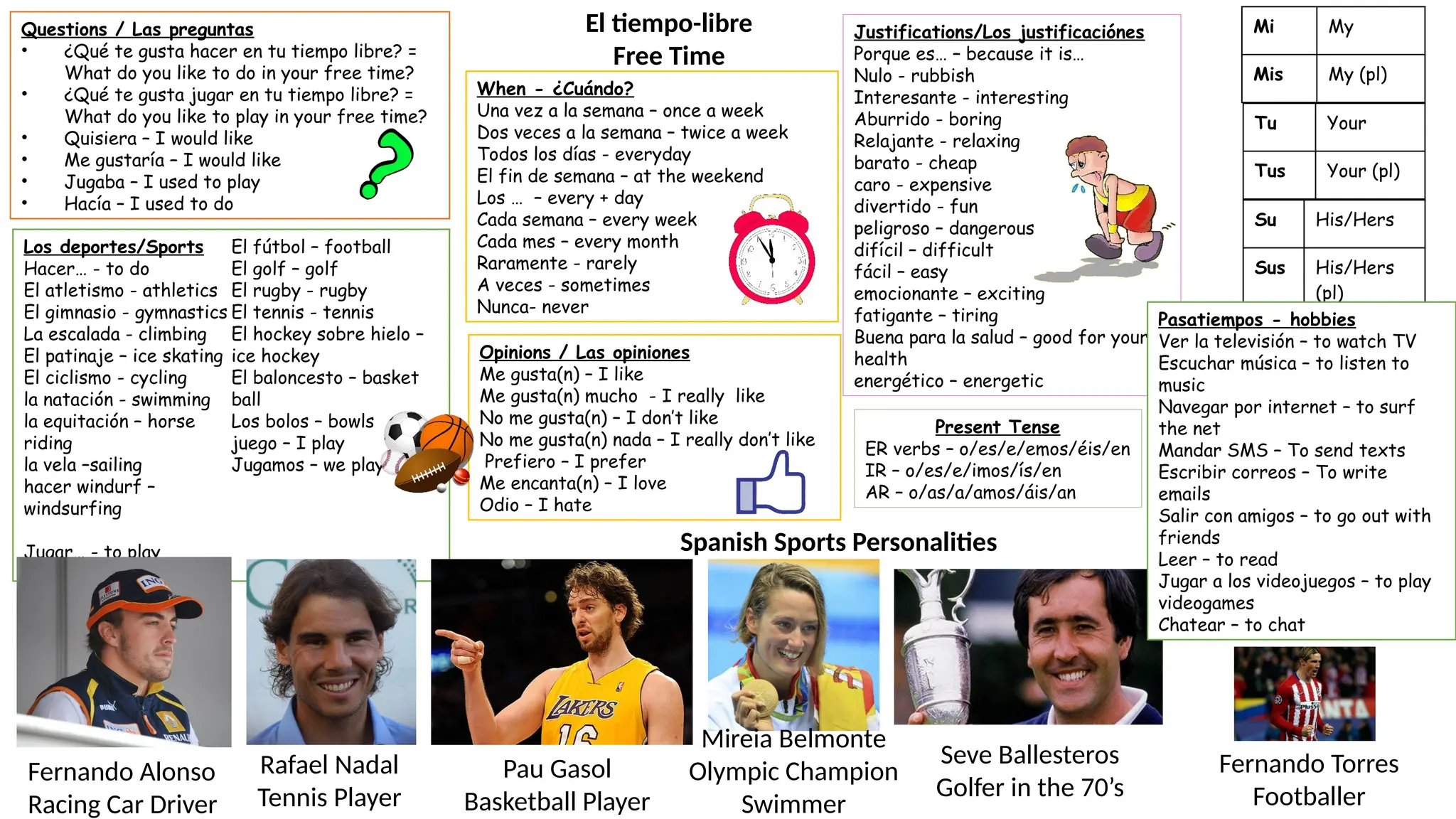
Questions / Laspreguntas
• ¿Qué te gusta hacer en tu tiempo libre? =
What do you like to do in your free time?
• ¿Qué te gusta jugar en tu tiempo libre? =
What do you like to play in your free time?
• Quisiera – I would like
• Me gustaría – I would like
• Jugaba – I used to play
• Hacía – I used to do
Los deportes/Sports
Hacer… - to do
El atletismo - athletics
El gimnasio - gymnastics
La escalada - climbing
El patinaje – ice skating
El ciclismo - cycling
la natación - swimming
la equitación – horse
riding
la vela –sailing
hacer windurf –
windsurfing
Jugar… - to play
El fútbol – football
El golf – golf
El rugby - rugby
El tennis - tennis
El hockey sobre hielo –
ice hockey
El baloncesto – basket
ball
Los bolos – bowls
juego – I play
Jugamos – we play
Justifications/Los justificaciónes
Porque es… – because it is…
Nulo - rubbish
Interesante - interesting
Aburrido - boring
Relajante - relaxing
barato - cheap
caro - expensive
divertido - fun
peligroso – dangerous
difícil – difficult
fácil – easy
emocionante – exciting
fatigante – tiring
Buena para la salud – good for your
health
energético – energetic
Opinions / Las opiniones
Me gusta(n) – I like
Me gusta(n) mucho - I really like
No me gusta(n) – I don’t like
No me gusta(n) nada – I really don’t like
Prefiero – I prefer
Me encanta(n) – I love
Odio – I hate
El tiempo-libre
Free Time
Mi My
Mis My (pl)
Tu Your
Tus Your (pl)
Su His/Hers
Sus His/Hers
(pl)
When - ¿Cuándo?
Una vez a la semana – once a week
Dos veces a la semana – twice a week
Todos los días - everyday
El fin de semana – at the weekend
Los … – every + day
Cada semana – every week
Cada mes – every month
Raramente - rarely
A veces - sometimes
Nunca- never
Fernando Alonso
Racing Car Driver
Rafael Nadal
Tennis Player
Pau Gasol
Basketball Player
Mireia Belmonte
Olympic Champion
Swimmer
Seve Ballesteros
Golfer in the 70’s
Fernando Torres
Footballer
Present Tense
ER verbs – o/es/e/emos/éis/en
IR – o/es/e/imos/ís/en
AR – o/as/a/amos/áis/an
Spanish Sports Personalities
Pasatiempos - hobbies
Ver la televisión – to watch TV
Escuchar música – to listen to
music
Navegar por internet – to surf
the net
Mandar SMS – To send texts
Escribir correos – To write
emails
Salir con amigos – to go out with
friends
Leer – to read
Jugar a los videojuegos – to play
videogames
Chatear – to chat
2.
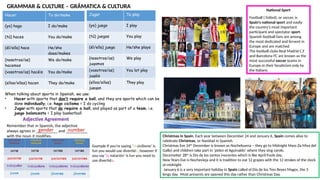
GRAMMAR & CULTURE– GRÁMATICA & CULTURA
National Sport
Football ( fútbol), or soccer, is
Spain's national sport and easily
the country's most important
participant and spectator sport.
Spanish football fans are among
the most dedicated and fervent in
Europe and are matched
The football clubs Real Madrid C.F
and Barcelona FC are known as the
most successful soccer teams in
Europe.in their fanaticism only by
the Italians.
Christmas in Spain. Each year between December 24 and January 6, Spain comes alive to
celebrate Christmas, or Navidad in Spanish.
Christmas Eve 24th
December is known as Nochebuena – they go to Midnight Mass (la Misa del
Gallo) and children take part in ‘piden el Aguinaldo’ where they sing carols.
Decemeber 28th
is Día de los santos inocentes which is like April Fools day.
New Years Eve is Nochevieja and it is tradition to eat 12 grapes with the 12 strokes of the clock
at midnight.
January 6 is a very important holiday in Spain called el Día de los Tres Reyes Magos, the 3
kings day. Most presents are opened this day rather than Christmas Day.
Hacer To do/make
(yo) hago I do/make
(tú) haces You do/make
(él/ella) hace He/she
does/makes
(nosotros/as)
hacemos
We do/make
(vosotros/as) hacéis You do/make
(ellos/ellas) hacen They do/make
When talking about sports in Spanish, we use:
• Hacer with sports that don’t require a ball, and they are sports which can be
done individually, i.e. hago ciclismo = I do cycling
• Jugar with sports that do require a ball, and played as part of a team, i.e.
juego baloncesto = I play basketball
Example if you’re saying ‘el cicilismo’ is
fun you would use divertido, however if
you say ‘la natación’ is fun you need to
use divertida.
Jugar To play
(yo) juego I play
(tú) juegas You play
(él/ella) juega He/she plays
(nosotros/as)
jugamos
We play
(vosotros/as)
jugáis
You lot play
(ellos/ellas)
juegan
They play



![Jessica Cannady[1]](https://cdn.slidesharecdn.com/ss_thumbnails/jessicacannady1-090723195210-phpapp02-thumbnail.jpg?width=640&height=640&fit=bounds)


