Pilot Project By Yash Salunkhe
To give an idea of the kind of community development
projects that participants would engage in, I personally led
the group, the SILVA AMICUS ( Latin for “Forest friends” )
to demonstrate the same.…. We engaged people throughout
our project and made them aware of the importance of forests
and the environment.
We have divided our project into 4 phases:-
To begin with, we volunteered to recycle paper in our school .
Moreover we interviewed a forest officer, who gave us his
various inputs on the current condition of forests in India.
Additionally, we conducted a survey to show the difference
between the mindset of city dwellers and rural inhabitants.
And .. Lastly , we went to a forest and helped in protecting
This is the first stage of our project, where we
decided to start with something simple. And also,
it seemed only right that we start from our
school, which so actively participates in
environment conservation, and inspires us to
work for it.
Well, paper is required and used for anything and
everything one can think of.
For every ton of paper, the paper industry
guzzles up 2.8 tons of dry timber besides
electricity and other resources.
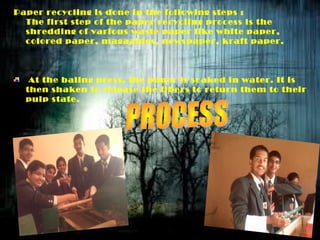
Paper recycling is done in the following steps :
The first step of the paper recycling process is the
shredding of various waste paper like white paper,
colored paper, magazines, newspaper, kraft paper.
At the baling press, the paper is soaked in water. It is
then shaken to release the fibers to return them to their
pulp state.
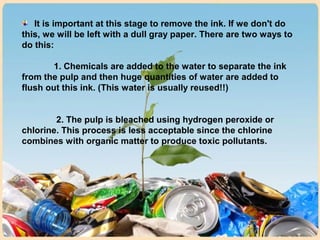
It is important at this stage to remove the ink. If we don't do
this, we will be left with a dull gray paper. There are two ways to
do this:
1. Chemicals are added to the water to separate the ink
from the pulp and then huge quantities of water are added to
flush out this ink. (This water is usually reused!!)
2. The pulp is bleached using hydrogen peroxide or
chlorine. This process is less acceptable since the chlorine
combines with organic matter to produce toxic pollutants.
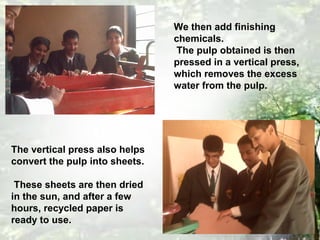
We then add finishing
chemicals.
The pulp obtained is then
pressed in a vertical press,
which removes the excess
water from the pulp.
The vertical press also helps
convert the pulp into sheets.
These sheets are then dried
in the sun, and after a few
hours, recycled paper is
ready to use.
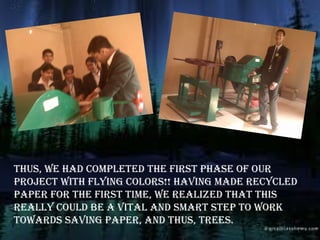
Thus, we had compleTed The firsT phase of our
projecT wiTh flying colors!! having made recycled
paper for The firsT Time, we realized ThaT This
really could be a viTal and smarT sTep To work
Towards saving paper, and Thus, Trees.
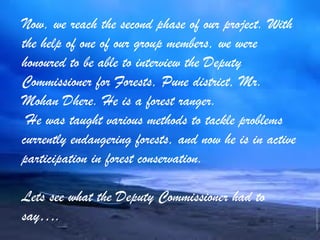
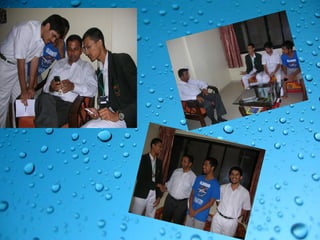
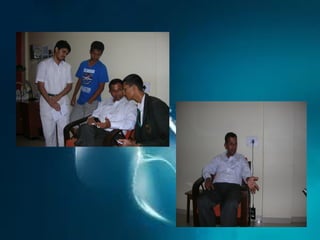
Now, we reach the second phase of our project. With
the help of one of our group members, we were
honoured to be able to interview the Deputy
Commissioner for Forests, Pune district, Mr.
Mohan Dhere. He is a forest ranger.
He was taught various methods to tackle problems
currently endangering forests, and now he is in active
participation in forest conservation.
Lets see what the Deputy Commissioner had to
say….
Q. Which forest do you work in? What is
the current condition of forests in
Maharashtra?
Q. What are private forests?
Q. What laws has the government
enforced to protect the forest cover of the
country?
Q. According to you, what hinders the
protection of forests in India?
Q. Are there any rules for farmers who
cultivate farms close to forests?
Q. Mines mostly come up in areas with dense
forests. Are there any provisions if such
cases come up?
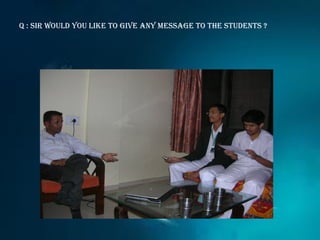
Q : sir would you like to give any message to the students ?
Mr. Mohan Dhere works in a forest near Baramati. He said that the state
target of forest cover for Maharashtra is 15%. But the current forest cover
is 8%. He also explained us about private forests, and the special laws
governing them.
He mentioned some laws pertaining to general forests. Although, he also
added that Indian law implementation requires much more stringency,
since corruption and poverty in India is a major driving force behind
poaching of animals and encroachment of forest land.
After these enlightening words with the forest
ranger.... we thanked him and took his leave... but
took with us a fruitful and cherished experience.
As the third phase of our project, we thought of
knowing exactly how we all feel and think about forests.
Agreed that humans’ lives depend upon forests, but what
is the approach of us humans towards our life source??
Lets find out……………..
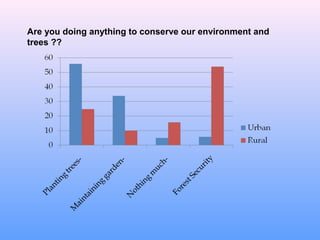
Are you doing anything to conserve our environment and
trees ??
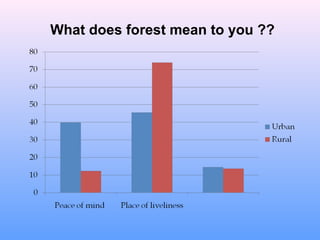
What does forest mean to you ??
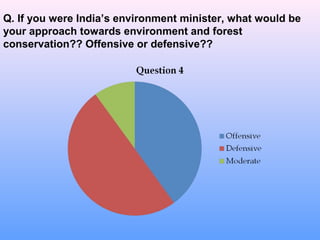
Q. If you were India’s environment minister, what would be
your approach towards environment and forest
conservation?? Offensive or defensive??
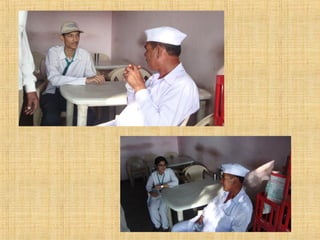
We, thus could analyze and realize the
difference between a city dweller and rural
dweller’s perception about forests. Though it is
heartening to see that rural areas tend to be
more closer and respectful to forests, it is also
necessary that they have the right education to
be more judicious in their use.
We city dwellers, on the other hand, have to bring in a
realization in ourselves.. That it is time to return to our
environment… if not anything else.. At least a token of
gratitude and appreciation for our Mother Earth.
This is The fourTh
phase of our
projecT ….
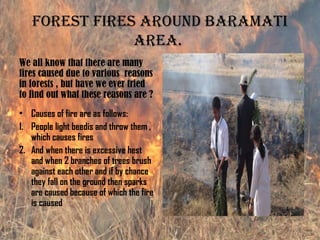
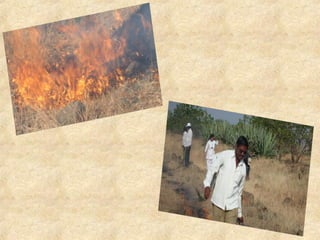
foresT fires around BaramaTi
area.
We all know that there are many
fires caused due to various reasons
in forests , but have we ever tried
to find out what these reasons are ?
• Causes of fire are as follows:
1. People light beedis and throw them ,
which causes fires
2. And when there is excessive hest
and when 2 branches of trees brush
against each other and if by chance
they fall on the ground then sparks
are caused because of which the fire
is caused
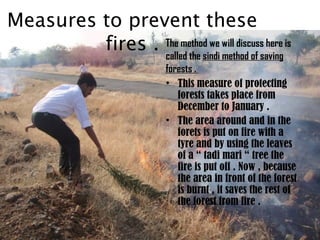
Measures to prevent these
fires . The method we will discuss here is
called the sindi method of savingsindi method of saving
forests .forests .
• This measure of protecting
forests takes place from
December to January .
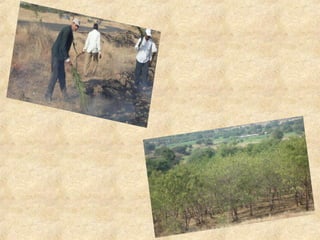
• The area around and in the
forets is put on fire with a
tyre and by using the leaves
of a “ tadi mari “ tree the
fire is put off . Now , because
the area in front of the forest
is burnt , it saves the rest of
the forest from fire .
Conclusion….
It is imperative that locals take a stand on the
issues faced by them, such as the locals suffered
mishaps of forest fires owing to reasons
exogenous to their environment.
Through our project ,it was quite enriching to
initiate our own citizen engagement initiative
wherein we recycled paper, identified a problem
through interviewing relevant authorities and by
interacting with the locals there .
We also enjoyed doing our bit to try and
Firstly, I would like to thank the World bank group for designing
such an intensive and enlightening course, which had a good
balance between theory and practice.
I would also like to acknowledge that the most active medium of
learning was by-far from my fellow colleagues, whose posts I
regularly read in the discussion forums.
And to express our deepest gratitude to Mr. Mohan Dhere for
giving us his precious time and sharing his vast knowledge.
Lastly, we also like to extend our vote of thanks to the inhabitants
of Baramati for sharing their views with us .
Yash Salunkhe's Citizen Engagement-Pilot project

Yash Salunkhe's Citizen Engagement-Pilot project

  • 1.
    Pilot Project ByYash Salunkhe
  • 2.
    To give anidea of the kind of community development projects that participants would engage in, I personally led the group, the SILVA AMICUS ( Latin for “Forest friends” ) to demonstrate the same.…. We engaged people throughout our project and made them aware of the importance of forests and the environment. We have divided our project into 4 phases:- To begin with, we volunteered to recycle paper in our school . Moreover we interviewed a forest officer, who gave us his various inputs on the current condition of forests in India. Additionally, we conducted a survey to show the difference between the mindset of city dwellers and rural inhabitants. And .. Lastly , we went to a forest and helped in protecting
  • 3.
    This is thefirst stage of our project, where we decided to start with something simple. And also, it seemed only right that we start from our school, which so actively participates in environment conservation, and inspires us to work for it. Well, paper is required and used for anything and everything one can think of. For every ton of paper, the paper industry guzzles up 2.8 tons of dry timber besides electricity and other resources.
  • 4.
    Paper recycling isdone in the following steps : The first step of the paper recycling process is the shredding of various waste paper like white paper, colored paper, magazines, newspaper, kraft paper. At the baling press, the paper is soaked in water. It is then shaken to release the fibers to return them to their pulp state.
  • 5.
    It is importantat this stage to remove the ink. If we don't do this, we will be left with a dull gray paper. There are two ways to do this: 1. Chemicals are added to the water to separate the ink from the pulp and then huge quantities of water are added to flush out this ink. (This water is usually reused!!) 2. The pulp is bleached using hydrogen peroxide or chlorine. This process is less acceptable since the chlorine combines with organic matter to produce toxic pollutants.
  • 6.
    We then addfinishing chemicals. The pulp obtained is then pressed in a vertical press, which removes the excess water from the pulp. The vertical press also helps convert the pulp into sheets. These sheets are then dried in the sun, and after a few hours, recycled paper is ready to use.
  • 7.
    Thus, we hadcompleTed The firsT phase of our projecT wiTh flying colors!! having made recycled paper for The firsT Time, we realized ThaT This really could be a viTal and smarT sTep To work Towards saving paper, and Thus, Trees.
  • 9.
    Now, we reachthe second phase of our project. With the help of one of our group members, we were honoured to be able to interview the Deputy Commissioner for Forests, Pune district, Mr. Mohan Dhere. He is a forest ranger. He was taught various methods to tackle problems currently endangering forests, and now he is in active participation in forest conservation. Lets see what the Deputy Commissioner had to say….
  • 10.
    Q. Which forestdo you work in? What is the current condition of forests in Maharashtra? Q. What are private forests? Q. What laws has the government enforced to protect the forest cover of the country?
  • 12.
    Q. According toyou, what hinders the protection of forests in India? Q. Are there any rules for farmers who cultivate farms close to forests? Q. Mines mostly come up in areas with dense forests. Are there any provisions if such cases come up?
  • 14.
    Q : sirwould you like to give any message to the students ?
  • 15.
    Mr. Mohan Dhereworks in a forest near Baramati. He said that the state target of forest cover for Maharashtra is 15%. But the current forest cover is 8%. He also explained us about private forests, and the special laws governing them. He mentioned some laws pertaining to general forests. Although, he also added that Indian law implementation requires much more stringency, since corruption and poverty in India is a major driving force behind poaching of animals and encroachment of forest land. After these enlightening words with the forest ranger.... we thanked him and took his leave... but took with us a fruitful and cherished experience.
  • 16.
    As the thirdphase of our project, we thought of knowing exactly how we all feel and think about forests. Agreed that humans’ lives depend upon forests, but what is the approach of us humans towards our life source?? Lets find out……………..
  • 18.
    Are you doinganything to conserve our environment and trees ??
  • 19.
    What does forestmean to you ??
  • 20.
    Q. If youwere India’s environment minister, what would be your approach towards environment and forest conservation?? Offensive or defensive??
  • 21.
    We, thus couldanalyze and realize the difference between a city dweller and rural dweller’s perception about forests. Though it is heartening to see that rural areas tend to be more closer and respectful to forests, it is also necessary that they have the right education to be more judicious in their use. We city dwellers, on the other hand, have to bring in a realization in ourselves.. That it is time to return to our environment… if not anything else.. At least a token of gratitude and appreciation for our Mother Earth.
  • 22.
    This is ThefourTh phase of our projecT ….
  • 23.
    foresT fires aroundBaramaTi area. We all know that there are many fires caused due to various reasons in forests , but have we ever tried to find out what these reasons are ? • Causes of fire are as follows: 1. People light beedis and throw them , which causes fires 2. And when there is excessive hest and when 2 branches of trees brush against each other and if by chance they fall on the ground then sparks are caused because of which the fire is caused
  • 25.
    Measures to preventthese fires . The method we will discuss here is called the sindi method of savingsindi method of saving forests .forests . • This measure of protecting forests takes place from December to January . • The area around and in the forets is put on fire with a tyre and by using the leaves of a “ tadi mari “ tree the fire is put off . Now , because the area in front of the forest is burnt , it saves the rest of the forest from fire .
  • 28.
    Conclusion…. It is imperativethat locals take a stand on the issues faced by them, such as the locals suffered mishaps of forest fires owing to reasons exogenous to their environment. Through our project ,it was quite enriching to initiate our own citizen engagement initiative wherein we recycled paper, identified a problem through interviewing relevant authorities and by interacting with the locals there . We also enjoyed doing our bit to try and
  • 29.
    Firstly, I wouldlike to thank the World bank group for designing such an intensive and enlightening course, which had a good balance between theory and practice. I would also like to acknowledge that the most active medium of learning was by-far from my fellow colleagues, whose posts I regularly read in the discussion forums. And to express our deepest gratitude to Mr. Mohan Dhere for giving us his precious time and sharing his vast knowledge. Lastly, we also like to extend our vote of thanks to the inhabitants of Baramati for sharing their views with us .