12th EARC AM
International Conference
April 25-26, Kyiv, Ukraine
Presentation Title:
XBRL – A Common Language for Data Reporting
Presented By:
Liv A. Watson
Sr. Director of Strategic Customer Initiatives
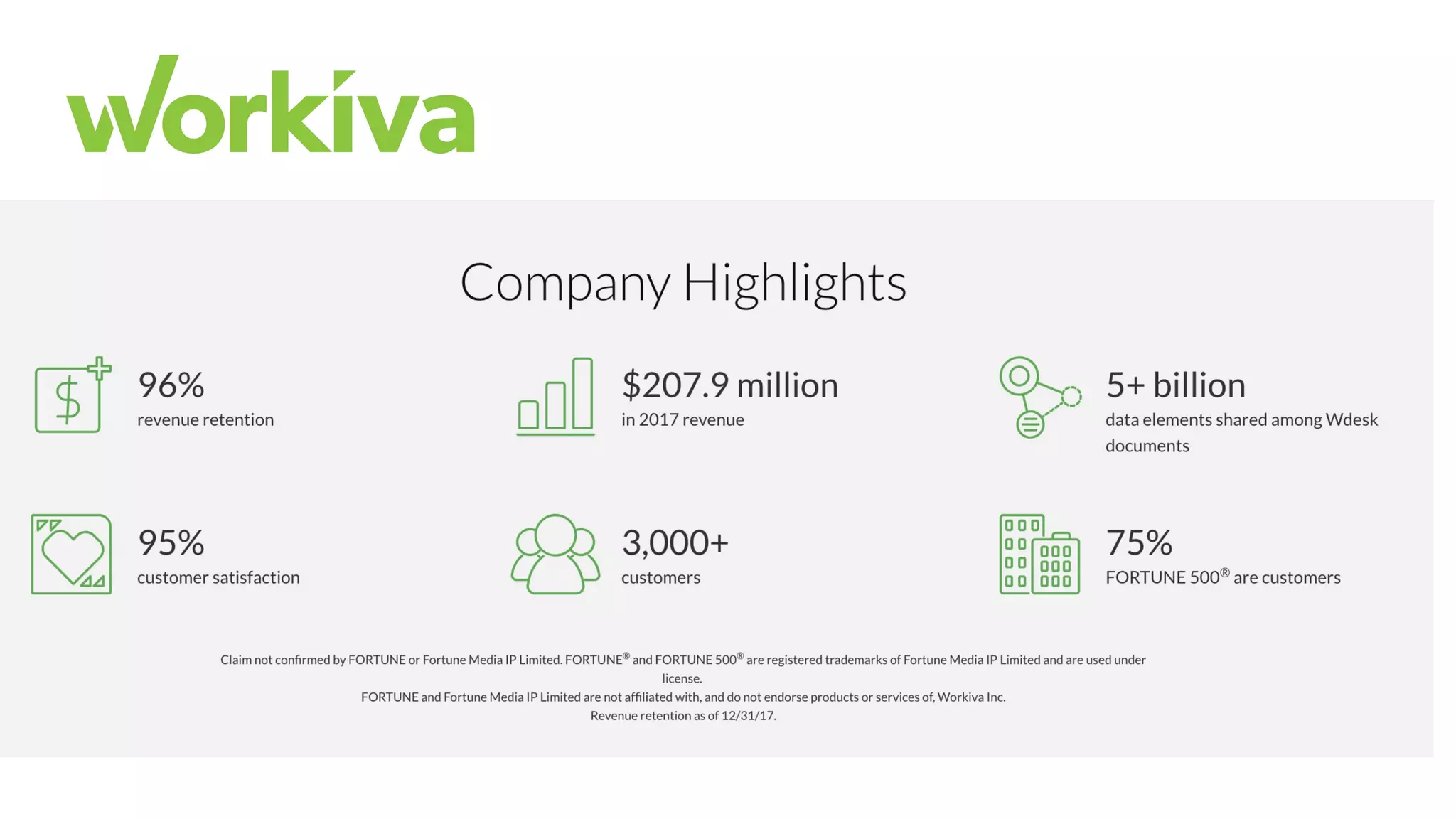
Workiva, Inc [NYSE: WK]
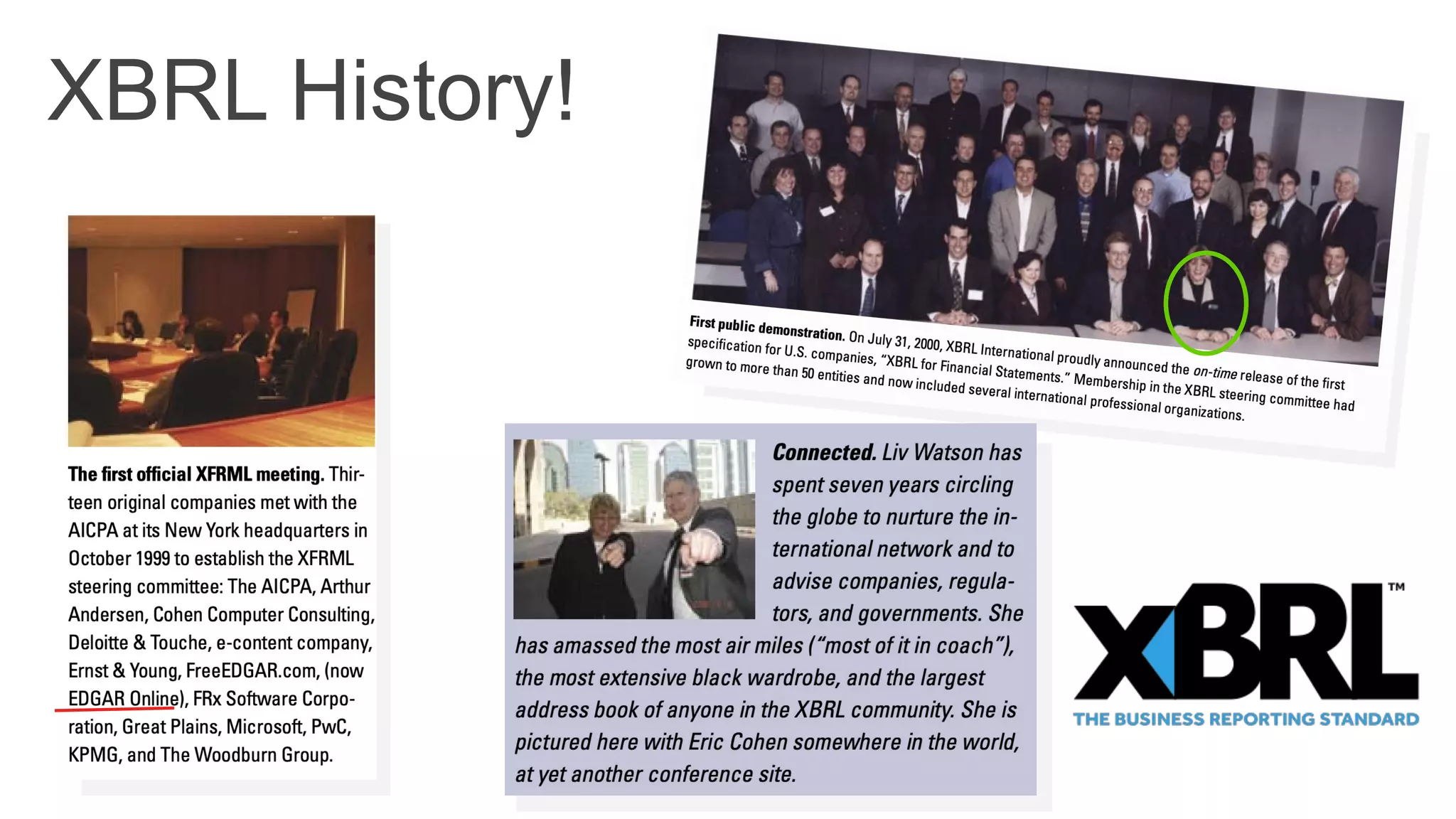
XBRL History!
Today's Agenda
XBRL for Dummies
Around the World with XBRL
RegTech Innovation with XBRL
Key Takeaway
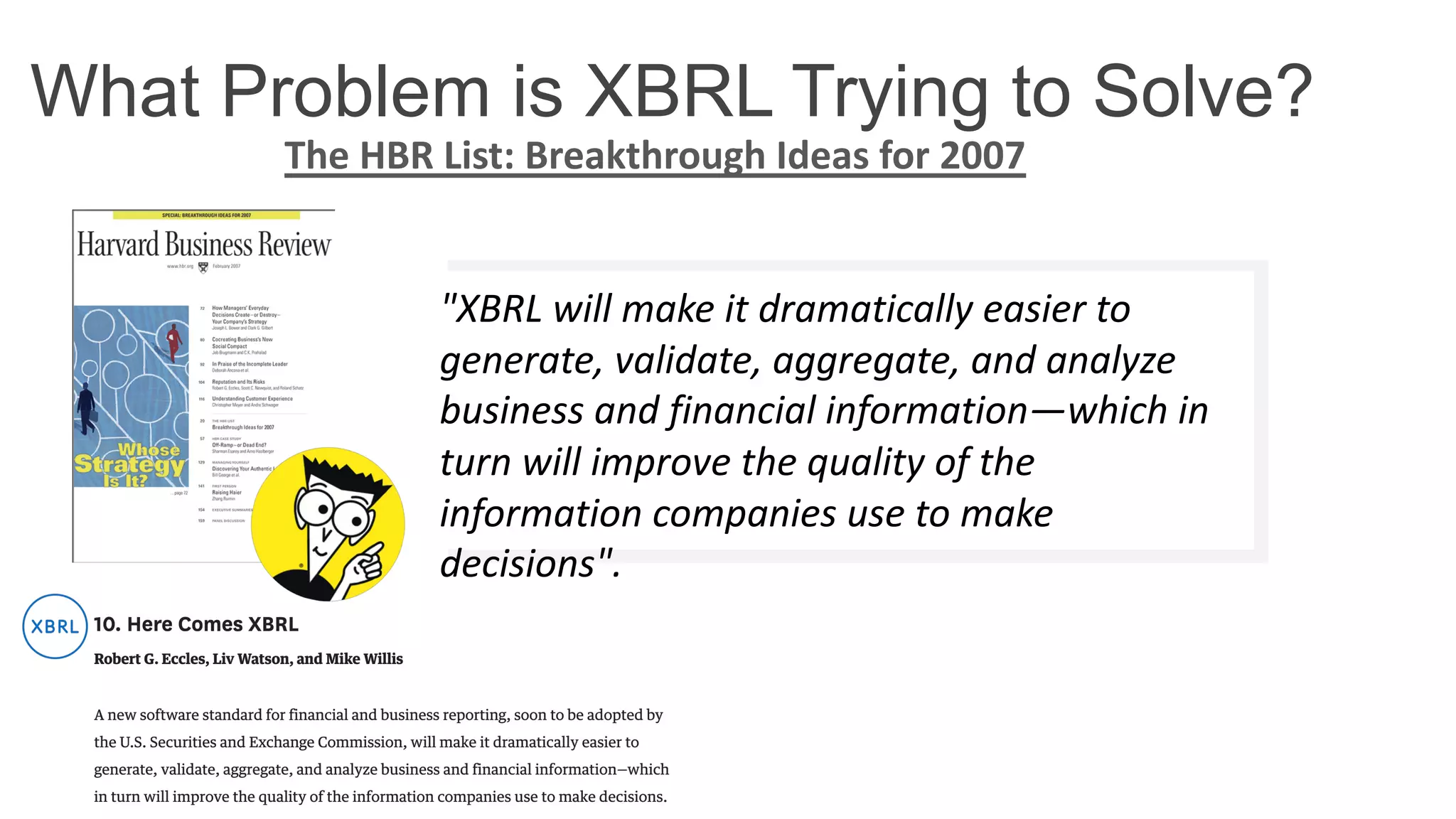
The HBR List: Breakthrough Ideas for 2007
What Problem is XBRL Trying to Solve?
"XBRL will make it dramatically easier to
generate, validate, aggregate, and analyze
business and financial information—which in
turn will improve the quality of the
information companies use to make
decisions".
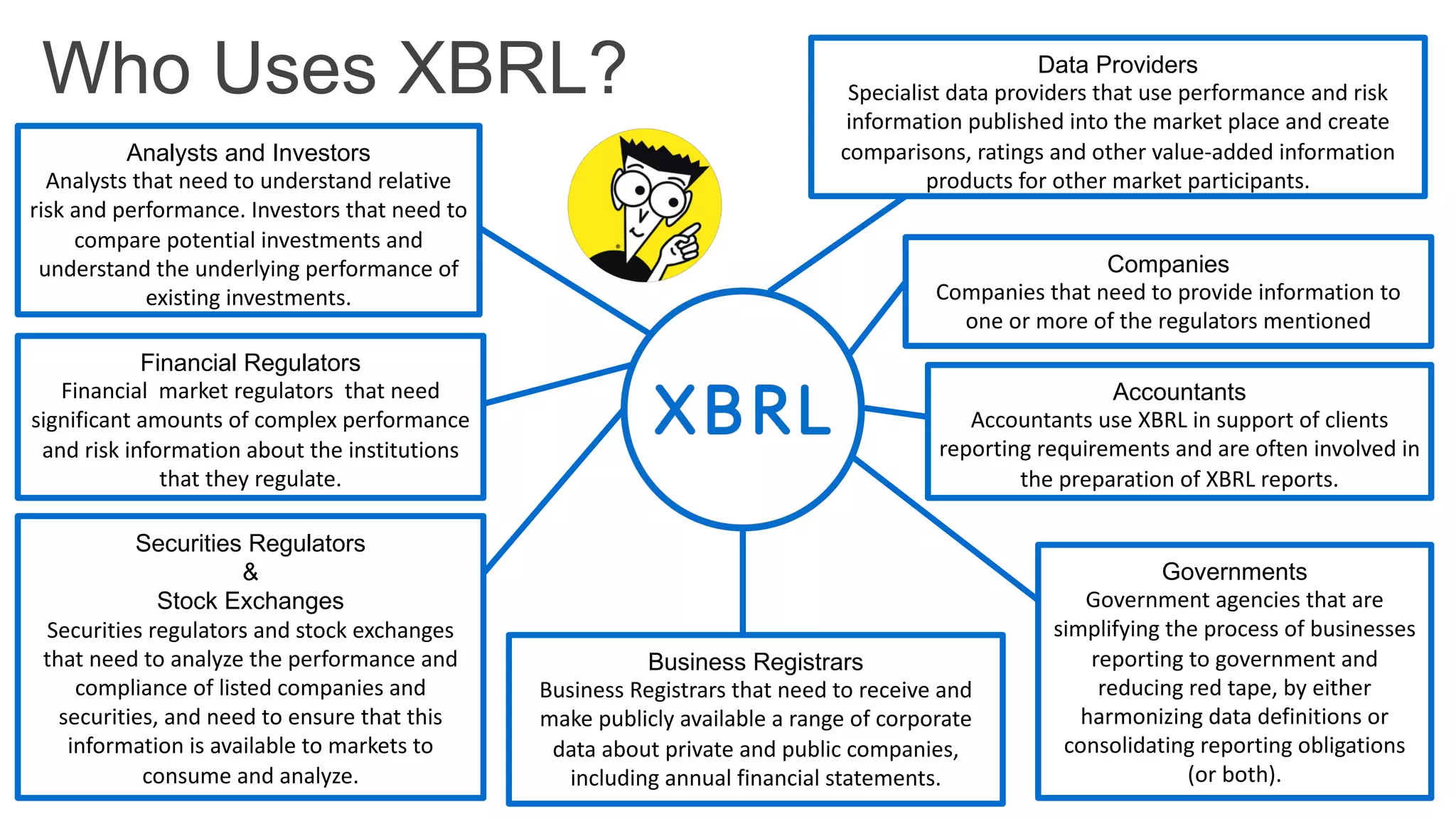
Who Uses XBRL?
Financial Regulators
Financial market regulators that need
significant amounts of complex performance
and risk information about the institutions
that they regulate.
Business Registrars
Business Registrars that need to receive and
make publicly available a range of corporate
data about private and public companies,
including annual financial statements.
Securities Regulators
&
Stock Exchanges
Securities regulators and stock exchanges
that need to analyze the performance and
compliance of listed companies and
securities, and need to ensure that this
information is available to markets to
consume and analyze.
Companies
Companies that need to provide information to
one or more of the regulators mentioned
Governments
Government agencies that are
simplifying the process of businesses
reporting to government and
reducing red tape, by either
harmonizing data definitions or
consolidating reporting obligations
(or both).
Data Providers
Specialist data providers that use performance and risk
information published into the market place and create
comparisons, ratings and other value-added information
products for other market participants.
Analysts and Investors
Analysts that need to understand relative
risk and performance. Investors that need to
compare potential investments and
understand the underlying performance of
existing investments.
Accountants
Accountants use XBRL in support of clients
reporting requirements and are often involved in
the preparation of XBRL reports.
XBRL Specification
Provides the fundamental technical
definition of how XBRL works.
XBRL Taxonomy
Taxonomies are dictionaries of business
terms and their corresponding tags—for
example, the IFRS Taxonomy.
Inline XBRL or iXBRL specification
The Inline XBRL or iXBRL specification
provides a mechanism for embedding
XBRL tags in XHTML documents.
How XBRL Work Together?
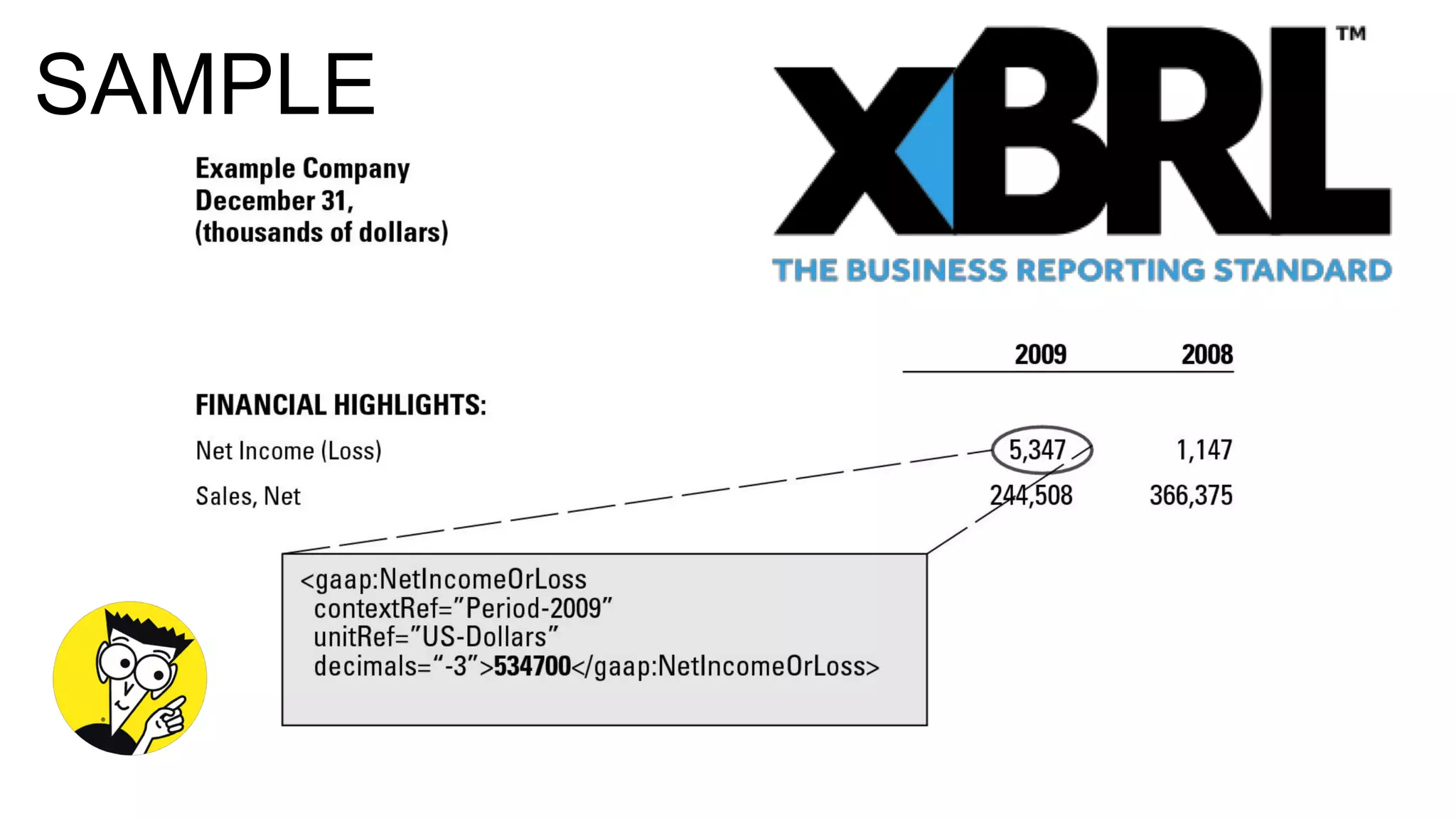
SAMPLE
SEC Committed to Human-and-Machine-Readable Format
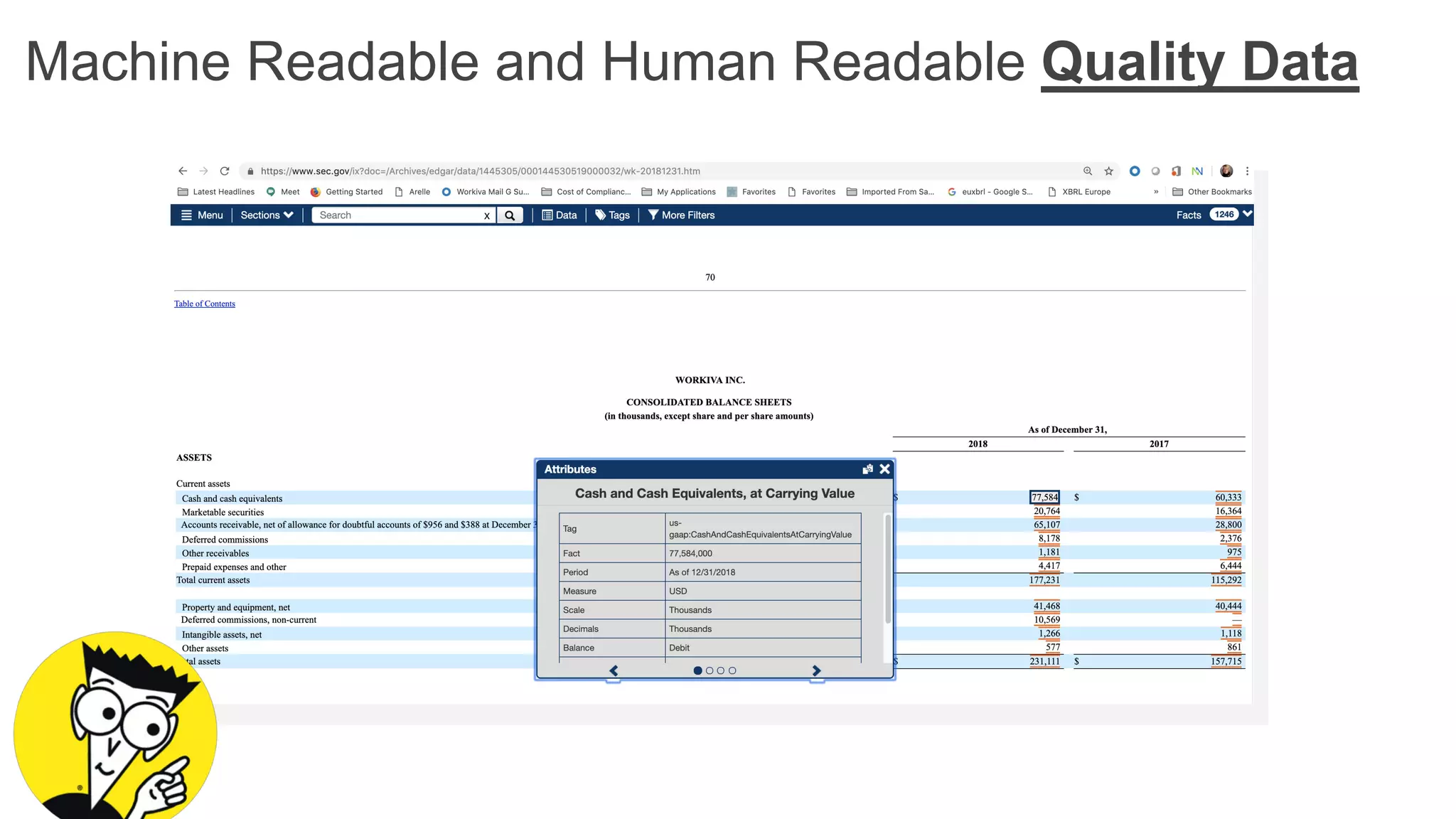
Machine Readable and Human Readable Quality Data
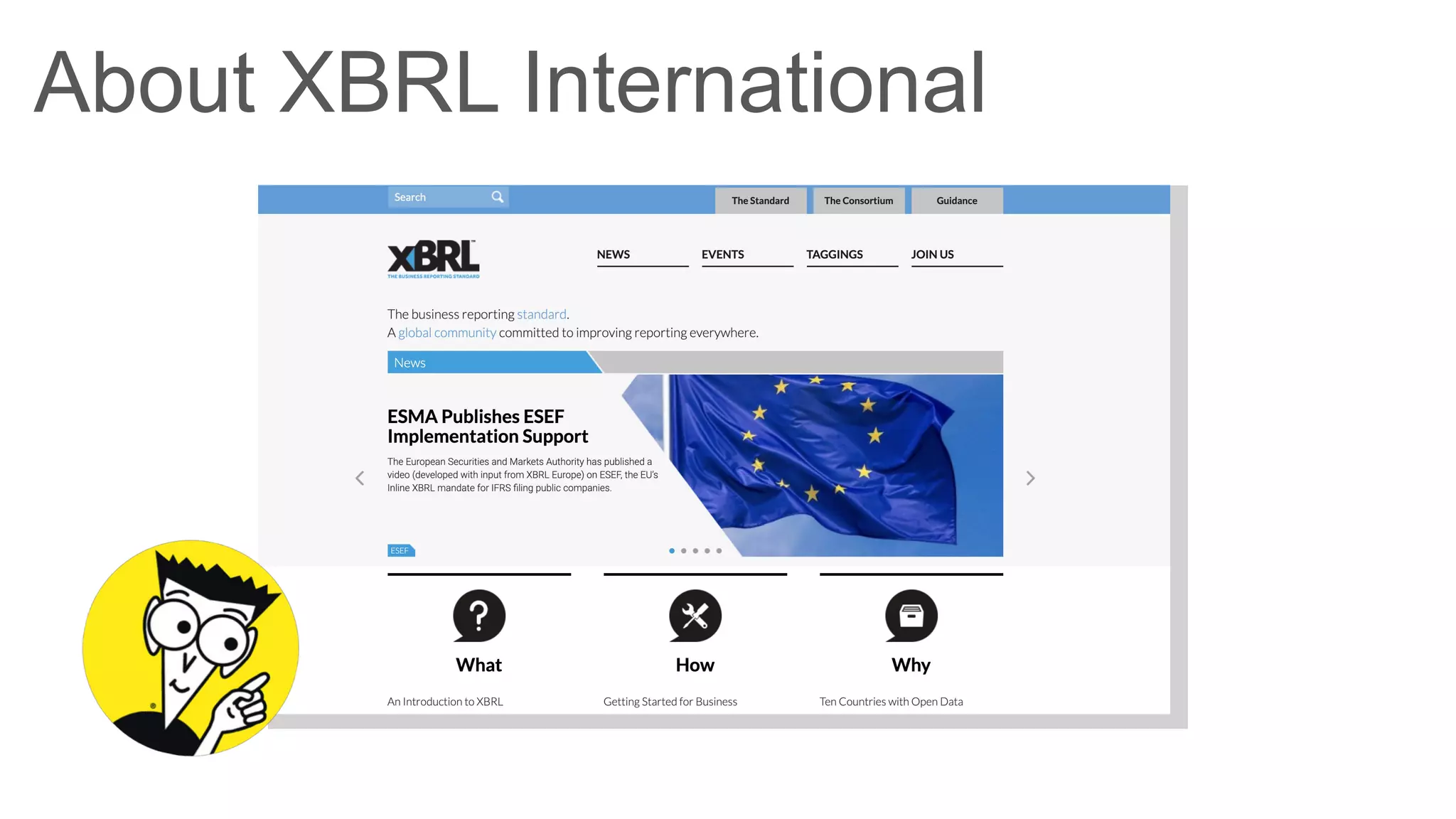
About XBRL International
Compelling Reasons to Consider XBRL
Making financial and business information exchange better, faster, and cheaper
Making financial reporting more transparent and discoverable
Explicitly articulating business meaning and thus enabling the exchange of that
meaning between humans or between business systems
Improving data integrity
Integrating business systems
Saving government agencies money and making them more efficient
Key Take Away
XBRL is a freely available electronic language for financial and business reporting.
XBRL provides an XML-based framework that the global business information supply chain can use
to create, exchange, and analyze business reporting information including, but not limited to,
regulatory filings such as annual and quarterly financial statements, general ledger information, and
audit schedules.
XBRL is not about establishing new accounting and reporting standards but enhancing the usability
of the ones that we have through the digital transformation of business reporting.
XBRL will not require additional disclosure from companies to outside audiences.
Around the World with XBRL
Project:
The Integrated
Reporting Framework
(IReF) and the Banks’
Integrated Reporting
Dictionary (BIRD)
Source: http://www.xbrleurope.org/wp-content/uploads/2019/02/2.-22ndXBRLEuropeDayRome2019-02-08-IReF-and-BIRD-.pdf
XBRL at ESMA
Decreased total cost of ownership:
• The FDIC reduced the total cost of ownership of their system from $65 million to $39 million, a
savings of $26 million.
Greater timeliness of information:
• The FDIC reduced the time it took to make information available from 45 days to 2 days.
Higher quality of information:
• Contributing to the reduction of mathematical errors from 18,000 to 0 in the very first filing
period XBRL was used
• Reduced the number of analysts needed to detect and correct mathematical errors by 33
percent because the analysts did not have to call banks and ask them to correct this type of
error in their submissions
XBRL at the U.S. FDIC
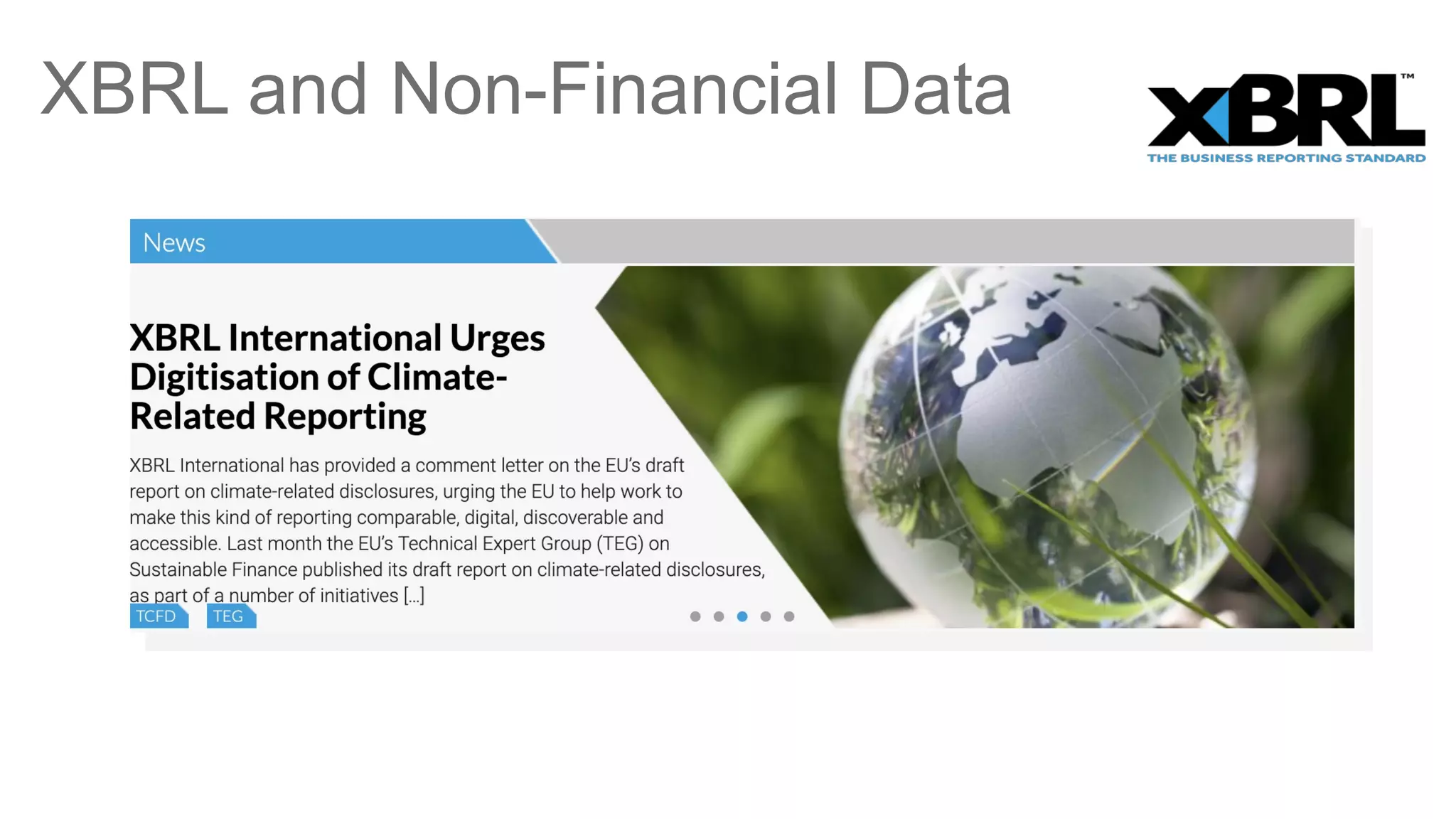
XBRL and Non-Financial Data
SDGs AND XBRL
XBRL at the Mumbai Stock Exchange
XBRL and SBR
RegTech
Innovation
with XBRL
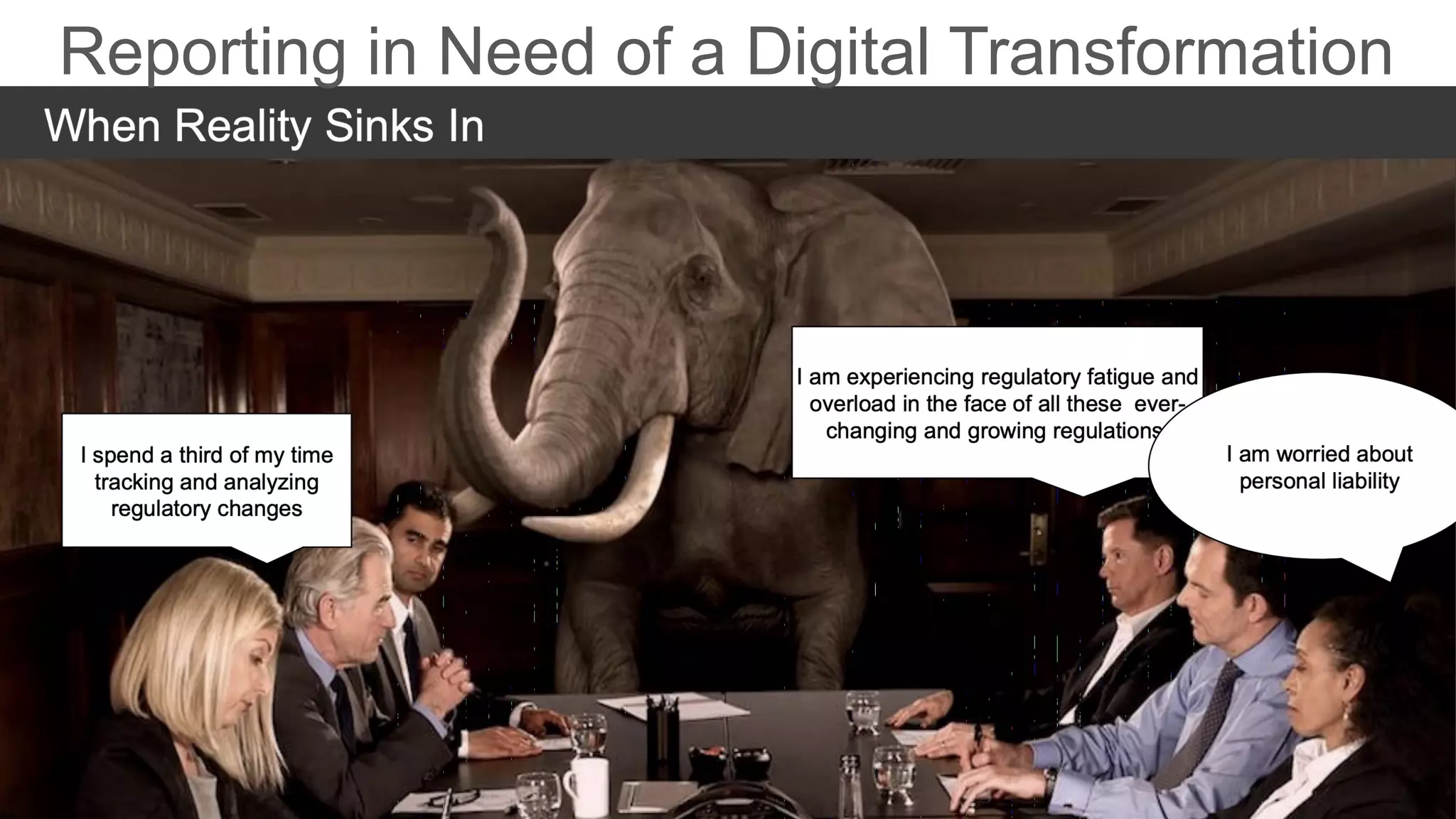
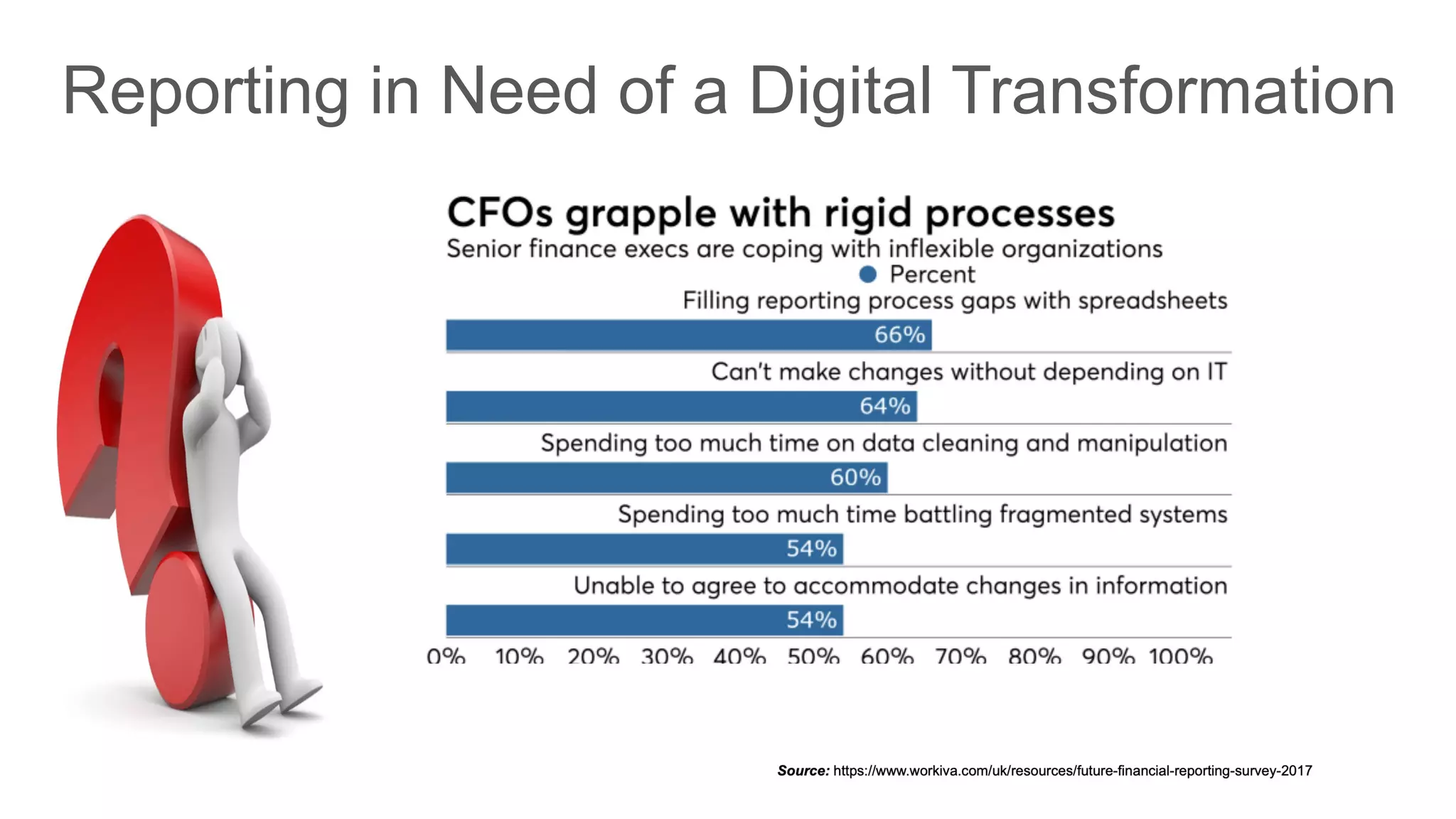
Reporting in Need of a Digital Transformation
Reimagine Data Architecture
Reimagine Data in the Cloud
Compliance in Need of a Digital Transformation
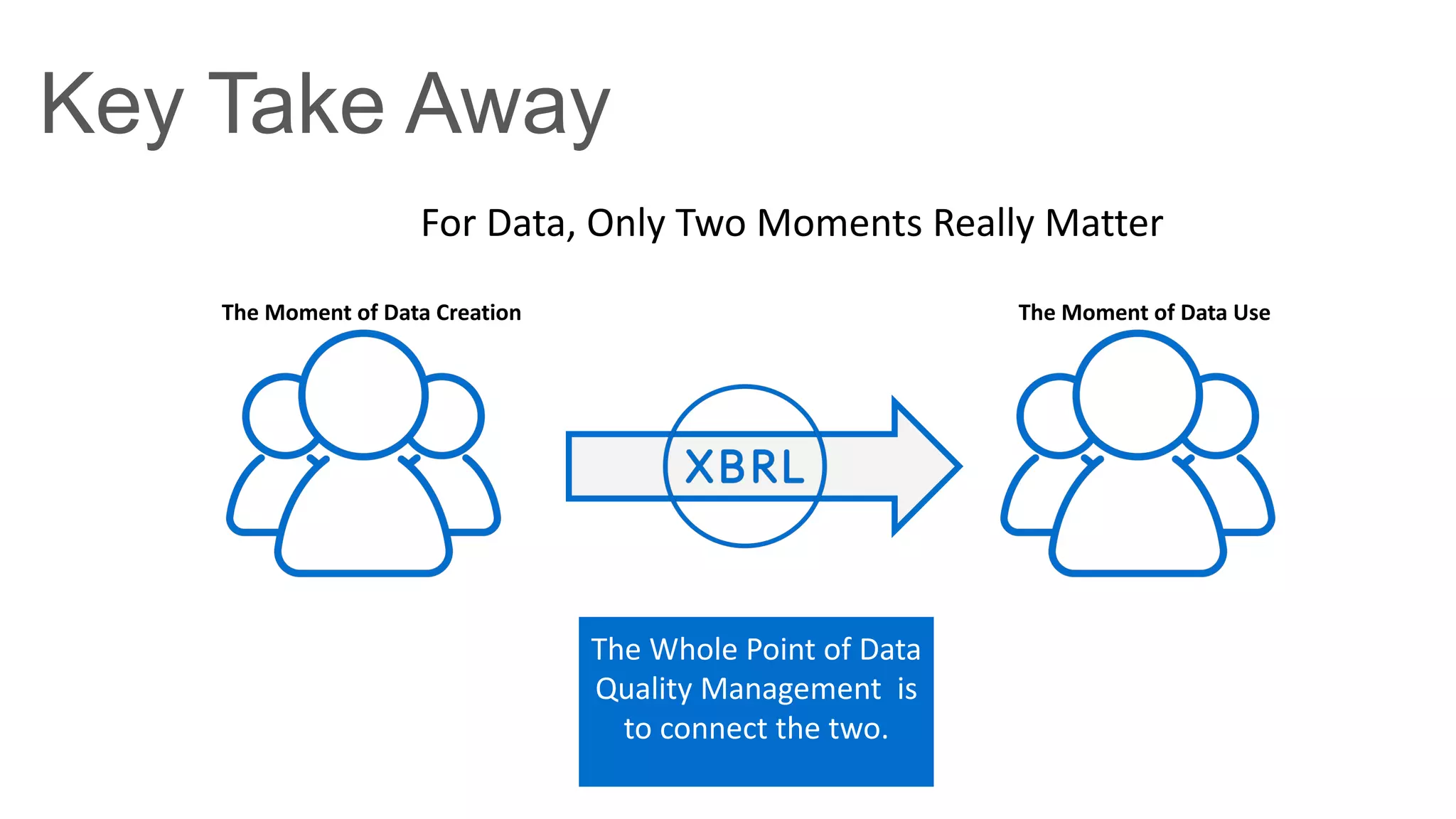
The Moment of Data Creation
Key Take Away
The Moment of Data Use
For Data, Only Two Moments Really Matter
The Whole Point of Data
Quality Management is
to connect the two.
Presenter
Honors-Awards
IMA Global Distinguished Member Award - 2016
Lybrand Silver Medal for article titled
" Possible Second-Wave Benefits of
XBRL"
Certificate of Merit Awarded by IMA
- Article "XBRL it Can Improve
Today's Business Environment
Eurofiling Hall of Fame - Recognition
to Outstanding Contributors
Lybrand Certificate of Merit for article
titled "XBRL AND THE CLOUD"
Liv Watson
Sr. Director of Strategic Customer Initiatives
Workiva Inc. (NYSE: WK)
Liv A. Watson is a Senior Director of Strategic Customer Initiatives at
Workiva Inc. (NYSE:WK). Watson recently served as Chair of the Institute
of Management Accountants (IMA) Technology Trends Subcommittee,
member of the Institute of Chartered Accountants in England and Wales
(ICAEW) Sustainability Committee, member of the Global Reporting
Initiative (GRI) Technology consortium, and an active member of the XBRL
International Funding Task Force.
Watson authored one of the IMA's most successful CPE courses,
Accounting System Technology for the 21st Century. She has published
numerous articles for international publications and journals, including
Harvard Business Review and Strategic Finance. She has also written a
monthly column on financial and business reporting trends for
CPA2Biz.com. Watson is the co-author and contributing author to several
books, including XBRL for Dummies as well as Governance, Risk, and
Compliance Handbook published by Wiley. She is also a contributing
author of the Harvard Business School’s first e-books titled, The Landscape
of Integrated Reporting, and Effective Auditing for Corporations published
by Bloomsbury.

XBRL - A Common Language For Data Reporting / Kyiv, 25-26 April 2019

  • 1.
    12th EARC AM InternationalConference April 25-26, Kyiv, Ukraine Presentation Title: XBRL – A Common Language for Data Reporting Presented By: Liv A. Watson Sr. Director of Strategic Customer Initiatives Workiva, Inc [NYSE: WK]
  • 3.
  • 4.
    Today's Agenda XBRL forDummies Around the World with XBRL RegTech Innovation with XBRL Key Takeaway
  • 6.
    The HBR List:Breakthrough Ideas for 2007 What Problem is XBRL Trying to Solve? "XBRL will make it dramatically easier to generate, validate, aggregate, and analyze business and financial information—which in turn will improve the quality of the information companies use to make decisions".
  • 7.
    Who Uses XBRL? FinancialRegulators Financial market regulators that need significant amounts of complex performance and risk information about the institutions that they regulate. Business Registrars Business Registrars that need to receive and make publicly available a range of corporate data about private and public companies, including annual financial statements. Securities Regulators & Stock Exchanges Securities regulators and stock exchanges that need to analyze the performance and compliance of listed companies and securities, and need to ensure that this information is available to markets to consume and analyze. Companies Companies that need to provide information to one or more of the regulators mentioned Governments Government agencies that are simplifying the process of businesses reporting to government and reducing red tape, by either harmonizing data definitions or consolidating reporting obligations (or both). Data Providers Specialist data providers that use performance and risk information published into the market place and create comparisons, ratings and other value-added information products for other market participants. Analysts and Investors Analysts that need to understand relative risk and performance. Investors that need to compare potential investments and understand the underlying performance of existing investments. Accountants Accountants use XBRL in support of clients reporting requirements and are often involved in the preparation of XBRL reports.
  • 8.
    XBRL Specification Provides thefundamental technical definition of how XBRL works. XBRL Taxonomy Taxonomies are dictionaries of business terms and their corresponding tags—for example, the IFRS Taxonomy. Inline XBRL or iXBRL specification The Inline XBRL or iXBRL specification provides a mechanism for embedding XBRL tags in XHTML documents. How XBRL Work Together?
  • 9.
  • 10.
    SEC Committed toHuman-and-Machine-Readable Format
  • 11.
    Machine Readable andHuman Readable Quality Data
  • 12.
  • 13.
    Compelling Reasons toConsider XBRL Making financial and business information exchange better, faster, and cheaper Making financial reporting more transparent and discoverable Explicitly articulating business meaning and thus enabling the exchange of that meaning between humans or between business systems Improving data integrity Integrating business systems Saving government agencies money and making them more efficient
  • 14.
    Key Take Away XBRLis a freely available electronic language for financial and business reporting. XBRL provides an XML-based framework that the global business information supply chain can use to create, exchange, and analyze business reporting information including, but not limited to, regulatory filings such as annual and quarterly financial statements, general ledger information, and audit schedules. XBRL is not about establishing new accounting and reporting standards but enhancing the usability of the ones that we have through the digital transformation of business reporting. XBRL will not require additional disclosure from companies to outside audiences.
  • 15.
  • 16.
    Project: The Integrated Reporting Framework (IReF)and the Banks’ Integrated Reporting Dictionary (BIRD)
  • 17.
  • 18.
  • 19.
    Decreased total costof ownership: • The FDIC reduced the total cost of ownership of their system from $65 million to $39 million, a savings of $26 million. Greater timeliness of information: • The FDIC reduced the time it took to make information available from 45 days to 2 days. Higher quality of information: • Contributing to the reduction of mathematical errors from 18,000 to 0 in the very first filing period XBRL was used • Reduced the number of analysts needed to detect and correct mathematical errors by 33 percent because the analysts did not have to call banks and ask them to correct this type of error in their submissions XBRL at the U.S. FDIC
  • 20.
  • 21.
  • 22.
    XBRL at theMumbai Stock Exchange
  • 23.
  • 24.
  • 25.
    Reporting in Needof a Digital Transformation
  • 26.
    Reporting in Needof a Digital Transformation
  • 27.
  • 28.
  • 29.
  • 30.
    Compliance in Needof a Digital Transformation
  • 31.
    The Moment ofData Creation Key Take Away The Moment of Data Use For Data, Only Two Moments Really Matter The Whole Point of Data Quality Management is to connect the two.
  • 32.
    Presenter Honors-Awards IMA Global DistinguishedMember Award - 2016 Lybrand Silver Medal for article titled " Possible Second-Wave Benefits of XBRL" Certificate of Merit Awarded by IMA - Article "XBRL it Can Improve Today's Business Environment Eurofiling Hall of Fame - Recognition to Outstanding Contributors Lybrand Certificate of Merit for article titled "XBRL AND THE CLOUD" Liv Watson Sr. Director of Strategic Customer Initiatives Workiva Inc. (NYSE: WK) Liv A. Watson is a Senior Director of Strategic Customer Initiatives at Workiva Inc. (NYSE:WK). Watson recently served as Chair of the Institute of Management Accountants (IMA) Technology Trends Subcommittee, member of the Institute of Chartered Accountants in England and Wales (ICAEW) Sustainability Committee, member of the Global Reporting Initiative (GRI) Technology consortium, and an active member of the XBRL International Funding Task Force. Watson authored one of the IMA's most successful CPE courses, Accounting System Technology for the 21st Century. She has published numerous articles for international publications and journals, including Harvard Business Review and Strategic Finance. She has also written a monthly column on financial and business reporting trends for CPA2Biz.com. Watson is the co-author and contributing author to several books, including XBRL for Dummies as well as Governance, Risk, and Compliance Handbook published by Wiley. She is also a contributing author of the Harvard Business School’s first e-books titled, The Landscape of Integrated Reporting, and Effective Auditing for Corporations published by Bloomsbury.