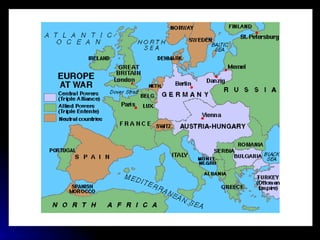
WWI: 1914-1918 Causes of the War Redivision of the world colonies Central Powers vs. Allies War begins with the assassination of an Austrian Prince
 
The US enters WWI US remains neutral until 1917 Enters the war because: German Submarines were to sink ships going to England German plot to make an alliance with Mexico German spies in America Lengthy war February Revolution (Russia)
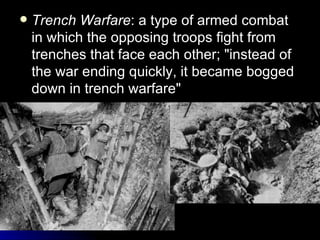
Trench Warfare : a type of armed combat in which the opposing troops fight from trenches that face each other; "instead of the war ending quickly, it became bogged down in trench warfare"
Peace Negotiations Wilson’s Fourteen Points: Open peace covenants Freedom of navigation on the seas Elimination of tariffs Reduction of arms Self-determination of all peoples Evacuation from Russia by Germany Restoration of Belgium German evacuation of France New frontier in Northern Italy New national states in Central Europe Freedom for Serbia Self-determination for the Turkish Empire A free Poland Formation of the League of Nations
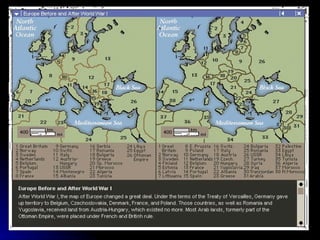
Treaty of Versailles  and the  Washington Conference June 28, 1919-Treaty of Versailles US refuses to ratify the treaty and join the league of nations an international organization formed in 1920 to promote cooperation and peace among nations; dissolved in 1946 after the United Nations was formed  November 1921-Washington Conference: Defined the Great Powers relations in the Far East and the Pacific region 1 st  disarmament in history
 
Causes of the Great Depression Speculation in the 1920s and the Stock Market:  many people bought stocks with loaned money, stock market boom was based on borrowed money and false optimism Short signed economic policies- government focused on business not wise   investing Unstable economy- unequal   distribution of   wealth Stock Market crash of 1929
Roosevelt’s New Deal The  New Deal  proposed by President Franklin Roosevelt was a plan intended to bring  economic relief ,  recovery and reform  to the country, which was suffering from the effects of the Great Depression. The emphasis was on  making government more responsive to the needs of the common people . Using activist government, the New Deal launched new programs  providing jobs and reviving the economy .
Causes of WWII Adolf Hitler and the Nazis Arian Race :  The Nazis, primarily applied the term to people of Northern European racial background. Their aim was to avoid what they considered the "worst of the German race" and to preserve the purity of European blood .  Band of Brothers
Blitzkrieg: German for 'lightning war'. A military strategy used by the Germans at the beginning of World War II to achieve victory through a series of quick offensives , especially in Belgium, Holland and France. After an initial bombardment, armor and motorized infantry were mobilized rapidly to break the weakest parts of the enemy line.
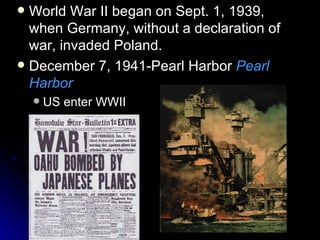
World War II began on Sept. 1, 1939, when Germany, without a declaration of war, invaded Poland.  December 7, 1941-Pearl Harbor  Pearl Harbor US enter WWII
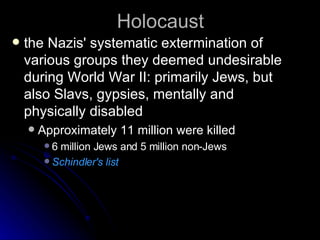
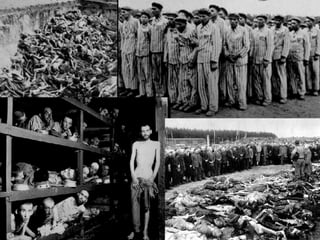
Holocaust the Nazis' systematic extermination of various groups they deemed undesirable during World War II: primarily Jews, but also Slavs, gypsies, mentally and physically disabled Approximately 11 million were killed 6 million Jews and 5 million non-Jews Schindler's list
 
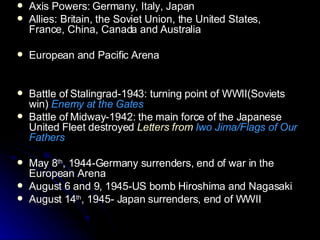
Axis Powers: Germany, Italy, Japan Allies: Britain, the Soviet Union, the United States, France, China, Canada and Australia  European and Pacific Arena Battle of Stalingrad-1943: turning point of WWII(Soviets win)  Enemy at the Gates Battle of Midway-1942: the main force of the Japanese United Fleet destroyed  Letters from  Iwo Jima/Flags of Our Fathers May 8 th , 1944-Germany surrenders, end of war in the European Arena August 6 and 9, 1945-US bomb Hiroshima and Nagasaki August 14 th , 1945- Japan surrenders, end of WWII
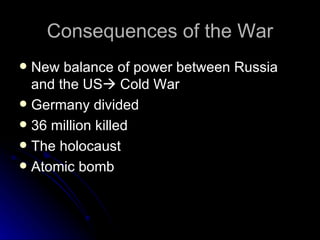
Consequences of the War New balance of power between Russia and the US   Cold War Germany divided 36 million killed The holocaust Atomic bomb
United Nations: established in 1945 at the end of World War II by 51 countries committed to preserving peace through international cooperation and collective security.
WWI: 1914-1918 Trench Warfare 1921-Washington Conference 1919-Treaty of Versailles The Great Depression1929-1933 Roosevelt’s “New Deal” WWII: 1939-1945 Aryan Race Blitzkrieg Pearl Harbor Axis vs. Allies United Nations

WW1 WW2

  • 1.
  • 2.
    WWI: 1914-1918 Causesof the War Redivision of the world colonies Central Powers vs. Allies War begins with the assassination of an Austrian Prince
  • 3.
  • 4.
    The US entersWWI US remains neutral until 1917 Enters the war because: German Submarines were to sink ships going to England German plot to make an alliance with Mexico German spies in America Lengthy war February Revolution (Russia)
  • 5.
    Trench Warfare :a type of armed combat in which the opposing troops fight from trenches that face each other; "instead of the war ending quickly, it became bogged down in trench warfare"
  • 6.
    Peace Negotiations Wilson’sFourteen Points: Open peace covenants Freedom of navigation on the seas Elimination of tariffs Reduction of arms Self-determination of all peoples Evacuation from Russia by Germany Restoration of Belgium German evacuation of France New frontier in Northern Italy New national states in Central Europe Freedom for Serbia Self-determination for the Turkish Empire A free Poland Formation of the League of Nations
  • 7.
    Treaty of Versailles and the Washington Conference June 28, 1919-Treaty of Versailles US refuses to ratify the treaty and join the league of nations an international organization formed in 1920 to promote cooperation and peace among nations; dissolved in 1946 after the United Nations was formed November 1921-Washington Conference: Defined the Great Powers relations in the Far East and the Pacific region 1 st disarmament in history
  • 8.
  • 9.
    Causes of theGreat Depression Speculation in the 1920s and the Stock Market: many people bought stocks with loaned money, stock market boom was based on borrowed money and false optimism Short signed economic policies- government focused on business not wise investing Unstable economy- unequal distribution of wealth Stock Market crash of 1929
  • 10.
    Roosevelt’s New DealThe New Deal proposed by President Franklin Roosevelt was a plan intended to bring economic relief , recovery and reform to the country, which was suffering from the effects of the Great Depression. The emphasis was on making government more responsive to the needs of the common people . Using activist government, the New Deal launched new programs providing jobs and reviving the economy .
  • 11.
    Causes of WWIIAdolf Hitler and the Nazis Arian Race : The Nazis, primarily applied the term to people of Northern European racial background. Their aim was to avoid what they considered the "worst of the German race" and to preserve the purity of European blood . Band of Brothers
  • 12.
    Blitzkrieg: German for'lightning war'. A military strategy used by the Germans at the beginning of World War II to achieve victory through a series of quick offensives , especially in Belgium, Holland and France. After an initial bombardment, armor and motorized infantry were mobilized rapidly to break the weakest parts of the enemy line.
  • 13.
    World War IIbegan on Sept. 1, 1939, when Germany, without a declaration of war, invaded Poland. December 7, 1941-Pearl Harbor Pearl Harbor US enter WWII
  • 14.
    Holocaust the Nazis'systematic extermination of various groups they deemed undesirable during World War II: primarily Jews, but also Slavs, gypsies, mentally and physically disabled Approximately 11 million were killed 6 million Jews and 5 million non-Jews Schindler's list
  • 15.
  • 16.
    Axis Powers: Germany,Italy, Japan Allies: Britain, the Soviet Union, the United States, France, China, Canada and Australia European and Pacific Arena Battle of Stalingrad-1943: turning point of WWII(Soviets win) Enemy at the Gates Battle of Midway-1942: the main force of the Japanese United Fleet destroyed Letters from Iwo Jima/Flags of Our Fathers May 8 th , 1944-Germany surrenders, end of war in the European Arena August 6 and 9, 1945-US bomb Hiroshima and Nagasaki August 14 th , 1945- Japan surrenders, end of WWII
  • 17.
    Consequences of theWar New balance of power between Russia and the US  Cold War Germany divided 36 million killed The holocaust Atomic bomb
  • 18.
    United Nations: establishedin 1945 at the end of World War II by 51 countries committed to preserving peace through international cooperation and collective security.
  • 19.
    WWI: 1914-1918 TrenchWarfare 1921-Washington Conference 1919-Treaty of Versailles The Great Depression1929-1933 Roosevelt’s “New Deal” WWII: 1939-1945 Aryan Race Blitzkrieg Pearl Harbor Axis vs. Allies United Nations