Structure of the US government
Chapter 1 Three main principles: Federalism Separation of powers(“Checks and Balances”) Constitution
Center of the National government is DC Federal of 50 States Each states inside itself has counties, townships, cities, and villages State constitution, government, laws Every citizen is under the control of two governments, their State and Federal government
Constitution-sets up a federal system of government Consists of 7 Articles and 26 amendments If there needs to be an amendment to the Constitution, it requires: 2/3 majority of Congress, or 2/3 of the States to ratify the amendment
Chapter 2: The Federal Government
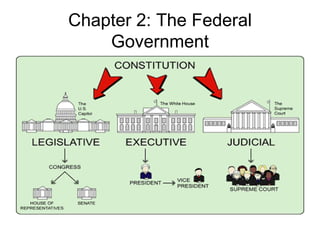
Separation of Powers/System of Checks and Balances The Constitution limits the power of each branch to prevent any one branch from gaining too much power
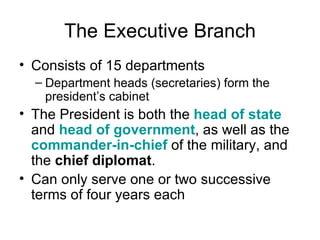
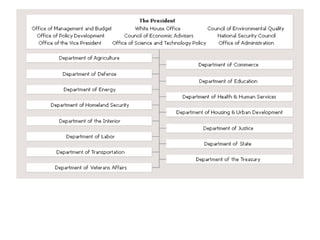
The Executive Branch Consists of 15 departments Department heads (secretaries) form the president’s cabinet The President is both the  head of state  and  head of government , as well as the  commander-in-chief  of the military, and the  chief diplomat .  Can only serve one or two successive terms of four years each
 
Legislative Branch Congress is the law-making and supreme legislative body of the US Two houses: The Senate and the House of representatives Senate: 100 members, 2 from each State House: 435 members, depending on population of the State Senators and Representatives are residents of the States they are elected
Vice President is the President of the Senate while the House has its own speaker Chief function is to make laws “Bill of impeachment”:2/3 of Congress Trial by Senate, if found guilty, the President is removed from office Also includes government officials “How a Congressional Bill becomes a law”
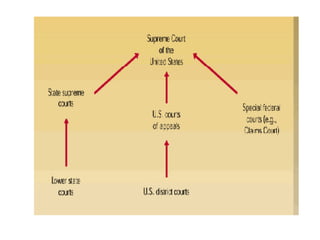
Judicial Branch “the highest court of the whole land and has the sole right to interpret the Constitution and review laws to see whether they are in agreement with the Constitution. The US Supreme Court is headed by a Chief Justice with either other judges, all called justices, who are appointed for life terms by the president with the consent of the Senate, and who can only be removed by impeachment”
Powers of the Supreme Court Interpret laws Hear appeals from any federal court cases Hear appeals from State court cases that involve the Constitution or National laws May declare a law unconstitutional May declare a presidential act unconstitutional “The Court of Last Resort”
 

US Government

  • 1.
    Structure of theUS government
  • 2.
    Chapter 1 Threemain principles: Federalism Separation of powers(“Checks and Balances”) Constitution
  • 3.
    Center of theNational government is DC Federal of 50 States Each states inside itself has counties, townships, cities, and villages State constitution, government, laws Every citizen is under the control of two governments, their State and Federal government
  • 4.
    Constitution-sets up afederal system of government Consists of 7 Articles and 26 amendments If there needs to be an amendment to the Constitution, it requires: 2/3 majority of Congress, or 2/3 of the States to ratify the amendment
  • 5.
    Chapter 2: TheFederal Government
  • 6.
    Separation of Powers/Systemof Checks and Balances The Constitution limits the power of each branch to prevent any one branch from gaining too much power
  • 7.
    The Executive BranchConsists of 15 departments Department heads (secretaries) form the president’s cabinet The President is both the head of state and head of government , as well as the commander-in-chief of the military, and the chief diplomat . Can only serve one or two successive terms of four years each
  • 8.
  • 9.
    Legislative Branch Congressis the law-making and supreme legislative body of the US Two houses: The Senate and the House of representatives Senate: 100 members, 2 from each State House: 435 members, depending on population of the State Senators and Representatives are residents of the States they are elected
  • 10.
    Vice President isthe President of the Senate while the House has its own speaker Chief function is to make laws “Bill of impeachment”:2/3 of Congress Trial by Senate, if found guilty, the President is removed from office Also includes government officials “How a Congressional Bill becomes a law”
  • 11.
    Judicial Branch “thehighest court of the whole land and has the sole right to interpret the Constitution and review laws to see whether they are in agreement with the Constitution. The US Supreme Court is headed by a Chief Justice with either other judges, all called justices, who are appointed for life terms by the president with the consent of the Senate, and who can only be removed by impeachment”
  • 12.
    Powers of theSupreme Court Interpret laws Hear appeals from any federal court cases Hear appeals from State court cases that involve the Constitution or National laws May declare a law unconstitutional May declare a presidential act unconstitutional “The Court of Last Resort”
  • 13.