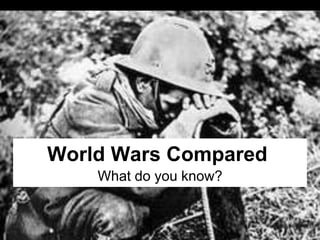
World Wars Compared
What do you know?
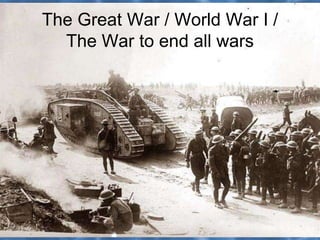
The Great War / World War I /
The War to end all wars
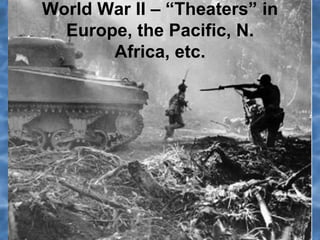
World War II – “Theaters” in
Europe, the Pacific, N.
Africa, etc.
What do you know about
World War I and World War II?
In your notebooks, brainstorm
what you know about
• Causes:
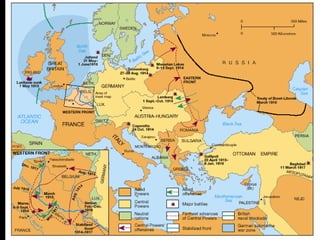
• Sides of the war:
• Who won:
• Why the winners won:
• Results:
• You have 5 minutes . . .GO!
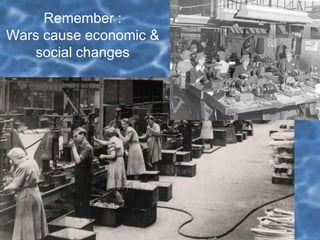
Remember :
Wars cause economic &
social changes
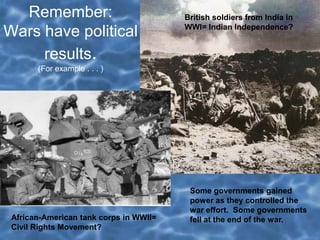
Remember:
Wars have political
results.
(For example . . . )
British soldiers from India in
WWI= Indian Independence?
African-American tank corps in WWII=
Civil Rights Movement?
Some governments gained
power as they controlled the
war effort. Some governments
fell at the end of the war.
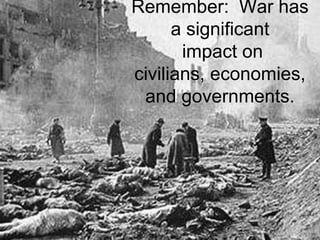
Remember: War has
a significant
impact on
civilians, economies,
and governments.
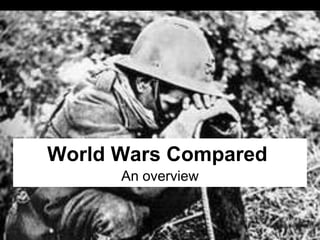
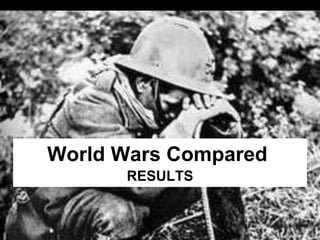
World Wars Compared
An overview
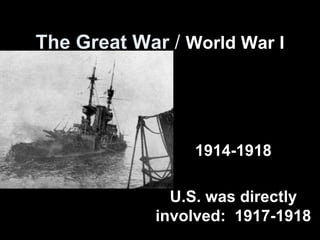
The Great War / World War I
1914-1918
U.S. was directly
involved: 1917-1918
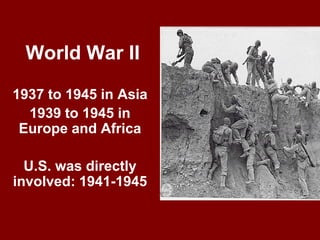
World War II
1937 to 1945 in Asia
1939 to 1945 in
Europe and Africa
U.S. was directly
involved: 1941-1945
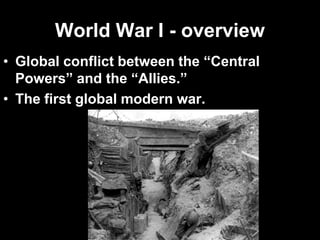
World War I - overview
• Global conflict between the “Central
Powers” and the “Allies.”
• The first global modern war.
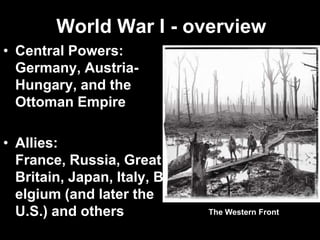
World War I - overview
• Central Powers:
Germany, Austria-
Hungary, and the
Ottoman Empire
• Allies:
France, Russia, Great
Britain, Japan, Italy, B
elgium (and later the
U.S.) and others The Western Front
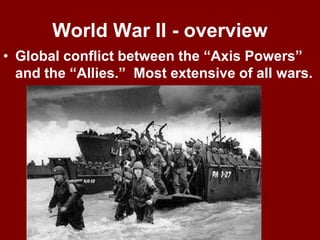
World War II - overview
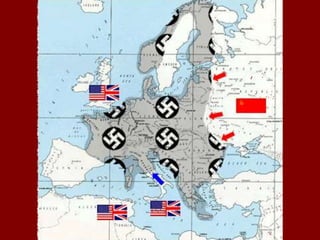
• Global conflict between the “Axis Powers”
and the “Allies.” Most extensive of all wars.
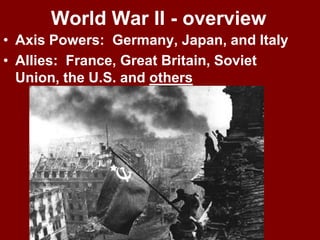
World War II - overview
• Axis Powers: Germany, Japan, and Italy
• Allies: France, Great Britain, Soviet
Union, the U.S. and others
World Wars Compared
CAUSES
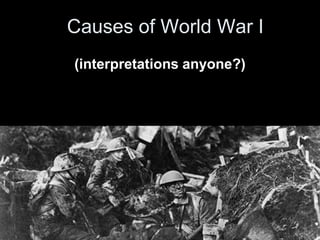
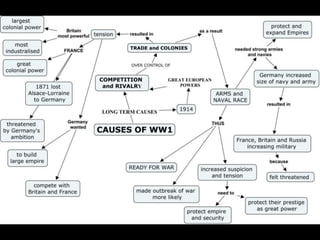
Causes of World War I
(interpretations anyone?)
The Environment for the Great
War was created by
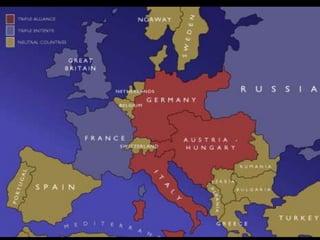
• ALLIANCES
In order to balance power and “protect”
themselves, the nations of Europe had
joined in military alliances with other
nations.
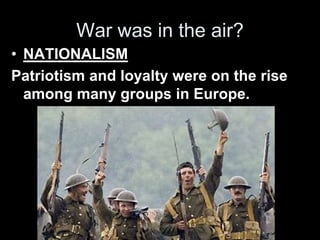
• NATIONALISM
Patriotism and loyalty were on the rise
among many groups in Europe.
War was in the air?
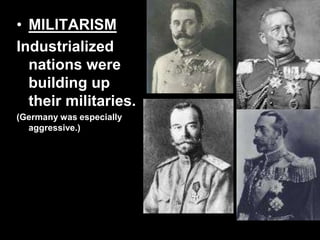
• MILITARISM
Industrialized
nations were
building up
their militaries.
(Germany was especially
aggressive.)
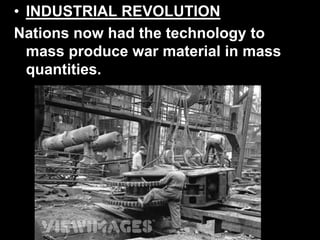
• INDUSTRIAL REVOLUTION
Nations now had the technology to
mass produce war material in mass
quantities.
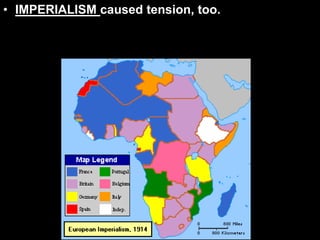
• IMPERIALISM caused tension, too.
There were of course many other
contributing factors to the outbreak of
WWI, for example:
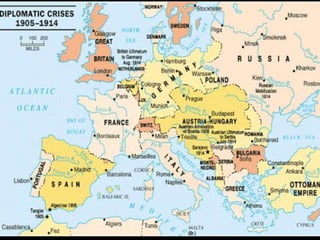
List of Events:
ď‚§ 1870-1871: Franco-Prussian War
ď‚§ 1899-1900: Boer War
ď‚§ 1900: German Navy Law
ď‚§ 1905-6:First Moroccan Crisis
ď‚§ 1908: Daily Telegraph article
ď‚§ 1908-9:Bosnian Crisis
ď‚§ 1911:Agadir Affair (Second Moroccan Crisis)
ď‚§ 1912: First Balkan War
ď‚§ 1913: Second Balkan War
ď‚§ These are examples of conflicts and increased tensions
between major European powers prior to the outbreak of
the First World War.
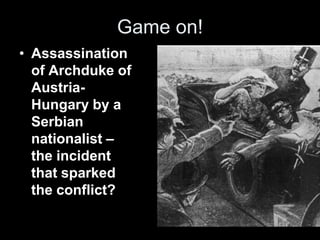
Game on!
• Assassination
of Archduke of
Austria-
Hungary by a
Serbian
nationalist –
the incident
that sparked
the conflict?
Game on!
• Germany assured Austria-Hungary of
full assistance in a war.
• Austria-Hungary declared war on
Serbia.
• Russia declared war on Austria-
Hungary.
• Germany declared war on Russia and
France.
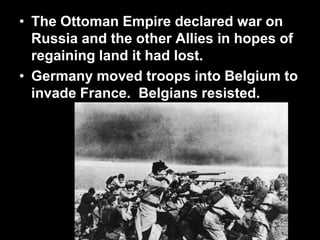
• The Ottoman Empire declared war on
Russia and the other Allies in hopes of
regaining land it had lost.
• Germany moved troops into Belgium to
invade France. Belgians resisted.
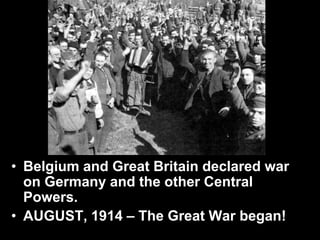
• Belgium and Great Britain declared war
on Germany and the other Central
Powers.
• AUGUST, 1914 – The Great War began!
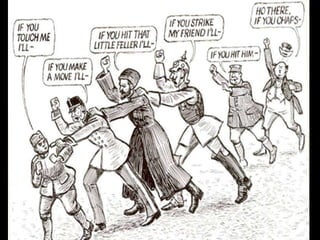
WWI - “A Family Feud”
Central Powers:
• Wilhelm II - the
Kaiser of Germany
• Franz Joseph - the
Emperor of Austria-
Hungary
Allies:
• Nicholas II - the Tsar
of Russia
• George V - King of
England
• Albert - King of
Belgium
• Wilhelm II, Nicholas
II, and George V were
COUSINS
• Albert was their
SECOND COUSIN
• Franz Joseph was their
GREAT UNCLE
ALSO:
• Alexandra, Nicholas
II’s wife, was a cousin
of Wilhelm II, George
V, and her husband
Nicholas II.
• She was a German
princess.
“The War (WWI) was decided in the
first twenty days of fighting, and all
that happened afterwards consisted
in battles which, however formidable
and devastating, were but desperate
and vain appeals against the decision
of Fate.”
Sir Winston Churchill (1874-1965), British
statesman, writer. Preface to E. L.
Spears, Liaison 1914 (1930).
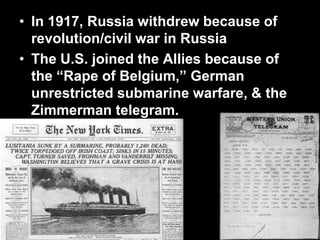
• In 1917, Russia withdrew because of
revolution/civil war in Russia
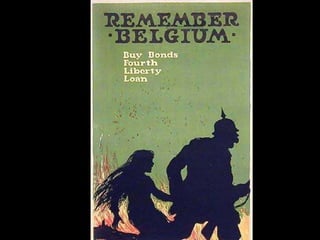
• The U.S. joined the Allies because of
the “Rape of Belgium,” German
unrestricted submarine warfare, & the
Zimmerman telegram.
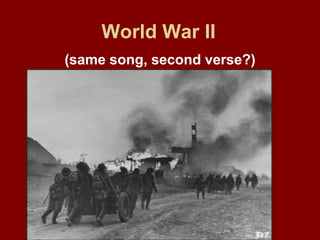
World War II
(same song, second verse?)
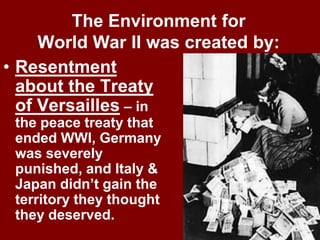
The Environment for
World War II was created by:
• Resentment
about the Treaty
of Versailles – in
the peace treaty that
ended WWI, Germany
was severely
punished, and Italy &
Japan didn’t gain the
territory they thought
they deserved.
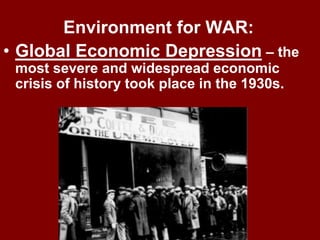
Environment for WAR:
• Global Economic Depression – the
most severe and widespread economic
crisis of history took place in the 1930s.
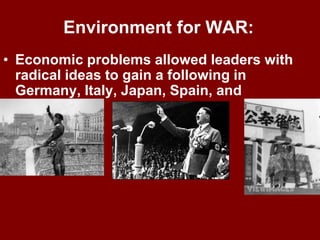
Environment for WAR:
• Economic problems allowed leaders with
radical ideas to gain a following in
Germany, Italy, Japan, Spain, and
elsewhere.
Fascism
Fascism
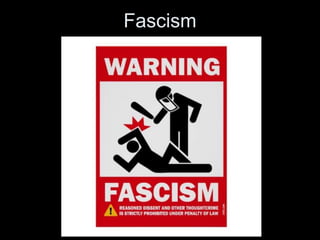
• What does Fascism mean? An extreme-right
totalitarian political regime ideologically based
on centralized government, violently repressing
any criticism or opposition of the regime. A
leader cult and exalting nation-state and/or
religion above individual rights. Originally
applied (usually capitalized) to Benito
Mussolini's Italy. By vague analogy, any system
of strong autocracy or oligarchy usually to the
extent of bending and breaking the law, race-
baiting and violence against largely unarmed
populations.
Fascism
Environment for WAR:
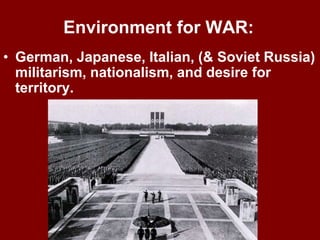
• German, Japanese, Italian, (& Soviet Russia)
militarism, nationalism, and desire for
territory.
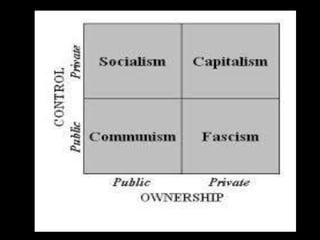
http://www.diffen.com/difference/Communis
m_vs_Fascism
Aggressors March!
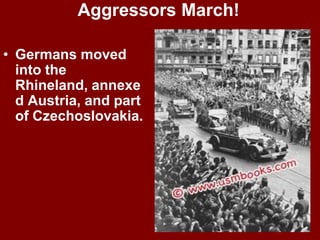
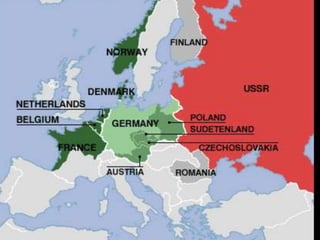
• Germans moved
into the
Rhineland, annexe
d Austria, and part
of Czechoslovakia.
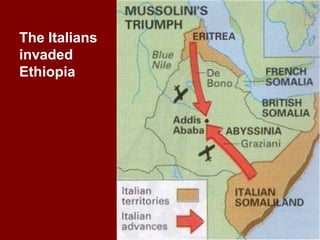
The Italians
invaded
Ethiopia
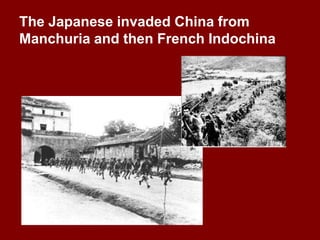
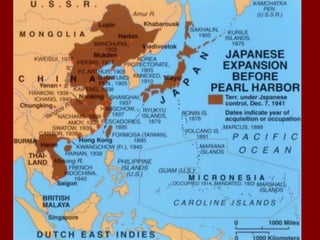
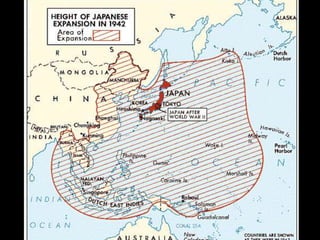
The Japanese invaded China from
Manchuria and then French Indochina
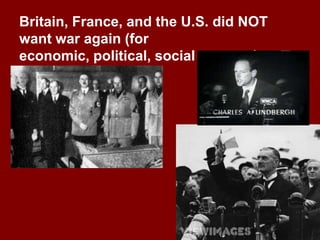
Britain, France, and the U.S. did NOT
want war again (for
economic, political, social reasons).
World leaders and World Opinion
included ideas that . . .
• Germany was wronged in the Treaty of
Versailles. Germans should be united.
• Hitler was better than Stalin. Maybe
they’ll destroy each other?
• Some thought, “It’s a European
problem / Asian problem”.
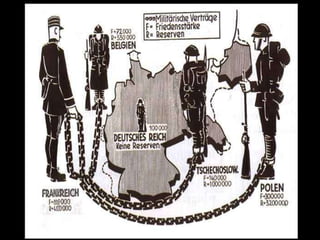
• War is being pushed by capitalists who
want to make money.
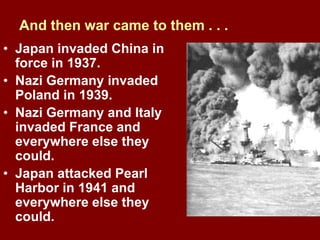
And then war came to them . . .
• Japan invaded China in
force in 1937.
• Nazi Germany invaded
Poland in 1939.
• Nazi Germany and Italy
invaded France and
everywhere else they
could.
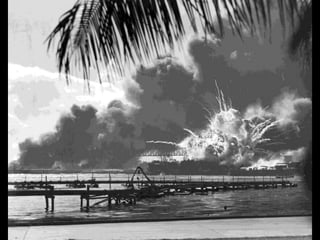
• Japan attacked Pearl
Harbor in 1941 and
everywhere else they
could.
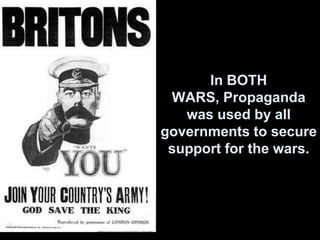
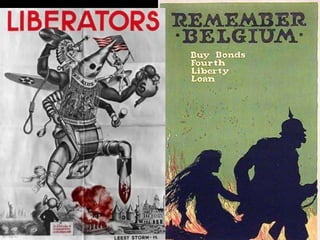
In BOTH
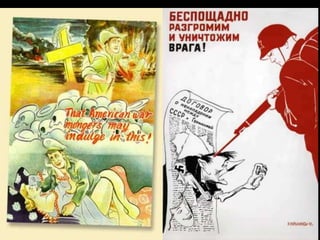
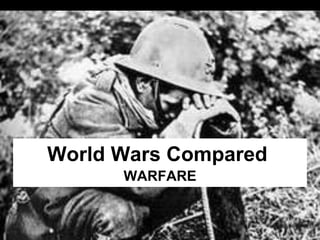
WARS, Propaganda
was used by all
governments to secure
support for the wars.
World Wars Compared
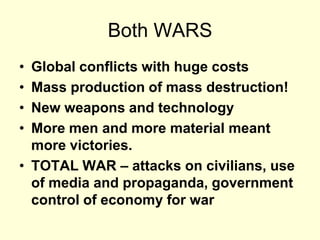
WARFARE
Both WARS
• Global conflicts with huge costs
• Mass production of mass destruction!
• New weapons and technology
• More men and more material meant
more victories.
• TOTAL WAR – attacks on civilians, use
of media and propaganda, government
control of economy for war
World War I - Warfare
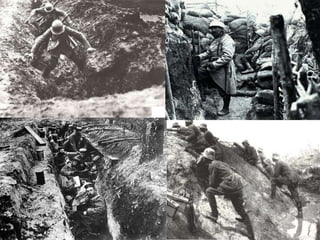
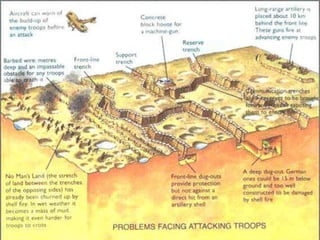
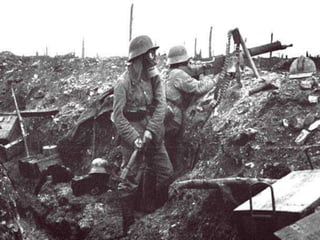
• Trench warfare
• Stalemate along the Western Front
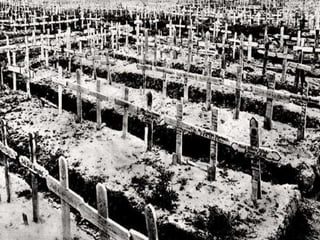
• War of attrition – neither side gaining
ground but war casualties very high.
• Tactics were old-school.
World War I - Warfare
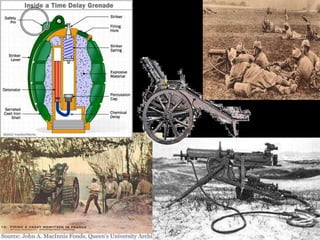
• Chemical Weapons – mustard gas and
chlorine gas
• New weapons of war – machine
guns, airplanes, tanks, submarines, flame
throwers, l o n g range artillery
World War II Warfare
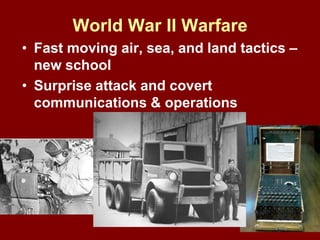
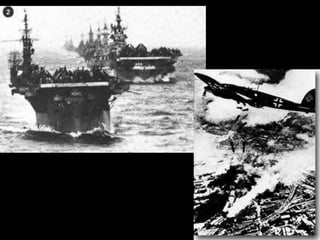
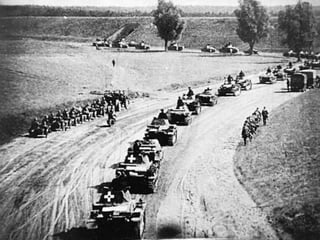
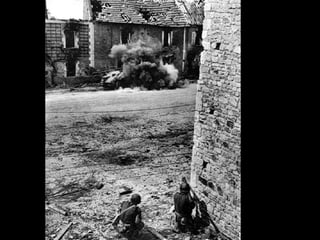
• Fast moving air, sea, and land tactics –
new school
• Surprise attack and covert
communications & operations
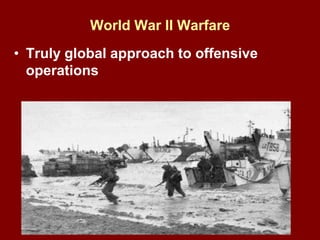
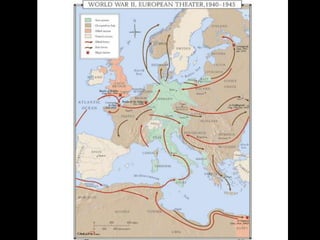
World War II Warfare
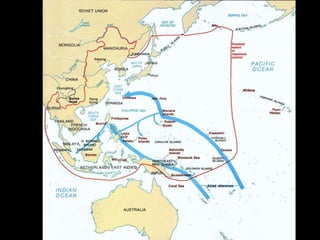
• Truly global approach to offensive
operations
World War II Warfare
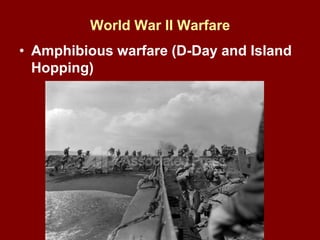
• Amphibious warfare (D-Day and Island
Hopping)
World War II Warfare
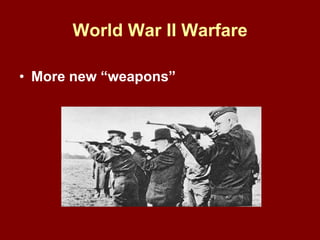
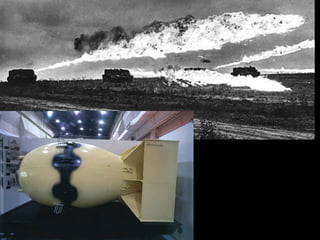
• More new “weapons”
World War II Warfare
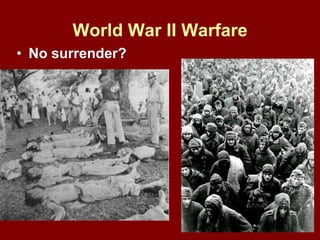
• No surrender?
World War II Warfare
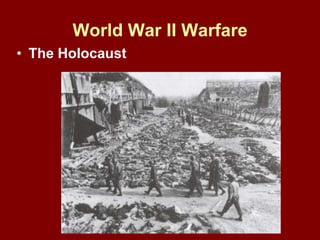
• The Holocaust
World Wars Compared
RESULTS
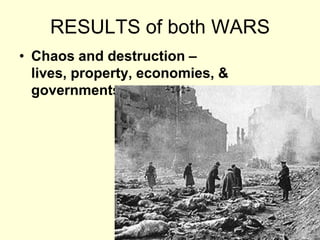
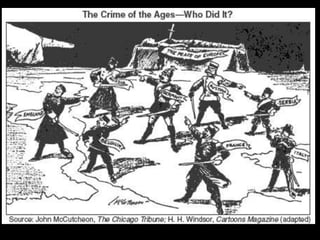
RESULTS of both WARS
• Chaos and destruction –
lives, property, economies, &
governments
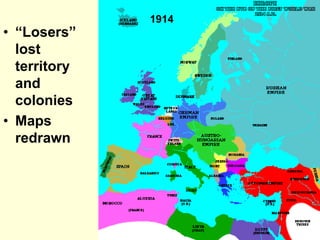
• “Losers”
lost
territory
and
colonies
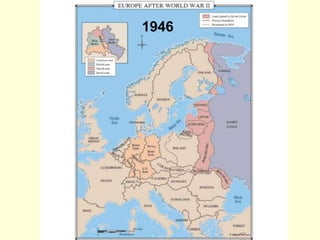
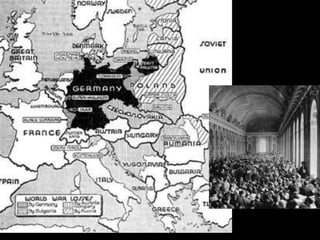
• Maps
redrawn
1914
1946
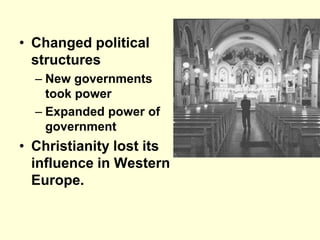
• Changed political
structures
– New governments
took power
– Expanded power of
government
• Christianity lost its
influence in Western
Europe.
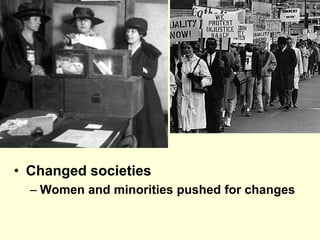
• Changed societies
– Women and minorities pushed for changes
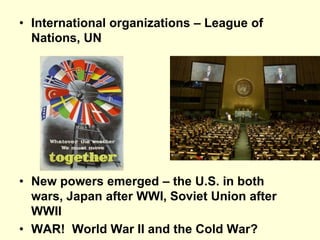
• International organizations – League of
Nations, UN
• New powers emerged – the U.S. in both
wars, Japan after WWI, Soviet Union after
WWII
• WAR! World War II and the Cold War?
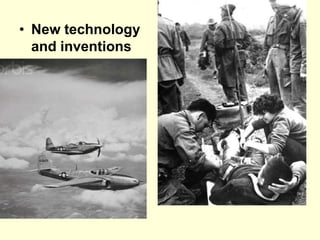
• New technology
and inventions
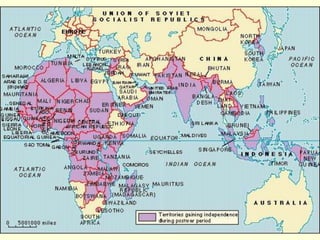
Western European superiority
was questioned
• Nationalism and Independence
movements grew in European colonies
– India, SE Asia, and Africa
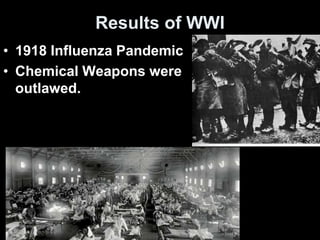
Results of WWI
• 1918 Influenza Pandemic
• Chemical Weapons were
outlawed.
Results of WWI
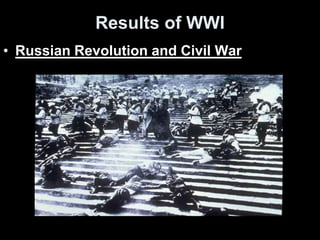
• Russian Revolution and Civil War
Results of WWI
• Germany punished severely
(reparations)
• Ottoman, Austro-
Hungarian, Russian, and German Empire
fell.
• The Great Depression?
Results of WWII
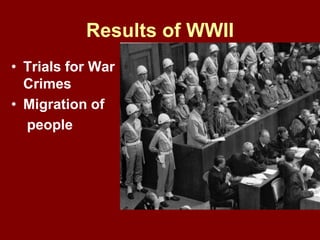
• Trials for War
Crimes
• Migration of
people
Results of WWII
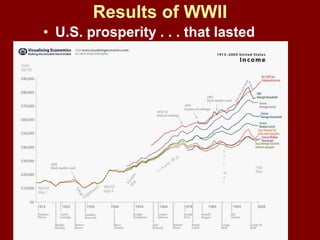
• U.S. prosperity . . . that lasted
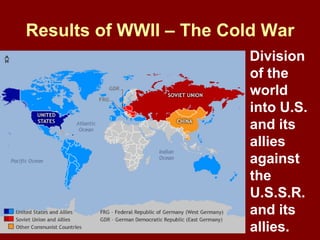
Results of WWII – The Cold War
Division
of the
world
into U.S.
and its
allies
against
the
U.S.S.R.
and its
allies.
Results of WWII
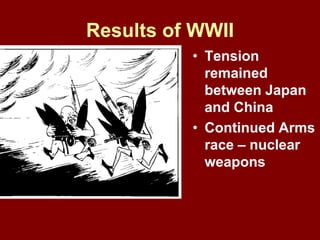
• Tension
remained
between Japan
and China
• Continued Arms
race – nuclear
weapons

World wars compared

  • 1.
  • 2.
    The Great War/ World War I / The War to end all wars
  • 3.
    World War II– “Theaters” in Europe, the Pacific, N. Africa, etc.
  • 4.
    What do youknow about World War I and World War II? In your notebooks, brainstorm what you know about • Causes: • Sides of the war: • Who won: • Why the winners won: • Results: • You have 5 minutes . . .GO!
  • 5.
    Remember : Wars causeeconomic & social changes
  • 6.
    Remember: Wars have political results. (Forexample . . . ) British soldiers from India in WWI= Indian Independence? African-American tank corps in WWII= Civil Rights Movement? Some governments gained power as they controlled the war effort. Some governments fell at the end of the war.
  • 7.
    Remember: War has asignificant impact on civilians, economies, and governments.
  • 8.
  • 9.
    The Great War/ World War I 1914-1918 U.S. was directly involved: 1917-1918
  • 10.
    World War II 1937to 1945 in Asia 1939 to 1945 in Europe and Africa U.S. was directly involved: 1941-1945
  • 11.
    World War I- overview • Global conflict between the “Central Powers” and the “Allies.” • The first global modern war.
  • 12.
    World War I- overview • Central Powers: Germany, Austria- Hungary, and the Ottoman Empire • Allies: France, Russia, Great Britain, Japan, Italy, B elgium (and later the U.S.) and others The Western Front
  • 13.
    World War II- overview • Global conflict between the “Axis Powers” and the “Allies.” Most extensive of all wars.
  • 14.
    World War II- overview • Axis Powers: Germany, Japan, and Italy • Allies: France, Great Britain, Soviet Union, the U.S. and others
  • 15.
  • 16.
    Causes of WorldWar I (interpretations anyone?)
  • 18.
    The Environment forthe Great War was created by • ALLIANCES In order to balance power and “protect” themselves, the nations of Europe had joined in military alliances with other nations.
  • 20.
    • NATIONALISM Patriotism andloyalty were on the rise among many groups in Europe. War was in the air?
  • 21.
    • MILITARISM Industrialized nations were buildingup their militaries. (Germany was especially aggressive.)
  • 22.
    • INDUSTRIAL REVOLUTION Nationsnow had the technology to mass produce war material in mass quantities.
  • 23.
  • 24.
    There were ofcourse many other contributing factors to the outbreak of WWI, for example: List of Events: ď‚§ 1870-1871: Franco-Prussian War ď‚§ 1899-1900: Boer War ď‚§ 1900: German Navy Law ď‚§ 1905-6:First Moroccan Crisis ď‚§ 1908: Daily Telegraph article ď‚§ 1908-9:Bosnian Crisis ď‚§ 1911:Agadir Affair (Second Moroccan Crisis) ď‚§ 1912: First Balkan War ď‚§ 1913: Second Balkan War ď‚§ These are examples of conflicts and increased tensions between major European powers prior to the outbreak of the First World War.
  • 25.
    Game on! • Assassination ofArchduke of Austria- Hungary by a Serbian nationalist – the incident that sparked the conflict?
  • 27.
    Game on! • Germanyassured Austria-Hungary of full assistance in a war. • Austria-Hungary declared war on Serbia. • Russia declared war on Austria- Hungary. • Germany declared war on Russia and France.
  • 29.
    • The OttomanEmpire declared war on Russia and the other Allies in hopes of regaining land it had lost. • Germany moved troops into Belgium to invade France. Belgians resisted.
  • 30.
    • Belgium andGreat Britain declared war on Germany and the other Central Powers. • AUGUST, 1914 – The Great War began!
  • 31.
    WWI - “AFamily Feud” Central Powers: • Wilhelm II - the Kaiser of Germany • Franz Joseph - the Emperor of Austria- Hungary Allies: • Nicholas II - the Tsar of Russia • George V - King of England • Albert - King of Belgium • Wilhelm II, Nicholas II, and George V were COUSINS • Albert was their SECOND COUSIN • Franz Joseph was their GREAT UNCLE ALSO: • Alexandra, Nicholas II’s wife, was a cousin of Wilhelm II, George V, and her husband Nicholas II. • She was a German princess.
  • 33.
    “The War (WWI)was decided in the first twenty days of fighting, and all that happened afterwards consisted in battles which, however formidable and devastating, were but desperate and vain appeals against the decision of Fate.” Sir Winston Churchill (1874-1965), British statesman, writer. Preface to E. L. Spears, Liaison 1914 (1930).
  • 34.
    • In 1917,Russia withdrew because of revolution/civil war in Russia • The U.S. joined the Allies because of the “Rape of Belgium,” German unrestricted submarine warfare, & the Zimmerman telegram.
  • 36.
    World War II (samesong, second verse?)
  • 39.
    The Environment for WorldWar II was created by: • Resentment about the Treaty of Versailles – in the peace treaty that ended WWI, Germany was severely punished, and Italy & Japan didn’t gain the territory they thought they deserved.
  • 40.
    Environment for WAR: •Global Economic Depression – the most severe and widespread economic crisis of history took place in the 1930s.
  • 41.
    Environment for WAR: •Economic problems allowed leaders with radical ideas to gain a following in Germany, Italy, Japan, Spain, and elsewhere.
  • 42.
  • 43.
    Fascism • What doesFascism mean? An extreme-right totalitarian political regime ideologically based on centralized government, violently repressing any criticism or opposition of the regime. A leader cult and exalting nation-state and/or religion above individual rights. Originally applied (usually capitalized) to Benito Mussolini's Italy. By vague analogy, any system of strong autocracy or oligarchy usually to the extent of bending and breaking the law, race- baiting and violence against largely unarmed populations.
  • 44.
  • 45.
    Environment for WAR: •German, Japanese, Italian, (& Soviet Russia) militarism, nationalism, and desire for territory.
  • 46.
  • 47.
    Aggressors March! • Germansmoved into the Rhineland, annexe d Austria, and part of Czechoslovakia.
  • 49.
  • 50.
    The Japanese invadedChina from Manchuria and then French Indochina
  • 52.
    Britain, France, andthe U.S. did NOT want war again (for economic, political, social reasons).
  • 53.
    World leaders andWorld Opinion included ideas that . . . • Germany was wronged in the Treaty of Versailles. Germans should be united. • Hitler was better than Stalin. Maybe they’ll destroy each other? • Some thought, “It’s a European problem / Asian problem”. • War is being pushed by capitalists who want to make money.
  • 54.
    And then warcame to them . . . • Japan invaded China in force in 1937. • Nazi Germany invaded Poland in 1939. • Nazi Germany and Italy invaded France and everywhere else they could. • Japan attacked Pearl Harbor in 1941 and everywhere else they could.
  • 57.
    In BOTH WARS, Propaganda wasused by all governments to secure support for the wars.
  • 60.
  • 61.
    Both WARS • Globalconflicts with huge costs • Mass production of mass destruction! • New weapons and technology • More men and more material meant more victories. • TOTAL WAR – attacks on civilians, use of media and propaganda, government control of economy for war
  • 62.
    World War I- Warfare • Trench warfare • Stalemate along the Western Front • War of attrition – neither side gaining ground but war casualties very high. • Tactics were old-school.
  • 66.
    World War I- Warfare • Chemical Weapons – mustard gas and chlorine gas • New weapons of war – machine guns, airplanes, tanks, submarines, flame throwers, l o n g range artillery
  • 69.
    World War IIWarfare • Fast moving air, sea, and land tactics – new school • Surprise attack and covert communications & operations
  • 73.
    World War IIWarfare • Truly global approach to offensive operations
  • 76.
    World War IIWarfare • Amphibious warfare (D-Day and Island Hopping)
  • 78.
    World War IIWarfare • More new “weapons”
  • 81.
    World War IIWarfare • No surrender?
  • 82.
    World War IIWarfare • The Holocaust
  • 83.
  • 84.
    RESULTS of bothWARS • Chaos and destruction – lives, property, economies, & governments
  • 86.
  • 87.
  • 88.
    • Changed political structures –New governments took power – Expanded power of government • Christianity lost its influence in Western Europe.
  • 89.
    • Changed societies –Women and minorities pushed for changes
  • 90.
    • International organizations– League of Nations, UN • New powers emerged – the U.S. in both wars, Japan after WWI, Soviet Union after WWII • WAR! World War II and the Cold War?
  • 91.
  • 92.
    Western European superiority wasquestioned • Nationalism and Independence movements grew in European colonies – India, SE Asia, and Africa
  • 94.
    Results of WWI •1918 Influenza Pandemic • Chemical Weapons were outlawed.
  • 95.
    Results of WWI •Russian Revolution and Civil War
  • 96.
    Results of WWI •Germany punished severely (reparations) • Ottoman, Austro- Hungarian, Russian, and German Empire fell. • The Great Depression?
  • 97.
    Results of WWII •Trials for War Crimes • Migration of people
  • 98.
    Results of WWII •U.S. prosperity . . . that lasted
  • 99.
    Results of WWII– The Cold War Division of the world into U.S. and its allies against the U.S.S.R. and its allies.
  • 100.
    Results of WWII •Tension remained between Japan and China • Continued Arms race – nuclear weapons