CSHP MEMORIAL PUBLIC SCHOOL
WORKSHEET
CH-2 IS MATTER AROUND US PURE?
1. Which method is used to separate cream from milk?
2. Difference between homogeneous mixture and heterogeneous
mixture.
3. What is tincture of iodine?
4. Difference between mixture and compounds.
5. Name the process by which pure NaCl can be obtained from salt
solution?
6. What are alloys? Give example.
7. Is alloys compound or mixture?
8. Write the size of particles.
9. Write the solute and solvent in cold drinks.
10. Explain saturated, unsaturated and supersaturated solution.
Give examples.
11, Write 4 characteristics of a solution.
12. What do you mean by Sol? Give example.
CSHP MEMORIALPUBLIC SCHOOL
CLASS- 9th
WORKSHEET
CH-3ATOMS AND MOLECULES
1. Atomic symbol of silver sodium and chlorine.
2. chemical formulaof NA2CO3.
3. electrons in KLM shell.
4. discoveryof electron proton and neutron.
5. distribution of electrons in carbon sodium aluminiumnitrogen
magnesium.
6. Write the postulates of Dalton atomic theory also explain the
laws.
7. Calculate the molecular mass of CH4,CH3CI, NH3, NA2 O C2H6,
C2H4
8. Describe Rutherford model and its conclusion.
9. Describe bohr's model.
10. Explain valenciesand alsothe nature of elements.
11. Find the variable yalencyof iron and copper.
CSHP MEMORIAL PUBLIC SCHOOL
CLASS gTH
WORKSHEET OF CH- THE FUNDAMENTAL UNIT OF LIFE
1. What is hypotonic, hypertonic and isotonic
solution?
2. What is plasmolysis?
3. Draw the labelled diagram of neuron. Where is
node of ranvier present?
4. Difference between prokaryotic and eukaryotic
cell. Give example
5. Difference between unicellular and multicellular
organisms. Give example.
6. Draw a labelled diagram of plant cell and animal
celland having six labellings.
7. Write 3 points of Cell theory.
8. Who discovered cell?
9. Draw a labelled diagram of mitochondria,
chloroplast.
10. which cell organelles is called energy currency of
cell?
11. What is the common name of plastid,
mitochondria and Golgi body?
12. Why cell is called structural and functional unit
of life?
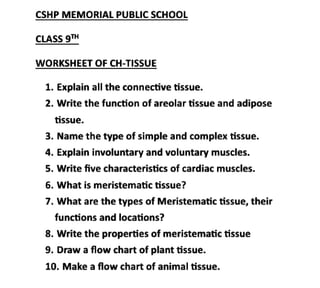
CSHP MEMORIAL PUBLIC SCHO0L
CLASS 9TH
WORKSHEET OF CH-TISSUE
1. Explain all the connective tissue.
2. Write the function of areolar tissue and adipose
tissue.
3. Name the type of simple and complex tissue.
4. Explain involuntary and voluntary muscles.
5. Write five characteristics of cardiac muscles.
6. What is meristematic tissue?
7. What are the types of Meristematic tissue, their
functions and locations?
8. Write the properties of meristematic tissue
9. Draw a flow chart of plant tissue.
10. Make a flow chart of animal tissue.
CSHP MEMORIAL PUBLICSCHOOL
CLASS-9TH
WORKSHEET OF CH- FORCE AND LAWS OF MOTION
1. IF THE MASS OF A BODY IS DOUBLE AND ITS
VELOCITY BECOMES HALF THEN WHAT WILL BE
THE LINEAR MOMENTUM?
2. If a force acting on a body causes no displacement
then what will be the work done?
3. Which would require greater force accelerating a 2
kg mass at 5 m/s² or a 4 kg mass at 2 m/s²?
4. Why do bicycles begin to slow down when we
stop pedalling?
5. Difference between balanced and unbalanced
force.

ws class 9.pdf

  • 1.
    CSHP MEMORIAL PUBLICSCHOOL WORKSHEET CH-2 IS MATTER AROUND US PURE? 1. Which method is used to separate cream from milk? 2. Difference between homogeneous mixture and heterogeneous mixture. 3. What is tincture of iodine? 4. Difference between mixture and compounds. 5. Name the process by which pure NaCl can be obtained from salt solution? 6. What are alloys? Give example. 7. Is alloys compound or mixture? 8. Write the size of particles. 9. Write the solute and solvent in cold drinks. 10. Explain saturated, unsaturated and supersaturated solution. Give examples. 11, Write 4 characteristics of a solution. 12. What do you mean by Sol? Give example.
  • 2.
    CSHP MEMORIALPUBLIC SCHOOL CLASS-9th WORKSHEET CH-3ATOMS AND MOLECULES 1. Atomic symbol of silver sodium and chlorine. 2. chemical formulaof NA2CO3. 3. electrons in KLM shell. 4. discoveryof electron proton and neutron. 5. distribution of electrons in carbon sodium aluminiumnitrogen magnesium. 6. Write the postulates of Dalton atomic theory also explain the laws. 7. Calculate the molecular mass of CH4,CH3CI, NH3, NA2 O C2H6, C2H4 8. Describe Rutherford model and its conclusion. 9. Describe bohr's model. 10. Explain valenciesand alsothe nature of elements. 11. Find the variable yalencyof iron and copper.
  • 3.
    CSHP MEMORIAL PUBLICSCHOOL CLASS gTH WORKSHEET OF CH- THE FUNDAMENTAL UNIT OF LIFE 1. What is hypotonic, hypertonic and isotonic solution? 2. What is plasmolysis? 3. Draw the labelled diagram of neuron. Where is node of ranvier present? 4. Difference between prokaryotic and eukaryotic cell. Give example 5. Difference between unicellular and multicellular organisms. Give example. 6. Draw a labelled diagram of plant cell and animal celland having six labellings. 7. Write 3 points of Cell theory. 8. Who discovered cell? 9. Draw a labelled diagram of mitochondria, chloroplast. 10. which cell organelles is called energy currency of cell? 11. What is the common name of plastid, mitochondria and Golgi body? 12. Why cell is called structural and functional unit of life?
  • 4.
    CSHP MEMORIAL PUBLICSCHO0L CLASS 9TH WORKSHEET OF CH-TISSUE 1. Explain all the connective tissue. 2. Write the function of areolar tissue and adipose tissue. 3. Name the type of simple and complex tissue. 4. Explain involuntary and voluntary muscles. 5. Write five characteristics of cardiac muscles. 6. What is meristematic tissue? 7. What are the types of Meristematic tissue, their functions and locations? 8. Write the properties of meristematic tissue 9. Draw a flow chart of plant tissue. 10. Make a flow chart of animal tissue.
  • 5.
    CSHP MEMORIAL PUBLICSCHOOL CLASS-9TH WORKSHEETOF CH- FORCE AND LAWS OF MOTION 1. IF THE MASS OF A BODY IS DOUBLE AND ITS VELOCITY BECOMES HALF THEN WHAT WILL BE THE LINEAR MOMENTUM? 2. If a force acting on a body causes no displacement then what will be the work done? 3. Which would require greater force accelerating a 2 kg mass at 5 m/s² or a 4 kg mass at 2 m/s²? 4. Why do bicycles begin to slow down when we stop pedalling? 5. Difference between balanced and unbalanced force.