Wrocław Agglomeration
Sector Analyses
Automotive
Industry
City of Perspectives
AUTOMOTIVE
TABLE OF CONTENTS
The publication prepared in cooperation:
City of Perspectives
01
02
03
04
05
06
The Automotive Industry in Poland
Lower Silesia and the Wrocław Agglomeration
as a Location for Investment
Development Prospects
Investment Incentives
The Regional Labour Market
Case Study - Toyota
Wrocław is a unique and dynamic city, making an excellent place for investment
and business development. The Wrocław Agglomeration’s assets have not only
been long appreciated by foreign investors, but they also have become a foun-
dation for growth and global expansion of many well known Polish companies.
However, the contemporary dynamics of change results in emergence of new ne-
eds, making information an increasingly valuable business resource. Both foreign
conglomerates and domestic businesses seek useful information, indispensable in
successful investment related decision-making. New economic conditions require
undertaking non-standard action, which led to originating the Invest in Wrocław
project (www.invest-in-wroclaw.pl). Many risk factors can be avoided, if one has a
better understanding of sector-specific determinants and the development pro-
spects of their own line of business as well as related industries. This was the ratio-
nale behind studies of the Wrocław Agglomeration’s priority, strongly developing
sectors, including the following ones:
Automotive industry, Eelectronics, Chemical and Pharmaceu-
tical industry, Mechanical engineering, IT, BPO, Food industry
We hope that the free of charge sector analyses will facilitate decision-making not
only for potential investors, but also the companies already operating in the area
of the Wrocław Agglomeration. Integration of information from different sour-
ces is supposed, by principle, to contribute to establishing co-operation between
suppliers, subcontractors and recipients from diverse lines of business related to
sectors which are priority for Wrocław’s development. Due to improving market
transparency and increased ease of contact with businesses, the resulting benefits
may be also enjoyed by local administration units, and most notably local com-
munities. By combining all of the elements mentioned, it becomes possible for the
whole Wrocław Agglomeration region to increase its growth dynamics and attain
a competitive advantage. We hope that in this way we are redefining the standards
of support for business development.
3
Introduction
Chapter 1 | Wrocław Agglomeration Sector Analyses - Automotive Industry
The Automotive Industry in Poland
Over the past decade, the Polish automotive sector has become one of the biggest ones in The Central Eastern
Europe (CEE). Among 40 car and engine production facilities located in this part of the continent, as many as 16
are in Poland. The automotive industry has become a key branch of the Polish economy, making it the second lar-
gest sector in Poland. In 2011, it attracted investment outlays of 4.4 billion PLN and opened workplaces to almost
150 thousand people. The data does not include employees from the related sectors, e.g. tyre manufacturing.
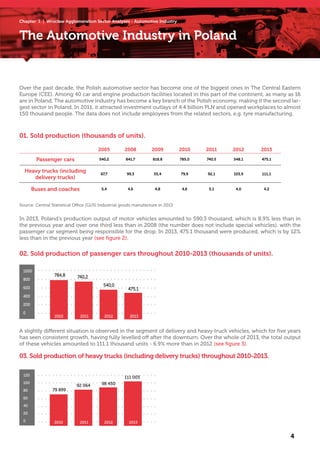
In 2013, Poland’s production output of motor vehicles amounted to 590.3 thousand, which is 8.9% less than in
the previous year and over one third less than in 2008 (the number does not include special vehicles), with the
passenger car segment being responsible for the drop. In 2013, 475.1 thousand were produced, which is by 12%
less than in the previous year (see figure 2).
A slightly different situation is observed in the segment of delivery and heavy truck vehicles, which for five years
has seen consistent growth, having fully levelled off after the downturn. Over the whole of 2013, the total output
of these vehicles amounted to 111.1 thousand units - 6.9% more than in 2012 (see figure 3).
01. Sold production (thousands of units).
02. Sold production of passenger cars throughout 2010-2013 (thousands of units).
03. Sold production of heavy trucks (including delivery trucks) throughout 2010-2013.
Source: Central Statistical Office (GUS) Industrial goods manufacture in 2013
2005 2008 2009 2010 2011 2012 2013
Passenger cars 540,2 841,7 818,8 785,0 740,5 548,1 475,1
Heavy trucks (including
delivery trucks)
67,7 99,3 55,4 79,9 92,1 103,9 111,1
Buses and coaches 5,4 4,6 4,8 4,6 5,1 4,0 4,2
0
200
400
600
800
1000
784,8 740,2
540,0
475,1
2010 2011 2012 2013
79 899
92 064 98 450
111 003
2010 2011 2012 20130
20
40
60
80
100
120
4
Chapter 1 | Wrocław Agglomeration Sector Analyses - Automotive Industry
The Automotive Industry in Poland
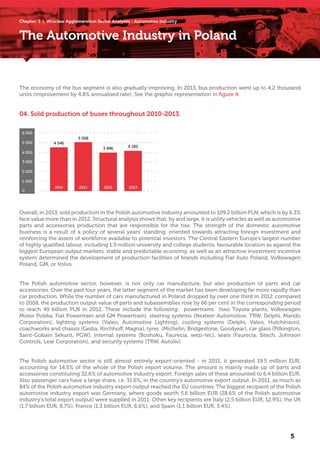
The economy of the bus segment is also gradually improving. In 2013, bus production went up to 4.2 thousand
units (improvement by 4.8% annualised rate). See the graphic representation in figure 4.
Overall, in 2013, sold production in the Polish automotive industry amounted to 109.2 billion PLN, which is by 6.3%
face value more than in 2012. Structural analysis shows that, by and large, it is utility vehicles as well as automotive
parts and accessories production that are responsible for the rise. The strength of the domestic automotive
business is a result of a policy of several years’ standing, oriented towards attracting foreign investment and
reinforcing the assets of workforce available to potential investors. The Central Eastern Europe’s largest number
of highly qualified labour, including 1.9 million university and college students, favourable location as against the
biggest European output markets, stable and predictable economy, as well as an attractive investment incentive
system determined the development of production facilities of brands including Fiat Auto Poland, Volkswagen
Poland, GM, or Volvo.
The Polish automotive sector, however, is not only car manufacture, but also production of parts and car
accessories. Over the past four years, the latter segment of the market has been developing far more rapidly than
car production. While the number of cars manufactured in Poland dropped by over one third in 2012 ,compared
to 2008, the production output value of parts and subassemblies rose by 66 per cent in the corresponding period
to reach 49 billion PLN in 2012. These include the following: powertrains (two Toyota plants, Volkswagen
Motor Polska, Fiat Powertrain and GM Powertrain), steering systems (Nexteer Automotive, TRW, Delphi, Mando
Corporation), lighting systems (Valeo, Automotive Lighting), cooling systems (Delphi, Valeo, Hutchinson),
coachworks and chassis (Gedia, Kirchhoff, Magna), tyres (Michelin, Bridgestone, Goodyear), car glass (Pilkington,
Saint-Gobain Sekurit, PGW), internal systems (Boshoku, Faurecia, wezi-tec), seats (Faurecia, Sitech, Johnson
Controls, Lear Corporation), and security systems (TRW, Autoliv).
The Polish automotive sector is still almost entirely export-oriented - in 2011, it generated 19.5 million EUR,
accounting for 14.5% of the whole of the Polish export volume. The amount is mainly made up of parts and
accessories constituting 32.6% of automotive industry export. Foreign sales of these amounted to 6.4 billion EUR.
Also passenger cars have a large share, i.e. 31.6%, in the country’s automotive export output. In 2011, as much as
84% of the Polish automotive industry export output reached the EU countries. The biggest recipient of the Polish
automotive industry export was Germany, where goods worth 5.6 billion EUR (28.6% of the Polish automotive
industry’s total export output) were supplied in 2011. Other key recipients are Italy (2.5 billion EUR, 12.9%), the UK
(1.7 billion EUR, 8.7%), France (1.3 billion EUR, 6.6%), and Spain (1.1 billion EUR, 5.4%).
04. Sold production of buses throughout 2010-2013.
4 1823 996
5 068
4 546
0
1 000
2 000
3 000
4 000
5 000
6 000
2011 2012 20132010
5
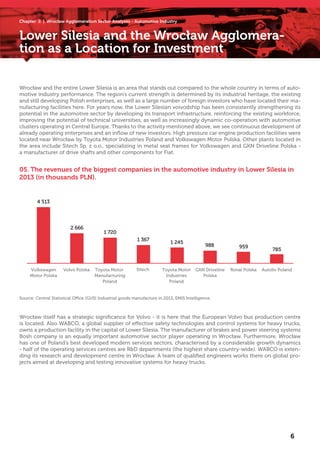
05. The revenues of the biggest companies in the automotive industry in Lower Silesia in
2013 (in thousands PLN).
Lower Silesia and the Wrocław Agglomera-
tion as a Location for Investment
Wrocław and the entire Lower Silesia is an area that stands out compared to the whole country in terms of auto-
motive industry performance. The region’s current strength is determined by its industrial heritage, the existing
and still developing Polish enterprises, as well as a large number of foreign investors who have located their ma-
nufacturing facilities here. For years now, the Lower Silesian voivodship has been consistently strengthening its
potential in the automotive sector by developing its transport infrastructure, reinforcing the existing workforce,
improving the potential of technical universities, as well as increasingly dynamic co-operation with automotive
clusters operating in Central Europe. Thanks to the activity mentioned above, we see continuous development of
already operating enterprises and an inflow of new investors. High pressure car engine production facilities were
located near Wrocław by Toyota Motor Industries Poland and Volkswagen Motor Polska. Other plants located in
the area include Sitech Sp. z o.o., specializing in metal seat frames for Volkswagen and GKN Driveline Polska -
a manufacturer of drive shafts and other components for Fiat.
Wrocław itself has a strategic significance for Volvo - it is here that the European Volvo bus production centre
is located. Also WABCO, a global supplier of effective safety technologies and control systems for heavy trucks,
owns a production facility in the capital of Lower Silesia. The manufacturer of brakes and power steering systems
Bosh company is an equally important automotive sector player operating in Wrocław. Furthermore, Wrocław
has one of Poland’s best developed modern services sectors, characterised by a considerable growth dynamics
- half of the operating services centres are R&D departments (the highest share country-wide). WABCO is exten-
ding its research and development centre in Wrocław. A team of qualified engineers works there on global pro-
jects aimed at developing and testing innovative systems for heavy trucks.
Source: Central Statistical Office (GUS) Industrial goods manufacture in 2013, EMIS Intelligence.
4 513
Motor Polska
Volkswagen
2 666
Toyota Motor
Manufacturing
Poland
1 720
Volvo Polska
1 367
Toyota Motor
Industries
Poland
1 245
Sitech
988
GKN Driveline
Polska
959
Ronal Polska
785
Autoliv Poland
6
Chapter 2 | Wrocław Agglomeration Sector Analyses - Automotive Industry
Lower Silesia and the Wrocław Agglomera-
tion as a Location for Investment
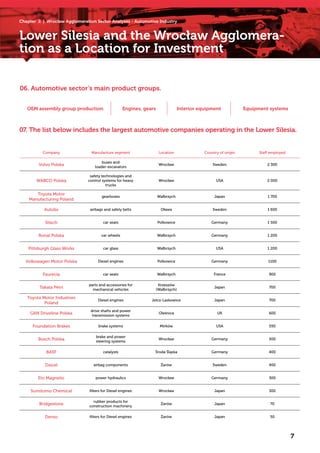
07. The list below includes the largest automotive companies operating in the Lower Silesia.
Company Manufacture segment Location Country of origin Staff employed
Volvo Polska
buses and
loader-excavators
Wrocław Sweden 2 300
WABCO Polska
safety technologies and
control systems for heavy
trucks
Wrocław USA 2 000
Toyota Motor
Manufacturing Poland
gearboxes Wałbrzych Japan 1 700
Autoliv airbags and safety belts Oława Sweden 1 600
Sitech car seats Polkowice Germany 1 500
Ronal Polska car wheels Wałbrzych Germany 1 200
Pittsburgh Glass Works car glass Wałbrzych USA 1 200
Volkswagen Motor Polska Diesel engines Polkowice Germany 1100
Faurecia car seats Wałbrzych France 900
Takata Petri
parts and accessories for
mechanical vehicles
Krzeszów
(Wałbrzych)
Japan 700
Toyota Motor Industries
Poland
Diesel engines Jelcz-Laskowice Japan 700
GKN Driveline Polska
drive shafts and power
transmission systems
Oleśnica UK 600
Foundation Brakes brake systems Mirków USA 550
Bosch Polska
brake and power
steering systems
Wrocław Germany 500
BASF catalysts Środa Śląska Germany 400
Daicel airbag components Żarów Sweden 400
Eto Magnetic power hydraulics Wrocław Germany 300
Sumitomo Chemical filters for Diesel engines Wrocław Japan 300
Bridgestone
rubber products for
construction machinery
Żarów Japan 70
Denso filters for Diesel engines Żarów Japan 50
7
06. Automotive sector’s main product groups.
OEM assembly group production Engines, gears Interior equipment Equipment systems
Chapter 2 | Wrocław Agglomeration Sector Analyses - Automotive Industry
Lower Silesia and the Wrocław Agglomera-
tion as a Location for Investment
8
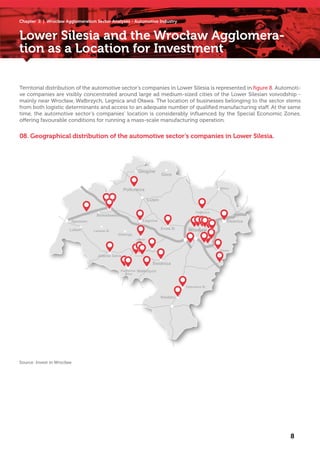
Territorial distribution of the automotive sector’s companies in Lower Silesia is represented in figure 8. Automoti-
ve companies are visibly concentrated around large ad medium-sized cities of the Lower Silesian voivodship -
mainly near Wrocław, Wałbrzych, Legnica and Oława. The location of businesses belonging to the sector stems
from both logistic determinants and access to an adequate number of qualified manufacturing staff. At the same
time, the automotive sector’s companies’ location is considerably influenced by the Special Economic Zones,
offering favourable conditions for running a mass-scale manufacturing operation.
08. Geographical distribution of the automotive sector’s companies in Lower Silesia.
Source: Invest in Wrocław
Wrocław
Chapter 2 | Wrocław Agglomeration Sector Analyses - Automotive Industry
Development Prospects
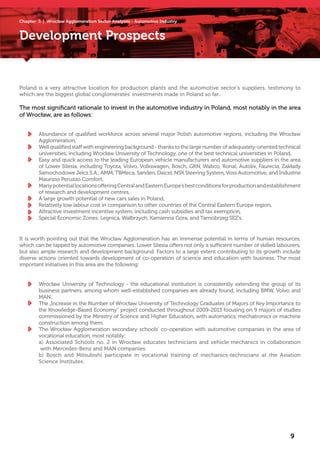
Poland is a very attractive location for production plants and the automotive sector’s suppliers, testimony to
which are the biggest global conglomerates’ investments made in Poland so far.
The most significant rationale to invest in the automotive industry in Poland, most notably in the area
of Wrocław, are as follows:
It is worth pointing out that the Wrocław Agglomeration has an immense potential in terms of human resources,
which can be tapped by automotive companies. Lower Silesia offers not only a sufficient number of skilled labourers,
but also ample research and development background. Factors to a large extent contributing to its growth include
diverse actions oriented towards development of co-operation of science and education with business. The most
important initiatives in this area are the following:
Abundance of qualified workforce across several major Polish automotive regions, including the Wrocław
Agglomeration,
Wellqualifiedstaffwithengineeringbackground-thankstothelargenumberofadequately-orientedtechnical
universities, including Wrocław University of Technology, one of the best technical universities in Poland,
Easy and quick access to the leading European vehicle manufacturers and automotive suppliers in the area
of Lower Silesia, including Toyota, Volvo, Volkswagen, Bosch, GKN, Wabco, Ronal, Autoliv, Faurecia, Zakłady
Samochodowe Jelcz S.A., AMM, TBMeca, Sanden, Daicel, NSK Steering System, Voss Automotive, and Industrie
Maurizio Peruzzo Comfort,
ManypotentiallocationsofferingCentralandEasternEurope’sbestconditionsforproductionandestablishment
of research and development centres,
A large growth potential of new cars sales in Poland,
Relatively low labour cost in comparison to other countries of the Central Eastern Europe region,
Attractive investment incentive system, including cash subsidies and tax exemption,
Special Economic Zones: Legnica, Wałbrzych, Kamienna Góra, and Tarnobrzeg SEZ’s.
Wrocław University of Technology - the educational institution is consistently extending the group of its
business partners, among whom well-established companies are already found, including BMW, Volvo and
MAN.
The „Increase in the Number of Wrocław University of Technology Graduates of Majors of Key Importance to
the Knowledge-Based Economy” project conducted throughout 2009-2013 focusing on 9 majors of studies
commissioned by the Ministry of Science and Higher Education, with automatics, mechatronics or machine
construction among them.
The Wrocław Agglomeration secondary schools’ co-operation with automotive companies in the area of
vocational education, most notably:
a) Associated Schools no. 2 in Wrocław educates technicians and vehicle mechanics in collaboration
with Mercedes-Benz and MAN companies.
b) Bosch and Mitsubishi participate in vocational training of mechanics-technicians at the Aviation
Science Institutes.
9
Chapter 3 | Wrocław Agglomeration Sector Analyses - Automotive Industry
Investment Incentives
Automotive industry investors who consider conducting their business projects in Poland are eligible to apply
for public assistance. The most important investment incentives in the form of public assistance include the
following:
The automotive industry has been categorised as one of sectors seen as priority from the point of view of Polish
economy development, which entails an opportunity to execute a new investment project with use of direct
subsidies from the state budget, within the framework of the so-called „Long-term Support Programs”*. The
assistance is offered on the basis of the volume of newly created workplaces or the total value of investment
outlay.
The maximum volume of incentive that an investment project is eligible to receive is determined by the assistance
intensity defined on the map of regional support. The maximum volume of regional support is, in turn, expressed
as a percentage of the qualified costs (i.e. project costs). The total amount of incentive granted cannot exceed
the value of qualified costs multiplied by the regional intensity index, which for Wrocław and Lower Silesia in the
period of 2014 – 2020 accounts for 25%.
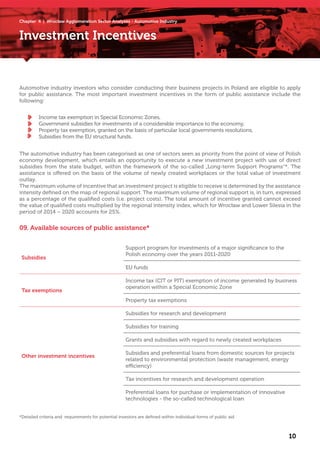
Income tax exemption in Special Economic Zones,
Government subsidies for investments of a considerable importance to the economy,
Property tax exemption, granted on the basis of particular local governments resolutions,
Subsidies from the EU structural funds.
09. Available sources of public assistance*
10
Subsidies
Support program for investments of a major significance to the
Polish economy over the years 2011-2020
EU funds
Tax exemptions
Income tax (CIT or PIT) exemption of income generated by business
operation within a Special Economic Zone
Property tax exemptions
Other investment incentives
Subsidies for research and development
Subsidies for training
Grants and subsidies with regard to newly created workplaces
Subsidies and preferential loans from domestic sources for projects
related to environmental protection (waste management, energy
efficiency)
Tax incentives for research and development operation
Preferential loans for purchase or implementation of innovative
technologies - the so-called technological loan
*Detailed criteria and requirements for potential investors are defined within individual forms of public aid
Chapter 4 | Wrocław Agglomeration Sector Analyses - Automotive Industry
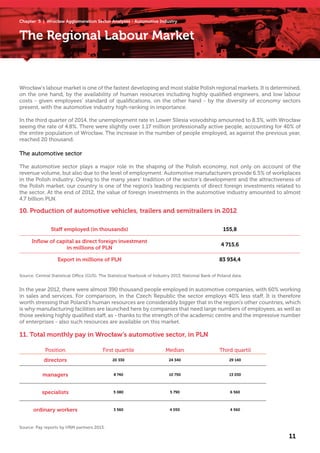
10. Production of automotive vehicles, trailers and semitrailers in 2012
The Regional Labour Market
Wrocław’s labour market is one of the fastest developing and most stable Polish regional markets. It is determined,
on the one hand, by the availability of human resources including highly qualified engineers, and low labour
costs - given employees’ standard of qualifications, on the other hand - by the diversity of economy sectors
present, with the automotive industry high-ranking in importance.
In the third quarter of 2014, the unemployment rate in Lower Silesia voivodship amounted to 8.3%, with Wrocław
seeing the rate of 4.8%. There were slightly over 1.17 million professionally active people, accounting for 40% of
the entire population of Wrocław. The increase in the number of people employed, as against the previous year,
reached 20 thousand.
The automotive sector
The automotive sector plays a major role in the shaping of the Polish economy, not only on account of the
revenue volume, but also due to the level of employment. Automotive manufacturers provide 6.5% of workplaces
in the Polish industry. Owing to the many years’ tradition of the sector’s development and the attractiveness of
the Polish market, our country is one of the region’s leading recipients of direct foreign investments related to
the sector. At the end of 2012, the value of foreign investments in the automotive industry amounted to almost
4.7 billion PLN.
In the year 2012, there were almost 390 thousand people employed in automotive companies, with 60% working
in sales and services. For comparison, in the Czech Republic the sector employs 40% less staff. It is therefore
worth stressing that Poland’s human resources are considerably bigger that in the region’s other countries, which
is why manufacturing facilities are launched here by companies that need large numbers of employees, as well as
those seeking highly qualified staff, as - thanks to the strength of the academic centre and the impressive number
of enterprises - also such resources are available on this market.
Staff employed (in thousands) 155,8
Inflow of capital as direct foreign investment
in millions of PLN
4 715,6
Export in millions of PLN 83 934,4
Source: Central Statistical Office (GUS), The Statistical Yearbook of Industry 2013, National Bank of Poland data.
11
Position First quartile Median Third quartil
directors 20 330 24 340 29 140
managers 8 740 10 750 13 030
specialists 5 080 5 790 6 560
ordinary workers 3 560 4 050 4 560
Source: Pay reports by HRM partners 2013.
Chapter 5 | Wrocław Agglomeration Sector Analyses - Automotive Industry
11. Total monthly pay in Wrocław’s automotive sector, in PLN
Chapter 5 | Wrocław Agglomeration Sector Analyses - Automotive Industry
The Regional Labour Market
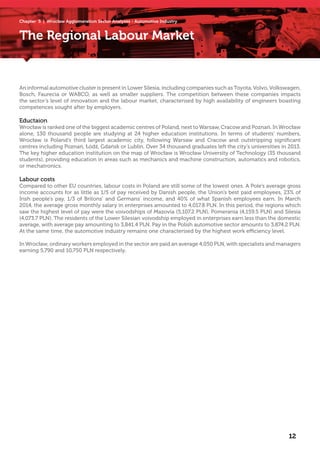
An informal automotive cluster is present in Lower Silesia, including companies such asToyota,Volvo,Volkswagen,
Bosch, Faurecia or WABCO, as well as smaller suppliers. The competition between these companies impacts
the sector’s level of innovation and the labour market, characterised by high availability of engineers boasting
competences sought after by employers.
Eductaion
Wrocław is ranked one of the biggest academic centres of Poland, next to Warsaw, Cracow and Poznań. In Wrocław
alone, 130 thousand people are studying at 24 higher education institutions. In terms of students’ numbers,
Wrocław is Poland’s third largest academic city, following Warsaw and Cracow and outstripping significant
centres including Poznań, Łódź, Gdańsk or Lublin. Over 34 thousand graduates left the city’s universities in 2013.
The key higher education institution on the map of Wrocław is Wrocław University of Technology (35 thousand
students), providing education in areas such as mechanics and machine construction, automatics and robotics,
or mechatronics.
Labour costs
Compared to other EU countries, labour costs in Poland are still some of the lowest ones. A Pole’s average gross
income accounts for as little as 1/5 of pay received by Danish people, the Union’s best paid employees, 23% of
Irish people’s pay, 1/3 of Britons’ and Germans’ income, and 40% of what Spanish employees earn. In March
2014, the average gross monthly salary in enterprises amounted to 4,017.8 PLN. In this period, the regions which
saw the highest level of pay were the voivodships of Mazovia (5,107.2 PLN), Pomerania (4,159.5 PLN) and Silesia
(4,073.7 PLN). The residents of the Lower Silesian voivodship employed in enterprises earn less than the domestic
average, with average pay amounting to 3,841.4 PLN. Pay in the Polish automotive sector amounts to 3,874.2 PLN.
At the same time, the automotive industry remains one characterised by the highest work efficiency level.
In Wrocław, ordinary workers employed in the sector are paid an average 4,050 PLN, with specialists and managers
earning 5,790 and 10,750 PLN respectively.
12
Chapter 6 | Wrocław Agglomeration Sector Analyses - Automotive Industry
Case Study - Toyota
13
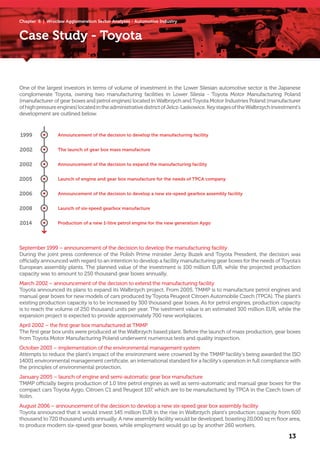
One of the largest investors in terms of volume of investment in the Lower Silesian automotive sector is the Japanese
conglomerate Toyota, owning two manufacturing facilities in Lower Silesia - Toyota Motor Manufacturing Poland
(manufacturer of gear boxes and petrol engines) located inWałbrzych andToyota Motor Industries Poland (manufacturer
ofhighpressureengines)locatedintheadministrativedistrictofJelcz-Laskowice.KeystagesoftheWałbrzychinvestment’s
development are outlined below.
September 1999 – announcement of the decision to develop the manufacturing facility
During the joint press conference of the Polish Prime minister Jerzy Buzek and Toyota President, the decision was
officially announced with regard to an intention to develop a facility manufacturing gear boxes for the needs of Toyota’s
European assembly plants. The planned value of the investment is 100 million EUR, while the projected production
capacity was to amount to 250 thousand gear boxes annually.
March 2002 – announcement of the decision to extend the manufacturing facility
Toyota announced its plans to expand its Wałbrzych project. From 2005, TMMP is to manufacture petrol engines and
manual gear boxes for new models of cars produced by Toyota Peugeot Citroen Automobile Czech (TPCA). The plant’s
existing production capacity is to be increased by 300 thousand gear boxes. As for petrol engines, production capacity
is to reach the volume of 250 thousand units per year. The ivestment value is an estimated 300 million EUR, while the
expansion project is expected to provide approximately 700 new workplaces.
April 2002 – the first gear box manufactured at TMMP
The first gear box units were produced at the Wałbrzych based plant. Before the launch of mass production, gear boxes
from Toyota Motor Manufacturing Poland underwent numerous tests and quality inspection.
October 2003 – implementation of the environmental management system
Attempts to reduce the plant’s impact of the environment were crowned by the TMMP facility’s being awarded the ISO
14001 environmental management certificate, an international standard for a facility’s operation in full compliance with
the principles of environmental protection.
January 2005 – launch of engine and semi-automatic gear box manufacture
TMMP officially begins production of 1.0 litre petrol engines as well as semi-automatic and manual gear boxes for the
compact cars Toyota Aygo, Citroen C1 and Peugeot 107, which are to be manufactured by TPCA in the Czech town of
Kolin.
August 2006 – announcement of the decision to develop a new six-speed gear box assembly facility
Toyota announced that it would invest 145 million EUR in the rise in Wałbrzych plant’s production capacity from 600
thousand to 720 thousand units annually. A new assembly facility would be developed, boasting 20,000 sq m floor area,
to produce modern six-speed gear boxes, while employment would go up by another 260 workers.
Announcement of the decision to develop the manufacturing facility1999
The launch of gear box mass manufacture2002
Announcement of the decision to expand the manufacturing facility2002
Launch of engine and gear box manufacture for the needs of TPCA company2005
2006 Announcement of the decision to develop a new six-speed gearbox assembly facility
2008 Launch of six-speed gearbox manufacture
2014 Production of a new 1-litre petrol engine for the new generation Aygo
Chapter 6 | Wrocław Agglomeration Sector Analyses - Automotive Industry
Case Study - Toyota
14
Setpember 2008 – launch of six-speed gearbox manufacture
TMMP launches its third investment project and starts the manufacture of modern gearboxes for Toyota Yaris, Auris,
Corolla and Corolla Verso.
June 2014 – production of a new 1-litre petrol engine
In its Wałbrzych plant, Toyota started production of a new petrol engine, to be used mainly for the new generation
Toyota Aygo. The company invested 123 mln PLN in the project.
It is worth emphasising that the facility’s annual production capacity is currently 720,000 gear boxes and 371,000
engines. The total investment value of the Wałbrzych facility has now exceeded 2 billion PLN, with about 1600 staff
employed.
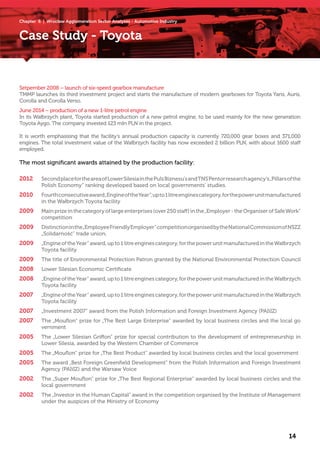
The most significant awards attained by the production facility:
2012	 SecondplacefortheareaofLowerSilesiainthePulsBiznesu’sandTNSPentorresearchagency’s„Pillarsofthe
	 Polish Economy” ranking developed based on local governments’ studies.
2010	 Fourthconsecutiveaward„EngineoftheYear”,upto1litreenginescategory,forthepowerunitmanufactured
	 in the Wałbrzych Toyota facility
2009	 Mainprizeinthecategoryoflargeenterprises(over250staff)inthe„Employer-theOrganiserofSafeWork”
	competition
2009	 Distinctioninthe„EmployeeFriendlyEmployer”competitionorganisedbytheNationalCommissionofNSZZ
	 „Solidarność” trade union.
2009	 „EngineoftheYear”award,upto1litreenginescategory,forthepowerunitmanufacturedintheWałbrzych
	 Toyota facility
2009	 The title of Environmental Protection Patron granted by the National Environmental Protection Council
2008	 Lower Silesian Economic Certificate
2008	 „EngineoftheYear”award,upto1litreenginescategory,forthepowerunitmanufacturedintheWałbrzych
	 Toyota facility
2007	 „EngineoftheYear”award,upto1litreenginescategory,forthepowerunitmanufacturedintheWałbrzych
	 Toyota facility
2007	 „Investment 2007” award from the Polish Information and Foreign Investment Agency (PAIiIZ)
2007	 The „Mouflon” prize for „The Best Large Enterprise” awarded by local business circles and the local go
	 vernment
2005	 The „Lower Silesian Griffon” prize for special contribution to the development of entrepreneurship in
	 Lower Silesia, awarded by the Western Chamber of Commerce
2005	 The „Mouflon” prize for „The Best Product” awarded by local business circles and the local government
2005	 The award „Best Foreign Greenfield Development” from the Polish Information and Foreign Investment
	 Agency (PAIiIZ) and the Warsaw Voice
2002	 The „Super Mouflon” prize for „The Best Regional Enterprise” awarded by local business circles and the
	 local government
2002	 The „Investor in the Human Capital” award in the competition organised by the Institute of Management
	 under the auspices of the Ministry of Economy
15
within the framework of „Mozart” 2013/2014 - the Municipal Program of Support for the Partnership of Higher Education conducted as
Partnership:
When planning to start business operation in the area of the Wrocław
agglomeration, every company is eligible to receive support from
the Agency of Wrocław Agglomeration Development, responsible
for supporting foreign investment activity. Already since 2005,
the Agency has been providing assistance to foreign investors in
the area of planning and conducting comprehensive investment
processes, also by ensuring post-investment care. The dedicated team
of specialists supports investors at every stage, making sure that the
whole investment process is carried through fast and effectively.
You are welcome to visit www.araw.pl.
HRK is one of the largest human resources management consultancy
organisations operating in Poland. We offer comprehensive services for
investors in the area of human resources management by supporting
them in their recruitment projects, as well as in professional potential
research and development, career path building and employer branding.
Under the brand of HRK Payroll Consulting, we deliver services with
regard to payroll administration and personnel documentation
management. As part of IRC Executive Search and Bernard Hodes Global
Networks international networks of globally active employer branding
experts, we deliver projects across the whole country and abroad.
You are welcome to visit our website www.hrk.eu.
For over 12 years, JP Weber has been supporting international investors
in their Poland based investment-related operations and their day-
to-day tax and accounts related, as well as legal dealings. We employ
over 60 investment and tax advisers, as well as lawyers operating
from our Wrocław and Warsaw offices. We provide services to both
large global conglomerates and SMB sector enterprises planning
their business activity in Poland and we support Polish companies in
looking for strategic investors and in their international expansion. We
support decision-makers in transactions and day-to-day handling of
their businesses, guaranteeing an individual client-oriented as well as
comprehensive approach to the Polish market’s business.
You are welcome to visit our website www.jpweber.com.
Jarosław Ignacy, Ph.D.
Doctor of economic sciences, specialising in strategic management
and lecturer at the Department of Strategic Management of Wrocław’s
University of Economics. He has combined his academic activity with
collaboration with business as an adviser and consultant for many years,
having authored numerous strategies, studies and expert opinions
for the needs of companies, institutions and local government units.
Participant and expert member of many research projects in Poland
and countries of the European Union, linked to various aspects of
entrepreneurship, strategic management and New Public Management.
The Invest in Wrocław team comprises professionals hailing from
the Agency of Wrocław Agglomeration Development and JP Weber.
The experts, boasting extensive knowledge of the region, investment
locations, conditions of investing and doing business in Poland, will
effectively support investment projects and provide all necessary
information.
You are welcome to visit the portal www.invest-in-wroclaw.pl.
City of Perspectives
Author of the study:
The following sources of information were used for the purpose of the study:
1) Statistical data and sector studies of the Central Statistical Office (GUS).
2) Data, analyses and sector presentations of PAIiIZ (Polish Information and Foreign Investment Agency).
3) Analyses and forecasts of the Ministry of Economy.
4) Data provided by the European Automobile Manufacturers Association (ACEA).
5) Publications of the Organisation of Economic Co-operation and Development and the World Bank (Doing business).
6) Automotive sector - Quarterly and annual reports (2012-2014) of the Polish Association of the Automotive Industry (PZPM), as well as
KPMG, CMS and BAKER&MCKENZIE.
7) The state of the automotive sector and its role in the Polish economy. KPMG/PZPM report for 2013.
8) Automotive Sector Poland, Emerging Markets Insights (EMIS).
9) Information from the website of the Ministry of Science and Higher Education.
10) Information from the websites of Toyota and Wabco companies.
11) Generally available press information (including Bankier, Forsal, Gazeta Prawna, Puls Biznesu, Gazeta.pl, and Money.pl) with regard to
the development of Toyota and Wabco companies.
16
Automotive
Contact:
Agencja Rozwoju Aglomeracji Wrocławskiej SA
pl. Solny 14
50-062 Wrocław
Tel. +48 71 78 35 310
Fax +48 71 78 35 311
email: araw@araw.pl
JP Weber sp. z o.o.
ul. Rynek 39/40
50-102 Wrocław
Tel. +48 71 36 99 630
Fax +48 71 36 99 639
email: info@jpweber.com
City of Perspectives

Wroclaw agglomeration sector analyses automotive industry

  • 1.
  • 2.
    TABLE OF CONTENTS Thepublication prepared in cooperation: City of Perspectives 01 02 03 04 05 06 The Automotive Industry in Poland Lower Silesia and the Wrocław Agglomeration as a Location for Investment Development Prospects Investment Incentives The Regional Labour Market Case Study - Toyota
  • 3.
    Wrocław is aunique and dynamic city, making an excellent place for investment and business development. The Wrocław Agglomeration’s assets have not only been long appreciated by foreign investors, but they also have become a foun- dation for growth and global expansion of many well known Polish companies. However, the contemporary dynamics of change results in emergence of new ne- eds, making information an increasingly valuable business resource. Both foreign conglomerates and domestic businesses seek useful information, indispensable in successful investment related decision-making. New economic conditions require undertaking non-standard action, which led to originating the Invest in Wrocław project (www.invest-in-wroclaw.pl). Many risk factors can be avoided, if one has a better understanding of sector-specific determinants and the development pro- spects of their own line of business as well as related industries. This was the ratio- nale behind studies of the Wrocław Agglomeration’s priority, strongly developing sectors, including the following ones: Automotive industry, Eelectronics, Chemical and Pharmaceu- tical industry, Mechanical engineering, IT, BPO, Food industry We hope that the free of charge sector analyses will facilitate decision-making not only for potential investors, but also the companies already operating in the area of the Wrocław Agglomeration. Integration of information from different sour- ces is supposed, by principle, to contribute to establishing co-operation between suppliers, subcontractors and recipients from diverse lines of business related to sectors which are priority for Wrocław’s development. Due to improving market transparency and increased ease of contact with businesses, the resulting benefits may be also enjoyed by local administration units, and most notably local com- munities. By combining all of the elements mentioned, it becomes possible for the whole Wrocław Agglomeration region to increase its growth dynamics and attain a competitive advantage. We hope that in this way we are redefining the standards of support for business development. 3 Introduction
  • 4.
    Chapter 1 |Wrocław Agglomeration Sector Analyses - Automotive Industry The Automotive Industry in Poland Over the past decade, the Polish automotive sector has become one of the biggest ones in The Central Eastern Europe (CEE). Among 40 car and engine production facilities located in this part of the continent, as many as 16 are in Poland. The automotive industry has become a key branch of the Polish economy, making it the second lar- gest sector in Poland. In 2011, it attracted investment outlays of 4.4 billion PLN and opened workplaces to almost 150 thousand people. The data does not include employees from the related sectors, e.g. tyre manufacturing. In 2013, Poland’s production output of motor vehicles amounted to 590.3 thousand, which is 8.9% less than in the previous year and over one third less than in 2008 (the number does not include special vehicles), with the passenger car segment being responsible for the drop. In 2013, 475.1 thousand were produced, which is by 12% less than in the previous year (see figure 2). A slightly different situation is observed in the segment of delivery and heavy truck vehicles, which for five years has seen consistent growth, having fully levelled off after the downturn. Over the whole of 2013, the total output of these vehicles amounted to 111.1 thousand units - 6.9% more than in 2012 (see figure 3). 01. Sold production (thousands of units). 02. Sold production of passenger cars throughout 2010-2013 (thousands of units). 03. Sold production of heavy trucks (including delivery trucks) throughout 2010-2013. Source: Central Statistical Office (GUS) Industrial goods manufacture in 2013 2005 2008 2009 2010 2011 2012 2013 Passenger cars 540,2 841,7 818,8 785,0 740,5 548,1 475,1 Heavy trucks (including delivery trucks) 67,7 99,3 55,4 79,9 92,1 103,9 111,1 Buses and coaches 5,4 4,6 4,8 4,6 5,1 4,0 4,2 0 200 400 600 800 1000 784,8 740,2 540,0 475,1 2010 2011 2012 2013 79 899 92 064 98 450 111 003 2010 2011 2012 20130 20 40 60 80 100 120 4
  • 5.
    Chapter 1 |Wrocław Agglomeration Sector Analyses - Automotive Industry The Automotive Industry in Poland The economy of the bus segment is also gradually improving. In 2013, bus production went up to 4.2 thousand units (improvement by 4.8% annualised rate). See the graphic representation in figure 4. Overall, in 2013, sold production in the Polish automotive industry amounted to 109.2 billion PLN, which is by 6.3% face value more than in 2012. Structural analysis shows that, by and large, it is utility vehicles as well as automotive parts and accessories production that are responsible for the rise. The strength of the domestic automotive business is a result of a policy of several years’ standing, oriented towards attracting foreign investment and reinforcing the assets of workforce available to potential investors. The Central Eastern Europe’s largest number of highly qualified labour, including 1.9 million university and college students, favourable location as against the biggest European output markets, stable and predictable economy, as well as an attractive investment incentive system determined the development of production facilities of brands including Fiat Auto Poland, Volkswagen Poland, GM, or Volvo. The Polish automotive sector, however, is not only car manufacture, but also production of parts and car accessories. Over the past four years, the latter segment of the market has been developing far more rapidly than car production. While the number of cars manufactured in Poland dropped by over one third in 2012 ,compared to 2008, the production output value of parts and subassemblies rose by 66 per cent in the corresponding period to reach 49 billion PLN in 2012. These include the following: powertrains (two Toyota plants, Volkswagen Motor Polska, Fiat Powertrain and GM Powertrain), steering systems (Nexteer Automotive, TRW, Delphi, Mando Corporation), lighting systems (Valeo, Automotive Lighting), cooling systems (Delphi, Valeo, Hutchinson), coachworks and chassis (Gedia, Kirchhoff, Magna), tyres (Michelin, Bridgestone, Goodyear), car glass (Pilkington, Saint-Gobain Sekurit, PGW), internal systems (Boshoku, Faurecia, wezi-tec), seats (Faurecia, Sitech, Johnson Controls, Lear Corporation), and security systems (TRW, Autoliv). The Polish automotive sector is still almost entirely export-oriented - in 2011, it generated 19.5 million EUR, accounting for 14.5% of the whole of the Polish export volume. The amount is mainly made up of parts and accessories constituting 32.6% of automotive industry export. Foreign sales of these amounted to 6.4 billion EUR. Also passenger cars have a large share, i.e. 31.6%, in the country’s automotive export output. In 2011, as much as 84% of the Polish automotive industry export output reached the EU countries. The biggest recipient of the Polish automotive industry export was Germany, where goods worth 5.6 billion EUR (28.6% of the Polish automotive industry’s total export output) were supplied in 2011. Other key recipients are Italy (2.5 billion EUR, 12.9%), the UK (1.7 billion EUR, 8.7%), France (1.3 billion EUR, 6.6%), and Spain (1.1 billion EUR, 5.4%). 04. Sold production of buses throughout 2010-2013. 4 1823 996 5 068 4 546 0 1 000 2 000 3 000 4 000 5 000 6 000 2011 2012 20132010 5
  • 6.
    05. The revenuesof the biggest companies in the automotive industry in Lower Silesia in 2013 (in thousands PLN). Lower Silesia and the Wrocław Agglomera- tion as a Location for Investment Wrocław and the entire Lower Silesia is an area that stands out compared to the whole country in terms of auto- motive industry performance. The region’s current strength is determined by its industrial heritage, the existing and still developing Polish enterprises, as well as a large number of foreign investors who have located their ma- nufacturing facilities here. For years now, the Lower Silesian voivodship has been consistently strengthening its potential in the automotive sector by developing its transport infrastructure, reinforcing the existing workforce, improving the potential of technical universities, as well as increasingly dynamic co-operation with automotive clusters operating in Central Europe. Thanks to the activity mentioned above, we see continuous development of already operating enterprises and an inflow of new investors. High pressure car engine production facilities were located near Wrocław by Toyota Motor Industries Poland and Volkswagen Motor Polska. Other plants located in the area include Sitech Sp. z o.o., specializing in metal seat frames for Volkswagen and GKN Driveline Polska - a manufacturer of drive shafts and other components for Fiat. Wrocław itself has a strategic significance for Volvo - it is here that the European Volvo bus production centre is located. Also WABCO, a global supplier of effective safety technologies and control systems for heavy trucks, owns a production facility in the capital of Lower Silesia. The manufacturer of brakes and power steering systems Bosh company is an equally important automotive sector player operating in Wrocław. Furthermore, Wrocław has one of Poland’s best developed modern services sectors, characterised by a considerable growth dynamics - half of the operating services centres are R&D departments (the highest share country-wide). WABCO is exten- ding its research and development centre in Wrocław. A team of qualified engineers works there on global pro- jects aimed at developing and testing innovative systems for heavy trucks. Source: Central Statistical Office (GUS) Industrial goods manufacture in 2013, EMIS Intelligence. 4 513 Motor Polska Volkswagen 2 666 Toyota Motor Manufacturing Poland 1 720 Volvo Polska 1 367 Toyota Motor Industries Poland 1 245 Sitech 988 GKN Driveline Polska 959 Ronal Polska 785 Autoliv Poland 6 Chapter 2 | Wrocław Agglomeration Sector Analyses - Automotive Industry
  • 7.
    Lower Silesia andthe Wrocław Agglomera- tion as a Location for Investment 07. The list below includes the largest automotive companies operating in the Lower Silesia. Company Manufacture segment Location Country of origin Staff employed Volvo Polska buses and loader-excavators Wrocław Sweden 2 300 WABCO Polska safety technologies and control systems for heavy trucks Wrocław USA 2 000 Toyota Motor Manufacturing Poland gearboxes Wałbrzych Japan 1 700 Autoliv airbags and safety belts Oława Sweden 1 600 Sitech car seats Polkowice Germany 1 500 Ronal Polska car wheels Wałbrzych Germany 1 200 Pittsburgh Glass Works car glass Wałbrzych USA 1 200 Volkswagen Motor Polska Diesel engines Polkowice Germany 1100 Faurecia car seats Wałbrzych France 900 Takata Petri parts and accessories for mechanical vehicles Krzeszów (Wałbrzych) Japan 700 Toyota Motor Industries Poland Diesel engines Jelcz-Laskowice Japan 700 GKN Driveline Polska drive shafts and power transmission systems Oleśnica UK 600 Foundation Brakes brake systems Mirków USA 550 Bosch Polska brake and power steering systems Wrocław Germany 500 BASF catalysts Środa Śląska Germany 400 Daicel airbag components Żarów Sweden 400 Eto Magnetic power hydraulics Wrocław Germany 300 Sumitomo Chemical filters for Diesel engines Wrocław Japan 300 Bridgestone rubber products for construction machinery Żarów Japan 70 Denso filters for Diesel engines Żarów Japan 50 7 06. Automotive sector’s main product groups. OEM assembly group production Engines, gears Interior equipment Equipment systems Chapter 2 | Wrocław Agglomeration Sector Analyses - Automotive Industry
  • 8.
    Lower Silesia andthe Wrocław Agglomera- tion as a Location for Investment 8 Territorial distribution of the automotive sector’s companies in Lower Silesia is represented in figure 8. Automoti- ve companies are visibly concentrated around large ad medium-sized cities of the Lower Silesian voivodship - mainly near Wrocław, Wałbrzych, Legnica and Oława. The location of businesses belonging to the sector stems from both logistic determinants and access to an adequate number of qualified manufacturing staff. At the same time, the automotive sector’s companies’ location is considerably influenced by the Special Economic Zones, offering favourable conditions for running a mass-scale manufacturing operation. 08. Geographical distribution of the automotive sector’s companies in Lower Silesia. Source: Invest in Wrocław Wrocław Chapter 2 | Wrocław Agglomeration Sector Analyses - Automotive Industry
  • 9.
    Development Prospects Poland isa very attractive location for production plants and the automotive sector’s suppliers, testimony to which are the biggest global conglomerates’ investments made in Poland so far. The most significant rationale to invest in the automotive industry in Poland, most notably in the area of Wrocław, are as follows: It is worth pointing out that the Wrocław Agglomeration has an immense potential in terms of human resources, which can be tapped by automotive companies. Lower Silesia offers not only a sufficient number of skilled labourers, but also ample research and development background. Factors to a large extent contributing to its growth include diverse actions oriented towards development of co-operation of science and education with business. The most important initiatives in this area are the following: Abundance of qualified workforce across several major Polish automotive regions, including the Wrocław Agglomeration, Wellqualifiedstaffwithengineeringbackground-thankstothelargenumberofadequately-orientedtechnical universities, including Wrocław University of Technology, one of the best technical universities in Poland, Easy and quick access to the leading European vehicle manufacturers and automotive suppliers in the area of Lower Silesia, including Toyota, Volvo, Volkswagen, Bosch, GKN, Wabco, Ronal, Autoliv, Faurecia, Zakłady Samochodowe Jelcz S.A., AMM, TBMeca, Sanden, Daicel, NSK Steering System, Voss Automotive, and Industrie Maurizio Peruzzo Comfort, ManypotentiallocationsofferingCentralandEasternEurope’sbestconditionsforproductionandestablishment of research and development centres, A large growth potential of new cars sales in Poland, Relatively low labour cost in comparison to other countries of the Central Eastern Europe region, Attractive investment incentive system, including cash subsidies and tax exemption, Special Economic Zones: Legnica, Wałbrzych, Kamienna Góra, and Tarnobrzeg SEZ’s. Wrocław University of Technology - the educational institution is consistently extending the group of its business partners, among whom well-established companies are already found, including BMW, Volvo and MAN. The „Increase in the Number of Wrocław University of Technology Graduates of Majors of Key Importance to the Knowledge-Based Economy” project conducted throughout 2009-2013 focusing on 9 majors of studies commissioned by the Ministry of Science and Higher Education, with automatics, mechatronics or machine construction among them. The Wrocław Agglomeration secondary schools’ co-operation with automotive companies in the area of vocational education, most notably: a) Associated Schools no. 2 in Wrocław educates technicians and vehicle mechanics in collaboration with Mercedes-Benz and MAN companies. b) Bosch and Mitsubishi participate in vocational training of mechanics-technicians at the Aviation Science Institutes. 9 Chapter 3 | Wrocław Agglomeration Sector Analyses - Automotive Industry
  • 10.
    Investment Incentives Automotive industryinvestors who consider conducting their business projects in Poland are eligible to apply for public assistance. The most important investment incentives in the form of public assistance include the following: The automotive industry has been categorised as one of sectors seen as priority from the point of view of Polish economy development, which entails an opportunity to execute a new investment project with use of direct subsidies from the state budget, within the framework of the so-called „Long-term Support Programs”*. The assistance is offered on the basis of the volume of newly created workplaces or the total value of investment outlay. The maximum volume of incentive that an investment project is eligible to receive is determined by the assistance intensity defined on the map of regional support. The maximum volume of regional support is, in turn, expressed as a percentage of the qualified costs (i.e. project costs). The total amount of incentive granted cannot exceed the value of qualified costs multiplied by the regional intensity index, which for Wrocław and Lower Silesia in the period of 2014 – 2020 accounts for 25%. Income tax exemption in Special Economic Zones, Government subsidies for investments of a considerable importance to the economy, Property tax exemption, granted on the basis of particular local governments resolutions, Subsidies from the EU structural funds. 09. Available sources of public assistance* 10 Subsidies Support program for investments of a major significance to the Polish economy over the years 2011-2020 EU funds Tax exemptions Income tax (CIT or PIT) exemption of income generated by business operation within a Special Economic Zone Property tax exemptions Other investment incentives Subsidies for research and development Subsidies for training Grants and subsidies with regard to newly created workplaces Subsidies and preferential loans from domestic sources for projects related to environmental protection (waste management, energy efficiency) Tax incentives for research and development operation Preferential loans for purchase or implementation of innovative technologies - the so-called technological loan *Detailed criteria and requirements for potential investors are defined within individual forms of public aid Chapter 4 | Wrocław Agglomeration Sector Analyses - Automotive Industry
  • 11.
    10. Production ofautomotive vehicles, trailers and semitrailers in 2012 The Regional Labour Market Wrocław’s labour market is one of the fastest developing and most stable Polish regional markets. It is determined, on the one hand, by the availability of human resources including highly qualified engineers, and low labour costs - given employees’ standard of qualifications, on the other hand - by the diversity of economy sectors present, with the automotive industry high-ranking in importance. In the third quarter of 2014, the unemployment rate in Lower Silesia voivodship amounted to 8.3%, with Wrocław seeing the rate of 4.8%. There were slightly over 1.17 million professionally active people, accounting for 40% of the entire population of Wrocław. The increase in the number of people employed, as against the previous year, reached 20 thousand. The automotive sector The automotive sector plays a major role in the shaping of the Polish economy, not only on account of the revenue volume, but also due to the level of employment. Automotive manufacturers provide 6.5% of workplaces in the Polish industry. Owing to the many years’ tradition of the sector’s development and the attractiveness of the Polish market, our country is one of the region’s leading recipients of direct foreign investments related to the sector. At the end of 2012, the value of foreign investments in the automotive industry amounted to almost 4.7 billion PLN. In the year 2012, there were almost 390 thousand people employed in automotive companies, with 60% working in sales and services. For comparison, in the Czech Republic the sector employs 40% less staff. It is therefore worth stressing that Poland’s human resources are considerably bigger that in the region’s other countries, which is why manufacturing facilities are launched here by companies that need large numbers of employees, as well as those seeking highly qualified staff, as - thanks to the strength of the academic centre and the impressive number of enterprises - also such resources are available on this market. Staff employed (in thousands) 155,8 Inflow of capital as direct foreign investment in millions of PLN 4 715,6 Export in millions of PLN 83 934,4 Source: Central Statistical Office (GUS), The Statistical Yearbook of Industry 2013, National Bank of Poland data. 11 Position First quartile Median Third quartil directors 20 330 24 340 29 140 managers 8 740 10 750 13 030 specialists 5 080 5 790 6 560 ordinary workers 3 560 4 050 4 560 Source: Pay reports by HRM partners 2013. Chapter 5 | Wrocław Agglomeration Sector Analyses - Automotive Industry 11. Total monthly pay in Wrocław’s automotive sector, in PLN
  • 12.
    Chapter 5 |Wrocław Agglomeration Sector Analyses - Automotive Industry The Regional Labour Market An informal automotive cluster is present in Lower Silesia, including companies such asToyota,Volvo,Volkswagen, Bosch, Faurecia or WABCO, as well as smaller suppliers. The competition between these companies impacts the sector’s level of innovation and the labour market, characterised by high availability of engineers boasting competences sought after by employers. Eductaion Wrocław is ranked one of the biggest academic centres of Poland, next to Warsaw, Cracow and Poznań. In Wrocław alone, 130 thousand people are studying at 24 higher education institutions. In terms of students’ numbers, Wrocław is Poland’s third largest academic city, following Warsaw and Cracow and outstripping significant centres including Poznań, Łódź, Gdańsk or Lublin. Over 34 thousand graduates left the city’s universities in 2013. The key higher education institution on the map of Wrocław is Wrocław University of Technology (35 thousand students), providing education in areas such as mechanics and machine construction, automatics and robotics, or mechatronics. Labour costs Compared to other EU countries, labour costs in Poland are still some of the lowest ones. A Pole’s average gross income accounts for as little as 1/5 of pay received by Danish people, the Union’s best paid employees, 23% of Irish people’s pay, 1/3 of Britons’ and Germans’ income, and 40% of what Spanish employees earn. In March 2014, the average gross monthly salary in enterprises amounted to 4,017.8 PLN. In this period, the regions which saw the highest level of pay were the voivodships of Mazovia (5,107.2 PLN), Pomerania (4,159.5 PLN) and Silesia (4,073.7 PLN). The residents of the Lower Silesian voivodship employed in enterprises earn less than the domestic average, with average pay amounting to 3,841.4 PLN. Pay in the Polish automotive sector amounts to 3,874.2 PLN. At the same time, the automotive industry remains one characterised by the highest work efficiency level. In Wrocław, ordinary workers employed in the sector are paid an average 4,050 PLN, with specialists and managers earning 5,790 and 10,750 PLN respectively. 12
  • 13.
    Chapter 6 |Wrocław Agglomeration Sector Analyses - Automotive Industry Case Study - Toyota 13 One of the largest investors in terms of volume of investment in the Lower Silesian automotive sector is the Japanese conglomerate Toyota, owning two manufacturing facilities in Lower Silesia - Toyota Motor Manufacturing Poland (manufacturer of gear boxes and petrol engines) located inWałbrzych andToyota Motor Industries Poland (manufacturer ofhighpressureengines)locatedintheadministrativedistrictofJelcz-Laskowice.KeystagesoftheWałbrzychinvestment’s development are outlined below. September 1999 – announcement of the decision to develop the manufacturing facility During the joint press conference of the Polish Prime minister Jerzy Buzek and Toyota President, the decision was officially announced with regard to an intention to develop a facility manufacturing gear boxes for the needs of Toyota’s European assembly plants. The planned value of the investment is 100 million EUR, while the projected production capacity was to amount to 250 thousand gear boxes annually. March 2002 – announcement of the decision to extend the manufacturing facility Toyota announced its plans to expand its Wałbrzych project. From 2005, TMMP is to manufacture petrol engines and manual gear boxes for new models of cars produced by Toyota Peugeot Citroen Automobile Czech (TPCA). The plant’s existing production capacity is to be increased by 300 thousand gear boxes. As for petrol engines, production capacity is to reach the volume of 250 thousand units per year. The ivestment value is an estimated 300 million EUR, while the expansion project is expected to provide approximately 700 new workplaces. April 2002 – the first gear box manufactured at TMMP The first gear box units were produced at the Wałbrzych based plant. Before the launch of mass production, gear boxes from Toyota Motor Manufacturing Poland underwent numerous tests and quality inspection. October 2003 – implementation of the environmental management system Attempts to reduce the plant’s impact of the environment were crowned by the TMMP facility’s being awarded the ISO 14001 environmental management certificate, an international standard for a facility’s operation in full compliance with the principles of environmental protection. January 2005 – launch of engine and semi-automatic gear box manufacture TMMP officially begins production of 1.0 litre petrol engines as well as semi-automatic and manual gear boxes for the compact cars Toyota Aygo, Citroen C1 and Peugeot 107, which are to be manufactured by TPCA in the Czech town of Kolin. August 2006 – announcement of the decision to develop a new six-speed gear box assembly facility Toyota announced that it would invest 145 million EUR in the rise in Wałbrzych plant’s production capacity from 600 thousand to 720 thousand units annually. A new assembly facility would be developed, boasting 20,000 sq m floor area, to produce modern six-speed gear boxes, while employment would go up by another 260 workers. Announcement of the decision to develop the manufacturing facility1999 The launch of gear box mass manufacture2002 Announcement of the decision to expand the manufacturing facility2002 Launch of engine and gear box manufacture for the needs of TPCA company2005 2006 Announcement of the decision to develop a new six-speed gearbox assembly facility 2008 Launch of six-speed gearbox manufacture 2014 Production of a new 1-litre petrol engine for the new generation Aygo
  • 14.
    Chapter 6 |Wrocław Agglomeration Sector Analyses - Automotive Industry Case Study - Toyota 14 Setpember 2008 – launch of six-speed gearbox manufacture TMMP launches its third investment project and starts the manufacture of modern gearboxes for Toyota Yaris, Auris, Corolla and Corolla Verso. June 2014 – production of a new 1-litre petrol engine In its Wałbrzych plant, Toyota started production of a new petrol engine, to be used mainly for the new generation Toyota Aygo. The company invested 123 mln PLN in the project. It is worth emphasising that the facility’s annual production capacity is currently 720,000 gear boxes and 371,000 engines. The total investment value of the Wałbrzych facility has now exceeded 2 billion PLN, with about 1600 staff employed. The most significant awards attained by the production facility: 2012 SecondplacefortheareaofLowerSilesiainthePulsBiznesu’sandTNSPentorresearchagency’s„Pillarsofthe Polish Economy” ranking developed based on local governments’ studies. 2010 Fourthconsecutiveaward„EngineoftheYear”,upto1litreenginescategory,forthepowerunitmanufactured in the Wałbrzych Toyota facility 2009 Mainprizeinthecategoryoflargeenterprises(over250staff)inthe„Employer-theOrganiserofSafeWork” competition 2009 Distinctioninthe„EmployeeFriendlyEmployer”competitionorganisedbytheNationalCommissionofNSZZ „Solidarność” trade union. 2009 „EngineoftheYear”award,upto1litreenginescategory,forthepowerunitmanufacturedintheWałbrzych Toyota facility 2009 The title of Environmental Protection Patron granted by the National Environmental Protection Council 2008 Lower Silesian Economic Certificate 2008 „EngineoftheYear”award,upto1litreenginescategory,forthepowerunitmanufacturedintheWałbrzych Toyota facility 2007 „EngineoftheYear”award,upto1litreenginescategory,forthepowerunitmanufacturedintheWałbrzych Toyota facility 2007 „Investment 2007” award from the Polish Information and Foreign Investment Agency (PAIiIZ) 2007 The „Mouflon” prize for „The Best Large Enterprise” awarded by local business circles and the local go vernment 2005 The „Lower Silesian Griffon” prize for special contribution to the development of entrepreneurship in Lower Silesia, awarded by the Western Chamber of Commerce 2005 The „Mouflon” prize for „The Best Product” awarded by local business circles and the local government 2005 The award „Best Foreign Greenfield Development” from the Polish Information and Foreign Investment Agency (PAIiIZ) and the Warsaw Voice 2002 The „Super Mouflon” prize for „The Best Regional Enterprise” awarded by local business circles and the local government 2002 The „Investor in the Human Capital” award in the competition organised by the Institute of Management under the auspices of the Ministry of Economy
  • 15.
    15 within the frameworkof „Mozart” 2013/2014 - the Municipal Program of Support for the Partnership of Higher Education conducted as Partnership: When planning to start business operation in the area of the Wrocław agglomeration, every company is eligible to receive support from the Agency of Wrocław Agglomeration Development, responsible for supporting foreign investment activity. Already since 2005, the Agency has been providing assistance to foreign investors in the area of planning and conducting comprehensive investment processes, also by ensuring post-investment care. The dedicated team of specialists supports investors at every stage, making sure that the whole investment process is carried through fast and effectively. You are welcome to visit www.araw.pl. HRK is one of the largest human resources management consultancy organisations operating in Poland. We offer comprehensive services for investors in the area of human resources management by supporting them in their recruitment projects, as well as in professional potential research and development, career path building and employer branding. Under the brand of HRK Payroll Consulting, we deliver services with regard to payroll administration and personnel documentation management. As part of IRC Executive Search and Bernard Hodes Global Networks international networks of globally active employer branding experts, we deliver projects across the whole country and abroad. You are welcome to visit our website www.hrk.eu. For over 12 years, JP Weber has been supporting international investors in their Poland based investment-related operations and their day- to-day tax and accounts related, as well as legal dealings. We employ over 60 investment and tax advisers, as well as lawyers operating from our Wrocław and Warsaw offices. We provide services to both large global conglomerates and SMB sector enterprises planning their business activity in Poland and we support Polish companies in looking for strategic investors and in their international expansion. We support decision-makers in transactions and day-to-day handling of their businesses, guaranteeing an individual client-oriented as well as comprehensive approach to the Polish market’s business. You are welcome to visit our website www.jpweber.com. Jarosław Ignacy, Ph.D. Doctor of economic sciences, specialising in strategic management and lecturer at the Department of Strategic Management of Wrocław’s University of Economics. He has combined his academic activity with collaboration with business as an adviser and consultant for many years, having authored numerous strategies, studies and expert opinions for the needs of companies, institutions and local government units. Participant and expert member of many research projects in Poland and countries of the European Union, linked to various aspects of entrepreneurship, strategic management and New Public Management. The Invest in Wrocław team comprises professionals hailing from the Agency of Wrocław Agglomeration Development and JP Weber. The experts, boasting extensive knowledge of the region, investment locations, conditions of investing and doing business in Poland, will effectively support investment projects and provide all necessary information. You are welcome to visit the portal www.invest-in-wroclaw.pl. City of Perspectives Author of the study:
  • 16.
    The following sourcesof information were used for the purpose of the study: 1) Statistical data and sector studies of the Central Statistical Office (GUS). 2) Data, analyses and sector presentations of PAIiIZ (Polish Information and Foreign Investment Agency). 3) Analyses and forecasts of the Ministry of Economy. 4) Data provided by the European Automobile Manufacturers Association (ACEA). 5) Publications of the Organisation of Economic Co-operation and Development and the World Bank (Doing business). 6) Automotive sector - Quarterly and annual reports (2012-2014) of the Polish Association of the Automotive Industry (PZPM), as well as KPMG, CMS and BAKER&MCKENZIE. 7) The state of the automotive sector and its role in the Polish economy. KPMG/PZPM report for 2013. 8) Automotive Sector Poland, Emerging Markets Insights (EMIS). 9) Information from the website of the Ministry of Science and Higher Education. 10) Information from the websites of Toyota and Wabco companies. 11) Generally available press information (including Bankier, Forsal, Gazeta Prawna, Puls Biznesu, Gazeta.pl, and Money.pl) with regard to the development of Toyota and Wabco companies. 16
  • 17.
    Automotive Contact: Agencja Rozwoju AglomeracjiWrocławskiej SA pl. Solny 14 50-062 Wrocław Tel. +48 71 78 35 310 Fax +48 71 78 35 311 email: araw@araw.pl JP Weber sp. z o.o. ul. Rynek 39/40 50-102 Wrocław Tel. +48 71 36 99 630 Fax +48 71 36 99 639 email: info@jpweber.com City of Perspectives