Writing a Journal Article Review
Discussion and Exam Instructions
What is a Journal Article?
A journal article, which is often scholarly
and peer-reviewed, is a written work that
focuses on research.
A research journal is a collection of
articles that is published regularly
throughout the year.
For many kinds of assignments, like a literature review, you may
be asked to offer a critique or review of a journal article. This is
an opportunity for you as a scholar to offer your qualified
opinion and evaluation of how another scholar has composed
their article, argument, and research. That means you will be
expected to go beyond a simple summary of the article and
evaluate it on a deeper level.
As a college student, this might sound intimidating. However, as
you engage with the research process, you are becoming
immersed in a particular topic, and your insights about the way
that topic is presented are valuable and can contribute to the
overall conversation surrounding your topic.
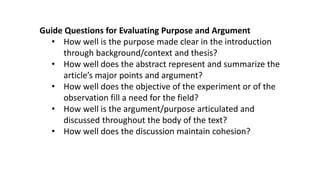
Guide Questions for Evaluating Purpose and Argument
• How well is the purpose made clear in the introduction
through background/context and thesis?
• How well does the abstract represent and summarize the
article’s major points and argument?
• How well does the objective of the experiment or of the
observation fill a need for the field?
• How well is the argument/purpose articulated and
discussed throughout the body of the text?
• How well does the discussion maintain cohesion?
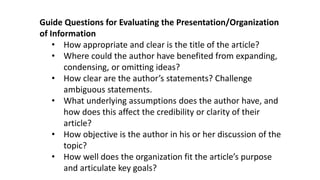
Guide Questions for Evaluating the Presentation/Organization
of Information
• How appropriate and clear is the title of the article?
• Where could the author have benefited from expanding,
condensing, or omitting ideas?
• How clear are the author’s statements? Challenge
ambiguous statements.
• What underlying assumptions does the author have, and
how does this affect the credibility or clarity of their
article?
• How objective is the author in his or her discussion of the
topic?
• How well does the organization fit the article’s purpose
and articulate key goals?
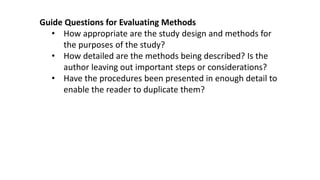
Guide Questions for Evaluating Methods
• How appropriate are the study design and methods for
the purposes of the study?
• How detailed are the methods being described? Is the
author leaving out important steps or considerations?
• Have the procedures been presented in enough detail to
enable the reader to duplicate them?
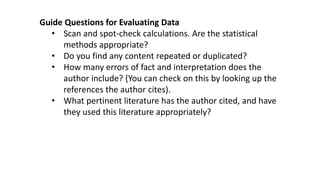
Guide Questions for Evaluating Data
• Scan and spot-check calculations. Are the statistical
methods appropriate?
• Do you find any content repeated or duplicated?
• How many errors of fact and interpretation does the
author include? (You can check on this by looking up the
references the author cites).
• What pertinent literature has the author cited, and have
they used this literature appropriately?
Guide Questions for Evaluating Data
• Scan and spot-check calculations. Are the statistical
methods appropriate?
• Do you find any content repeated or duplicated?
• How many errors of fact and interpretation does the
author include? (You can check on this by looking up the
references the author cites).
• What pertinent literature has the author cited, and have
they used this literature appropriately?
Sample Journal Article Review
Annotated Bibliography | Summary | Actual Review
PART I: Annotated Bibliography
Chik, A. (2012). Digital gameplay for autonomous foreign
language learning: Gamers’ and language teachers’
perspectives. Journal of Modern Technologies, 26 (8), 95-
114. https://doi.org/10.1090.10
In most stand-alone journal article review, an annotated
bibliography is added before the summary and actual review. In
a review of related literature and studies (research paper), this
must be part of a list of references (bibliography).
PART II: Summary
In Chik’s article “Digital Gameplay for Autonomous Foreign Language
Learning: Gamers’ and Teachers’ Perspectives”, she explores the ways in
which “digital gamers manage gaming and gaming-related activities to
assume autonomy in their foreign language learning,” (96) which is
presented in contrast to how teachers view the “pedagogical potential” of
gaming. The research was described as an “umbrella project” consisting of
two parts. The first part examined 34 language teachers’ perspectives who
had limited experience with gaming (only five stated they played games
regularly) (99). Their data was recorded through a survey, class discussion,
and a seven-day gaming trial done by six teachers who recorded their
reflections through personal blog posts…
The summary includes the article’s purpose, methods, results, discussion,
and citations when necessary.
PART III: Actual Review
This article did a good job representing the undergraduate gamers’ voices
through extended quotes and stories. Particularly for the data collection of
the undergraduate gamers, there were many opportunities for an in-depth
examination of their gaming practices and histories. However, the
representation of the teachers in this study was very uneven when
compared to the students. Not only were teachers labeled as numbers
while the students picked out their own pseudonyms, but also when
viewing the data collection, the undergraduate students were more closely
examined in comparison to the teachers in the study…
You may begin an evaluation with something positive but isn’t always necessary. The
evaluation is clearly organized and uses transitional phrases when moving to a new topic.
This includes a summative statement that gives the overall impression of the article at the
end, but this can also be placed at the beginning of the evaluation.
Your 1st Quarter Exam
Instructions
1st QUARTER EXAM INSTRUCTIONS
• Start with the approved research title or topic of your
group.
• Research and download a published journal article
(research, usually in IMRaD format) related to your
group’s research topic.
• Write an annotated bibliography for it.
• Then, write a two-paragraph review. The first paragraph
must be the summary. The second paragraph must be the
actual review.
• Upload your review to the designated eLMS dropbox
together with the subject material (the journal article).
• After or during the exam week, it is expected that your
group will compile the reviews for your RRL.
What to Do Today
• Finalize your research topic.
• Go surf the web and choose a good journal article.
• Get the title, author, and other details.
• Have it listed by your group leader to avoid duplicated
reviews.

Writing-a-Journal-Article-Review-1i.pptx

  • 1.
    Writing a JournalArticle Review Discussion and Exam Instructions
  • 2.
    What is aJournal Article? A journal article, which is often scholarly and peer-reviewed, is a written work that focuses on research. A research journal is a collection of articles that is published regularly throughout the year.
  • 3.
    For many kindsof assignments, like a literature review, you may be asked to offer a critique or review of a journal article. This is an opportunity for you as a scholar to offer your qualified opinion and evaluation of how another scholar has composed their article, argument, and research. That means you will be expected to go beyond a simple summary of the article and evaluate it on a deeper level. As a college student, this might sound intimidating. However, as you engage with the research process, you are becoming immersed in a particular topic, and your insights about the way that topic is presented are valuable and can contribute to the overall conversation surrounding your topic.
  • 4.
    Guide Questions forEvaluating Purpose and Argument • How well is the purpose made clear in the introduction through background/context and thesis? • How well does the abstract represent and summarize the article’s major points and argument? • How well does the objective of the experiment or of the observation fill a need for the field? • How well is the argument/purpose articulated and discussed throughout the body of the text? • How well does the discussion maintain cohesion?
  • 5.
    Guide Questions forEvaluating the Presentation/Organization of Information • How appropriate and clear is the title of the article? • Where could the author have benefited from expanding, condensing, or omitting ideas? • How clear are the author’s statements? Challenge ambiguous statements. • What underlying assumptions does the author have, and how does this affect the credibility or clarity of their article? • How objective is the author in his or her discussion of the topic? • How well does the organization fit the article’s purpose and articulate key goals?
  • 6.
    Guide Questions forEvaluating Methods • How appropriate are the study design and methods for the purposes of the study? • How detailed are the methods being described? Is the author leaving out important steps or considerations? • Have the procedures been presented in enough detail to enable the reader to duplicate them?
  • 7.
    Guide Questions forEvaluating Data • Scan and spot-check calculations. Are the statistical methods appropriate? • Do you find any content repeated or duplicated? • How many errors of fact and interpretation does the author include? (You can check on this by looking up the references the author cites). • What pertinent literature has the author cited, and have they used this literature appropriately?
  • 8.
    Guide Questions forEvaluating Data • Scan and spot-check calculations. Are the statistical methods appropriate? • Do you find any content repeated or duplicated? • How many errors of fact and interpretation does the author include? (You can check on this by looking up the references the author cites). • What pertinent literature has the author cited, and have they used this literature appropriately?
  • 9.
    Sample Journal ArticleReview Annotated Bibliography | Summary | Actual Review
  • 10.
    PART I: AnnotatedBibliography Chik, A. (2012). Digital gameplay for autonomous foreign language learning: Gamers’ and language teachers’ perspectives. Journal of Modern Technologies, 26 (8), 95- 114. https://doi.org/10.1090.10 In most stand-alone journal article review, an annotated bibliography is added before the summary and actual review. In a review of related literature and studies (research paper), this must be part of a list of references (bibliography).
  • 11.
    PART II: Summary InChik’s article “Digital Gameplay for Autonomous Foreign Language Learning: Gamers’ and Teachers’ Perspectives”, she explores the ways in which “digital gamers manage gaming and gaming-related activities to assume autonomy in their foreign language learning,” (96) which is presented in contrast to how teachers view the “pedagogical potential” of gaming. The research was described as an “umbrella project” consisting of two parts. The first part examined 34 language teachers’ perspectives who had limited experience with gaming (only five stated they played games regularly) (99). Their data was recorded through a survey, class discussion, and a seven-day gaming trial done by six teachers who recorded their reflections through personal blog posts… The summary includes the article’s purpose, methods, results, discussion, and citations when necessary.
  • 12.
    PART III: ActualReview This article did a good job representing the undergraduate gamers’ voices through extended quotes and stories. Particularly for the data collection of the undergraduate gamers, there were many opportunities for an in-depth examination of their gaming practices and histories. However, the representation of the teachers in this study was very uneven when compared to the students. Not only were teachers labeled as numbers while the students picked out their own pseudonyms, but also when viewing the data collection, the undergraduate students were more closely examined in comparison to the teachers in the study… You may begin an evaluation with something positive but isn’t always necessary. The evaluation is clearly organized and uses transitional phrases when moving to a new topic. This includes a summative statement that gives the overall impression of the article at the end, but this can also be placed at the beginning of the evaluation.
  • 13.
    Your 1st QuarterExam Instructions
  • 14.
    1st QUARTER EXAMINSTRUCTIONS • Start with the approved research title or topic of your group. • Research and download a published journal article (research, usually in IMRaD format) related to your group’s research topic. • Write an annotated bibliography for it. • Then, write a two-paragraph review. The first paragraph must be the summary. The second paragraph must be the actual review. • Upload your review to the designated eLMS dropbox together with the subject material (the journal article). • After or during the exam week, it is expected that your group will compile the reviews for your RRL.
  • 15.
    What to DoToday • Finalize your research topic. • Go surf the web and choose a good journal article. • Get the title, author, and other details. • Have it listed by your group leader to avoid duplicated reviews.