Write that Down!
Tips for effective writing
Questions we seek answers for:
• Why is writing difficult?
• Where does the writing effort begin and end?
• How can I improve my writing?
© The Write Stride Team 2
Design the Script
It is all a part of the design. Read the script; follow the design.
#1
© The Write Stride Team 3
The Teapot Theory
© The Write Stride Team 4
The Writer’s take: design like a writer, write like a designer.
Help Objective Interpretation
A miss is as good as a mile.
#2
© The Write Stride Team 5
Interpretation is Subjective
© The Write Stride Team 7
The Writer’s take: Little information and too much information both mean the same.
“a woman without her man is nothing”
• A woman, without her man, is nothing.
• A woman: without her, man is nothing.
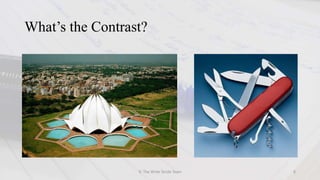
What’s the Contrast?
© The Write Stride Team 8
Learning is a By-Product
The journey, the pursuit is more enjoyable than the outcome. Build
experiences.
#3
The Writer’s take: readers learn more when they don’t know they are learning.
© The Write Stride Team 9
Be a Better Rewriter
Rome wasn’t built in a day, and so wouldn’t be your success story.
#4
The Writer’s take: learn to rewrite.
© The Write Stride Team 10
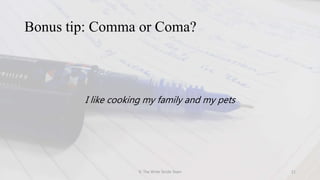
Bonus tip: Comma or Coma?
I like cooking my family and my pets
© The Write Stride Team 11
Get it Write!
A, C, B, B, C
© The Write Stride Team 12
Be a Better Editor
Be specific about what you seek. Keep an eye for details.
#5
The Writer’s take: meanings lie between and across sentences.
© The Write Stride Team 13
Bonus tip: The Only Matter
• Only I have seen your new book
• I have only seen your new book
• I have seen only your new book
• I have seen your only new book
© The Write Stride Team 14
Pick one
© The Write Stride Team 15
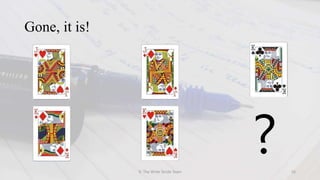
Gone, it is!
© The Write Stride Team 16
?
Edit it Correctly!
B, C, A, C, C
© The Write Stride Team 17
Questions, anyone?
© The Write Stride Team 18
Image and content credits: The Internet
Background and template credits: Blame the shutterbug within me.
Author’s Bio
SuyogKetkar.com
© The Write Stride Team 19

Write that Down

  • 1.
    Write that Down! Tipsfor effective writing
  • 2.
    Questions we seekanswers for: • Why is writing difficult? • Where does the writing effort begin and end? • How can I improve my writing? © The Write Stride Team 2
  • 3.
    Design the Script Itis all a part of the design. Read the script; follow the design. #1 © The Write Stride Team 3
  • 4.
    The Teapot Theory ©The Write Stride Team 4 The Writer’s take: design like a writer, write like a designer.
  • 5.
    Help Objective Interpretation Amiss is as good as a mile. #2 © The Write Stride Team 5
  • 6.
    Interpretation is Subjective ©The Write Stride Team 7 The Writer’s take: Little information and too much information both mean the same. “a woman without her man is nothing” • A woman, without her man, is nothing. • A woman: without her, man is nothing.
  • 7.
    What’s the Contrast? ©The Write Stride Team 8
  • 8.
    Learning is aBy-Product The journey, the pursuit is more enjoyable than the outcome. Build experiences. #3 The Writer’s take: readers learn more when they don’t know they are learning. © The Write Stride Team 9
  • 9.
    Be a BetterRewriter Rome wasn’t built in a day, and so wouldn’t be your success story. #4 The Writer’s take: learn to rewrite. © The Write Stride Team 10
  • 10.
    Bonus tip: Commaor Coma? I like cooking my family and my pets © The Write Stride Team 11
  • 11.
    Get it Write! A,C, B, B, C © The Write Stride Team 12
  • 12.
    Be a BetterEditor Be specific about what you seek. Keep an eye for details. #5 The Writer’s take: meanings lie between and across sentences. © The Write Stride Team 13
  • 13.
    Bonus tip: TheOnly Matter • Only I have seen your new book • I have only seen your new book • I have seen only your new book • I have seen your only new book © The Write Stride Team 14
  • 14.
    Pick one © TheWrite Stride Team 15
  • 15.
    Gone, it is! ©The Write Stride Team 16 ?
  • 16.
    Edit it Correctly! B,C, A, C, C © The Write Stride Team 17
  • 17.
    Questions, anyone? © TheWrite Stride Team 18 Image and content credits: The Internet Background and template credits: Blame the shutterbug within me.
  • 18.

Editor's Notes

  • #2 Notes: Technical writing must be one of the most weirdest jobs in the world. No matter how carefully the words have been prepared, one amongst your audiences will still successfully fail to understand them. Some years back, I remember, I got a spam call – back then I did not have Truecaller to save my time and myself from all the humiliation. The call turned out to be from a bank that was trying to sell their credit cards to me. After all the information vomit that the caller did, she finally paused for a second, when I seized the moment and said, “Ma’m I respect whatever you told me, but I do not need a credit card as of now.” She said, “I am fine with this, Sir, but I would request you to provide me some information about what you do so that I can at least tell you the credit limit you are eligible for.” I was OK with it, so I asked her to go ahead with the template of questions that she had.” She began, “What’s your profession?” I assumed that she might have a problem comprehending me correctly if I told her that I was a technical communicator. Those were two big words for her – with all that “made up” English accent, I was sure she wouldn’t understand how the words “technical” and “communicator” can be combined meaningfully. So, I said, “I am a writer who writes.” And, then there was a pause. A big pause; for about a whole of 90 seconds, I didn’t hear anything. So, I inquired, “Hello! Have I lost you?” Then came a meek response from her, “Sir, even I don’t think you need a credit card.” And, there she put down the phone. Technical writing is surely one of the most weirdest jobs in the world. No matter how carefully the words have been prepared, one amongst your audiences will still successfully fail to understand them. With that, my friends, good evening and welcome to the presentation.
  • #3 While we wish you to become an expert at writing after attending this presentation, it is fairly a stretched expectation. On a more realistic note, here are the questions we wish to address today: For today’s presentation, it is a given for us, as much as it is for you, that we focus mainly on the last question. However, together we will address the remaining questions, too. And, if there is anything that you find useful, please raise your hand and let others know about it.
  • #4 Have you ever noticed that if you stop at a traffic light on a given day, you will have to stop at every next traffic light that day. That, if you are planning to reach early to your office on a given day, you will surely be late to the office on that day. There are numerous examples like of our lives setting a design for us and we being bound to follow those designs. But, what do we learn from all that? Writing, we learn, is much like Physics. It is all around us. Just that we need to observe the things, the everyday life, and the everyday happenings around us. Example of iPhone’s Mute button. That’s what a good design can do to you.
  • #5 As a writer, I wish to use this knowledge to write like a designer or design like a writer. Make what’s simple simpler. Give example of the teapot and how someone uses it. Describe how there are different teapots in some countries for right and left-handed people. For example, the Japanese Kyusu teapots that have a handle instead of an ear.
  • #9 Many problems-one solution vs. One solution for each of the problems
  • #10 A reader wishes to know who you are based on what they read from you. So, what you write has to be a reflection of who you are as a person. The clearer your thoughts are the clearer your writing will be. That’s not to say that you will write stories and poems like user manuals. What it means is that the reader will become a part of your journey. It should appear to them as if they are watching you earn your experiences as you act. They should be a witness to your story. I will repeat the last part: YOUR story. Learning is only a by-product. In the process of throwing more than one thing (insights, philosophy, thoughts, and others) at your user, you might lose your reader. Now I want all of you to close your eyes and imagine what I say: Imagine that you are sitting by a French windows on a lonely night, witnessing the sluicing rains, breathing in the petrichor of the first rains that wet the throat of a thirsty patch of earth. Don’t you think that that person is thinking about either their lover or getting drenched in this blessing of the Mother Nature called rains. And, you don’t need any rocket science to write about how energized you feel when you see, imagine, or describe them.
  • #11 The next two tips of writing and editing better are rather mechanical and with a little help from books and online references, you can train yourself to get adept at these skills. However, they still are important enough to be listed in our top five favorite ones to help improve the effectiveness of writing. We will give you some handy advice along, but the fun part is in seeing you participate.
  • #14 It is often said that if a writer is what they write, then editors are how, not what, they edit. So, how you edit what you write will determine what kind of editor you are. And, in most cases, the more critical you are on what you write, the clearer your writing becomes. Make sure you pay attention to the last line here, because what follows is just amazing.
  • #16 Magic is in not knowing what logic does.
  • #17 Magic is in not knowing what logic does.
  • #19 As promised, we have kept our focus on helping you improve your writing, while on a more subtle note, we have answered the other two questions. The first question, “Why is writing difficult”: Writing is difficult because we think it is difficult for us to communicate our thoughts correctly. The second question, “Where does the writing process begin and end”: The writing process begins where it ends; understanding the need for communication. With this we come to the end of this small preparation of what we thought were some of the most important things to keep in mind when writing. Both I, the author, and Arun and Sanjeev, the editors, of The Write Stride: A Conversation with Your Writing Self are from the technical writing industry. Throughout our daily job requirements, we keep our messages precise and according to the needs of the audiences. But, like with every other thing, writing is subjective. Every change in the factors has its impact on the way we write. But, the principles that we discussed today apply to any writing effort that you might have to do. And, that’s precisely the purpose of today’s presentation. We believe that when you go back, you will have some points to ponder and some, to improve. Clarity of thought is of the utmost importance in writing, and we are happy to see that we could make you think.