The Political Context of Community-
Based Prevention Research in
Germany

Dr. Michael T. Wright, LICSW, MS
Research Group Public Health
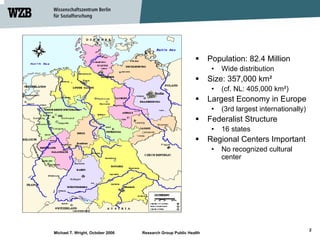
Population: 82.4 Million
                                                                  •   Wide distribution
                                                                 Size: 357,000 km²
                                                                  •   (cf. NL: 405,000 km²)
                                                                 Largest Economy in Europe
                                                                  •   (3rd largest internationally)
                                                                 Federalist Structure
                                                                  •   16 states
                                                                 Regional Centers Important
                                                                  •   No recognized cultural
                                                                      center


                                                                                                      2
Michael T. Wright, October 2006   Research Group Public Health
German health care and prevention structures

           Constitutionally based social welfare
           state
           Health as a state issue
           Insurance structure and §20 SGB V
           Prevention Law
           EU Initiative “Closing the Gap”


                                                                     3
    Michael T. Wright, October 2006   Research Group Public Health
Constitutionally Based Social Welfare State

   Core concept in the German understanding of
   social responsibility and the role of
   government
   Principle not alligned with a particular party or
   ideology
   Related concepts:
     • Solidarity
     • Subsidiarty


                                                                 4
Michael T. Wright, October 2006   Research Group Public Health
Health as a State Issue

       The issue of health is principally the
       responsibility of the federal states
       Federal jurisdiction is limited, for
       example, regarding the financing and
       structuring of prevention
       interventions


                                                                 5
Michael T. Wright, October 2006   Research Group Public Health
Health Insurance Structure

    Not a nationalized system
    Not a central payer system
    Statutory health insurance funds (circa
    300)
      • Owned by the insured
      • Self-administered by elected representatives
      • Acting under public law
    Prevention and self-help are financed by
    these companies (§20 SGBV)


                                                                 6
Michael T. Wright, October 2006   Research Group Public Health
Health Insurance, Prevention and Self-Help
A particular focus on addressing social inequalities in health
Workplace prevention, individual prevention, community-based
prevention for socially disadvantaged groups, self-help (not
just prevention)
Total: € 148 million/year
    Circa € 2.60 per person insured
Community-based work: € 35 million/year
Self-help: € 35 million/year
Decentralized disbursement
Common guidelines and core documentation
Wide variation in practice and lack of professional capacity


                                                                     7
    Michael T. Wright, October 2006   Research Group Public Health
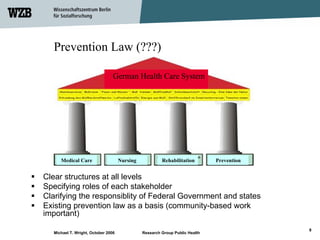
Prevention Law (???)

                                German Health Care System


     Medical Care                   Nursing            Rehabilitation        Prevention


Clear structures at all levels
Specifying roles of each stakeholder
Clarifying the responsiblity of Federal Government and states
Existing prevention law as a basis (community-based work
important)
                                                                                          8
  Michael T. Wright, October 2006             Research Group Public Health
Closing the Gap – Strategies for Action to
Tackle Health Inequalities in Europe
 EU Initiative: Exchange and documentation of effective
 policies and interventions
 National Level: Federal Center for Health Education
  • Good Practice Criteria for Community-Based Interventions
  • Regional Coordinators for Community-Based Interventions
  • National Alliance on Prevention for Socially Disadvantaged
    Groups (focus: community-based interventions)

       Setting the stage for a next attempt at a Prevention Law


                                                                    9
   Michael T. Wright, October 2006   Research Group Public Health
Our Work: National Demonstration Projects to
Establish Participatory Models for Quality
Assurance
 Filling the structural gap for quality assurance in
 community work
 Partners: Deutsche AIDS-Hilfe and Gesundheit Berlin
 Funders: Federal Center for Health Education (Ministry
 for Health); Ministry for Education and Research
 Focus on Quality Assurance, not Evaluation
  • Consensus on supporting processes of quality
      development


                                                                     10
    Michael T. Wright, October 2006   Research Group Public Health
Project Components
Skill-Building Workshops on Participatory Methods
 • partcipatory curriculum
Methods Handbook
 • internet based, interactive
Individualized Consulting
 • project-driven focus
Peer Review Process
Good Practice Criteria
 • systematic input from CBOs at the regional level
Network of Researchers Interesting in participatory
methods
 • opening a new discursive space in German


                                                                 11
Michael T. Wright, October 2006   Research Group Public Health
As politically engaged researchers:
         We participate actively in the political
         discourse.
         We reference structural and political factors
         in grant writing and project implementation.
         We do not separate behavioral from
         structural (social) factors.
         We position our work in order to make the
         strongest contribution possible to social
         change for the public’s health.
         We reject claims of scientific objectivity but
         maintain an analytical stance.


                                                                    12
   Michael T. Wright, October 2006   Research Group Public Health
Methodological and Theoretical
Implications of a Politically Engaged,
Community-Based Science
 We view community experience as the source of
 knowledge.
 We explicitly recognize all levels of change being
 targeted by community groups, including political goals.
 We see the primary role of science as facilitating the
 process of transforming local knowledge to local theory
 in the interest of generating local evidence.
 The primary focus of our scientific inquiry is the
 community learning process and developing methods to
 facilitate this process.


                                                                    13
   Michael T. Wright, October 2006   Research Group Public Health
Looking Toward the Future

The explicit connection between political processes and
political goals and community-based science needs to
be openly acknowledged.
The scientific argument for community-based research
needs to be further developed, addressing issues of
theory, particularly of epistemology (how is knowledge
generated, for whom and to what effect?)
Community-based research needs to be judged on its
own terms, which requires that standards be set for this
kind of work.

                              This we can do together!


                                                                    14
 Michael T. Wright, October 2006     Research Group Public Health
15
Michael T. Wright, October 2006   Research Group Public Health

The Political Context of Community-Based Prevention Research in Germany

  • 1.
    The Political Contextof Community- Based Prevention Research in Germany Dr. Michael T. Wright, LICSW, MS Research Group Public Health
  • 2.
    Population: 82.4 Million • Wide distribution Size: 357,000 km² • (cf. NL: 405,000 km²) Largest Economy in Europe • (3rd largest internationally) Federalist Structure • 16 states Regional Centers Important • No recognized cultural center 2 Michael T. Wright, October 2006 Research Group Public Health
  • 3.
    German health careand prevention structures Constitutionally based social welfare state Health as a state issue Insurance structure and §20 SGB V Prevention Law EU Initiative “Closing the Gap” 3 Michael T. Wright, October 2006 Research Group Public Health
  • 4.
    Constitutionally Based SocialWelfare State Core concept in the German understanding of social responsibility and the role of government Principle not alligned with a particular party or ideology Related concepts: • Solidarity • Subsidiarty 4 Michael T. Wright, October 2006 Research Group Public Health
  • 5.
    Health as aState Issue The issue of health is principally the responsibility of the federal states Federal jurisdiction is limited, for example, regarding the financing and structuring of prevention interventions 5 Michael T. Wright, October 2006 Research Group Public Health
  • 6.
    Health Insurance Structure Not a nationalized system Not a central payer system Statutory health insurance funds (circa 300) • Owned by the insured • Self-administered by elected representatives • Acting under public law Prevention and self-help are financed by these companies (§20 SGBV) 6 Michael T. Wright, October 2006 Research Group Public Health
  • 7.
    Health Insurance, Preventionand Self-Help A particular focus on addressing social inequalities in health Workplace prevention, individual prevention, community-based prevention for socially disadvantaged groups, self-help (not just prevention) Total: € 148 million/year Circa € 2.60 per person insured Community-based work: € 35 million/year Self-help: € 35 million/year Decentralized disbursement Common guidelines and core documentation Wide variation in practice and lack of professional capacity 7 Michael T. Wright, October 2006 Research Group Public Health
  • 8.
    Prevention Law (???) German Health Care System Medical Care Nursing Rehabilitation Prevention Clear structures at all levels Specifying roles of each stakeholder Clarifying the responsiblity of Federal Government and states Existing prevention law as a basis (community-based work important) 8 Michael T. Wright, October 2006 Research Group Public Health
  • 9.
    Closing the Gap– Strategies for Action to Tackle Health Inequalities in Europe EU Initiative: Exchange and documentation of effective policies and interventions National Level: Federal Center for Health Education • Good Practice Criteria for Community-Based Interventions • Regional Coordinators for Community-Based Interventions • National Alliance on Prevention for Socially Disadvantaged Groups (focus: community-based interventions) Setting the stage for a next attempt at a Prevention Law 9 Michael T. Wright, October 2006 Research Group Public Health
  • 10.
    Our Work: NationalDemonstration Projects to Establish Participatory Models for Quality Assurance Filling the structural gap for quality assurance in community work Partners: Deutsche AIDS-Hilfe and Gesundheit Berlin Funders: Federal Center for Health Education (Ministry for Health); Ministry for Education and Research Focus on Quality Assurance, not Evaluation • Consensus on supporting processes of quality development 10 Michael T. Wright, October 2006 Research Group Public Health
  • 11.
    Project Components Skill-Building Workshopson Participatory Methods • partcipatory curriculum Methods Handbook • internet based, interactive Individualized Consulting • project-driven focus Peer Review Process Good Practice Criteria • systematic input from CBOs at the regional level Network of Researchers Interesting in participatory methods • opening a new discursive space in German 11 Michael T. Wright, October 2006 Research Group Public Health
  • 12.
    As politically engagedresearchers: We participate actively in the political discourse. We reference structural and political factors in grant writing and project implementation. We do not separate behavioral from structural (social) factors. We position our work in order to make the strongest contribution possible to social change for the public’s health. We reject claims of scientific objectivity but maintain an analytical stance. 12 Michael T. Wright, October 2006 Research Group Public Health
  • 13.
    Methodological and Theoretical Implicationsof a Politically Engaged, Community-Based Science We view community experience as the source of knowledge. We explicitly recognize all levels of change being targeted by community groups, including political goals. We see the primary role of science as facilitating the process of transforming local knowledge to local theory in the interest of generating local evidence. The primary focus of our scientific inquiry is the community learning process and developing methods to facilitate this process. 13 Michael T. Wright, October 2006 Research Group Public Health
  • 14.
    Looking Toward theFuture The explicit connection between political processes and political goals and community-based science needs to be openly acknowledged. The scientific argument for community-based research needs to be further developed, addressing issues of theory, particularly of epistemology (how is knowledge generated, for whom and to what effect?) Community-based research needs to be judged on its own terms, which requires that standards be set for this kind of work. This we can do together! 14 Michael T. Wright, October 2006 Research Group Public Health
  • 15.
    15 Michael T. Wright,October 2006 Research Group Public Health