How important is water?
Without water no life could exist on
Earth - Our bodies are made up of up to
60% water. Not only do we need it to
survive and function, it also underpins
all human activity; food and energy
production, travel, industrial processes,
construction – we rely on all of these
things to sustain our society and way of
life and all of these things rely on H₂o.
Flushing toilets and hot showers are
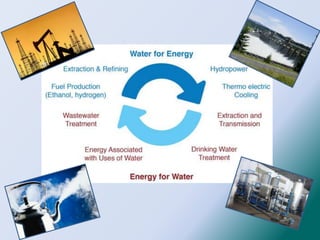
This is called the water/energy nexus
Water for Energy
All energy production needs
water at some stage in the
process. It is used in energy
production and conversion, as
well as in other processes, such
as the refining of coal, gas and
crude oil.
Energy for Water
A massive amount of energy is
used in the collection, refining
and distribution of water as well
as the disposal of waste water.
Think of the amount of gas and
electricity homes and business use
to heat water everyday…
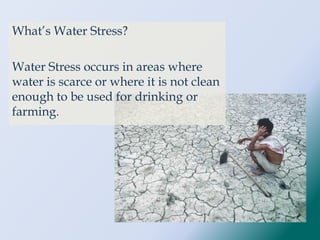
What’s Water Stress?
Water Stress occurs in areas where
water is scarce or where it is not clean
enough to be used for drinking or
farming.
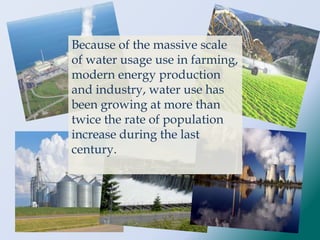
Because of the massive scale
of water usage use in farming,
modern energy production
and industry, water use has
been growing at more than
twice the rate of population
increase during the last
century.
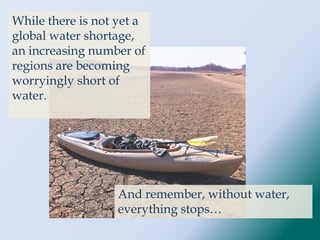
While there is not yet a
global water shortage,
an increasing number of
regions are becoming
worryingly short of
water.
And remember, without water,
everything stops…
“Water scarcity is both a natural and a human-made
phenomenon. There is enough freshwater on the planet
for seven billion people but it is distributed unevenly
and too much of it is wasted, polluted and unsustainably
managed.”
Human Development Report 2006. UNDP, 2006
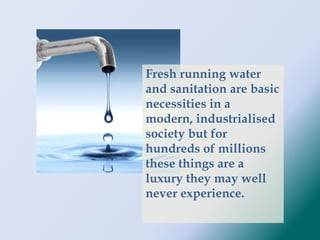
Fresh running water
and sanitation are basic
necessities in a
modern, industrialised
society but for
hundreds of millions
these things are a
luxury they may well
never experience.
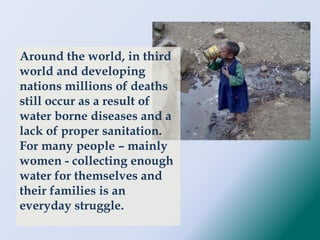
Around the world, in third
world and developing
nations millions of deaths
still occur as a result of
water borne diseases and a
lack of proper sanitation.
For many people – mainly
women - collecting enough
water for themselves and
their families is an
everyday struggle.
The good news
Over two billion people have gained access to
safer drinking water since 1990, according to a
report by UNICEF and the World Health
Organization.
2010 89% of the world’s population or 6.1 billion
had access to clean drinking water five years
ahead of the World Health Organisation’s 2015
target.
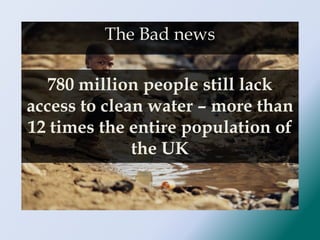
780 million people still lack
access to clean water – more than
12 times the entire population of
the UK
The Bad news
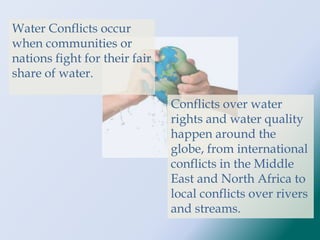
Water Conflicts occur
when communities or
nations fight for their fair
share of water.
Conflicts over water
rights and water quality
happen around the
globe, from international
conflicts in the Middle
East and North Africa to
local conflicts over rivers
and streams.
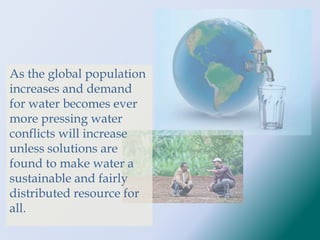
As the global population
increases and demand
for water becomes ever
more pressing water
conflicts will increase
unless solutions are
found to make water a
sustainable and fairly
distributed resource for
all.
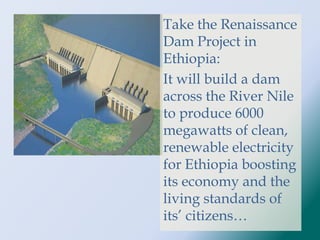
Take the Renaissance
Dam Project in
Ethiopia:
It will build a dam
across the River Nile
to produce 6000
megawatts of clean,
renewable electricity
for Ethiopia boosting
its economy and the
living standards of
its’ citizens…
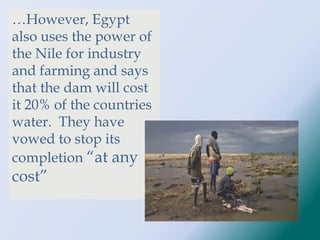
…However, Egypt
also uses the power of
the Nile for industry
and farming and says
that the dam will cost
it 20% of the countries
water. They have
vowed to stop its
completion “at any
cost”
”…the risk of conflicts over water is
growing – not shrinking – because
of increased competition, because of
bad management and, ultimately,
because of the impacts of climate
change”
Peter Gleick, president of the Pacific Institute.
"For us, water is [now] more important than
oil.“
Mohammed bin Zayed bin Sultan Al Nahyan, president of the United Arab
Emirates
The future?
If our society chooses to ignore the reality of
limited water resources, the number of
people impacted by water stress will double
from 2.4 billion people to 4.8 billion, water
prices will rise dramatically and armed
conflicts over water may become a reality.
…But if we waste less, pollute less,
reuse more, manage more
effectively and become more
efficient in all uses of water –
individual, collective, agricultural
and industrial – more than 1 billion
people could escape exposure to
risks and challenges from severe
water scarcity.
World Water Day 2014

  • 2.
    How important iswater? Without water no life could exist on Earth - Our bodies are made up of up to 60% water. Not only do we need it to survive and function, it also underpins all human activity; food and energy production, travel, industrial processes, construction – we rely on all of these things to sustain our society and way of life and all of these things rely on H₂o. Flushing toilets and hot showers are
  • 4.
    This is calledthe water/energy nexus Water for Energy All energy production needs water at some stage in the process. It is used in energy production and conversion, as well as in other processes, such as the refining of coal, gas and crude oil. Energy for Water A massive amount of energy is used in the collection, refining and distribution of water as well as the disposal of waste water. Think of the amount of gas and electricity homes and business use to heat water everyday…
  • 6.
    What’s Water Stress? WaterStress occurs in areas where water is scarce or where it is not clean enough to be used for drinking or farming.
  • 7.
    Because of themassive scale of water usage use in farming, modern energy production and industry, water use has been growing at more than twice the rate of population increase during the last century.
  • 8.
    While there isnot yet a global water shortage, an increasing number of regions are becoming worryingly short of water. And remember, without water, everything stops…
  • 9.
    “Water scarcity isboth a natural and a human-made phenomenon. There is enough freshwater on the planet for seven billion people but it is distributed unevenly and too much of it is wasted, polluted and unsustainably managed.” Human Development Report 2006. UNDP, 2006
  • 10.
    Fresh running water andsanitation are basic necessities in a modern, industrialised society but for hundreds of millions these things are a luxury they may well never experience.
  • 11.
    Around the world,in third world and developing nations millions of deaths still occur as a result of water borne diseases and a lack of proper sanitation. For many people – mainly women - collecting enough water for themselves and their families is an everyday struggle.
  • 12.
    The good news Overtwo billion people have gained access to safer drinking water since 1990, according to a report by UNICEF and the World Health Organization. 2010 89% of the world’s population or 6.1 billion had access to clean drinking water five years ahead of the World Health Organisation’s 2015 target.
  • 13.
    780 million peoplestill lack access to clean water – more than 12 times the entire population of the UK The Bad news
  • 14.
    Water Conflicts occur whencommunities or nations fight for their fair share of water. Conflicts over water rights and water quality happen around the globe, from international conflicts in the Middle East and North Africa to local conflicts over rivers and streams.
  • 15.
    As the globalpopulation increases and demand for water becomes ever more pressing water conflicts will increase unless solutions are found to make water a sustainable and fairly distributed resource for all.
  • 16.
    Take the Renaissance DamProject in Ethiopia: It will build a dam across the River Nile to produce 6000 megawatts of clean, renewable electricity for Ethiopia boosting its economy and the living standards of its’ citizens…
  • 17.
    …However, Egypt also usesthe power of the Nile for industry and farming and says that the dam will cost it 20% of the countries water. They have vowed to stop its completion “at any cost”
  • 18.
    ”…the risk ofconflicts over water is growing – not shrinking – because of increased competition, because of bad management and, ultimately, because of the impacts of climate change” Peter Gleick, president of the Pacific Institute.
  • 19.
    "For us, wateris [now] more important than oil.“ Mohammed bin Zayed bin Sultan Al Nahyan, president of the United Arab Emirates
  • 20.
  • 21.
    If our societychooses to ignore the reality of limited water resources, the number of people impacted by water stress will double from 2.4 billion people to 4.8 billion, water prices will rise dramatically and armed conflicts over water may become a reality.
  • 22.
    …But if wewaste less, pollute less, reuse more, manage more effectively and become more efficient in all uses of water – individual, collective, agricultural and industrial – more than 1 billion people could escape exposure to risks and challenges from severe water scarcity.