Chapter 29: World War II
Section 1: World Affairs, 1933-1939
Question
• What is going on in the U.S. during this time period (1933-1939)?
• What do we know is going on in the world as a whole?
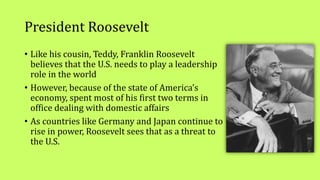
President Roosevelt
• Like his cousin, Teddy, Franklin Roosevelt
believes that the U.S. needs to play a leadership
role in the world
• However, because of the state of America’s
economy, spent most of his first two terms in
office dealing with domestic affairs
• As countries like Germany and Japan continue to
rise in power, Roosevelt sees that as a threat to
the U.S.
Foreign Policy
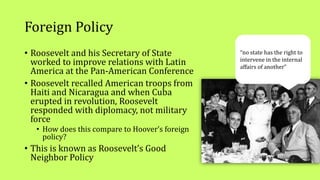
• Roosevelt and his Secretary of State
worked to improve relations with Latin
America at the Pan-American Conference
• Roosevelt recalled American troops from
Haiti and Nicaragua and when Cuba
erupted in revolution, Roosevelt
responded with diplomacy, not military
force
• How does this compare to Hoover’s foreign
policy?
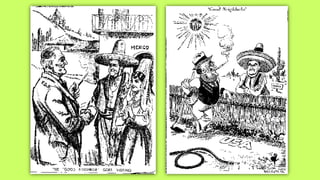
• This is known as Roosevelt’s Good
Neighbor Policy
“no state has the right to
intervene in the internal
affairs of another”
Foreign Policy
• During the New Deal, the U.S. adopted a policy of
economic isolationism
• Our New Deal programs were not taking the rest of the
world into account
• In 1933, delegates met in London to confront the
worldwide depression
• Roosevelt rejected other nation’s demands to peg the
value of the dollar to any other currency
• Secretary of State Cordell Hull saw the necessity of
world prosperity and sought to reduce tariffs
• The Reciprocal Trade Agreements Act of 1934
allowed the State Department to make treaties with
foreign nations that would lower import tariffs
Foreign Policy
• The U.S.S.R. formed after the Bolshevik Revolution
in 1917, but the U.S. did not recognize them as a
nation because they encouraged communism
• Because of serious economic problems within the
U.S.S.R. come 1933, we saw them as less of a threat
• Roosevelt also hoped that a strong Soviet Union
would challenge the rising power of Japan and
slow their expansion
• In addition, their need for food and industrial
goods gave struggling U.S. farmers and businesses
a new market
“The United States would
probably recognize the
Devil if it could sell him
pitchforks”
-Will Rogers
Rising Powers: Japan
• Japan began rapidly growing and industrializing at the end of the
19th century
Question
• How will Japan sustain this growth?
Rising Powers: Japan
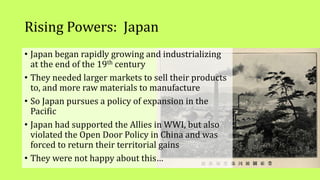
• Japan began rapidly growing and industrializing
at the end of the 19th century
• They needed larger markets to sell their products
to, and more raw materials to manufacture
• So Japan pursues a policy of expansion in the
Pacific
• Japan had supported the Allies in WWI, but also
violated the Open Door Policy in China and was
forced to return their territorial gains
• They were not happy about this…
Rising Powers: Japan
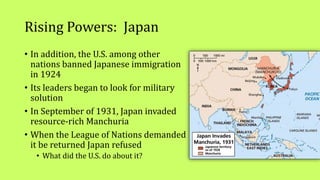
• In addition, the U.S. among other
nations banned Japanese immigration
in 1924
• Its leaders began to look for military
solution
• In September of 1931, Japan invaded
resource-rich Manchuria
• When the League of Nations demanded
it be returned Japan refused
• What did the U.S. do about it?
Rising Powers: Germany and Italy
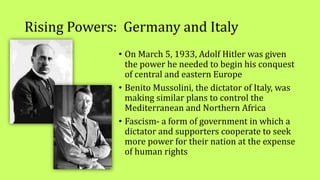
• On March 5, 1933, Adolf Hitler was given
the power he needed to begin his conquest
of central and eastern Europe
• Benito Mussolini, the dictator of Italy, was
making similar plans to control the
Mediterranean and Northern Africa
• Fascism- a form of government in which a
dictator and supporters cooperate to seek
more power for their nation at the expense
of human rights
Rising Powers: Germany and Italy
• Both Hitler and Mussolini established a totalitarian state within
their nations
• Totalitarian state- a nation that totally controls the life of its people
• The Communists in Russia, Fascists in Italy, and Nazis in Germany were all
powerful political parties
• Each leader blamed their countries problems on “undesirables” in
their countries
• Mussolini blamed the communists in Italy
• Hitler blamed the Jews
• Both leaders hinted at the possibility of another war in order to
right the wrongs of the Treaty of Versailles
Rising Powers
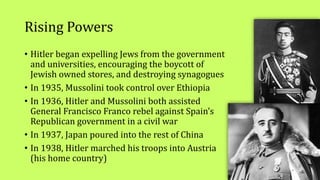
• Hitler began expelling Jews from the government
and universities, encouraging the boycott of
Jewish owned stores, and destroying synagogues
• In 1935, Mussolini took control over Ethiopia
• In 1936, Hitler and Mussolini both assisted
General Francisco Franco rebel against Spain’s
Republican government in a civil war
• In 1937, Japan poured into the rest of China
• In 1938, Hitler marched his troops into Austria
(his home country)
Appeasement
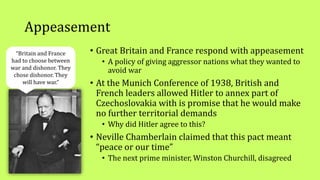
• Great Britain and France respond with appeasement
• A policy of giving aggressor nations what they wanted to
avoid war
• At the Munich Conference of 1938, British and
French leaders allowed Hitler to annex part of
Czechoslovakia with is promise that he would make
no further territorial demands
• Why did Hitler agree to this?
• Neville Chamberlain claimed that this pact meant
“peace or our time”
• The next prime minister, Winston Churchill, disagreed
“Britain and France
had to choose between
war and dishonor. They
chose dishonor. They
will have war.”
America’s Response
• America was determined to avoid war
• WWI had left the U.S. with a huge domestic debt and billions of
dollars in foreign debt that would never be collected
• Congress passed the Neutrality Acts in 1935, 1936, and 1937
• Barred transportation and sale of arms to warring nations
• Banned loans to nations at war outside of the Western Hemisphere
• Roosevelt agreed with the Neutrality Acts, but thought Congress
should differentiate between victims and aggressors
• The American public remained adamant that they wanted nothing
to do with war
Quote
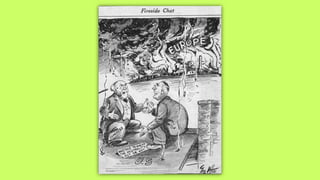
• “Let no one imagine that America will escape…there is no escape
through mere isolation or neutrality…the epidemic of lawlessness
is spreading. When an epidemic of physical disease starts to
spread, the community…joins in a quarantine of the patients in
order to protect the health of the community against the spread of
the disease.”
• Franklin Roosevelt, 1937
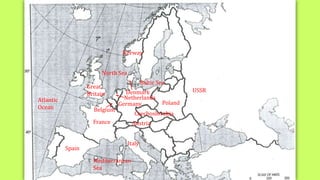
Great
Britain
France
USSR
Germany
Italy
Spain
Poland
North Sea
Baltic Sea
Atlantic
Ocean
Mediterranean
Sea
Czechoslovakia
Belgium
Austria
Norway
Denmark
Netherlands
Chapter 29: World War II
Section 2: Moving Closer to War
Video
• https://www.youtube.com/watch?v=skrdyoabmgA
Question
• What role do you think the United States
should play in WWII?
• We know that most of America supports
isolationism. Do you think President
Roosevelt agrees?
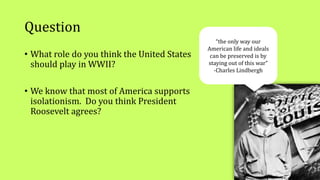
“the only way our
American life and ideals
can be preserved is by
staying out of this war”
-Charles Lindbergh
Europe at War, Again
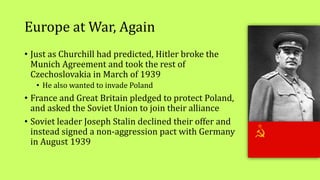
• Just as Churchill had predicted, Hitler broke the
Munich Agreement and took the rest of
Czechoslovakia in March of 1939
• He also wanted to invade Poland
• France and Great Britain pledged to protect Poland,
and asked the Soviet Union to join their alliance
• Soviet leader Joseph Stalin declined their offer and
instead signed a non-aggression pact with Germany
in August 1939
Europe at War, Again
• Signing the non-aggression pact guaranteed for
the time being that Germany would not have to
fight a war on two fronts (France and the USSR)
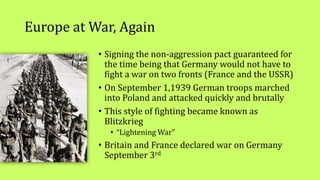
• On September 1,1939 German troops marched
into Poland and attacked quickly and brutally
• This style of fighting became known as
Blitzkrieg
• “Lightening War”
• Britain and France declared war on Germany
September 3rd
Neutrality
• Roosevelt declared American neutrality, but
within a few weeks he was asking Congress to
lift the embargo under the Neutrality Acts that
prevented Britain and France from buying U.S.
weapons
• Eventually Congress agreed as long as the allies
paid cash and carried the goods in their own
ships
• Why was it important to Congress that the allies
carry the weapons out of the U.S. in their own
ships?
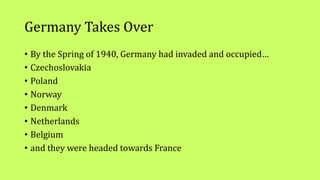
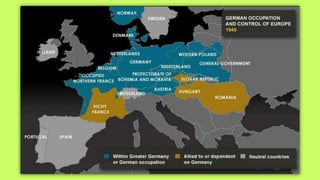
Germany Takes Over
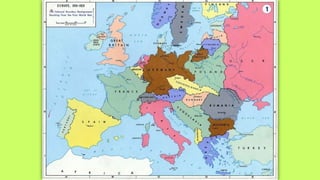
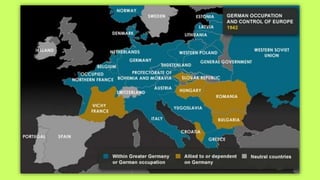
• By the Spring of 1940, Germany had invaded and occupied…
• Czechoslovakia
• Poland
• Norway
• Denmark
• Netherlands
• Belgium
• and they were headed towards France
Germany Takes Over
• May 1940
• After an Allied defeat, German troops had trapped 300,000 British
and French troops in the town of Dunkirk on the France-Belgium
border
• Over nine-days, 600 private boats evacuated them across the
English Channel
• June 1940
• Italy invaded Southern France and declared war on Great Britain
• On June 22nd, France surrendered and Great Britain was up against
Germany alone
Question
• Do you think Great Britain stands a chance against Germany
alone?
• Remember, at this time the German Air Force is frequently
bombing Great Britain (particularly London).
• Who will Great Britain look to for help?
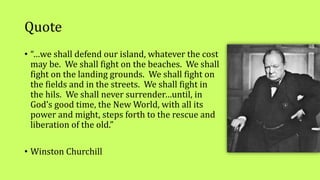
Quote
• “…we shall defend our island, whatever the cost
may be. We shall fight on the beaches. We shall
fight on the landing grounds. We shall fight on
the fields and in the streets. We shall fight in
the hils. We shall never surrender…until, in
God’s good time, the New World, with all its
power and might, steps forth to the rescue and
liberation of the old.”
• Winston Churchill
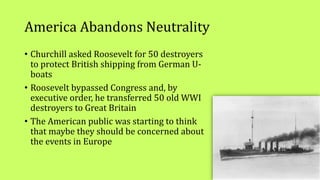
America Abandons Neutrality
• Churchill asked Roosevelt for 50 destroyers
to protect British shipping from German U-
boats
• Roosevelt bypassed Congress and, by
executive order, he transferred 50 old WWI
destroyers to Great Britain
• The American public was starting to think
that maybe they should be concerned about
the events in Europe
America Abandons Neutrality
• With Germany in the Atlantic Ocean,
Congress began appropriating billions of
dollars to defense
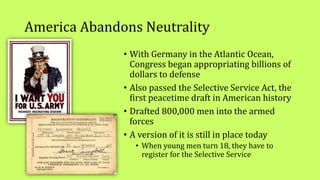
• Also passed the Selective Service Act, the
first peacetime draft in American history
• Drafted 800,000 men into the armed
forces
• A version of it is still in place today
• When young men turn 18, they have to
register for the Selective Service
The Election of 1940
• Internationalism vs. Isolationism
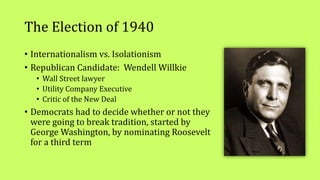
• Republican Candidate: Wendell Willkie
• Wall Street lawyer
• Utility Company Executive
• Critic of the New Deal
• Democrats had to decide whether or not they
were going to break tradition, started by
George Washington, by nominating Roosevelt
for a third term
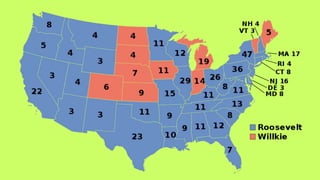
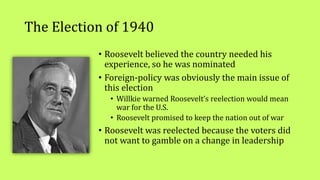
The Election of 1940
• Roosevelt believed the country needed his experience, so he was
nominated
• Foreign-policy was obviously the main issue of this election
• Willkie warned Roosevelt’s reelection would mean war for the U.S.
• Roosevelt promised to keep the nation out of war
Question
• Why did Willkie believe reelecting Roosevelt would lead to war?
• Think of Roosevelt’s other campaign promises, like his promise to
balance the budget
• Think of other leaders who promised to keep the nation out of war,
like Wilson
The Election of 1940
• Roosevelt believed the country needed his
experience, so he was nominated
• Foreign-policy was obviously the main issue of
this election
• Willkie warned Roosevelt’s reelection would mean
war for the U.S.
• Roosevelt promised to keep the nation out of war
• Roosevelt was reelected because the voters did
not want to gamble on a change in leadership
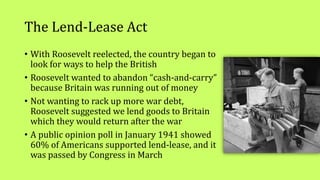
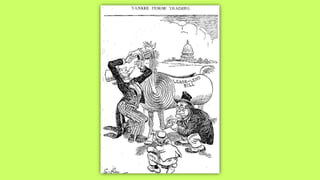
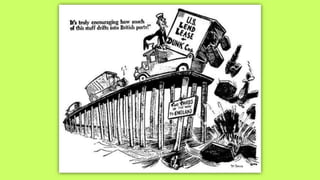
The Lend-Lease Act
• With Roosevelt reelected, the country began to
look for ways to help the British
• Roosevelt wanted to abandon “cash-and-carry”
because Britain was running out of money
• Not wanting to rack up more war debt,
Roosevelt suggested we lend goods to Britain
which they would return after the war
• A public opinion poll in January 1941 showed
60% of Americans supported lend-lease, and it
was passed by Congress in March
German U-Boats
• Before weapons made it to the British, Hitler invaded Greece and
Yugoslavia Spring of 1941
• Unable to control Britain’s airspace, Hitler began ordering
submarine attacks on the ships moving supplies from America to
Britain
• Daily attacks
• By the Fall of 1941, German and American warships were
exchanging fire
• In October, a German U-Boat sank an American destroyer killing
90 Americans, so Congress allowed merchant ships to arm
themselves
Arsenal of Democracy
• Hitler wanted the Soviet’s wheat and oil supplies
• Abruptly attacked the USSR in June 1941, breaking the non-
aggression pact he had signed with Stalin
• Stalin signed an alliance with Great Britain and U.S. started
sending them lend-lease weapons
• The United States became an “arsenal of democracy,” supplying
weapons to Great Britain and the USSR
• The U.S. was ready for war
• About 15,000 young men were already fighting for Canada or Britain
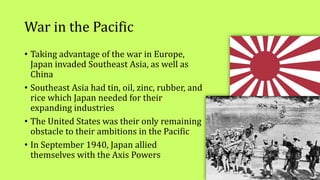
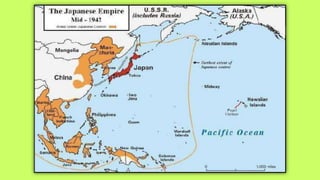
War in the Pacific
• Taking advantage of the war in Europe,
Japan invaded Southeast Asia, as well as
China
• Southeast Asia had tin, oil, zinc, rubber, and
rice which Japan needed for their
expanding industries
• The United States was their only remaining
obstacle to their ambitions in the Pacific
• In September 1940, Japan allied
themselves with the Axis Powers
War in the Pacific
• Roosevelt placed an embargo on Japan for
anything that could be used for war
• The U.S. would only help Japan find raw materials
if they abandoned their policy of conquest
• They didn’t, so we stopped all trade with Japan
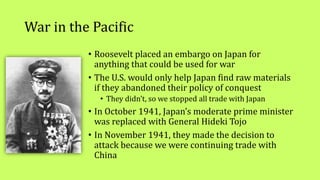
• In October 1941, Japan’s moderate prime minister
was replaced with General Hideki Tojo
• In November 1941, they made the decision to
attack because we were continuing trade with
China
War in the Pacific
• On December 6, 1941, Roosevelt asked Emperor Hirohito directly
for peace to avoid attack
• He didn’t know the Japanese Naval fleet had been put to see November
26th
• Roosevelt knew something was going to happen, but not when or where,
so he warned generals throughout the Pacific to prepare
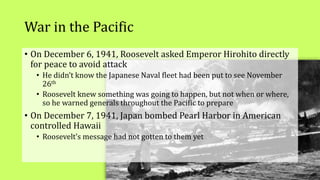
• On December 7, 1941, Japan bombed Pearl Harbor in American
controlled Hawaii
• Roosevelt’s message had not gotten to them yet
Chapter 29: World War II
Section 3: The United States at War
Chapter 29: World War II
Section 4: War on the Home Front

Chapter 29: World War II

  • 1.
    Chapter 29: WorldWar II Section 1: World Affairs, 1933-1939
  • 2.
    Question • What isgoing on in the U.S. during this time period (1933-1939)? • What do we know is going on in the world as a whole?
  • 3.
    President Roosevelt • Likehis cousin, Teddy, Franklin Roosevelt believes that the U.S. needs to play a leadership role in the world • However, because of the state of America’s economy, spent most of his first two terms in office dealing with domestic affairs • As countries like Germany and Japan continue to rise in power, Roosevelt sees that as a threat to the U.S.
  • 4.
    Foreign Policy • Rooseveltand his Secretary of State worked to improve relations with Latin America at the Pan-American Conference • Roosevelt recalled American troops from Haiti and Nicaragua and when Cuba erupted in revolution, Roosevelt responded with diplomacy, not military force • How does this compare to Hoover’s foreign policy? • This is known as Roosevelt’s Good Neighbor Policy “no state has the right to intervene in the internal affairs of another”
  • 6.
    Foreign Policy • Duringthe New Deal, the U.S. adopted a policy of economic isolationism • Our New Deal programs were not taking the rest of the world into account • In 1933, delegates met in London to confront the worldwide depression • Roosevelt rejected other nation’s demands to peg the value of the dollar to any other currency • Secretary of State Cordell Hull saw the necessity of world prosperity and sought to reduce tariffs • The Reciprocal Trade Agreements Act of 1934 allowed the State Department to make treaties with foreign nations that would lower import tariffs
  • 7.
    Foreign Policy • TheU.S.S.R. formed after the Bolshevik Revolution in 1917, but the U.S. did not recognize them as a nation because they encouraged communism • Because of serious economic problems within the U.S.S.R. come 1933, we saw them as less of a threat • Roosevelt also hoped that a strong Soviet Union would challenge the rising power of Japan and slow their expansion • In addition, their need for food and industrial goods gave struggling U.S. farmers and businesses a new market “The United States would probably recognize the Devil if it could sell him pitchforks” -Will Rogers
  • 8.
    Rising Powers: Japan •Japan began rapidly growing and industrializing at the end of the 19th century
  • 9.
    Question • How willJapan sustain this growth?
  • 10.
    Rising Powers: Japan •Japan began rapidly growing and industrializing at the end of the 19th century • They needed larger markets to sell their products to, and more raw materials to manufacture • So Japan pursues a policy of expansion in the Pacific • Japan had supported the Allies in WWI, but also violated the Open Door Policy in China and was forced to return their territorial gains • They were not happy about this…
  • 11.
    Rising Powers: Japan •In addition, the U.S. among other nations banned Japanese immigration in 1924 • Its leaders began to look for military solution • In September of 1931, Japan invaded resource-rich Manchuria • When the League of Nations demanded it be returned Japan refused • What did the U.S. do about it?
  • 12.
    Rising Powers: Germanyand Italy • On March 5, 1933, Adolf Hitler was given the power he needed to begin his conquest of central and eastern Europe • Benito Mussolini, the dictator of Italy, was making similar plans to control the Mediterranean and Northern Africa • Fascism- a form of government in which a dictator and supporters cooperate to seek more power for their nation at the expense of human rights
  • 13.
    Rising Powers: Germanyand Italy • Both Hitler and Mussolini established a totalitarian state within their nations • Totalitarian state- a nation that totally controls the life of its people • The Communists in Russia, Fascists in Italy, and Nazis in Germany were all powerful political parties • Each leader blamed their countries problems on “undesirables” in their countries • Mussolini blamed the communists in Italy • Hitler blamed the Jews • Both leaders hinted at the possibility of another war in order to right the wrongs of the Treaty of Versailles
  • 14.
    Rising Powers • Hitlerbegan expelling Jews from the government and universities, encouraging the boycott of Jewish owned stores, and destroying synagogues • In 1935, Mussolini took control over Ethiopia • In 1936, Hitler and Mussolini both assisted General Francisco Franco rebel against Spain’s Republican government in a civil war • In 1937, Japan poured into the rest of China • In 1938, Hitler marched his troops into Austria (his home country)
  • 15.
    Appeasement • Great Britainand France respond with appeasement • A policy of giving aggressor nations what they wanted to avoid war • At the Munich Conference of 1938, British and French leaders allowed Hitler to annex part of Czechoslovakia with is promise that he would make no further territorial demands • Why did Hitler agree to this? • Neville Chamberlain claimed that this pact meant “peace or our time” • The next prime minister, Winston Churchill, disagreed “Britain and France had to choose between war and dishonor. They chose dishonor. They will have war.”
  • 16.
    America’s Response • Americawas determined to avoid war • WWI had left the U.S. with a huge domestic debt and billions of dollars in foreign debt that would never be collected • Congress passed the Neutrality Acts in 1935, 1936, and 1937 • Barred transportation and sale of arms to warring nations • Banned loans to nations at war outside of the Western Hemisphere • Roosevelt agreed with the Neutrality Acts, but thought Congress should differentiate between victims and aggressors • The American public remained adamant that they wanted nothing to do with war
  • 17.
    Quote • “Let noone imagine that America will escape…there is no escape through mere isolation or neutrality…the epidemic of lawlessness is spreading. When an epidemic of physical disease starts to spread, the community…joins in a quarantine of the patients in order to protect the health of the community against the spread of the disease.” • Franklin Roosevelt, 1937
  • 20.
  • 21.
    Chapter 29: WorldWar II Section 2: Moving Closer to War
  • 22.
  • 23.
    Question • What roledo you think the United States should play in WWII? • We know that most of America supports isolationism. Do you think President Roosevelt agrees? “the only way our American life and ideals can be preserved is by staying out of this war” -Charles Lindbergh
  • 24.
    Europe at War,Again • Just as Churchill had predicted, Hitler broke the Munich Agreement and took the rest of Czechoslovakia in March of 1939 • He also wanted to invade Poland • France and Great Britain pledged to protect Poland, and asked the Soviet Union to join their alliance • Soviet leader Joseph Stalin declined their offer and instead signed a non-aggression pact with Germany in August 1939
  • 25.
    Europe at War,Again • Signing the non-aggression pact guaranteed for the time being that Germany would not have to fight a war on two fronts (France and the USSR) • On September 1,1939 German troops marched into Poland and attacked quickly and brutally • This style of fighting became known as Blitzkrieg • “Lightening War” • Britain and France declared war on Germany September 3rd
  • 27.
    Neutrality • Roosevelt declaredAmerican neutrality, but within a few weeks he was asking Congress to lift the embargo under the Neutrality Acts that prevented Britain and France from buying U.S. weapons • Eventually Congress agreed as long as the allies paid cash and carried the goods in their own ships • Why was it important to Congress that the allies carry the weapons out of the U.S. in their own ships?
  • 28.
    Germany Takes Over •By the Spring of 1940, Germany had invaded and occupied… • Czechoslovakia • Poland • Norway • Denmark • Netherlands • Belgium • and they were headed towards France
  • 30.
    Germany Takes Over •May 1940 • After an Allied defeat, German troops had trapped 300,000 British and French troops in the town of Dunkirk on the France-Belgium border • Over nine-days, 600 private boats evacuated them across the English Channel • June 1940 • Italy invaded Southern France and declared war on Great Britain • On June 22nd, France surrendered and Great Britain was up against Germany alone
  • 31.
    Question • Do youthink Great Britain stands a chance against Germany alone? • Remember, at this time the German Air Force is frequently bombing Great Britain (particularly London). • Who will Great Britain look to for help?
  • 32.
    Quote • “…we shalldefend our island, whatever the cost may be. We shall fight on the beaches. We shall fight on the landing grounds. We shall fight on the fields and in the streets. We shall fight in the hils. We shall never surrender…until, in God’s good time, the New World, with all its power and might, steps forth to the rescue and liberation of the old.” • Winston Churchill
  • 33.
    America Abandons Neutrality •Churchill asked Roosevelt for 50 destroyers to protect British shipping from German U- boats • Roosevelt bypassed Congress and, by executive order, he transferred 50 old WWI destroyers to Great Britain • The American public was starting to think that maybe they should be concerned about the events in Europe
  • 34.
    America Abandons Neutrality •With Germany in the Atlantic Ocean, Congress began appropriating billions of dollars to defense • Also passed the Selective Service Act, the first peacetime draft in American history • Drafted 800,000 men into the armed forces • A version of it is still in place today • When young men turn 18, they have to register for the Selective Service
  • 35.
    The Election of1940 • Internationalism vs. Isolationism • Republican Candidate: Wendell Willkie • Wall Street lawyer • Utility Company Executive • Critic of the New Deal • Democrats had to decide whether or not they were going to break tradition, started by George Washington, by nominating Roosevelt for a third term
  • 36.
    The Election of1940 • Roosevelt believed the country needed his experience, so he was nominated • Foreign-policy was obviously the main issue of this election • Willkie warned Roosevelt’s reelection would mean war for the U.S. • Roosevelt promised to keep the nation out of war
  • 37.
    Question • Why didWillkie believe reelecting Roosevelt would lead to war? • Think of Roosevelt’s other campaign promises, like his promise to balance the budget • Think of other leaders who promised to keep the nation out of war, like Wilson
  • 38.
    The Election of1940 • Roosevelt believed the country needed his experience, so he was nominated • Foreign-policy was obviously the main issue of this election • Willkie warned Roosevelt’s reelection would mean war for the U.S. • Roosevelt promised to keep the nation out of war • Roosevelt was reelected because the voters did not want to gamble on a change in leadership
  • 40.
    The Lend-Lease Act •With Roosevelt reelected, the country began to look for ways to help the British • Roosevelt wanted to abandon “cash-and-carry” because Britain was running out of money • Not wanting to rack up more war debt, Roosevelt suggested we lend goods to Britain which they would return after the war • A public opinion poll in January 1941 showed 60% of Americans supported lend-lease, and it was passed by Congress in March
  • 42.
    German U-Boats • Beforeweapons made it to the British, Hitler invaded Greece and Yugoslavia Spring of 1941 • Unable to control Britain’s airspace, Hitler began ordering submarine attacks on the ships moving supplies from America to Britain • Daily attacks • By the Fall of 1941, German and American warships were exchanging fire • In October, a German U-Boat sank an American destroyer killing 90 Americans, so Congress allowed merchant ships to arm themselves
  • 45.
    Arsenal of Democracy •Hitler wanted the Soviet’s wheat and oil supplies • Abruptly attacked the USSR in June 1941, breaking the non- aggression pact he had signed with Stalin • Stalin signed an alliance with Great Britain and U.S. started sending them lend-lease weapons • The United States became an “arsenal of democracy,” supplying weapons to Great Britain and the USSR • The U.S. was ready for war • About 15,000 young men were already fighting for Canada or Britain
  • 46.
    War in thePacific • Taking advantage of the war in Europe, Japan invaded Southeast Asia, as well as China • Southeast Asia had tin, oil, zinc, rubber, and rice which Japan needed for their expanding industries • The United States was their only remaining obstacle to their ambitions in the Pacific • In September 1940, Japan allied themselves with the Axis Powers
  • 48.
    War in thePacific • Roosevelt placed an embargo on Japan for anything that could be used for war • The U.S. would only help Japan find raw materials if they abandoned their policy of conquest • They didn’t, so we stopped all trade with Japan • In October 1941, Japan’s moderate prime minister was replaced with General Hideki Tojo • In November 1941, they made the decision to attack because we were continuing trade with China
  • 49.
    War in thePacific • On December 6, 1941, Roosevelt asked Emperor Hirohito directly for peace to avoid attack • He didn’t know the Japanese Naval fleet had been put to see November 26th • Roosevelt knew something was going to happen, but not when or where, so he warned generals throughout the Pacific to prepare • On December 7, 1941, Japan bombed Pearl Harbor in American controlled Hawaii • Roosevelt’s message had not gotten to them yet
  • 50.
    Chapter 29: WorldWar II Section 3: The United States at War
  • 51.
    Chapter 29: WorldWar II Section 4: War on the Home Front