How to Stellarium Grade XI - Physics
Lesson Plan
Safety
N/A
Description
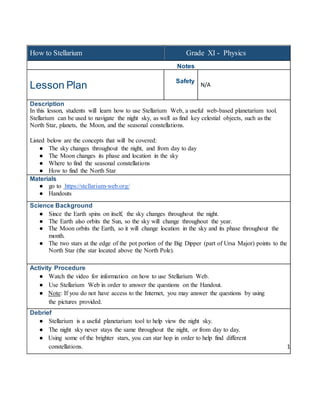
In this lesson, students will learn how to use Stellarium Web, a useful web-based planetarium tool.
Stellarium can be used to navigate the night sky, as well as find key celestial objects, such as the
North Star, planets, the Moon, and the seasonal constellations.
Listed below are the concepts that will be covered:
● The sky changes throughout the night, and from day to day
● The Moon changes its phase and location in the sky
● Where to find the seasonal constellations
● How to find the North Star
Materials
● go to https://stellarium-web.org/
● Handouts
Science Background
● Since the Earth spins on itself, the sky changes throughout the night.
● The Earth also orbits the Sun, so the sky will change throughout the year.
● The Moon orbits the Earth, so it will change location in the sky and its phase throughout the
month.
● The two stars at the edge of the pot portion of the Big Dipper (part of Ursa Major) points to the
North Star (the star located above the North Pole).
Activity Procedure
● Watch the video for information on how to use Stellarium Web.
● Use Stellarium Web in order to answer the questions on the Handout.
● Note: If you do not have access to the Internet, you may answer the questions by using
the pictures provided.
Debrief
● Stellarium is a useful planetarium tool to help view the night sky.
● The night sky never stays the same throughout the night, or from day to day.
● Using some of the brighter stars, you can star hop in order to help find different
constellations.
Notes
1
How to Stellarium Grade XI - Physics
Handout
1
Go to https://stellarium-web.org/
Exercises
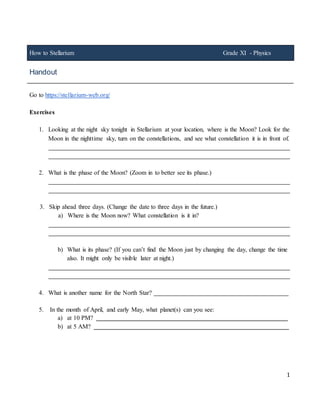
1. Looking at the night sky tonight in Stellarium at your location, where is the Moon? Look for the
Moon in the nighttime sky, turn on the constellations, and see what constellation it is in front of.
2. What is the phase of the Moon? (Zoom in to better see its phase.)
3. Skip ahead three days. (Change the date to three days in the future.)
a) Where is the Moon now? What constellation is it in?
b) What is its phase? (If you can’t find the Moon just by changing the day, change the time
also. It might only be visible later at night.)
4. What is another name for the North Star?
5. In the month of April, and early May, what planet(s) can you see:
a) at 10 PM?
b) at 5 AM?
1

Worksheet physics

  • 1.
    How to StellariumGrade XI - Physics Lesson Plan Safety N/A Description In this lesson, students will learn how to use Stellarium Web, a useful web-based planetarium tool. Stellarium can be used to navigate the night sky, as well as find key celestial objects, such as the North Star, planets, the Moon, and the seasonal constellations. Listed below are the concepts that will be covered: ● The sky changes throughout the night, and from day to day ● The Moon changes its phase and location in the sky ● Where to find the seasonal constellations ● How to find the North Star Materials ● go to https://stellarium-web.org/ ● Handouts Science Background ● Since the Earth spins on itself, the sky changes throughout the night. ● The Earth also orbits the Sun, so the sky will change throughout the year. ● The Moon orbits the Earth, so it will change location in the sky and its phase throughout the month. ● The two stars at the edge of the pot portion of the Big Dipper (part of Ursa Major) points to the North Star (the star located above the North Pole). Activity Procedure ● Watch the video for information on how to use Stellarium Web. ● Use Stellarium Web in order to answer the questions on the Handout. ● Note: If you do not have access to the Internet, you may answer the questions by using the pictures provided. Debrief ● Stellarium is a useful planetarium tool to help view the night sky. ● The night sky never stays the same throughout the night, or from day to day. ● Using some of the brighter stars, you can star hop in order to help find different constellations. Notes 1
  • 2.
    How to StellariumGrade XI - Physics Handout 1 Go to https://stellarium-web.org/ Exercises 1. Looking at the night sky tonight in Stellarium at your location, where is the Moon? Look for the Moon in the nighttime sky, turn on the constellations, and see what constellation it is in front of. 2. What is the phase of the Moon? (Zoom in to better see its phase.) 3. Skip ahead three days. (Change the date to three days in the future.) a) Where is the Moon now? What constellation is it in? b) What is its phase? (If you can’t find the Moon just by changing the day, change the time also. It might only be visible later at night.) 4. What is another name for the North Star? 5. In the month of April, and early May, what planet(s) can you see: a) at 10 PM? b) at 5 AM?
  • 3.