Work and
Energy
Activity:
► Place the palms of your hands
against a (sturdy) wall and push with
all your strength for 10 seconds.
► Do you feel tired? How would you
feel if you had pushed for 10
minutes?
► Did you do any work while you were
pushing?
Work
► Work is done when a force is
exerted and there is a change
in position.
► Work is the product of a force
and the distance moved in the
direction of the force.
► work = force x displacement
► The SI unit of Work is the joule, J
► 1 J = 1 Nm
Worked Example
► Chris pushes a block 25 m across a smooth
floor with a horizontal force of 20 N.
Determine how much work was done.
Solution:
work = force x displacement
W = F x d
W = 20 N x 25 m
W = 500 Nm
= 500 J
Activity: How would you sort the following
pictures into 2 groups?
HEAT
SOIL
METAL
WATER
SOUND
LIGHT
HEAT
SOIL
METAL
WATER
SOUND
LIGHT
ENERGY MATTER
Energy
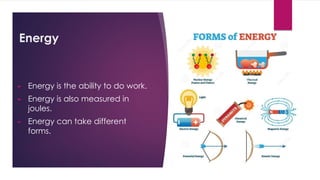
► Energy is the ability to do work.
► Energy is also measured in
joules.
► Energy can take different
forms.
Forms of Energy
► Follow the link below to a YouTube
video describing the different forms
of energy.
https://www.youtube.com/watch?v=86PzkR
bw4_U
Test Your Understanding
► For each of the 9 forms of energy in
the table below, match the form of
energy on the left to the correct
descriptions on the right.
Form of Energy Description
1 Kinetic A The energy of an object as a result of its position or height.
e.g. a bucket about to fall from a ladder.
2 Sound B The energy of an object as a result of its condition.
e.g. a compressed spring or a stretched rubber band
3 Heat (or Thermal) C The energy stored in the bonds of chemical compounds. e.g. food
or fuel
4 Electric D The energy transferred by the vibrating particles of a sound wave.
5 Nuclear E The energy due to the motion of the particles (molecules) of a
substance or body.
6 Gravitational
Potential
F The energy resulting from charged particles in an electric field.
7 Chemical G The energy binding the particles of the nucleus of an atom.
8 Elastic Potential H The energy resulting from the vibration of electric and magnetic
fields. e.g. visible light, radio waves, microwaves.
9 Light (or
Electromagnetic)
I The energy of an object as a result of its motion.
Answers
Form of Energy Description
1 Kinetic I The energy of an object as a result of its motion.
2 Sound D The energy transferred by the vibrating particles of a sound wave.
3 Heat (or Thermal) E The energy due to the motion of the particles (molecules) of a substance or
body.
4 Electric F The energy resulting from charged particles in an electric field.
5 Nuclear G The energy binding the particles of the nucleus of an atom.
6 Gravitational Potential A The energy of an object as a result of its position or height.
e.g. a bucket about to fall from a ladder.
7 Chemical C The energy stored in the bonds of chemical compounds. e.g. food or fuel
8 Elastic Potential B The energy of an object as a result of its condition.
e.g. a compressed spring or a stretched rubber band
9 Light (or
Electromagnetic)
H The energy resulting from the vibration of electric and magnetic fields. e.g.
visible light, radio waves, microwaves.
The Principle of Conservation of Energy
► This states that energy cannot be created or destroyed but is instead
transformed from one type of energy to another.
► Take a look at this YouTube video about the Conservation of Energy
https://www.youtube.com/watch?v=k4b3oxO0WqE
Examples of energy conversions
1. A coconut falling from a tree and striking the ground below (not rebounding):
gravitational potential kinetic sound + thermal
2. A gasoline-fueled car accelerating on a level road:
chemical kinetic + sound + thermal
3. An aircraft taking off:
chemical kinetic + gravitational + sound + thermal
* Note that thermal energy is a product of all energy transformations.
Test your understanding
► Identify the energy changes in the following scenarios.
1. A battery charging
2. An electric fan that is plugged in and switched on.
3. An electric oven
4. A microphone
5. A loudspeaker
Answers
1. A battery charging: electric to chemical and heat
2. An electric fan that is plugged in and switched on : electric to kinetic and sound and heat
3. An electric oven: electric to heat and light
4. A microphone: sound to electric and heat
5. A loudspeaker: electric to sound and heat
Activity
► Click on the link below and use the
PhET Simulation to investigate energy
transformations.
► https://phet.colorado.edu/sims/html/ene
rgy-forms-and-changes/latest/energy-for
ms-and-changes_en.html
Closure
Before we go, think about today’s lesson
and type the following inti the chat:
► Two new things I learned.
► One question I still have.

Work and Energy.pdf

  • 1.
  • 2.
    Activity: ► Place thepalms of your hands against a (sturdy) wall and push with all your strength for 10 seconds. ► Do you feel tired? How would you feel if you had pushed for 10 minutes? ► Did you do any work while you were pushing?
  • 3.
    Work ► Work isdone when a force is exerted and there is a change in position. ► Work is the product of a force and the distance moved in the direction of the force. ► work = force x displacement ► The SI unit of Work is the joule, J ► 1 J = 1 Nm
  • 4.
    Worked Example ► Chrispushes a block 25 m across a smooth floor with a horizontal force of 20 N. Determine how much work was done. Solution: work = force x displacement W = F x d W = 20 N x 25 m W = 500 Nm = 500 J
  • 5.
    Activity: How wouldyou sort the following pictures into 2 groups? HEAT SOIL METAL WATER SOUND LIGHT
  • 6.
  • 7.
    Energy ► Energy isthe ability to do work. ► Energy is also measured in joules. ► Energy can take different forms.
  • 8.
    Forms of Energy ►Follow the link below to a YouTube video describing the different forms of energy. https://www.youtube.com/watch?v=86PzkR bw4_U
  • 9.
    Test Your Understanding ►For each of the 9 forms of energy in the table below, match the form of energy on the left to the correct descriptions on the right.
  • 10.
    Form of EnergyDescription 1 Kinetic A The energy of an object as a result of its position or height. e.g. a bucket about to fall from a ladder. 2 Sound B The energy of an object as a result of its condition. e.g. a compressed spring or a stretched rubber band 3 Heat (or Thermal) C The energy stored in the bonds of chemical compounds. e.g. food or fuel 4 Electric D The energy transferred by the vibrating particles of a sound wave. 5 Nuclear E The energy due to the motion of the particles (molecules) of a substance or body. 6 Gravitational Potential F The energy resulting from charged particles in an electric field. 7 Chemical G The energy binding the particles of the nucleus of an atom. 8 Elastic Potential H The energy resulting from the vibration of electric and magnetic fields. e.g. visible light, radio waves, microwaves. 9 Light (or Electromagnetic) I The energy of an object as a result of its motion.
  • 11.
    Answers Form of EnergyDescription 1 Kinetic I The energy of an object as a result of its motion. 2 Sound D The energy transferred by the vibrating particles of a sound wave. 3 Heat (or Thermal) E The energy due to the motion of the particles (molecules) of a substance or body. 4 Electric F The energy resulting from charged particles in an electric field. 5 Nuclear G The energy binding the particles of the nucleus of an atom. 6 Gravitational Potential A The energy of an object as a result of its position or height. e.g. a bucket about to fall from a ladder. 7 Chemical C The energy stored in the bonds of chemical compounds. e.g. food or fuel 8 Elastic Potential B The energy of an object as a result of its condition. e.g. a compressed spring or a stretched rubber band 9 Light (or Electromagnetic) H The energy resulting from the vibration of electric and magnetic fields. e.g. visible light, radio waves, microwaves.
  • 12.
    The Principle ofConservation of Energy ► This states that energy cannot be created or destroyed but is instead transformed from one type of energy to another. ► Take a look at this YouTube video about the Conservation of Energy https://www.youtube.com/watch?v=k4b3oxO0WqE
  • 13.
    Examples of energyconversions 1. A coconut falling from a tree and striking the ground below (not rebounding): gravitational potential kinetic sound + thermal 2. A gasoline-fueled car accelerating on a level road: chemical kinetic + sound + thermal 3. An aircraft taking off: chemical kinetic + gravitational + sound + thermal * Note that thermal energy is a product of all energy transformations.
  • 14.
    Test your understanding ►Identify the energy changes in the following scenarios. 1. A battery charging 2. An electric fan that is plugged in and switched on. 3. An electric oven 4. A microphone 5. A loudspeaker
  • 15.
    Answers 1. A batterycharging: electric to chemical and heat 2. An electric fan that is plugged in and switched on : electric to kinetic and sound and heat 3. An electric oven: electric to heat and light 4. A microphone: sound to electric and heat 5. A loudspeaker: electric to sound and heat
  • 16.
    Activity ► Click onthe link below and use the PhET Simulation to investigate energy transformations. ► https://phet.colorado.edu/sims/html/ene rgy-forms-and-changes/latest/energy-for ms-and-changes_en.html
  • 17.
    Closure Before we go,think about today’s lesson and type the following inti the chat: ► Two new things I learned. ► One question I still have.