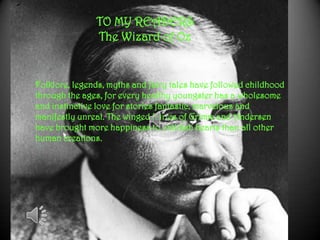
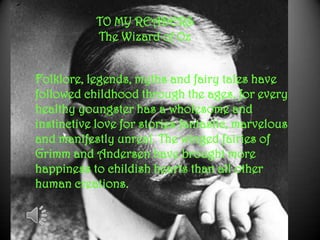
Folklore, legends, myths and fairy tales have followed childhood
through the ages, for every healthy youngster has a wholesome
and instinctive love for stories fantastic, marvelous and
manifestly unreal. The winged fairies of Grimm and Andersen
have brought more happiness to childish hearts than all other
human creations.
TO MY READERS
The Wizard of Oz
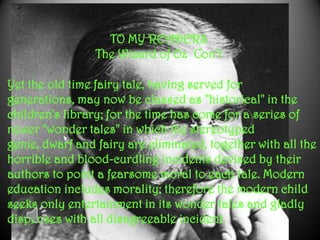
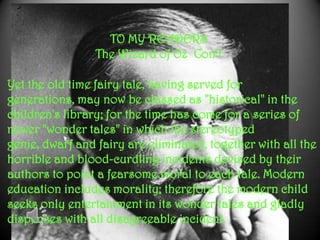
Yet the old time fairy tale, having served for
generations, may now be classed as "historical" in the
children's library; for the time has come for a series of
newer "wonder tales" in which the stereotyped
genie, dwarf and fairy are eliminated, together with all the
horrible and blood-curdling incidents devised by their
authors to point a fearsome moral to each tale. Modern
education includes morality; therefore the modern child
seeks only entertainment in its wonder tales and gladly
dispenses with all disagreeable incident.
TO MY READERS
The Wizard of Oz Con’t
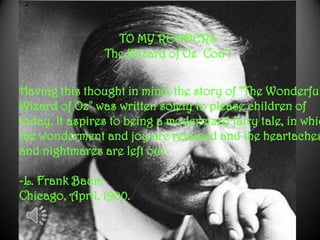
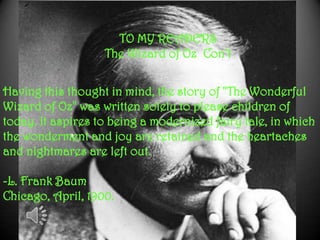
Having this thought in mind, the story of "The Wonderful
Wizard of Oz" was written solely to please children of
today. It aspires to being a modernized fairy tale, in whic
the wonderment and joy are retained and the heartaches
and nightmares are left out.
-L. Frank Baum
Chicago, April, 1900.
TO MY READERS
The Wizard of Oz Con’t
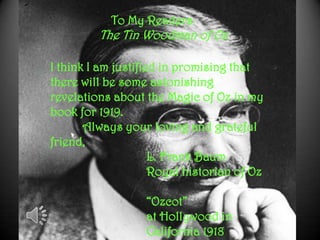
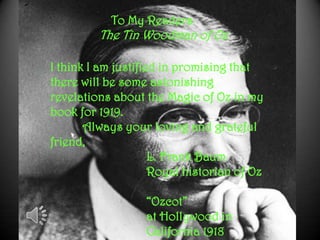
To My Readers
The Tin Woodman of Oz
I think I am justified in promising that
there will be some astonishing
revelations about the Magic of Oz in my
book for 1919.
Always your loving and grateful
friend,
L. Frank Baum
Royal historian of Oz
“Ozcot”
at Hollywood in
California 1918
Folklore, legends, myths and fairy tales have
followed childhood through the ages, for every
healthy youngster has a wholesome and
instinctive love for stories fantastic, marvelous
and manifestly unreal. The winged fairies of
Grimm and Andersen have brought more
happiness to childish hearts than all other
human creations.
TO MY READERS
The Wizard of Oz
Yet the old time fairy tale, having served for
generations, may now be classed as "historical" in the
children's library; for the time has come for a series of
newer "wonder tales" in which the stereotyped
genie, dwarf and fairy are eliminated, together with all the
horrible and blood-curdling incidents devised by their
authors to point a fearsome moral to each tale. Modern
education includes morality; therefore the modern child
seeks only entertainment in its wonder tales and gladly
dispenses with all disagreeable incident.
TO MY READERS
The Wizard of Oz Con’t
Having this thought in mind, the story of "The Wonderful
Wizard of Oz" was written solely to please children of
today. It aspires to being a modernized fairy tale, in which
the wonderment and joy are retained and the heartaches
and nightmares are left out.
-L. Frank Baum
Chicago, April, 1900.
TO MY READERS
The Wizard of Oz Con’t
To My Readers
The Tin Woodman of Oz
I think I am justified in promising that
there will be some astonishing
revelations about the Magic of Oz in my
book for 1919.
Always your loving and grateful
friend,
L. Frank Baum
Royal historian of Oz
“Ozcot”
at Hollywood in
California 1918
ENJOY YOUR
PRESENTATION
L. Frank Baum
OZ series By L. Frank Baum
• The Wonderful Wizard of Oz (1900)
• The Marvelous Land of Oz (1904)
• Queer Visitors from the Marvelous Land of Oz (1905, comic strip depicting 27 stories)
• The Woggle-Bug Book (1905)
• Ozma of Oz (1907)
• Dorothy and the Wizard in Oz (1908)
• The Road to Oz (1909)
• The Emerald City of Oz (1910)
• The Patchwork Girl of Oz (1913)
• Little Wizard Stories of Oz (1913, collection of 6 short stories)
• Tik-Tok of Oz (1914)
• The Scarecrow of Oz (1915)
• Rinkitink in Oz (1916)
• The Lost Princess of Oz (1917)
• The Tin Woodman of Oz (1918)
• The Magic of Oz (1919, posthumously published)
• Glinda of Oz (1920, posthumously published)
• The Royal Book of Oz (1921, posthumous attribution—entirely the work of Ruth Plumly Thompson)
Princess Truella, a character from The Magical Monarch of Mo, illustrated by Frank Ver Beck

Wizard of oz

  • 1.
    Folklore, legends, mythsand fairy tales have followed childhood through the ages, for every healthy youngster has a wholesome and instinctive love for stories fantastic, marvelous and manifestly unreal. The winged fairies of Grimm and Andersen have brought more happiness to childish hearts than all other human creations. TO MY READERS The Wizard of Oz
  • 2.
    Yet the oldtime fairy tale, having served for generations, may now be classed as "historical" in the children's library; for the time has come for a series of newer "wonder tales" in which the stereotyped genie, dwarf and fairy are eliminated, together with all the horrible and blood-curdling incidents devised by their authors to point a fearsome moral to each tale. Modern education includes morality; therefore the modern child seeks only entertainment in its wonder tales and gladly dispenses with all disagreeable incident. TO MY READERS The Wizard of Oz Con’t
  • 3.
    Having this thoughtin mind, the story of "The Wonderful Wizard of Oz" was written solely to please children of today. It aspires to being a modernized fairy tale, in whic the wonderment and joy are retained and the heartaches and nightmares are left out. -L. Frank Baum Chicago, April, 1900. TO MY READERS The Wizard of Oz Con’t
  • 4.
    To My Readers TheTin Woodman of Oz I think I am justified in promising that there will be some astonishing revelations about the Magic of Oz in my book for 1919. Always your loving and grateful friend, L. Frank Baum Royal historian of Oz “Ozcot” at Hollywood in California 1918
  • 5.
    Folklore, legends, mythsand fairy tales have followed childhood through the ages, for every healthy youngster has a wholesome and instinctive love for stories fantastic, marvelous and manifestly unreal. The winged fairies of Grimm and Andersen have brought more happiness to childish hearts than all other human creations. TO MY READERS The Wizard of Oz
  • 6.
    Yet the oldtime fairy tale, having served for generations, may now be classed as "historical" in the children's library; for the time has come for a series of newer "wonder tales" in which the stereotyped genie, dwarf and fairy are eliminated, together with all the horrible and blood-curdling incidents devised by their authors to point a fearsome moral to each tale. Modern education includes morality; therefore the modern child seeks only entertainment in its wonder tales and gladly dispenses with all disagreeable incident. TO MY READERS The Wizard of Oz Con’t
  • 7.
    Having this thoughtin mind, the story of "The Wonderful Wizard of Oz" was written solely to please children of today. It aspires to being a modernized fairy tale, in which the wonderment and joy are retained and the heartaches and nightmares are left out. -L. Frank Baum Chicago, April, 1900. TO MY READERS The Wizard of Oz Con’t
  • 8.
    To My Readers TheTin Woodman of Oz I think I am justified in promising that there will be some astonishing revelations about the Magic of Oz in my book for 1919. Always your loving and grateful friend, L. Frank Baum Royal historian of Oz “Ozcot” at Hollywood in California 1918
  • 9.
  • 10.
  • 11.
    OZ series ByL. Frank Baum • The Wonderful Wizard of Oz (1900) • The Marvelous Land of Oz (1904) • Queer Visitors from the Marvelous Land of Oz (1905, comic strip depicting 27 stories) • The Woggle-Bug Book (1905) • Ozma of Oz (1907) • Dorothy and the Wizard in Oz (1908) • The Road to Oz (1909) • The Emerald City of Oz (1910) • The Patchwork Girl of Oz (1913) • Little Wizard Stories of Oz (1913, collection of 6 short stories) • Tik-Tok of Oz (1914) • The Scarecrow of Oz (1915) • Rinkitink in Oz (1916) • The Lost Princess of Oz (1917) • The Tin Woodman of Oz (1918) • The Magic of Oz (1919, posthumously published) • Glinda of Oz (1920, posthumously published) • The Royal Book of Oz (1921, posthumous attribution—entirely the work of Ruth Plumly Thompson) Princess Truella, a character from The Magical Monarch of Mo, illustrated by Frank Ver Beck