Smart Specialisation in the Region of Attica
Intermediate Authority of Attica Region
WIRE2014 / 12-06-2014
Logo area
ATTICA IS A METROPOLITAN AREA
• The producer of 45% of the National GDP
• The place of employment of 37% of National Workforce
• The place of operation of 35% of National Enterprises
• The main exporter (48% of total GDP from exports), main
transportation & Logistics Hub within South-Eastern Europe
& Mediterranean (Port of Piraeus, El. Venizelos Airport,
national roads, Attiki Odos etc), main university and research
centre (11 Universities & Highest Technological Education
Institutions and 10 Public Research Institutions)
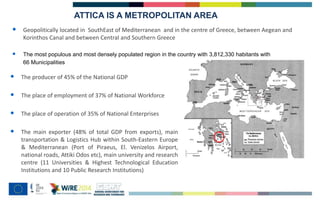
• Geopolitically located in SouthEast of Mediterranean and in the centre of Greece, between Aegean and
Korinthos Canal and between Central and Southern Greece
• The most populous and most densely populated region in the country with 3,812,330 habitants with
66 Municipalities
THE ECONOMIC POTENTIAL : BUSINESS & INVESTMENTS
Region’s growth model is based mainly on domestic consumption
Entrepreneurship
• Attica Region involve 57% of National Tertiary Sector (trade, financial services, transport and ICT, health and social
services, real estate, recreation, research and business services) and of 31% National Secondary Sector (food
industry, metal products, chemicals and basic pharmaceuticals, textiles)
• Some specialization in maritime transport, transportation and logistics
• High-tech manufacturing and knowledge intensive service sectors are dynamically emerging
• High Attachment to SMEs/ Self-Employed Business Models - 94% of the companies in Attica are small and very
small – 80% are family model companies
• More than one third (36.32%) of the early‐stage entrepreneurs are young (25‐34 years old)
Major Scale Ongoing Projects : Waste Management, Metro, Logistics Center, Port Of Piraeus etc
THE HUMAN CAPITAL POTENTIAL
People are Charged with Brainpower
• Highly educated citizens – 33,1% with a university degree and 41,8% on science and technology areas
• A region of 243.638 students (36,9% of the country)
• 57% of the regional population uses regularly a PC and the Internet
• High foreign demand for local Researchers & Specialised Scientists
Unemployment
• 535.500 unemployed in 2013, 155.000 are 15-29 years old (37% on the country level), 1/2 are long term
unemployed
• While in 2008-2012 people holding Phd increased by 1,61 times (from 76.026 to 122.447), unemployment hit
this group from 4,8% to 12,9%
• Universities Graduated unemployed have been 4 times more in 2012 than in 2008
Social Division Issues
• Illegal Immigration
• 480 homeless (street work) in the Historical Center of Athens , 71% between 26-55 years old, 54% for poverty
reasons
THE INNOVATION POTENTIAL : UNIVERSITIES & RESEARCH
High Scientific Excellence regarding Publications on agricultural sciences, medical and health sciences,
engineering, natural sciences and social science (even if funding is limited on RTD : 0,72% or €775,192 of the
Regional GDP)
Research is equally allocated among universities and business (28.727 employers on R&D activities)
Some mature clusters on Microelectronics, Space Technologies and Applications Cluster, Innovative Gaming
Technologies and Life Sciences (HBio)
Some dynamic organic clusters on pharmaceuticals, telecom/ICT, chemical products, entertainment,
processed food, tourism & hospitality
Although a small number of firms in more high-tech sectors are better connected to the regional innovation
system
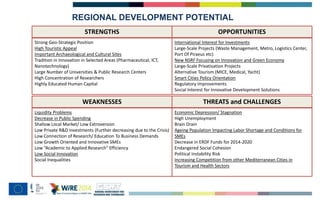
REGIONAL DEVELOPMENT POTENTIAL
STRENGTHS
Strong Geo-Strategic Position
High Touristic Appeal
Important Archaeological and Cultural Sites
Tradition in Innovation in Selected Areas (Pharmaceutical, ICT,
Nanotechnology)
Large Number of Universities & Public Research Centers
High Concentration of Researchers
Highly Educated Human Capital
OPPORTUNITIES
International Interest for Investments
Large-Scale Projects (Waste Management, Metro, Logistics Center,
Port Of Piraeus etc)
New NSRF Focusing on Innovation and Green Economy
Large-Scale Privatisation Projects
Alternative Tourism (MICE, Medical, Yacht)
Smart Cities Policy Orientation
Regulatory Improvements
Social Interest for Innovative Development Solutions
WEAKNESSES
Liquidity Problems
Decrease in Public Spending
Shallow Local Market/ Low Extroversion
Low Private R&D Investments (Further decreasing due to the Crisis)
Low Connection of Research/ Education To Business Demands
Low Growth Oriented and Innovative SMEs
Low “Academic to Applied Research“ Efficiency
Low Social Innovation
Social Inequalities
THREATS and CHALLENGES
Economic Depression/ Stagnation
High Unemployment
Brain Drain
Ageing Population Impacting Labor Shortage and Conditions for
SMEs
Decrease in ERDF Funds for 2014-2020
Endangered Social Cohesion
Political Instability Risk
Increasing Competition from other Mediterranean Cities in
Tourism and Health Sectors
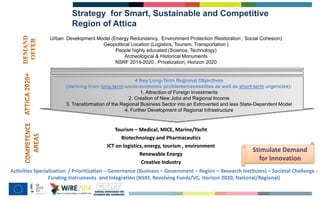
Strategy for Smart, Sustainable and Competitive
Region of Attica
Tourism – Medical, MICE, Marine/Yacht
Biotechnology and Pharmaceutics
ICT on logistics, energy, tourism , environment
Renewable Energy
Creative Industry
Activities Specialization / Prioritization – Governance (Business – Government – Region – Research Institutes) – Societal Challenge -
Funding Instruments and Integration (NSRF, Revolving Funds/VC, Horizon 2020, National/Regional)
Urban Development Model (Energy Redundancy, Environment Protection /Restoration , Social Cohesion)
Geopolitical Location (Logistics, Tourism, Transportation )
People highly educated (Science, Technology)
Archeological & Historical Monuments
NSRF 2014-2020 , Privatization, Horizon 2020
Stimulate Demand
for Innovation
4 Key Long-Term Regional Objectives
(deriving from long-term socio-economic problems/necessities as well as short-term urgencies):
1. Attraction of Foreign Investments
2. Creation of New Jobs and Regional Income
3. Transformation of the Regional Business Sector into an Extroverted and less State-Dependent Model
4. Further Development of Regional Infrastructure
Theodora Zacharia
Intermediate Managing Authority
Attica Region
Deputy Director
τηλ. 2131501511, 6977390583
e-mail : thzachar@gmail.com

WiRE2014_Theodora Zacharia 10062014 final wc

  • 1.
    Smart Specialisation inthe Region of Attica Intermediate Authority of Attica Region WIRE2014 / 12-06-2014 Logo area
  • 2.
    ATTICA IS AMETROPOLITAN AREA • The producer of 45% of the National GDP • The place of employment of 37% of National Workforce • The place of operation of 35% of National Enterprises • The main exporter (48% of total GDP from exports), main transportation & Logistics Hub within South-Eastern Europe & Mediterranean (Port of Piraeus, El. Venizelos Airport, national roads, Attiki Odos etc), main university and research centre (11 Universities & Highest Technological Education Institutions and 10 Public Research Institutions) • Geopolitically located in SouthEast of Mediterranean and in the centre of Greece, between Aegean and Korinthos Canal and between Central and Southern Greece • The most populous and most densely populated region in the country with 3,812,330 habitants with 66 Municipalities
  • 3.
    THE ECONOMIC POTENTIAL: BUSINESS & INVESTMENTS Region’s growth model is based mainly on domestic consumption Entrepreneurship • Attica Region involve 57% of National Tertiary Sector (trade, financial services, transport and ICT, health and social services, real estate, recreation, research and business services) and of 31% National Secondary Sector (food industry, metal products, chemicals and basic pharmaceuticals, textiles) • Some specialization in maritime transport, transportation and logistics • High-tech manufacturing and knowledge intensive service sectors are dynamically emerging • High Attachment to SMEs/ Self-Employed Business Models - 94% of the companies in Attica are small and very small – 80% are family model companies • More than one third (36.32%) of the early‐stage entrepreneurs are young (25‐34 years old) Major Scale Ongoing Projects : Waste Management, Metro, Logistics Center, Port Of Piraeus etc
  • 4.
    THE HUMAN CAPITALPOTENTIAL People are Charged with Brainpower • Highly educated citizens – 33,1% with a university degree and 41,8% on science and technology areas • A region of 243.638 students (36,9% of the country) • 57% of the regional population uses regularly a PC and the Internet • High foreign demand for local Researchers & Specialised Scientists Unemployment • 535.500 unemployed in 2013, 155.000 are 15-29 years old (37% on the country level), 1/2 are long term unemployed • While in 2008-2012 people holding Phd increased by 1,61 times (from 76.026 to 122.447), unemployment hit this group from 4,8% to 12,9% • Universities Graduated unemployed have been 4 times more in 2012 than in 2008 Social Division Issues • Illegal Immigration • 480 homeless (street work) in the Historical Center of Athens , 71% between 26-55 years old, 54% for poverty reasons
  • 5.
    THE INNOVATION POTENTIAL: UNIVERSITIES & RESEARCH High Scientific Excellence regarding Publications on agricultural sciences, medical and health sciences, engineering, natural sciences and social science (even if funding is limited on RTD : 0,72% or €775,192 of the Regional GDP) Research is equally allocated among universities and business (28.727 employers on R&D activities) Some mature clusters on Microelectronics, Space Technologies and Applications Cluster, Innovative Gaming Technologies and Life Sciences (HBio) Some dynamic organic clusters on pharmaceuticals, telecom/ICT, chemical products, entertainment, processed food, tourism & hospitality Although a small number of firms in more high-tech sectors are better connected to the regional innovation system
  • 6.
    REGIONAL DEVELOPMENT POTENTIAL STRENGTHS StrongGeo-Strategic Position High Touristic Appeal Important Archaeological and Cultural Sites Tradition in Innovation in Selected Areas (Pharmaceutical, ICT, Nanotechnology) Large Number of Universities & Public Research Centers High Concentration of Researchers Highly Educated Human Capital OPPORTUNITIES International Interest for Investments Large-Scale Projects (Waste Management, Metro, Logistics Center, Port Of Piraeus etc) New NSRF Focusing on Innovation and Green Economy Large-Scale Privatisation Projects Alternative Tourism (MICE, Medical, Yacht) Smart Cities Policy Orientation Regulatory Improvements Social Interest for Innovative Development Solutions WEAKNESSES Liquidity Problems Decrease in Public Spending Shallow Local Market/ Low Extroversion Low Private R&D Investments (Further decreasing due to the Crisis) Low Connection of Research/ Education To Business Demands Low Growth Oriented and Innovative SMEs Low “Academic to Applied Research“ Efficiency Low Social Innovation Social Inequalities THREATS and CHALLENGES Economic Depression/ Stagnation High Unemployment Brain Drain Ageing Population Impacting Labor Shortage and Conditions for SMEs Decrease in ERDF Funds for 2014-2020 Endangered Social Cohesion Political Instability Risk Increasing Competition from other Mediterranean Cities in Tourism and Health Sectors
  • 7.
    Strategy for Smart,Sustainable and Competitive Region of Attica Tourism – Medical, MICE, Marine/Yacht Biotechnology and Pharmaceutics ICT on logistics, energy, tourism , environment Renewable Energy Creative Industry Activities Specialization / Prioritization – Governance (Business – Government – Region – Research Institutes) – Societal Challenge - Funding Instruments and Integration (NSRF, Revolving Funds/VC, Horizon 2020, National/Regional) Urban Development Model (Energy Redundancy, Environment Protection /Restoration , Social Cohesion) Geopolitical Location (Logistics, Tourism, Transportation ) People highly educated (Science, Technology) Archeological & Historical Monuments NSRF 2014-2020 , Privatization, Horizon 2020 Stimulate Demand for Innovation 4 Key Long-Term Regional Objectives (deriving from long-term socio-economic problems/necessities as well as short-term urgencies): 1. Attraction of Foreign Investments 2. Creation of New Jobs and Regional Income 3. Transformation of the Regional Business Sector into an Extroverted and less State-Dependent Model 4. Further Development of Regional Infrastructure
  • 8.
    Theodora Zacharia Intermediate ManagingAuthority Attica Region Deputy Director τηλ. 2131501511, 6977390583 e-mail : thzachar@gmail.com