Wipe Out Worksheets:
creating collaborative reference
 skills units that require higher
        level thinking skills

           Susan L. Garvin
       (susanlgarvin@cox.net)
          Annie Weissman
     (annieweissman@aol.com)
                                    1
Understanding by Design
The units were planned using the templates found in Understanding by
Design by Grant Wiggins and Jay McTigue (ASCD, 2005.) They have
updated their ideas in the books The Understanding by Design Guide
to Creating High-Quality Units (2011) and The Understanding by
Design Guide to Advanced Concepts in Creating and Reviewing Units
(2012).
         The book opens by analyzing the logic of backward design as
an alternative to coverage and activity-oriented plans. The book
proposes a multifaceted approach, with the six “facets” of
understanding. The facets combine with backward design to provide a
powerful, expanded array of practical tools and strategies for designing
curriculum, instruction, and assessments that lead students at all grade
levels to genuine understanding.


                                                                       2
Three Stages of Designing a Unit
Stage One – Identify Desired Results
   Established Goals
   Essential Questions
    Understandings
    Key Knowledge and Skills
 Stage Two – Evidence
     Performance Tasks
    Assessment and Reflection
 Stage Three – Plan Learning Experiences

                                           3
Stage One: Established Goal
     In the first step of the first stage, the
planner identifies the desired results by first
basing the unit on established goals. These
are either national, state, or district content
standards.


                                                  4
Fourth Grade Biome Unit
First Step – Established goal.
National Science Education Content
Standard C: Life Science
      Organisms and their environments: An
organism‟s patterns of behavior are related
to the nature of that organism‟s environment
including the kinds and numbers of other
organisms present, the availability of food
and resources and the physical
characteristics of the environment.
                                               5
Second Step: Essential Questions
The next step in the first stage is that the
planner decides on the essential questions:
     What is it that makes this unit worth
studying? These questions are broad in
nature but have specific answers. This is
where the words of Bloom‟s Taxonomy,
especially why and how, are used.


                                               6
Essential Questions for Biome Unit
1. What is a biome and what are its
characteristics?
 2. Where are the biomes on the earth?
 3. What are humans doing to change or
influence the condition and future of the
biomes?
4. Which biome do you live in?


                                            7
Third Step: Understandings
The third step in Stage One is to
write down what understandings
the students will learn. These are
also broad statements.


                                     8
Understandings for the Biome Unit

1. Students identify the characteristics of a
biome.
2. Students identify the seven biomes, their
characteristics, and where they are located.
3. Students understand that the plants and
animals that live in each biome are
interdependent.
4. Students understand that plants and animals
have adapted to the biome in which they live.
5. Students understand that human activity affects
the basic underlying conditions and future of
biomes.
                                                     9
Key Knowledge and Skills

     The final step of Stage One
is to break down the
understandings into key
knowledge and skills the
students will learn from the unit.


                                     10
Key Knowledge and Skills of Biome Unit

1. Students define the key vocabulary of the
unit: biome, taiga, tundra, grassland,
deciduous, forest, desert, tropical, rainforest,
savannah, climate, adaptation, annual, arid,
atmosphere, basin, community, competition,
conserve, drought, evergreen, humid,
habitat, landforms, organism, perennial,
prairie, species, steppe, symbiosis, and
vegetation.
                                               11
Key knowledge and skills of Biome Unit
2. Students use the encyclopedia,
Internet, dictionary, online catalog, and
nonfiction books to research: location,
climate, dominant plants, common
animals and impact of humans.
3. Using Microsoft Publisher, students
create a brochure on their assigned
biome.
                                         12
Stage Two: Evidence
      The second stage is to decide on
what evidence will show that the
students have acquired the
understandings, key knowledge and
skills, performance tasks.
      The performance tasks should
mirror the understandings, knowledge,
and skills that have been targeted for
the unit.
                                         13
Stage Two: Determine Acceptable
       Evidence of Biome Unit

• Performance Tasks:
• Students make a brochure describing the
  characteristics of their assigned biome.
• Using the cooperative learning jigsaw
  strategy, students present and teach their
  biome brochures to a small group.


                                               14
Assessment and Reflection
Part of the second stage is student self-
assessment and reflection. Rubrics can
either be used by the instructor to assess
performance tasks or by the students to
assess their performance tasks. The rubric
in this unit was created on Rubistar,
http://rubistar.4teachers.org/index.php . This
is a free website at which all kinds of rubrics
can be designed.

                                              15
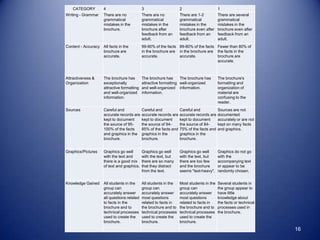
CATEGORY         4                       3                      2                      1
Writing - Grammar    There are no            There are no           There are 1-2          There are several
                     grammatical             grammatical            grammatical            grammatical
                     mistakes in the         mistakes in the        mistakes in the        mistakes in the
                     brochure.               brochure after         brochure even after    brochure even after
                                             feedback from an       feedback from an       feedback from an
                                             adult.                 adult.                 adult.
Content - Accuracy All facts in the          99-90% of the facts 89-80% of the facts Fewer than 80% of
                   brochure are              in the brochure are in the brochure are the facts in the
                   accurate.                 accurate.           accurate.           brochure are
                                                                                     accurate.


Attractiveness &     The brochure has        The brochure has      The brochure has        The brochure's
Organization         exceptionally           attractive formatting well-organized          formatting and
                     attractive formatting   and well-organized information.               organization of
                     and well-organized      information.                                  material are
                     information.                                                          confusing to the
                                                                                           reader.
Sources              Careful and             Careful and            Careful and            Sources are not
                     accurate records are    accurate records are   accurate records are   documented
                     kept to document        kept to document       kept to document       accurately or are not
                     the source of 95-       the source of 94-      the source of 84-      kept on many facts
                     100% of the facts       85% of the facts and   75% of the facts and   and graphics.
                     and graphics in the     graphics in the        graphics in the
                     brochure.               brochure.              brochure.


Graphics/Pictures    Graphics go well        Graphics go well       Graphics go well       Graphics do not go
                     with the text and       with the text, but     with the text, but     with the
                     there is a good mix     there are so many      there are too few      accompanying text
                     of text and graphics.   that they distract     and the brochure       or appear to be
                                             from the text.         seems "text-heavy".    randomly chosen.


Knowledge Gained     All students in the     All students in the    Most students in the   Several students in
                     group can               group can              group can              the group appear to
                     accurately answer       accurately answer      accurately answer      have little
                     all questions related   most questions         most questions         knowledge about
                     to facts in the         related to facts in    related to facts in    the facts or technical
                     brochure and to         the brochure and to    the brochure and to    processes used in
                     technical processes     technical processes    technical processes    the brochure.
                     used to create the      used to create the     used to create the
                     brochure.               brochure.              brochure.
                                                                                                                    16
Stage Three: Plan Learning
           Experiences
The third and last stage is planning
the learning experiences. They are
made specific with the lesson plans
for the unit. The dictionary lesson is
to build background information,
not for a particular product.

                                     17
Stage Three: Learning Experiences
          for Biome Unit
• The instructor reads a book and discusses the
  characteristics of a biome: location, climate, plants,
  animals, conditions, and future. S/he brainstorms
  identifying the seven biomes and introduces the
  performance tasks and rubric for the unit.
• Using a dictionary, students research key biome
  vocabulary words.
• Each group is assigned a biome [tundra, taiga (boreal
  forest), deciduous temperate forest, grasslands,
  savanna, desert, and tropical rainforest] to research
  using the encyclopedia, nonfiction books, and Internet
  websites. Using an Internet website, students create a
  map of the location of their assigned biome.

                                                      18
Stage Three: Learning Experiences
          for Biome Unit
• Each group makes a brochure about their
  assigned biome. The brochure must
  contain information about the location,
  climate, dominant plants, common
  animals, conditions, and future of the
  biome.
• After the first draft, students use the rubric
  to rate and revise their biome brochure.

                                               19
Stage Three: Learning Experiences
          for Biome Unit
• Using the cooperative learning
  jigsaw strategy, students present
  and teach their biome brochure to
  a small group.
• The instructor leads a class
  discussion using key and
  concluding questions.
                                  20
Fourth Grade Biome Unit: Lesson
       One “Brainstorming”
Standards:
National Science Education Content Standard
C: Life Science

      Organisms and their environments: An
organism‟s patterns of behavior are related to
the nature of that organism‟s environment
including the kinds and numbers of other
organisms present, the availability of food and
resources and the physical characteristics of
the environment.

                                                  21
Objectives: Lesson One
           “Brainstorming”

     Students identify the
characteristics of a biome: location,
climate, dominant plants, common
animals, conditions, and future.
     Students understand the
performance tasks and rubric required
for the unit.
                                    22
Materials: Lesson One
           “Brainstorming”
Chart or empty board ready paper
One of the following books:
   Burnie, David. Scrublands. Steck-Vaugh, 2003. 64 pp.
   Kalman, Bobbie. What is a Biome? Crabtree Publishing
   Company, 2005. 32pp.
   Tocci, Salvatore. The Chaparral Life on the Scrubby Coast.
            Franklin Watts, 2004. 65 pp.
   Worhol, Tom. Chaparral and Scrubs. Marshall Cavendish,
                     2007. 80 pp.
   Thirty copies of the biome brochure rubric
   Visual of tundra


                                                                23
Lesson One “Brainstorming”
Set: The instructor says, “There is a
part of the world where it is very cold
and dark in the winter, polar bears
roam, and the land is flat and frozen.
What one word could you use to
describe this region of the world?” The
instructor gives the answer, “tundra,” if
no one guesses it correctly.
                                        24
Lesson One “Brainstorming”
Input: Before the instructor reads sections of
the book, s/he tells the students to notice the
following characteristics: location, climate,
dominant plants, and common animals.
       After the reading the instructor uses
think-pair-share and asks the students to name
or describe the biome mentioned in the book.
      The instructor records their descriptions.
Using think-pair-share, the instructor asks the
students to brainstorm other biomes they know.
      S/he records the biomes that match the
ones that will be covered in the unit. The
instructor adds any biomes that are missing.
                                               25
Input: Part Two
    S/he explains the unit and the performance tasks.
The instructor projects the board ready biome brochure
rubric. S/he hands out a copy of the rubric to the
students. The instructor goes over the categories and
the rating system from four to one, making sure that the
students understand the rubric.
    S/he then arranges the students into seven groups
and assigns each group a biome: [tundra, taiga (boreal
forest), deciduous temperate forest, grassland,
savanna, desert, and tropical rainforest].
    The instructor gives each group a folder and tells the
students to write on the front of the folder their assigned
biome, their names, and their room number. Students
are then to number themselves from one to four.


                                                         26
Lesson One “Brainstorming”
Guided Practice: The students meet
with their groups, write their biome and
room number on the folder, as well as
their names next to the numbers one
through four.
     They put copies of the biome
brochure rubric in their folder. The
instructor collects the group folders.
                                       27
Lesson One “Brainstorming”

Assessment: The instructor
informally observes if the students
can describe the characteristics of
biomes and if they understand the
performance tasks and rubric as
explained.
                                      28
Closure: Lesson One
         “Brainstorming”

Closure: Using think-pair-share,
the instructor asks, “What are
some characteristics of
biomes?”


                               29
Additional Lessons for Biome Unit
• Lesson Two “Using the Dictionary to
  Understand the Vocabulary of Biomes”
• Lesson Three “Researching Biomes Using
  the Encyclopedia”
• Lesson Four “Using Nonfiction Books to
  Research Biomes”
• Lesson Five “Information and a Biome
  Map from the Internet”

                                       30
Additional Lessons for Biome Unit

• Lesson Six “Writing a Biome
  Brochure”
• Lesson Seven “Designing a Biome
  Brochure Using a Story Board”
• Lesson Eight “Making a Biome
  Brochure using Microsoft Publisher”


                                        31
Additional Lessons for Biome Unit

• Lesson Nine “Reading, Rating,
  and Changing the Biome
  Brochures”
• Lesson Ten „Presentation of the
  Biome Brochures”


                                    32

Wipe out worksheets

  • 1.
    Wipe Out Worksheets: creatingcollaborative reference skills units that require higher level thinking skills Susan L. Garvin (susanlgarvin@cox.net) Annie Weissman (annieweissman@aol.com) 1
  • 2.
    Understanding by Design Theunits were planned using the templates found in Understanding by Design by Grant Wiggins and Jay McTigue (ASCD, 2005.) They have updated their ideas in the books The Understanding by Design Guide to Creating High-Quality Units (2011) and The Understanding by Design Guide to Advanced Concepts in Creating and Reviewing Units (2012). The book opens by analyzing the logic of backward design as an alternative to coverage and activity-oriented plans. The book proposes a multifaceted approach, with the six “facets” of understanding. The facets combine with backward design to provide a powerful, expanded array of practical tools and strategies for designing curriculum, instruction, and assessments that lead students at all grade levels to genuine understanding. 2
  • 3.
    Three Stages ofDesigning a Unit Stage One – Identify Desired Results Established Goals Essential Questions Understandings Key Knowledge and Skills Stage Two – Evidence Performance Tasks Assessment and Reflection Stage Three – Plan Learning Experiences 3
  • 4.
    Stage One: EstablishedGoal In the first step of the first stage, the planner identifies the desired results by first basing the unit on established goals. These are either national, state, or district content standards. 4
  • 5.
    Fourth Grade BiomeUnit First Step – Established goal. National Science Education Content Standard C: Life Science Organisms and their environments: An organism‟s patterns of behavior are related to the nature of that organism‟s environment including the kinds and numbers of other organisms present, the availability of food and resources and the physical characteristics of the environment. 5
  • 6.
    Second Step: EssentialQuestions The next step in the first stage is that the planner decides on the essential questions: What is it that makes this unit worth studying? These questions are broad in nature but have specific answers. This is where the words of Bloom‟s Taxonomy, especially why and how, are used. 6
  • 7.
    Essential Questions forBiome Unit 1. What is a biome and what are its characteristics? 2. Where are the biomes on the earth? 3. What are humans doing to change or influence the condition and future of the biomes? 4. Which biome do you live in? 7
  • 8.
    Third Step: Understandings Thethird step in Stage One is to write down what understandings the students will learn. These are also broad statements. 8
  • 9.
    Understandings for theBiome Unit 1. Students identify the characteristics of a biome. 2. Students identify the seven biomes, their characteristics, and where they are located. 3. Students understand that the plants and animals that live in each biome are interdependent. 4. Students understand that plants and animals have adapted to the biome in which they live. 5. Students understand that human activity affects the basic underlying conditions and future of biomes. 9
  • 10.
    Key Knowledge andSkills The final step of Stage One is to break down the understandings into key knowledge and skills the students will learn from the unit. 10
  • 11.
    Key Knowledge andSkills of Biome Unit 1. Students define the key vocabulary of the unit: biome, taiga, tundra, grassland, deciduous, forest, desert, tropical, rainforest, savannah, climate, adaptation, annual, arid, atmosphere, basin, community, competition, conserve, drought, evergreen, humid, habitat, landforms, organism, perennial, prairie, species, steppe, symbiosis, and vegetation. 11
  • 12.
    Key knowledge andskills of Biome Unit 2. Students use the encyclopedia, Internet, dictionary, online catalog, and nonfiction books to research: location, climate, dominant plants, common animals and impact of humans. 3. Using Microsoft Publisher, students create a brochure on their assigned biome. 12
  • 13.
    Stage Two: Evidence The second stage is to decide on what evidence will show that the students have acquired the understandings, key knowledge and skills, performance tasks. The performance tasks should mirror the understandings, knowledge, and skills that have been targeted for the unit. 13
  • 14.
    Stage Two: DetermineAcceptable Evidence of Biome Unit • Performance Tasks: • Students make a brochure describing the characteristics of their assigned biome. • Using the cooperative learning jigsaw strategy, students present and teach their biome brochures to a small group. 14
  • 15.
    Assessment and Reflection Partof the second stage is student self- assessment and reflection. Rubrics can either be used by the instructor to assess performance tasks or by the students to assess their performance tasks. The rubric in this unit was created on Rubistar, http://rubistar.4teachers.org/index.php . This is a free website at which all kinds of rubrics can be designed. 15
  • 16.
    CATEGORY 4 3 2 1 Writing - Grammar There are no There are no There are 1-2 There are several grammatical grammatical grammatical grammatical mistakes in the mistakes in the mistakes in the mistakes in the brochure. brochure after brochure even after brochure even after feedback from an feedback from an feedback from an adult. adult. adult. Content - Accuracy All facts in the 99-90% of the facts 89-80% of the facts Fewer than 80% of brochure are in the brochure are in the brochure are the facts in the accurate. accurate. accurate. brochure are accurate. Attractiveness & The brochure has The brochure has The brochure has The brochure's Organization exceptionally attractive formatting well-organized formatting and attractive formatting and well-organized information. organization of and well-organized information. material are information. confusing to the reader. Sources Careful and Careful and Careful and Sources are not accurate records are accurate records are accurate records are documented kept to document kept to document kept to document accurately or are not the source of 95- the source of 94- the source of 84- kept on many facts 100% of the facts 85% of the facts and 75% of the facts and and graphics. and graphics in the graphics in the graphics in the brochure. brochure. brochure. Graphics/Pictures Graphics go well Graphics go well Graphics go well Graphics do not go with the text and with the text, but with the text, but with the there is a good mix there are so many there are too few accompanying text of text and graphics. that they distract and the brochure or appear to be from the text. seems "text-heavy". randomly chosen. Knowledge Gained All students in the All students in the Most students in the Several students in group can group can group can the group appear to accurately answer accurately answer accurately answer have little all questions related most questions most questions knowledge about to facts in the related to facts in related to facts in the facts or technical brochure and to the brochure and to the brochure and to processes used in technical processes technical processes technical processes the brochure. used to create the used to create the used to create the brochure. brochure. brochure. 16
  • 17.
    Stage Three: PlanLearning Experiences The third and last stage is planning the learning experiences. They are made specific with the lesson plans for the unit. The dictionary lesson is to build background information, not for a particular product. 17
  • 18.
    Stage Three: LearningExperiences for Biome Unit • The instructor reads a book and discusses the characteristics of a biome: location, climate, plants, animals, conditions, and future. S/he brainstorms identifying the seven biomes and introduces the performance tasks and rubric for the unit. • Using a dictionary, students research key biome vocabulary words. • Each group is assigned a biome [tundra, taiga (boreal forest), deciduous temperate forest, grasslands, savanna, desert, and tropical rainforest] to research using the encyclopedia, nonfiction books, and Internet websites. Using an Internet website, students create a map of the location of their assigned biome. 18
  • 19.
    Stage Three: LearningExperiences for Biome Unit • Each group makes a brochure about their assigned biome. The brochure must contain information about the location, climate, dominant plants, common animals, conditions, and future of the biome. • After the first draft, students use the rubric to rate and revise their biome brochure. 19
  • 20.
    Stage Three: LearningExperiences for Biome Unit • Using the cooperative learning jigsaw strategy, students present and teach their biome brochure to a small group. • The instructor leads a class discussion using key and concluding questions. 20
  • 21.
    Fourth Grade BiomeUnit: Lesson One “Brainstorming” Standards: National Science Education Content Standard C: Life Science Organisms and their environments: An organism‟s patterns of behavior are related to the nature of that organism‟s environment including the kinds and numbers of other organisms present, the availability of food and resources and the physical characteristics of the environment. 21
  • 22.
    Objectives: Lesson One “Brainstorming” Students identify the characteristics of a biome: location, climate, dominant plants, common animals, conditions, and future. Students understand the performance tasks and rubric required for the unit. 22
  • 23.
    Materials: Lesson One “Brainstorming” Chart or empty board ready paper One of the following books: Burnie, David. Scrublands. Steck-Vaugh, 2003. 64 pp. Kalman, Bobbie. What is a Biome? Crabtree Publishing Company, 2005. 32pp. Tocci, Salvatore. The Chaparral Life on the Scrubby Coast. Franklin Watts, 2004. 65 pp. Worhol, Tom. Chaparral and Scrubs. Marshall Cavendish, 2007. 80 pp. Thirty copies of the biome brochure rubric Visual of tundra 23
  • 24.
    Lesson One “Brainstorming” Set:The instructor says, “There is a part of the world where it is very cold and dark in the winter, polar bears roam, and the land is flat and frozen. What one word could you use to describe this region of the world?” The instructor gives the answer, “tundra,” if no one guesses it correctly. 24
  • 25.
    Lesson One “Brainstorming” Input:Before the instructor reads sections of the book, s/he tells the students to notice the following characteristics: location, climate, dominant plants, and common animals. After the reading the instructor uses think-pair-share and asks the students to name or describe the biome mentioned in the book. The instructor records their descriptions. Using think-pair-share, the instructor asks the students to brainstorm other biomes they know. S/he records the biomes that match the ones that will be covered in the unit. The instructor adds any biomes that are missing. 25
  • 26.
    Input: Part Two S/he explains the unit and the performance tasks. The instructor projects the board ready biome brochure rubric. S/he hands out a copy of the rubric to the students. The instructor goes over the categories and the rating system from four to one, making sure that the students understand the rubric. S/he then arranges the students into seven groups and assigns each group a biome: [tundra, taiga (boreal forest), deciduous temperate forest, grassland, savanna, desert, and tropical rainforest]. The instructor gives each group a folder and tells the students to write on the front of the folder their assigned biome, their names, and their room number. Students are then to number themselves from one to four. 26
  • 27.
    Lesson One “Brainstorming” GuidedPractice: The students meet with their groups, write their biome and room number on the folder, as well as their names next to the numbers one through four. They put copies of the biome brochure rubric in their folder. The instructor collects the group folders. 27
  • 28.
    Lesson One “Brainstorming” Assessment:The instructor informally observes if the students can describe the characteristics of biomes and if they understand the performance tasks and rubric as explained. 28
  • 29.
    Closure: Lesson One “Brainstorming” Closure: Using think-pair-share, the instructor asks, “What are some characteristics of biomes?” 29
  • 30.
    Additional Lessons forBiome Unit • Lesson Two “Using the Dictionary to Understand the Vocabulary of Biomes” • Lesson Three “Researching Biomes Using the Encyclopedia” • Lesson Four “Using Nonfiction Books to Research Biomes” • Lesson Five “Information and a Biome Map from the Internet” 30
  • 31.
    Additional Lessons forBiome Unit • Lesson Six “Writing a Biome Brochure” • Lesson Seven “Designing a Biome Brochure Using a Story Board” • Lesson Eight “Making a Biome Brochure using Microsoft Publisher” 31
  • 32.
    Additional Lessons forBiome Unit • Lesson Nine “Reading, Rating, and Changing the Biome Brochures” • Lesson Ten „Presentation of the Biome Brochures” 32