Programme
Architecture 3a, Trimester 1, 2010
20:10 SRD 363
A+B: Deakin University School of Architecture and Building
Architecture 3A/3C SRD 336/333
Quick Facts
Unit Chair: Dr Sambit Datta
Office: D 4.112 (by appointment: Wednesdays, 3.00-5.00; Fridays 3.00-5.00)
Email: sdatta@deakin.edu.au
Phone: 03 5227 8311
Studio Staff: Sambit Datta, John Rollo, Yolanda Esteban, Stuart Hanafin, Gregory Pitts, Lana Van Galen
Lectures Wednesdays 11.00--11.50 in D 2.194, Lecture Theatre, Waterfront
Studio Tutorials Wednesdays & Fridays (SRD363 only) 12.00--14.50, D4.319, A+B Studio, Waterfront
Presentations Fridays (SRD363 only) 15.00--16.50, D4.319, A+B Studio, Waterfront
Reviews Interim (Friday 23rd
April, 2010)
Final (Friday 4th
June, 2010)
Portfolio Cut-off for electronic submission (Wednesday, 09th
June, 2010, 5pm on DSO)
Online http://www.deakin.edu.au/dso
Welcome to Architecture 3A/3C.
This guide will help you understand the teaching and learning aims for this unit. If you have any suggestions for the
creative refinement of the materials presented in this document you can write to the unit chair, James Coulson
(sdatta@deakin.edu.au). If you have trouble understanding the material or any disability which might impair your
progress please advise the lecturer at the very beginning of semester (preferably week one). Please refer to the
disability and plagiarism statements in the unit guide. The complete unit guide is available online at the above web
address and a CDROM resource with study material, readings and case studies is available from the university
bookshop.
Students are reminded that all information regarding their enrolment and course of study is distributed via the Deakin
Portal and/or Deakin email. Therefore students MUST access the Deakin Portal and check their Deakin email regularly
(at least weekly). The Portal is accessible via http://www.deakin.edu.au. Deakin email can be accessed via the Portal.
UNIT: Architecture 3A & 3C
UNIT CODE: SRD363 & SRD333
CAMPUS OF OFFER: Waterfront
TRIMESTER OF OFFER: ONE
CREDIT POINTS: ONE (SRD333) & TWO (SRD363)
UNIT CHAIR/
STAFF CO-ORDINATOR:
Dr Sambit Datta Snr Lecturer, School of Architecture and
Building, Faculty of Science & Technology, Geelong
Waterfront Campus
PRE-REQUISITES: Check handbook
Programme
Architecture 3a, Trimester 1, 2010
“Wine and architecture have a long history together. If architecture is frozen music, then wine is liquid weather. Each transmutes
something into a whole greater than the sum of its parts.”
Mick Moloney, Barwon Ridge Winery, 2004
TERROIR
Programme
Architecture 3a, Trimester 1, 2010
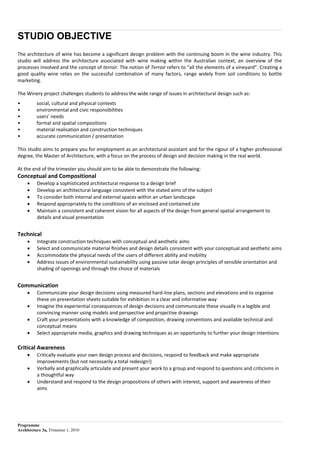
STUDIO OBJECTIVE
The architecture of wine has become a significant design problem with the continuing boom in the wine industry. This
studio will address the architecture associated with wine making within the Australian context, an overview of the
processes involved and the concept of terroir. The notion of Terroir refers to “all the elements of a vineyard”. Creating a
good quality wine relies on the successful combination of many factors, range widely from soil conditions to bottle
marketing.
The Winery project challenges students to address the wide range of issues in architectural design such as:
• social, cultural and physical contexts
• environmental and civic responsibilities
• usersʼ needs
• formal and spatial compositions
• material realisation and construction techniques
• accurate communication / presentation
This studio aims to prepare you for employment as an architectural assistant and for the rigour of a higher professional
degree, the Master of Architecture, with a focus on the process of design and decision making in the real world.
At the end of the trimester you should aim to be able to demonstrate the following:
Conceptual and Compositional
 Develop a sophisticated architectural response to a design brief
 Develop an architectural language consistent with the stated aims of the subject
 To consider both internal and external spaces within an urban landscape
 Respond appropriately to the conditions of an enclosed and contained site
 Maintain a consistent and coherent vision for all aspects of the design from general spatial arrangement to
details and visual presentation
Technical
 Integrate construction techniques with conceptual and aesthetic aims
 Select and communicate material finishes and design details consistent with your conceptual and aesthetic aims
 Accommodate the physical needs of the users of different ability and mobility
 Address issues of environmental sustainability using passive solar design principles of sensible orientation and
shading of openings and through the choice of materials
Communication
 Communicate your design decisions using measured hard-line plans, sections and elevations and to organise
these on presentation sheets suitable for exhibition in a clear and informative way
 Imagine the experiential consequences of design decisions and communicate these visually in a legible and
convincing manner using models and perspective and projective drawings
 Craft your presentations with a knowledge of composition, drawing conventions and available technical and
conceptual means
 Select appropriate media, graphics and drawing techniques as an opportunity to further your design intentions
Critical Awareness
 Critically evaluate your own design process and decisions, respond to feedback and make appropriate
improvements (but not necessarily a total redesign!)
 Verbally and graphically articulate and present your work to a group and respond to questions and criticisms in
a thoughtful way
 Understand and respond to the design propositions of others with interest, support and awareness of their
aims
Programme
Architecture 3a, Trimester 1, 2010
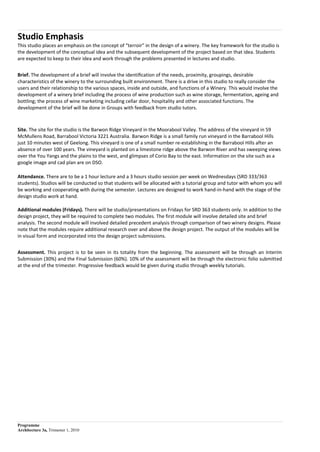
Studio Emphasis
This studio places an emphasis on the concept of “terroir” in the design of a winery. The key framework for the studio is
the development of the conceptual idea and the subsequent development of the project based on that idea. Students
are expected to keep to their idea and work through the problems presented in lectures and studio.
Brief. The development of a brief will involve the identification of the needs, proximity, groupings, desirable
characteristics of the winery to the surrounding built environment. There is a drive in this studio to really consider the
users and their relationship to the various spaces, inside and outside, and functions of a Winery. This would involve the
development of a winery brief including the process of wine production such as wine storage, fermentation, ageing and
bottling; the process of wine marketing including cellar door, hospitality and other associated functions. The
development of the brief will be done in Groups with feedback from studio tutors.
Site. The site for the studio is the Barwon Ridge Vineyard in the Moorabool Valley. The address of the vineyard in 59
McMullens Road, Barrabool Victoria 3221 Australia. Barwon Ridge is a small family run vineyard in the Barrabool Hills
just 10 minutes west of Geelong. This vineyard is one of a small number re-establishing in the Barrabool Hills after an
absence of over 100 years. The vineyard is planted on a limestone ridge above the Barwon River and has sweeping views
over the You Yangs and the plains to the west, and glimpses of Corio Bay to the east. Information on the site such as a
google image and cad plan are on DSO.
Attendance. There are to be a 1 hour lecture and a 3 hours studio session per week on Wednesdays (SRD 333/363
students). Studios will be conducted so that students will be allocated with a tutorial group and tutor with whom you will
be working and cooperating with during the semester. Lectures are designed to work hand-in-hand with the stage of the
design studio work at hand.
Additional modules (Fridays). There will be studio/presentations on Fridays for SRD 363 students only. In addition to the
design project, they will be required to complete two modules. The first module will involve detailed site and brief
analysis. The second module will involved detailed precedent analysis through comparison of two winery designs. Please
note that the modules require additional research over and above the design project. The output of the modules will be
in visual form and incorporated into the design project submissions.
Assessment. This project is to be seen in its totality from the beginning. The assessment will be through an Interim
Submission (30%) and the Final Submission (60%). 10% of the assessment will be through the electronic folio submitted
at the end of the trimester. Progressive feedback would be given during studio through weekly tutorials.
Programme
Architecture 3a, Trimester 1, 2010
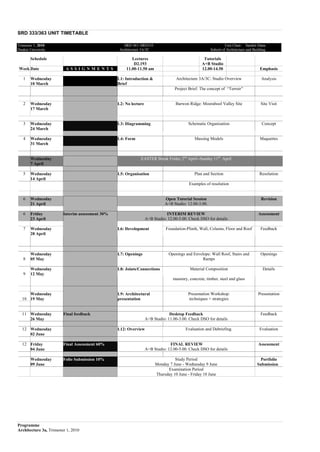
SRD 333/363 UNIT TIMETABLE
Trimester 1, 2010 SRD 363 /SRD333 Unit Chair: Sambit Datta
Deakin University Architecture 3A/3C School of Architecture and Building
Schedule Lectures
D2.193
Tutorials
A+B Studio
Week Date A S S I G N M E N T S 11.00-11.50 am 12.00-14.50 Emphasis
1 Wednesday
10 March
L1: Introduction &
Brief
Architecture 3A/3C: Studio Overview Analysis
Project Brief: The concept of “Terroir”
2 Wednesday
17 March
L2: No lecture Barwon Ridge: Moorabool Valley Site Site Visit
3 Wednesday
24 March
L3: Diagramming Schematic Organisation Concept
4 Wednesday
31 March
L4: Form Massing Models Maquettes
Wednesday
7 April
EASTER Break Friday 2nd
April--Sunday 11th
April
5 Wednesday
14 April
L5: Organisation Plan and Section Resolution
Examples of resolution
6 Wednesday
21 April
Open Tutorial Session
A+B Studio: 12.00-3.00.
Revision
6 Friday
23 April
Interim assessment 30% INTERIM REVIEW
A+B Studio: 12.00-5.00. Check DSO for details
Assessment
7 Wednesday
28 April
L6: Development Foundation-Plinth, Wall, Column, Floor and Roof Feedback
8
Wednesday
05 May
L7: Openings Openings and Envelope: Wall Roof, Stairs and
Ramps
Openings
9
Wednesday
12 May
L8: Joints/Connections Material Composition Details
masonry, concrete, timber, steel and glass
10
Wednesday
19 May
L9: Architectural
presentation
Presentation Workshop:
techniques + strategies
Presentation
11 Wednesday
26 May
Final feedback Desktop Feedback
A+B Studio: 11.00-3.00. Check DSO for details
Feedback
12 Wednesday
02 June
L12: Overview Evaluation and Debriefing. Evaluation
12 Friday
04 June
Final Assessment 60% FINAL REVIEW
A+B Studio: 12.00-5.00. Check DSO for details
Assessment
Wednesday
09 June
Folio Submission 10% Study Period
Monday 7 June - Wednesday 9 June
Portfolio
Submission
Examination Period
Thursday 10 June - Friday 18 June
Programme
Architecture 3a, Trimester 1, 2010
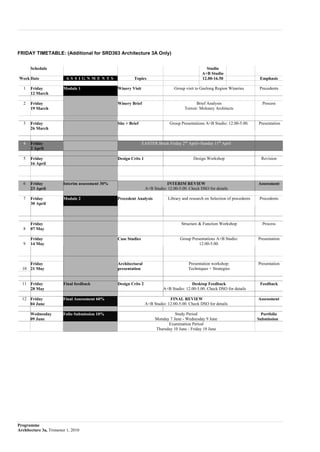
FRIDAY TIMETABLE: (Additional for SRD363 Architecture 3A Only)
Schedule Studio
A+B Studio
Week Date A S S I G N M E N T S Topics 12.00-16.50 Emphasis
1 Friday
12 March
Module 1 Winery Visit Group visit to Geelong Region Wineries Precedents
2 Friday
19 March
Winery Brief Brief Analysis
Terroir: Moloney Architects
Process
3 Friday
26 March
Site + Brief Group Presentations A+B Studio: 12.00-5.00. Presentation
4 Friday
2 April
EASTER Break Friday 2nd
April--Sunday 11th
April
5 Friday
16 April
Design Crits 1 Design Workshop Revision
6 Friday
23 April
Interim assessment 30% INTERIM REVIEW
A+B Studio: 12.00-5.00. Check DSO for details
Assessment
7 Friday
30 April
Module 2 Precedent Analysis Library and research on Selection of precedents Precedents
8
Friday
07 May
Structure & Function Structure & Function Workshop Process
9
Friday
14 May
Case Studies Group Presentations A+B Studio:
12.00-5.00.
Presentation
10
Friday
21 May
Architectural
presentation
Presentation workshop:
Techniques + Strategies
Presentation
11 Friday
28 May
Final feedback Design Crits 2 Desktop Feedback
A+B Studio: 12.00-5.00. Check DSO for details
Feedback
12 Friday
04 June
Final Assessment 60% FINAL REVIEW
A+B Studio: 12.00-5.00. Check DSO for details
Assessment
Wednesday
09 June
Folio Submission 10% Study Period
Monday 7 June - Wednesday 9 June
Portfolio
Submission
Examination Period
Thursday 10 June - Friday 18 June

Winery design

  • 1.
    Programme Architecture 3a, Trimester1, 2010 20:10 SRD 363 A+B: Deakin University School of Architecture and Building Architecture 3A/3C SRD 336/333 Quick Facts Unit Chair: Dr Sambit Datta Office: D 4.112 (by appointment: Wednesdays, 3.00-5.00; Fridays 3.00-5.00) Email: sdatta@deakin.edu.au Phone: 03 5227 8311 Studio Staff: Sambit Datta, John Rollo, Yolanda Esteban, Stuart Hanafin, Gregory Pitts, Lana Van Galen Lectures Wednesdays 11.00--11.50 in D 2.194, Lecture Theatre, Waterfront Studio Tutorials Wednesdays & Fridays (SRD363 only) 12.00--14.50, D4.319, A+B Studio, Waterfront Presentations Fridays (SRD363 only) 15.00--16.50, D4.319, A+B Studio, Waterfront Reviews Interim (Friday 23rd April, 2010) Final (Friday 4th June, 2010) Portfolio Cut-off for electronic submission (Wednesday, 09th June, 2010, 5pm on DSO) Online http://www.deakin.edu.au/dso Welcome to Architecture 3A/3C. This guide will help you understand the teaching and learning aims for this unit. If you have any suggestions for the creative refinement of the materials presented in this document you can write to the unit chair, James Coulson (sdatta@deakin.edu.au). If you have trouble understanding the material or any disability which might impair your progress please advise the lecturer at the very beginning of semester (preferably week one). Please refer to the disability and plagiarism statements in the unit guide. The complete unit guide is available online at the above web address and a CDROM resource with study material, readings and case studies is available from the university bookshop. Students are reminded that all information regarding their enrolment and course of study is distributed via the Deakin Portal and/or Deakin email. Therefore students MUST access the Deakin Portal and check their Deakin email regularly (at least weekly). The Portal is accessible via http://www.deakin.edu.au. Deakin email can be accessed via the Portal. UNIT: Architecture 3A & 3C UNIT CODE: SRD363 & SRD333 CAMPUS OF OFFER: Waterfront TRIMESTER OF OFFER: ONE CREDIT POINTS: ONE (SRD333) & TWO (SRD363) UNIT CHAIR/ STAFF CO-ORDINATOR: Dr Sambit Datta Snr Lecturer, School of Architecture and Building, Faculty of Science & Technology, Geelong Waterfront Campus PRE-REQUISITES: Check handbook
  • 2.
    Programme Architecture 3a, Trimester1, 2010 “Wine and architecture have a long history together. If architecture is frozen music, then wine is liquid weather. Each transmutes something into a whole greater than the sum of its parts.” Mick Moloney, Barwon Ridge Winery, 2004 TERROIR
  • 3.
    Programme Architecture 3a, Trimester1, 2010 STUDIO OBJECTIVE The architecture of wine has become a significant design problem with the continuing boom in the wine industry. This studio will address the architecture associated with wine making within the Australian context, an overview of the processes involved and the concept of terroir. The notion of Terroir refers to “all the elements of a vineyard”. Creating a good quality wine relies on the successful combination of many factors, range widely from soil conditions to bottle marketing. The Winery project challenges students to address the wide range of issues in architectural design such as: • social, cultural and physical contexts • environmental and civic responsibilities • usersʼ needs • formal and spatial compositions • material realisation and construction techniques • accurate communication / presentation This studio aims to prepare you for employment as an architectural assistant and for the rigour of a higher professional degree, the Master of Architecture, with a focus on the process of design and decision making in the real world. At the end of the trimester you should aim to be able to demonstrate the following: Conceptual and Compositional  Develop a sophisticated architectural response to a design brief  Develop an architectural language consistent with the stated aims of the subject  To consider both internal and external spaces within an urban landscape  Respond appropriately to the conditions of an enclosed and contained site  Maintain a consistent and coherent vision for all aspects of the design from general spatial arrangement to details and visual presentation Technical  Integrate construction techniques with conceptual and aesthetic aims  Select and communicate material finishes and design details consistent with your conceptual and aesthetic aims  Accommodate the physical needs of the users of different ability and mobility  Address issues of environmental sustainability using passive solar design principles of sensible orientation and shading of openings and through the choice of materials Communication  Communicate your design decisions using measured hard-line plans, sections and elevations and to organise these on presentation sheets suitable for exhibition in a clear and informative way  Imagine the experiential consequences of design decisions and communicate these visually in a legible and convincing manner using models and perspective and projective drawings  Craft your presentations with a knowledge of composition, drawing conventions and available technical and conceptual means  Select appropriate media, graphics and drawing techniques as an opportunity to further your design intentions Critical Awareness  Critically evaluate your own design process and decisions, respond to feedback and make appropriate improvements (but not necessarily a total redesign!)  Verbally and graphically articulate and present your work to a group and respond to questions and criticisms in a thoughtful way  Understand and respond to the design propositions of others with interest, support and awareness of their aims
  • 4.
    Programme Architecture 3a, Trimester1, 2010 Studio Emphasis This studio places an emphasis on the concept of “terroir” in the design of a winery. The key framework for the studio is the development of the conceptual idea and the subsequent development of the project based on that idea. Students are expected to keep to their idea and work through the problems presented in lectures and studio. Brief. The development of a brief will involve the identification of the needs, proximity, groupings, desirable characteristics of the winery to the surrounding built environment. There is a drive in this studio to really consider the users and their relationship to the various spaces, inside and outside, and functions of a Winery. This would involve the development of a winery brief including the process of wine production such as wine storage, fermentation, ageing and bottling; the process of wine marketing including cellar door, hospitality and other associated functions. The development of the brief will be done in Groups with feedback from studio tutors. Site. The site for the studio is the Barwon Ridge Vineyard in the Moorabool Valley. The address of the vineyard in 59 McMullens Road, Barrabool Victoria 3221 Australia. Barwon Ridge is a small family run vineyard in the Barrabool Hills just 10 minutes west of Geelong. This vineyard is one of a small number re-establishing in the Barrabool Hills after an absence of over 100 years. The vineyard is planted on a limestone ridge above the Barwon River and has sweeping views over the You Yangs and the plains to the west, and glimpses of Corio Bay to the east. Information on the site such as a google image and cad plan are on DSO. Attendance. There are to be a 1 hour lecture and a 3 hours studio session per week on Wednesdays (SRD 333/363 students). Studios will be conducted so that students will be allocated with a tutorial group and tutor with whom you will be working and cooperating with during the semester. Lectures are designed to work hand-in-hand with the stage of the design studio work at hand. Additional modules (Fridays). There will be studio/presentations on Fridays for SRD 363 students only. In addition to the design project, they will be required to complete two modules. The first module will involve detailed site and brief analysis. The second module will involved detailed precedent analysis through comparison of two winery designs. Please note that the modules require additional research over and above the design project. The output of the modules will be in visual form and incorporated into the design project submissions. Assessment. This project is to be seen in its totality from the beginning. The assessment will be through an Interim Submission (30%) and the Final Submission (60%). 10% of the assessment will be through the electronic folio submitted at the end of the trimester. Progressive feedback would be given during studio through weekly tutorials.
  • 5.
    Programme Architecture 3a, Trimester1, 2010 SRD 333/363 UNIT TIMETABLE Trimester 1, 2010 SRD 363 /SRD333 Unit Chair: Sambit Datta Deakin University Architecture 3A/3C School of Architecture and Building Schedule Lectures D2.193 Tutorials A+B Studio Week Date A S S I G N M E N T S 11.00-11.50 am 12.00-14.50 Emphasis 1 Wednesday 10 March L1: Introduction & Brief Architecture 3A/3C: Studio Overview Analysis Project Brief: The concept of “Terroir” 2 Wednesday 17 March L2: No lecture Barwon Ridge: Moorabool Valley Site Site Visit 3 Wednesday 24 March L3: Diagramming Schematic Organisation Concept 4 Wednesday 31 March L4: Form Massing Models Maquettes Wednesday 7 April EASTER Break Friday 2nd April--Sunday 11th April 5 Wednesday 14 April L5: Organisation Plan and Section Resolution Examples of resolution 6 Wednesday 21 April Open Tutorial Session A+B Studio: 12.00-3.00. Revision 6 Friday 23 April Interim assessment 30% INTERIM REVIEW A+B Studio: 12.00-5.00. Check DSO for details Assessment 7 Wednesday 28 April L6: Development Foundation-Plinth, Wall, Column, Floor and Roof Feedback 8 Wednesday 05 May L7: Openings Openings and Envelope: Wall Roof, Stairs and Ramps Openings 9 Wednesday 12 May L8: Joints/Connections Material Composition Details masonry, concrete, timber, steel and glass 10 Wednesday 19 May L9: Architectural presentation Presentation Workshop: techniques + strategies Presentation 11 Wednesday 26 May Final feedback Desktop Feedback A+B Studio: 11.00-3.00. Check DSO for details Feedback 12 Wednesday 02 June L12: Overview Evaluation and Debriefing. Evaluation 12 Friday 04 June Final Assessment 60% FINAL REVIEW A+B Studio: 12.00-5.00. Check DSO for details Assessment Wednesday 09 June Folio Submission 10% Study Period Monday 7 June - Wednesday 9 June Portfolio Submission Examination Period Thursday 10 June - Friday 18 June
  • 6.
    Programme Architecture 3a, Trimester1, 2010 FRIDAY TIMETABLE: (Additional for SRD363 Architecture 3A Only) Schedule Studio A+B Studio Week Date A S S I G N M E N T S Topics 12.00-16.50 Emphasis 1 Friday 12 March Module 1 Winery Visit Group visit to Geelong Region Wineries Precedents 2 Friday 19 March Winery Brief Brief Analysis Terroir: Moloney Architects Process 3 Friday 26 March Site + Brief Group Presentations A+B Studio: 12.00-5.00. Presentation 4 Friday 2 April EASTER Break Friday 2nd April--Sunday 11th April 5 Friday 16 April Design Crits 1 Design Workshop Revision 6 Friday 23 April Interim assessment 30% INTERIM REVIEW A+B Studio: 12.00-5.00. Check DSO for details Assessment 7 Friday 30 April Module 2 Precedent Analysis Library and research on Selection of precedents Precedents 8 Friday 07 May Structure & Function Structure & Function Workshop Process 9 Friday 14 May Case Studies Group Presentations A+B Studio: 12.00-5.00. Presentation 10 Friday 21 May Architectural presentation Presentation workshop: Techniques + Strategies Presentation 11 Friday 28 May Final feedback Design Crits 2 Desktop Feedback A+B Studio: 12.00-5.00. Check DSO for details Feedback 12 Friday 04 June Final Assessment 60% FINAL REVIEW A+B Studio: 12.00-5.00. Check DSO for details Assessment Wednesday 09 June Folio Submission 10% Study Period Monday 7 June - Wednesday 9 June Portfolio Submission Examination Period Thursday 10 June - Friday 18 June