2009 SRD 264
A+B: Deakin University School of Architecture and Building
Architecture 2B
SRD 264 – 2-Credit Point Unit
Project 1: Minima (25%)
The first major project is conceptually driven and requires work at a high level of
representation and abstraction. It is worth 25% of the course marks (equivalent to ½
of one unit). In this project, apply the knowledge and learning from Year One to
enhance your design synthesis.
Task
Minima: Design a self-contained, demountable, re-locatable living capsule for one person
and of minimal dimensions. The living space must cater for a sleeping space, a study space,
a cooking and eating space, a shower and a toilet. In this project, analyse how the
dimensions of the human body relate ergonomically to constructed space, and how objects of
everyday use structure, define and order design.
Objectives:
 Analyse how the dimensions of the human body relate to design and how the objects
of everyday use structure, define and order design;
 Develop skills in the shaping, containing and defining of minimal space;
 Explore placing activities and motion in space, generation of space and its geometric
aspects, and the relationships between body, object and space;
 Explore anthropometric geometry as a generator of form; the relationship of human
dimensions to the size, shape and proportion of a single minimal, living space;
 Explore the role of furniture, enclosure and functional criteria in shaping space.
 Explore the idea of minimizing resource consumption through the design of efficient
living space.
 Determine how to minimize the use of resources by minimizing the use of space for
dwelling.
Requirements
The minima must accommodate one person. The living space must cater for a sleeping
space, a study or work space, a cooking and eating space, a shower and a toilet.
Tutorials
Tutorial timetables will be pinned up in Studio at the beginning of each Studio session.
Times will be rotated so that each group has a different tutorial time each week.
 Week 1, Analysis of Minima
Analyse each of the functions within the minima using diagrams based on your
individual dimensions. A site for locating the minima within the waterfront campus must
be chosen by the group in consultation with the tutors in week one. Present your
analysis of the site chosen, the programme and your approach to the design during the
pinup tutorials on Friday.
 Week 2, Abstraction of Minima
Based on your analysis, develop an abstraction, idea or concept about how you are
going to synthesise the program and site. Typically this process of ideation in
architectural design relies on metaphor, symbolic connections or previous exemplars of
similar problems. Explore your concept through sketches, drawings and discussions
with your tutorial groups and in consultation with your tutor. At the end of this week, you
must be able to articulate what your concept of Minima is. You must bring with you to
your tutorial a „thumb-nail‟ (please view the I-Lecture on “Diagram”) that represents
your idea for Minima. Without this thumbnail you will not be given a tutorial.
 Week 3, Sectioning of Minima
In this week, you will be introduced to the concept of sectioning as a tool for
representing architectural ideas. Cutting and slicing through space allows you to see
“inside” and “in-between” objects. You have done exercises in model dissection in the
first year. Explore your concept of the Minima by creating massing models, dissections
of the model and drawings that reveal the spatial qualities of your concept in horizontal
section (plan) and vertical sections. By the Friday pin-up you must be able to visually
present your concepts using dissections. You must bring with you to your tutorial last
week‟s thumb-nail and a second thumb-nail that represents your idea for Minima as it
stands now.
In this week, you will discuss the presentation of your exploration of Minima with your
tutors. The presentation requirements, submission process and review programme are
outlined below.
Presentation of Assignment 1
The presentation should include representation and communication of your Minima as
sketches, drawings and a form model or maquette. The presentation should consist of
2 A2 sheets in portrait format and a mounted sectional collage or physical model.
The drawings should be well-presented and thoughtfully composed. Each sheet must
address the following:
 Analysis
The 1
st
A2 sheet must demonstrate your understanding of the concept of Minima as
outlined in the programme. It must clearly express your interpretation and study of
minimal space through sketches and visual diagrams (a mix of physical and/or digital
scale drawings like orthographic projections, plans, sections and elevations). You must
submit a minimum of 1 plan and 2 sections on this drawing.
 Concept and Process
In the 2
nd
A2 sheet, demonstrate your exploration and design process. In other words,
how did you go from the brief to a solution? The lineage/evolution of ideas must be
clearly shown in a visual narrative of your design process. Pay particular attention to
the abstract concepts underlying your scheme such as circulation, ordering principles
and spatial organization.
 Synthesis (1:20)
Represent your design through a Sectional Model or full model able to reveal the
interior (1:20)
In the model represent your proposal as a full model or sectional form (either a
horizontal or a vertical) model mounted on an A2 base. This sectional model is to be
constructed out of any material that you are interested in exploring. Card or balsa-wood
are examples of materials you may wish to use.
Submission process
On the morning of the Week 4 studio, submit your work between 10:00 and 10:45 am in
studio where either Marj Timberlake or a Studio tutor will note that you have completed
your project, and add a submission stamp on the back of each of your A2 sheets. You
must have pinned up your submission in Studio by 11:30 am. If your work is not
stamped on time, pinned up by 11:30 or you are late for your review you will be
penalised for late submission. Any student who does not present for review will be
penalised 30% of the project marks.
Electronic documentation
In addition to the above, please ensure that you record your design process, models
and final presentation drawings in a digital format. Keep these carefully as you will
need them for your final folio.
Review Programme
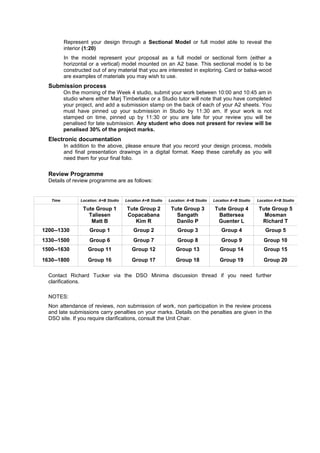
Details of review programme are as follows:
Time Location: A+B Studio Location A+B Studio Location: A+B Studio Location A+B Studio Location A+B Studio
Tute Group 1
Taliesen
Matt B
Tute Group 2
Copacabana
Kim R
Tute Group 3
Sangath
Danilo P
Tute Group 4
Battersea
Guenter L
Tute Group 5
Mosman
Richard T
1200--1330 Group 1 Group 2 Group 3 Group 4 Group 5
1330--1500 Group 6 Group 7 Group 8 Group 9 Group 10
1500--1630 Group 11 Group 12 Group 13 Group 14 Group 15
1630--1800 Group 16 Group 17 Group 18 Group 19 Group 20
Contact Richard Tucker via the DSO Minima discussion thread if you need further
clarifications.
NOTES:
Non attendance of reviews, non submission of work, non participation in the review process
and late submissions carry penalties on your marks. Details on the penalties are given in the
DSO site. If you require clarifications, consult the Unit Chair.

Minima breif

  • 1.
    2009 SRD 264 A+B:Deakin University School of Architecture and Building Architecture 2B SRD 264 – 2-Credit Point Unit Project 1: Minima (25%) The first major project is conceptually driven and requires work at a high level of representation and abstraction. It is worth 25% of the course marks (equivalent to ½ of one unit). In this project, apply the knowledge and learning from Year One to enhance your design synthesis. Task Minima: Design a self-contained, demountable, re-locatable living capsule for one person and of minimal dimensions. The living space must cater for a sleeping space, a study space, a cooking and eating space, a shower and a toilet. In this project, analyse how the dimensions of the human body relate ergonomically to constructed space, and how objects of everyday use structure, define and order design. Objectives:  Analyse how the dimensions of the human body relate to design and how the objects of everyday use structure, define and order design;  Develop skills in the shaping, containing and defining of minimal space;  Explore placing activities and motion in space, generation of space and its geometric aspects, and the relationships between body, object and space;  Explore anthropometric geometry as a generator of form; the relationship of human dimensions to the size, shape and proportion of a single minimal, living space;  Explore the role of furniture, enclosure and functional criteria in shaping space.  Explore the idea of minimizing resource consumption through the design of efficient living space.  Determine how to minimize the use of resources by minimizing the use of space for dwelling. Requirements The minima must accommodate one person. The living space must cater for a sleeping space, a study or work space, a cooking and eating space, a shower and a toilet.
  • 2.
    Tutorials Tutorial timetables willbe pinned up in Studio at the beginning of each Studio session. Times will be rotated so that each group has a different tutorial time each week.  Week 1, Analysis of Minima Analyse each of the functions within the minima using diagrams based on your individual dimensions. A site for locating the minima within the waterfront campus must be chosen by the group in consultation with the tutors in week one. Present your analysis of the site chosen, the programme and your approach to the design during the pinup tutorials on Friday.  Week 2, Abstraction of Minima Based on your analysis, develop an abstraction, idea or concept about how you are going to synthesise the program and site. Typically this process of ideation in architectural design relies on metaphor, symbolic connections or previous exemplars of similar problems. Explore your concept through sketches, drawings and discussions with your tutorial groups and in consultation with your tutor. At the end of this week, you must be able to articulate what your concept of Minima is. You must bring with you to your tutorial a „thumb-nail‟ (please view the I-Lecture on “Diagram”) that represents your idea for Minima. Without this thumbnail you will not be given a tutorial.  Week 3, Sectioning of Minima In this week, you will be introduced to the concept of sectioning as a tool for representing architectural ideas. Cutting and slicing through space allows you to see “inside” and “in-between” objects. You have done exercises in model dissection in the first year. Explore your concept of the Minima by creating massing models, dissections of the model and drawings that reveal the spatial qualities of your concept in horizontal section (plan) and vertical sections. By the Friday pin-up you must be able to visually present your concepts using dissections. You must bring with you to your tutorial last week‟s thumb-nail and a second thumb-nail that represents your idea for Minima as it stands now. In this week, you will discuss the presentation of your exploration of Minima with your tutors. The presentation requirements, submission process and review programme are outlined below. Presentation of Assignment 1 The presentation should include representation and communication of your Minima as sketches, drawings and a form model or maquette. The presentation should consist of 2 A2 sheets in portrait format and a mounted sectional collage or physical model. The drawings should be well-presented and thoughtfully composed. Each sheet must address the following:  Analysis The 1 st A2 sheet must demonstrate your understanding of the concept of Minima as outlined in the programme. It must clearly express your interpretation and study of minimal space through sketches and visual diagrams (a mix of physical and/or digital scale drawings like orthographic projections, plans, sections and elevations). You must submit a minimum of 1 plan and 2 sections on this drawing.  Concept and Process In the 2 nd A2 sheet, demonstrate your exploration and design process. In other words, how did you go from the brief to a solution? The lineage/evolution of ideas must be clearly shown in a visual narrative of your design process. Pay particular attention to the abstract concepts underlying your scheme such as circulation, ordering principles and spatial organization.  Synthesis (1:20)
  • 3.
    Represent your designthrough a Sectional Model or full model able to reveal the interior (1:20) In the model represent your proposal as a full model or sectional form (either a horizontal or a vertical) model mounted on an A2 base. This sectional model is to be constructed out of any material that you are interested in exploring. Card or balsa-wood are examples of materials you may wish to use. Submission process On the morning of the Week 4 studio, submit your work between 10:00 and 10:45 am in studio where either Marj Timberlake or a Studio tutor will note that you have completed your project, and add a submission stamp on the back of each of your A2 sheets. You must have pinned up your submission in Studio by 11:30 am. If your work is not stamped on time, pinned up by 11:30 or you are late for your review you will be penalised for late submission. Any student who does not present for review will be penalised 30% of the project marks. Electronic documentation In addition to the above, please ensure that you record your design process, models and final presentation drawings in a digital format. Keep these carefully as you will need them for your final folio. Review Programme Details of review programme are as follows: Time Location: A+B Studio Location A+B Studio Location: A+B Studio Location A+B Studio Location A+B Studio Tute Group 1 Taliesen Matt B Tute Group 2 Copacabana Kim R Tute Group 3 Sangath Danilo P Tute Group 4 Battersea Guenter L Tute Group 5 Mosman Richard T 1200--1330 Group 1 Group 2 Group 3 Group 4 Group 5 1330--1500 Group 6 Group 7 Group 8 Group 9 Group 10 1500--1630 Group 11 Group 12 Group 13 Group 14 Group 15 1630--1800 Group 16 Group 17 Group 18 Group 19 Group 20 Contact Richard Tucker via the DSO Minima discussion thread if you need further clarifications. NOTES: Non attendance of reviews, non submission of work, non participation in the review process and late submissions carry penalties on your marks. Details on the penalties are given in the DSO site. If you require clarifications, consult the Unit Chair.