Development of an advanced noise propagation
model for noise optimization in wind farm
Emre Barlas
Supervisors: Wen Z. Shen, Wei J. Zhu, Jens N. Sørensen
PhD Defense
DTU Wind Energy
Department of Wind Energy
Fluid Mechanics
26.01.2018
1
1. Introduction & Motivation
2. Atmospheric Acoustics & Modelling
3. Sound Propagation & Wind Turbine Wake
4. Wind Turbine Noise Generation & Propagation Model
5. Preliminary Wind Farm Study
6. Conclusions & Future Work
Content
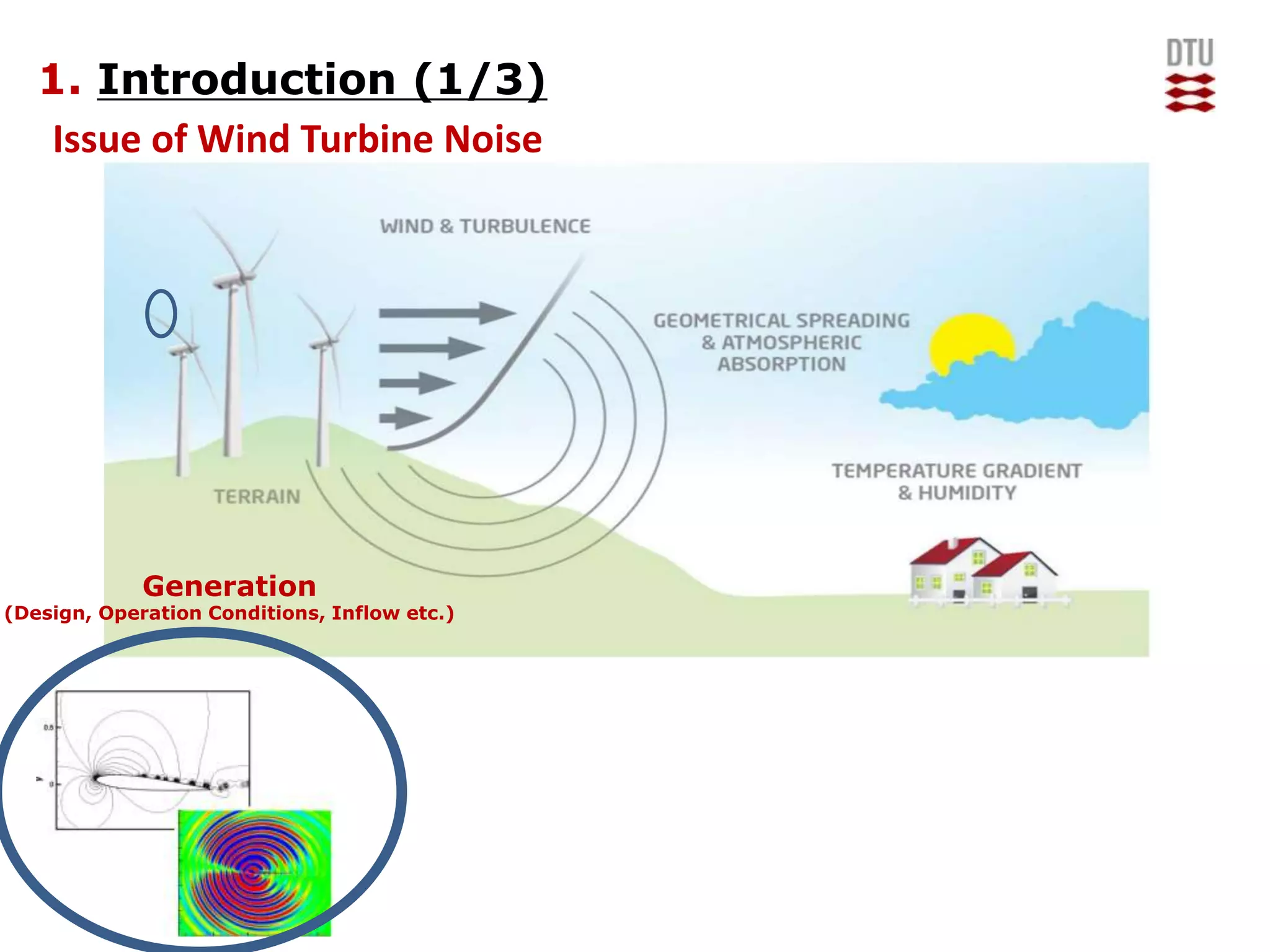
1. Introduction (1/3)
Issue of Wind Turbine Noise
1. Introduction (1/3)
Issue of Wind Turbine Noise
Generation
(Design, Operation Conditions, Inflow etc.)
1. Introduction (1/3)
Issue of Wind Turbine Noise
Propagation
(atmospheric conditions, terrain, ground characteristics etc. )
1. Introduction (1/3)
Issue of Wind Turbine Noise
Perception
(social background, age, landscape etc.
Motivation & Objectives
Motivation
Inaccurate wind farm noise assessment would result in:
Under-prediction:
causes downregulation of wind turbines under certain
atmospheric conditions.
Over-prediction:
causes turbines to be located at less resourceful sites.
1. Introduction (2/3)
Objectives are;
• to develop a high-fidelity sound propagation model (accuracy / comp. demand)
SECTION 2 & 3
• to develop a suitable source model that can handle the variability of wind
turbine noise generation. - SECTION 4
• to investigate the various effects (i.e. wind and temperature gradient, ground cover,
atmospheric and wake turbulence, turbine operation conditions) - SECTION 4
• to prepare a code to be applied for wind farm noise mapping and/or optimization. -
SECTION 5
Motivation & Objectives
1. Introduction (3/3)
1. Introduction & Motivation
2. Atmospheric Acoustics & Modelling
3. Sound Propagation & Wind Turbine Wake
4. Wind Turbine Noise Generation & Propagation Model
5. Preliminary Wind Farm Study
6. Conclusions & Future Work
Content
2. Atmospheric Acoustics & Modelling (1/6)
Engineering approach
– Ray model (very fast, limited accurate).
Accurate numerical approach: Time domain (expensive, propagation in all
directions)
– DNS, LES/CAA: compute source + propagation, based on solving Navier-
Stokes equations.
– FDTD: given source + propagation, based on solving Euler equations
Accurate numerical approach: Frequency domain (less expensive, one way
propagation)
– Parabolic equation (PE)
– Fast Field Program (FFP) (layered atmosphere and homogeneous
ground)
2. Atmospheric Acoustics & Modelling (2/6)
Engineering approach
– Ray model (very fast, the least accurate).
Accurate numerical approach: Time domain (expensive, propagation in all
directions)
– DNS, LES/CAA: compute source + propagation, based on solving Navier-
Stokes equations.
– FDTD: given source + propagation, based on solving Euler equations
Accurate numerical approach: Frequency domain (less expensive, one way
propagation)
– Parabolic equation (PE)
– Fast Field Program (FFP) (layered atmosphere and homogeneous
ground)
Propagation Model : Parabolic Equation Method
2. Atmospheric Acoustics & Modelling (3/6)
Propagation Model : Parabolic Equation Method
Solve the wave equation with;
General assumptions; Implies;
• Harmonic wave - Frequency Domain
• Axisymmetric - 2D
• Far field - Long range propagation
• One way propagation - Waves that are traveling from the source to the receiver (no backscattering
• Effective Speed of Sound (optional) - Moving atmosphere is replaced by a hypothetical motionless medium
with the effective sound speed.
2. Atmospheric Acoustics & Modelling (3/6)
Propagation Model : Parabolic Equation Method
Solve the wave equation with;
General assumptions; Implies;
• Harmonic wave - Frequency Domain
• Axisymmetric - 2D
• Far field - Long range propagation
• One way propagation - Waves that are traveling from the source to the receiver (no backscattering
• Effective Speed of Sound (optional) - Moving atmosphere is replaced by a hypothetical motionless medium
with the effective sound speed.
OR
2. Atmospheric Acoustics & Modelling (3/6)
2. Atmospheric Acoustics & Modelling (6/6)
With
turbulence
Without
turbulence
Transmission Loss for 800 Hz
Wind
direction
dB
1. Introduction & Motivation
2. Atmospheric Acoustics & Modelling
3. Sound Propagation & Wind Turbine Wake
4. Wind Turbine Noise Generation & Propagation Model
5. Preliminary Wind Farm Study
6. Conclusions & Future Work
Content
Receiver
3. Sound Propagation & Wake (1/6)
SOFAR Channel
in the ocean
(sound fixing and ranging channel)
Noise Behind a Barrier
in the atmosphere
SPL with Non Varying Wind
SPL with Varying Wind
3. Sound Propagation & Wake (2/6)
Turbine : NM 80 - Incoming Turbulence Int. : 3%
Snapshot of the flow field obtained from unsteady simulations
Time Averaged Wind Profile
3. Sound Propagation & Wake (3/6)
3. Sound Propagation & Wake
skipped
1. Introduction & Motivation
2. Atmospheric Acoustics & Modelling
3. Sound Propagation & Wind Turbine Wake
4. Wind Turbine Noise Generation & Propagation Model
5. Preliminary Wind Farm Study
6. Conclusions & Future Work
Content
4. Combined Model (1/19)
Generation
(Design, Operation Conditions,
Inflow etc.)
Propagation
(atmospheric conditions, terrain, ground
characteristics etc. )
COMBINED MODEL OVERVIEW
UNSTEADY FLOW MODEL
(Large Eddy Simulation)
Aeroelastics tool (FAST v8)
+
Semi Empirical Airfoil Noise (BPM)
Propagation
(Parabolic Equation)
1
2
3
4. Combined Model (3/19)
Source : Aeroelastics + Aeroacoustics
Turbulent Boundary Layer
Trailing Edge noise
Separation-Stall noise
Turbulent Inflow Noise
Store the highest SPL contributor airfoil location
along each blade
(freq, blade, receiver, time)
4. Combined Model (4/19)
Source : Aeroelastics + Aeroacoustics
Source Locations
For 2 frequencies
Run PE (freq,blade,receiver,time)
4. Combined Model (5/19)
4. Combined Model (6/19)
Source Only Simulations
OSPL @ 2 m receiver height 20-1000 Hz
Interpolated in between receivers
Variability is caused by
• Blade Movement
• Angle of attack and TI
change due to turbulent
atmosphere
Lacking propagation physics
• Atmosphere (refraction)
• Ground (reflection)
4. Combined Model (8/19)
Coupled Simulations
OSPL @ 2 m receiver height 20-1000 Hz
Interpolated in between receivers
Z0 – Roughness Value : 0.6 m
Neutrally stratified atmosphere
Grassland
4. Combined Model (9/19)
Amplitude Modulation
4. Combined Model (10/19)
Amplitude Modulation
Source Only Simulations
Wind Direction
High AM at crosswind
4. Combined Model (10/19)
TOP VIEW
Wind Direction
High AM at crosswind &
Downwind & Upwind
Amplitude Modulation
Coupled Simulations
4. Combined Model (11/19)
TOP VIEW
Amplitude Modulation
Coupled Simulations
Wind Direction
High AM at crosswind &
Downwind & Upwind
4. Combined Model (12/19)
TOP VIEW
LES Flow Field Output
• Horizontal slice at hub height
• Vertical Slice at the rotor
4. Combined Model (13/19)
Unsteady nature of
wake + unsteady
nature of the
source results in
‘’unexpected’’ far
field modulation
Flow @ Hub height With WakeOSPL @ 2m height With Wake
Flow @ Hub height Without WakeOSPL @ 2m height Without Wake
Amplitude Modulation - Coupled Simulations Wake Effect
4. Combined Model (15/19)
4. Combined Model (16/19)
Variability
Flow variability
During a day for the
same hub height
wind speed
4. Combined Model (17/19)
Variability - SNAPSHOT
FLOW SOUND PRESSURE LEVELS
4. Combined Model (18/19)
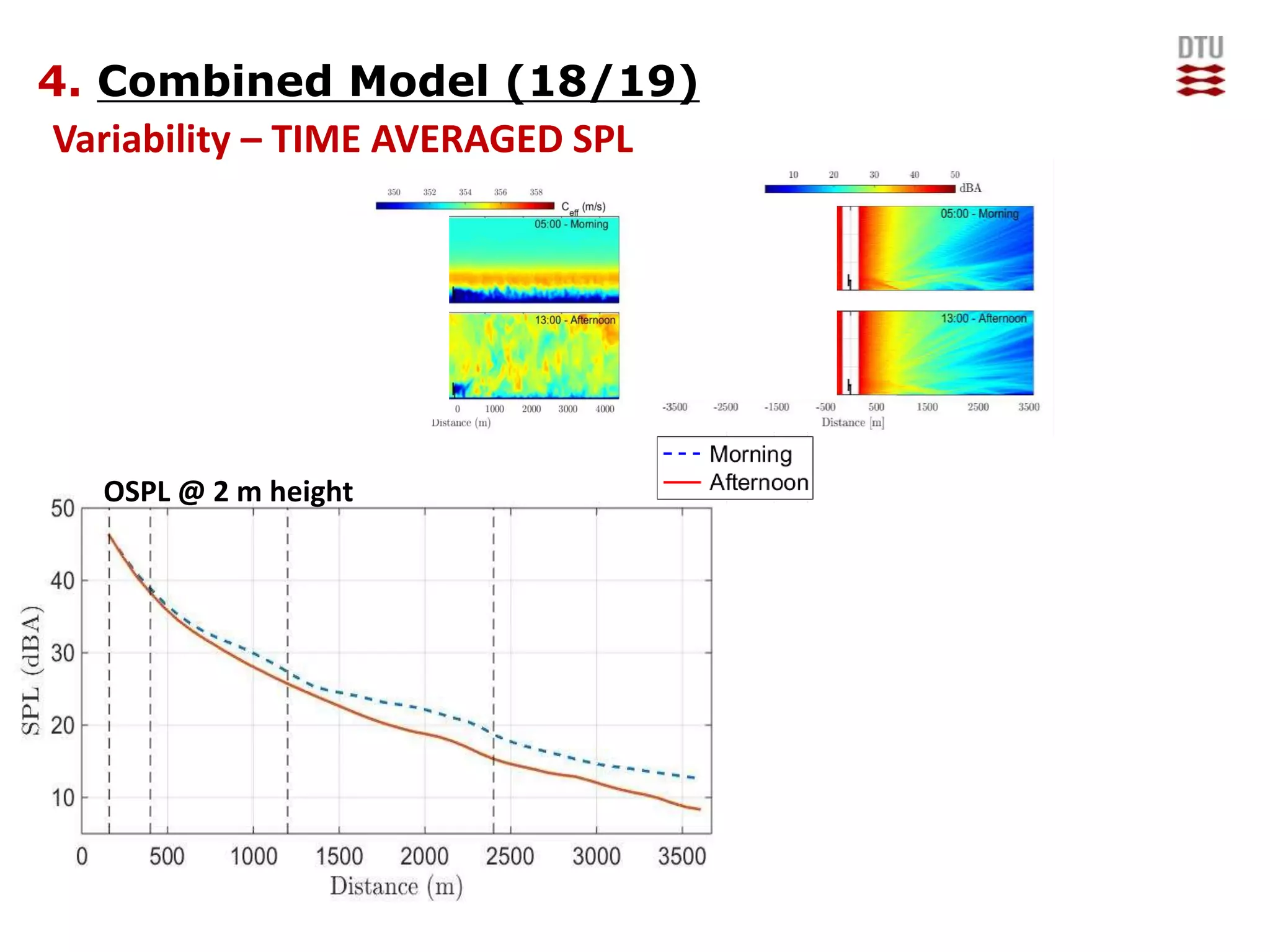
Variability – TIME AVERAGED SPL
OSPL @ 2 m height
4. Combined Model (18/19)
Variability – TIME AVERAGED SPL
OSPL @ 2 m height Spectra at different distances
4. Combined Model (19/19)
Variability - AMPLITUDE MODULATION
Ampl. Modul.
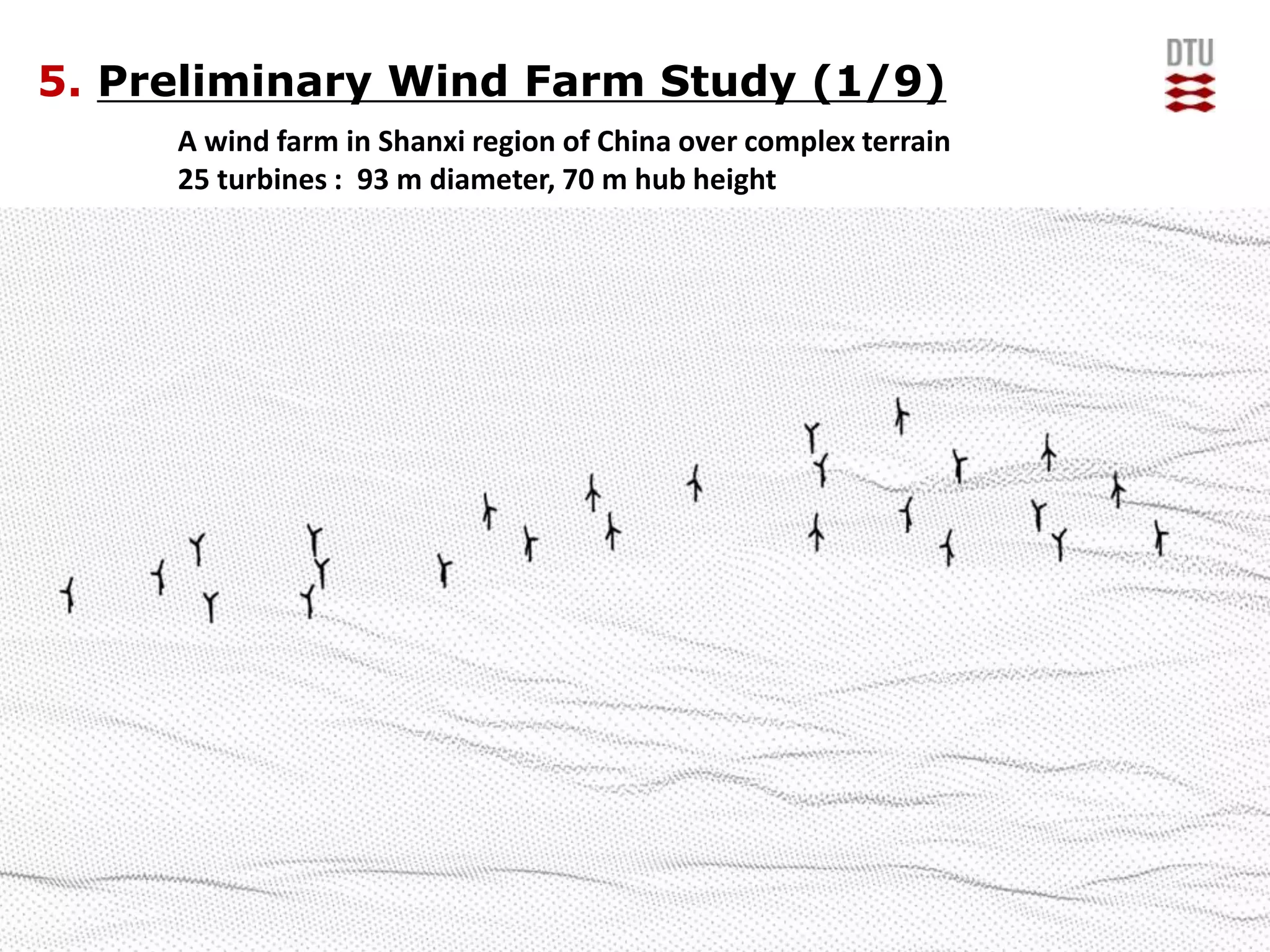
5. Preliminary Wind Farm Study (1/9)
A wind farm in Shanxi region of China over complex terrain
25 turbines : 93 m diameter, 70 m hub height
5. Preliminary Wind Farm Study (2/9)
RANS Flow Field - EllipSys3D
Stream-wise velocity
different 2d slices
Wind Direction
Wind Direction
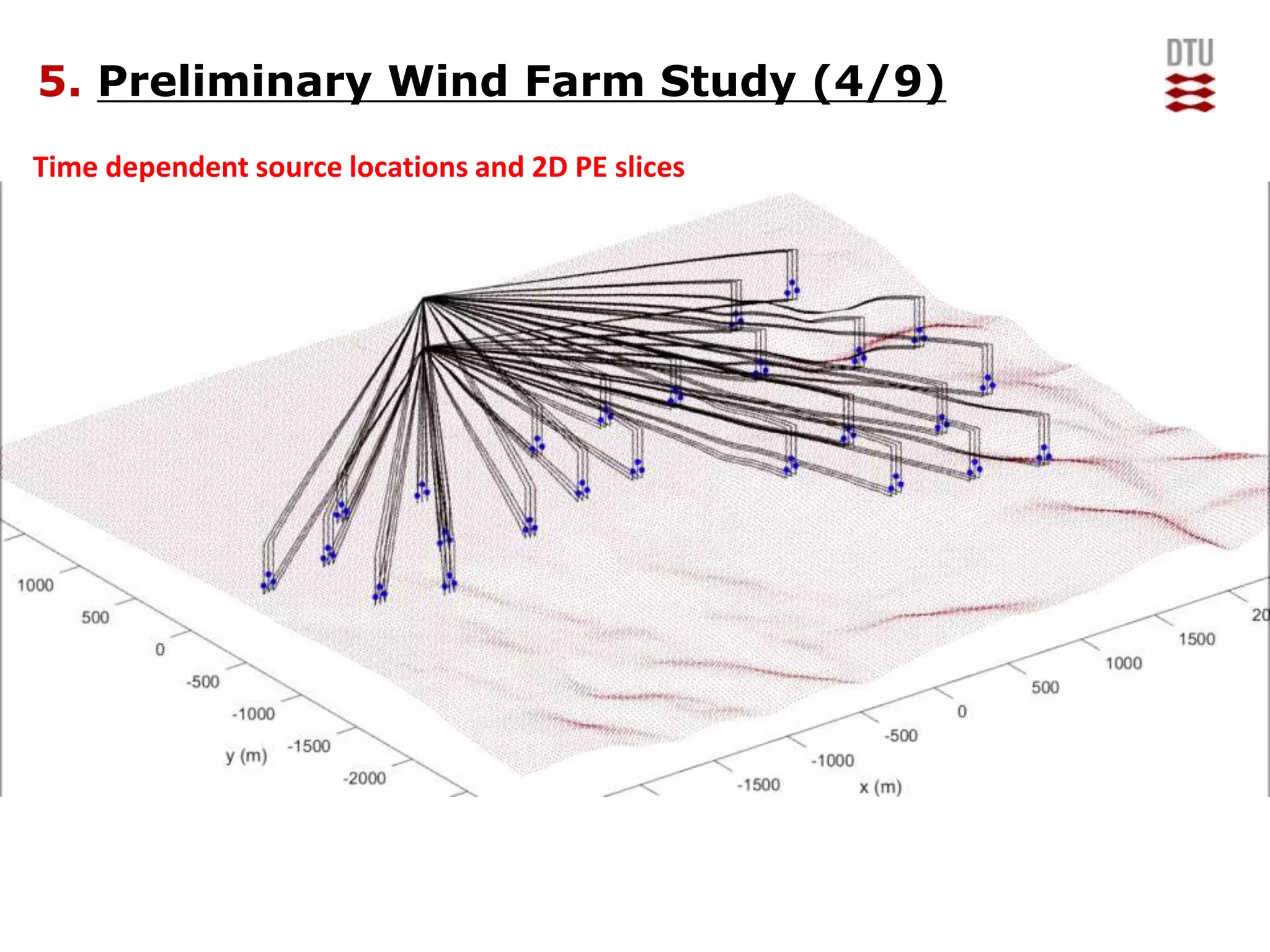
5. Preliminary Wind Farm Study (4/9)
Time dependent source locations and 2D PE slices
5. Preliminary Wind Farm Study (4/9)
Time dependent source locations and 2D PE slices
5. Preliminary Wind Farm Study (5/9)
Receiver distribution around the wind farm
5. Preliminary Wind Farm Study (6/9)
OSPL around the wind farm
5. Preliminary Wind Farm Study (7/9)
Parameter study with 4 cases.
CASE NUMBER TERRAIN WIND
1 FLAT NO WIND
(homogenous atmosphere)
2 FLAT LOG WIND
3 COMPLEX LOG WIND
4 COMPLEX RANS WIND
5. Preliminary Wind Farm Study (8/9)
5. Preliminary Wind Farm Study (9/9)
Difference between flat
and complex terrain
Difference between log wind
and RANS flow (both complex terrain)
6. Conclusions and Future Work
Objectives were;
• to develop a high-fidelity sound propagation model (accuracy / comp. demand)
• to develop a suitable source model that can handle the variability of wind
turbine noise generation.
• to investigate the various effects (i.e. wind and temperature gradient, ground cover, atmospheric
and wake turbulence, turbine operation conditions)
• to prepare a code to be applied for wind farm noise mapping and/or optimization.
53
6. Conclusions and Future Work
Objectives were;
• to develop a high-fidelity sound propagation model (accuracy / comp. demand)
Fortran/MPI implementation for Parabolic Wave Equation (vector or scalar PE).
• to develop a suitable source model that can handle the variability of wind
turbine noise generation.
• to investigate the various effects (i.e. wind and temperature gradient, ground cover, atmospheric
and wake turbulence, turbine operation conditions)
• to prepare a code to be applied for wind farm noise mapping and/or optimization.
54
6. Conclusions and Future Work
Objectives were;
• to develop a high-fidelity sound propagation model (accuracy / comp. demand)
Fortran/MPI implementation for Parabolic Wave Equation (vector or scalar PE).
• to develop a suitable source model that can handle the variability of wind
turbine noise generation.
Point sources represented within PE model, in which the source power levels are obtained from airfoil
aeroacoustics combined with aeroelastic simulations and high fidelity solvers LES.
• to investigate the various effects (i.e. wind and temperature gradient, ground cover, atmospheric
and wake turbulence, turbine operation conditions)
• to prepare a code to be applied for wind farm noise mapping and/or optimization.
55
6. Conclusions and Future Work
Objectives were;
• to develop a high-fidelity sound propagation model (accuracy / comp. demand)
Fortran/MPI implementation for Parabolic Wave Equation (vector or scalar PE).
• to develop a suitable source model that can handle the variability of wind
turbine noise generation.
Point sources represented within PE model, in which the source power levels are obtained from airfoil
aeroacoustics combined with aeroelastic simulations and high fidelity solvers LES.
• to investigate the various effects (i.e. wind and temperature gradient, ground cover, atmospheric
and wake turbulence, turbine operation conditions)
Day & Night / Ground & Terrain effects (next slide).
• to prepare a code to be applied for wind farm noise mapping and/or optimization.
56
6. Conclusions and Future Work
Objectives were;
• to develop a high-fidelity sound propagation model (accuracy / comp. demand)
Fortran/MPI implementation for Parabolic Wave Equation (vector or scalar PE).
• to develop a suitable source model that can handle the variability of wind
turbine noise generation.
Point sources represented within PE model, in which the source power levels are obtained from airfoil
aeroacoustics combined with aeroelastic simulations and high fidelity solvers LES.
• to investigate the various effects (i.e. wind and temperature gradient, ground cover, atmospheric
and wake turbulence, turbine operation conditions)
Day & Night / Ground & Terrain effects (next slide).
• to prepare a code to be applied for wind farm noise mapping and/or optimization.
Wind Farm Study 57
6. Conclusions and Future Work
• Time Averaged SPL can be captured within reasonable accuracy via
moving 2D source + mean flow
• Near field daytime levels are higher than night time levels due to enhanced
turbulence under convective conditions.
• The atmospheric conditions affect propagation significantly and in the far
field levels at night time are higher than daytime. (contrary to near field)
• Wake is an important factor for downwind propagation.
Wake deficit entrapment
• Unsteady Wake + Unsteady Sources lead to enhanced far field AM.
58
6. Conclusions and Future Work
Future Work
• Unsteady Wind Farm Noise
• Wind Farm Control
• Further validation
59
Wind Turbine/Farm Noise : Propagation Modelling

Wind Turbine/Farm Noise : Propagation Modelling

  • 1.
    Development of anadvanced noise propagation model for noise optimization in wind farm Emre Barlas Supervisors: Wen Z. Shen, Wei J. Zhu, Jens N. Sørensen PhD Defense DTU Wind Energy Department of Wind Energy Fluid Mechanics 26.01.2018 1
  • 2.
    1. Introduction &Motivation 2. Atmospheric Acoustics & Modelling 3. Sound Propagation & Wind Turbine Wake 4. Wind Turbine Noise Generation & Propagation Model 5. Preliminary Wind Farm Study 6. Conclusions & Future Work Content
  • 3.
    1. Introduction (1/3) Issueof Wind Turbine Noise
  • 4.
    1. Introduction (1/3) Issueof Wind Turbine Noise Generation (Design, Operation Conditions, Inflow etc.)
  • 5.
    1. Introduction (1/3) Issueof Wind Turbine Noise Propagation (atmospheric conditions, terrain, ground characteristics etc. )
  • 6.
    1. Introduction (1/3) Issueof Wind Turbine Noise Perception (social background, age, landscape etc.
  • 7.
    Motivation & Objectives Motivation Inaccuratewind farm noise assessment would result in: Under-prediction: causes downregulation of wind turbines under certain atmospheric conditions. Over-prediction: causes turbines to be located at less resourceful sites. 1. Introduction (2/3)
  • 8.
    Objectives are; • todevelop a high-fidelity sound propagation model (accuracy / comp. demand) SECTION 2 & 3 • to develop a suitable source model that can handle the variability of wind turbine noise generation. - SECTION 4 • to investigate the various effects (i.e. wind and temperature gradient, ground cover, atmospheric and wake turbulence, turbine operation conditions) - SECTION 4 • to prepare a code to be applied for wind farm noise mapping and/or optimization. - SECTION 5 Motivation & Objectives 1. Introduction (3/3)
  • 9.
    1. Introduction &Motivation 2. Atmospheric Acoustics & Modelling 3. Sound Propagation & Wind Turbine Wake 4. Wind Turbine Noise Generation & Propagation Model 5. Preliminary Wind Farm Study 6. Conclusions & Future Work Content
  • 10.
    2. Atmospheric Acoustics& Modelling (1/6)
  • 11.
    Engineering approach – Raymodel (very fast, limited accurate). Accurate numerical approach: Time domain (expensive, propagation in all directions) – DNS, LES/CAA: compute source + propagation, based on solving Navier- Stokes equations. – FDTD: given source + propagation, based on solving Euler equations Accurate numerical approach: Frequency domain (less expensive, one way propagation) – Parabolic equation (PE) – Fast Field Program (FFP) (layered atmosphere and homogeneous ground) 2. Atmospheric Acoustics & Modelling (2/6)
  • 12.
    2. Atmospheric Acoustics& Modelling (2/6) Engineering approach – Ray model (very fast, the least accurate). Accurate numerical approach: Time domain (expensive, propagation in all directions) – DNS, LES/CAA: compute source + propagation, based on solving Navier- Stokes equations. – FDTD: given source + propagation, based on solving Euler equations Accurate numerical approach: Frequency domain (less expensive, one way propagation) – Parabolic equation (PE) – Fast Field Program (FFP) (layered atmosphere and homogeneous ground)
  • 13.
    Propagation Model :Parabolic Equation Method 2. Atmospheric Acoustics & Modelling (3/6)
  • 14.
    Propagation Model :Parabolic Equation Method Solve the wave equation with; General assumptions; Implies; • Harmonic wave - Frequency Domain • Axisymmetric - 2D • Far field - Long range propagation • One way propagation - Waves that are traveling from the source to the receiver (no backscattering • Effective Speed of Sound (optional) - Moving atmosphere is replaced by a hypothetical motionless medium with the effective sound speed. 2. Atmospheric Acoustics & Modelling (3/6)
  • 15.
    Propagation Model :Parabolic Equation Method Solve the wave equation with; General assumptions; Implies; • Harmonic wave - Frequency Domain • Axisymmetric - 2D • Far field - Long range propagation • One way propagation - Waves that are traveling from the source to the receiver (no backscattering • Effective Speed of Sound (optional) - Moving atmosphere is replaced by a hypothetical motionless medium with the effective sound speed. OR 2. Atmospheric Acoustics & Modelling (3/6)
  • 16.
    2. Atmospheric Acoustics& Modelling (6/6) With turbulence Without turbulence Transmission Loss for 800 Hz Wind direction dB
  • 17.
    1. Introduction &Motivation 2. Atmospheric Acoustics & Modelling 3. Sound Propagation & Wind Turbine Wake 4. Wind Turbine Noise Generation & Propagation Model 5. Preliminary Wind Farm Study 6. Conclusions & Future Work Content
  • 18.
    Receiver 3. Sound Propagation& Wake (1/6) SOFAR Channel in the ocean (sound fixing and ranging channel) Noise Behind a Barrier in the atmosphere SPL with Non Varying Wind SPL with Varying Wind
  • 19.
    3. Sound Propagation& Wake (2/6) Turbine : NM 80 - Incoming Turbulence Int. : 3% Snapshot of the flow field obtained from unsteady simulations Time Averaged Wind Profile
  • 20.
  • 21.
    3. Sound Propagation& Wake skipped
  • 22.
    1. Introduction &Motivation 2. Atmospheric Acoustics & Modelling 3. Sound Propagation & Wind Turbine Wake 4. Wind Turbine Noise Generation & Propagation Model 5. Preliminary Wind Farm Study 6. Conclusions & Future Work Content
  • 23.
    4. Combined Model(1/19) Generation (Design, Operation Conditions, Inflow etc.) Propagation (atmospheric conditions, terrain, ground characteristics etc. )
  • 24.
    COMBINED MODEL OVERVIEW UNSTEADYFLOW MODEL (Large Eddy Simulation) Aeroelastics tool (FAST v8) + Semi Empirical Airfoil Noise (BPM) Propagation (Parabolic Equation) 1 2 3
  • 26.
    4. Combined Model(3/19) Source : Aeroelastics + Aeroacoustics Turbulent Boundary Layer Trailing Edge noise Separation-Stall noise Turbulent Inflow Noise
  • 27.
    Store the highestSPL contributor airfoil location along each blade (freq, blade, receiver, time) 4. Combined Model (4/19) Source : Aeroelastics + Aeroacoustics Source Locations For 2 frequencies
  • 28.
  • 29.
  • 30.
    Source Only Simulations OSPL@ 2 m receiver height 20-1000 Hz Interpolated in between receivers Variability is caused by • Blade Movement • Angle of attack and TI change due to turbulent atmosphere Lacking propagation physics • Atmosphere (refraction) • Ground (reflection) 4. Combined Model (8/19)
  • 31.
    Coupled Simulations OSPL @2 m receiver height 20-1000 Hz Interpolated in between receivers Z0 – Roughness Value : 0.6 m Neutrally stratified atmosphere Grassland 4. Combined Model (9/19)
  • 32.
  • 33.
    Amplitude Modulation Source OnlySimulations Wind Direction High AM at crosswind 4. Combined Model (10/19) TOP VIEW
  • 34.
    Wind Direction High AMat crosswind & Downwind & Upwind Amplitude Modulation Coupled Simulations 4. Combined Model (11/19) TOP VIEW
  • 35.
    Amplitude Modulation Coupled Simulations WindDirection High AM at crosswind & Downwind & Upwind 4. Combined Model (12/19) TOP VIEW
  • 36.
    LES Flow FieldOutput • Horizontal slice at hub height • Vertical Slice at the rotor 4. Combined Model (13/19)
  • 37.
    Unsteady nature of wake+ unsteady nature of the source results in ‘’unexpected’’ far field modulation Flow @ Hub height With WakeOSPL @ 2m height With Wake Flow @ Hub height Without WakeOSPL @ 2m height Without Wake
  • 38.
    Amplitude Modulation -Coupled Simulations Wake Effect 4. Combined Model (15/19)
  • 39.
    4. Combined Model(16/19) Variability Flow variability During a day for the same hub height wind speed
  • 40.
    4. Combined Model(17/19) Variability - SNAPSHOT FLOW SOUND PRESSURE LEVELS
  • 41.
    4. Combined Model(18/19) Variability – TIME AVERAGED SPL OSPL @ 2 m height
  • 42.
    4. Combined Model(18/19) Variability – TIME AVERAGED SPL OSPL @ 2 m height Spectra at different distances
  • 43.
    4. Combined Model(19/19) Variability - AMPLITUDE MODULATION Ampl. Modul.
  • 44.
    5. Preliminary WindFarm Study (1/9) A wind farm in Shanxi region of China over complex terrain 25 turbines : 93 m diameter, 70 m hub height
  • 45.
    5. Preliminary WindFarm Study (2/9) RANS Flow Field - EllipSys3D Stream-wise velocity different 2d slices Wind Direction Wind Direction
  • 46.
    5. Preliminary WindFarm Study (4/9) Time dependent source locations and 2D PE slices
  • 47.
    5. Preliminary WindFarm Study (4/9) Time dependent source locations and 2D PE slices
  • 48.
    5. Preliminary WindFarm Study (5/9) Receiver distribution around the wind farm
  • 49.
    5. Preliminary WindFarm Study (6/9) OSPL around the wind farm
  • 50.
    5. Preliminary WindFarm Study (7/9) Parameter study with 4 cases. CASE NUMBER TERRAIN WIND 1 FLAT NO WIND (homogenous atmosphere) 2 FLAT LOG WIND 3 COMPLEX LOG WIND 4 COMPLEX RANS WIND
  • 51.
    5. Preliminary WindFarm Study (8/9)
  • 52.
    5. Preliminary WindFarm Study (9/9) Difference between flat and complex terrain Difference between log wind and RANS flow (both complex terrain)
  • 53.
    6. Conclusions andFuture Work Objectives were; • to develop a high-fidelity sound propagation model (accuracy / comp. demand) • to develop a suitable source model that can handle the variability of wind turbine noise generation. • to investigate the various effects (i.e. wind and temperature gradient, ground cover, atmospheric and wake turbulence, turbine operation conditions) • to prepare a code to be applied for wind farm noise mapping and/or optimization. 53
  • 54.
    6. Conclusions andFuture Work Objectives were; • to develop a high-fidelity sound propagation model (accuracy / comp. demand) Fortran/MPI implementation for Parabolic Wave Equation (vector or scalar PE). • to develop a suitable source model that can handle the variability of wind turbine noise generation. • to investigate the various effects (i.e. wind and temperature gradient, ground cover, atmospheric and wake turbulence, turbine operation conditions) • to prepare a code to be applied for wind farm noise mapping and/or optimization. 54
  • 55.
    6. Conclusions andFuture Work Objectives were; • to develop a high-fidelity sound propagation model (accuracy / comp. demand) Fortran/MPI implementation for Parabolic Wave Equation (vector or scalar PE). • to develop a suitable source model that can handle the variability of wind turbine noise generation. Point sources represented within PE model, in which the source power levels are obtained from airfoil aeroacoustics combined with aeroelastic simulations and high fidelity solvers LES. • to investigate the various effects (i.e. wind and temperature gradient, ground cover, atmospheric and wake turbulence, turbine operation conditions) • to prepare a code to be applied for wind farm noise mapping and/or optimization. 55
  • 56.
    6. Conclusions andFuture Work Objectives were; • to develop a high-fidelity sound propagation model (accuracy / comp. demand) Fortran/MPI implementation for Parabolic Wave Equation (vector or scalar PE). • to develop a suitable source model that can handle the variability of wind turbine noise generation. Point sources represented within PE model, in which the source power levels are obtained from airfoil aeroacoustics combined with aeroelastic simulations and high fidelity solvers LES. • to investigate the various effects (i.e. wind and temperature gradient, ground cover, atmospheric and wake turbulence, turbine operation conditions) Day & Night / Ground & Terrain effects (next slide). • to prepare a code to be applied for wind farm noise mapping and/or optimization. 56
  • 57.
    6. Conclusions andFuture Work Objectives were; • to develop a high-fidelity sound propagation model (accuracy / comp. demand) Fortran/MPI implementation for Parabolic Wave Equation (vector or scalar PE). • to develop a suitable source model that can handle the variability of wind turbine noise generation. Point sources represented within PE model, in which the source power levels are obtained from airfoil aeroacoustics combined with aeroelastic simulations and high fidelity solvers LES. • to investigate the various effects (i.e. wind and temperature gradient, ground cover, atmospheric and wake turbulence, turbine operation conditions) Day & Night / Ground & Terrain effects (next slide). • to prepare a code to be applied for wind farm noise mapping and/or optimization. Wind Farm Study 57
  • 58.
    6. Conclusions andFuture Work • Time Averaged SPL can be captured within reasonable accuracy via moving 2D source + mean flow • Near field daytime levels are higher than night time levels due to enhanced turbulence under convective conditions. • The atmospheric conditions affect propagation significantly and in the far field levels at night time are higher than daytime. (contrary to near field) • Wake is an important factor for downwind propagation. Wake deficit entrapment • Unsteady Wake + Unsteady Sources lead to enhanced far field AM. 58
  • 59.
    6. Conclusions andFuture Work Future Work • Unsteady Wind Farm Noise • Wind Farm Control • Further validation 59

Editor's Notes