European Institutions…
Are they clients for my company ?
A practical approach
Benoît Conti (Euro TASC Consulting)
Objectives of this session
• Reasons to work with EU Institutions
• EU contracts & procedures
• What’s in it for my Cy
• Definition of the right EU Institution
supplying Cy profile
• Define your clues to select contracts to go
for
• How to win a contract?
2
Why not working with EU Institutions ?
You have definitely established that:
• A project should always be presented live to a
potential client
• The best way to win a contract is to systematically
break the client’s briefing
• The only good business is fast business
• Good business is always settled at the end of a good
meal with a prospect
• The budget prices listed in the offer will be
renegotiated when the contract will be signed
• The hell with written documents!!
3
Why working with EU Institutions ?
1. Public money (financial stability)
2. Long term relationship
3. Contractual prices
4. Excellent references
5. Broad market (28 EU MS + …)
6. Partnership oriented
4
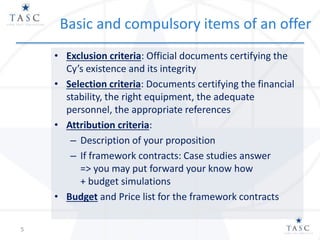
Basic and compulsory items of an offer
• Exclusion criteria: Official documents certifying the
Cy’s existence and its integrity
• Selection criteria: Documents certifying the financial
stability, the right equipment, the adequate
personnel, the appropriate references
• Attribution criteria:
– Description of your proposition
– If framework contracts: Case studies answer
=> you may put forward your know how
+ budget simulations
• Budget and Price list for the framework contracts
5
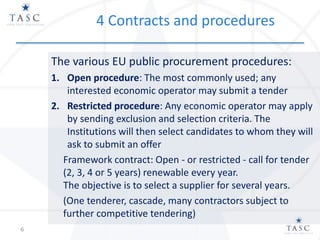
4 Contracts and procedures
The various EU public procurement procedures:
1. Open procedure: The most commonly used; any
interested economic operator may submit a tender
2. Restricted procedure: Any economic operator may apply
by sending exclusion and selection criteria. The
Institutions will then select candidates to whom they will
ask to submit an offer
Framework contract: Open - or restricted - call for tender
(2, 3, 4 or 5 years) renewable every year.
The objective is to select a supplier for several years.
(One tenderer, cascade, many contractors subject to
further competitive tendering)
6
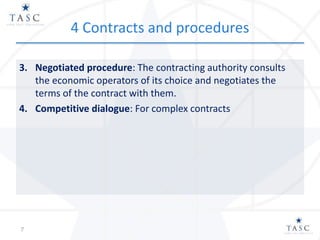
4 Contracts and procedures
3. Negotiated procedure: The contracting authority consults
the economic operators of its choice and negotiates the
terms of the contract with them.
4. Competitive dialogue: For complex contracts
7
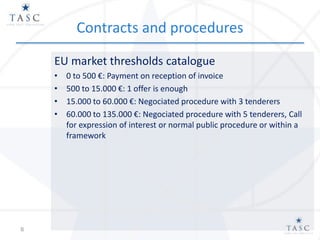
Contracts and procedures
EU market thresholds catalogue
• 0 to 500 €: Payment on reception of invoice
• 500 to 15.000 €: 1 offer is enough
• 15.000 to 60.000 €: Negociated procedure with 3 tenderers
• 60.000 to 135.000 €: Negociated procedure with 5 tenderers, Call
for expression of interest or normal public procedure or within a
framework
8
Contracts and procedures
Beginning here, compulsory to publish on the TED:
• 133.000 € for public supply and service contracts awarded by central
government authorities (ministries, national public establishments)
• 211.000 € for public supply and service contracts: awarded by
contracting authorities which are not central government authorities
• 412.000 € for "special sectors" of water, energy, transport and postal
services
• 5.150.000 € in the case of works contracts: awarded by contracting
authorities which are either central government authorities
(ministries, national public establishments) or not central
government authorities
Under these thresholds, no obligation to publish on the TED (tenders
Electronic Daily)
9
What do EU Institutions expect from their
suppliers ?
About your company profile:
• TO: No minimal turnover but a kind of ratio
• Cy’s years of existence: 2 to 3
• Number and type of staff members: No specific compliances unless
specifically mentioned
• CY’s entitled to tender: Officially all of them... BUT...
be specialised, local and partnership minded
• References expected: Institutional first and private also if appropriate
experiences + clients letters
• Cy’s rigorously managed, quality focused (ISO) and in possession of a
well-established methodology
10
What do EU Institutions expect from their
suppliers ?
About your company culture and internal
organisation:
• Don’t replace the people in charge of the jobs from what has been
announced in the offer.
EU Institutions trust the experts’ advices (more attached to the people than
to the Cy’s)
• Don’t be « business minded » but rather « advice minded »
• Good knowledge of the EU politics in your field
• Multilingual: staff members must at least speak 1: English,
2: French, 3: German,...
• Be always reachable, very flexible and reactive
• Connection with same profile Cy’s throughout whole Europe and other
countries
11
Clues to select contract to bid for
Questions to investigate to build your go/no go
SWOT
• Does the Company have the right profile?
• Is it in my field of expertise? Do I know the
subject + do I have appropriate references
in that field
• Do I cover all the requested expertises and,
if not, how can I solve this => partnership
(with who and how?)
• Do I have the right people and, if not, can I
find them and is it worthwhile to hire
them?
12
Clues to select contract to bid for
• Is the management involved in this pitch?
• Do I have enough time to assemble the whole bid
and can I get organised to reach that target?
• Who can be my competitors + is the contracting
authority willing to change contractor (in case of
a contract’s renewal)?
• Do I have the tools to build competitive prices?
13
Steps of a bid construction
1. Daily attentive reading of the new tenders
electronic daily and quick reaction (within 2 to 3
days) => 52 days between contract notice and
tender submission
2. Make advantage of the prior information (*) to:
1. establish your assets
2. find the right ways to get round your weaknesses
3. create agreement with your future partners
(*): when prior info, delay between contract notice
and tender submission may be shortened to 36
days
14
Steps of a bid construction
3. Downloading the call for tender documents from EU site
and careful reading (read what is exactly written, no
more, no less)
4. Ask your company the questions to investigate
5. Ask your questions to the contracting authority but…
6. Set up your working team and contact with the external
needed experts
7. You have assembled the elements to make a firm
decision of Go/No Go
8. Formal agreement with strategic partners (companies
and experts)
9. Writing of the bid structure (what do we have to put in it
and what do we wish to put in it)
10. Draw up the planning of work (and get it approved by
the people involved)
15
Steps of a bid construction
11. Bid’s writing, prices’ search and/or calculation and the
assembling begins
12. Make sure all official documents (exclusion and selection
criteria) will be in on time (beware official institutions timings
and situations you thought were ok)
13. Several days, meetings and sweat buckets later… (about 1
week before submitting the bid):
Reading of the whole documents and pinpoint all the errors
and weaknesses (missing documents, samples, …) and …
repair!
14. Lay out of the bid’s template and inserting of all documents in
the lay out
15. Printing of the original version and the required number of
copies (Numbering of all pages)
16
Steps of a bid construction
16. Wrap it up as requested in the tender and post it
17. SLEEP!
18. Participate to the tenders opening (about 10 days after
tender deposit)
19. Evaluation by an “evaluation committee” of a minimum
of 3 persons ?
20. Awarding letter sent by the authority to all tenderers
(no obligation to select a winner) after 2 to 4 months
21. Period of 2 weeks to send a complain
22. Signature of the contract
17
Conclusion
• Assemble your assets
• Build your SWOT
• Adjust your weaknesses
And be prepared to lose twice before you win
your first EU contract
18
Thank you for your attention
Euro TASC Consulting sprl/bvba
Email: benoit.conti@eurotasc.com
Website: www.eurotasc.com
Mobile: +32 (0)496/127.327
19

Why working with eu institutions

  • 1.
    European Institutions… Are theyclients for my company ? A practical approach Benoît Conti (Euro TASC Consulting)
  • 2.
    Objectives of thissession • Reasons to work with EU Institutions • EU contracts & procedures • What’s in it for my Cy • Definition of the right EU Institution supplying Cy profile • Define your clues to select contracts to go for • How to win a contract? 2
  • 3.
    Why not workingwith EU Institutions ? You have definitely established that: • A project should always be presented live to a potential client • The best way to win a contract is to systematically break the client’s briefing • The only good business is fast business • Good business is always settled at the end of a good meal with a prospect • The budget prices listed in the offer will be renegotiated when the contract will be signed • The hell with written documents!! 3
  • 4.
    Why working withEU Institutions ? 1. Public money (financial stability) 2. Long term relationship 3. Contractual prices 4. Excellent references 5. Broad market (28 EU MS + …) 6. Partnership oriented 4
  • 5.
    Basic and compulsoryitems of an offer • Exclusion criteria: Official documents certifying the Cy’s existence and its integrity • Selection criteria: Documents certifying the financial stability, the right equipment, the adequate personnel, the appropriate references • Attribution criteria: – Description of your proposition – If framework contracts: Case studies answer => you may put forward your know how + budget simulations • Budget and Price list for the framework contracts 5
  • 6.
    4 Contracts andprocedures The various EU public procurement procedures: 1. Open procedure: The most commonly used; any interested economic operator may submit a tender 2. Restricted procedure: Any economic operator may apply by sending exclusion and selection criteria. The Institutions will then select candidates to whom they will ask to submit an offer Framework contract: Open - or restricted - call for tender (2, 3, 4 or 5 years) renewable every year. The objective is to select a supplier for several years. (One tenderer, cascade, many contractors subject to further competitive tendering) 6
  • 7.
    4 Contracts andprocedures 3. Negotiated procedure: The contracting authority consults the economic operators of its choice and negotiates the terms of the contract with them. 4. Competitive dialogue: For complex contracts 7
  • 8.
    Contracts and procedures EUmarket thresholds catalogue • 0 to 500 €: Payment on reception of invoice • 500 to 15.000 €: 1 offer is enough • 15.000 to 60.000 €: Negociated procedure with 3 tenderers • 60.000 to 135.000 €: Negociated procedure with 5 tenderers, Call for expression of interest or normal public procedure or within a framework 8
  • 9.
    Contracts and procedures Beginninghere, compulsory to publish on the TED: • 133.000 € for public supply and service contracts awarded by central government authorities (ministries, national public establishments) • 211.000 € for public supply and service contracts: awarded by contracting authorities which are not central government authorities • 412.000 € for "special sectors" of water, energy, transport and postal services • 5.150.000 € in the case of works contracts: awarded by contracting authorities which are either central government authorities (ministries, national public establishments) or not central government authorities Under these thresholds, no obligation to publish on the TED (tenders Electronic Daily) 9
  • 10.
    What do EUInstitutions expect from their suppliers ? About your company profile: • TO: No minimal turnover but a kind of ratio • Cy’s years of existence: 2 to 3 • Number and type of staff members: No specific compliances unless specifically mentioned • CY’s entitled to tender: Officially all of them... BUT... be specialised, local and partnership minded • References expected: Institutional first and private also if appropriate experiences + clients letters • Cy’s rigorously managed, quality focused (ISO) and in possession of a well-established methodology 10
  • 11.
    What do EUInstitutions expect from their suppliers ? About your company culture and internal organisation: • Don’t replace the people in charge of the jobs from what has been announced in the offer. EU Institutions trust the experts’ advices (more attached to the people than to the Cy’s) • Don’t be « business minded » but rather « advice minded » • Good knowledge of the EU politics in your field • Multilingual: staff members must at least speak 1: English, 2: French, 3: German,... • Be always reachable, very flexible and reactive • Connection with same profile Cy’s throughout whole Europe and other countries 11
  • 12.
    Clues to selectcontract to bid for Questions to investigate to build your go/no go SWOT • Does the Company have the right profile? • Is it in my field of expertise? Do I know the subject + do I have appropriate references in that field • Do I cover all the requested expertises and, if not, how can I solve this => partnership (with who and how?) • Do I have the right people and, if not, can I find them and is it worthwhile to hire them? 12
  • 13.
    Clues to selectcontract to bid for • Is the management involved in this pitch? • Do I have enough time to assemble the whole bid and can I get organised to reach that target? • Who can be my competitors + is the contracting authority willing to change contractor (in case of a contract’s renewal)? • Do I have the tools to build competitive prices? 13
  • 14.
    Steps of abid construction 1. Daily attentive reading of the new tenders electronic daily and quick reaction (within 2 to 3 days) => 52 days between contract notice and tender submission 2. Make advantage of the prior information (*) to: 1. establish your assets 2. find the right ways to get round your weaknesses 3. create agreement with your future partners (*): when prior info, delay between contract notice and tender submission may be shortened to 36 days 14
  • 15.
    Steps of abid construction 3. Downloading the call for tender documents from EU site and careful reading (read what is exactly written, no more, no less) 4. Ask your company the questions to investigate 5. Ask your questions to the contracting authority but… 6. Set up your working team and contact with the external needed experts 7. You have assembled the elements to make a firm decision of Go/No Go 8. Formal agreement with strategic partners (companies and experts) 9. Writing of the bid structure (what do we have to put in it and what do we wish to put in it) 10. Draw up the planning of work (and get it approved by the people involved) 15
  • 16.
    Steps of abid construction 11. Bid’s writing, prices’ search and/or calculation and the assembling begins 12. Make sure all official documents (exclusion and selection criteria) will be in on time (beware official institutions timings and situations you thought were ok) 13. Several days, meetings and sweat buckets later… (about 1 week before submitting the bid): Reading of the whole documents and pinpoint all the errors and weaknesses (missing documents, samples, …) and … repair! 14. Lay out of the bid’s template and inserting of all documents in the lay out 15. Printing of the original version and the required number of copies (Numbering of all pages) 16
  • 17.
    Steps of abid construction 16. Wrap it up as requested in the tender and post it 17. SLEEP! 18. Participate to the tenders opening (about 10 days after tender deposit) 19. Evaluation by an “evaluation committee” of a minimum of 3 persons ? 20. Awarding letter sent by the authority to all tenderers (no obligation to select a winner) after 2 to 4 months 21. Period of 2 weeks to send a complain 22. Signature of the contract 17
  • 18.
    Conclusion • Assemble yourassets • Build your SWOT • Adjust your weaknesses And be prepared to lose twice before you win your first EU contract 18
  • 19.
    Thank you foryour attention Euro TASC Consulting sprl/bvba Email: benoit.conti@eurotasc.com Website: www.eurotasc.com Mobile: +32 (0)496/127.327 19