WHILE LOOP
PROGRAMMING
LEARNING OBJECTIVES
1.1.2.1 write code using a While loop
11.1.2.2 implement a loop algorithm according to a flowchart
11.1.2.3 trace program code
11.4.3.2 solve applied problems from various subject areas
Why do we
need loops?
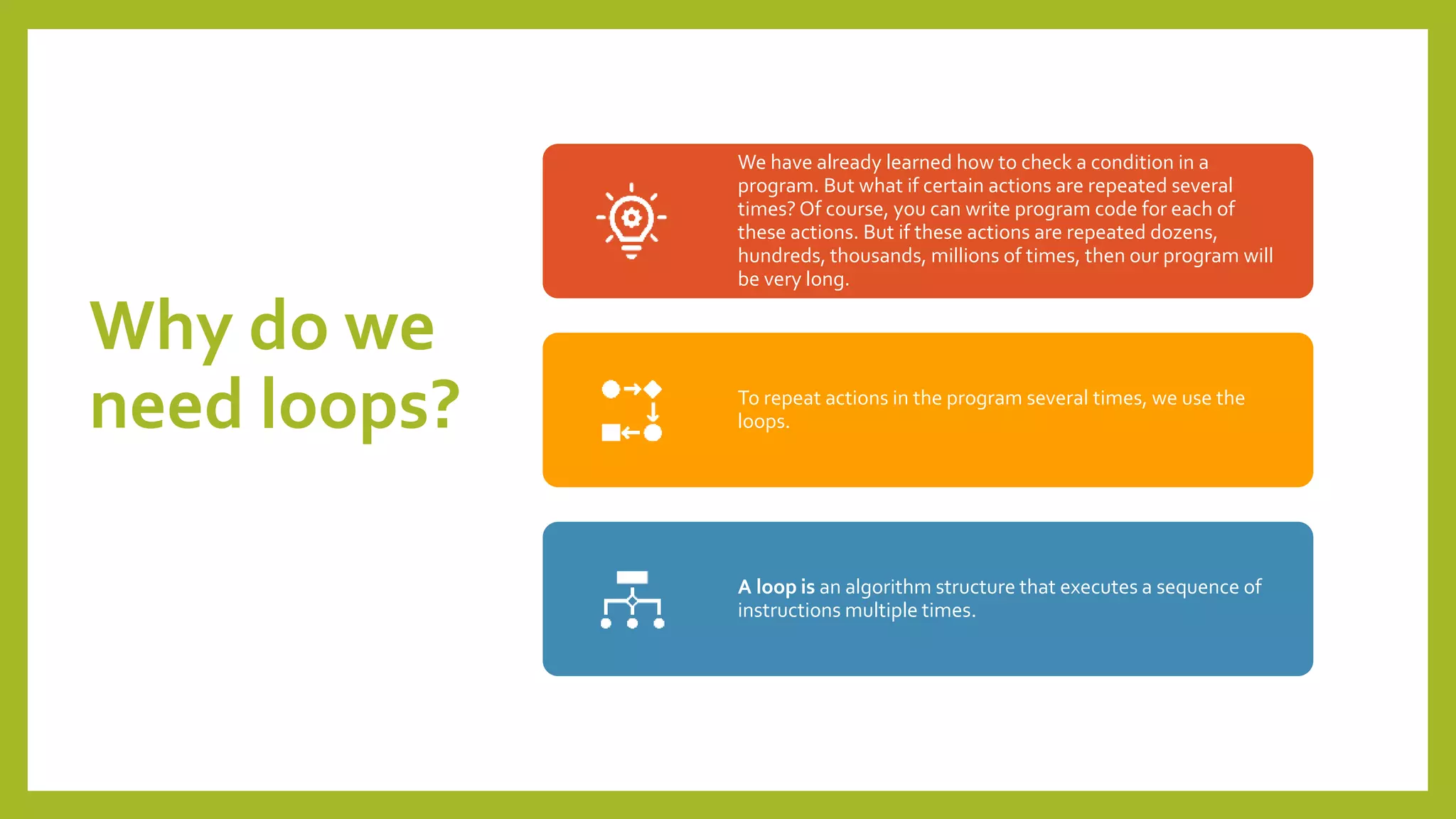
We have already learned how to check a condition in a
program. But what if certain actions are repeated several
times? Of course, you can write program code for each of
these actions. But if these actions are repeated dozens,
hundreds, thousands, millions of times, then our program will
be very long.
To repeat actions in the program several times, we use the
loops.
A loop is an algorithm structure that executes a sequence of
instructions multiple times.
VOCABULARY
• iterate - to repeat in order to achieve, or get closer to, a desired goal.
• while loop - a programming construct used to repeat a set of commands (loop) as
long as (while) a boolean condition is true.
A preconditioned loop has the following structure:
while [condition]: # checking the loop condition
action1 # loop body (actions that are repeated)
action2 # is executed WHILE the condition is met
... # each line in the body of the loop is
indented - 4 spaces
actionN
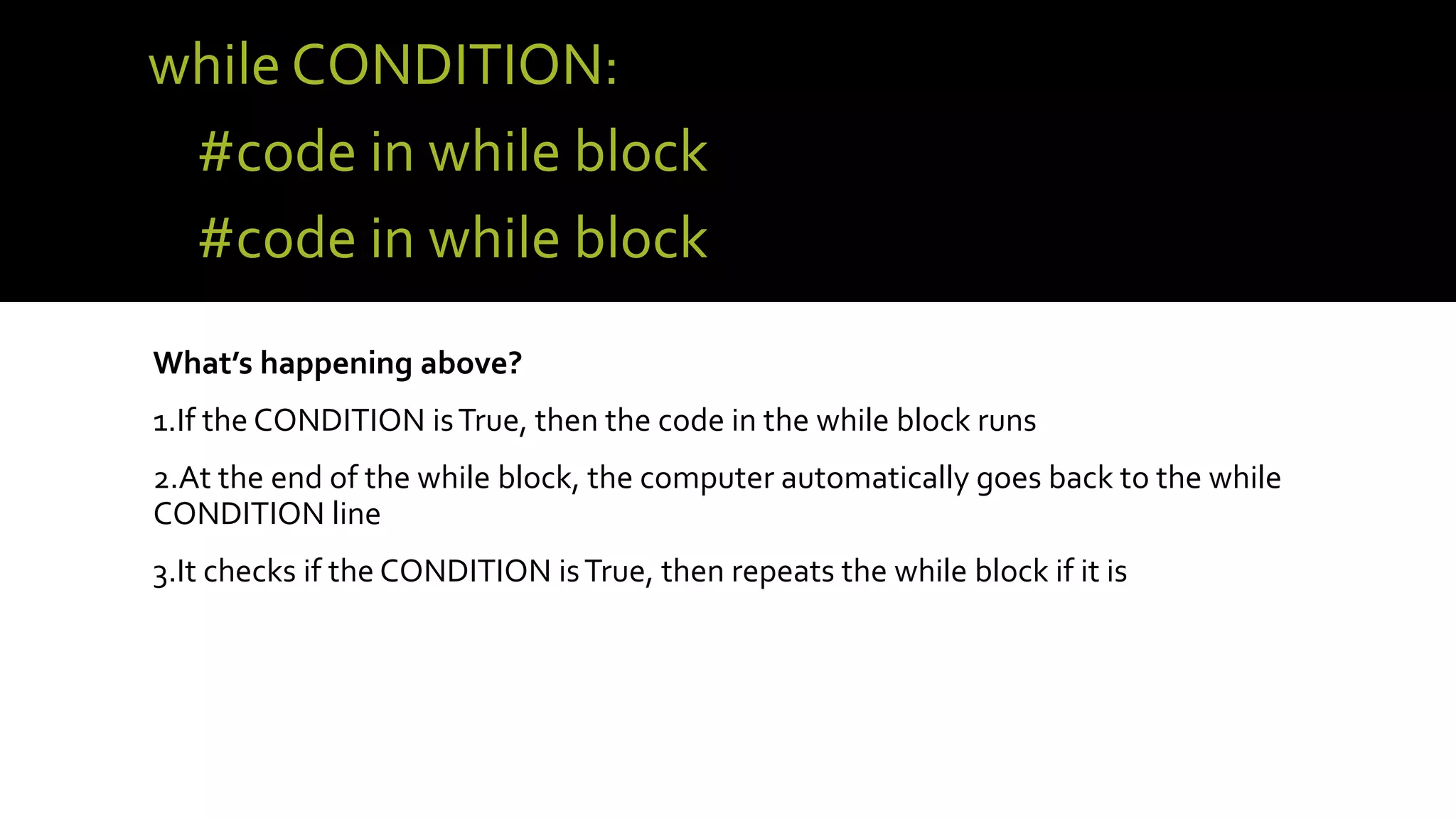
while CONDITION:
#code in while block
What’s happening above?
1.If the CONDITION isTrue, then the code in the while block runs
2.At the end of the while block, the computer automatically goes back to the while
CONDITION line
3.It checks if the CONDITION isTrue, then repeats the while block if it is
There are a few more important
concepts to know:
• The body of the loop is the sequence of code that needs to be executed several
times.
• One-time execution is iteration.
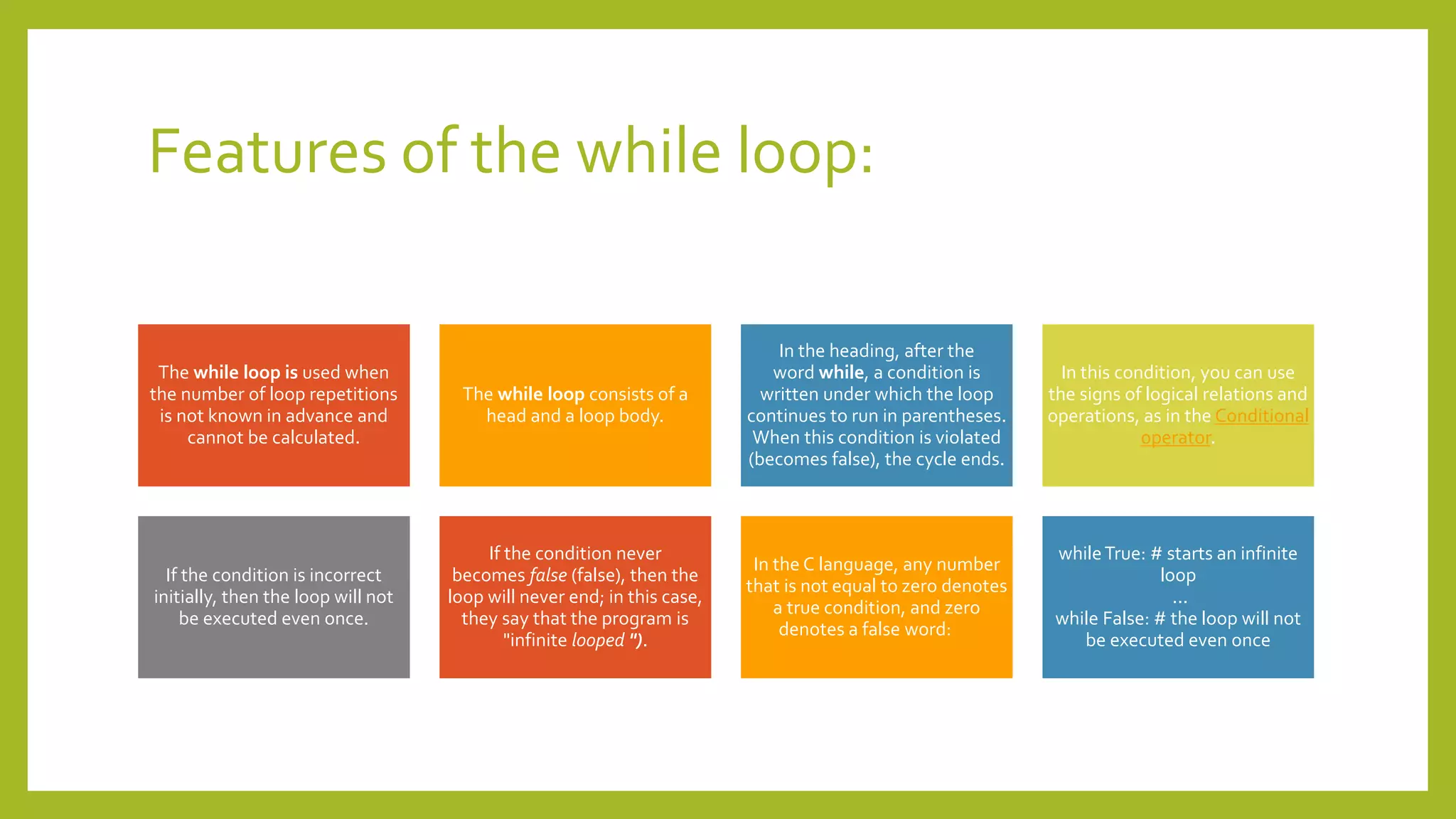
Features of the while loop:
The while loop is used when
the number of loop repetitions
is not known in advance and
cannot be calculated.
The while loop consists of a
head and a loop body.
In the heading, after the
word while, a condition is
written under which the loop
continues to run in parentheses.
When this condition is violated
(becomes false), the cycle ends.
In this condition, you can use
the signs of logical relations and
operations, as in the Conditional
operator.
If the condition is incorrect
initially, then the loop will not
be executed even once.
If the condition never
becomes false (false), then the
loop will never end; in this case,
they say that the program is
"infinite looped ").
In the C language, any number
that is not equal to zero denotes
a true condition, and zero
denotes a false word:
whileTrue: # starts an infinite
loop
...
while False: # the loop will not
be executed even once
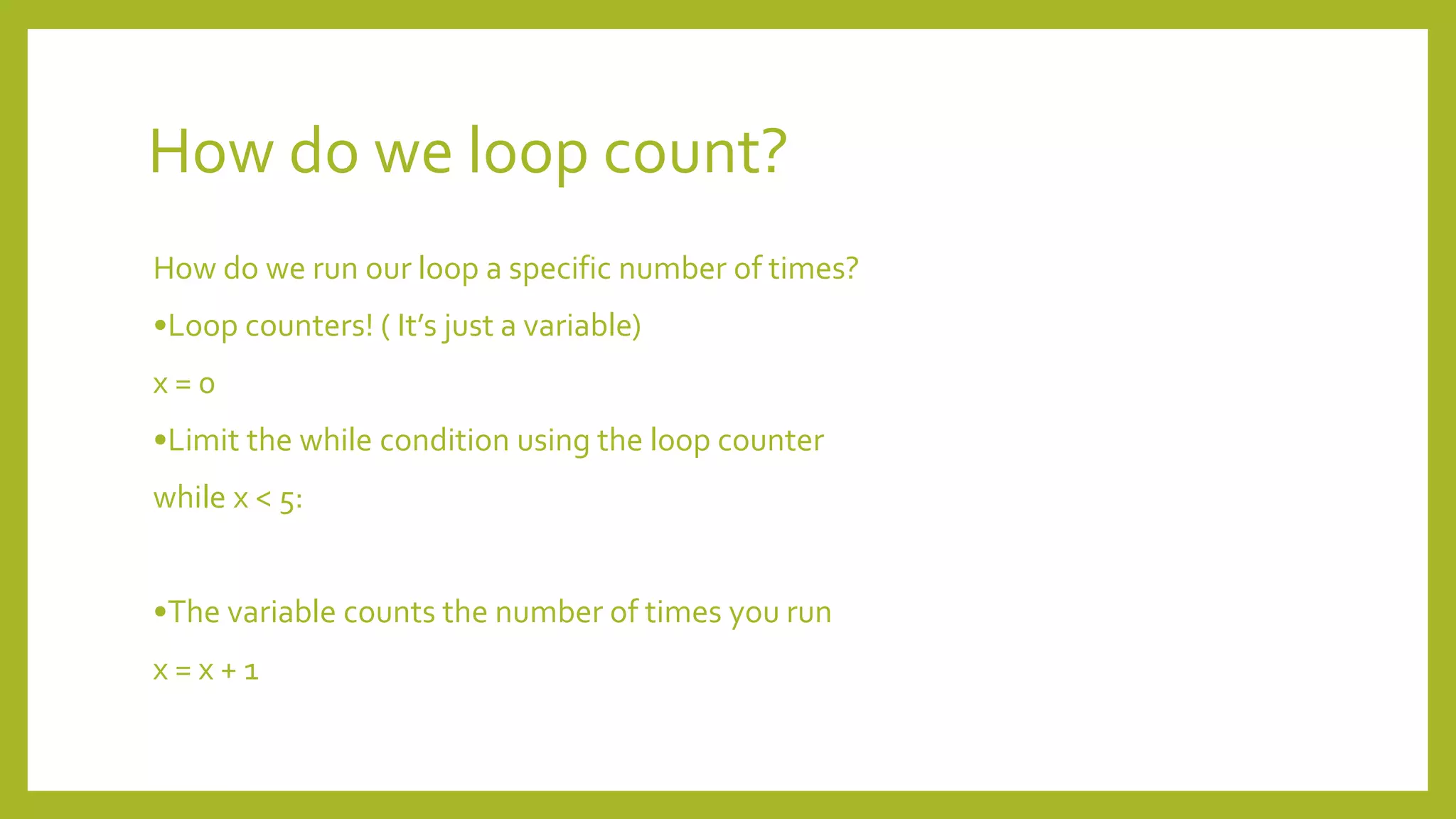
How do we loop count?
How do we run our loop a specific number of times?
•Loop counters! ( It’s just a variable)
x = 0
•Limit the while condition using the loop counter
while x < 5:
•The variable counts the number of times you run
x = x + 1
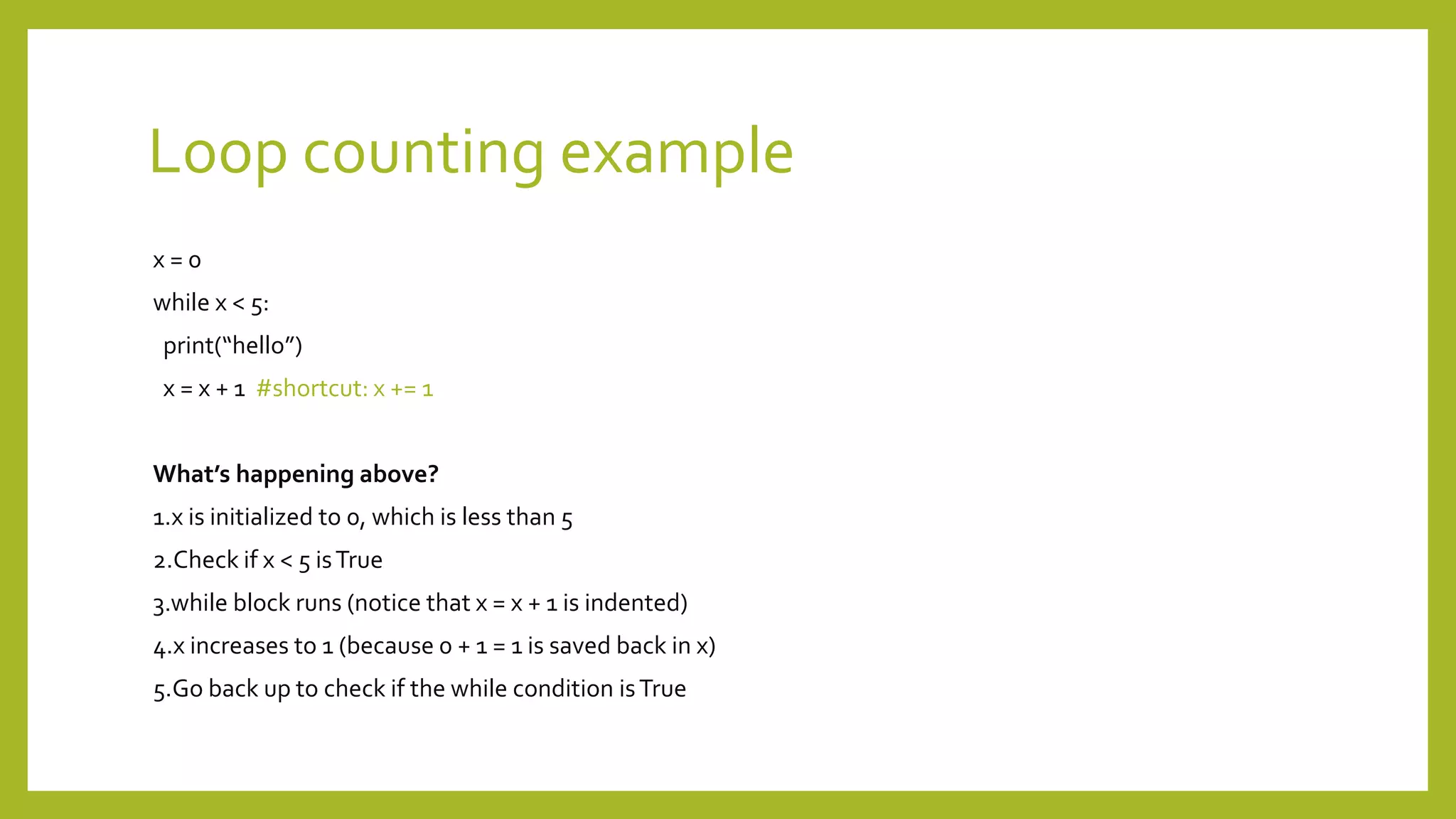
Loop counting example
x = 0
while x < 5:
print(“hello”)
x = x + 1 #shortcut: x += 1
What’s happening above?
1.x is initialized to 0, which is less than 5
2.Check if x < 5 isTrue
3.while block runs (notice that x = x + 1 is indented)
4.x increases to 1 (because 0 + 1 = 1 is saved back in x)
5.Go back up to check if the while condition isTrue
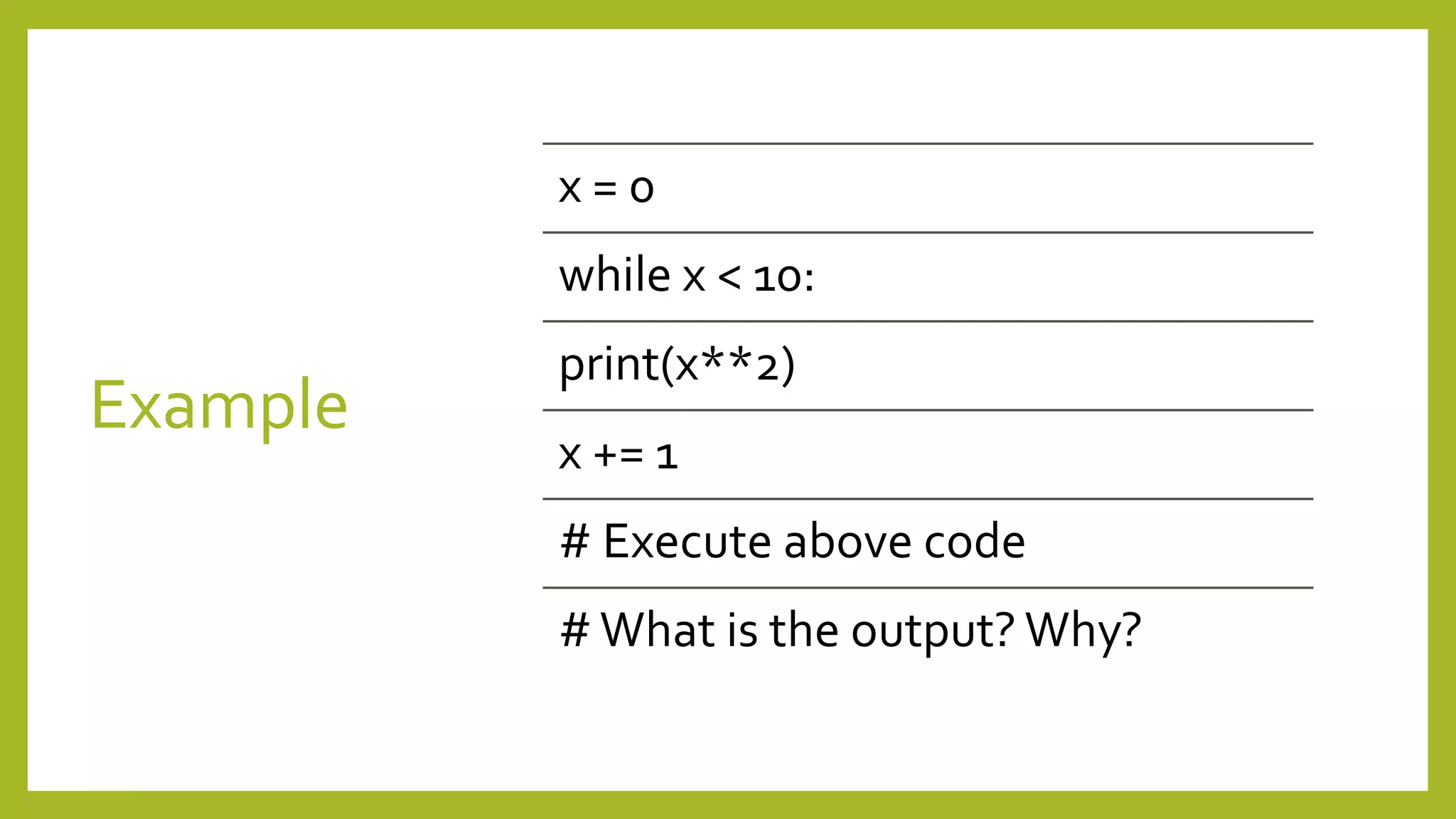
Example
x = 0
while x < 10:
print(x**2)
x += 1
# Execute above code
#What is the output? Why?
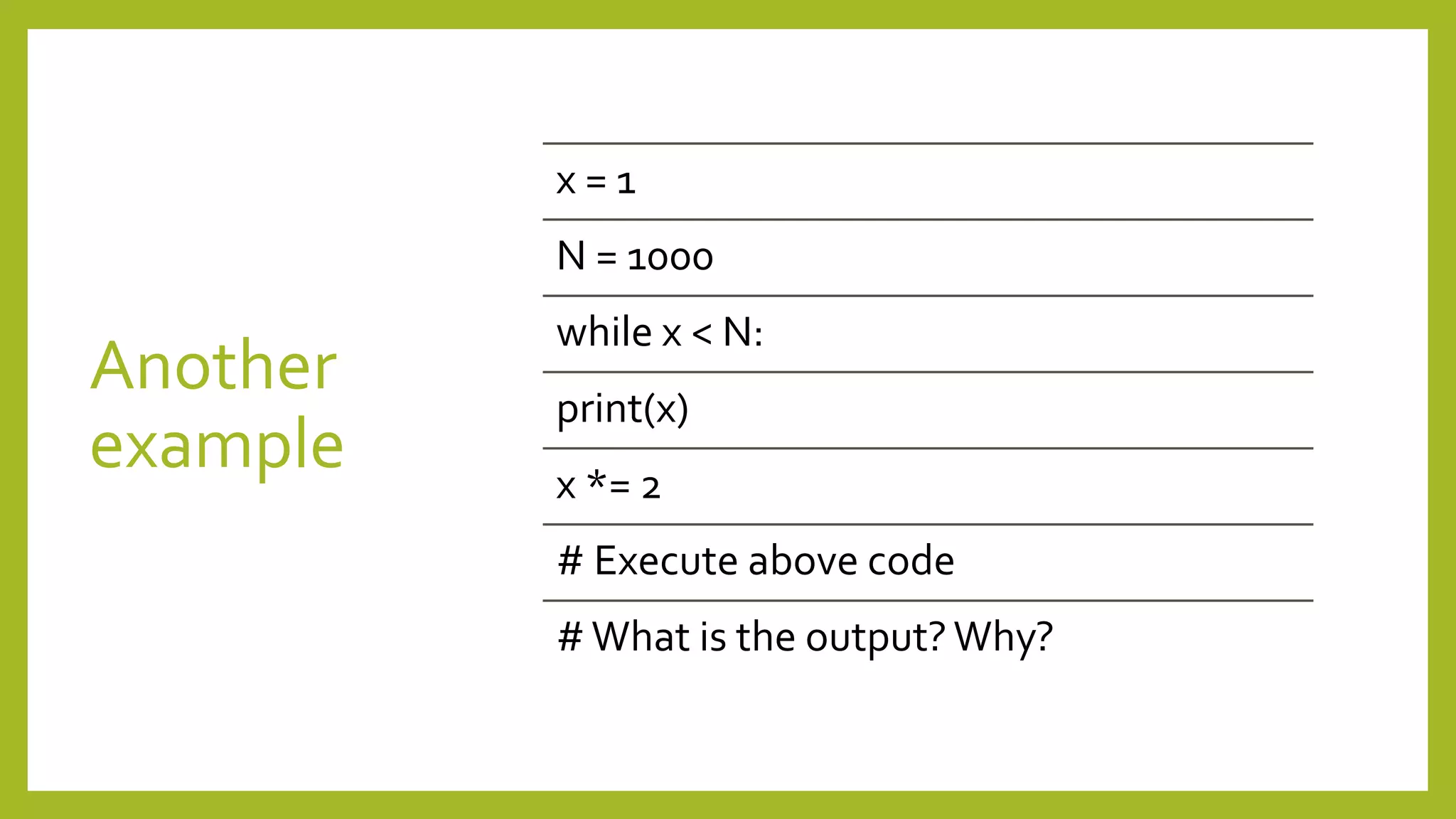
Another
example
x = 1
N = 1000
while x < N:
print(x)
x *= 2
# Execute above code
#What is the output?Why?
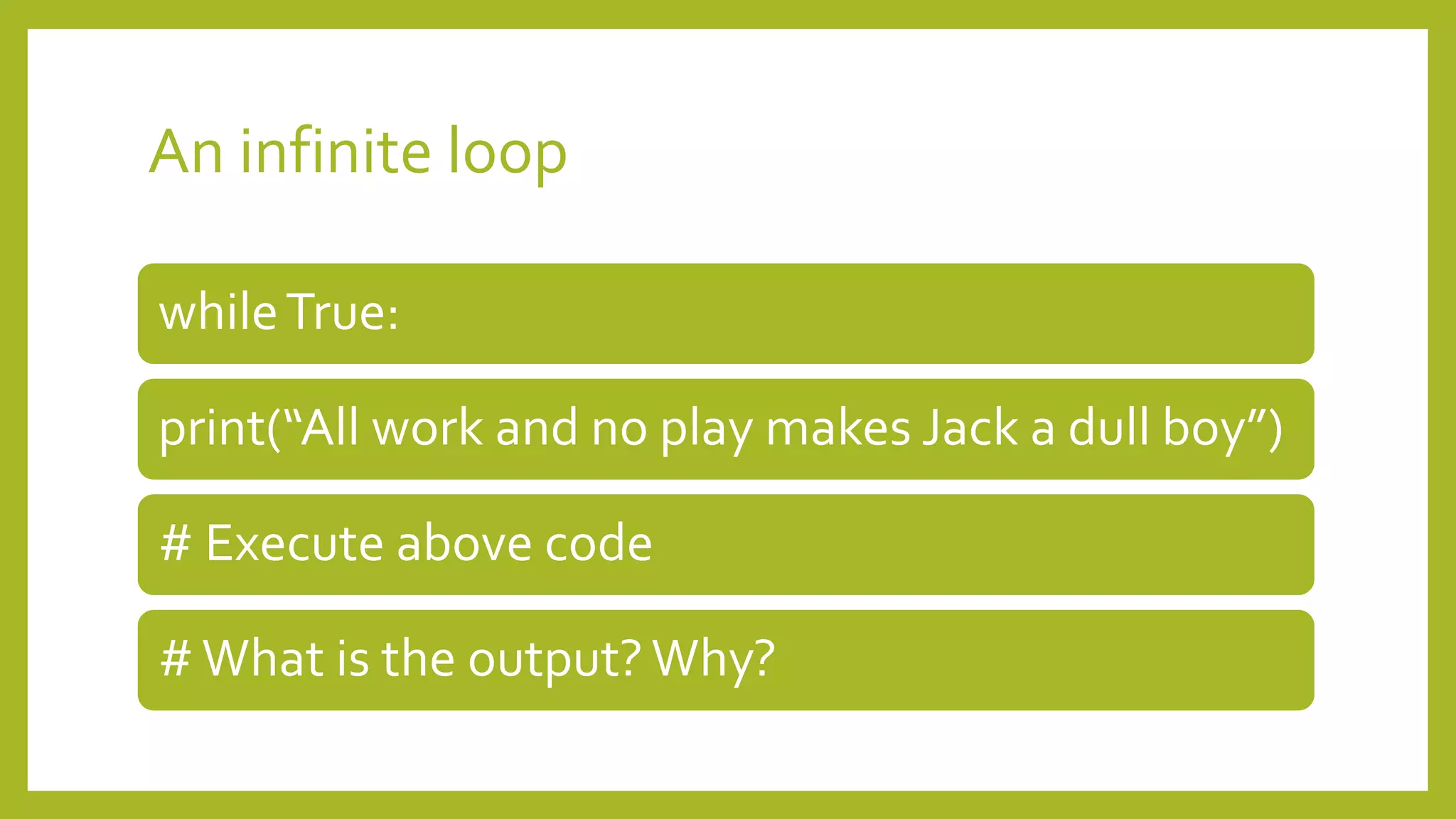
An infinite loop
whileTrue:
print(“All work and no play makes Jack a dull boy”)
# Execute above code
#What is the output?Why?
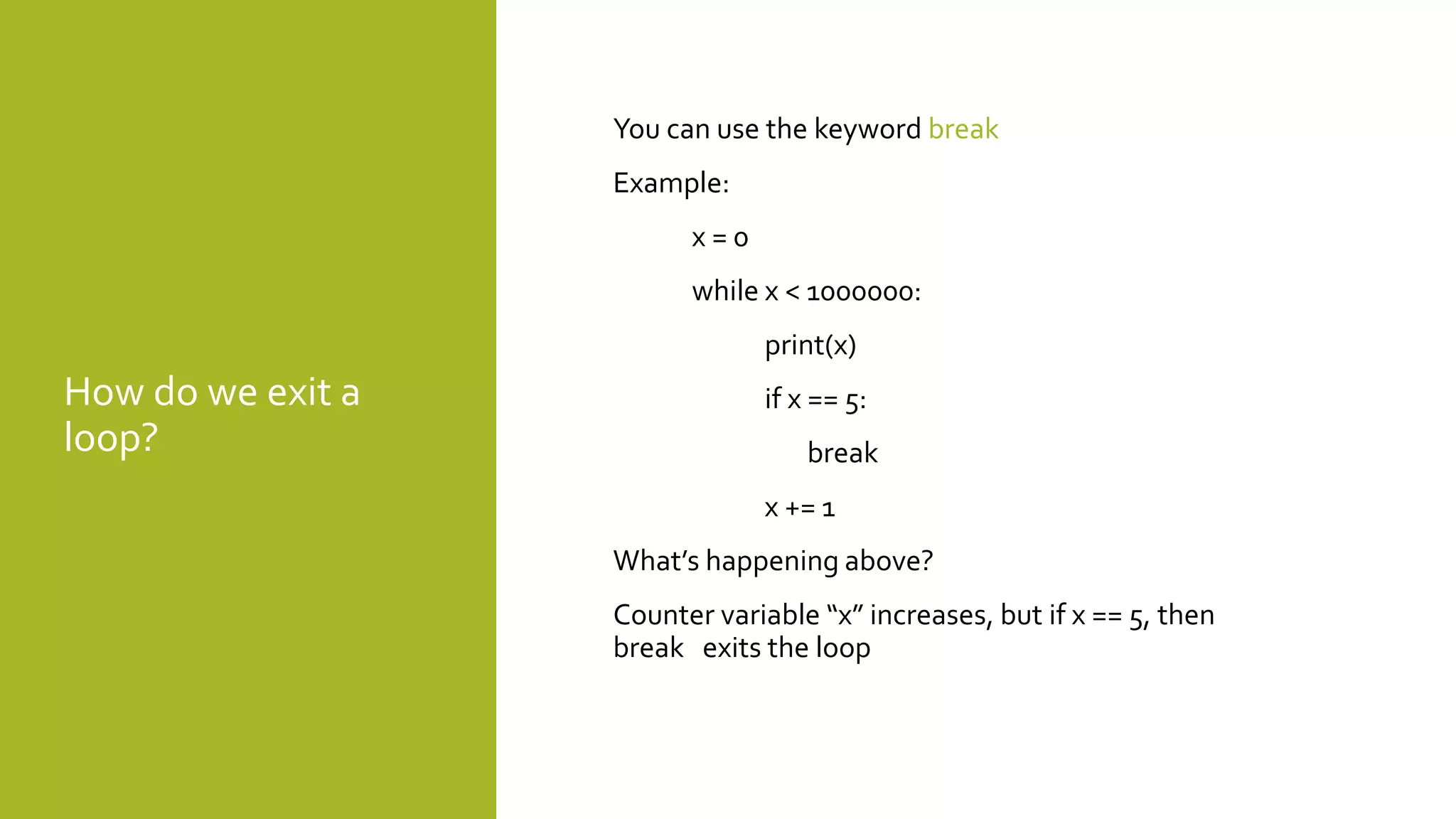
How do we exit a
loop?
You can use the keyword break
Example:
x = 0
while x < 1000000:
print(x)
if x == 5:
break
x += 1
What’s happening above?
Counter variable “x” increases, but if x == 5, then
break exits the loop
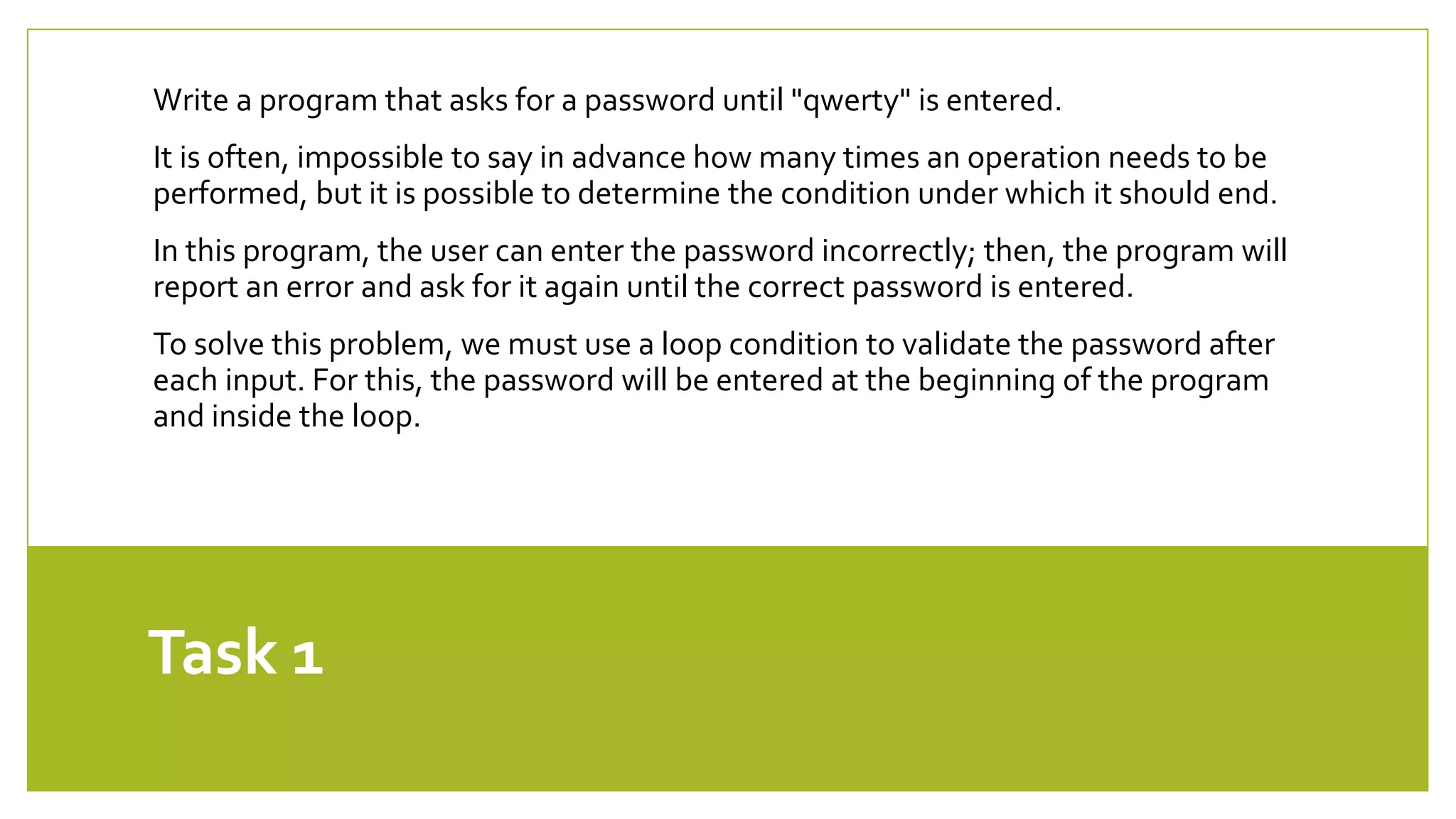
Task 1
Write a program that asks for a password until "qwerty" is entered.
It is often, impossible to say in advance how many times an operation needs to be
performed, but it is possible to determine the condition under which it should end.
In this program, the user can enter the password incorrectly; then, the program will
report an error and ask for it again until the correct password is entered.
To solve this problem, we must use a loop condition to validate the password after
each input. For this, the password will be entered at the beginning of the program
and inside the loop.
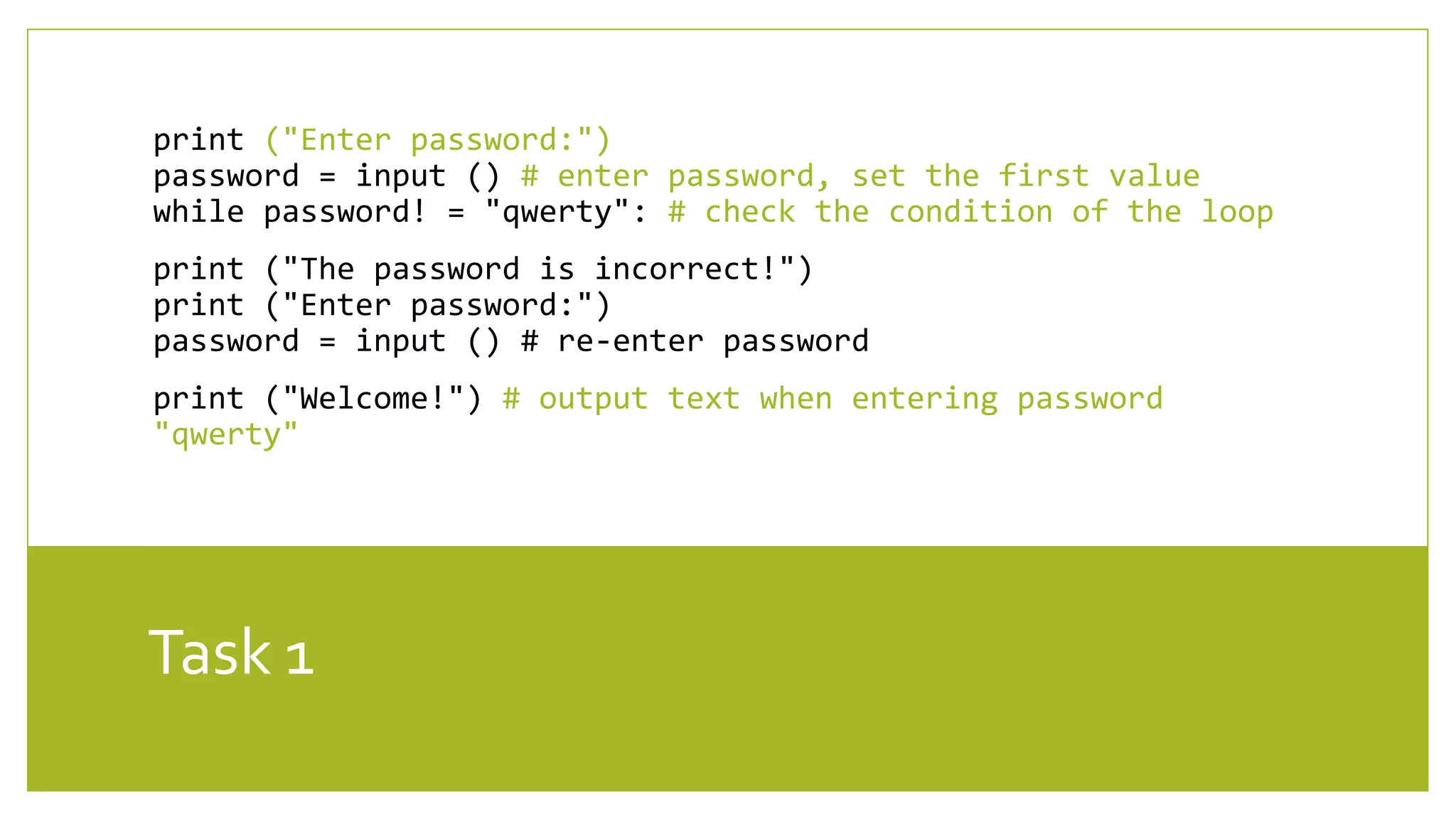
Task 1
print ("Enter password:")
password = input () # enter password, set the first value
while password! = "qwerty": # check the condition of the loop
print ("The password is incorrect!")
print ("Enter password:")
password = input () # re-enter password
print ("Welcome!") # output text when entering password
"qwerty"
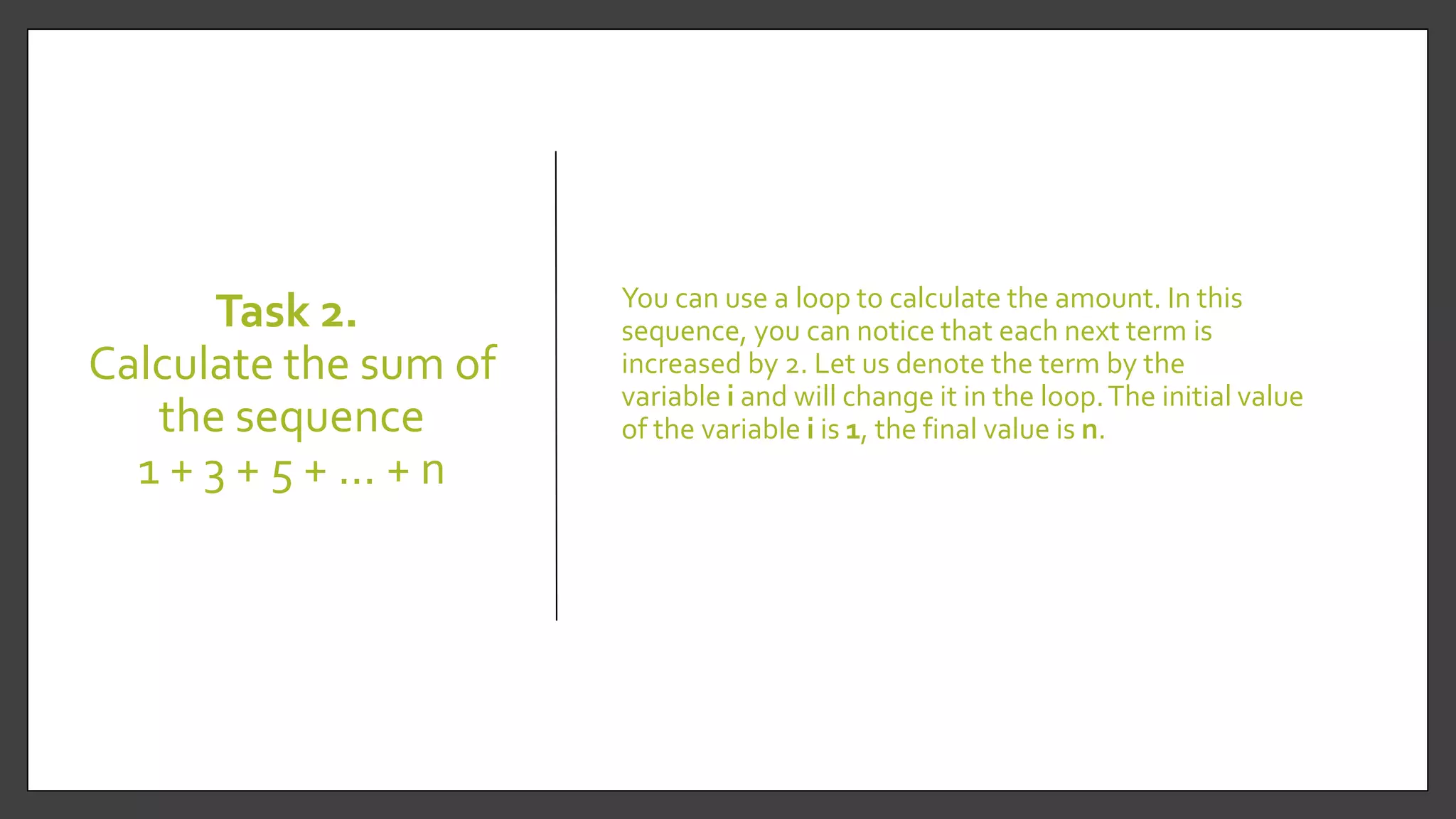
Task 2.
Calculate the sum of
the sequence
1 + 3 + 5 + ... + n
You can use a loop to calculate the amount. In this
sequence, you can notice that each next term is
increased by 2. Let us denote the term by the
variable i and will change it in the loop.The initial value
of the variable i is 1, the final value is n.
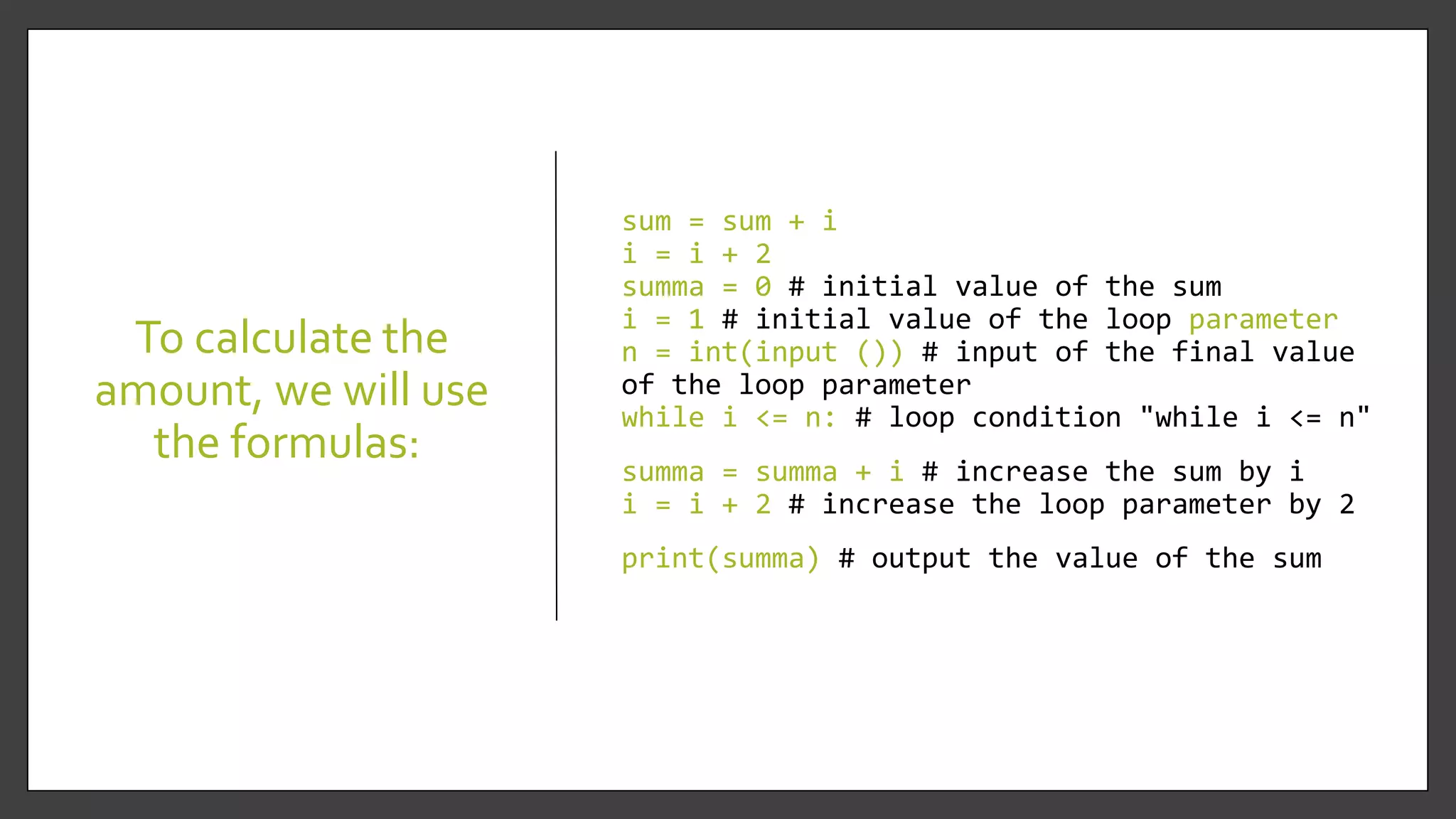
To calculate the
amount, we will use
the formulas:
sum = sum + i
i = i + 2
summa = 0 # initial value of the sum
i = 1 # initial value of the loop parameter
n = int(input ()) # input of the final value
of the loop parameter
while i <= n: # loop condition "while i <= n"
summa = summa + i # increase the sum by i
i = i + 2 # increase the loop parameter by 2
print(summa) # output the value of the sum
Practice
• https://snakify.org/en/lessons/while_loop/
Evaluation
While Loop Quiz
https://quizizz.com/admin/quiz/5c9935ef6521ae001a8bb721/python-conditional-
loops
Home work
• worksheet

While loop

  • 1.
  • 2.
    LEARNING OBJECTIVES 1.1.2.1 writecode using a While loop 11.1.2.2 implement a loop algorithm according to a flowchart 11.1.2.3 trace program code 11.4.3.2 solve applied problems from various subject areas
  • 3.
    Why do we needloops? We have already learned how to check a condition in a program. But what if certain actions are repeated several times? Of course, you can write program code for each of these actions. But if these actions are repeated dozens, hundreds, thousands, millions of times, then our program will be very long. To repeat actions in the program several times, we use the loops. A loop is an algorithm structure that executes a sequence of instructions multiple times.
  • 4.
    VOCABULARY • iterate -to repeat in order to achieve, or get closer to, a desired goal. • while loop - a programming construct used to repeat a set of commands (loop) as long as (while) a boolean condition is true.
  • 5.
    A preconditioned loophas the following structure: while [condition]: # checking the loop condition action1 # loop body (actions that are repeated) action2 # is executed WHILE the condition is met ... # each line in the body of the loop is indented - 4 spaces actionN
  • 6.
    while CONDITION: #code inwhile block #code in while block What’s happening above? 1.If the CONDITION isTrue, then the code in the while block runs 2.At the end of the while block, the computer automatically goes back to the while CONDITION line 3.It checks if the CONDITION isTrue, then repeats the while block if it is
  • 7.
    There are afew more important concepts to know: • The body of the loop is the sequence of code that needs to be executed several times. • One-time execution is iteration.
  • 8.
    Features of thewhile loop: The while loop is used when the number of loop repetitions is not known in advance and cannot be calculated. The while loop consists of a head and a loop body. In the heading, after the word while, a condition is written under which the loop continues to run in parentheses. When this condition is violated (becomes false), the cycle ends. In this condition, you can use the signs of logical relations and operations, as in the Conditional operator. If the condition is incorrect initially, then the loop will not be executed even once. If the condition never becomes false (false), then the loop will never end; in this case, they say that the program is "infinite looped "). In the C language, any number that is not equal to zero denotes a true condition, and zero denotes a false word: whileTrue: # starts an infinite loop ... while False: # the loop will not be executed even once
  • 9.
    How do weloop count? How do we run our loop a specific number of times? •Loop counters! ( It’s just a variable) x = 0 •Limit the while condition using the loop counter while x < 5: •The variable counts the number of times you run x = x + 1
  • 10.
    Loop counting example x= 0 while x < 5: print(“hello”) x = x + 1 #shortcut: x += 1 What’s happening above? 1.x is initialized to 0, which is less than 5 2.Check if x < 5 isTrue 3.while block runs (notice that x = x + 1 is indented) 4.x increases to 1 (because 0 + 1 = 1 is saved back in x) 5.Go back up to check if the while condition isTrue
  • 11.
    Example x = 0 whilex < 10: print(x**2) x += 1 # Execute above code #What is the output? Why?
  • 12.
    Another example x = 1 N= 1000 while x < N: print(x) x *= 2 # Execute above code #What is the output?Why?
  • 13.
    An infinite loop whileTrue: print(“Allwork and no play makes Jack a dull boy”) # Execute above code #What is the output?Why?
  • 14.
    How do weexit a loop? You can use the keyword break Example: x = 0 while x < 1000000: print(x) if x == 5: break x += 1 What’s happening above? Counter variable “x” increases, but if x == 5, then break exits the loop
  • 15.
    Task 1 Write aprogram that asks for a password until "qwerty" is entered. It is often, impossible to say in advance how many times an operation needs to be performed, but it is possible to determine the condition under which it should end. In this program, the user can enter the password incorrectly; then, the program will report an error and ask for it again until the correct password is entered. To solve this problem, we must use a loop condition to validate the password after each input. For this, the password will be entered at the beginning of the program and inside the loop.
  • 16.
    Task 1 print ("Enterpassword:") password = input () # enter password, set the first value while password! = "qwerty": # check the condition of the loop print ("The password is incorrect!") print ("Enter password:") password = input () # re-enter password print ("Welcome!") # output text when entering password "qwerty"
  • 17.
    Task 2. Calculate thesum of the sequence 1 + 3 + 5 + ... + n You can use a loop to calculate the amount. In this sequence, you can notice that each next term is increased by 2. Let us denote the term by the variable i and will change it in the loop.The initial value of the variable i is 1, the final value is n.
  • 18.
    To calculate the amount,we will use the formulas: sum = sum + i i = i + 2 summa = 0 # initial value of the sum i = 1 # initial value of the loop parameter n = int(input ()) # input of the final value of the loop parameter while i <= n: # loop condition "while i <= n" summa = summa + i # increase the sum by i i = i + 2 # increase the loop parameter by 2 print(summa) # output the value of the sum
  • 19.
  • 20.
  • 21.