Steve Brown
WHAT MAKES AN
AGREEMENT A
CONTRACT
www.etiennelaw.com
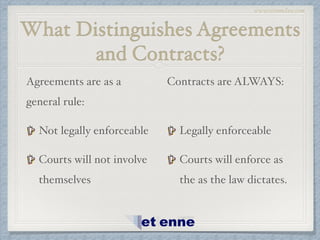
What Distinguishes Agreements
and Contracts?
Agreements are as a
general rule:!
Not legally enforceable !
Courts will not involve
themselves!
Contracts are ALWAYS:!
Legally enforceable!
Courts will enforce as
the as the law dictates.
www.etiennelaw.com
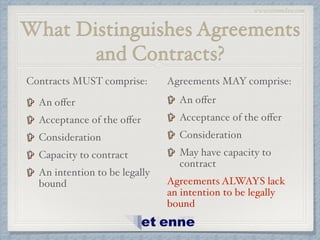
What Distinguishes Agreements
and Contracts?
Contracts MUST comprise:!
An offer !
Acceptance of the offer!
Consideration!
Capacity to contract!
An intention to be legally
bound!
Agreements MAY comprise:!
An offer!
Acceptance of the offer!
Consideration!
May have capacity to
contract!
Agreements ALWAYS lack
an intention to be legally
bound
www.etiennelaw.com
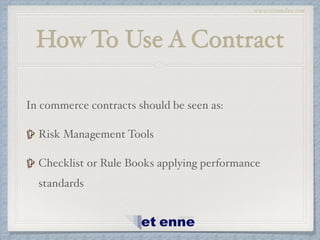
How To Use A Contract
In commerce contracts should be seen as:!
Risk Management Tools!
Checklist or Rule Books applying performance
standards
www.etiennelaw.com
How to Use a Contract As a Risk
Management Tool
Agreement to meet and discuss a form of
long term supply arrangement!
Contract to supply an apple!
Contract or agreement to toll manufacture
chemicals in Australia
www.etiennelaw.com
How to use a contract as a
checklist or rulebook
Who is to do what - who is to supply goods or
services; Who is paying for the goods or services!
When are the services/good to be supplies; when are
they to be paid for!
How are the goods/services to be supplied!
Consequences of good or poor performance
www.etiennelaw.com
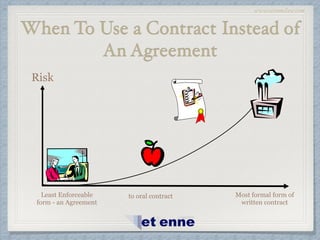
When To Use a Contract Instead of
An Agreement
Least Enforceable
form - an Agreement
to oral contract Most formal form of
written contract
Risk
www.etiennelaw.com
Types of Formal Contracts
Oral!
Partly oral, Partly written - varied by phone!
Written!
Informal - exchange of letters or emails!
Formal!
Standard!
Negotiated (one off)
www.etiennelaw.com
Types & Forms of Contracts -
Formalities
Formalities - must contracts be in
writing?!
Privity of contract!
Assignment of interests!
Terms of a contract!
express!
implied!
conditions!
warranties
www.etiennelaw.com
Types & Forms of Contracts -
Formalities
Understood within an industry!
Legally interpreted (precedent)!
Trust in project relationship!
Familiarity in administration and making
of claims!
Dangerous with consumers if not fair
TheCaseforStandard
Forms
www.etiennelaw.com
Types & Forms of Contracts -
Formalities
Needs of project!
Non-traditional project strategy!
“Minimal Risk” client!
Specific checklist gives certainty of
outcomes
TheCaseforOne-off
Contracts
www.etiennelaw.com
Rules of Contract Construction
The Objective to ascertain the mutual intentions of the parties!
The Objective v Subjective!
Objectivity!
How determined!
Object of Contract!
Parties Words!
Actions!
Surrounding Circumstances
www.etiennelaw.com
Rules of Contract Construction
Mutual intentions of the parties of who is to do what,
how and when ONLY from the words used in the
contract!
The intention of the parties as to what the words
mean is irrelevant!
Courts construe the objective intention of the parties
not the parties actual intention
www.etiennelaw.com
Rules of Contract Construction
Business common sense is sometimes used in addition to
the words chosen by the parties. Here the courts look at
the purpose of the contract, whether the form of the
contract was a standard form or negotiated by the
parties, and the commercial experience of the judge who
is to construe the meaning of the words used.!
Where the words used are clear, the court must give
effect to them even if they have no discernible
commercial purpose.
www.etiennelaw.com
Rules of Contract Construction
Although not overtly recognised, courts sometime
manipulate the construction of a contract to achieve a fair
result on the facts as ascertained by the court!
In construing a contract, clauses must not be considered
in isolation but must be considered in the context of the
whole of the contract!
The words of a contract should be con trued in their
grammatical and ordinary sense, except to the extent that
some modification is necessary to avoid absurdity,
inconsistency or repugnancy
www.etiennelaw.com
Rules of Contract Construction
The ordinary meaning of a word is its meaning in its
plain, ordinary and popular sense, although that sense
may be a sense among a particular group of persons!
Where a contract contains technical terms the court
may discover the meaning of those terms using a
dictionary, or where the technical terms are in
dispute the court may only proceed upon calling
expert evidence as to what the terms mean
www.etiennelaw.com
Rules of Contract Construction
Special situations!
Standard form
contracts!
Any special conditions are given
greater weight to the standard
conditions in the case of conflict!
Implied Terms!
Courts may imply terms where a
contract is silent upon a point
but only if all of the next 5
conditions are able to be
satisfied!
it is reasonable;!
it is necessary to give business
efficacy to the contract;!
It is so obvious a term it goes
without saying;!
it is able to be expressed clearly;!
it is not contrary to an express
term.
www.etiennelaw.com
Rules of Contract Construction
Implied terms!
Business efficacy!
the Moorcock (1889)!
Statute
www.etiennelaw.com
To Use A Contract or Agreement
Analyse the risks that the deal is designed to
minimise!
Analyse the rewards the deal is expected to return!
Determine if you need certainty or need commercial
flexibility!
Determine if you can obtain a contract or have to use
an agreement
For Further Information Contact!
Steve Brown!
8845 2400 sbrown@etiennelaw.com
It is not wrong to not always have
a contract: PROVIDED the risk of
there not being a contract is
accepted.
Call Etienne Lawyers today to
establish if you need a contract.

When is an Agreement a Contract

  • 1.
    Steve Brown WHAT MAKESAN AGREEMENT A CONTRACT
  • 2.
    www.etiennelaw.com What Distinguishes Agreements andContracts? Agreements are as a general rule:! Not legally enforceable ! Courts will not involve themselves! Contracts are ALWAYS:! Legally enforceable! Courts will enforce as the as the law dictates.
  • 3.
    www.etiennelaw.com What Distinguishes Agreements andContracts? Contracts MUST comprise:! An offer ! Acceptance of the offer! Consideration! Capacity to contract! An intention to be legally bound! Agreements MAY comprise:! An offer! Acceptance of the offer! Consideration! May have capacity to contract! Agreements ALWAYS lack an intention to be legally bound
  • 4.
    www.etiennelaw.com How To UseA Contract In commerce contracts should be seen as:! Risk Management Tools! Checklist or Rule Books applying performance standards
  • 5.
    www.etiennelaw.com How to Usea Contract As a Risk Management Tool Agreement to meet and discuss a form of long term supply arrangement! Contract to supply an apple! Contract or agreement to toll manufacture chemicals in Australia
  • 6.
    www.etiennelaw.com How to usea contract as a checklist or rulebook Who is to do what - who is to supply goods or services; Who is paying for the goods or services! When are the services/good to be supplies; when are they to be paid for! How are the goods/services to be supplied! Consequences of good or poor performance
  • 7.
    www.etiennelaw.com When To Usea Contract Instead of An Agreement Least Enforceable form - an Agreement to oral contract Most formal form of written contract Risk
  • 8.
    www.etiennelaw.com Types of FormalContracts Oral! Partly oral, Partly written - varied by phone! Written! Informal - exchange of letters or emails! Formal! Standard! Negotiated (one off)
  • 9.
    www.etiennelaw.com Types & Formsof Contracts - Formalities Formalities - must contracts be in writing?! Privity of contract! Assignment of interests! Terms of a contract! express! implied! conditions! warranties
  • 10.
    www.etiennelaw.com Types & Formsof Contracts - Formalities Understood within an industry! Legally interpreted (precedent)! Trust in project relationship! Familiarity in administration and making of claims! Dangerous with consumers if not fair TheCaseforStandard Forms
  • 11.
    www.etiennelaw.com Types & Formsof Contracts - Formalities Needs of project! Non-traditional project strategy! “Minimal Risk” client! Specific checklist gives certainty of outcomes TheCaseforOne-off Contracts
  • 12.
    www.etiennelaw.com Rules of ContractConstruction The Objective to ascertain the mutual intentions of the parties! The Objective v Subjective! Objectivity! How determined! Object of Contract! Parties Words! Actions! Surrounding Circumstances
  • 13.
    www.etiennelaw.com Rules of ContractConstruction Mutual intentions of the parties of who is to do what, how and when ONLY from the words used in the contract! The intention of the parties as to what the words mean is irrelevant! Courts construe the objective intention of the parties not the parties actual intention
  • 14.
    www.etiennelaw.com Rules of ContractConstruction Business common sense is sometimes used in addition to the words chosen by the parties. Here the courts look at the purpose of the contract, whether the form of the contract was a standard form or negotiated by the parties, and the commercial experience of the judge who is to construe the meaning of the words used.! Where the words used are clear, the court must give effect to them even if they have no discernible commercial purpose.
  • 15.
    www.etiennelaw.com Rules of ContractConstruction Although not overtly recognised, courts sometime manipulate the construction of a contract to achieve a fair result on the facts as ascertained by the court! In construing a contract, clauses must not be considered in isolation but must be considered in the context of the whole of the contract! The words of a contract should be con trued in their grammatical and ordinary sense, except to the extent that some modification is necessary to avoid absurdity, inconsistency or repugnancy
  • 16.
    www.etiennelaw.com Rules of ContractConstruction The ordinary meaning of a word is its meaning in its plain, ordinary and popular sense, although that sense may be a sense among a particular group of persons! Where a contract contains technical terms the court may discover the meaning of those terms using a dictionary, or where the technical terms are in dispute the court may only proceed upon calling expert evidence as to what the terms mean
  • 17.
    www.etiennelaw.com Rules of ContractConstruction Special situations! Standard form contracts! Any special conditions are given greater weight to the standard conditions in the case of conflict! Implied Terms! Courts may imply terms where a contract is silent upon a point but only if all of the next 5 conditions are able to be satisfied! it is reasonable;! it is necessary to give business efficacy to the contract;! It is so obvious a term it goes without saying;! it is able to be expressed clearly;! it is not contrary to an express term.
  • 18.
    www.etiennelaw.com Rules of ContractConstruction Implied terms! Business efficacy! the Moorcock (1889)! Statute
  • 19.
    www.etiennelaw.com To Use AContract or Agreement Analyse the risks that the deal is designed to minimise! Analyse the rewards the deal is expected to return! Determine if you need certainty or need commercial flexibility! Determine if you can obtain a contract or have to use an agreement
  • 20.
    For Further InformationContact! Steve Brown! 8845 2400 sbrown@etiennelaw.com It is not wrong to not always have a contract: PROVIDED the risk of there not being a contract is accepted. Call Etienne Lawyers today to establish if you need a contract.