What your IDE
could do
once you understand
your code
Questions & Directions

Arie van Deursen
Delft University of Technology

                                 1
Acknowledgments
• WSE & VISSOFT Organizers

• Members of the TU Delft Software
  Engineering Research Group, including
   – Ali Mesbah, Bas Cornelissen, Andy Zaidman, Martin
     Pinzger, Rini van Solingen, Cor-Paul Bezemer, …

• Additional collaborators, including
   – Leon Moonen, Rainer Koschke, Danny Holten, Jack van
     Wijk, Bart van Rompaey, …

• flickr photos from faisco, elizabethsalib, andywon
                                                           2
Today’s Structure
• Part I
   – What’s the problem? Documenting understanding
• Part II
   – Solution direction: Web 2.0?
• Part III
   – Evaluation: Begin with the end in mind
• Part IV
   – Conclusions: Towards a Knowledgeable IDE

                                                     3
Andreas Zeller: The Future of Programming Environments:
Integration, Synergy, and Assistance. FOSE 2007: 316-325
                                                           4
5
6
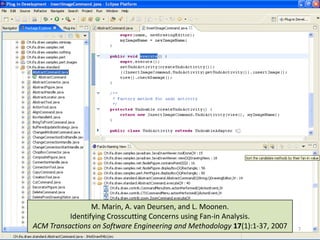
M. Marin, A. van Deursen, and L. Moonen.
          Identifying Crosscutting Concerns using Fan-in Analysis.
ACM Transactions on Software Engineering and Methodology 17(1):1-37, 2007   7
Program Understanding
• “40% of developing time is spent on program
  understanding”
• Probably more accurately:
  – 1% on understanding
  – 39% is spent on misunderstanding


• Should we tell the IDE the difference?
  – What could the IDE do with that knowledge?

                                                 8
Part II
The Great Move to the Web


                            9
Wave.google.com


                  10
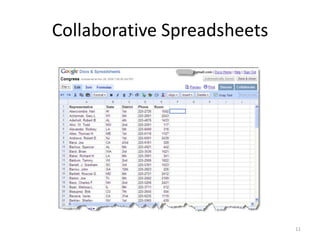
Collaborative Spreadsheets


                             11
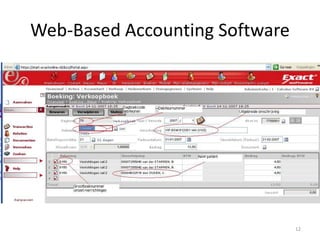
Web-Based Accounting Software


                                12
13
“Why I’m Done Making Desktop Applications”

•   Better conversion
•   Easier to support
•   The end of piracy
•   Interaction analytics
•   Customization per user
•   Short innovation cycles

                             Patrick Mckenzie
     http://www.kalzumeus.com/2009/09/05/desktop-aps-versus-web-apps/
                                                                        14
[ Ajax: The Technology Behind It ]


A. Mesbah and A. van Deursen. A Component- and Push-based Architectural Style for
    Ajax Applications. Journal of Systems and Software 81(12):2194-2209, 2008.

   A. Mesbah and A. van Deursen. Invariant-Based Automatic Testing of Ajax User
   Interfaces. Proc. 31st International Conference on Software Engineering (ICSE), 2009
                                                                                     15
Google Chrome Frame
• Applications such as Google Waves require
  ultrafast Javascript, and HTML5 (canvas)
  – Not supported by IE6, IE7, IE8
• Released this Tuesday: Google Chrome Frame
  – Plugin for Internet Explorer
  – V8 Javascript Engine
  – HTML5 support
  – Essentially runs Chrome within IE

                                               16
Web 2.0
• Technology paradigm:
  – Ajax: Asynchronous JavaScript and XML
• Usage paradigm
  – Architecture of participation
• An attitude:
  – Processes and tools are socially open
  – Content can be used in several different contexts
• Self-organizing means for informal
  communication
                                                        17
Twitter


          18
Micro-blogging Using Twitter
•   Short updates on what you’re doing
•   Visible to all
•   Follow friends, or be followed
•   ReTweet tweets you like
•   Respond to tweets you like
•   “Trending” topics

• Follow what’s hot in your area of interest
• Follow what people are doing
                                               19
20
21
22
23
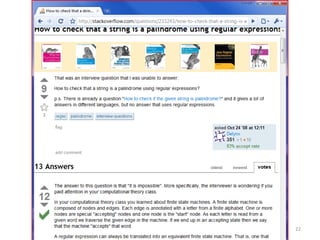
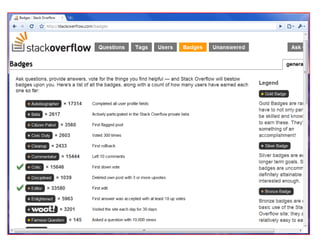
Stackoverflow Mechanisms
•   Voting on questions & answers
•   Spotting similar questions
•   Adding comments
•   Starring questions
•   Picking the right answer
•   Earning reputation points
•   Earning badges

                                    24
25
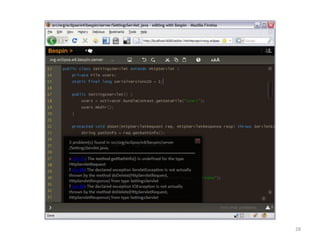
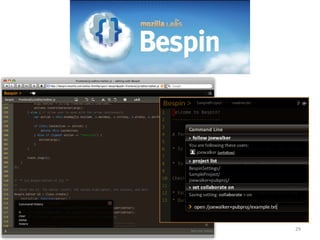
Will the IDE go on line too?
• Mozilla Bespin:
  – HTML5 Canvas-based editing
• Heroku:
  – Ruby-on-Rails deployment (+ IDE?)
• Eclipse E4 project plans include:
  – "Eclipse in browser"; DOM-based access to
    workbench; REST-full IDE services
• WWWorkspace
  – Browser-access to Eclipse OSGi services

                                                26
27
28
29
Mixing all of these ….


                         30
… would it then be possible to…:
• Tell the IDE simply what you’re doing
• Follow the activities of your co-developers
• Hit the “YES” button to tell the IDE that you
  understand
• Learn from the IDE which paths others took to
  understand their code
• Appreciate the value of comments by seeing
  the author’s reputation
                                              31
… or…
• Compose your IDE plugins the way you select
  widgets in, e.g., pageflakes?
• Share … execution traces?
• Share … breakpoints?
• Do … joint editing?
• Share … configurations and workspaces?
• Identify (local) “trending topics” in current
  development?
                                                  32
With that in place…
• The IDE just … knows
  – It learns from interactions,
  – and encourages the developers to add information at
    any time
• At moments of enlightenment
  – The developer knows
  – and is forced by the IDE to share his/her
    understanding
  – which is merged with stored interaction information

                                                          33
Many Starting Points Exist …
•   IBM Jazz, MS Team Foundation Server, Bespin
•   DeLine: Del.icio.us development tools (CHASE’08)
•   Begel et al: Codebook (ICSE NIER’09)
•   Treude & Storey: Tagging (ICSE’09)
•   Shihab et al: IRC channels (MSR’09)
•   Fritz/Murphy: Interaction mining (ESEC/FSE’07)
•   .... and a lot more!

• …. But still much work remains to be done!

                                                   34
Part III
        Begin With the End in Mind
• J. Ziman, 1978: Reliable Knowledge:
  An Exploration of the Grounds for Belief in Science
• Consensual knowledge:
   – The ultimate goal of science is a
     consensus of rational opinion
• Consensual statement:
   – Fully tested and accepted by overwhelming
     majority of well-informed scientists
• Consensible statement:
   – Has the potential for eventually
     contributing to a consensus
                                                    35
Comprehension & Dynamic Analysis:
           A Systematic Survey
   • A person understands a program:
       – Ability to explain the program, its structure, its behavior,
         its effects on its operation context, and its relationships to
         its application domain
       – in terms that are qualitatively different from the tokens
         used to construct the source code of the program
   • Dynamic analysis:
       – Properties of running system


B. Cornelissen, A. Zaidman, A. van Deursen, L. Moonen, and Rainer Koschke
A Systematic Survey of Program Comprehension through Dynamic Analysis.
              IEEE Transactions on Software Engineering, 2009               36
Survey Steps


               37
Analyzed 172 Papers
33

     26

          20 19                                            21


                  11
                       9   9
                               5   5   5   4   3   3   3


                                                                38
39
Attribute Occurrences
            90


                                                 79
                                                                                                                                     72
                 68
                                                                            61
                                                                                 59 58
            60
frequency


                      48

                                                                                         39
                                                                                              36
                                                                                                                                          32
                           30                         30                                           30                                          30
            30                                                                                          27 26
                                                                                                              25
                                                                                                                   23
                                19 19
                                        13                 12                                                                                       12 11 11
                                                                                                                        11
                                             9
                                                                7   7                                                        6                                 6
                                                                        5                                                        5

             0


                                                                                                                                                         40
Example: Evaluating
ExtraVis Trace Visualization


                               41
Hierarchical Edge Bundles


Danny Holten: Hierarchical Edge Bundles: Visualization of Adjacency Relations in
   Hierarchical Data. IEEE Trans. Vis. Comput. Graph. 12(5): 741-748 (2006)
Evaluation Through Case Studies
   • Assessed how/why ExtraVis could be helpful in
     three dynamic analysis use cases:
       – Trace exploration, feature location,
         phase identification
   • Selected three subject systems:
       – 1 industrial, 2 open source
   • Exploration, theory building

B. Cornelissen, A. Zaidman, D. Holten, L. Moonen, A. van Deursen, and J. van Wijk.
 Execution Trace Analysis through Massive Sequence and Circular Bundle Views.
             Journal of Systems and Software 81(12):2252-2268, 2008                  43
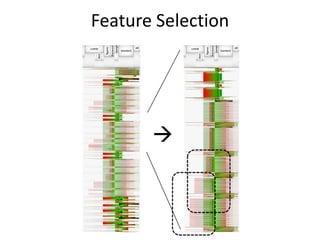
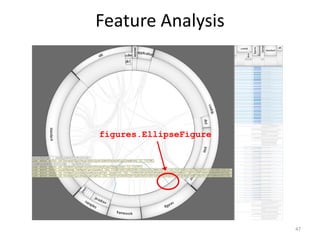
Featue Location
Goal:
Establishing relations
between feature            }   3x

invocations and the
corresponding source
code elements.

           Execution scenario (150,000 events)
             – Create new drawing
             – Draw five types of figures
                                            }   3x


                                                     44
Feature Selection


       
Feature Analysis


                   46
Feature Analysis


figures.EllipseFigure


                        47
Analytical Generalization
• Helpful to understand user-triggerable
  functions.
   – Massive sequence chart helps to
     reveal recurring patterns
   – Circular bundle view helps to understand more
     detailed interactions
• Effective use of “screen real estate”
• Threats to (external) validity:
   – size of trace, presence of treads, role of
     identifiers, triggering the features, applied filtering in
     some cases.

                                                                  48
ExtraVis Controlled Experiment
• Baseline: Eclipse
• Partition 34 subjects (academic + industry)
  into two groups:
   – Control group: Eclipse
   – Experimental group: Eclipse + ExtraVis
• Perform eight comprehension tasks on Checkstyle
  source code
• Measure time spent, and
  correctness of answers
          B. Cornelissen, A. Zaidman, B. van Rompaey, and A. van Deursen
     Trace Visualization for Program Comprehension: A Controlled Experiment.
  In Proc. 17th International Conference on Program Comprehension (ICPC), 2009   49
M. J. Pacione, M. Roper, and M. Wood,
               “Comparative evaluation of dynamic visualisation tools,”
In Proc. Working Conference on Reverse Engineering (WCRE), pp. 80–89, IEEE C.S., 2003.
                                                                                    50
Task design (cont’d)
• Example: Activity A1
   – “Investigating the functionality of (part of) the system”
   – is covered by
       • Task 1: globally understanding the main stages in a typical scenario
       • Task 4.1: providing a detailed description of the violation handling process
       • Task 4.2: determining whether check X reports violations

• Example: Activity A4
   – “Investigating dependencies between artifacts”
   – is covered by
       •   Task 2.1: identifying three classes with high fanin and low fanout
       •   Task 2.2: identifying a class in package X with a strong coupling to package Y
       •   Task 3.2: listing the identifiers of all interactions between classes X and Y
       •   Task 3.3: listing the identifiers of additional interactions in case of class Z
Correctness Results


Mean score Eclipse           17.88
Mean score Ecl + ExtraVis    12.47
Score Improvement           43.38%
p value                     < 0.001   52
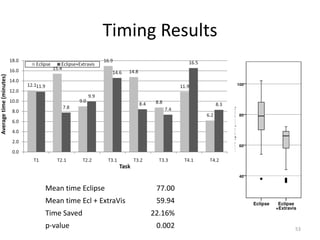
Timing Results


Mean time Eclipse           77.00
Mean time Ecl + ExtraVis    59.94
Time Saved                 22.16%
p-value                     0.002   53
Findings
• 22% faster, 43% better
  – For the given comprehension tasks
• ExtraVis offers
  – global structural insight;
  – global and detailed behavioral insight;
• ExtraVis works best with a goal-oriented
  strategy


                                              54
Threats to Validity
• Construct validity:
   – Can we distinguish use of traces in general from use of
     ExtraVis in particular?
• Internal validity:
   –   Is background knowledge evenly distributed across groups?
   –   Were subjects motivated?
   –   Are the tasks biased? Are they too difficult? Too easy?
   –   Was the time set realistic?
   –   Did we grade the tasks correctly?
• External validity:
   – Are the tasks, checkstyle, and the subjects representative?
                                                               55
How do we Evaluate our Results?
• Through realistic, effort-   • Through controlled
  taking, case studies           experiments
• Permitting analytical        • Smaller tasks by more
  generalization                 people
                               • Statistical generalization

        • All done with the most critical attitude
     • Reflected in at least the “threats to validity”


                                                          56
Part IV
            Five Years from now…
 Collaboration as in Web    We want our research to
  2.0 and the move of          – Play a leading role in
  applications to the web        these directions
  will be universal            – Leverage these trends in
                                 our methods & tools


What do we need in order to conduct the most critical
and insightful evaluations?
   What do we have to set in place right now?

                                                        57
Empirical Studies
including Collaboration

• Visualizations are means for collaboration
  – Future tools will include collaboration support
• How can we evaluate this?
  – Case studies will be more complicated
• Community effort
  – Volunteer in each other’s experiments
  – Grant access to each other’s students

                                                      58
Access to Shared Web Applications
• We need compelling shared case studies
  – Web app sources harder to find on source forge

• Which maintenance tasks do we want to speed
  up and improve?
  – What role does collaboration play in there?


• To be able to compare results the community
  needs to work on common cases and tasks

                                                     59
Shared Analysis Infrastructures
• Analyzing web applications is
  highly challenging
  – Multitude of combined technologies
  – Static analysis insufficient
  – Ajax adds significant complexity
• Community effort to build web analysis tools
  – Our open source Crawljax infrastructure can be a
    starting point

                                                       60
Picasso Visualizations

• ExtraVis is heavy weight visualization artillery
• What about light-weight visualizations?
• Can the browser force us to simplicity? (gmail)
• Can we exploit HTML5 and rich
  Javascript visualization libraries?
• How does collaboration fit in?

                                                 61
Rethinking the IDE
       • What is the essential IDE that
         is so simple that it can run in a
         browser?

       • Shouldn’t collaboration be the
         central feature of an IDE?

       • How can the IDE encourage
         developers to share their
         thoughts?

       • How can the IDE distinguish
         right from wrong?
                                         62

What your IDE could do once you understand your code

  • 1.
    What your IDE coulddo once you understand your code Questions & Directions Arie van Deursen Delft University of Technology 1
  • 2.
    Acknowledgments • WSE &VISSOFT Organizers • Members of the TU Delft Software Engineering Research Group, including – Ali Mesbah, Bas Cornelissen, Andy Zaidman, Martin Pinzger, Rini van Solingen, Cor-Paul Bezemer, … • Additional collaborators, including – Leon Moonen, Rainer Koschke, Danny Holten, Jack van Wijk, Bart van Rompaey, … • flickr photos from faisco, elizabethsalib, andywon 2
  • 3.
    Today’s Structure • PartI – What’s the problem? Documenting understanding • Part II – Solution direction: Web 2.0? • Part III – Evaluation: Begin with the end in mind • Part IV – Conclusions: Towards a Knowledgeable IDE 3
  • 4.
    Andreas Zeller: TheFuture of Programming Environments: Integration, Synergy, and Assistance. FOSE 2007: 316-325 4
  • 5.
  • 6.
  • 7.
    M. Marin, A.van Deursen, and L. Moonen. Identifying Crosscutting Concerns using Fan-in Analysis. ACM Transactions on Software Engineering and Methodology 17(1):1-37, 2007 7
  • 8.
    Program Understanding • “40%of developing time is spent on program understanding” • Probably more accurately: – 1% on understanding – 39% is spent on misunderstanding • Should we tell the IDE the difference? – What could the IDE do with that knowledge? 8
  • 9.
    Part II The GreatMove to the Web 9
  • 10.
  • 11.
  • 12.
  • 13.
  • 14.
    “Why I’m DoneMaking Desktop Applications” • Better conversion • Easier to support • The end of piracy • Interaction analytics • Customization per user • Short innovation cycles Patrick Mckenzie http://www.kalzumeus.com/2009/09/05/desktop-aps-versus-web-apps/ 14
  • 15.
    [ Ajax: TheTechnology Behind It ] A. Mesbah and A. van Deursen. A Component- and Push-based Architectural Style for Ajax Applications. Journal of Systems and Software 81(12):2194-2209, 2008. A. Mesbah and A. van Deursen. Invariant-Based Automatic Testing of Ajax User Interfaces. Proc. 31st International Conference on Software Engineering (ICSE), 2009 15
  • 16.
    Google Chrome Frame •Applications such as Google Waves require ultrafast Javascript, and HTML5 (canvas) – Not supported by IE6, IE7, IE8 • Released this Tuesday: Google Chrome Frame – Plugin for Internet Explorer – V8 Javascript Engine – HTML5 support – Essentially runs Chrome within IE 16
  • 17.
    Web 2.0 • Technologyparadigm: – Ajax: Asynchronous JavaScript and XML • Usage paradigm – Architecture of participation • An attitude: – Processes and tools are socially open – Content can be used in several different contexts • Self-organizing means for informal communication 17
  • 18.
  • 19.
    Micro-blogging Using Twitter • Short updates on what you’re doing • Visible to all • Follow friends, or be followed • ReTweet tweets you like • Respond to tweets you like • “Trending” topics • Follow what’s hot in your area of interest • Follow what people are doing 19
  • 20.
  • 21.
  • 22.
  • 23.
  • 24.
    Stackoverflow Mechanisms • Voting on questions & answers • Spotting similar questions • Adding comments • Starring questions • Picking the right answer • Earning reputation points • Earning badges 24
  • 25.
  • 26.
    Will the IDEgo on line too? • Mozilla Bespin: – HTML5 Canvas-based editing • Heroku: – Ruby-on-Rails deployment (+ IDE?) • Eclipse E4 project plans include: – "Eclipse in browser"; DOM-based access to workbench; REST-full IDE services • WWWorkspace – Browser-access to Eclipse OSGi services 26
  • 27.
  • 28.
  • 29.
  • 30.
    Mixing all ofthese …. 30
  • 31.
    … would itthen be possible to…: • Tell the IDE simply what you’re doing • Follow the activities of your co-developers • Hit the “YES” button to tell the IDE that you understand • Learn from the IDE which paths others took to understand their code • Appreciate the value of comments by seeing the author’s reputation 31
  • 32.
    … or… • Composeyour IDE plugins the way you select widgets in, e.g., pageflakes? • Share … execution traces? • Share … breakpoints? • Do … joint editing? • Share … configurations and workspaces? • Identify (local) “trending topics” in current development? 32
  • 33.
    With that inplace… • The IDE just … knows – It learns from interactions, – and encourages the developers to add information at any time • At moments of enlightenment – The developer knows – and is forced by the IDE to share his/her understanding – which is merged with stored interaction information 33
  • 34.
    Many Starting PointsExist … • IBM Jazz, MS Team Foundation Server, Bespin • DeLine: Del.icio.us development tools (CHASE’08) • Begel et al: Codebook (ICSE NIER’09) • Treude & Storey: Tagging (ICSE’09) • Shihab et al: IRC channels (MSR’09) • Fritz/Murphy: Interaction mining (ESEC/FSE’07) • .... and a lot more! • …. But still much work remains to be done! 34
  • 35.
    Part III Begin With the End in Mind • J. Ziman, 1978: Reliable Knowledge: An Exploration of the Grounds for Belief in Science • Consensual knowledge: – The ultimate goal of science is a consensus of rational opinion • Consensual statement: – Fully tested and accepted by overwhelming majority of well-informed scientists • Consensible statement: – Has the potential for eventually contributing to a consensus 35
  • 36.
    Comprehension & DynamicAnalysis: A Systematic Survey • A person understands a program: – Ability to explain the program, its structure, its behavior, its effects on its operation context, and its relationships to its application domain – in terms that are qualitatively different from the tokens used to construct the source code of the program • Dynamic analysis: – Properties of running system B. Cornelissen, A. Zaidman, A. van Deursen, L. Moonen, and Rainer Koschke A Systematic Survey of Program Comprehension through Dynamic Analysis. IEEE Transactions on Software Engineering, 2009 36
  • 37.
  • 38.
    Analyzed 172 Papers 33 26 20 19 21 11 9 9 5 5 5 4 3 3 3 38
  • 39.
  • 40.
    Attribute Occurrences 90 79 72 68 61 59 58 60 frequency 48 39 36 32 30 30 30 30 30 27 26 25 23 19 19 13 12 12 11 11 11 9 7 7 6 6 5 5 0 40
  • 41.
  • 42.
    Hierarchical Edge Bundles DannyHolten: Hierarchical Edge Bundles: Visualization of Adjacency Relations in Hierarchical Data. IEEE Trans. Vis. Comput. Graph. 12(5): 741-748 (2006)
  • 43.
    Evaluation Through CaseStudies • Assessed how/why ExtraVis could be helpful in three dynamic analysis use cases: – Trace exploration, feature location, phase identification • Selected three subject systems: – 1 industrial, 2 open source • Exploration, theory building B. Cornelissen, A. Zaidman, D. Holten, L. Moonen, A. van Deursen, and J. van Wijk. Execution Trace Analysis through Massive Sequence and Circular Bundle Views. Journal of Systems and Software 81(12):2252-2268, 2008 43
  • 44.
    Featue Location Goal: Establishing relations betweenfeature } 3x invocations and the corresponding source code elements. Execution scenario (150,000 events) – Create new drawing – Draw five types of figures } 3x 44
  • 45.
  • 46.
  • 47.
  • 48.
    Analytical Generalization • Helpfulto understand user-triggerable functions. – Massive sequence chart helps to reveal recurring patterns – Circular bundle view helps to understand more detailed interactions • Effective use of “screen real estate” • Threats to (external) validity: – size of trace, presence of treads, role of identifiers, triggering the features, applied filtering in some cases. 48
  • 49.
    ExtraVis Controlled Experiment •Baseline: Eclipse • Partition 34 subjects (academic + industry) into two groups: – Control group: Eclipse – Experimental group: Eclipse + ExtraVis • Perform eight comprehension tasks on Checkstyle source code • Measure time spent, and correctness of answers B. Cornelissen, A. Zaidman, B. van Rompaey, and A. van Deursen Trace Visualization for Program Comprehension: A Controlled Experiment. In Proc. 17th International Conference on Program Comprehension (ICPC), 2009 49
  • 50.
    M. J. Pacione,M. Roper, and M. Wood, “Comparative evaluation of dynamic visualisation tools,” In Proc. Working Conference on Reverse Engineering (WCRE), pp. 80–89, IEEE C.S., 2003. 50
  • 51.
    Task design (cont’d) •Example: Activity A1 – “Investigating the functionality of (part of) the system” – is covered by • Task 1: globally understanding the main stages in a typical scenario • Task 4.1: providing a detailed description of the violation handling process • Task 4.2: determining whether check X reports violations • Example: Activity A4 – “Investigating dependencies between artifacts” – is covered by • Task 2.1: identifying three classes with high fanin and low fanout • Task 2.2: identifying a class in package X with a strong coupling to package Y • Task 3.2: listing the identifiers of all interactions between classes X and Y • Task 3.3: listing the identifiers of additional interactions in case of class Z
  • 52.
    Correctness Results Mean scoreEclipse 17.88 Mean score Ecl + ExtraVis 12.47 Score Improvement 43.38% p value < 0.001 52
  • 53.
    Timing Results Mean timeEclipse 77.00 Mean time Ecl + ExtraVis 59.94 Time Saved 22.16% p-value 0.002 53
  • 54.
    Findings • 22% faster,43% better – For the given comprehension tasks • ExtraVis offers – global structural insight; – global and detailed behavioral insight; • ExtraVis works best with a goal-oriented strategy 54
  • 55.
    Threats to Validity •Construct validity: – Can we distinguish use of traces in general from use of ExtraVis in particular? • Internal validity: – Is background knowledge evenly distributed across groups? – Were subjects motivated? – Are the tasks biased? Are they too difficult? Too easy? – Was the time set realistic? – Did we grade the tasks correctly? • External validity: – Are the tasks, checkstyle, and the subjects representative? 55
  • 56.
    How do weEvaluate our Results? • Through realistic, effort- • Through controlled taking, case studies experiments • Permitting analytical • Smaller tasks by more generalization people • Statistical generalization • All done with the most critical attitude • Reflected in at least the “threats to validity” 56
  • 57.
    Part IV Five Years from now… Collaboration as in Web We want our research to 2.0 and the move of – Play a leading role in applications to the web these directions will be universal – Leverage these trends in our methods & tools What do we need in order to conduct the most critical and insightful evaluations? What do we have to set in place right now? 57
  • 58.
    Empirical Studies including Collaboration •Visualizations are means for collaboration – Future tools will include collaboration support • How can we evaluate this? – Case studies will be more complicated • Community effort – Volunteer in each other’s experiments – Grant access to each other’s students 58
  • 59.
    Access to SharedWeb Applications • We need compelling shared case studies – Web app sources harder to find on source forge • Which maintenance tasks do we want to speed up and improve? – What role does collaboration play in there? • To be able to compare results the community needs to work on common cases and tasks 59
  • 60.
    Shared Analysis Infrastructures •Analyzing web applications is highly challenging – Multitude of combined technologies – Static analysis insufficient – Ajax adds significant complexity • Community effort to build web analysis tools – Our open source Crawljax infrastructure can be a starting point 60
  • 61.
    Picasso Visualizations • ExtraVisis heavy weight visualization artillery • What about light-weight visualizations? • Can the browser force us to simplicity? (gmail) • Can we exploit HTML5 and rich Javascript visualization libraries? • How does collaboration fit in? 61
  • 62.
    Rethinking the IDE • What is the essential IDE that is so simple that it can run in a browser? • Shouldn’t collaboration be the central feature of an IDE? • How can the IDE encourage developers to share their thoughts? • How can the IDE distinguish right from wrong? 62