WHAT IS
SHOCK?
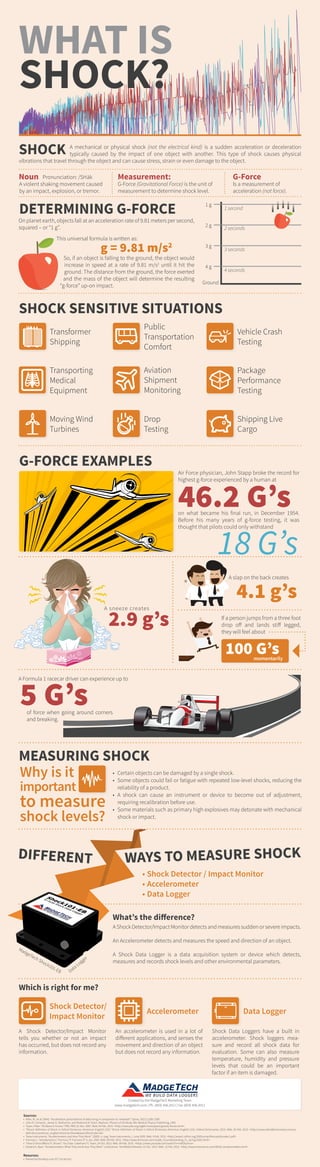
A mechanical or physical shock (not the electrical kind) is a sudden acceleration or deceleration
typically caused by the impact of one object with another. This type of shock causes physical
vibrations that travel through the object and can cause stress, strain or even damage to the object.
SHOCK
SHOCK SENSITIVE SITUATIONS
DETERMINING G-FORCE
Transformer
Shipping
Public
Transportation
Comfort
Transporting
Medical
Equipment
Vehicle Crash
Testing
Aviation
Shipment
Monitoring
Package
Performance
Testing
Shipping Live
Cargo
Moving Wind
Turbines
Drop
Testing
Air Force physician, John Stapp broke the record for
highest g-force experienced by a human at
on what became his final run, in December 1954.
Before his many years of g-force testing, it was
thought that pilots could only withstand
46.2 G’s
4.1 g’s
A slap on the back creates
1 g
2 g
3 g
4 g
Ground
Pronunciation: /SHäk
A violent shaking movement caused
by an impact, explosion, or tremor.
Noun Measurement:
G-Force (Gravitational Force) is the unit of
measurement to determine shock level.
Is a measurement of
acceleration (not force).
G-Force
G-FORCE EXAMPLES
A sneeze creates
If a person jumps from a three foot
drop off and lands stiff legged,
they will feel about
100 G’smomentarily
2.9 g’s
•	 Certain objects can be damaged by a single shock.
•	 Some objects could fail or fatigue with repeated low-level shocks, reducing the
reliability of a product.
•	 A shock can cause an instrument or device to become out of adjustment,
requiring recalibration before use.
•	 Some materials such as primary high explosives may detonate with mechanical
shock or impact.
MEASURING SHOCK
What’s the difference?
Which is right for me?
WAYS TO MEASURE SHOCK
Why is it
important
to measure
shock levels?
DIFFERENT
•	Shock Detector / Impact Monitor
•	Accelerometer
•	Data Logger
A Shock Detector/Impact Monitor detects and measures sudden or severe impacts.
An Accelerometer detects and measures the speed and direction of an object.
A Shock Data Logger is a data acquisition system or device which detects,
measures and records shock levels and other environmental parameters.
A Shock Detector/Impact Monitor
tells you whether or not an impact
has occurred, but does not record any
information.
An accelerometer is used in a lot of
different applications, and senses the
movement and direction of an object
but does not record any information.
Shock Data Loggers have a built in
accelerometer. Shock loggers mea-
sure and record all shock data for
evaluation. Some can also measure
temperature, humidity and pressure
levels that could be an important
factor if an item is damaged.
Sources:
•	 Allen, M., et al (1994). “Acceleration perturbations of daily living: A comparison to ‘whiplash’.” Spine, 19(11):1285-1290.
•	 John R. Cameron, James G. Skofronick, and Roderick M. Grant. Madison. Physics of the Body. WS: Medical Physics Publishing, 1992
•	 Tyson, Peter. “All About G Forces.” PBS. PBS, 01 Nov. 2007. Web. 04 Feb. 2015. <http://www.pbs.org/wgbh/nova/space/gravity-forces.html>.
•	 “Shock: Definition of Shock in Oxford Dictionary (American English) (US).” Shock: Definition of Shock in Oxford Dictionary (American English) (US). Oxford Dictionaries, 2015. Web. 05 Feb. 2015. <http://www.oxforddictionaries.com/us/
definition/american_english/shock?q=Shock&searchDictCode=all>.
•	 Texas Instruments. “Accelerometers and How They Work.” (2005): n. pag. Texas Instruments, 1 June 2005. Web. 9 Feb. 2015. <http://www2.usfirst.org/2005comp/Manuals/Acceler1.pdf>.
•	 Formula 1. “Aerodynamics.” Formula 1®. Formula 1®, 6 Jan. 2003. Web. 09 Feb. 2015. <http://www.formula1.com/inside_f1/understanding_f1_racing/5281.html>.
•	 “How G-force Affects F1 Drivers.” YouTube. Caterham F1 Team, 24 Oct. 2013. Web. 09 Feb. 2015. <https://www.youtube.com/watch?v=nr8Fjhymvis>.
•	 Goodrich, Ryan. “Accelerometers: What They Are & How They Work.” LiveScience. TechMedia Network, 01 Oct. 2013. Web. 12 Feb. 2015. <http://www.livescience.com/40102-accelerometers.html>.
Reources:
•	 freevector/Vecteezy.com (F1 Car Vector)
www.madgetech.com | Ph. (603) 456.2011 | Fax (603) 456.2012
Created by the MadgeTech Marketing Team
MadgeTech Shock101-EB Data Logger
Shock Detector/
Impact Monitor
Accelerometer Data Logger
A Formula 1 racecar driver can experience up to
5 G’sof force when going around corners
and breaking.
On planet earth, objects fall at an acceleration rate of 9.81 meters per second,
squared – or “1 g”.
This universal formula is written as:
So, if an object is falling to the ground, the object would
increase in speed at a rate of 9.81 m/s2
until it hit the
ground. The distance from the ground, the force exerted
and the mass of the object will determine the resulting
“g-force” up-on impact.
18 G’s
2 seconds
1 second
3 seconds
4 seconds
g = 9.81 m/s2

What is Shock?

  • 1.
    WHAT IS SHOCK? A mechanicalor physical shock (not the electrical kind) is a sudden acceleration or deceleration typically caused by the impact of one object with another. This type of shock causes physical vibrations that travel through the object and can cause stress, strain or even damage to the object. SHOCK SHOCK SENSITIVE SITUATIONS DETERMINING G-FORCE Transformer Shipping Public Transportation Comfort Transporting Medical Equipment Vehicle Crash Testing Aviation Shipment Monitoring Package Performance Testing Shipping Live Cargo Moving Wind Turbines Drop Testing Air Force physician, John Stapp broke the record for highest g-force experienced by a human at on what became his final run, in December 1954. Before his many years of g-force testing, it was thought that pilots could only withstand 46.2 G’s 4.1 g’s A slap on the back creates 1 g 2 g 3 g 4 g Ground Pronunciation: /SHäk A violent shaking movement caused by an impact, explosion, or tremor. Noun Measurement: G-Force (Gravitational Force) is the unit of measurement to determine shock level. Is a measurement of acceleration (not force). G-Force G-FORCE EXAMPLES A sneeze creates If a person jumps from a three foot drop off and lands stiff legged, they will feel about 100 G’smomentarily 2.9 g’s • Certain objects can be damaged by a single shock. • Some objects could fail or fatigue with repeated low-level shocks, reducing the reliability of a product. • A shock can cause an instrument or device to become out of adjustment, requiring recalibration before use. • Some materials such as primary high explosives may detonate with mechanical shock or impact. MEASURING SHOCK What’s the difference? Which is right for me? WAYS TO MEASURE SHOCK Why is it important to measure shock levels? DIFFERENT • Shock Detector / Impact Monitor • Accelerometer • Data Logger A Shock Detector/Impact Monitor detects and measures sudden or severe impacts. An Accelerometer detects and measures the speed and direction of an object. A Shock Data Logger is a data acquisition system or device which detects, measures and records shock levels and other environmental parameters. A Shock Detector/Impact Monitor tells you whether or not an impact has occurred, but does not record any information. An accelerometer is used in a lot of different applications, and senses the movement and direction of an object but does not record any information. Shock Data Loggers have a built in accelerometer. Shock loggers mea- sure and record all shock data for evaluation. Some can also measure temperature, humidity and pressure levels that could be an important factor if an item is damaged. Sources: • Allen, M., et al (1994). “Acceleration perturbations of daily living: A comparison to ‘whiplash’.” Spine, 19(11):1285-1290. • John R. Cameron, James G. Skofronick, and Roderick M. Grant. Madison. Physics of the Body. WS: Medical Physics Publishing, 1992 • Tyson, Peter. “All About G Forces.” PBS. PBS, 01 Nov. 2007. Web. 04 Feb. 2015. <http://www.pbs.org/wgbh/nova/space/gravity-forces.html>. • “Shock: Definition of Shock in Oxford Dictionary (American English) (US).” Shock: Definition of Shock in Oxford Dictionary (American English) (US). Oxford Dictionaries, 2015. Web. 05 Feb. 2015. <http://www.oxforddictionaries.com/us/ definition/american_english/shock?q=Shock&searchDictCode=all>. • Texas Instruments. “Accelerometers and How They Work.” (2005): n. pag. Texas Instruments, 1 June 2005. Web. 9 Feb. 2015. <http://www2.usfirst.org/2005comp/Manuals/Acceler1.pdf>. • Formula 1. “Aerodynamics.” Formula 1®. Formula 1®, 6 Jan. 2003. Web. 09 Feb. 2015. <http://www.formula1.com/inside_f1/understanding_f1_racing/5281.html>. • “How G-force Affects F1 Drivers.” YouTube. Caterham F1 Team, 24 Oct. 2013. Web. 09 Feb. 2015. <https://www.youtube.com/watch?v=nr8Fjhymvis>. • Goodrich, Ryan. “Accelerometers: What They Are & How They Work.” LiveScience. TechMedia Network, 01 Oct. 2013. Web. 12 Feb. 2015. <http://www.livescience.com/40102-accelerometers.html>. Reources: • freevector/Vecteezy.com (F1 Car Vector) www.madgetech.com | Ph. (603) 456.2011 | Fax (603) 456.2012 Created by the MadgeTech Marketing Team MadgeTech Shock101-EB Data Logger Shock Detector/ Impact Monitor Accelerometer Data Logger A Formula 1 racecar driver can experience up to 5 G’sof force when going around corners and breaking. On planet earth, objects fall at an acceleration rate of 9.81 meters per second, squared – or “1 g”. This universal formula is written as: So, if an object is falling to the ground, the object would increase in speed at a rate of 9.81 m/s2 until it hit the ground. The distance from the ground, the force exerted and the mass of the object will determine the resulting “g-force” up-on impact. 18 G’s 2 seconds 1 second 3 seconds 4 seconds g = 9.81 m/s2