Models/frameworks/definitions
   One definition of „leadership‟ can been
    described as the “process of social influence in
    which one person can enlist the aid and support
    of others in the accomplishment of a common
    task” (Chemers, 1997).
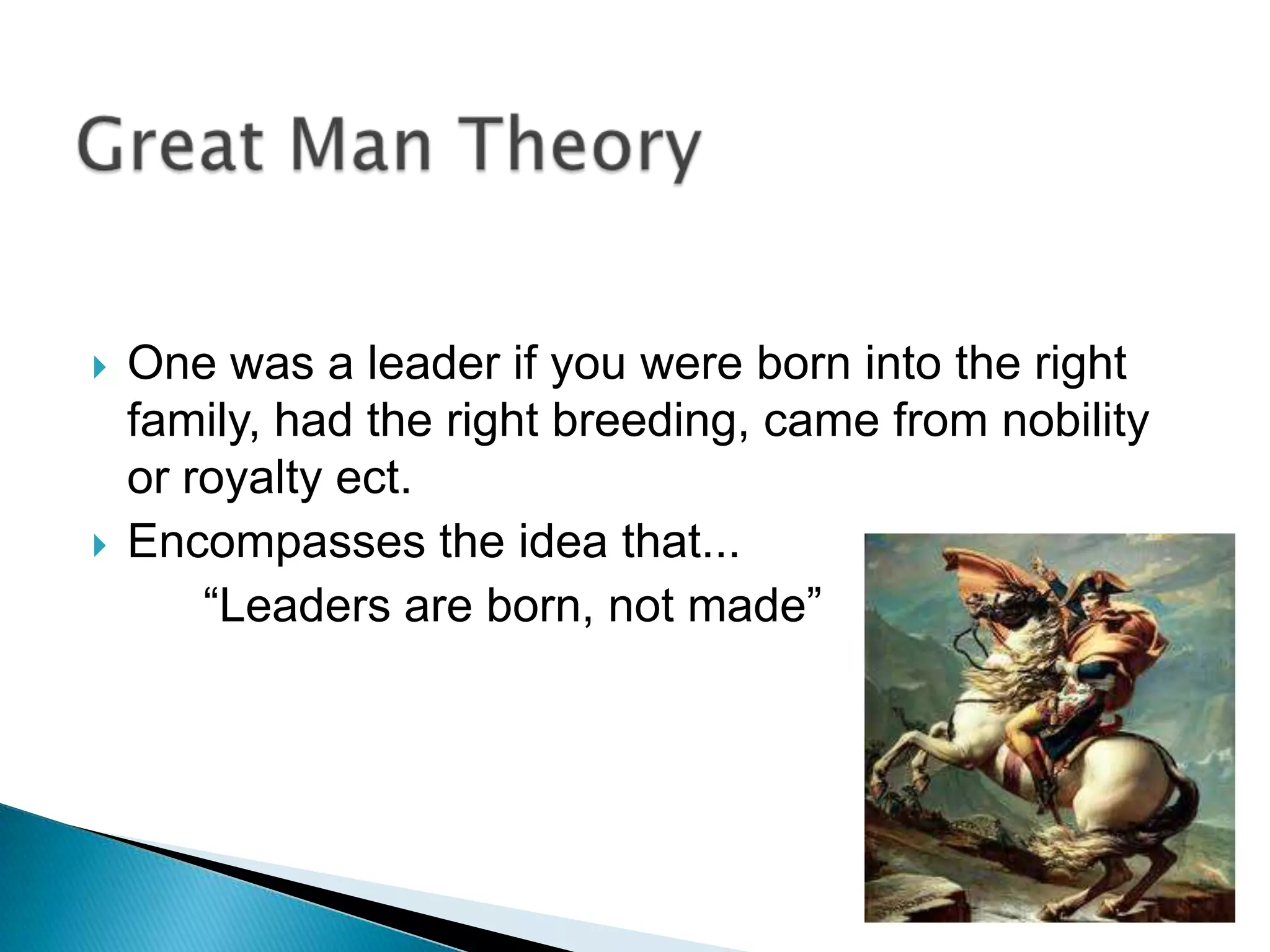
   One was a leader if you were born into the right
    family, had the right breeding, came from nobility
    or royalty ect.
   Encompasses the idea that...
        “Leaders are born, not made”
   An attempt to distinguish leaders as possessing
    extraordinary traits in comparison to others, for
    example: intelligence, dominance, self-
    confidence, high energy level
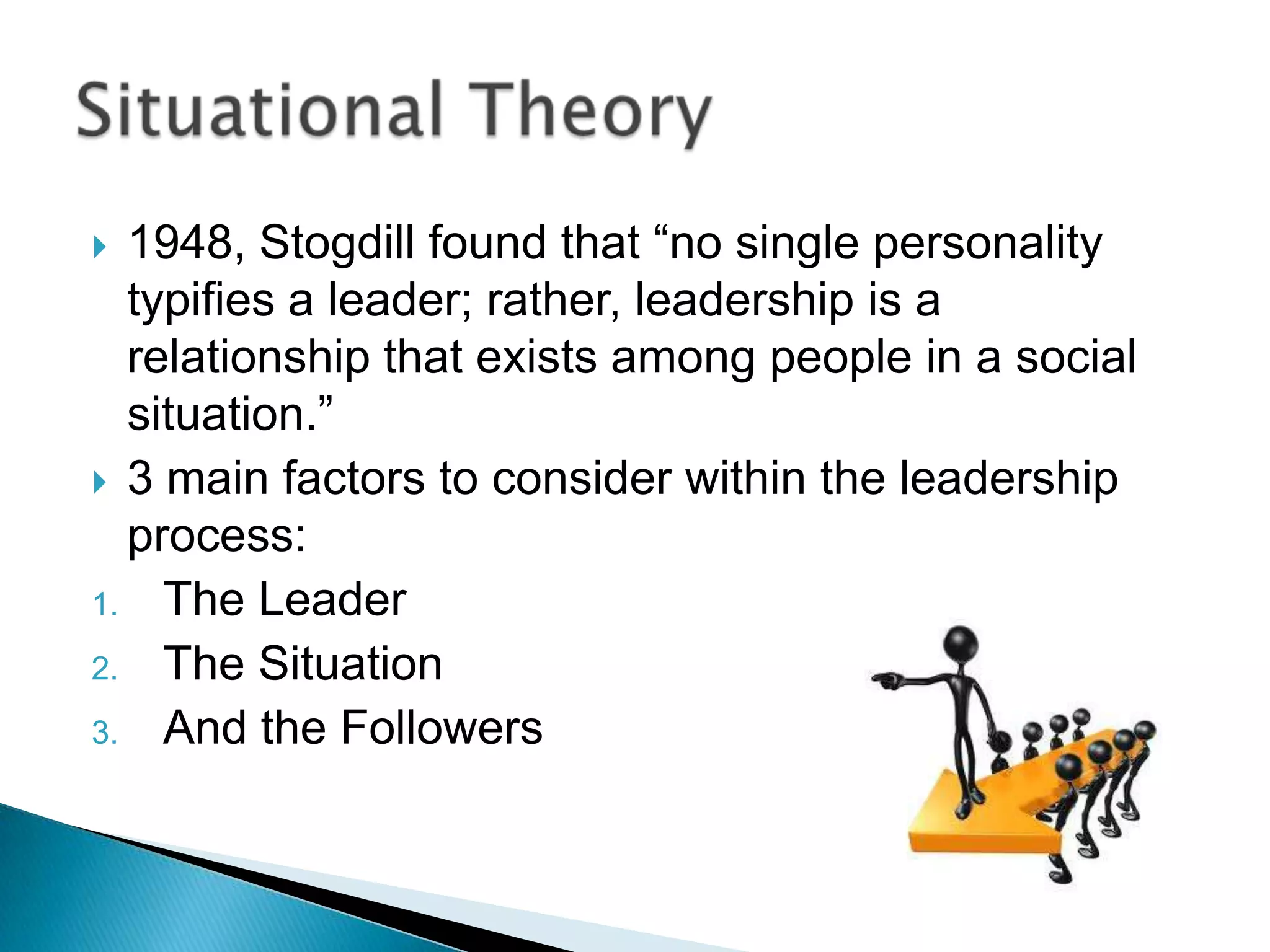
 1948, Stogdill found that “no single personality
  typifies a leader; rather, leadership is a
  relationship that exists among people in a social
  situation.”
 3 main factors to consider within the leadership
  process:
1. The Leader
2. The Situation
3. And the Followers
 Forces within the managers, subordinates and
  situations determine leadership effectiveness, this
  includes:
 Supervisors/Managers:
1. Supervisor‟s view of people, performance and
    status.
2. Degree of confidence held for the subordinates
3. Leadership inclinations
4. Feelings of security in an uncertain situation
    Subordinates:

1.    Need for independence
2.    Readiness to assume responsibility
3.    Expectations to share in decision making
4.    Tolerance for ambiguity
5.    Level of knowledge and experience to deal
      with situations.
    The situation/Forces in the situation:

1.    The organisation‟s values and traditions
2.    The organisation‟s reaction to change
3.    Whether the organisation is dominated by the
      physicians, administrators or nurses
4.    To what extent the group is effective, cohesive
      and able to assume responsibility in different
      situations.
 Based on Fiedler‟s 1985 model...
Model of a given situation:
1. Leader-member relations
2. A task structure
3. A position of power
  Through this theory it is possible to predict the
   most productive leadership style through the
   analysis of the above components and their
   relationship to a critical situation (Grohar-Murray
   & Langan, 2011).
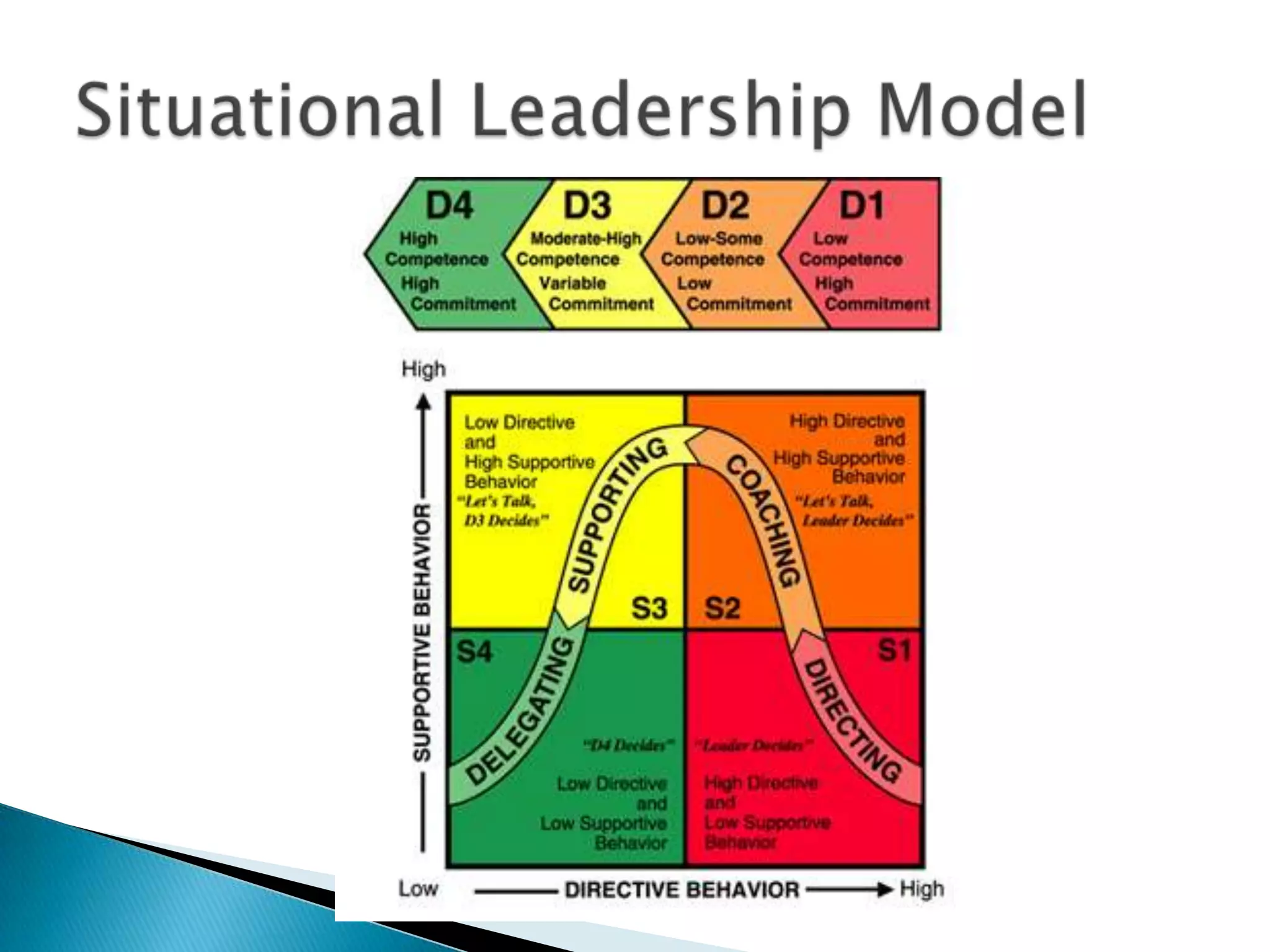
   Encompassed in the Life Cycle Theory of Hersey-
    Blanchard.

   “Leadership behaviour may be predicted on the
    basis of the follower‟s readiness” (Grohar-Murray
    & Langan, 2011).
 Bennis and Nanus (1985) suggested a new theory
  of leadership based on a study they conducted on
  90 leaders, for the purpose of discovering what is
  common to leadership and leaders.
 Found that there are 4 types of “Human Handling
  Skills” common to leaders:
Strategy 1: Attention through vision
Strategy 2: Meaning through communication
Strategy 3: Trust through positioning
Strategy 4: the deployment of self through positive
  self-regard and the Wallenda factor.
(Grohar-Murray & Langan, 2011).
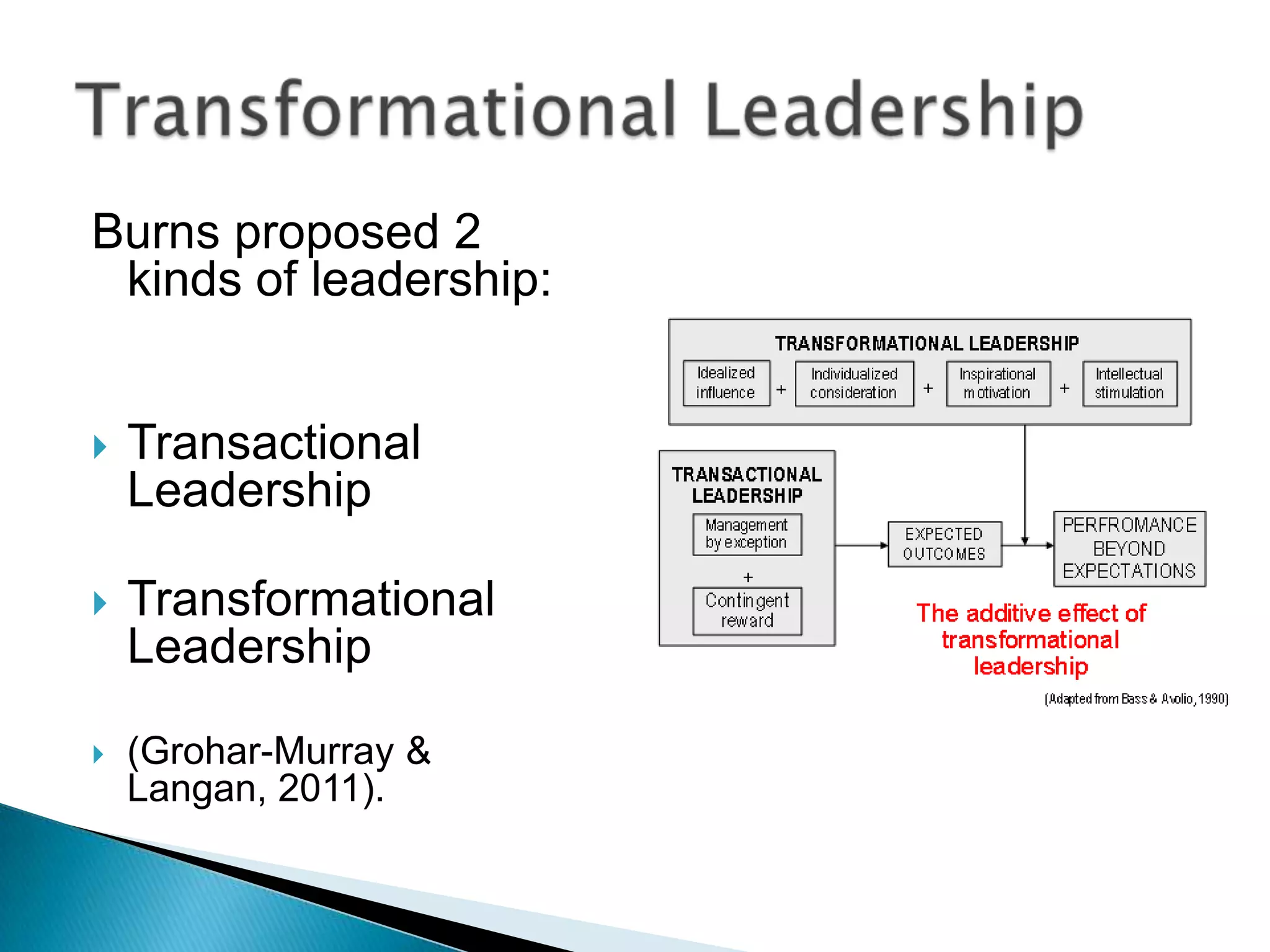
Burns proposed 2
 kinds of leadership:


   Transactional
    Leadership

   Transformational
    Leadership

   (Grohar-Murray &
    Langan, 2011).
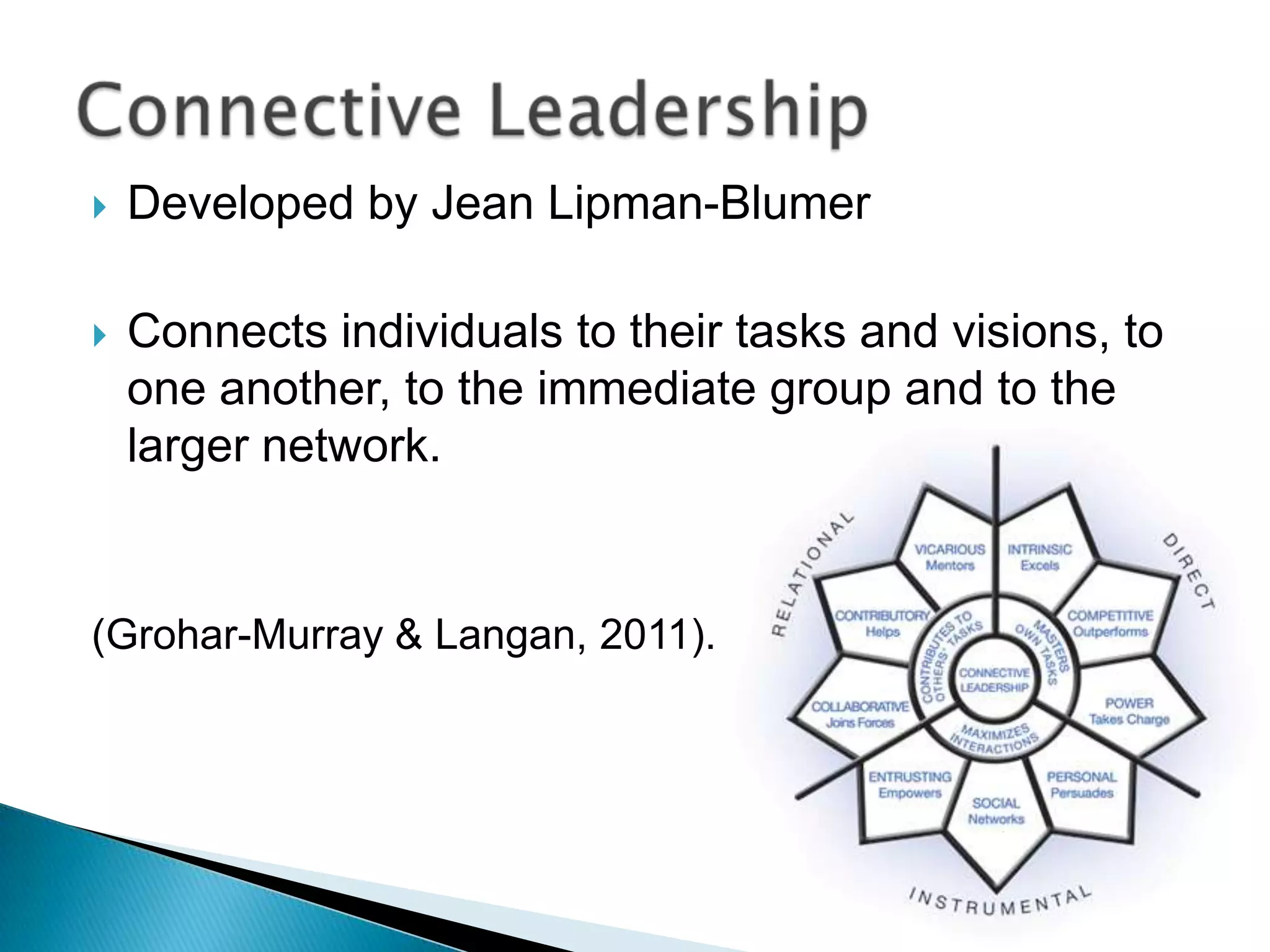
   Developed by Jean Lipman-Blumer

   Connects individuals to their tasks and visions, to
    one another, to the immediate group and to the
    larger network.


(Grohar-Murray & Langan, 2011).
   Stage One: Analysis and problem identification

   Stage Two: Determination of action

   Stage Three: Evaluation of action

(Grohar-Murray & Langan, 2011)

What is leadership? Definitions and models

  • 1.
  • 2.
    One definition of „leadership‟ can been described as the “process of social influence in which one person can enlist the aid and support of others in the accomplishment of a common task” (Chemers, 1997).
  • 3.
    One was a leader if you were born into the right family, had the right breeding, came from nobility or royalty ect.  Encompasses the idea that... “Leaders are born, not made”
  • 4.
    An attempt to distinguish leaders as possessing extraordinary traits in comparison to others, for example: intelligence, dominance, self- confidence, high energy level
  • 5.
     1948, Stogdillfound that “no single personality typifies a leader; rather, leadership is a relationship that exists among people in a social situation.”  3 main factors to consider within the leadership process: 1. The Leader 2. The Situation 3. And the Followers
  • 6.
     Forces withinthe managers, subordinates and situations determine leadership effectiveness, this includes:  Supervisors/Managers: 1. Supervisor‟s view of people, performance and status. 2. Degree of confidence held for the subordinates 3. Leadership inclinations 4. Feelings of security in an uncertain situation
  • 7.
    Subordinates: 1. Need for independence 2. Readiness to assume responsibility 3. Expectations to share in decision making 4. Tolerance for ambiguity 5. Level of knowledge and experience to deal with situations.
  • 8.
    The situation/Forces in the situation: 1. The organisation‟s values and traditions 2. The organisation‟s reaction to change 3. Whether the organisation is dominated by the physicians, administrators or nurses 4. To what extent the group is effective, cohesive and able to assume responsibility in different situations.
  • 9.
     Based onFiedler‟s 1985 model... Model of a given situation: 1. Leader-member relations 2. A task structure 3. A position of power  Through this theory it is possible to predict the most productive leadership style through the analysis of the above components and their relationship to a critical situation (Grohar-Murray & Langan, 2011).
  • 10.
    Encompassed in the Life Cycle Theory of Hersey- Blanchard.  “Leadership behaviour may be predicted on the basis of the follower‟s readiness” (Grohar-Murray & Langan, 2011).
  • 12.
     Bennis andNanus (1985) suggested a new theory of leadership based on a study they conducted on 90 leaders, for the purpose of discovering what is common to leadership and leaders.  Found that there are 4 types of “Human Handling Skills” common to leaders: Strategy 1: Attention through vision Strategy 2: Meaning through communication Strategy 3: Trust through positioning Strategy 4: the deployment of self through positive self-regard and the Wallenda factor. (Grohar-Murray & Langan, 2011).
  • 13.
    Burns proposed 2 kinds of leadership:  Transactional Leadership  Transformational Leadership  (Grohar-Murray & Langan, 2011).
  • 14.
    Developed by Jean Lipman-Blumer  Connects individuals to their tasks and visions, to one another, to the immediate group and to the larger network. (Grohar-Murray & Langan, 2011).
  • 15.
    Stage One: Analysis and problem identification  Stage Two: Determination of action  Stage Three: Evaluation of action (Grohar-Murray & Langan, 2011)

Editor's Notes

  • #3 Chemers M. (1997) An integrative theory of leadership. Lawrence Erlbaum Associates, Publishers. ISBN 9780805826791One definition of ‘leadership’ can been described as the “process of social influence in which one person can enlist the aid and support of others in the accomplishment of a common task” (Chemers, 1997).
  • #4 Grossman, S.C. & Valiga, T.M. (2009).The new leadership challenge: Creating the future of nursing. 3rd (ed). FA Davis Company: Philadelphia. Great Man Theory – encompasses the idea that one was a leader if you were born into the right family, had the right breeding, came from nobility or royalty.It is embodied in the idea that... “Leaders are born, not made”
  • #5 Grossman, S.C. & Valiga, T.M. (2009).The new leadership challenge: Creating the future of nursing. 3rd (ed). FA Davis Company: Philadelphia. Theofanidis, D. &Dikatpanidou, S. (2006). Leadership in nursing. ICUS Nursing Web Journal, 25(1). Until the mid-1940s, this theory was the basis for most leadership research. Early work in this area maintained that traits are inherited, but later theories suggested that traits could be obtained through learning and experience.
  • #6 Grohar-Murray, M.E. & Langan, J. (2011). Leadership and management in nursing. 4th (ed). Pearson Education Inc: New Jersey. 1948, Stogdill found that “no single personality typifies a leader; rather, leadership is a relationship that exists among people in a social situation.” Therefore encompassing the idea that a person may be a leader in one situation and not in another. 3 main factors to consider within the leadership process: The LeaderThe SituationAnd the Followers
  • #7 Grohar-Murray, M.E. & Langan, J. (2011). Leadership and management in nursing. 4th (ed). Pearson Education Inc: New Jersey. Forces within the managers, subordinates and situations determine leadership effectiveness, this includes: Supervisors/Managers: Supervisor’s view of people, performance and status.Degree of confidence held for the subordinatesLeadership inclinationsFeelings of security in an uncertain situation
  • #8 Grohar-Murray, M.E. & Langan, J. (2011). Leadership and management in nursing. 4th (ed). Pearson Education Inc: New Jersey. Subordinates:Need for independenceReadiness to assume responsibilityExpectations to share in decision makingTolerance for ambiguityLevel of knowledge and experience to deal with situations.
  • #9 Grohar-Murray, M.E. & Langan, J. (2011). Leadership and management in nursing. 4th (ed). Pearson Education Inc: New Jersey. The situation/Forces in the situation:The organisation’s values and traditionsThe organisation’s reaction to changeWhether the organisation is dominated by the physicians, administrators or nursesTo what extent the group is effective, cohesive and able to assume responsibility in different situations.
  • #10 Grohar-Murray, M.E. & Langan, J. (2011). Leadership and management in nursing. 4th (ed). Pearson Education Inc: New Jersey. The contingency model is based on Fiedler’s 1985 model:A three dimensional model of a given situation:Leader-member relations – includes the amount of confidence and loyalty followers have in their leadersA task structure – is the number of correct solutions to a given situational dilemmaA position of power – refers to the amount of organisational support available to the leaderThrough this theory it is possible to predict the most productive leadership style through the analysis of the above components and their relationship to a critical situation (Grohar-Murray & Langan, 2011).
  • #11 Grohar-Murray, M.E. & Langan, J. (2011). Leadership and management in nursing. 4th (ed). Pearson Education Inc: New Jersey. Situational Leadership Model: Encompassed in the Life Cycle Theory of Hersey-Blanchard.“Leadership behaviour may be predicted on the basis of the follower’s readiness” (Grohar-Murray & Langan, 2011).
  • #12 http://elmundopequeno.wordpress.com/2010/10/03/situational-leadership/Themodel has 4 quadrants representing the degree of emphasis on relationship behaviour and task behaviour. Leadership behaviours are delegating, supporting, coaching and directing. According to this model the leader will alter the style of leadership based on an analysis of the follower’s readiness.
  • #13 Grohar-Murray, M.E. & Langan, J. (2011). Leadership and management in nursing. 4th (ed). Pearson Education Inc: New Jersey. New Theory of Leadership:In 1985, Bennis and Nanus suggested a new theory of leadership based on a study they conducted on 90 leaders, for the purpose of discovering what is common to leadership and leaders. Found that there are 4 types of “Human Handling Skills” common to leaders: Strategy 1: Attention through vision – Ability of the leader to create a focus or a clear picture of outcomeStrategy 2: Meaning through communication – Ability of the leader to translate their ideas into symbols with real meaning Strategy 3: Trust through positioning – Ability of the leader to inspire trust in others by contributing to the organisation’s integrity, also reflects the leader’s ability to stay consistently on task. Strategy 4: the deployment of self through positive self-regard and the Wallenda factor: this includes the idea that the leader leads in their own personal way, and reflects the leader’s positive self-image and self-respect. The Wallenda factor encompasses the idea that attitudes influence an outcome.
  • #14 Grohar-Murray, M.E. & Langan, J. (2011). Leadership and management in nursing. 4th (ed). Pearson Education Inc: New Jersey. http://www.gu.edu.lb/ETAG/bok-5.htmThe theorist Burns proposed 2 kinds of leadership:Transactional Leadership – one person takes the initiative for the exchange, with both the leader and the follower having separate but related purposes and their differences are the focus of the system. Transformational Leadership – Both the leader and the followers have the same purpose and raise one another to higher levels of performance. Leaders mobilise others and grow and develop with their followers. There is an emphasis on the outcome because the process of achieving the outcome changes.
  • #15 Grohar-Murray, M.E. & Langan, J. (2011). Leadership and management in nursing. 4th (ed). Pearson Education Inc: New Jersey. Image taken from: http://www.achievingstyles.com/asi/connective_leadership.aspConnective Leadership is based on an idea developed by Jean Lipman-Blumer...Connects individuals to their tasks and visions, to one another, to the immediate group and to the larger network. Emphasis is on the need for a leader to cope with the requirements of the multiple levels connected.
  • #16 Grohar-Murray, M.E. & Langan, J. (2011). Leadership and management in nursing. 4th (ed). Pearson Education Inc: New Jersey. Grohar-Murray& Langan in their text: Leadership and management in nursing, proposed the idea of a process model of leadership for the beginning student to the topic of leadership, this model have three stages...Stage One: Analysis and problem identification – categorises elements of the problem or event, the participants and the organisational factorsStage Two: Determination of action – considers the defined problem and categorises information about it based on specific information including what, who and how best to solve the problem. Stage Three: Evaluation of action taken and suitability to the task.