Unit – 3:
Leadership
By Radhika
Faculty of Commerce and Management
JHBWC
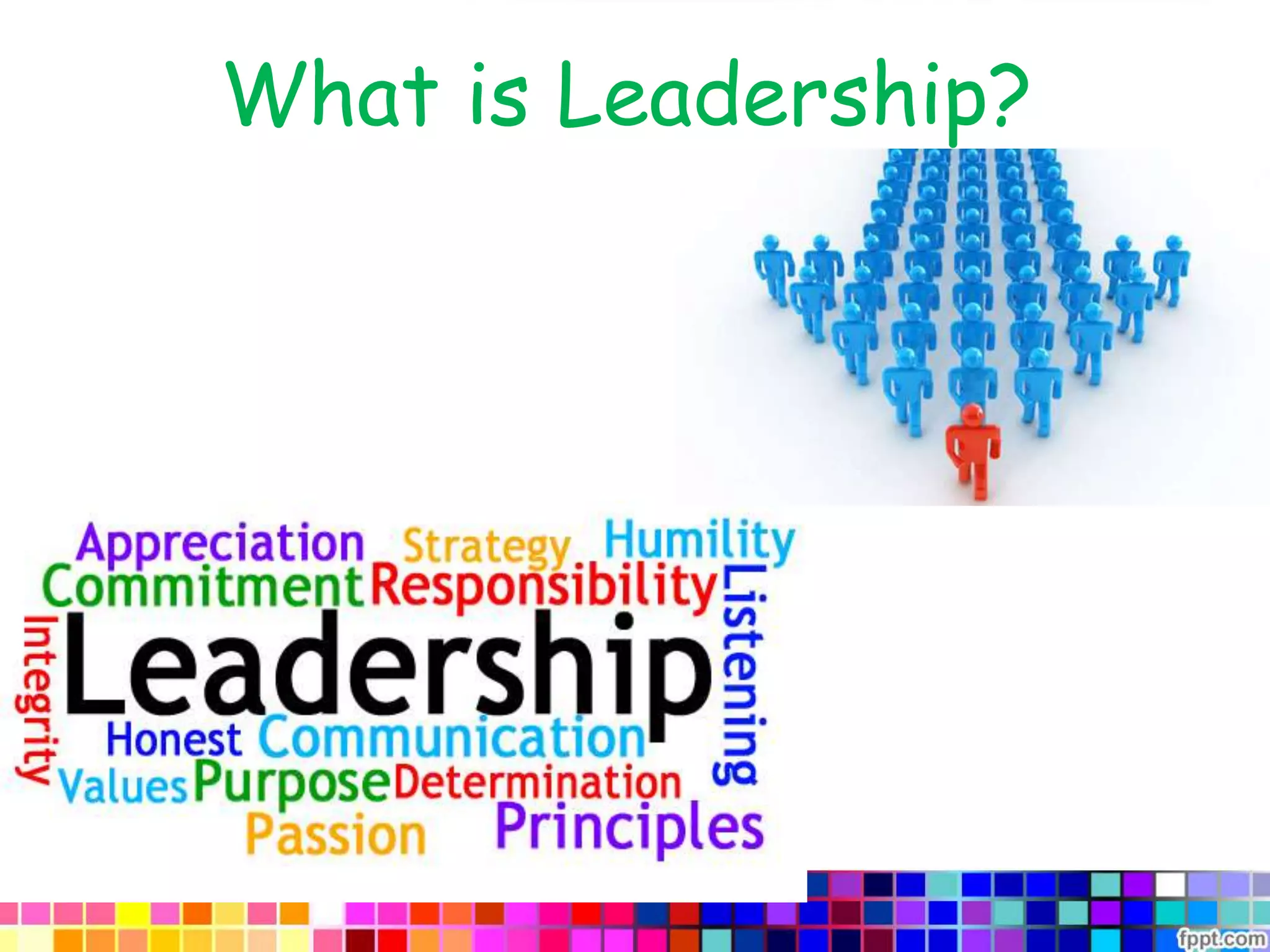
What is Leadership?
Introduction
 Integral Part of work as well as Social Life
 Leader is required to do any kind of work
 Weather it is formal or informal, leader influences people to
work towards common goals.
 People have to be guided with Zeal and confidence
Meaning
 Leadership is a process by which a person influences others to
accomplish an objective and directs the organization more to
make it more cohesive and coherent.
 It is the ability to build confidence and zeal among people and
create an urge in them to be led.
 In corporate terms, leadership is the process by which an
executive imaginatively directs, guides & influences the work
of others in choosing attaining specified goals by mediating
between individuals and the organization in such a manner that
both obtain maximum benefit.
Definition
1. Leadership is an activity controlling the voluntary efforts of
people achieving corresponding objectives.
-George R Terry
2. Leadership is an activity of skillful effort to be induced to
achieve the general goals.
-Livingston
3. Leadership is an activity of influencing people so that they
will strive willingly towards achievement of group goals.
-Koontz & O’Donnel
Nature of Leadership
1. Depends upon personal traits
2. It is situational
3. Leadership vs. management
4. It is function
5. Role model
6. Leaders are also followers
7. Pervasive function
8. It aims at goal achievement
Leadership Styles
On The Basis Of Rewards
1. Positive Leaders
2. Negative Leaders
On The Basis Of Power
1. Autocratic Leaders
2. Participative Leaders [Democratic]
Cont.
 On The Basis Of Rewards
1. Positive Leaders
 Motivate their employees through rewards
2. Negative Leaders
 They use penalties and punishment s as means of motivation
NO LEADER CAN BE FULLY POSITIVE OR NEGATIVE
Cont.
 On The Basis Of Power
1. Autocratic Leaders:
 Make decisions and issue orders by virtue of authority & position
 Hold authority & responsibility
 Can use both positive & negative motivation
 When he wants how he wants what he wants
 Bossing people
2. Participative Leaders [Democratic]
 Involvement of employees in decision making
 Employees will respect instead of felt threat
 Mutual benefit
Trait theories
• Trait theories: this theory was described by Kelly 1974. it was
an attempt to classify what personal characteristics such as
physical, mental and relating to personality are associated
with the success of leadership.
• Is there a set of characteristics that determine a good leader?
– Personality?
– Charisma?
– Self confidence?
– Achievement?
– Ability to formulate a clear vision?
cont…
• According to this theory, there are certain personal qualities &
traits which are essential to be a successful leader.
• Psychologically better, good judgments and involve in social
activities.
• Share more n more information.
• This theory believes that leadership traits are inherited and
cannot be learned.
Behavioural Theory
• The limitations of Trait Theory led to a significant change in the
leadership approach.
• In this theory full focus is on the actual behavior and actions of
leaders instead of their personal qualities.
• This theory emphasis on what the leaders do and how they behave
to become effective leaders.
• According to trait theory leadership is inherited but according to
behavior theory leadership can be learned.
• Several attempts have been made to identify the dimensions of
leader behavior. The most systematic and comprehensive studies in
this direction were conducted in USA at Ohio State University and
University of Michigan during 1945-47.
Fiedler’s Contingency Model
of Leadership
• After a long and painstaking research Fiedler argued that
effectiveness of leadership depends on the combination of a
leader’s personality and the situation in which he functions.
Situational variables are described by Fiedler in terms of following
three dimensions:
1. Leader Member Relationship: the extent to which the leader is
accepted, respected and trusted by members of his work group.
2. Task Structure: the extent to which the jobs of members of the
work group are defined and known.
3. Position Power: the extent of formal authority commanded by the
leader and also the rewards and penalties he can dispense to
members.
Hersey & Blanchard’s
Situational Theory
• This model is developed by Paul Hersey & Ken Blanchard. This
theory has been used by nearly 500 companies. It has been widely
accepted in all the military services.
• This theory focuses on the followers. Successful leadership is
achieved by selecting the right leadership style, which is
contingent on the level of followers readiness or maturity.
• Situational leadership uses the same two leadership dimensions
that Fiedler identified: Task and relationship behavior.
• However Hersey & Balanchard go a step further by considering
each as either high or low and then combining them into 4 specific
leader behaviors; telling, selling, participating, delegating.
Contd…
1. Telling (high-task-low relationship): the leader defines roles
and tells people what, how, when, and where to do various
tasks. It emphasizes direct behavior.
2. Selling (high-task high relationship): the leader provides both
supportive as well as directive behavior.
3. Participating (low-task-high relationship): the leader and
follower share in decision making, with the main role of the
leader being facilitating and communicating.
4. Delegating (low-task-low relationship): the leader provides
little direction and support.
Contd…
The final component in Hersey & Balanchard’s theory is defining
4 stages of follower readiness:
1. R1: people are both unable and unwilling to take
responsibility to do something. They are neither competent
nor confident.
2. R2: people are unable but willing to do the necessary job
tasks. They are motivated but currently lack the apropriate
skills.
3. R3: people are able but unwilling to do what the leader wnts.
4. R4: people are both able and willing to do what is asked of
them.
Hersey & Blanchard's
Situational Model
(High)
(Low)
Relationship
Behavior
High
Relationship
& low task
High task
&High
Relationship
Low
Relationship
& low task
Low
Relationship
& High task
(SupportiveBehavior)
Task Behavior
(Directive Behavior)
(High)
Mature Immatur
e
High LowModerates
R4 R3 R2 R1
Managerial Grid
• This theory is propounded by Robert R. black & Jane S. Mouton.
• Managerial Grid is a graphic model of alternative combinations
of managerial styles or behaviors on a 2 dimensional space.
• The 2 styles are :
1. concern for people
2. concern for production
• According to this theory, leaders are most effective when they
achieve a high & balanced concerned for people and for task.
• These are shown on vertical and horizontal dimensions of the
Grid on a 1 to 9 scale or degree.
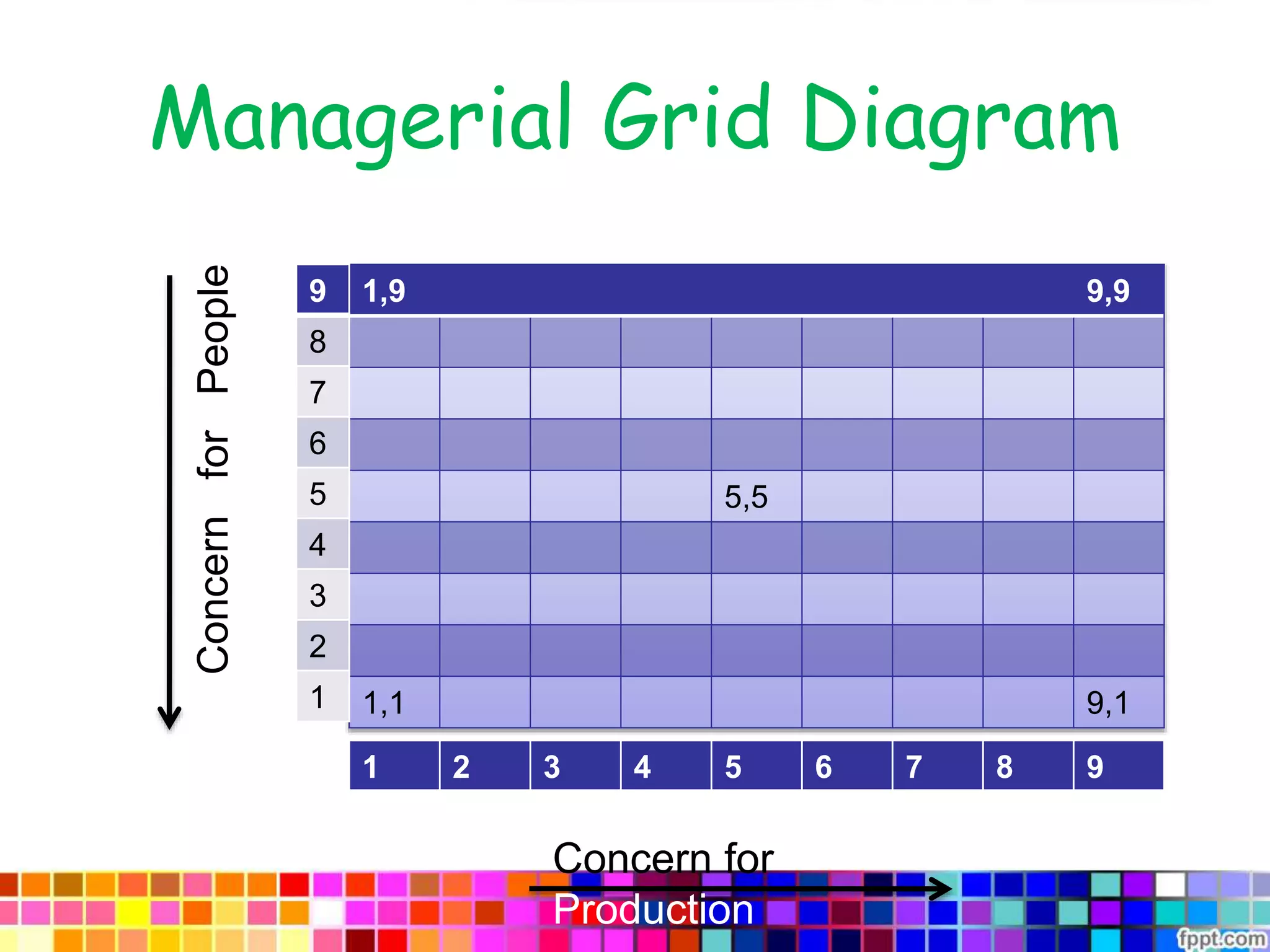
Managerial Grid Diagram
1,9 9,9
5,5
1,1 9,1
9
8
7
6
5
4
3
2
1
1 2 3 4 5 6 7 8 9
Concern for
Production
ConcernforPeople
Contd…
Although there can be 81 possible combinations (9*9), but for
illustrative purposes they have identified 5 combinations of
styles. These are as follows:
• Impoverished leadership: 1,1 low concern for production as
well as for people.
• Country club leadership: 1,9 low concern for production and
high concern for people.
• Task leadership : 9,1 high concern for production and low
concern for people.
• Middle of the row leadership: 5,5 moderate concern for
production and people.
• Team Leadership: 9,9 high concern for production and people.
Likert’s Management
Systems
• Rensis Likert of Michigan University USA and his associates made
extensive research on management and leadership patterns in a large
number of organizations.
• Likert evolved 4 models of management as systems of management.
His system are:
system 1 : Exploitative – authoritative
system 2 : Benevolent – authoritative
system 3 : Consultative
system 4 : Participative – Democratic
• Likert found that most individual managers and organization fit into
one or the other of his systems in terms of certain operating
characteristics as goal setting, decision making, motivation,
leadership, communication and control.
M com unit 3 leadership

M com unit 3 leadership

  • 1.
    Unit – 3: Leadership ByRadhika Faculty of Commerce and Management JHBWC
  • 2.
  • 3.
    Introduction  Integral Partof work as well as Social Life  Leader is required to do any kind of work  Weather it is formal or informal, leader influences people to work towards common goals.  People have to be guided with Zeal and confidence
  • 4.
    Meaning  Leadership isa process by which a person influences others to accomplish an objective and directs the organization more to make it more cohesive and coherent.  It is the ability to build confidence and zeal among people and create an urge in them to be led.  In corporate terms, leadership is the process by which an executive imaginatively directs, guides & influences the work of others in choosing attaining specified goals by mediating between individuals and the organization in such a manner that both obtain maximum benefit.
  • 5.
    Definition 1. Leadership isan activity controlling the voluntary efforts of people achieving corresponding objectives. -George R Terry 2. Leadership is an activity of skillful effort to be induced to achieve the general goals. -Livingston 3. Leadership is an activity of influencing people so that they will strive willingly towards achievement of group goals. -Koontz & O’Donnel
  • 6.
    Nature of Leadership 1.Depends upon personal traits 2. It is situational 3. Leadership vs. management 4. It is function 5. Role model 6. Leaders are also followers 7. Pervasive function 8. It aims at goal achievement
  • 7.
    Leadership Styles On TheBasis Of Rewards 1. Positive Leaders 2. Negative Leaders On The Basis Of Power 1. Autocratic Leaders 2. Participative Leaders [Democratic]
  • 8.
    Cont.  On TheBasis Of Rewards 1. Positive Leaders  Motivate their employees through rewards 2. Negative Leaders  They use penalties and punishment s as means of motivation NO LEADER CAN BE FULLY POSITIVE OR NEGATIVE
  • 9.
    Cont.  On TheBasis Of Power 1. Autocratic Leaders:  Make decisions and issue orders by virtue of authority & position  Hold authority & responsibility  Can use both positive & negative motivation  When he wants how he wants what he wants  Bossing people 2. Participative Leaders [Democratic]  Involvement of employees in decision making  Employees will respect instead of felt threat  Mutual benefit
  • 10.
    Trait theories • Traittheories: this theory was described by Kelly 1974. it was an attempt to classify what personal characteristics such as physical, mental and relating to personality are associated with the success of leadership. • Is there a set of characteristics that determine a good leader? – Personality? – Charisma? – Self confidence? – Achievement? – Ability to formulate a clear vision?
  • 11.
    cont… • According tothis theory, there are certain personal qualities & traits which are essential to be a successful leader. • Psychologically better, good judgments and involve in social activities. • Share more n more information. • This theory believes that leadership traits are inherited and cannot be learned.
  • 12.
    Behavioural Theory • Thelimitations of Trait Theory led to a significant change in the leadership approach. • In this theory full focus is on the actual behavior and actions of leaders instead of their personal qualities. • This theory emphasis on what the leaders do and how they behave to become effective leaders. • According to trait theory leadership is inherited but according to behavior theory leadership can be learned. • Several attempts have been made to identify the dimensions of leader behavior. The most systematic and comprehensive studies in this direction were conducted in USA at Ohio State University and University of Michigan during 1945-47.
  • 13.
    Fiedler’s Contingency Model ofLeadership • After a long and painstaking research Fiedler argued that effectiveness of leadership depends on the combination of a leader’s personality and the situation in which he functions. Situational variables are described by Fiedler in terms of following three dimensions: 1. Leader Member Relationship: the extent to which the leader is accepted, respected and trusted by members of his work group. 2. Task Structure: the extent to which the jobs of members of the work group are defined and known. 3. Position Power: the extent of formal authority commanded by the leader and also the rewards and penalties he can dispense to members.
  • 14.
    Hersey & Blanchard’s SituationalTheory • This model is developed by Paul Hersey & Ken Blanchard. This theory has been used by nearly 500 companies. It has been widely accepted in all the military services. • This theory focuses on the followers. Successful leadership is achieved by selecting the right leadership style, which is contingent on the level of followers readiness or maturity. • Situational leadership uses the same two leadership dimensions that Fiedler identified: Task and relationship behavior. • However Hersey & Balanchard go a step further by considering each as either high or low and then combining them into 4 specific leader behaviors; telling, selling, participating, delegating.
  • 15.
    Contd… 1. Telling (high-task-lowrelationship): the leader defines roles and tells people what, how, when, and where to do various tasks. It emphasizes direct behavior. 2. Selling (high-task high relationship): the leader provides both supportive as well as directive behavior. 3. Participating (low-task-high relationship): the leader and follower share in decision making, with the main role of the leader being facilitating and communicating. 4. Delegating (low-task-low relationship): the leader provides little direction and support.
  • 16.
    Contd… The final componentin Hersey & Balanchard’s theory is defining 4 stages of follower readiness: 1. R1: people are both unable and unwilling to take responsibility to do something. They are neither competent nor confident. 2. R2: people are unable but willing to do the necessary job tasks. They are motivated but currently lack the apropriate skills. 3. R3: people are able but unwilling to do what the leader wnts. 4. R4: people are both able and willing to do what is asked of them.
  • 17.
    Hersey & Blanchard's SituationalModel (High) (Low) Relationship Behavior High Relationship & low task High task &High Relationship Low Relationship & low task Low Relationship & High task (SupportiveBehavior) Task Behavior (Directive Behavior) (High) Mature Immatur e High LowModerates R4 R3 R2 R1
  • 18.
    Managerial Grid • Thistheory is propounded by Robert R. black & Jane S. Mouton. • Managerial Grid is a graphic model of alternative combinations of managerial styles or behaviors on a 2 dimensional space. • The 2 styles are : 1. concern for people 2. concern for production • According to this theory, leaders are most effective when they achieve a high & balanced concerned for people and for task. • These are shown on vertical and horizontal dimensions of the Grid on a 1 to 9 scale or degree.
  • 19.
    Managerial Grid Diagram 1,99,9 5,5 1,1 9,1 9 8 7 6 5 4 3 2 1 1 2 3 4 5 6 7 8 9 Concern for Production ConcernforPeople
  • 20.
    Contd… Although there canbe 81 possible combinations (9*9), but for illustrative purposes they have identified 5 combinations of styles. These are as follows: • Impoverished leadership: 1,1 low concern for production as well as for people. • Country club leadership: 1,9 low concern for production and high concern for people. • Task leadership : 9,1 high concern for production and low concern for people. • Middle of the row leadership: 5,5 moderate concern for production and people. • Team Leadership: 9,9 high concern for production and people.
  • 21.
    Likert’s Management Systems • RensisLikert of Michigan University USA and his associates made extensive research on management and leadership patterns in a large number of organizations. • Likert evolved 4 models of management as systems of management. His system are: system 1 : Exploitative – authoritative system 2 : Benevolent – authoritative system 3 : Consultative system 4 : Participative – Democratic • Likert found that most individual managers and organization fit into one or the other of his systems in terms of certain operating characteristics as goal setting, decision making, motivation, leadership, communication and control.