BASIC
ACCOUNTING
Presented By
Shikha Shrivastava
 Accounting is a means of collecting, summarising,
analysing and reporting in monetary terms, information
about business.
“R.N. Anthony”
 Accounting is a means of reporting the result of economic
activities.
“ Smith and Ashburne”
1. To know profit or loss in business
2. To know the worth of assets and liabilities of a
business
3. To know the position of cash
4. To satisfy taxation authority
5. To know financial condition
6. To know what amount is paid to particular person or
received by particular person on a particular date
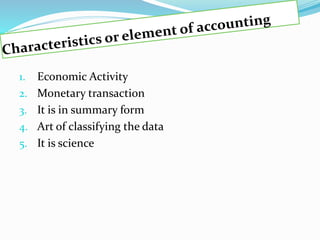
1. Economic Activity
2. Monetary transaction
3. It is in summary form
4. Art of classifying the data
5. It is science
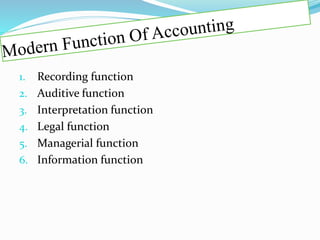
1. Recording function
2. Auditive function
3. Interpretation function
4. Legal function
5. Managerial function
6. Information function
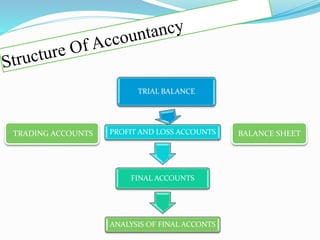
TRIAL BALANCE
PROFIT AND LOSS ACCOUNTS
FINAL ACCOUNTS
ANALYSIS OF FINAL ACCONTS
TRADING ACCOUNTS BALANCE SHEET
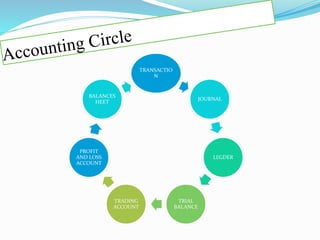
TRANSACTIO
N
JOURNAL
LEGDER
TRIAL
BALANCE
TRADING
ACCOUNT
PROFIT
AND LOSS
ACCOUNT
BALANCES
HEET
1) Personal accounting
Invidiual,firms, Companies,bank,corporation
RULE
Debit the receiver’s account
 credit the payer’s account
For example
Mohan a/c, sheetal a/c
2.Real account
 Cash, Land, Building ,Patent , Goodwill Etc.
RULE
 Debit the account what comes in
 Credit the account of what goes out
For example
Furniture is purchase for cash.
Furniture is received and cash is going out (paid)
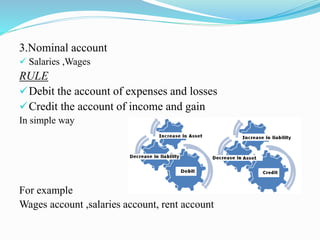
3.Nominal account
 Salaries ,Wages
RULE
Debit the account of expenses and losses
Credit the account of income and gain
In simple way
For example
Wages account ,salaries account, rent account
Accounting refers to the
actual process
of preparing and presenting
the accounts in a scientific and
systematic manner
In the shape of final accounts.
What    is   accounting

What is accounting

  • 1.
  • 2.
     Accounting isa means of collecting, summarising, analysing and reporting in monetary terms, information about business. “R.N. Anthony”  Accounting is a means of reporting the result of economic activities. “ Smith and Ashburne”
  • 3.
    1. To knowprofit or loss in business 2. To know the worth of assets and liabilities of a business 3. To know the position of cash 4. To satisfy taxation authority 5. To know financial condition 6. To know what amount is paid to particular person or received by particular person on a particular date
  • 4.
    1. Economic Activity 2.Monetary transaction 3. It is in summary form 4. Art of classifying the data 5. It is science
  • 5.
    1. Recording function 2.Auditive function 3. Interpretation function 4. Legal function 5. Managerial function 6. Information function
  • 6.
    TRIAL BALANCE PROFIT ANDLOSS ACCOUNTS FINAL ACCOUNTS ANALYSIS OF FINAL ACCONTS TRADING ACCOUNTS BALANCE SHEET
  • 7.
  • 8.
    1) Personal accounting Invidiual,firms,Companies,bank,corporation RULE Debit the receiver’s account  credit the payer’s account For example Mohan a/c, sheetal a/c
  • 9.
    2.Real account  Cash,Land, Building ,Patent , Goodwill Etc. RULE  Debit the account what comes in  Credit the account of what goes out For example Furniture is purchase for cash. Furniture is received and cash is going out (paid)
  • 10.
    3.Nominal account  Salaries,Wages RULE Debit the account of expenses and losses Credit the account of income and gain In simple way For example Wages account ,salaries account, rent account
  • 12.
    Accounting refers tothe actual process of preparing and presenting the accounts in a scientific and systematic manner In the shape of final accounts.