Big Data
Big data refers to extremely large and complex data sets that cannot be easily
managed or analyzed using traditional data processing methods.
It includes structured, semi-structured, and unstructured data from various sources
such as social media, sensors, and machines.
Big data is characterized by 5Vs: volume (large amount of data), velocity (high
speed at which data is generated), value, veracity, volume, and variety (diverse
type of course).
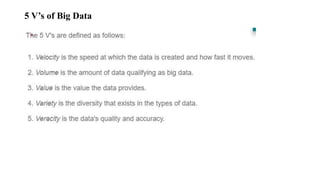
5 V’s of Big Data
Importance of Big data
Big data has become increasingly important in various fields, including
business, healthcare, finance, and marketing.
It allows organizations to gain valuable insights, make data-driven
decisions, and improve efficiency and productivity.
Big data analysis can help identify patterns, trends, and correlations that
were previously unknown, leading to better predictions and strategic
planning.
Challenges of Big Data
Big data poses several challenges, including data storage and
management, data quality and integrity, data privacy and security, and
data analysis.
Traditional data processing tools and techniques are often insufficient to
handle the volume, velocity, value, veracity and variety of big data.
Extracting meaningful insights from big data requires advanced
analytics methods, such as machine learning, and artificial intelligence.
Benefits of Big Data
Big data analytics can help organizations improve customer experience, personalize
marketing campaign, and optimize operations.
It enables real-time monitoring and analysis, allowing for quick decision-making
and problem-solving.
Big data can also contribute to scientific research, social good initiatives, and public
policy by providing valuable insights into various domains.
Applications of Big Data
Big data is widely used in areas such as e-commerce, social media, healthcare,
finance, transportation, and smart cities.
It helps companies understand customer behavior, optimize supply chains, detect
fraud, and enhance cybersecurity.
Big data is also utilized in scientific research, weather forecasting, urban planning,
and environmental monitoring.
Ethical considerations of Big Data
The use of big data raises ethical concerns related to privacy, consent, transparency,
and bias.
Organizations must ensure the responsible and ethical use of data, protecting
individuals privacy rights and avoiding discrimination.
Regulations and guidelines, such as the General Data Protection Regulation
(GDPR), aim to address these ethical considerations.
Future trends in Big data
Big data will continue to grow exponentially with the advancement of technology
and the increasing interconnectedness of devices.
Artificial intelligence and machine learning will play a crucial role in analyzing and
extracting insights from big data.
The integration of big data with emerging technologies like the internet of things
(IoT) and blockchain will further expand its applications.
Examples of Big Data
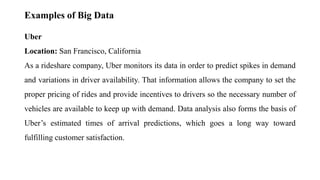
Uber
Location: San Francisco, California
As a rideshare company, Uber monitors its data in order to predict spikes in demand
and variations in driver availability. That information allows the company to set the
proper pricing of rides and provide incentives to drivers so the necessary number of
vehicles are available to keep up with demand. Data analysis also forms the basis of
Uber’s estimated times of arrival predictions, which goes a long way toward
fulfilling customer satisfaction.
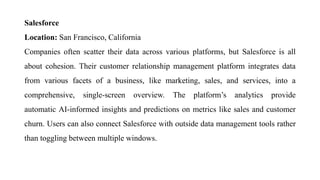
Salesforce
Location: San Francisco, California
Companies often scatter their data across various platforms, but Salesforce is all
about cohesion. Their customer relationship management platform integrates data
from various facets of a business, like marketing, sales, and services, into a
comprehensive, single-screen overview. The platform’s analytics provide
automatic AI-informed insights and predictions on metrics like sales and customer
churn. Users can also connect Salesforce with outside data management tools rather
than toggling between multiple windows.
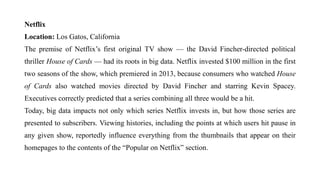
Netflix
Location: Los Gatos, California
The premise of Netflix’s first original TV show — the David Fincher-directed political
thriller House of Cards — had its roots in big data. Netflix invested $100 million in the first
two seasons of the show, which premiered in 2013, because consumers who watched House
of Cards also watched movies directed by David Fincher and starring Kevin Spacey.
Executives correctly predicted that a series combining all three would be a hit.
Today, big data impacts not only which series Netflix invests in, but how those series are
presented to subscribers. Viewing histories, including the points at which users hit pause in
any given show, reportedly influence everything from the thumbnails that appear on their
homepages to the contents of the “Popular on Netflix” section.
What exactly is big data? What exactly is big data? .pptx

What exactly is big data? What exactly is big data? .pptx

  • 1.
    Big Data Big datarefers to extremely large and complex data sets that cannot be easily managed or analyzed using traditional data processing methods. It includes structured, semi-structured, and unstructured data from various sources such as social media, sensors, and machines. Big data is characterized by 5Vs: volume (large amount of data), velocity (high speed at which data is generated), value, veracity, volume, and variety (diverse type of course).
  • 2.
    5 V’s ofBig Data
  • 3.
    Importance of Bigdata Big data has become increasingly important in various fields, including business, healthcare, finance, and marketing. It allows organizations to gain valuable insights, make data-driven decisions, and improve efficiency and productivity. Big data analysis can help identify patterns, trends, and correlations that were previously unknown, leading to better predictions and strategic planning.
  • 4.
    Challenges of BigData Big data poses several challenges, including data storage and management, data quality and integrity, data privacy and security, and data analysis. Traditional data processing tools and techniques are often insufficient to handle the volume, velocity, value, veracity and variety of big data. Extracting meaningful insights from big data requires advanced analytics methods, such as machine learning, and artificial intelligence.
  • 5.
    Benefits of BigData Big data analytics can help organizations improve customer experience, personalize marketing campaign, and optimize operations. It enables real-time monitoring and analysis, allowing for quick decision-making and problem-solving. Big data can also contribute to scientific research, social good initiatives, and public policy by providing valuable insights into various domains.
  • 6.
    Applications of BigData Big data is widely used in areas such as e-commerce, social media, healthcare, finance, transportation, and smart cities. It helps companies understand customer behavior, optimize supply chains, detect fraud, and enhance cybersecurity. Big data is also utilized in scientific research, weather forecasting, urban planning, and environmental monitoring.
  • 7.
    Ethical considerations ofBig Data The use of big data raises ethical concerns related to privacy, consent, transparency, and bias. Organizations must ensure the responsible and ethical use of data, protecting individuals privacy rights and avoiding discrimination. Regulations and guidelines, such as the General Data Protection Regulation (GDPR), aim to address these ethical considerations.
  • 8.
    Future trends inBig data Big data will continue to grow exponentially with the advancement of technology and the increasing interconnectedness of devices. Artificial intelligence and machine learning will play a crucial role in analyzing and extracting insights from big data. The integration of big data with emerging technologies like the internet of things (IoT) and blockchain will further expand its applications.
  • 9.
    Examples of BigData Uber Location: San Francisco, California As a rideshare company, Uber monitors its data in order to predict spikes in demand and variations in driver availability. That information allows the company to set the proper pricing of rides and provide incentives to drivers so the necessary number of vehicles are available to keep up with demand. Data analysis also forms the basis of Uber’s estimated times of arrival predictions, which goes a long way toward fulfilling customer satisfaction.
  • 10.
    Salesforce Location: San Francisco,California Companies often scatter their data across various platforms, but Salesforce is all about cohesion. Their customer relationship management platform integrates data from various facets of a business, like marketing, sales, and services, into a comprehensive, single-screen overview. The platform’s analytics provide automatic AI-informed insights and predictions on metrics like sales and customer churn. Users can also connect Salesforce with outside data management tools rather than toggling between multiple windows.
  • 11.
    Netflix Location: Los Gatos,California The premise of Netflix’s first original TV show — the David Fincher-directed political thriller House of Cards — had its roots in big data. Netflix invested $100 million in the first two seasons of the show, which premiered in 2013, because consumers who watched House of Cards also watched movies directed by David Fincher and starring Kevin Spacey. Executives correctly predicted that a series combining all three would be a hit. Today, big data impacts not only which series Netflix invests in, but how those series are presented to subscribers. Viewing histories, including the points at which users hit pause in any given show, reportedly influence everything from the thumbnails that appear on their homepages to the contents of the “Popular on Netflix” section.