What Causes Inflation and Price
Increases?
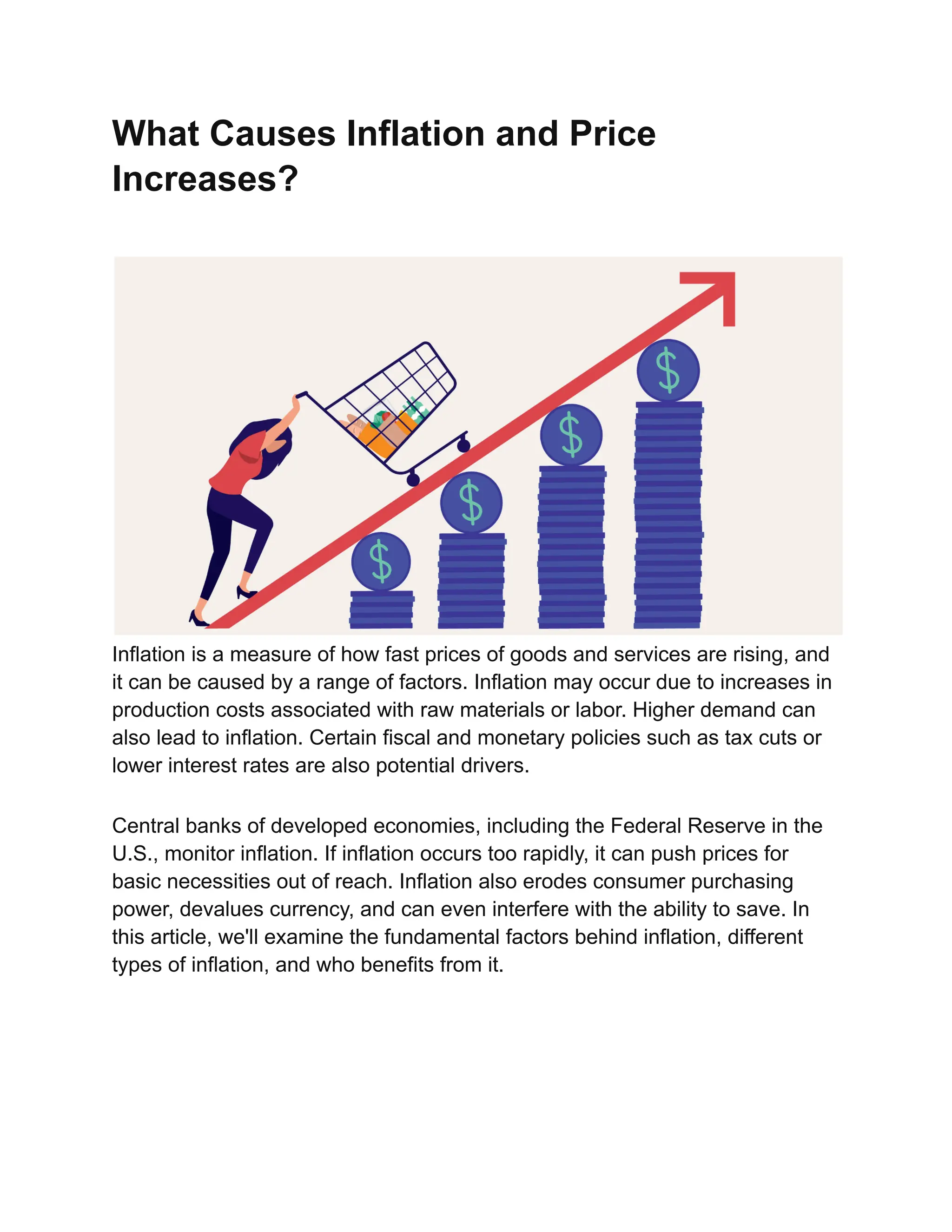
Inflation is a measure of how fast prices of goods and services are rising, and
it can be caused by a range of factors. Inflation may occur due to increases in
production costs associated with raw materials or labor. Higher demand can
also lead to inflation. Certain fiscal and monetary policies such as tax cuts or
lower interest rates are also potential drivers.
Central banks of developed economies, including the Federal Reserve in the
U.S., monitor inflation. If inflation occurs too rapidly, it can push prices for
basic necessities out of reach. Inflation also erodes consumer purchasing
power, devalues currency, and can even interfere with the ability to save. In
this article, we'll examine the fundamental factors behind inflation, different
types of inflation, and who benefits from it.
🔴Learn More About How to Grow on YouTube?
KEY TAKEAWAYS
● Inflation is a measure of the rate of rising prices of goods and services
in an economy.
● Inflation can occur when prices rise due to increases in production
costs, such as raw materials and wages.
● A surge in demand for products and services can cause inflation as
consumers are willing to pay more for the product.
● Some companies reap the rewards of inflation if they can charge more
for their products as a result of the high demand for their goods.
What Is Inflation?
Inflation is an indicator of how quickly prices rise. It can occur in nearly any
product or service, including need-based expenses such as housing, food,
medical care, and utilities, as well as want-based expenses, such as
cosmetics, automobiles, and jewelry. Once inflation becomes prevalent
throughout an economy, the expectation of further inflation becomes an
overriding concern in the consciousness of consumers and businesses alike.
Inflation can also be thought of as the devaluation of money. It can be a
concern because it makes money saved in the present less valuable in the
future. Inflation erodes both purchasing power and the value of investments.
For example, if an investor earned 5% from investments in stocks and bonds,
but the inflation rate was 3%, the investor only earned 2% in real terms.
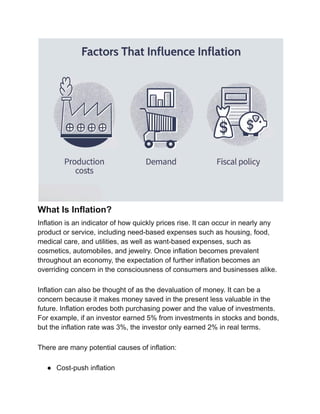
There are many potential causes of inflation:
● Cost-push inflation
● Demand-pull inflation
● Built-in inflation
● The housing market
● Expansionary monetary and fiscal policy
● Monetary devaluation
🔴Learn More About How to Grow on YouTube?
Cost-Push Inflation
Cost-push inflation occurs when prices rise because production costs
increase, such as raw materials and wages. The demand for goods is
unchanged while the supply of goods declines due to the higher costs of
production. As a result, the added costs of production are passed onto
consumers in the form of higher prices for the finished goods.
One of the signs of possible cost-push inflation can be seen in rising
commodity prices such as oil and metals since they're major production
inputs. For example, if the price of copper rises, companies that use copper to
make their products might increase the prices of their goods. If the demand for
the product is independent of the demand for copper, the business will pass
on the higher costs of raw materials to consumers. The result is higher prices
for consumers without any change in demand for the products consumed.
Wages also affect the cost of production and are typically the single biggest
expense for businesses. When the economy is performing well, and the
unemployment rate is low, shortages in labor or workers can occur.
Companies, in turn, increase wages to attract qualified candidates, causing
production costs to rise for the company. If the company raises prices due to
the rise in employee wages, cost-plus inflation occurs.
Natural disasters can also drive prices higher. For example, if a hurricane
destroys a crop such as corn, prices can rise across the economy since corn
is used in many products.
🔴Learn More About How to Grow on YouTube?
Demand-Pull Inflation
Demand-pull inflation can be caused by strong consumer demand for a
product or service. When there's a surge in demand for a wide breadth of
goods across an economy, their prices tend to increase. While this is not often
a concern for short-term imbalances of supply and demand, sustained
demand can reverberate in the economy and raise costs for other goods; the
result is demand-pull inflation.
Consumer confidence tends to be high when unemployment is low, and
wages are rising—leading to more spending. Economic expansion has a
direct impact on the level of consumer spending in an economy, which can
lead to high demand for products and services.
As the demand for a particular good or service increases, the available supply
decreases. When fewer items are available, consumers are willing to pay
more to obtain the item—as outlined in the economic principle of supply and
demand. The result is higher prices due to demand-pull inflation.
Companies also play a role in inflation, especially if they manufacture popular
products. A company can raise prices simply because consumers are willing
to pay the increased amount. Corporations also raise prices freely when the
item for sale is something consumers need for everyday existence, such as oil
and gas. However, it's the demand from consumers that provide corporations
with the leverage to raise prices.
Built-In Inflation and Rising Wages
Built-in inflation occurs when enough people expect inflation to continue in the
future. As the price of goods and services rises, people may come to believe
in a continuous rise in the future at a similar rate. Because of these shared
expectations, workers may start to demand higher wages in order to anticipate
rising prices and maintain their standard of living. Increased wages would
result in higher costs for businesses, which may pass those costs on to
consumers. Higher wages also increase consumers' disposable income,
increasing the demand for goods that can push prices even higher. A
wage-price spiral can then be set in place as one factor feeds back into the
other and vice-versa.
The Housing Market
The housing market, for example, has seen its ups and downs over the years.
If homes are in demand because the economy is experiencing an expansion,
home prices will rise. The demand also impacts ancillary products and
services that support the housing industry. Construction products such as
lumber and steel, as well as the nails and rivets used in homes, might all see
increases in demand resulting from higher demand for homes.
🔴Learn More About How to Grow on YouTube?
Expansionary Fiscal and Monetary Policy
Expansionary fiscal policy by governments can increase the amount of
discretionary income for both businesses and consumers. If a government
cuts taxes, businesses may spend it on capital improvements, employee
compensation, or new hiring. Consumers may purchase more goods as well.
The government could also stimulate the economy by increasing spending on
infrastructure projects. The result could be an increase in demand for goods
and services, leading to price increases.
Just as expansionary fiscal policy can spur inflation, so too can loose
monetary policy. Expansionary monetary policy by central banks can lower
interest rates. Central banks like the Federal Reserve can lower the cost for
banks to lend, which allows banks to lend more money to businesses and
consumers. The increase in money available throughout the economy leads to
more spending and demand for goods and services.
Monetary Devaluation
Monetarists understand inflation to be caused by too many dollars chasing too
few goods. In other words, the supply of money has grown too large.
According to this theory, money's value is subject to the law of supply and
demand, just like any other good in the market. As the supply grows, the value
goes down. If the value of money goes down, its purchasing power drops and
things become relatively more expensive.
This quantity theory of money (QTM) can be summarized in the equation of
exchange, which states that the money supply, multiplied by the rate at which
money is spent per year (the velocity of money), equals the nominal
expenditures in the economy: MV = PQ. P (prices) can thus go up as the
money supply increases, and/or the velocity of money increases (given a
constant quantity of goods in the economy).
Money can also lose value due to a general lack of confidence or trust in the
issuer of the money. In this case, hyperinflation may even set it as the money
is seen as lacking value altogether.
🔴Learn More About How to Grow on YouTube?
How to Protect Your Finances During Inflation
High inflation is generally a negative, hurting both consumers and businesses.
There are, however, some ways to protect against inflation:
● Lock in low fixed interest rates: A 30-year mortgage at a low fixed
interest rate is protected against inflation. Look to borrow when interest
rates are low and consider refinancing when rates drop
● Invest in stocks: Stock markets tend to do relatively better than bonds
in a high-inflation environment, as many companies end up passing on
higher costs to consumers, which protects profits. Firms that produce
commodities or staple goods are often good bets. Bonds, on the other
hand, see their prices go down as interest rates rise along with inflation.
● Buy inflation-protected securities: Some financial products are linked
to inflation (often via changes in CPI), such as Treasury
Inflation-Protected Securities, or TIPS, which adjust in price to offset
inflation. Some permanent life insurance products and annuities may
also have an option to be adjusted for inflation, often in the form of a
cost of living adjustment (COLA) rider.3
● Save at high interest rates: Use high interest rates to save money in
money market accounts or CDs at more favorable yields. Note,
however, that if the yield proves to be lower than the rate of inflation,
you'll still lose buying power.
● Buy an inflation hedge: Certain assets like gold and real estate are
thought to be good hedges against inflation, increasing in value along
with a general rise in prices.
● Own rental real estate: When inflation hits, landlords can often raise
the rent to keep pace. If you have an income property with a fixed-rate
mortgage, this can greatly improve your bottom line.
🔴Learn More About How to Grow on YouTube?
Measures of Inflation
Consumer Price Index (CPI)
There are a few metrics that are used to measure the inflation rate. One of the
most popular is the Consumer Price Index (CPI), which measures prices for a
basket of goods and services in the economy, including food, cars, education,
and recreation. Changes in the prices of this basket, therefore, approximate
changes in prices across the whole economy. The CPI is often the economic
indicator of choice used for measuring inflation.
While the CPI does measure the price changes for retail goods and other
items paid by consumers, it does not include things like savings and
investments, and will often exclude spending by foreign visitors.
Producer Price Index (PPI)
Another measure of inflation is the Producer Price Index (PPI), which reports
the price changes that affect domestic producers. The PPI measures prices
for fuel, farm products (meats and grains), chemical products, and metals. If
the price increases that cause the PPI to spike get passed onto consumers, it
will be reflected in the Consumer Price Index.
PPI measures inflation from the viewpoint of the producers; the average
selling price they receive for their output over a period of time. Meanwhile, CPI
measures prices from the standpoint of the consumer.
GDP Deflator
The U.S. Bureau of Economic Analysis (BEA) uses the gross domestic
product (GDP) deflator (also known as the GDP price deflator) as an
additional indicator of the level of U.S. inflation. The GDP deflator measures
the aggregate prices of all goods and services produced by the entire nation;
it encompasses both the CPI and PPI statistics.
Personal Consumption Expenditures (PCE) Price Index
The personal consumption expenditures (PCE) index is another measure of
inflation that tracks price changes in the amount spent on consumer goods
and services exchanged in the U.S. economy. The PCE Price Index is
composed of a broad range of expenditures that is far larger than the basket
of goods used in the CPI, and it is weighted by data provided by regular
business surveys, which tend to be more reliable than the consumer surveys
used by the CPI.
In 2012, the PCE Price Index became the primary inflation index used by the
U.S. Federal Reserve when making monetary policy decisions.
🔴Learn More About How to Grow on YouTube?
What Has Caused Inflation in the 2020s?
The early 2020s saw high inflationary pressures drive up costs for consumer
goods, particularly food and energy. Prior to 2020, CPI increased at a rate of
approximately 2% on an annual basis. In 2021, this metric began to climb
rapidly, hitting a peak of 8.99% in June 2022. In the time since, change in CPI
has cooled down gradually. As of April 2024, the inflation measure stands at
3.36%.
Federal Reserve Bank of St. Louis. "Consumer Price Index for All Urban
Consumers: All Items in U.S. City Average."
This high rate of inflation can be attributed in large part to market disruptions
caused by the COVID-19 pandemic. Examples include increased demand for
consumer goods, reductions in manufacturing and shipping capacity
nationwide and globally, and increased labor costs.
Consumer demand was stimulated in part due to high levels of fiscal spending
and monetary policy enacted to mitigate the economic impacts of the public
health emergency. Supply of goods tightened as trade restrictions and
shelter-in-place delayed production and transportation. As economies opened
back up in 2021 and beyond, low unemployment put upward pressure on
wages and, thus, prices.
How Can We Stop Inflation?
Governments have many tools at their disposal to control inflation. Most often,
a central bank may choose to increase interest rates. This is a contractionary
monetary policy that makes credit more expensive, reducing the money
supply and curtailing individual and business spending. Fiscal measures like
raising taxes can also reduce inflation. Historically, governments have also
implemented measures like price controls to cap costs for specific goods, with
limited success.
Who Benefits From Inflation?
In general, inflation benefits borrowers who have lower fixed interest rates and
owners of assets that rise along with inflation. The relative costs of servicing
these debts becomes less expensive with inflation.
Investors can enjoy a boost if they hold assets in markets affected by inflation.
For example, those who are invested in energy companies might see a rise in
their stock prices if energy prices are rising. Often, value stocks perform better
than growth stocks during inflationary periods.
🔴Learn More About How to Grow
Who Is Hurt by Inflation?
Inflation tends to harm savers and lenders the most. Savers see their cash
deposits eroded of purchasing power, while those who loaned money at lower
fixed interest rates are stuck with less valuable loans until they mature.
Consumers are also harmed by inflation as goods become more expensive.
Lower-income consumers can be hurt the most as these people tend to spend
a higher proportion of their income overall and on necessities than those with
higher incomes, and so have less of a cushion against the loss of purchasing
power inherent in inflation.
Can Companies Benefit From Inflation?
Some companies reap the rewards of inflation if they can charge more for
their products as a result of a surge in demand for their goods. If the economy
is performing well and housing demand is high, home-building companies can
charge higher prices for selling homes.
In other words, inflation can provide businesses with pricing power and
increase their profit margins. If profit margins are rising, it means the prices
that companies charge for their products are increasing at a faster rate than
increases in production costs.
Also, business owners can deliberately withhold supplies from the market,
allowing prices to rise to a favorable level. However, companies can also be
hurt by inflation if it's the result of a surge in production costs. Companies are
at risk if they're unable to pass on the higher costs to consumers through
higher prices. If foreign competition, for example, is unaffected by the
production cost increases, their prices wouldn't need to rise. As a result, U.S.
companies might have to eat the higher production costs, otherwise, risk
losing customers to foreign-based companies.
The Bottom Line
Inflation occurs when prices rise in an economy and/or the purchasing power
of money loses value. Economists have identified several possible causes for
inflation from rising wages to increased aggregate demand to an increase in
the supply of money. In 2022, inflation rates in the U.S. and around the world
rose to their highest levels since the early 1980s. While there is no single
reason for this rapid rise in global prices, a series of events worked together to
boost inflation in its latest cycle, including the repercussions of the COVID-19
pandemic, Russia's unprovoked invasion of Ukraine, and the shock to energy
and food prices that resulted.
🔴Learn More About How to Grow on YouTube?
What Causes Inflation and Price Increases?

What Causes Inflation and Price Increases?

  • 1.
    What Causes Inflationand Price Increases? Inflation is a measure of how fast prices of goods and services are rising, and it can be caused by a range of factors. Inflation may occur due to increases in production costs associated with raw materials or labor. Higher demand can also lead to inflation. Certain fiscal and monetary policies such as tax cuts or lower interest rates are also potential drivers. Central banks of developed economies, including the Federal Reserve in the U.S., monitor inflation. If inflation occurs too rapidly, it can push prices for basic necessities out of reach. Inflation also erodes consumer purchasing power, devalues currency, and can even interfere with the ability to save. In this article, we'll examine the fundamental factors behind inflation, different types of inflation, and who benefits from it.
  • 2.
    🔴Learn More AboutHow to Grow on YouTube? KEY TAKEAWAYS ● Inflation is a measure of the rate of rising prices of goods and services in an economy. ● Inflation can occur when prices rise due to increases in production costs, such as raw materials and wages. ● A surge in demand for products and services can cause inflation as consumers are willing to pay more for the product. ● Some companies reap the rewards of inflation if they can charge more for their products as a result of the high demand for their goods.
  • 3.
    What Is Inflation? Inflationis an indicator of how quickly prices rise. It can occur in nearly any product or service, including need-based expenses such as housing, food, medical care, and utilities, as well as want-based expenses, such as cosmetics, automobiles, and jewelry. Once inflation becomes prevalent throughout an economy, the expectation of further inflation becomes an overriding concern in the consciousness of consumers and businesses alike. Inflation can also be thought of as the devaluation of money. It can be a concern because it makes money saved in the present less valuable in the future. Inflation erodes both purchasing power and the value of investments. For example, if an investor earned 5% from investments in stocks and bonds, but the inflation rate was 3%, the investor only earned 2% in real terms. There are many potential causes of inflation: ● Cost-push inflation
  • 4.
    ● Demand-pull inflation ●Built-in inflation ● The housing market ● Expansionary monetary and fiscal policy ● Monetary devaluation 🔴Learn More About How to Grow on YouTube? Cost-Push Inflation Cost-push inflation occurs when prices rise because production costs increase, such as raw materials and wages. The demand for goods is unchanged while the supply of goods declines due to the higher costs of production. As a result, the added costs of production are passed onto consumers in the form of higher prices for the finished goods. One of the signs of possible cost-push inflation can be seen in rising commodity prices such as oil and metals since they're major production inputs. For example, if the price of copper rises, companies that use copper to make their products might increase the prices of their goods. If the demand for the product is independent of the demand for copper, the business will pass on the higher costs of raw materials to consumers. The result is higher prices for consumers without any change in demand for the products consumed. Wages also affect the cost of production and are typically the single biggest expense for businesses. When the economy is performing well, and the unemployment rate is low, shortages in labor or workers can occur. Companies, in turn, increase wages to attract qualified candidates, causing
  • 5.
    production costs torise for the company. If the company raises prices due to the rise in employee wages, cost-plus inflation occurs. Natural disasters can also drive prices higher. For example, if a hurricane destroys a crop such as corn, prices can rise across the economy since corn is used in many products. 🔴Learn More About How to Grow on YouTube? Demand-Pull Inflation Demand-pull inflation can be caused by strong consumer demand for a product or service. When there's a surge in demand for a wide breadth of goods across an economy, their prices tend to increase. While this is not often a concern for short-term imbalances of supply and demand, sustained demand can reverberate in the economy and raise costs for other goods; the result is demand-pull inflation. Consumer confidence tends to be high when unemployment is low, and wages are rising—leading to more spending. Economic expansion has a direct impact on the level of consumer spending in an economy, which can lead to high demand for products and services. As the demand for a particular good or service increases, the available supply decreases. When fewer items are available, consumers are willing to pay more to obtain the item—as outlined in the economic principle of supply and demand. The result is higher prices due to demand-pull inflation.
  • 6.
    Companies also playa role in inflation, especially if they manufacture popular products. A company can raise prices simply because consumers are willing to pay the increased amount. Corporations also raise prices freely when the item for sale is something consumers need for everyday existence, such as oil and gas. However, it's the demand from consumers that provide corporations with the leverage to raise prices. Built-In Inflation and Rising Wages Built-in inflation occurs when enough people expect inflation to continue in the future. As the price of goods and services rises, people may come to believe in a continuous rise in the future at a similar rate. Because of these shared expectations, workers may start to demand higher wages in order to anticipate rising prices and maintain their standard of living. Increased wages would result in higher costs for businesses, which may pass those costs on to consumers. Higher wages also increase consumers' disposable income, increasing the demand for goods that can push prices even higher. A wage-price spiral can then be set in place as one factor feeds back into the other and vice-versa. The Housing Market The housing market, for example, has seen its ups and downs over the years. If homes are in demand because the economy is experiencing an expansion, home prices will rise. The demand also impacts ancillary products and services that support the housing industry. Construction products such as lumber and steel, as well as the nails and rivets used in homes, might all see increases in demand resulting from higher demand for homes.
  • 7.
    🔴Learn More AboutHow to Grow on YouTube? Expansionary Fiscal and Monetary Policy Expansionary fiscal policy by governments can increase the amount of discretionary income for both businesses and consumers. If a government cuts taxes, businesses may spend it on capital improvements, employee compensation, or new hiring. Consumers may purchase more goods as well. The government could also stimulate the economy by increasing spending on infrastructure projects. The result could be an increase in demand for goods and services, leading to price increases. Just as expansionary fiscal policy can spur inflation, so too can loose monetary policy. Expansionary monetary policy by central banks can lower interest rates. Central banks like the Federal Reserve can lower the cost for banks to lend, which allows banks to lend more money to businesses and consumers. The increase in money available throughout the economy leads to more spending and demand for goods and services. Monetary Devaluation Monetarists understand inflation to be caused by too many dollars chasing too few goods. In other words, the supply of money has grown too large. According to this theory, money's value is subject to the law of supply and demand, just like any other good in the market. As the supply grows, the value goes down. If the value of money goes down, its purchasing power drops and things become relatively more expensive. This quantity theory of money (QTM) can be summarized in the equation of exchange, which states that the money supply, multiplied by the rate at which money is spent per year (the velocity of money), equals the nominal expenditures in the economy: MV = PQ. P (prices) can thus go up as the money supply increases, and/or the velocity of money increases (given a constant quantity of goods in the economy).
  • 8.
    Money can alsolose value due to a general lack of confidence or trust in the issuer of the money. In this case, hyperinflation may even set it as the money is seen as lacking value altogether. 🔴Learn More About How to Grow on YouTube? How to Protect Your Finances During Inflation High inflation is generally a negative, hurting both consumers and businesses. There are, however, some ways to protect against inflation: ● Lock in low fixed interest rates: A 30-year mortgage at a low fixed interest rate is protected against inflation. Look to borrow when interest rates are low and consider refinancing when rates drop ● Invest in stocks: Stock markets tend to do relatively better than bonds in a high-inflation environment, as many companies end up passing on higher costs to consumers, which protects profits. Firms that produce commodities or staple goods are often good bets. Bonds, on the other hand, see their prices go down as interest rates rise along with inflation. ● Buy inflation-protected securities: Some financial products are linked to inflation (often via changes in CPI), such as Treasury Inflation-Protected Securities, or TIPS, which adjust in price to offset inflation. Some permanent life insurance products and annuities may also have an option to be adjusted for inflation, often in the form of a cost of living adjustment (COLA) rider.3 ● Save at high interest rates: Use high interest rates to save money in money market accounts or CDs at more favorable yields. Note, however, that if the yield proves to be lower than the rate of inflation, you'll still lose buying power.
  • 9.
    ● Buy aninflation hedge: Certain assets like gold and real estate are thought to be good hedges against inflation, increasing in value along with a general rise in prices. ● Own rental real estate: When inflation hits, landlords can often raise the rent to keep pace. If you have an income property with a fixed-rate mortgage, this can greatly improve your bottom line. 🔴Learn More About How to Grow on YouTube? Measures of Inflation Consumer Price Index (CPI) There are a few metrics that are used to measure the inflation rate. One of the most popular is the Consumer Price Index (CPI), which measures prices for a basket of goods and services in the economy, including food, cars, education, and recreation. Changes in the prices of this basket, therefore, approximate changes in prices across the whole economy. The CPI is often the economic indicator of choice used for measuring inflation. While the CPI does measure the price changes for retail goods and other items paid by consumers, it does not include things like savings and investments, and will often exclude spending by foreign visitors. Producer Price Index (PPI) Another measure of inflation is the Producer Price Index (PPI), which reports the price changes that affect domestic producers. The PPI measures prices for fuel, farm products (meats and grains), chemical products, and metals. If
  • 10.
    the price increasesthat cause the PPI to spike get passed onto consumers, it will be reflected in the Consumer Price Index. PPI measures inflation from the viewpoint of the producers; the average selling price they receive for their output over a period of time. Meanwhile, CPI measures prices from the standpoint of the consumer. GDP Deflator The U.S. Bureau of Economic Analysis (BEA) uses the gross domestic product (GDP) deflator (also known as the GDP price deflator) as an additional indicator of the level of U.S. inflation. The GDP deflator measures the aggregate prices of all goods and services produced by the entire nation; it encompasses both the CPI and PPI statistics. Personal Consumption Expenditures (PCE) Price Index The personal consumption expenditures (PCE) index is another measure of inflation that tracks price changes in the amount spent on consumer goods and services exchanged in the U.S. economy. The PCE Price Index is composed of a broad range of expenditures that is far larger than the basket of goods used in the CPI, and it is weighted by data provided by regular business surveys, which tend to be more reliable than the consumer surveys used by the CPI. In 2012, the PCE Price Index became the primary inflation index used by the U.S. Federal Reserve when making monetary policy decisions. 🔴Learn More About How to Grow on YouTube?
  • 11.
    What Has CausedInflation in the 2020s? The early 2020s saw high inflationary pressures drive up costs for consumer goods, particularly food and energy. Prior to 2020, CPI increased at a rate of approximately 2% on an annual basis. In 2021, this metric began to climb rapidly, hitting a peak of 8.99% in June 2022. In the time since, change in CPI has cooled down gradually. As of April 2024, the inflation measure stands at 3.36%. Federal Reserve Bank of St. Louis. "Consumer Price Index for All Urban Consumers: All Items in U.S. City Average." This high rate of inflation can be attributed in large part to market disruptions caused by the COVID-19 pandemic. Examples include increased demand for consumer goods, reductions in manufacturing and shipping capacity nationwide and globally, and increased labor costs. Consumer demand was stimulated in part due to high levels of fiscal spending and monetary policy enacted to mitigate the economic impacts of the public health emergency. Supply of goods tightened as trade restrictions and shelter-in-place delayed production and transportation. As economies opened back up in 2021 and beyond, low unemployment put upward pressure on wages and, thus, prices. How Can We Stop Inflation? Governments have many tools at their disposal to control inflation. Most often, a central bank may choose to increase interest rates. This is a contractionary monetary policy that makes credit more expensive, reducing the money supply and curtailing individual and business spending. Fiscal measures like raising taxes can also reduce inflation. Historically, governments have also implemented measures like price controls to cap costs for specific goods, with limited success. Who Benefits From Inflation?
  • 12.
    In general, inflationbenefits borrowers who have lower fixed interest rates and owners of assets that rise along with inflation. The relative costs of servicing these debts becomes less expensive with inflation. Investors can enjoy a boost if they hold assets in markets affected by inflation. For example, those who are invested in energy companies might see a rise in their stock prices if energy prices are rising. Often, value stocks perform better than growth stocks during inflationary periods. 🔴Learn More About How to Grow Who Is Hurt by Inflation? Inflation tends to harm savers and lenders the most. Savers see their cash deposits eroded of purchasing power, while those who loaned money at lower fixed interest rates are stuck with less valuable loans until they mature. Consumers are also harmed by inflation as goods become more expensive. Lower-income consumers can be hurt the most as these people tend to spend a higher proportion of their income overall and on necessities than those with higher incomes, and so have less of a cushion against the loss of purchasing power inherent in inflation. Can Companies Benefit From Inflation? Some companies reap the rewards of inflation if they can charge more for their products as a result of a surge in demand for their goods. If the economy is performing well and housing demand is high, home-building companies can charge higher prices for selling homes.
  • 13.
    In other words,inflation can provide businesses with pricing power and increase their profit margins. If profit margins are rising, it means the prices that companies charge for their products are increasing at a faster rate than increases in production costs. Also, business owners can deliberately withhold supplies from the market, allowing prices to rise to a favorable level. However, companies can also be hurt by inflation if it's the result of a surge in production costs. Companies are at risk if they're unable to pass on the higher costs to consumers through higher prices. If foreign competition, for example, is unaffected by the production cost increases, their prices wouldn't need to rise. As a result, U.S. companies might have to eat the higher production costs, otherwise, risk losing customers to foreign-based companies. The Bottom Line Inflation occurs when prices rise in an economy and/or the purchasing power of money loses value. Economists have identified several possible causes for inflation from rising wages to increased aggregate demand to an increase in the supply of money. In 2022, inflation rates in the U.S. and around the world rose to their highest levels since the early 1980s. While there is no single reason for this rapid rise in global prices, a series of events worked together to boost inflation in its latest cycle, including the repercussions of the COVID-19 pandemic, Russia's unprovoked invasion of Ukraine, and the shock to energy and food prices that resulted. 🔴Learn More About How to Grow on YouTube?