Monetary
Policy and
Central Banking
Lesson #2
February 6, 2022
History of Money.. A review..
Monetary Theory
Not a single country in this world has ever experienced no socio-economic
problems. Even the richest countries, like the United States and those of Western
Europe, have encountered ups and downs in their economies. However, for the
less developed countries, the serious problems of inflation and unemployment
have persistently remained.
Among the less developed countries, the rate of production has been extremely
low. It is only their population growth which moves very fast. As a result,
demand for goods and services far exceeds supply. This certainly creates
inflation, among other things. In the case of unemployment, it is the product of
low investments. There are very few factories, financial institutions and service
industries. Thus, there are also very few employers. The level of investments is
primarily determined by profits, political stability, peace and order, fair fiscal and
monetary policies, and demand for goods and services. Unfortunately, such
positive factors are weak in not a few less developed countries.
Monetary Theory
Monetary theory is simply the theory of the value of money or the theory
of the price level. When we speak of the value of money, we are concerned
with the amount goods and services we can buy with our money. If we can
buy less number of goods and services with the same amount of money at
present than the last year- and other previous years- then we say that the
value of our money depends has decreased. Clearly, the value of money
depends on the prices of goods and services. When price level rises, the
value of money falls. Value of money also refers to the purchasing power
of an individual. We have greater purchasing power when the prices of
goods and services are lower. It means with the same amount of money,
we can acquire more goods and services.
Monetary Theory
According to monetary theory, if a nation's supply of money increases, economic
activity will rise, too, and vice versa. A simple formula governs monetary theory:
MV = PQ. M represents the money supply, V is the velocity (number of times per
year the average dollar is spent), P is the price of goods and services, and Q is the
number of goods and services. Assuming constant V, when M is increased, either
P, Q, or both P and Q rise.
General price levels tend to rise more than the production of goods and services
when the economy is closer to full employment. When there is slack in the
economy, Q will increase at a faster rate than P under monetary theory.
In many developing economies, monetary theory is controlled by the central
government, which may also be conducting most of the monetary policy
decisions.
Monetary Theory
Criticisms of Monetary Theory
Not everyone agrees that boosting the amount of money in circulation is wise. Some
economists warn that such behavior can lead to a lack of discipline and, if not managed
properly, cause inflation to spike, eroding the value of savings, triggering uncertainty, and
discouraging firms from investing, among other things.
The premise that taxation can fix these problems has also come under fire. Taking more
money from paychecks is a deeply unpopular policy, particularly when prices are rising,
meaning that many politicians are hesitant to pursue such measures. Critics also point
out that higher taxation will end up triggering a further increase in unemployment,
destroying the economy even more.
Japan is often cited as an example. The country has run fiscal deficits for decades now,
with mixed results. Critics regularly point out that continual deficit spending there has
forced more people out of work and done little to boost GDP growth.
Inflation
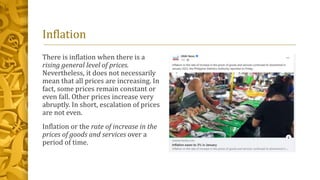
There is inflation when there is a
rising general level of prices.
Nevertheless, it does not necessarily
mean that all prices are increasing. In
fact, some prices remain constant or
even fall. Other prices increase very
abruptly. In short, escalation of prices
are not even.
Inflation or the rate of increase in the
prices of goods and services over a
period of time.
Stagflation and Hyperinflation: Two Extremes
Although as consumers we may hate rising prices, many economists
believe a moderate degree of inflation is healthy for a nation’s economy.
Typically, central banks aim to maintain inflation around 2% to 3%.1
Increases in inflation significantly beyond this range can lead to fears of
possible hyperinflation, a devastating scenario in which inflation rises
rapidly out of control.
Stagflation (a time of economic stagnation combined with inflation) can
also wreak havoc. This type of inflation is a witch’s brew of economic
adversity, combining poor economic growth, high unemployment, and
severe inflation all in one. Although recorded instances of stagflation are
rare, the phenomenon occurred as recently as the 1970s, when it gripped
the United States and the United Kingdom—much to the dismay of both
nations’ central banks.
Negative Inflation
Also known as deflation, negative inflation occurs when prices drop for
various reasons. Having a smaller money supply increases the value of
money, which in turn decreases prices. A reduction in demand either
because there is too large of a supply or a reduction in consumer spending
can also cause negative inflation. Deflation may seem like a good thing
because it reduces the prices of goods and services, thus making them
more affordable, but it can negatively affect the economy in the long run.
When businesses make less money on their products, they are forced to
cut costs, which often means laying off or terminating employees, thereby
increasing unemployment.
What Causes Inflation?
We can define inflation with relative ease, but the question of what causes
inflation is significantly more complex. Although numerous theories exist,
arguably the two most influential schools of thought on inflation are those
of Keynesian and monetarist economics.
The Keynesian school believes inflation results from economic pressures
such as rising costs of production or increases in aggregate demand.
Specifically, they distinguish between two broad types of inflation: cost-
push inflation and demand-pull inflation.
What Causes Inflation?
• Cost-push inflation results from
general increases in the costs of the
factors of production. These factors—
which include capital, land, labor, and
entrepreneurship—are the necessary
inputs required to produce goods and
services. When the cost of these factors
rise, producers wishing to retain their
profit margins must increase the price of
their goods and services. When these
production costs rise on an economy-
wide level, it can lead to increased
consumer prices throughout the whole
economy, as producers pass on their
increased costs to consumers. Consumer
prices, in effect, are thus pushed up by
production costs.
• Demand-pull inflation results from an
excess of aggregate demand relative to
aggregate supply. For example, consider
a popular product where demand for
the product outstrips supply. The price
of the product would increase. The
theory in demand-pull inflation is if
aggregate demand exceeds aggregate
supply, prices will increase economy-
wide.
Monetarists: It's All About the Money
• Monetarists have historically explained inflation as a consequence of an expanding
money supply. The monetarist view is perfectly encapsulated by Friedman’s remark
that “inflation is always and everywhere a monetary phenomenon.” According to this
view, the principal factor underlying inflation has little to do with things like labor,
materials costs, or consumer demand. Instead, it is all about the supply of money.8
• At the heart of this perspective is the quantity theory of money, which posits the
relationship between the money supply and inflation is governed by the relationship
M∗V=P∗T
where:
M=The money supply
V=The velocity of money
P=The average price level
T=The volume of transactions
Monetarists: It's All About the Money
• Implicit in this equation is the belief that if the velocity of money and the
volume of transactions is constant, an increase (or decrease) in the
supply of money will cause a corresponding increase (or decrease) in
the average price level.
• Given that the velocity of money and the volume of transactions are in
reality never constant, it follows that this relationship is not as
straightforward as it may initially seem. Nevertheless, this equation
serves as an effective model of the monetarists’ belief that the expansion
of the money supply is the principal cause of inflation.
Objectives of Monetary Policies
The Monetary Board formulates the monetary policies of the country. The
major objectives of monetary policies are:
1. Price stabilization
2. Full employment
3. Economic growth
MPCB Lesson #2 (Feb 6, 2022).pptx

MPCB Lesson #2 (Feb 6, 2022).pptx

  • 1.
  • 2.
  • 3.
    Monetary Theory Not asingle country in this world has ever experienced no socio-economic problems. Even the richest countries, like the United States and those of Western Europe, have encountered ups and downs in their economies. However, for the less developed countries, the serious problems of inflation and unemployment have persistently remained. Among the less developed countries, the rate of production has been extremely low. It is only their population growth which moves very fast. As a result, demand for goods and services far exceeds supply. This certainly creates inflation, among other things. In the case of unemployment, it is the product of low investments. There are very few factories, financial institutions and service industries. Thus, there are also very few employers. The level of investments is primarily determined by profits, political stability, peace and order, fair fiscal and monetary policies, and demand for goods and services. Unfortunately, such positive factors are weak in not a few less developed countries.
  • 4.
    Monetary Theory Monetary theoryis simply the theory of the value of money or the theory of the price level. When we speak of the value of money, we are concerned with the amount goods and services we can buy with our money. If we can buy less number of goods and services with the same amount of money at present than the last year- and other previous years- then we say that the value of our money depends has decreased. Clearly, the value of money depends on the prices of goods and services. When price level rises, the value of money falls. Value of money also refers to the purchasing power of an individual. We have greater purchasing power when the prices of goods and services are lower. It means with the same amount of money, we can acquire more goods and services.
  • 5.
    Monetary Theory According tomonetary theory, if a nation's supply of money increases, economic activity will rise, too, and vice versa. A simple formula governs monetary theory: MV = PQ. M represents the money supply, V is the velocity (number of times per year the average dollar is spent), P is the price of goods and services, and Q is the number of goods and services. Assuming constant V, when M is increased, either P, Q, or both P and Q rise. General price levels tend to rise more than the production of goods and services when the economy is closer to full employment. When there is slack in the economy, Q will increase at a faster rate than P under monetary theory. In many developing economies, monetary theory is controlled by the central government, which may also be conducting most of the monetary policy decisions.
  • 6.
    Monetary Theory Criticisms ofMonetary Theory Not everyone agrees that boosting the amount of money in circulation is wise. Some economists warn that such behavior can lead to a lack of discipline and, if not managed properly, cause inflation to spike, eroding the value of savings, triggering uncertainty, and discouraging firms from investing, among other things. The premise that taxation can fix these problems has also come under fire. Taking more money from paychecks is a deeply unpopular policy, particularly when prices are rising, meaning that many politicians are hesitant to pursue such measures. Critics also point out that higher taxation will end up triggering a further increase in unemployment, destroying the economy even more. Japan is often cited as an example. The country has run fiscal deficits for decades now, with mixed results. Critics regularly point out that continual deficit spending there has forced more people out of work and done little to boost GDP growth.
  • 7.
    Inflation There is inflationwhen there is a rising general level of prices. Nevertheless, it does not necessarily mean that all prices are increasing. In fact, some prices remain constant or even fall. Other prices increase very abruptly. In short, escalation of prices are not even. Inflation or the rate of increase in the prices of goods and services over a period of time.
  • 9.
    Stagflation and Hyperinflation:Two Extremes Although as consumers we may hate rising prices, many economists believe a moderate degree of inflation is healthy for a nation’s economy. Typically, central banks aim to maintain inflation around 2% to 3%.1 Increases in inflation significantly beyond this range can lead to fears of possible hyperinflation, a devastating scenario in which inflation rises rapidly out of control. Stagflation (a time of economic stagnation combined with inflation) can also wreak havoc. This type of inflation is a witch’s brew of economic adversity, combining poor economic growth, high unemployment, and severe inflation all in one. Although recorded instances of stagflation are rare, the phenomenon occurred as recently as the 1970s, when it gripped the United States and the United Kingdom—much to the dismay of both nations’ central banks.
  • 10.
    Negative Inflation Also knownas deflation, negative inflation occurs when prices drop for various reasons. Having a smaller money supply increases the value of money, which in turn decreases prices. A reduction in demand either because there is too large of a supply or a reduction in consumer spending can also cause negative inflation. Deflation may seem like a good thing because it reduces the prices of goods and services, thus making them more affordable, but it can negatively affect the economy in the long run. When businesses make less money on their products, they are forced to cut costs, which often means laying off or terminating employees, thereby increasing unemployment.
  • 11.
    What Causes Inflation? Wecan define inflation with relative ease, but the question of what causes inflation is significantly more complex. Although numerous theories exist, arguably the two most influential schools of thought on inflation are those of Keynesian and monetarist economics. The Keynesian school believes inflation results from economic pressures such as rising costs of production or increases in aggregate demand. Specifically, they distinguish between two broad types of inflation: cost- push inflation and demand-pull inflation.
  • 12.
    What Causes Inflation? •Cost-push inflation results from general increases in the costs of the factors of production. These factors— which include capital, land, labor, and entrepreneurship—are the necessary inputs required to produce goods and services. When the cost of these factors rise, producers wishing to retain their profit margins must increase the price of their goods and services. When these production costs rise on an economy- wide level, it can lead to increased consumer prices throughout the whole economy, as producers pass on their increased costs to consumers. Consumer prices, in effect, are thus pushed up by production costs. • Demand-pull inflation results from an excess of aggregate demand relative to aggregate supply. For example, consider a popular product where demand for the product outstrips supply. The price of the product would increase. The theory in demand-pull inflation is if aggregate demand exceeds aggregate supply, prices will increase economy- wide.
  • 13.
    Monetarists: It's AllAbout the Money • Monetarists have historically explained inflation as a consequence of an expanding money supply. The monetarist view is perfectly encapsulated by Friedman’s remark that “inflation is always and everywhere a monetary phenomenon.” According to this view, the principal factor underlying inflation has little to do with things like labor, materials costs, or consumer demand. Instead, it is all about the supply of money.8 • At the heart of this perspective is the quantity theory of money, which posits the relationship between the money supply and inflation is governed by the relationship M∗V=P∗T where: M=The money supply V=The velocity of money P=The average price level T=The volume of transactions
  • 14.
    Monetarists: It's AllAbout the Money • Implicit in this equation is the belief that if the velocity of money and the volume of transactions is constant, an increase (or decrease) in the supply of money will cause a corresponding increase (or decrease) in the average price level. • Given that the velocity of money and the volume of transactions are in reality never constant, it follows that this relationship is not as straightforward as it may initially seem. Nevertheless, this equation serves as an effective model of the monetarists’ belief that the expansion of the money supply is the principal cause of inflation.
  • 15.
    Objectives of MonetaryPolicies The Monetary Board formulates the monetary policies of the country. The major objectives of monetary policies are: 1. Price stabilization 2. Full employment 3. Economic growth