What can Natural Language Processing do for you?
Yves Peirsman
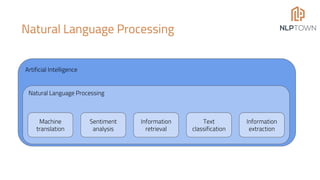
Artificial Intelligence
Natural Language Processing
Machine
translation
Sentiment
analysis
Information
retrieval
Information
extraction
Text
classification
NLP Town
We provide guidance
to the NLP domain to
companies that would
like to develop their AI
software in-house.
We develop software
and train NLP models
for challenging or
domain-specific
applications.
We bridge the gap
between
state-of-the-art NLP
research and
innovative industry
applications.
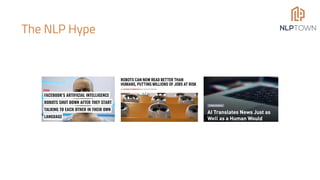
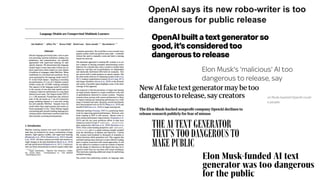
The NLP Hype
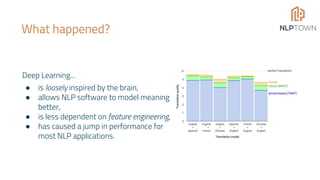
What happened?
Deep Learning...
● is loosely inspired by the brain,
● allows NLP software to model meaning
better,
● is less dependent on feature engineering,
● has caused a jump in performance for
most NLP applications.
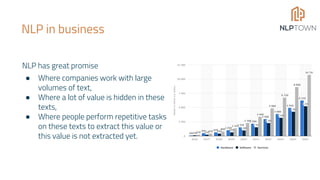
NLP in business
NLP has great promise
● Where companies work with large
volumes of text,
● Where a lot of value is hidden in these
texts,
● Where people perform repetitive tasks
on these texts to extract this value or
this value is not extracted yet.
NLP in business
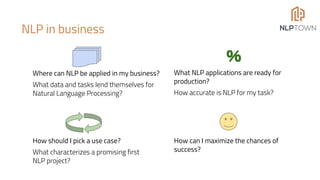
Where can NLP be applied in my business?
What data and tasks lend themselves for
Natural Language Processing?
%
What NLP applications are ready for
production?
How accurate is NLP for my task?
How can I maximize the chances of
success?
How should I pick a use case?
What characterizes a promising first
NLP project?
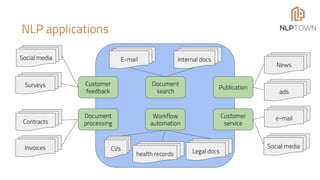
NLP applications
Publication
Customer
service
Workflow
automation
Document
search
Customer
feedback
Document
processing
Social media
Surveys
Contracts
Invoices
E-mail Internal docs
News
ads
e-mail
CVs Legal docs
Social media
health records
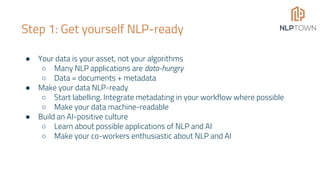
Step 1: Get yourself NLP-ready
● Your data is your asset, not your algorithms
○ Many NLP applications are data-hungry
○ Data = documents + metadata
● Make your data NLP-ready
○ Start labelling. Integrate metadating in your workflow where possible
○ Make your data machine-readable
● Build an AI-positive culture
○ Learn about possible applications of NLP and AI
○ Make your co-workers enthusiastic about NLP and AI
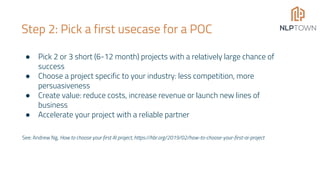
Step 2: Pick a first usecase for a POC
● Pick 2 or 3 short (6-12 month) projects with a relatively large chance of
success
● Choose a project specific to your industry: less competition, more
persuasiveness
● Create value: reduce costs, increase revenue or launch new lines of
business
● Accelerate your project with a reliable partner
See: Andrew Ng, How to choose your first AI project, https://hbr.org/2019/02/how-to-choose-your-first-ai-project
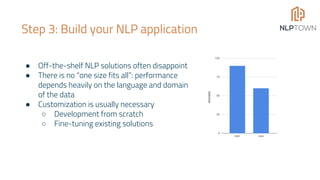
Step 3: Build your NLP application
● Off-the-shelf NLP solutions often disappoint
● There is no “one size fits all”: performance
depends heavily on the language and domain
of the data
● Customization is usually necessary
○ Development from scratch
○ Fine-tuning existing solutions
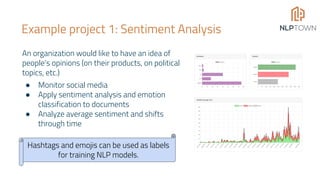
Example project 1: Sentiment Analysis
An organization would like to have an idea of
people’s opinions (on their products, on political
topics, etc.)
● Monitor social media
● Apply sentiment analysis and emotion
classification to documents
● Analyze average sentiment and shifts
through time
Hashtags and emojis can be used as labels
for training NLP models.
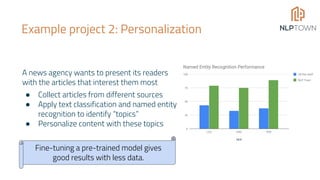
Example project 2: Personalization
A news agency wants to present its readers
with the articles that interest them most
● Collect articles from different sources
● Apply text classification and named entity
recognition to identify “topics”
● Personalize content with these topics
Fine-tuning a pre-trained model gives
good results with less data.
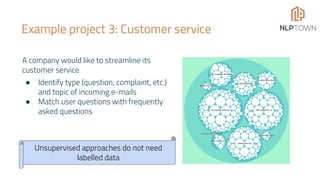
Example project 3: Customer service
A company would like to streamline its
customer service
● Identify type (question, complaint, etc.)
and topic of incoming e-mails
● Match user questions with frequently
asked questions
Unsupervised approaches do not need
labelled data
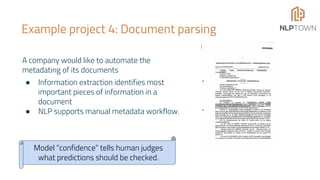
Example project 4: Document parsing
A company would like to automate the
metadating of its documents
● Information extraction identifies most
important pieces of information in a
document
● NLP supports manual metadata workflow.
Model “confidence” tells human judges
what predictions should be checked.
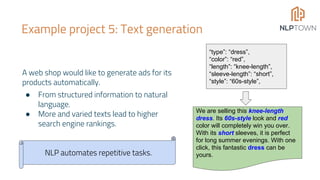
Example project 5: Text generation
A web shop would like to generate ads for its
products automatically.
● From structured information to natural
language.
● More and varied texts lead to higher
search engine rankings.
“type”: “dress”,
“color”: “red”,
“length”: “knee-length”,
“sleeve-length”: “short”,
“style”: “60s-style”,
We are selling this knee-length
dress. Its 60s-style look and red
color will completely win you over.
With its short sleeves, it is perfect
for long summer evenings. With one
click, this fantastic dress can be
yours.NLP automates repetitive tasks.
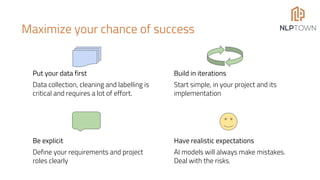
Maximize your chance of success
Put your data first
Data collection, cleaning and labelling is
critical and requires a lot of effort.
Build in iterations
Start simple, in your project and its
implementation
Have realistic expectations
AI models will always make mistakes.
Deal with the risks.
Be explicit
Define your requirements and project
roles clearly
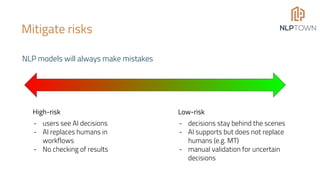
Mitigate risks
NLP models will always make mistakes
Low-risk
- decisions stay behind the scenes
- AI supports but does not replace
humans (e.g. MT)
- manual validation for uncertain
decisions
High-risk
- users see AI decisions
- AI replaces humans in
workflows
- No checking of results
Strategic advice?
NLP consultancy?
Workshops?
Model training?
Software development?
http://www.nlp.town yves@nlp.town
Do you need…

What can Natural Language Processing do for you?

  • 1.
    What can NaturalLanguage Processing do for you? Yves Peirsman
  • 2.
    Artificial Intelligence Natural LanguageProcessing Natural Language Processing Machine translation Sentiment analysis Information retrieval Information extraction Text classification
  • 3.
    NLP Town We provideguidance to the NLP domain to companies that would like to develop their AI software in-house. We develop software and train NLP models for challenging or domain-specific applications. We bridge the gap between state-of-the-art NLP research and innovative industry applications.
  • 4.
  • 7.
    What happened? Deep Learning... ●is loosely inspired by the brain, ● allows NLP software to model meaning better, ● is less dependent on feature engineering, ● has caused a jump in performance for most NLP applications.
  • 8.
    NLP in business NLPhas great promise ● Where companies work with large volumes of text, ● Where a lot of value is hidden in these texts, ● Where people perform repetitive tasks on these texts to extract this value or this value is not extracted yet.
  • 9.
    NLP in business Wherecan NLP be applied in my business? What data and tasks lend themselves for Natural Language Processing? % What NLP applications are ready for production? How accurate is NLP for my task? How can I maximize the chances of success? How should I pick a use case? What characterizes a promising first NLP project?
  • 10.
  • 11.
    Step 1: Getyourself NLP-ready ● Your data is your asset, not your algorithms ○ Many NLP applications are data-hungry ○ Data = documents + metadata ● Make your data NLP-ready ○ Start labelling. Integrate metadating in your workflow where possible ○ Make your data machine-readable ● Build an AI-positive culture ○ Learn about possible applications of NLP and AI ○ Make your co-workers enthusiastic about NLP and AI
  • 12.
    Step 2: Picka first usecase for a POC ● Pick 2 or 3 short (6-12 month) projects with a relatively large chance of success ● Choose a project specific to your industry: less competition, more persuasiveness ● Create value: reduce costs, increase revenue or launch new lines of business ● Accelerate your project with a reliable partner See: Andrew Ng, How to choose your first AI project, https://hbr.org/2019/02/how-to-choose-your-first-ai-project
  • 13.
    Step 3: Buildyour NLP application ● Off-the-shelf NLP solutions often disappoint ● There is no “one size fits all”: performance depends heavily on the language and domain of the data ● Customization is usually necessary ○ Development from scratch ○ Fine-tuning existing solutions
  • 14.
    Example project 1:Sentiment Analysis An organization would like to have an idea of people’s opinions (on their products, on political topics, etc.) ● Monitor social media ● Apply sentiment analysis and emotion classification to documents ● Analyze average sentiment and shifts through time Hashtags and emojis can be used as labels for training NLP models.
  • 15.
    Example project 2:Personalization A news agency wants to present its readers with the articles that interest them most ● Collect articles from different sources ● Apply text classification and named entity recognition to identify “topics” ● Personalize content with these topics Fine-tuning a pre-trained model gives good results with less data.
  • 16.
    Example project 3:Customer service A company would like to streamline its customer service ● Identify type (question, complaint, etc.) and topic of incoming e-mails ● Match user questions with frequently asked questions Unsupervised approaches do not need labelled data
  • 17.
    Example project 4:Document parsing A company would like to automate the metadating of its documents ● Information extraction identifies most important pieces of information in a document ● NLP supports manual metadata workflow. Model “confidence” tells human judges what predictions should be checked.
  • 18.
    Example project 5:Text generation A web shop would like to generate ads for its products automatically. ● From structured information to natural language. ● More and varied texts lead to higher search engine rankings. “type”: “dress”, “color”: “red”, “length”: “knee-length”, “sleeve-length”: “short”, “style”: “60s-style”, We are selling this knee-length dress. Its 60s-style look and red color will completely win you over. With its short sleeves, it is perfect for long summer evenings. With one click, this fantastic dress can be yours.NLP automates repetitive tasks.
  • 19.
    Maximize your chanceof success Put your data first Data collection, cleaning and labelling is critical and requires a lot of effort. Build in iterations Start simple, in your project and its implementation Have realistic expectations AI models will always make mistakes. Deal with the risks. Be explicit Define your requirements and project roles clearly
  • 20.
    Mitigate risks NLP modelswill always make mistakes Low-risk - decisions stay behind the scenes - AI supports but does not replace humans (e.g. MT) - manual validation for uncertain decisions High-risk - users see AI decisions - AI replaces humans in workflows - No checking of results
  • 21.
    Strategic advice? NLP consultancy? Workshops? Modeltraining? Software development? http://www.nlp.town yves@nlp.town Do you need…