What Are the Core Technologies Powering IoT App Development?
Discover the essential technologies driving IoT App Development, from edge computing to AI integration. Learn how startups and enterprises can leverage these tools for scalable, secure, and efficient IoT solutions in today’s connected world.
What Are the Core Technologies Powering IoT App Development?
1.
What Are theCore Technologies
Powering IoT App Development?
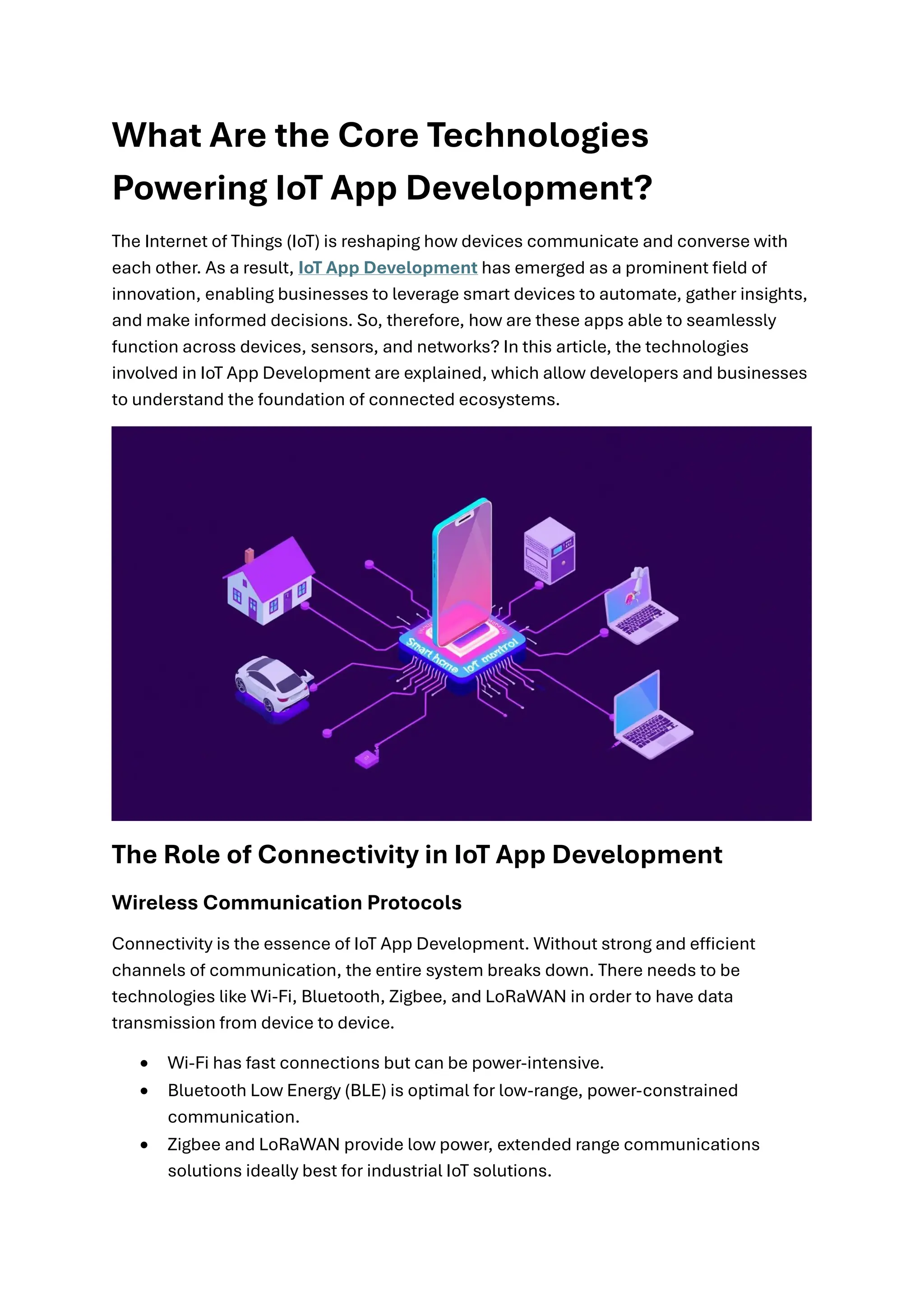
The Internet of Things (IoT) is reshaping how devices communicate and converse with
each other. As a result, IoT App Development has emerged as a prominent field of
innovation, enabling businesses to leverage smart devices to automate, gather insights,
and make informed decisions. So, therefore, how are these apps able to seamlessly
function across devices, sensors, and networks? In this article, the technologies
involved in IoT App Development are explained, which allow developers and businesses
to understand the foundation of connected ecosystems.
The Role of Connectivity in IoT App Development
Wireless Communication Protocols
Connectivity is the essence of IoT App Development. Without strong and efficient
channels of communication, the entire system breaks down. There needs to be
technologies like Wi-Fi, Bluetooth, Zigbee, and LoRaWAN in order to have data
transmission from device to device.
• Wi-Fi has fast connections but can be power-intensive.
• Bluetooth Low Energy (BLE) is optimal for low-range, power-constrained
communication.
• Zigbee and LoRaWAN provide low power, extended range communications
solutions ideally best for industrial IoT solutions.
2.
Cellular Networks
As 4Gand, more recently, the 5G progressed, cellular networks are becoming the
center of IoT App Development, particularly in those applications where there is much
mobility and widespread coverage. The low latency and high bandwidth of 5G make it
particularly suited for real-time data applications.
Major Hardware Components for IoT Applications
Sensors and Actuators
Sensors gather information from the environment around them, like temperature,
motion, or illumination, and have it interpreted by the application. Actuators perform
physical tasks based on data-directed instructions, like opening a valve or setting a
thermostat.
Microcontrollers and Gateways
Microcontrollers are the intellectual centers of IoT devices. They execute instructions
and manage device operations. Gateways are intermediaries, which facilitate
communication between IoT devices and cloud servers, and are very important to IoT
App Development.
Infrastructure software underlies IoT apps.
IoT Platforms
IoT platforms such as AWS IoT, Microsoft Azure IoT, and Google Cloud IoT offer end-to-
end solutions for device management, data acquisition, analytics, and security. These
platforms accelerate IoT App Development through pre-built modules and tools.
Cloud Computing
Cloud services are crucial in IoT App Development. They provide the infrastructure
necessary to store, process, and manage large quantities of data. Cloud platforms also
enable scalability because applications can manage growing numbers of devices and
users.
Data Management and Analytics
Big Data Technologies
3.
As IoT devicesgenerate enormous data, technologies like Hadoop, Apache Spark, and
NoSQL databases help process and manage the data. They support real-time analytics
and visualization, which are central to good decision-making.
Artificial Intelligence (AI) and Machine Learning (ML)
AI and ML enhance IoT App Development by offering predictive analytics, anomaly
detection, and autonomous decision-making. With AI models, IoT apps can be smart
systems that learn from experience and adapt over time.
IoT App Development Security Technologies
End-to-End E ncryption
Security of communication between devices and servers is of utmost concern. End-to-
end encryption is used to encrypt data transit and storage, ensuring protection against
cyber-attacks.
Authentication and Authorization Protocols
Security measures like OAuth 2.0 and two-factor authentication safeguard the IoT
system against unauthorized devices and users. Such security measures form the core
of building trust and safeguarding IoT application integrity.
Edge Computing and Its Impact on IoT
Edge computing reduces latency by processing data closer to its origin and not relying
solely on cloud servers. Edge computing is ideal for applications that require quick
response, like autonomous cars or factories.
Edge devices can pre-process data and transmit only the most essential data to the
cloud, which saves bandwidth and performance efforts for IoT App Development.
Conclusion
It is important to understand the technologies of IoT App Development in order to create
effective, scalable, and secure solutions. Ranging from hardware and connectivity
protocols to cloud platforms, artificial intelligence, and edge computing, all of them are
important in creating successful IoT ecosystems. With IoT developing further, the use of
such technologies will be of prime importance for organizations looking to stay ahead of
a connected world. In the recent past, mobile app development has also started to
4.
merge with IoTapplications, providing seamless remote control and real-time
monitoring. Merging the power of IoT App Development with mobile app development
ensures an easier experience and greater accessibility.
FAQs
1. Which are the most popular programming languages for IoT App
Development?
The most popular are C, C++, Python, and JavaScript. The most appropriate one
depends on the hardware and the project requirements.
2. How does 5G influence IoT App Development?
5G offers superior connectivity with increased speed, lower latency, and higher
reliability, appropriate for real-time and large-scale IoT applications.
3. Are IoT applications compatible with mobile platforms?
Yes, most IoT solutions do have companion mobile apps by which users are able to
control and monitor devices remotely. One of the most important features of easy-to-
use IoT App Development is integration.
4. What are the challenges in IoT App Development?
Some of the issues include data security, handling vast amounts of data, device
compatibility, and low power consumption.
ARTICLE SOURCE : https://medium.com/@Miller_Smith/what-are-the-core-
technologies-powering-iot-app-development-b0e74f0fabbc