Essential Tools and Technologies for IoT
Software Development
The rapid expansion of the Internet of Things (IoT) has transformed how we interact with
technology, creating smarter, more connected systems. At the heart of this revolution is
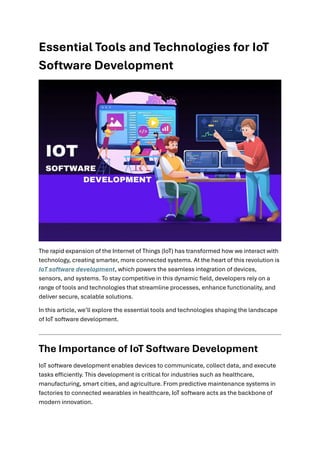
IoT software development, which powers the seamless integration of devices,
sensors, and systems. To stay competitive in this dynamic field, developers rely on a
range of tools and technologies that streamline processes, enhance functionality, and
deliver secure, scalable solutions.
In this article, we’ll explore the essential tools and technologies shaping the landscape
of IoT software development.
The Importance of IoT Software Development
IoT software development enables devices to communicate, collect data, and execute
tasks efficiently. This development is critical for industries such as healthcare,
manufacturing, smart cities, and agriculture. From predictive maintenance systems in
factories to connected wearables in healthcare, IoT software acts as the backbone of
modern innovation.
To deliver effective solutions, developers must navigate complex challenges such as
data security, interoperability, and scalability, making the right tools and technologies
indispensable.
Key Tools for IoT Software Development
1. IoT Development Platforms
IoT platforms serve as the foundation for building, deploying, and managing IoT
applications. These platforms offer pre-built frameworks that accelerate development
while ensuring compatibility across devices.
Popular IoT Development Platforms:
• AWS IoT Core: Provides cloud-based services for secure device connections and
data management.
• Google Cloud IoT: Offers robust analytics tools and machine learning
integration.
• Microsoft Azure IoT Suite: Enables seamless deployment and monitoring of IoT
applications.
These platforms simplify the complex process of connecting devices, managing data,
and scaling operations.
2. Programming Languages
The choice of programming languages depends on the specific requirements of an IoT
project. Some commonly used languages in IoT software development include:
• C and C++: Ideal for programming microcontrollers and embedded systems.
• Python: Popular for its simplicity and extensive libraries.
• JavaScript: Used for front-end IoT applications and Node.js-based back-end
solutions.
Each language offers unique benefits, making them suitable for various IoT use cases.
3. Embedded System Tools
Embedded systems are crucial components of IoT devices, and tools for developing and
testing these systems are indispensable.
Examples:
• Arduino IDE: A simple tool for programming microcontrollers.
• Raspberry Pi: A versatile platform for developing and prototyping IoT
applications.
• Keil MDK: A robust solution for embedded system debugging and testing.
These tools ensure the smooth functioning of hardware components in IoT devices.
4. IoT Testing Tools
Testing is a critical phase in IoT software development, ensuring the reliability and
security of devices and applications.
Recommended Testing Tools:
• Wireshark: Monitors network traffic to identify vulnerabilities.
• IoTIFY: A cloud-based platform for simulating IoT networks and devices.
• Postman: Used for testing APIs and ensuring smooth communication between
devices.
Effective testing tools help developers identify and resolve issues before deployment.
5. Data Analytics and Visualization Tools
IoT generates vast amounts of data, making analytics tools essential for deriving
actionable insights.
Popular Tools:
• Tableau: Provides intuitive data visualization capabilities.
• Power BI: A Microsoft tool for creating interactive dashboards.
• Kibana: Offers real-time data monitoring and visualization.
These tools enable businesses to make data-driven decisions, enhancing the value of
IoT solutions.
Essential Technologies for IoT Software
Development
1. Cloud Computing
Cloud computing is integral to IoT software development, offering the scalability and
flexibility required to manage connected devices.
Benefits:
• Facilitates remote data storage and processing.
• Supports seamless device integration.
• Enhances security through robust encryption protocols.
Leading cloud service providers like AWS, Microsoft Azure, and Google Cloud are pivotal
in enabling IoT applications.
2. Edge Computing
Edge computing brings data processing closer to the devices, reducing latency and
bandwidth usage.
Applications:
• Real-time analytics in manufacturing.
• Autonomous vehicles requiring instant decision-making.
• Smart home systems with minimal delay.
By leveraging edge computing, developers can build faster and more efficient IoT
solutions.
3. Artificial Intelligence and Machine Learning
AI and ML technologies enhance the functionality of IoT systems by enabling devices to
learn from data and adapt to changing conditions.
Use Cases:
• Predictive maintenance in industrial equipment.
• Personalized recommendations in smart retail systems.
• Automated anomaly detection in security systems.
Integrating AI and ML into IoT applications allows developers to create intelligent, self-
improving systems.
4. Blockchain
Blockchain technology ensures secure and transparent data exchanges between IoT
devices.
Benefits:
• Prevents data tampering.
• Enhances trust in multi-device ecosystems.
• Streamlines supply chain management through secure record-keeping.
As IoT networks grow, blockchain will play a crucial role in maintaining data integrity.
5. 5G Connectivity
The rollout of 5G networks is revolutionizing IoT by providing faster, more reliable
connectivity.
Advantages:
• Supports high device density in smart cities.
• Enables ultra-low latency for real-time applications.
• Facilitates seamless communication between IoT devices.
5G technology unlocks new possibilities for IoT software development, particularly in
industries requiring instantaneous data transfer.
Challenges in IoT Software Development
Despite its transformative potential, IoT software development presents unique
challenges:
• Security Risks: IoT networks are susceptible to cyberattacks, requiring robust
encryption and authentication protocols.
• Interoperability: Ensuring seamless communication between devices from
different manufacturers can be complex.
• Scalability: As IoT ecosystems grow, maintaining performance and reliability
becomes increasingly challenging.
Addressing these challenges requires expertise and the right combination of tools and
technologies.
Conclusion
IoT software development is at the forefront of technological innovation, enabling
industries to achieve greater efficiency, automation, and connectivity. The tools and
technologies highlighted in this article are essential for creating reliable and scalable IoT
solutions.
From IoT development platforms and embedded system tools to emerging
technologies like edge computing and blockchain, these resources empower
developers to overcome challenges and deliver cutting-edge applications.
As IoT continues to evolve, investing in the right tools and staying updated with
technological advancements will be crucial for businesses and developers alike. By
leveraging these resources, IoT software developers can shape a smarter, more
connected future.

Essential Tools and Technologies for IoT Software Development.pdf

  • 1.
    Essential Tools andTechnologies for IoT Software Development The rapid expansion of the Internet of Things (IoT) has transformed how we interact with technology, creating smarter, more connected systems. At the heart of this revolution is IoT software development, which powers the seamless integration of devices, sensors, and systems. To stay competitive in this dynamic field, developers rely on a range of tools and technologies that streamline processes, enhance functionality, and deliver secure, scalable solutions. In this article, we’ll explore the essential tools and technologies shaping the landscape of IoT software development. The Importance of IoT Software Development IoT software development enables devices to communicate, collect data, and execute tasks efficiently. This development is critical for industries such as healthcare, manufacturing, smart cities, and agriculture. From predictive maintenance systems in factories to connected wearables in healthcare, IoT software acts as the backbone of modern innovation.
  • 2.
    To deliver effectivesolutions, developers must navigate complex challenges such as data security, interoperability, and scalability, making the right tools and technologies indispensable. Key Tools for IoT Software Development 1. IoT Development Platforms IoT platforms serve as the foundation for building, deploying, and managing IoT applications. These platforms offer pre-built frameworks that accelerate development while ensuring compatibility across devices. Popular IoT Development Platforms: • AWS IoT Core: Provides cloud-based services for secure device connections and data management. • Google Cloud IoT: Offers robust analytics tools and machine learning integration. • Microsoft Azure IoT Suite: Enables seamless deployment and monitoring of IoT applications. These platforms simplify the complex process of connecting devices, managing data, and scaling operations. 2. Programming Languages The choice of programming languages depends on the specific requirements of an IoT project. Some commonly used languages in IoT software development include: • C and C++: Ideal for programming microcontrollers and embedded systems. • Python: Popular for its simplicity and extensive libraries. • JavaScript: Used for front-end IoT applications and Node.js-based back-end solutions. Each language offers unique benefits, making them suitable for various IoT use cases. 3. Embedded System Tools Embedded systems are crucial components of IoT devices, and tools for developing and testing these systems are indispensable.
  • 3.
    Examples: • Arduino IDE:A simple tool for programming microcontrollers. • Raspberry Pi: A versatile platform for developing and prototyping IoT applications. • Keil MDK: A robust solution for embedded system debugging and testing. These tools ensure the smooth functioning of hardware components in IoT devices. 4. IoT Testing Tools Testing is a critical phase in IoT software development, ensuring the reliability and security of devices and applications. Recommended Testing Tools: • Wireshark: Monitors network traffic to identify vulnerabilities. • IoTIFY: A cloud-based platform for simulating IoT networks and devices. • Postman: Used for testing APIs and ensuring smooth communication between devices. Effective testing tools help developers identify and resolve issues before deployment. 5. Data Analytics and Visualization Tools IoT generates vast amounts of data, making analytics tools essential for deriving actionable insights. Popular Tools: • Tableau: Provides intuitive data visualization capabilities. • Power BI: A Microsoft tool for creating interactive dashboards. • Kibana: Offers real-time data monitoring and visualization. These tools enable businesses to make data-driven decisions, enhancing the value of IoT solutions. Essential Technologies for IoT Software Development
  • 4.
    1. Cloud Computing Cloudcomputing is integral to IoT software development, offering the scalability and flexibility required to manage connected devices. Benefits: • Facilitates remote data storage and processing. • Supports seamless device integration. • Enhances security through robust encryption protocols. Leading cloud service providers like AWS, Microsoft Azure, and Google Cloud are pivotal in enabling IoT applications. 2. Edge Computing Edge computing brings data processing closer to the devices, reducing latency and bandwidth usage. Applications: • Real-time analytics in manufacturing. • Autonomous vehicles requiring instant decision-making. • Smart home systems with minimal delay. By leveraging edge computing, developers can build faster and more efficient IoT solutions. 3. Artificial Intelligence and Machine Learning AI and ML technologies enhance the functionality of IoT systems by enabling devices to learn from data and adapt to changing conditions. Use Cases: • Predictive maintenance in industrial equipment. • Personalized recommendations in smart retail systems. • Automated anomaly detection in security systems. Integrating AI and ML into IoT applications allows developers to create intelligent, self- improving systems.
  • 5.
    4. Blockchain Blockchain technologyensures secure and transparent data exchanges between IoT devices. Benefits: • Prevents data tampering. • Enhances trust in multi-device ecosystems. • Streamlines supply chain management through secure record-keeping. As IoT networks grow, blockchain will play a crucial role in maintaining data integrity. 5. 5G Connectivity The rollout of 5G networks is revolutionizing IoT by providing faster, more reliable connectivity. Advantages: • Supports high device density in smart cities. • Enables ultra-low latency for real-time applications. • Facilitates seamless communication between IoT devices. 5G technology unlocks new possibilities for IoT software development, particularly in industries requiring instantaneous data transfer. Challenges in IoT Software Development Despite its transformative potential, IoT software development presents unique challenges: • Security Risks: IoT networks are susceptible to cyberattacks, requiring robust encryption and authentication protocols. • Interoperability: Ensuring seamless communication between devices from different manufacturers can be complex. • Scalability: As IoT ecosystems grow, maintaining performance and reliability becomes increasingly challenging.
  • 6.
    Addressing these challengesrequires expertise and the right combination of tools and technologies. Conclusion IoT software development is at the forefront of technological innovation, enabling industries to achieve greater efficiency, automation, and connectivity. The tools and technologies highlighted in this article are essential for creating reliable and scalable IoT solutions. From IoT development platforms and embedded system tools to emerging technologies like edge computing and blockchain, these resources empower developers to overcome challenges and deliver cutting-edge applications. As IoT continues to evolve, investing in the right tools and staying updated with technological advancements will be crucial for businesses and developers alike. By leveraging these resources, IoT software developers can shape a smarter, more connected future.