WET COFFEE PROCESSING PLANT BUSINESS PLAN
BUSINESS NAME: SHANBAL ENTERPRISE
BUSINESS TYPE: AGRO-PROCESSING
BUSINESS OWNER: SHANBAL
BUSINESS LOCATION: KACHO TARTERA KEBELE, LUMMU KOSSA
WOREDA, JIMMA ZONE, OROMIA REGIONAL STATE, ETHIOPIA
SUBMITTED TO: CBE
JULY, 2025
KOSSA, ETHIOPIA
Table of Contents
Contents Page
I. Executive Summary.................................................................................................................1
1. Background and Introduction of the Project............................................................................2
1.1. Background of the Project.................................................................................................2
1.2. Introduction of the Project................................................................................................3
1.2.1. Profile of the Company..............................................................................................3
1.2.2. Objective of the Project.............................................................................................4
2. Product/Service Description.....................................................................................................5
3. SWOT and PESTEL Analysis..................................................................................................6
3.1. SWOT Analysis................................................................................................................6
3.2. PESTEL Analysis.............................................................................................................7
4. Key Drivers, Success Factors, Constraints and Risk..............................................................10
4.1. Key Drivers.....................................................................................................................10
4.2. Key Success Factors........................................................................................................10
4.3. Constraints......................................................................................................................11
4.4. Risks................................................................................................................................11
5. Input/ Output of Product/Service...........................................................................................13
5.1. Input................................................................................................................................ 13
5.1.1. Raw Materials and Source.......................................................................................13
5.1.2. Input Requirement and Summary Cost of Raw Materials.......................................14
6. Technology and Engineering..................................................................................................16
6.1. Technology......................................................................................................................16
6.1.1. Production Processing Technology.........................................................................16
6.1.2. Machinery and Equipment Specification.................................................................17
6.2. Engineering..................................................................................................................... 18
6.2.1. Land Requirement and Layout Design....................................................................18
6.2.2. Building Specification.............................................................................................20
7. Market Study.......................................................................................................................... 22
7.2. Market Overview............................................................................................................22
7.3. Market Demand and Supply...........................................................................................22
7.4. Marketing Strategy..........................................................................................................24
7.5. Competition.....................................................................................................................26
7.6. Price and Price Trend of Product/Service.......................................................................27
8. Organizational Structure and Management............................................................................28
8.1. Organizational Management...........................................................................................28
8.2. Organizational Structure.................................................................................................28
8.3. Human Resource Requirement.......................................................................................29
9. Financial Study.......................................................................................................................30
ii
9.1. Underlying Assumption..................................................................................................30
9.2. Fixed Investment.............................................................................................................31
9.2.1. Building Specification.............................................................................................31
9.2.2. Machineries and Equipment Specification..............................................................32
9.2.3. Office Furniture.......................................................................................................33
9.3. Working Capital..............................................................................................................33
9.3.1. Input Material Cost..................................................................................................33
9.3.2. Human Power Salary and Wages............................................................................34
9.3.3. Utilities Expense......................................................................................................35
9.3.4. Repair and Maintenance..........................................................................................35
9.3.5. Pre-operating Expense.............................................................................................36
9.3.6. Operating Expenses at Full Capacity.......................................................................36
9.4. Summary of Total Initial Investment Cost......................................................................37
9.5. Source of Finance............................................................................................................38
9.6. Revenues Projection........................................................................................................38
9.7. Depreciation and Amortization Schedule.......................................................................39
9.7.1. Depreciation Schedule.............................................................................................39
9.7.2. Amortization Schedule............................................................................................39
9.8. Financial Analysis and Statements.................................................................................40
9.8.1. Income Statement....................................................................................................40
9.8.2. Cash Flow Statement...............................................................................................41
9.8.3. Discounted Cash Flow.............................................................................................42
9.8.4. Financial Viability...................................................................................................42
9.8.5. Break Even Analysis................................................................................................43
9.8.6. Financial Ratio.........................................................................................................44
10. Environmental Consideration and Socio Economic Impact...............................................46
10.1. Environmental Impact and Mitigation Measure..........................................................46
10.1.1. Environmental Impact Assessment..........................................................................46
10.1.2. Environmental Mitigation Measures.......................................................................47
10.2. Socio-Economic Impact and Mitigation Method........................................................48
10.2.1. Socio-Economic Impacts.........................................................................................48
10.2.2. Mitigation Methods.................................................................................................49
11. Project Implementation Schedule.......................................................................................51
iii
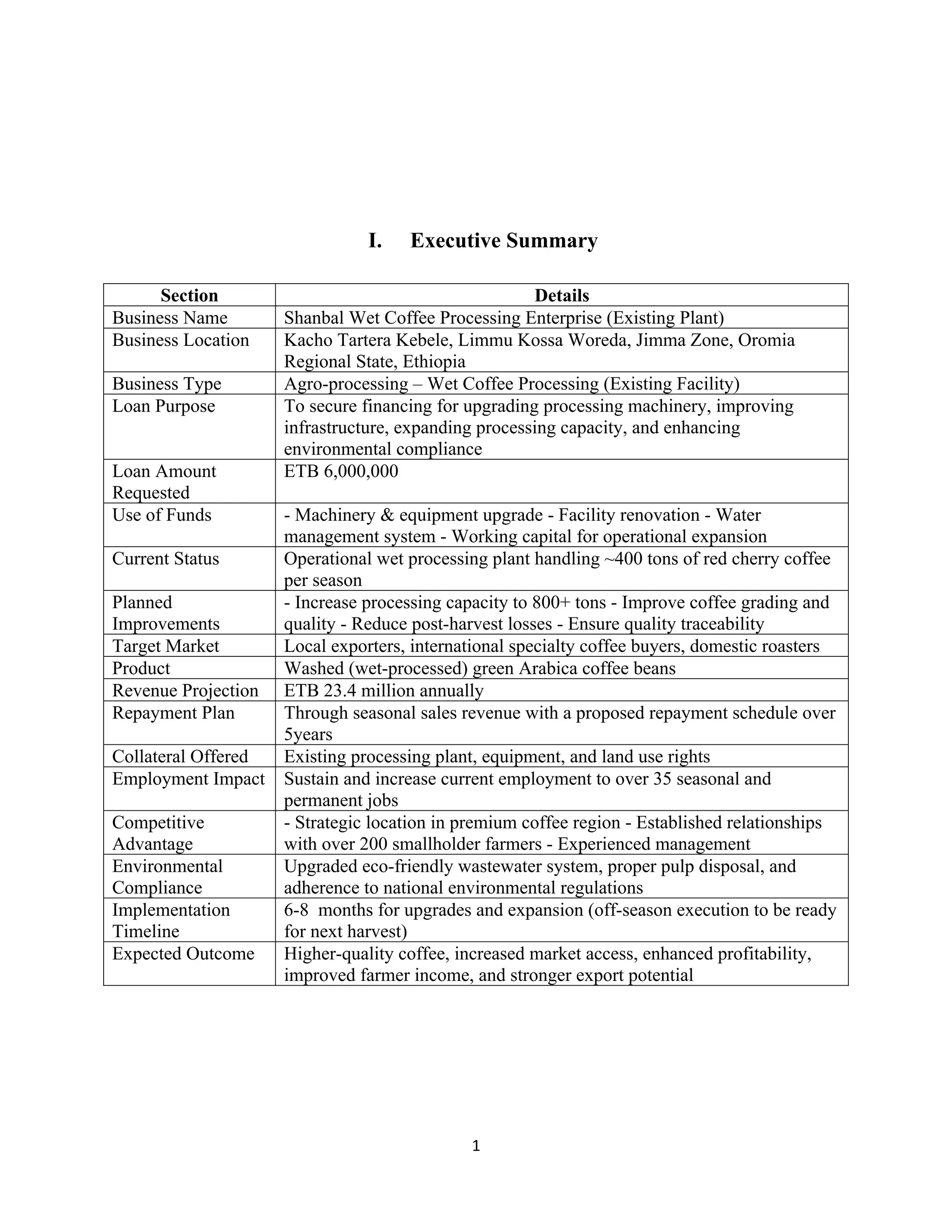
I. Executive Summary
Section Details
Business Name Shanbal Wet Coffee Processing Enterprise (Existing Plant)
Business Location Kacho Tartera Kebele, Limmu Kossa Woreda, Jimma Zone, Oromia
Regional State, Ethiopia
Business Type Agro-processing – Wet Coffee Processing (Existing Facility)
Loan Purpose To secure financing for upgrading processing machinery, improving
infrastructure, expanding processing capacity, and enhancing
environmental compliance
Loan Amount
Requested
ETB 6,000,000
Use of Funds - Machinery & equipment upgrade - Facility renovation - Water
management system - Working capital for operational expansion
Current Status Operational wet processing plant handling ~400 tons of red cherry coffee
per season
Planned
Improvements
- Increase processing capacity to 800+ tons - Improve coffee grading and
quality - Reduce post-harvest losses - Ensure quality traceability
Target Market Local exporters, international specialty coffee buyers, domestic roasters
Product Washed (wet-processed) green Arabica coffee beans
Revenue Projection ETB 23.4 million annually
Repayment Plan Through seasonal sales revenue with a proposed repayment schedule over
5years
Collateral Offered Existing processing plant, equipment, and land use rights
Employment Impact Sustain and increase current employment to over 35 seasonal and
permanent jobs
Competitive
Advantage
- Strategic location in premium coffee region - Established relationships
with over 200 smallholder farmers - Experienced management
Environmental
Compliance
Upgraded eco-friendly wastewater system, proper pulp disposal, and
adherence to national environmental regulations
Implementation
Timeline
6-8 months for upgrades and expansion (off-season execution to be ready
for next harvest)
Expected Outcome Higher-quality coffee, increased market access, enhanced profitability,
improved farmer income, and stronger export potential
1
1. Background and Introduction of the Project
1.1. Background of the Project
Shanbal Wet Coffee Processing Enterprise is an existing agro-processing facility located in
Kacho Tartera Kebele, within Limmu Kossa Woreda of Jimma Zone, in the Oromia Regional
State of Ethiopia. The facility has been operational for the past one year and has been engaged in
the processing of red cherry coffee through the wet (washed) method, a process known for
producing high-quality specialty coffee favored in both local and international markets.
The enterprise is strategically situated in a renowned coffee-growing area, known for its fertile
highlands, favorable altitude, and ideal climatic conditions, all of which contribute to the
production of premium-grade Arabica coffee. Shanbal Wet Coffee Processing has established
long-standing relationships with over 200 smallholder farmers in the surrounding communities
who consistently supply red cherry coffee during the harvest season.
Currently, the plant processes approximately 400 tons of red cherry coffee per season. However,
due to increased demand for high-quality washed coffee and the growing interest from
international specialty coffee buyers, there is a strong need to expand and modernize the existing
facility. The current infrastructure and machinery are outdated and limit the plant’s efficiency,
output quality, and environmental compliance.
To address these challenges and meet market demand, Shanbal is seeking a loan to upgrade its
processing equipment, renovate its infrastructure, and implement improved water treatment
systems. The objective of the loan is to double the facility’s capacity to 800+ tons per season,
improve grading and quality assurance practices, enhance environmental safeguards, and boost
operational efficiency.
By securing this loan, the enterprise will not only strengthen its competitiveness in the global
coffee value chain but also create additional employment opportunities and improve income for
local farmers. The expansion will further position Shanbal as a sustainable and impactful player
in Ethiopia’s specialty coffee sector.
2
1.2. Introduction of the Project
1.2.1. Profile of the Company
Shanbal Wet Coffee Processing Enterprise is a well-established agro-processing company
specializing in the wet (washed) processing of Arabica coffee cherries. Located in Kacho Tartera
Kebele of Limmu Kossa Woreda in the Jimma Zone, Oromia Regional State, the company is
situated in one of Ethiopia’s most renowned coffee-producing areas, famous for its rich soils,
optimal altitude, and favorable climate conducive to high-quality coffee cultivation.
Since its inception, Shanbal has been dedicated to processing premium-grade washed coffee by
applying traditional and modern wet processing techniques. The enterprise works closely with a
network of over 200 smallholder coffee farmers in the local community, providing them with
training, support, and a reliable market for their coffee cherries. This partnership ensures a
consistent supply of high-quality raw materials and fosters sustainable livelihoods in the region.
The company currently operates an existing wet coffee processing plant with an annual capacity
of approximately 400 tons of red cherry coffee. The plant includes pulping, fermentation,
washing, drying, and grading units, which collectively transform freshly harvested coffee
cherries into clean, high-quality green coffee beans ready for export and domestic markets.
Recognizing the increasing demand for specialty coffee and the need for improved operational
efficiency, Shanbal is committed to upgrading and expanding its facility. The planned
modernization efforts aim to double production capacity, enhance quality control, and introduce
environmentally sustainable practices, including wastewater treatment and eco-friendly pulp
disposal.
Shanbal Wet Coffee Processing Enterprise prides itself on its commitment to quality,
environmental stewardship, and community development. The company’s mission is to
contribute to Ethiopia’s coffee sector by delivering exceptional washed coffee products that meet
international standards while supporting the economic well-being of local coffee producers.
3
1.2.2. Objective of the Project
The primary objective of Shanbal Wet Coffee Processing Enterprise in seeking a loan is to
modernize and expand its existing wet coffee processing plant to meet the rising demand for
high-quality washed coffee both domestically and internationally. This objective includes
increasing processing capacity, improving product quality, and adopting environmentally
sustainable practices to enhance operational efficiency and competitiveness.
Specifically, the loan will enable Shanbal to:
Specifically, the working capital loan will be utilized to:
1. Procure Raw Coffee Cherries: Ensure timely and adequate purchase of red cherry coffee
from over 200 smallholder farmers in the local area, securing a reliable supply to sustain
continuous processing.
2. Cover Labor and Operational Costs: Support payment of seasonal and permanent staff
wages, utilities, transportation, and other operational expenses critical to maintaining high-
quality processing activities.
3. Manage Inventory and Supplies: Finance the purchase of necessary inputs such as water,
fuel, packaging materials, and maintenance supplies required for uninterrupted plant
operations.
4. Support Quality Control and Marketing Activities: Facilitate costs related to coffee grading,
quality assurance, certification, and marketing efforts aimed at accessing premium buyers
and exporters.
5. Maintain Financial Stability: Improve cash flow management to ensure timely payments to
suppliers and employees, thereby strengthening supplier relationships and workforce
motivation.
By securing this working capital loan, Shanbal aims to optimize its operational capacity, reduce
delays in processing, and enhance overall productivity during the critical coffee season. This will
contribute to sustained revenue generation, improved farmer incomes, and strengthened market
position in the specialty coffee sector.
4
2. Product/Service Description
The core product of Shanbal is washed green Arabica coffee beans, processed through a
carefully controlled wet milling procedure designed to enhance the coffee’s flavor profile,
cleanliness, and overall quality. The processing steps include:
 Sorting and Pulping: Freshly harvested red coffee cherries are sorted to remove under
ripe or defective fruit, and then pulped to separate the coffee beans from the outer cherry
skin.
 Fermentation: The pulped beans undergo controlled fermentation to remove the mucilage
layer, a critical step for developing the coffee’s flavor characteristics.
 Washing: Beans are thoroughly washed with clean water to ensure removal of any
remaining residue.
 Drying: Washed beans are dried on raised beds or mechanical dryers to reach optimal
moisture content for storage and export.
 Grading and Packaging: Once dried, the green coffee beans are sorted by size and quality,
and then packed for shipment to domestic and international buyers.
The company prides itself on maintaining stringent quality control measures throughout the
processing cycle to meet specialty coffee standards. This includes adopting best practices in
hygiene, timely processing, and quality assurance protocols.
Shanbal’s service extends beyond processing, offering smallholder farmer’s technical assistance
and training on harvesting and post-harvest handling to improve the overall quality of coffee
cherries supplied to the plant.
5
3. SWOT and PESTEL Analysis
3.1. SWOT Analysis
Shanbal Wet Coffee Processing Enterprise has established itself as a key player in the wet coffee
processing sector within the Jimma Zone, leveraging its advantageous location and operational
experience.
Table 3.1 SWOT Analysis
SWOT Analysis Details
Strengths - Established operational plant with proven processing experience
- Strategic location in a prime coffee-growing region
- Strong relationships with over 200 local smallholder farmers
- Existing customer base and market connections
- Skilled labor familiar with wet processing methods
- Commitment to producing high
-quality washed Arabica coffee
Weaknesses - Limited processing capacity (~400 tons) restricting scalability
- Outdated machinery and infrastructure affecting efficiency
- Insufficient working capital for peak seasons
- Partial environmental compliance, requiring upgrades
- Dependence on seasonal coffee supply which can be variable due to
weather or pests
Opportunities - Growing global demand for specialty and washed coffee
- Potential for capacity expansion to meet increasing market needs
- Access to export markets and premium coffee buyers
- Availability of financial support and grants for agro-processing
development
- Training and capacity building opportunities for staff and farmers
- Ability to improve environmental sustainability practices to meet
international standards
6
Threats - Price volatility in international coffee markets
- Climate change impacts affecting coffee yield and quality
- Competition from other wet mills and processors in the region
- Potential delays in loan approval or disbursement
- Political or social instability impacting supply chains
- Risk of disease or pest outbreaks affecting coffee production
3.2. PESTEL Analysis
These factors, categorized under the PESTEL (Political, Economic, Social, Technological,
Environmental, and Legal) framework, provide insight into the opportunities and challenges that
influence the success and sustainability of the business, particularly in the context of a loan
request for working capital and operational expansion.
Political Factors
The Government of Ethiopia recognizes coffee as a strategic export commodity and actively
supports the coffee sector through favorable agricultural and industrial policies. Initiatives such
as investment incentives for agro-processing businesses and access to land through lease
arrangements make the political environment relatively conducive. However, occasional political
instability or ethnic tensions in some areas of the country—including parts of Oromia—pose
risks to transportation, logistics, and labor mobility. Stability at the local level in Limmu Kossa
Woreda has so far supported smooth operations, but future developments remain an area to
monitor.
Economic Factors
Ethiopia’s economy is heavily dependent on coffee, making the sector a key contributor to
national GDP and foreign exchange earnings. Shanbal benefits from this economic focus and
from access to development-oriented financial services such as agricultural loans. However, the
business is also exposed to broader economic challenges, including inflation, fluctuating fuel and
input prices, and depreciation of the Ethiopian birr, which can increase operating costs.
Additionally, global coffee price volatility impacts export earnings and financial planning.
7
Securing a loan for working capital is therefore essential to maintain liquidity during peak
harvest and processing periods.
Social Factors
Coffee holds cultural and social significance in Ethiopia and the surrounding community is
deeply involved in coffee farming. Shanbal enjoys strong relationships with over 200 local
smallholder farmers, providing a stable and community-supported supply chain. The social
environment is favorable for collaboration, labor recruitment, and community-based
development. Moreover, there is a strong sense of ownership and participation among local
stakeholders, which boosts productivity and loyalty. Increasing public awareness of quality
coffee production and sustainable farming practices also supports Shanbal’s vision and
objectives.
Technological Factors
Technology adoption in coffee processing is gradually improving in Ethiopia, and Shanbal has
access to basic wet processing technologies. However, the enterprise still uses some outdated
equipment, limiting efficiency and product consistency. The loan request includes plans to
upgrade technology to improve pulping, fermentation, drying, and grading processes. Access to
digital tools and modern machinery will enhance operational performance. Nonetheless, rural
digital infrastructure remains weak, limiting opportunities for real-time data management,
traceability, and direct market access via e-commerce or digital platforms.
Environmental Factors
Environmental considerations are increasingly important in the coffee sector. Wet coffee
processing generates significant wastewater and organic waste (coffee pulp), which must be
managed responsibly to avoid polluting local water sources. Shanbal is committed to
implementing eco-friendly wastewater treatment and pulp composting systems as part of its
facility upgrade. Additionally, climate change is a growing threat to coffee production in
Ethiopia, with unpredictable rainfall patterns and rising temperatures impacting yields and
quality. Environmental sustainability measures are essential not only for compliance but also for
long-term operational viability.
8
Legal Factors
Shanbal operates under the legal framework set by Ethiopian authorities, including regulations
from the Ministry of Agriculture and the Ethiopian Coffee and Tea Authority. These include
requirements for export licensing, quality certification, environmental protection, and labor
rights. Compliance with these legal standards is crucial to access both local and international
markets. While the government has streamlined some bureaucratic procedures, challenges such
as delays in licensing, inspections, or land certification can occasionally hinder operations or
expansion timelines.
If you want the full document (DOCX and XLS), you can
get it by completing the payment
Payment: ETB 3,000
Account number CBE: 1000138514618
telebirr: 0977684566
If you want business plan and Project Proposal click
link below: Telegram link: https://t.me/bprojectp
Contact for further information: +251977684566
Send Screenshot of Payment via telegram:
0923345749 or 0977684566 and then you will get full
document
Email: tahirkasim10@gmail.com
9
10

Wet Coffee Processing Plant Business Plan in Limmu Kossa Woreda, Jimma Zone, Oromia, Ethiopia (1).pdf

  • 1.
    WET COFFEE PROCESSINGPLANT BUSINESS PLAN BUSINESS NAME: SHANBAL ENTERPRISE BUSINESS TYPE: AGRO-PROCESSING BUSINESS OWNER: SHANBAL BUSINESS LOCATION: KACHO TARTERA KEBELE, LUMMU KOSSA WOREDA, JIMMA ZONE, OROMIA REGIONAL STATE, ETHIOPIA SUBMITTED TO: CBE JULY, 2025 KOSSA, ETHIOPIA
  • 2.
    Table of Contents ContentsPage I. Executive Summary.................................................................................................................1 1. Background and Introduction of the Project............................................................................2 1.1. Background of the Project.................................................................................................2 1.2. Introduction of the Project................................................................................................3 1.2.1. Profile of the Company..............................................................................................3 1.2.2. Objective of the Project.............................................................................................4 2. Product/Service Description.....................................................................................................5 3. SWOT and PESTEL Analysis..................................................................................................6 3.1. SWOT Analysis................................................................................................................6 3.2. PESTEL Analysis.............................................................................................................7 4. Key Drivers, Success Factors, Constraints and Risk..............................................................10 4.1. Key Drivers.....................................................................................................................10 4.2. Key Success Factors........................................................................................................10 4.3. Constraints......................................................................................................................11 4.4. Risks................................................................................................................................11 5. Input/ Output of Product/Service...........................................................................................13 5.1. Input................................................................................................................................ 13 5.1.1. Raw Materials and Source.......................................................................................13 5.1.2. Input Requirement and Summary Cost of Raw Materials.......................................14 6. Technology and Engineering..................................................................................................16 6.1. Technology......................................................................................................................16 6.1.1. Production Processing Technology.........................................................................16 6.1.2. Machinery and Equipment Specification.................................................................17 6.2. Engineering..................................................................................................................... 18 6.2.1. Land Requirement and Layout Design....................................................................18 6.2.2. Building Specification.............................................................................................20 7. Market Study.......................................................................................................................... 22 7.2. Market Overview............................................................................................................22 7.3. Market Demand and Supply...........................................................................................22 7.4. Marketing Strategy..........................................................................................................24 7.5. Competition.....................................................................................................................26 7.6. Price and Price Trend of Product/Service.......................................................................27 8. Organizational Structure and Management............................................................................28 8.1. Organizational Management...........................................................................................28 8.2. Organizational Structure.................................................................................................28 8.3. Human Resource Requirement.......................................................................................29 9. Financial Study.......................................................................................................................30 ii
  • 3.
    9.1. Underlying Assumption..................................................................................................30 9.2.Fixed Investment.............................................................................................................31 9.2.1. Building Specification.............................................................................................31 9.2.2. Machineries and Equipment Specification..............................................................32 9.2.3. Office Furniture.......................................................................................................33 9.3. Working Capital..............................................................................................................33 9.3.1. Input Material Cost..................................................................................................33 9.3.2. Human Power Salary and Wages............................................................................34 9.3.3. Utilities Expense......................................................................................................35 9.3.4. Repair and Maintenance..........................................................................................35 9.3.5. Pre-operating Expense.............................................................................................36 9.3.6. Operating Expenses at Full Capacity.......................................................................36 9.4. Summary of Total Initial Investment Cost......................................................................37 9.5. Source of Finance............................................................................................................38 9.6. Revenues Projection........................................................................................................38 9.7. Depreciation and Amortization Schedule.......................................................................39 9.7.1. Depreciation Schedule.............................................................................................39 9.7.2. Amortization Schedule............................................................................................39 9.8. Financial Analysis and Statements.................................................................................40 9.8.1. Income Statement....................................................................................................40 9.8.2. Cash Flow Statement...............................................................................................41 9.8.3. Discounted Cash Flow.............................................................................................42 9.8.4. Financial Viability...................................................................................................42 9.8.5. Break Even Analysis................................................................................................43 9.8.6. Financial Ratio.........................................................................................................44 10. Environmental Consideration and Socio Economic Impact...............................................46 10.1. Environmental Impact and Mitigation Measure..........................................................46 10.1.1. Environmental Impact Assessment..........................................................................46 10.1.2. Environmental Mitigation Measures.......................................................................47 10.2. Socio-Economic Impact and Mitigation Method........................................................48 10.2.1. Socio-Economic Impacts.........................................................................................48 10.2.2. Mitigation Methods.................................................................................................49 11. Project Implementation Schedule.......................................................................................51 iii
  • 4.
    I. Executive Summary SectionDetails Business Name Shanbal Wet Coffee Processing Enterprise (Existing Plant) Business Location Kacho Tartera Kebele, Limmu Kossa Woreda, Jimma Zone, Oromia Regional State, Ethiopia Business Type Agro-processing – Wet Coffee Processing (Existing Facility) Loan Purpose To secure financing for upgrading processing machinery, improving infrastructure, expanding processing capacity, and enhancing environmental compliance Loan Amount Requested ETB 6,000,000 Use of Funds - Machinery & equipment upgrade - Facility renovation - Water management system - Working capital for operational expansion Current Status Operational wet processing plant handling ~400 tons of red cherry coffee per season Planned Improvements - Increase processing capacity to 800+ tons - Improve coffee grading and quality - Reduce post-harvest losses - Ensure quality traceability Target Market Local exporters, international specialty coffee buyers, domestic roasters Product Washed (wet-processed) green Arabica coffee beans Revenue Projection ETB 23.4 million annually Repayment Plan Through seasonal sales revenue with a proposed repayment schedule over 5years Collateral Offered Existing processing plant, equipment, and land use rights Employment Impact Sustain and increase current employment to over 35 seasonal and permanent jobs Competitive Advantage - Strategic location in premium coffee region - Established relationships with over 200 smallholder farmers - Experienced management Environmental Compliance Upgraded eco-friendly wastewater system, proper pulp disposal, and adherence to national environmental regulations Implementation Timeline 6-8 months for upgrades and expansion (off-season execution to be ready for next harvest) Expected Outcome Higher-quality coffee, increased market access, enhanced profitability, improved farmer income, and stronger export potential 1
  • 5.
    1. Background andIntroduction of the Project 1.1. Background of the Project Shanbal Wet Coffee Processing Enterprise is an existing agro-processing facility located in Kacho Tartera Kebele, within Limmu Kossa Woreda of Jimma Zone, in the Oromia Regional State of Ethiopia. The facility has been operational for the past one year and has been engaged in the processing of red cherry coffee through the wet (washed) method, a process known for producing high-quality specialty coffee favored in both local and international markets. The enterprise is strategically situated in a renowned coffee-growing area, known for its fertile highlands, favorable altitude, and ideal climatic conditions, all of which contribute to the production of premium-grade Arabica coffee. Shanbal Wet Coffee Processing has established long-standing relationships with over 200 smallholder farmers in the surrounding communities who consistently supply red cherry coffee during the harvest season. Currently, the plant processes approximately 400 tons of red cherry coffee per season. However, due to increased demand for high-quality washed coffee and the growing interest from international specialty coffee buyers, there is a strong need to expand and modernize the existing facility. The current infrastructure and machinery are outdated and limit the plant’s efficiency, output quality, and environmental compliance. To address these challenges and meet market demand, Shanbal is seeking a loan to upgrade its processing equipment, renovate its infrastructure, and implement improved water treatment systems. The objective of the loan is to double the facility’s capacity to 800+ tons per season, improve grading and quality assurance practices, enhance environmental safeguards, and boost operational efficiency. By securing this loan, the enterprise will not only strengthen its competitiveness in the global coffee value chain but also create additional employment opportunities and improve income for local farmers. The expansion will further position Shanbal as a sustainable and impactful player in Ethiopia’s specialty coffee sector. 2
  • 6.
    1.2. Introduction ofthe Project 1.2.1. Profile of the Company Shanbal Wet Coffee Processing Enterprise is a well-established agro-processing company specializing in the wet (washed) processing of Arabica coffee cherries. Located in Kacho Tartera Kebele of Limmu Kossa Woreda in the Jimma Zone, Oromia Regional State, the company is situated in one of Ethiopia’s most renowned coffee-producing areas, famous for its rich soils, optimal altitude, and favorable climate conducive to high-quality coffee cultivation. Since its inception, Shanbal has been dedicated to processing premium-grade washed coffee by applying traditional and modern wet processing techniques. The enterprise works closely with a network of over 200 smallholder coffee farmers in the local community, providing them with training, support, and a reliable market for their coffee cherries. This partnership ensures a consistent supply of high-quality raw materials and fosters sustainable livelihoods in the region. The company currently operates an existing wet coffee processing plant with an annual capacity of approximately 400 tons of red cherry coffee. The plant includes pulping, fermentation, washing, drying, and grading units, which collectively transform freshly harvested coffee cherries into clean, high-quality green coffee beans ready for export and domestic markets. Recognizing the increasing demand for specialty coffee and the need for improved operational efficiency, Shanbal is committed to upgrading and expanding its facility. The planned modernization efforts aim to double production capacity, enhance quality control, and introduce environmentally sustainable practices, including wastewater treatment and eco-friendly pulp disposal. Shanbal Wet Coffee Processing Enterprise prides itself on its commitment to quality, environmental stewardship, and community development. The company’s mission is to contribute to Ethiopia’s coffee sector by delivering exceptional washed coffee products that meet international standards while supporting the economic well-being of local coffee producers. 3
  • 7.
    1.2.2. Objective ofthe Project The primary objective of Shanbal Wet Coffee Processing Enterprise in seeking a loan is to modernize and expand its existing wet coffee processing plant to meet the rising demand for high-quality washed coffee both domestically and internationally. This objective includes increasing processing capacity, improving product quality, and adopting environmentally sustainable practices to enhance operational efficiency and competitiveness. Specifically, the loan will enable Shanbal to: Specifically, the working capital loan will be utilized to: 1. Procure Raw Coffee Cherries: Ensure timely and adequate purchase of red cherry coffee from over 200 smallholder farmers in the local area, securing a reliable supply to sustain continuous processing. 2. Cover Labor and Operational Costs: Support payment of seasonal and permanent staff wages, utilities, transportation, and other operational expenses critical to maintaining high- quality processing activities. 3. Manage Inventory and Supplies: Finance the purchase of necessary inputs such as water, fuel, packaging materials, and maintenance supplies required for uninterrupted plant operations. 4. Support Quality Control and Marketing Activities: Facilitate costs related to coffee grading, quality assurance, certification, and marketing efforts aimed at accessing premium buyers and exporters. 5. Maintain Financial Stability: Improve cash flow management to ensure timely payments to suppliers and employees, thereby strengthening supplier relationships and workforce motivation. By securing this working capital loan, Shanbal aims to optimize its operational capacity, reduce delays in processing, and enhance overall productivity during the critical coffee season. This will contribute to sustained revenue generation, improved farmer incomes, and strengthened market position in the specialty coffee sector. 4
  • 8.
    2. Product/Service Description Thecore product of Shanbal is washed green Arabica coffee beans, processed through a carefully controlled wet milling procedure designed to enhance the coffee’s flavor profile, cleanliness, and overall quality. The processing steps include:  Sorting and Pulping: Freshly harvested red coffee cherries are sorted to remove under ripe or defective fruit, and then pulped to separate the coffee beans from the outer cherry skin.  Fermentation: The pulped beans undergo controlled fermentation to remove the mucilage layer, a critical step for developing the coffee’s flavor characteristics.  Washing: Beans are thoroughly washed with clean water to ensure removal of any remaining residue.  Drying: Washed beans are dried on raised beds or mechanical dryers to reach optimal moisture content for storage and export.  Grading and Packaging: Once dried, the green coffee beans are sorted by size and quality, and then packed for shipment to domestic and international buyers. The company prides itself on maintaining stringent quality control measures throughout the processing cycle to meet specialty coffee standards. This includes adopting best practices in hygiene, timely processing, and quality assurance protocols. Shanbal’s service extends beyond processing, offering smallholder farmer’s technical assistance and training on harvesting and post-harvest handling to improve the overall quality of coffee cherries supplied to the plant. 5
  • 9.
    3. SWOT andPESTEL Analysis 3.1. SWOT Analysis Shanbal Wet Coffee Processing Enterprise has established itself as a key player in the wet coffee processing sector within the Jimma Zone, leveraging its advantageous location and operational experience. Table 3.1 SWOT Analysis SWOT Analysis Details Strengths - Established operational plant with proven processing experience - Strategic location in a prime coffee-growing region - Strong relationships with over 200 local smallholder farmers - Existing customer base and market connections - Skilled labor familiar with wet processing methods - Commitment to producing high -quality washed Arabica coffee Weaknesses - Limited processing capacity (~400 tons) restricting scalability - Outdated machinery and infrastructure affecting efficiency - Insufficient working capital for peak seasons - Partial environmental compliance, requiring upgrades - Dependence on seasonal coffee supply which can be variable due to weather or pests Opportunities - Growing global demand for specialty and washed coffee - Potential for capacity expansion to meet increasing market needs - Access to export markets and premium coffee buyers - Availability of financial support and grants for agro-processing development - Training and capacity building opportunities for staff and farmers - Ability to improve environmental sustainability practices to meet international standards 6
  • 10.
    Threats - Pricevolatility in international coffee markets - Climate change impacts affecting coffee yield and quality - Competition from other wet mills and processors in the region - Potential delays in loan approval or disbursement - Political or social instability impacting supply chains - Risk of disease or pest outbreaks affecting coffee production 3.2. PESTEL Analysis These factors, categorized under the PESTEL (Political, Economic, Social, Technological, Environmental, and Legal) framework, provide insight into the opportunities and challenges that influence the success and sustainability of the business, particularly in the context of a loan request for working capital and operational expansion. Political Factors The Government of Ethiopia recognizes coffee as a strategic export commodity and actively supports the coffee sector through favorable agricultural and industrial policies. Initiatives such as investment incentives for agro-processing businesses and access to land through lease arrangements make the political environment relatively conducive. However, occasional political instability or ethnic tensions in some areas of the country—including parts of Oromia—pose risks to transportation, logistics, and labor mobility. Stability at the local level in Limmu Kossa Woreda has so far supported smooth operations, but future developments remain an area to monitor. Economic Factors Ethiopia’s economy is heavily dependent on coffee, making the sector a key contributor to national GDP and foreign exchange earnings. Shanbal benefits from this economic focus and from access to development-oriented financial services such as agricultural loans. However, the business is also exposed to broader economic challenges, including inflation, fluctuating fuel and input prices, and depreciation of the Ethiopian birr, which can increase operating costs. Additionally, global coffee price volatility impacts export earnings and financial planning. 7
  • 11.
    Securing a loanfor working capital is therefore essential to maintain liquidity during peak harvest and processing periods. Social Factors Coffee holds cultural and social significance in Ethiopia and the surrounding community is deeply involved in coffee farming. Shanbal enjoys strong relationships with over 200 local smallholder farmers, providing a stable and community-supported supply chain. The social environment is favorable for collaboration, labor recruitment, and community-based development. Moreover, there is a strong sense of ownership and participation among local stakeholders, which boosts productivity and loyalty. Increasing public awareness of quality coffee production and sustainable farming practices also supports Shanbal’s vision and objectives. Technological Factors Technology adoption in coffee processing is gradually improving in Ethiopia, and Shanbal has access to basic wet processing technologies. However, the enterprise still uses some outdated equipment, limiting efficiency and product consistency. The loan request includes plans to upgrade technology to improve pulping, fermentation, drying, and grading processes. Access to digital tools and modern machinery will enhance operational performance. Nonetheless, rural digital infrastructure remains weak, limiting opportunities for real-time data management, traceability, and direct market access via e-commerce or digital platforms. Environmental Factors Environmental considerations are increasingly important in the coffee sector. Wet coffee processing generates significant wastewater and organic waste (coffee pulp), which must be managed responsibly to avoid polluting local water sources. Shanbal is committed to implementing eco-friendly wastewater treatment and pulp composting systems as part of its facility upgrade. Additionally, climate change is a growing threat to coffee production in Ethiopia, with unpredictable rainfall patterns and rising temperatures impacting yields and quality. Environmental sustainability measures are essential not only for compliance but also for long-term operational viability. 8
  • 12.
    Legal Factors Shanbal operatesunder the legal framework set by Ethiopian authorities, including regulations from the Ministry of Agriculture and the Ethiopian Coffee and Tea Authority. These include requirements for export licensing, quality certification, environmental protection, and labor rights. Compliance with these legal standards is crucial to access both local and international markets. While the government has streamlined some bureaucratic procedures, challenges such as delays in licensing, inspections, or land certification can occasionally hinder operations or expansion timelines. If you want the full document (DOCX and XLS), you can get it by completing the payment Payment: ETB 3,000 Account number CBE: 1000138514618 telebirr: 0977684566 If you want business plan and Project Proposal click link below: Telegram link: https://t.me/bprojectp Contact for further information: +251977684566 Send Screenshot of Payment via telegram: 0923345749 or 0977684566 and then you will get full document Email: tahirkasim10@gmail.com 9
  • 13.