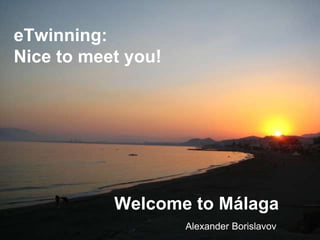
eTwinning:
Nice to meet you!


           Welcome to Málaga
                    Alexander Borislavov
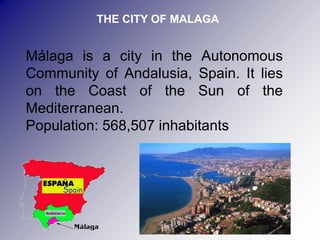
THE CITY OF MALAGA


Málaga is a city in the Autonomous
Community of Andalusia, Spain. It lies
on the Coast of the Sun of the
Mediterranean.
Population: 568,507 inhabitants
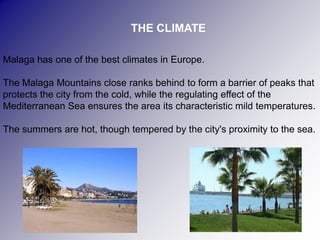
THE CLIMATE

Malaga has one of the best climates in Europe.

The Malaga Mountains close ranks behind to form a barrier of peaks that
protects the city from the cold, while the regulating effect of the
Mediterranean Sea ensures the area its characteristic mild temperatures.

The summers are hot, though tempered by the city's proximity to the sea.
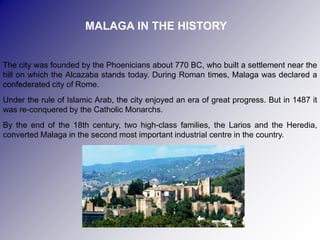
MALAGA IN THE HISTORY


The city was founded by the Phoenicians about 770 BC, who built a settlement near the
hill on which the Alcazaba stands today. During Roman times, Malaga was declared a
confederated city of Rome.
Under the rule of Islamic Arab, the city enjoyed an era of great progress. But in 1487 it
was re-conquered by the Catholic Monarchs.
By the end of the 18th century, two high-class families, the Larios and the Heredia,
converted Malaga in the second most important industrial centre in the country.
Festivities
                          HOLY WEEK


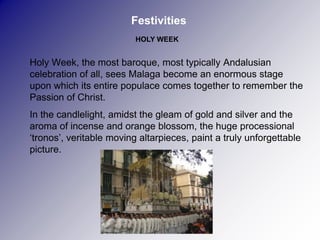
Holy Week, the most baroque, most typically Andalusian
celebration of all, sees Malaga become an enormous stage
upon which its entire populace comes together to remember the
Passion of Christ.
In the candlelight, amidst the gleam of gold and silver and the
aroma of incense and orange blossom, the huge processional
‘tronos’, veritable moving altarpieces, paint a truly unforgettable
picture.
Festivities
                             ST JOHN’S EVE


   The Feast of St John coincides with the June solstice also
    referred to as Midsummer. Festivities are celebrated the night
    before, on St John's Eve (June 23), the shortest night of the
    year.
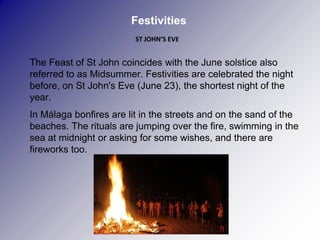
   In Málaga bonfires are lit in the streets and on the sand of the
    beaches. The rituals are jumping over the fire, swimming in the
    sea at midnight or asking for some wishes, and there are
    fireworks too.
Festivities
                             ST JOHN’S EVE


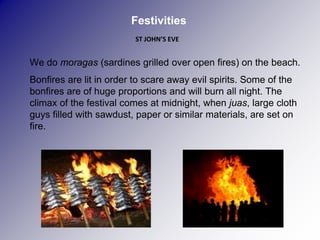
   We do moragas (sardines grilled over open fires) on the beach.
   Bonfires are lit in order to scare away evil spirits. Some of the
    bonfires are of huge proportions and will burn all night. The
    climax of the festival comes at midnight, when juas, large cloth
    guys filled with sawdust, paper or similar materials, are set on
    fire.

Festivities
ST JOHN’S EVE


                Some students burn their
                books in bonfires celebrating
                that the school finished and
                the summer begins.
Festivities
            ST JOHN’S EVE


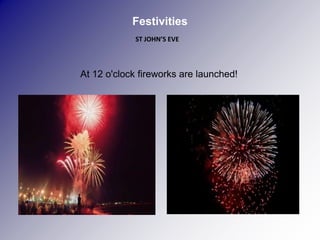
At 12 o'clock fireworks are launched!
Festivities
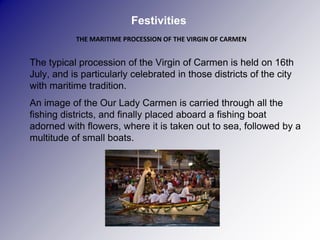
               THE MARITIME PROCESSION OF THE VIRGIN OF CARMEN


   The typical procession of the Virgin of Carmen is held on 16th
    July, and is particularly celebrated in those districts of the city
    with maritime tradition.
   An image of the Our Lady Carmen is carried through all the
    fishing districts, and finally placed aboard a fishing boat
    adorned with flowers, where it is taken out to sea, followed by a
    multitude of small boats.

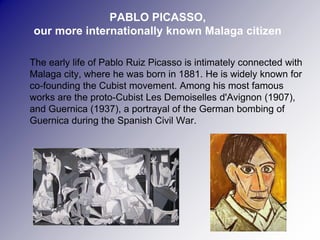
PABLO PICASSO,
    our more internationally known Malaga citizen

   The early life of Pablo Ruiz Picasso is intimately connected with
    Malaga city, where he was born in 1881. He is widely known for
    co-founding the Cubist movement. Among his most famous
    works are the proto-Cubist Les Demoiselles d'Avignon (1907),
    and Guernica (1937), a portrayal of the German bombing of
    Guernica during the Spanish Civil War.

Welcome to malaga2

  • 1.
    eTwinning: Nice to meetyou! Welcome to Málaga Alexander Borislavov
  • 2.
    THE CITY OFMALAGA Málaga is a city in the Autonomous Community of Andalusia, Spain. It lies on the Coast of the Sun of the Mediterranean. Population: 568,507 inhabitants
  • 3.
    THE CLIMATE Malaga hasone of the best climates in Europe. The Malaga Mountains close ranks behind to form a barrier of peaks that protects the city from the cold, while the regulating effect of the Mediterranean Sea ensures the area its characteristic mild temperatures. The summers are hot, though tempered by the city's proximity to the sea.
  • 4.
    MALAGA IN THEHISTORY The city was founded by the Phoenicians about 770 BC, who built a settlement near the hill on which the Alcazaba stands today. During Roman times, Malaga was declared a confederated city of Rome. Under the rule of Islamic Arab, the city enjoyed an era of great progress. But in 1487 it was re-conquered by the Catholic Monarchs. By the end of the 18th century, two high-class families, the Larios and the Heredia, converted Malaga in the second most important industrial centre in the country.
  • 5.
    Festivities HOLY WEEK Holy Week, the most baroque, most typically Andalusian celebration of all, sees Malaga become an enormous stage upon which its entire populace comes together to remember the Passion of Christ. In the candlelight, amidst the gleam of gold and silver and the aroma of incense and orange blossom, the huge processional ‘tronos’, veritable moving altarpieces, paint a truly unforgettable picture.
  • 6.
    Festivities ST JOHN’S EVE  The Feast of St John coincides with the June solstice also referred to as Midsummer. Festivities are celebrated the night before, on St John's Eve (June 23), the shortest night of the year.  In Málaga bonfires are lit in the streets and on the sand of the beaches. The rituals are jumping over the fire, swimming in the sea at midnight or asking for some wishes, and there are fireworks too.
  • 7.
    Festivities ST JOHN’S EVE  We do moragas (sardines grilled over open fires) on the beach.  Bonfires are lit in order to scare away evil spirits. Some of the bonfires are of huge proportions and will burn all night. The climax of the festival comes at midnight, when juas, large cloth guys filled with sawdust, paper or similar materials, are set on fire. 
  • 8.
    Festivities ST JOHN’S EVE Some students burn their books in bonfires celebrating that the school finished and the summer begins.
  • 9.
    Festivities ST JOHN’S EVE At 12 o'clock fireworks are launched!
  • 10.
    Festivities THE MARITIME PROCESSION OF THE VIRGIN OF CARMEN  The typical procession of the Virgin of Carmen is held on 16th July, and is particularly celebrated in those districts of the city with maritime tradition.  An image of the Our Lady Carmen is carried through all the fishing districts, and finally placed aboard a fishing boat adorned with flowers, where it is taken out to sea, followed by a multitude of small boats. 
  • 11.
    PABLO PICASSO, our more internationally known Malaga citizen  The early life of Pablo Ruiz Picasso is intimately connected with Malaga city, where he was born in 1881. He is widely known for co-founding the Cubist movement. Among his most famous works are the proto-Cubist Les Demoiselles d'Avignon (1907), and Guernica (1937), a portrayal of the German bombing of Guernica during the Spanish Civil War.