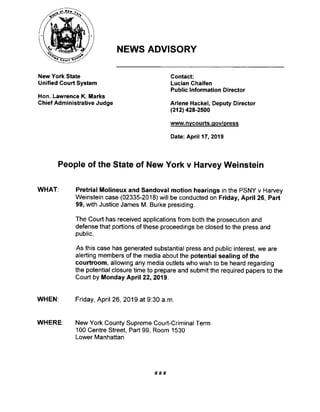
NEWS ADVISORY
New York State Contact:
Unified Court System Lucian Chalfen
Public Information Director
Hon. Lawrence K. Marks
Chief Administrative Judge Arlene Hackel, Deputy Director
(212) 428-2500
www.nycourts.gov/press
Date: April 17, 2019
People of the State of New York v Harvey Weinstein
WHAT:
WHEN:
WHERE:
Pretrial Molineux and Sandoval motion hearings in the PSNY v Harvey
Weinstein case (02335-2018) will be conducted on Friday, April 26, Part
99, with Justice James M. Burke presiding.
The Court has received applications from both the prosecution and
defense that portions of these proceedings be closed to the press and
public.
As this case has generated substantial press and public interest, we are
alerting members of the media about the potential sealing of the
courtroom, allowing any media outlets who wish to be heard regarding
the potential closure time to prepare and submit the required papers to the
Court by Monday April 22, 2019.
Friday, April 26, 2019 at 9:30 a.m.
New York County Supreme Court-Criminal Term
100 Centre Street, Part 99, Room 1530
Lower Manhattan
###
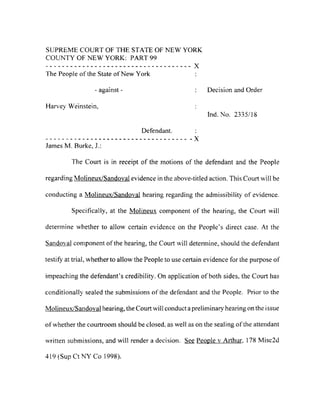
SUPREME COURT OF THE STATE OF NEV YORK
COUNTY OF NEW YORK: PART 99
- - - - - - - - - - - - - - - - - - - - - - - - - - - - - - - - - - - - X
The People of the State of New York
- against -
Harvey Weinstein,
Defendant.
-X
James M. Burke, J.:
Decision and Order
Ind. No. 2335/l 8
The Court is in receipt of the motions of the defendant and the People
regarding Jvlolineux/Sandoval evidence in the above-titled action. This Court will be
conducting a Molineux/Sandoval hearing regarding the admissibility of evidence.
Specifically, at the Molineux component of the hearing, the Court will
determine whether to allow certain evidence on the People's direct case. At the
Sandoval component of the hearing, the Court will detennine, should the defendant
testify at trial, whether to allow the People to use certain evidence for the purpose of
impeaching the defendant's credibility. On application of both sides, the Court has
conditionally sealed the submissions of the defendant and the People. Prior to the
J,1olineux/Sandoval hearing, the Court will conducta preliminary hearing on the issue
of whether the courtroom should be closed, as well as on the sealing ofthe attendant
written submissions, and will render a decision. See People v Arthur. 178 Misc2d
419 (Sup Ct NY Co 1998).
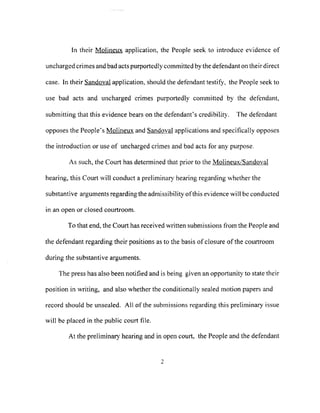
In their Molineux application, the People seek to introduce evidence of
uncharged crimes and bad acts purportedly committed by the defendant on their direct
case. In their Sandoval application, should the defendant testify, the People seek to
use bad acts and uncharged crimes purportedly committed by the defendant,
submitting that this evidence bears on the defendant's credibility. The defendant
opposes the People's Molineux and Sandoval applications and specifically opposes
the introduction or use of uncharged crimes and bad acts for any purpose.
As such, the Court has detennined that prior to the Molineux/Sandoval
hearing, this Court will conduct a preliminary hearing regarding whether the
substantive arguments regarding the admissibility ofthis evidence will be conducted
in an open or closed courtroom.
To that end, the Court has received written submissions from the People and
the defendant regarding their positions as to the basis ofclosure ofthe courtroom
during the substantive arguments.
The press has also been notified and is being given an opportunity to state their
position in writing, and also whether the conditionally sealed motion papers and
record should be unsealed. All of the submissions regarding this preliminary issue
will be placed in the public court file.
At the preliminary hearing and in open court, the People and the defendant
2
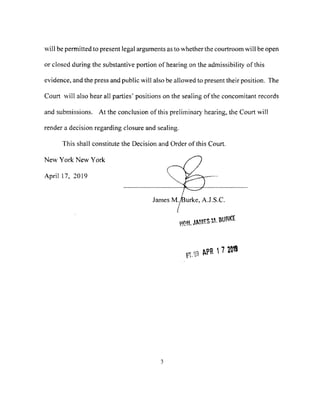
will be permitted to present legal arguments as to whether the courtroom will be open
or closed during the substantive portion of hearing on the admissibility of this
evidence, and the press and public will also be allowed to present their position. The
Court will also hear all parties' positions on the sealing of the concomitant records
and submissions. At the conclusion of this preliminary hearing, the Court will
render a decision regarding closure and sealing.
This shall constitute the Decision and Order of this Court.
New York New York
Aprill 7, 2019
3
CYRUS R. VANCE, JR.
O!sTFl'CT ATTORNEY
},pril 16, 2019
Honorable James Burke
DISTRICT ATTORNEY
COUNTY OF NEW YORK
ONE HOGAN PLACE
New York, N. Y. 10013
(212) 335-9000
Supreme Court of the State of New York
Part 99
100 Centre Street
1':ew York, NY 10013
DearJudge Burke:
Re: People v. Harvey Weinstein
Ind. No. 2335/2018
This lcncr is in response to the Court's communication of April 11, 2019, seeking the
position of the parties on closure of the courtroom during the Sandm,al and Jfo!tneu:,: hearings
to be conducted on April 26, 2019. The People seek an order of this Court, closing the
courtroom to the public and the press during these hearings. 1 In response to the specific
c1uestions posed by the Court, this letter provides (1) the reasons for closure, (2) the legal basis
therefor, and (3) the procedures required prior to excluding the public and press.
,'s this Court is well aware, this case has generated extensive media cm·crage and will
continue to do so in light of the celebrity st.atus of the defendant and others in the
entertainment field who have had dealings with him. The public's appetite for information
relating to the defendant shows no sign of abating. To strike the proper balance in this case
between the public's and prcss's qualified right ro attend court proceedings and the defendant's
right to a fair trial by an impartial jury, the Court should-after hearing in open court from
the parties and representatives of the media, and making specific findings on the record-
order that the Sandwal and Malineux hearings be closed to the public and the press. Howen·r,
the Court should make clear that any evidence that it determines is admissible will be made
public at the trial of this matter, or earlier if disclosure will nor compromise the defendant's
right to a fair trial.
TI1e First Amendment guarantees the public and the press a qualified right of access to
criminal trials. Richmond Newspapers v. Virginia, 448 U.S. 555, 580 (1980) (plurality opinion).
:!though the public acquires information abom trials primarily from the press, "the press is
not imbued with any special right of access," bur rather possesses "the same righr of access as
the public." GJJ1rtroom '/derision 1'etwork IJ.C I'. State ofNew York, 5 N.Y.3d 222, 229 (2005)
(9uoting R.frhn1011d 1Vewspapers, at 573). "Thus, the press has 'no right to information about a
' 'c belie,·e thar the defense is also moving for closure of these proceedings.
trial superior to that of the general public."' Id. at 229 (quoting 1't:-,:on v. IJ:7amerCi1mrmm1;'a!tims,
Int:, 432 lJ.S. 589, 609 (1978)). In addition to trials, other court proceedings, such as pretrial
hearings, are presumptively open to the public and the press. E.g., Afatter ofAsso,io1!ed Press v.
Bell, 70 ;,,,.;,Y.2d 32, 38 (1987) (H11ntky hearings); /;latter q/ W'estchester Rockland Newspaper., t'.
Lt;g~ett, 48 N.Y.2d 430, 440 (1979) (competencv hearings); Press-Enterprise C.o. v. Superior Court,
478 l'.S. 1, 10 (1986) (Press-Enterprise If) (preliminary hearings); Gannett Co., hi,: v. DePa.rquo1ie,
4.' N.Y.2d 370, 380-81 (1977), a[J'd, 443 U.S. 368 (1979) (suppression hearings).
HoweYer, the right of the public and the press to attend court proceedings is not
absolute and the trial court "has an affirmatiYc constitutional duty to minimize the effects of
prejudicial pretrial publicity" by raking measures that preserve a defendant's right to a fair trial.
MatteroflFe.rlchater Roddo1nd Newspapers v. Le..~~e!t, 48 N.Y.2d at 438 (quoti11,~ Gannett, 443 LS. at
378). 'The public's right of access may be limited where there is a compelling governmental
interest and closure is narrowly tailored to serve that interest." Matter of Daily S,ws, LP. J'.
IV'ile,Y, 126 i.D.3d 511,512 (1st Dept. 2015) (citing Pre.,~·-Entetprisc Co. r. SuperiorCourt, 464 C.S.
501, 510 (1984) (Presc-Enterprire l)).2 Accordingly, where a defendant seeks to exclude the public
from a pretrial proceeding, he must move for relief, on the record in open court, and show "a
strong likelihood" that specific evidence would prejudice his right to a fair trial if disclosed.
/1.Jatter~/Daily News, LP. v. tWiley, 126 }.D.3d at 513; MatterofAS<ociated Press n Bell, 70 l's.Y.2d
at 39 (defendant bears burden of showing that bis right to fair trial may be compromised by
an open proceeding). Moreover, the trial courr must make "specific findings" that closure will
prevent "a substantial probability" that the defendant's right to a fair trial will be prejudiced
by publicity and that "there arc no reasonable alternatives to closure to protect the defendant's
fair trial rights." :'v1atlerofDaily News, LP. v. Wiley, 126 AD.3d at 513 (citing Mattero//1s.ro,iated
l'ress v. Bell, 70 N.Y.2d at 39 and Press-Enterprise JJ, 478 U.S. at 13-14).
lo People v. /lrthm; 178 Misc.2d 419 (Sup. Ct., N.Y. Co. 1998) (Kahn, J.), a case that
"generated intense media scrutiny and an enormous amount of pretrial publicirv all over the
world," the trial court granted the motion of the People, joined by the defendant, to seal the
mm-ing papers, responses, and rhe court's decision on rhe People's application ro introduce
e,·idence of uncharged crimes or bad acts allegedly committed by the defendant, pursuant to
;fo/ineu:.: and Sandoval. Id. at 420, 423. The court concluded that until such time as the evidence
was determined to be admissible, either because the defendant chose to testify (Sandow~, or
the court determined that probative value outweighed prejudice (Moline1c.:), the publication of
the evidence "would serve no purpose other than to a.rouse negative public sentiment m,,.ird
the defendant and would have a devastating effect on defendant's ability ro selecr an impartial
jury." 1d. at 425. The court further held that any measure short of sealing the documents.
including "the most probing 1'fJir dire followed by the clearest jury instruction, could nor
'Likewise, decisions tO seal or disclose records fall within the court's inherent power to control the
records of its own proceedings. M11ttn-q{Dai{y Xews, LP. v. lViky, 126 A.D.3d at 512 (citing Jfat!erof
Crain Con1munirnlio11s I', llt1,.~hes, 74 N.Y.2d 626,628 (1989) (holding that mandamus did not lie
because decision to initially seal or to later disclose court tccord.s involved balancing of competing
interests through exercise of judicial discretion)).
2
effectivelr eliminate the prejudicial impact on the jury of the publication of defendant's alleged
uncharged bad acrs in this case." Id. Ammi P«!ple 1•. Arroyo, 177 llisc.2d 106, 112 (Schoharie
County Ct.1998) (denying motion to close courtroom during suppression hearing, but granting
motion to seal Sandoval motion on ground that if defendant chose not to testify, "the
prosecution is totally precluded from using the infonnation").3
This reasoning is fully applicable here and should result in (1) continuing the sealed
status of the parties' Mo/ineux: and Sandoval motions and responses and (2) dosing the :pril 26
hearing on the admiss.ibilitv of this evidence. Moreover, in this case, another pertinent
consideration is the pri,·acy of those potential witnesses who have been 'ictims of sexual
assault and whose identity is protected by law. See Civil Rights Law § 50-b(1); People v. Ffotf~e.r,
172 Misc.2d 112, 116 (Sup. CL, Kings Cry. 1997). If the Court precludes such witnesses from
test.ifying at trial, their identities should remain protected from public disclosure.
Accordingly, pursuant to the authorities cited above, we respectfullv submit that the
Court, after giving any representatives of the press who so request an opporturutv to be heard,
make a finding, on the record and in open court, that closure of the courtroom for a
determination of the Sandoval and l'vfolinm;,: motions is necessary to "prevent a substantial
probability that the defendant's right to a fair trial would be prejudiced bY publicity and that
there are no rea,onable alternatives to closure to protect the defendant's fair trial rights." Matter
of Daily News, LP. v. W'ilV', 126 A.D.3d at 513. See Matter ofCapital Newspapers Div. ~ffletmt
Corp. 1•. Cjyne, 56 N.Y2d 870, 872-73 (1982) (holding that trial court erred in not conducting
preliminary inquiry before deciding to exclude newspaper reporter from midtrial Sandoml
hearing) (citing ,Watter ~/Matt.er o/lY7esttheu,•r Rockland Newspapers v. l.,;,P,,~ett, 48 N.Y.2d at 442
(holding that morion to exclude press and public from hearing must be made on the record in
open court and all proceedings on the motion must be recorded for appellate review)).4
' "!be court in A,thur aptly noted that the proffered evidence (pursuant to Sandm•aland Moline11.,7 was
different in kind than that at issue in a suppression h<,>aring where the public has a lcgirimare interest
in challenges to the conduct of police and prosccutr,rs, in seizing evidence or interrogating
suspects. 178 Misc.2d at 422. Ste <1L,a Mattrr o(dJsod<1ted P111Js I'. Bell, 70 N.Y.2<l at .18 (noring that the
"need for an open proceeding may be particubrlv strong vc-ith respect to suppression hearings")
(quoting l/7a/ler t•. Geory,1,1, 467 L:.s. 39, 47 (1984)). Such considerations arc not present when deciding
whether closure is proper in a Sandoval or 110/ine11x hearing.
4
In Matier ofWestdm1er Rockland ,'ewspapers 1,: µr,,,eett, 48 N.Y.2d at 442, the Coun of Appeals noted
that, if in the course of the argument on the closure motion that is conducted in open court, ir
becomes- necessary for counsel to discuss certain ltcms of evidence, the disclosure of which '"vould
create the "ery prejudice soughr to be. avoided/' counsel can request that such portion of the
argument be continued in rmnem, in the presence of opposing counsel but out of the hearing of the
public
3
As stated above, the Court's order should make clear that any evidence it determines
is admissible under Molinmx, and under Sandoval should the defendant choose to testify, will
be disclosed at trial, or earlier if disclosure will not compromise rhe defendant's right to a fair
trial.
cc: Jose A. Baez, Esq.
4
Respectfully submitted,
.Jrn
., ..isrnnt District ,ttorney
(212) 335-41 SG
April 16, 2019
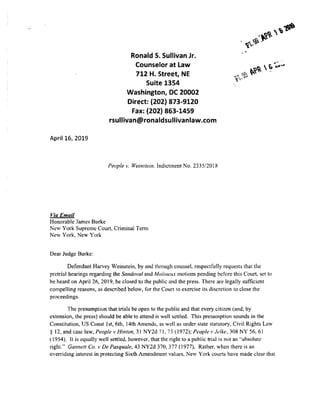
Via Email
Honorable James Burke
Ronald S. Sullivan Jr.
Counselor at Law
712 H. Street, NE
Suite 1354
Washington, DC 20002
Direct: (202) 873-9120
Fax: (202) 863-1459
rsullivan@ronaldsullivanlaw.com
People v. Weinstein. Indictment No. 2335/2018
New York Supreme Court. Criminal Tem1
New York, New York
Dear Judge Burke:
Defendant Harvey Weinstein, by and through counsel. respectfully requests that the
pretrial hearings regarding the Sandoval and Mo/i11e11x motions pending before this Court, set to
he heard on April 26, 2019, be closed to the public and the press. There are legally sufficient
compelling reasons, as described below, for the Court to exercise its discretion to close the
proceedings.
The presumption that trials be open to the public and that every citizen (and, by
extension, the press) should be able to attend is well settled. This presumption sounds in the
Constitution, US Const 1st, 6th, 14th Amends, as well as under state statutory, Civil Rights Law
§ 12, and case law, People v Hinton, 31 NY2d 71. 73 ( 1972); People,. Je/ke, 308 NY 56, 61
(1954). It is equally well settled, however, that the right to a public trial is not an "absolute
right." Gannet/ Co. v De Pasquale, 43 NY2d 370,377 (1977). Rather. when there is an
overriding interest in protecting Sixth Amendment values, New York courts have made clear that
the ·'the public trial concept has. , . 'never been viewed as imposing a rigid, inflexible
straightjacket on the courts. It has uniformly been held to be subject to the inherent power of the
court . , . to protect the rights of parties and witnesses[] and generally to further the
administration ofjustice."' Id (citing People ,·Jelke, supra, at 63). Furthermore, New York
statutory law expressly affinns the right of the Court, at its discretion, to close the courtroom for
cases regarding, inter alia, rape, assault with intent to commit rape, and criminal sexual acts,
provided that the reasons for closure are given in open court. Judiciary Law § 4; Westchester
Rockland Newspapers, Inc, v Leggett, 48 NY2d 430, 442 (1979); United Press Ass 'ns v Valente,
120 NYS2d 642 (Sup Ct, New York County 1953) (trial court may close proceedings even as lo
sexual crimes not expressly named in § 4); See also People vJones, 82 AD2d 674 (2d Dept
1981 ); People v Roberts, 151 AD2d .1028 (4th Dept 1989).
The Court may clearly and appropriately exercise its discretion to exclude the public and
the press from the courtroom during the Sando,·al a11d Molineux pretrial hearings scheduled for
April 26th. In "a highly publicized case," this Coun has the "inherent power" to close the
proceeding in order 10 protect Mr. Weinstein's "right to a fair trial." Westchester Rockland
1Vewspape,c~. Inc. ,. Leggett, supra at 439. These motions concern alleged, uncharged, and
unproven misconduct that may ultimately never be allowed in evidence. To expose prospective
Jurors to such material will prejudice both Mr. Weinstein's and the People's right to a fair trial
and an impartial jury. In Daily News, L.P. v Teresi, the Appellate Division affirmed the lower
court's decision to seal all documents relating to a Sandoval motion, finding that the release of
such materials ''would have generated considerable media attention on irrelevant and prejudicial
infom1ation al a crucial time, i.e., when jury selection was imminent and the impact on the.
jury pool[] would be at its greatest." Teresi, 265 AD2d 129, 133 (3rd Dept 2000).
Pretrial proceedings, such as Sandm•al and Molineux hearings, are "often a potent source
for the revelation of evidence which is both highly prejudicial to the defendant's case and not
properly admissible at trial." Westchester Rockland Newspapers. Inc. v Leggett, supra at 439.
Such is the case here. The People's Sandoval motion seeks to introduce instances of uncharged,
unproven accusations that have absolutely no bearing on the facts of the charges faced by Mr.
Weinstein. Similarly, its Molineux motion contains allegations !hat the People likely will seek
to adduce as an alleged pattern ofcriminal behavior in the minds ofjurors rather than establish
necessary elements of the current case. Both motions rely heavily on prejudicial descriptions of
alleged behavior having dubious probative value. As important, any arguable probative value is
outweighed by the undue prejudice associated with public disclosure of such unproved and
uncharged allegations that will reach the jury pool i11 the instant matter.
Significantly, the Court has already engaged in the afore-described balancing of interests
when it entered its original order to seal certain material in this case. In this sense, the Court has
correctly r~cognized the potential injury to Mr. Weinstein's and the People's right to a fair trial
unburdened by the form and substance of pre-trial and extra-judicial commentary that inevitably
would result from an open Sandoval and Mo/tneux hearing, The Coun's analysis then retains the
2
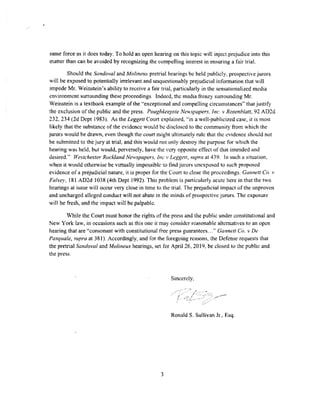
same force'as it does today, To hold an open hearing on this topic will inject prejudice into this
matter than can be avoided by recognizing the compelling interest in ensuring a fair trial.
Should the Sandoval and Molinertx pretrial hearings be held publicly, prospective jurors
will be exposed to potentially irrelevant and unquestionably prejudicial information that will
impede Mr, Weinstein's ability to receive a fair trial, particularly in the sensationalized media
environment surrounding these proceedings. Indeed, the media frenzy surrounding Mr.
Weinstein is a textbook example of the "exceptional and compelling circumstances" that justify
the exclusion of the public and the press. Poughkeepsie Newspapers, Inc. v Rosenblatt, n AD2d
232, 234 (2d Dept l983). As the Leggett Court explained, "in a well-publicized case, it is most
likely that the substance of the evidence would be disclosed to the community from which the
jurors would be drawn, even though the court might ultimately rule that the evidence should not
be submitted to the jury at trial, and this would not only destroy the purpose for which the
hearing was held. but would, perversely, have the very opposite effect of that intended and
desired." Westchester Rockland N,~vspapers, Inc,. Leggett, supra at 439. ln such a situation,
when it would otherwise be virtually impossible m find jurors unexposed to such proposed
evidence of a prejudicial nature, it is proper for the Court to close the proceedings. Gonnett Co. "
Falvey, 181 AD2d 1038 (4th Dept 1992). This prohkm is panicularly acute here in that the two
hearings at issue will occur very close in time to the trial. The prejudicial impact of the unproven
and uncharged alleged conduct will not abate in the minds of prospective Jurors. The exposure
will be fresh, and the impact will be palpable.
Vhile the Court must honor the rights of the press and the public under constitutional an.d
New York law, in occasions such as this one it may consider reasonable alternatives to an open
hearing that are "consonant with constitutional free press guarantees...'' Gannet/ Co. v De
Pasquale, supra at 38 l). Accordingly, and for the foregoing reasons. the Defense requests that
the pretrial Sandoval and Molineux hearings, set for April 26, 2019, be closed to the public and
the press.
Sincerely.
/
Ronald S. Sullivan Jr., Esq.
3

Weinstein News Advisory

  • 1.
    NEWS ADVISORY New YorkState Contact: Unified Court System Lucian Chalfen Public Information Director Hon. Lawrence K. Marks Chief Administrative Judge Arlene Hackel, Deputy Director (212) 428-2500 www.nycourts.gov/press Date: April 17, 2019 People of the State of New York v Harvey Weinstein WHAT: WHEN: WHERE: Pretrial Molineux and Sandoval motion hearings in the PSNY v Harvey Weinstein case (02335-2018) will be conducted on Friday, April 26, Part 99, with Justice James M. Burke presiding. The Court has received applications from both the prosecution and defense that portions of these proceedings be closed to the press and public. As this case has generated substantial press and public interest, we are alerting members of the media about the potential sealing of the courtroom, allowing any media outlets who wish to be heard regarding the potential closure time to prepare and submit the required papers to the Court by Monday April 22, 2019. Friday, April 26, 2019 at 9:30 a.m. New York County Supreme Court-Criminal Term 100 Centre Street, Part 99, Room 1530 Lower Manhattan ###
  • 2.
    SUPREME COURT OFTHE STATE OF NEV YORK COUNTY OF NEW YORK: PART 99 - - - - - - - - - - - - - - - - - - - - - - - - - - - - - - - - - - - - X The People of the State of New York - against - Harvey Weinstein, Defendant. -X James M. Burke, J.: Decision and Order Ind. No. 2335/l 8 The Court is in receipt of the motions of the defendant and the People regarding Jvlolineux/Sandoval evidence in the above-titled action. This Court will be conducting a Molineux/Sandoval hearing regarding the admissibility of evidence. Specifically, at the Molineux component of the hearing, the Court will determine whether to allow certain evidence on the People's direct case. At the Sandoval component of the hearing, the Court will detennine, should the defendant testify at trial, whether to allow the People to use certain evidence for the purpose of impeaching the defendant's credibility. On application of both sides, the Court has conditionally sealed the submissions of the defendant and the People. Prior to the J,1olineux/Sandoval hearing, the Court will conducta preliminary hearing on the issue of whether the courtroom should be closed, as well as on the sealing ofthe attendant written submissions, and will render a decision. See People v Arthur. 178 Misc2d 419 (Sup Ct NY Co 1998).
  • 3.
    In their Molineuxapplication, the People seek to introduce evidence of uncharged crimes and bad acts purportedly committed by the defendant on their direct case. In their Sandoval application, should the defendant testify, the People seek to use bad acts and uncharged crimes purportedly committed by the defendant, submitting that this evidence bears on the defendant's credibility. The defendant opposes the People's Molineux and Sandoval applications and specifically opposes the introduction or use of uncharged crimes and bad acts for any purpose. As such, the Court has detennined that prior to the Molineux/Sandoval hearing, this Court will conduct a preliminary hearing regarding whether the substantive arguments regarding the admissibility ofthis evidence will be conducted in an open or closed courtroom. To that end, the Court has received written submissions from the People and the defendant regarding their positions as to the basis ofclosure ofthe courtroom during the substantive arguments. The press has also been notified and is being given an opportunity to state their position in writing, and also whether the conditionally sealed motion papers and record should be unsealed. All of the submissions regarding this preliminary issue will be placed in the public court file. At the preliminary hearing and in open court, the People and the defendant 2
  • 4.
    will be permittedto present legal arguments as to whether the courtroom will be open or closed during the substantive portion of hearing on the admissibility of this evidence, and the press and public will also be allowed to present their position. The Court will also hear all parties' positions on the sealing of the concomitant records and submissions. At the conclusion of this preliminary hearing, the Court will render a decision regarding closure and sealing. This shall constitute the Decision and Order of this Court. New York New York Aprill 7, 2019 3
  • 5.
    CYRUS R. VANCE,JR. O!sTFl'CT ATTORNEY },pril 16, 2019 Honorable James Burke DISTRICT ATTORNEY COUNTY OF NEW YORK ONE HOGAN PLACE New York, N. Y. 10013 (212) 335-9000 Supreme Court of the State of New York Part 99 100 Centre Street 1':ew York, NY 10013 DearJudge Burke: Re: People v. Harvey Weinstein Ind. No. 2335/2018 This lcncr is in response to the Court's communication of April 11, 2019, seeking the position of the parties on closure of the courtroom during the Sandm,al and Jfo!tneu:,: hearings to be conducted on April 26, 2019. The People seek an order of this Court, closing the courtroom to the public and the press during these hearings. 1 In response to the specific c1uestions posed by the Court, this letter provides (1) the reasons for closure, (2) the legal basis therefor, and (3) the procedures required prior to excluding the public and press. ,'s this Court is well aware, this case has generated extensive media cm·crage and will continue to do so in light of the celebrity st.atus of the defendant and others in the entertainment field who have had dealings with him. The public's appetite for information relating to the defendant shows no sign of abating. To strike the proper balance in this case between the public's and prcss's qualified right ro attend court proceedings and the defendant's right to a fair trial by an impartial jury, the Court should-after hearing in open court from the parties and representatives of the media, and making specific findings on the record- order that the Sandwal and Malineux hearings be closed to the public and the press. Howen·r, the Court should make clear that any evidence that it determines is admissible will be made public at the trial of this matter, or earlier if disclosure will nor compromise the defendant's right to a fair trial. TI1e First Amendment guarantees the public and the press a qualified right of access to criminal trials. Richmond Newspapers v. Virginia, 448 U.S. 555, 580 (1980) (plurality opinion). :!though the public acquires information abom trials primarily from the press, "the press is not imbued with any special right of access," bur rather possesses "the same righr of access as the public." GJJ1rtroom '/derision 1'etwork IJ.C I'. State ofNew York, 5 N.Y.3d 222, 229 (2005) (9uoting R.frhn1011d 1Vewspapers, at 573). "Thus, the press has 'no right to information about a ' 'c belie,·e thar the defense is also moving for closure of these proceedings.
  • 6.
    trial superior tothat of the general public."' Id. at 229 (quoting 1't:-,:on v. IJ:7amerCi1mrmm1;'a!tims, Int:, 432 lJ.S. 589, 609 (1978)). In addition to trials, other court proceedings, such as pretrial hearings, are presumptively open to the public and the press. E.g., Afatter ofAsso,io1!ed Press v. Bell, 70 ;,,,.;,Y.2d 32, 38 (1987) (H11ntky hearings); /;latter q/ W'estchester Rockland Newspaper., t'. Lt;g~ett, 48 N.Y.2d 430, 440 (1979) (competencv hearings); Press-Enterprise C.o. v. Superior Court, 478 l'.S. 1, 10 (1986) (Press-Enterprise If) (preliminary hearings); Gannett Co., hi,: v. DePa.rquo1ie, 4.' N.Y.2d 370, 380-81 (1977), a[J'd, 443 U.S. 368 (1979) (suppression hearings). HoweYer, the right of the public and the press to attend court proceedings is not absolute and the trial court "has an affirmatiYc constitutional duty to minimize the effects of prejudicial pretrial publicity" by raking measures that preserve a defendant's right to a fair trial. MatteroflFe.rlchater Roddo1nd Newspapers v. Le..~~e!t, 48 N.Y.2d at 438 (quoti11,~ Gannett, 443 LS. at 378). 'The public's right of access may be limited where there is a compelling governmental interest and closure is narrowly tailored to serve that interest." Matter of Daily S,ws, LP. J'. IV'ile,Y, 126 i.D.3d 511,512 (1st Dept. 2015) (citing Pre.,~·-Entetprisc Co. r. SuperiorCourt, 464 C.S. 501, 510 (1984) (Presc-Enterprire l)).2 Accordingly, where a defendant seeks to exclude the public from a pretrial proceeding, he must move for relief, on the record in open court, and show "a strong likelihood" that specific evidence would prejudice his right to a fair trial if disclosed. /1.Jatter~/Daily News, LP. v. tWiley, 126 }.D.3d at 513; MatterofAS<ociated Press n Bell, 70 l's.Y.2d at 39 (defendant bears burden of showing that bis right to fair trial may be compromised by an open proceeding). Moreover, the trial courr must make "specific findings" that closure will prevent "a substantial probability" that the defendant's right to a fair trial will be prejudiced by publicity and that "there arc no reasonable alternatives to closure to protect the defendant's fair trial rights." :'v1atlerofDaily News, LP. v. Wiley, 126 AD.3d at 513 (citing Mattero//1s.ro,iated l'ress v. Bell, 70 N.Y.2d at 39 and Press-Enterprise JJ, 478 U.S. at 13-14). lo People v. /lrthm; 178 Misc.2d 419 (Sup. Ct., N.Y. Co. 1998) (Kahn, J.), a case that "generated intense media scrutiny and an enormous amount of pretrial publicirv all over the world," the trial court granted the motion of the People, joined by the defendant, to seal the mm-ing papers, responses, and rhe court's decision on rhe People's application ro introduce e,·idence of uncharged crimes or bad acts allegedly committed by the defendant, pursuant to ;fo/ineu:.: and Sandoval. Id. at 420, 423. The court concluded that until such time as the evidence was determined to be admissible, either because the defendant chose to testify (Sandow~, or the court determined that probative value outweighed prejudice (Moline1c.:), the publication of the evidence "would serve no purpose other than to a.rouse negative public sentiment m,,.ird the defendant and would have a devastating effect on defendant's ability ro selecr an impartial jury." 1d. at 425. The court further held that any measure short of sealing the documents. including "the most probing 1'fJir dire followed by the clearest jury instruction, could nor 'Likewise, decisions tO seal or disclose records fall within the court's inherent power to control the records of its own proceedings. M11ttn-q{Dai{y Xews, LP. v. lViky, 126 A.D.3d at 512 (citing Jfat!erof Crain Con1munirnlio11s I', llt1,.~hes, 74 N.Y.2d 626,628 (1989) (holding that mandamus did not lie because decision to initially seal or to later disclose court tccord.s involved balancing of competing interests through exercise of judicial discretion)). 2
  • 7.
    effectivelr eliminate theprejudicial impact on the jury of the publication of defendant's alleged uncharged bad acrs in this case." Id. Ammi P«!ple 1•. Arroyo, 177 llisc.2d 106, 112 (Schoharie County Ct.1998) (denying motion to close courtroom during suppression hearing, but granting motion to seal Sandoval motion on ground that if defendant chose not to testify, "the prosecution is totally precluded from using the infonnation").3 This reasoning is fully applicable here and should result in (1) continuing the sealed status of the parties' Mo/ineux: and Sandoval motions and responses and (2) dosing the :pril 26 hearing on the admiss.ibilitv of this evidence. Moreover, in this case, another pertinent consideration is the pri,·acy of those potential witnesses who have been 'ictims of sexual assault and whose identity is protected by law. See Civil Rights Law § 50-b(1); People v. Ffotf~e.r, 172 Misc.2d 112, 116 (Sup. CL, Kings Cry. 1997). If the Court precludes such witnesses from test.ifying at trial, their identities should remain protected from public disclosure. Accordingly, pursuant to the authorities cited above, we respectfullv submit that the Court, after giving any representatives of the press who so request an opporturutv to be heard, make a finding, on the record and in open court, that closure of the courtroom for a determination of the Sandoval and l'vfolinm;,: motions is necessary to "prevent a substantial probability that the defendant's right to a fair trial would be prejudiced bY publicity and that there are no rea,onable alternatives to closure to protect the defendant's fair trial rights." Matter of Daily News, LP. v. W'ilV', 126 A.D.3d at 513. See Matter ofCapital Newspapers Div. ~ffletmt Corp. 1•. Cjyne, 56 N.Y2d 870, 872-73 (1982) (holding that trial court erred in not conducting preliminary inquiry before deciding to exclude newspaper reporter from midtrial Sandoml hearing) (citing ,Watter ~/Matt.er o/lY7esttheu,•r Rockland Newspapers v. l.,;,P,,~ett, 48 N.Y.2d at 442 (holding that morion to exclude press and public from hearing must be made on the record in open court and all proceedings on the motion must be recorded for appellate review)).4 ' "!be court in A,thur aptly noted that the proffered evidence (pursuant to Sandm•aland Moline11.,7 was different in kind than that at issue in a suppression h<,>aring where the public has a lcgirimare interest in challenges to the conduct of police and prosccutr,rs, in seizing evidence or interrogating suspects. 178 Misc.2d at 422. Ste <1L,a Mattrr o(dJsod<1ted P111Js I'. Bell, 70 N.Y.2<l at .18 (noring that the "need for an open proceeding may be particubrlv strong vc-ith respect to suppression hearings") (quoting l/7a/ler t•. Geory,1,1, 467 L:.s. 39, 47 (1984)). Such considerations arc not present when deciding whether closure is proper in a Sandoval or 110/ine11x hearing. 4 In Matier ofWestdm1er Rockland ,'ewspapers 1,: µr,,,eett, 48 N.Y.2d at 442, the Coun of Appeals noted that, if in the course of the argument on the closure motion that is conducted in open court, ir becomes- necessary for counsel to discuss certain ltcms of evidence, the disclosure of which '"vould create the "ery prejudice soughr to be. avoided/' counsel can request that such portion of the argument be continued in rmnem, in the presence of opposing counsel but out of the hearing of the public 3
  • 8.
    As stated above,the Court's order should make clear that any evidence it determines is admissible under Molinmx, and under Sandoval should the defendant choose to testify, will be disclosed at trial, or earlier if disclosure will not compromise rhe defendant's right to a fair trial. cc: Jose A. Baez, Esq. 4 Respectfully submitted, .Jrn ., ..isrnnt District ,ttorney (212) 335-41 SG
  • 9.
    April 16, 2019 ViaEmail Honorable James Burke Ronald S. Sullivan Jr. Counselor at Law 712 H. Street, NE Suite 1354 Washington, DC 20002 Direct: (202) 873-9120 Fax: (202) 863-1459 rsullivan@ronaldsullivanlaw.com People v. Weinstein. Indictment No. 2335/2018 New York Supreme Court. Criminal Tem1 New York, New York Dear Judge Burke: Defendant Harvey Weinstein, by and through counsel. respectfully requests that the pretrial hearings regarding the Sandoval and Mo/i11e11x motions pending before this Court, set to he heard on April 26, 2019, be closed to the public and the press. There are legally sufficient compelling reasons, as described below, for the Court to exercise its discretion to close the proceedings. The presumption that trials be open to the public and that every citizen (and, by extension, the press) should be able to attend is well settled. This presumption sounds in the Constitution, US Const 1st, 6th, 14th Amends, as well as under state statutory, Civil Rights Law § 12, and case law, People v Hinton, 31 NY2d 71. 73 ( 1972); People,. Je/ke, 308 NY 56, 61 (1954). It is equally well settled, however, that the right to a public trial is not an "absolute right." Gannet/ Co. v De Pasquale, 43 NY2d 370,377 (1977). Rather. when there is an overriding interest in protecting Sixth Amendment values, New York courts have made clear that
  • 10.
    the ·'the publictrial concept has. , . 'never been viewed as imposing a rigid, inflexible straightjacket on the courts. It has uniformly been held to be subject to the inherent power of the court . , . to protect the rights of parties and witnesses[] and generally to further the administration ofjustice."' Id (citing People ,·Jelke, supra, at 63). Furthermore, New York statutory law expressly affinns the right of the Court, at its discretion, to close the courtroom for cases regarding, inter alia, rape, assault with intent to commit rape, and criminal sexual acts, provided that the reasons for closure are given in open court. Judiciary Law § 4; Westchester Rockland Newspapers, Inc, v Leggett, 48 NY2d 430, 442 (1979); United Press Ass 'ns v Valente, 120 NYS2d 642 (Sup Ct, New York County 1953) (trial court may close proceedings even as lo sexual crimes not expressly named in § 4); See also People vJones, 82 AD2d 674 (2d Dept 1981 ); People v Roberts, 151 AD2d .1028 (4th Dept 1989). The Court may clearly and appropriately exercise its discretion to exclude the public and the press from the courtroom during the Sando,·al a11d Molineux pretrial hearings scheduled for April 26th. In "a highly publicized case," this Coun has the "inherent power" to close the proceeding in order 10 protect Mr. Weinstein's "right to a fair trial." Westchester Rockland 1Vewspape,c~. Inc. ,. Leggett, supra at 439. These motions concern alleged, uncharged, and unproven misconduct that may ultimately never be allowed in evidence. To expose prospective Jurors to such material will prejudice both Mr. Weinstein's and the People's right to a fair trial and an impartial jury. In Daily News, L.P. v Teresi, the Appellate Division affirmed the lower court's decision to seal all documents relating to a Sandoval motion, finding that the release of such materials ''would have generated considerable media attention on irrelevant and prejudicial infom1ation al a crucial time, i.e., when jury selection was imminent and the impact on the. jury pool[] would be at its greatest." Teresi, 265 AD2d 129, 133 (3rd Dept 2000). Pretrial proceedings, such as Sandm•al and Molineux hearings, are "often a potent source for the revelation of evidence which is both highly prejudicial to the defendant's case and not properly admissible at trial." Westchester Rockland Newspapers. Inc. v Leggett, supra at 439. Such is the case here. The People's Sandoval motion seeks to introduce instances of uncharged, unproven accusations that have absolutely no bearing on the facts of the charges faced by Mr. Weinstein. Similarly, its Molineux motion contains allegations !hat the People likely will seek to adduce as an alleged pattern ofcriminal behavior in the minds ofjurors rather than establish necessary elements of the current case. Both motions rely heavily on prejudicial descriptions of alleged behavior having dubious probative value. As important, any arguable probative value is outweighed by the undue prejudice associated with public disclosure of such unproved and uncharged allegations that will reach the jury pool i11 the instant matter. Significantly, the Court has already engaged in the afore-described balancing of interests when it entered its original order to seal certain material in this case. In this sense, the Court has correctly r~cognized the potential injury to Mr. Weinstein's and the People's right to a fair trial unburdened by the form and substance of pre-trial and extra-judicial commentary that inevitably would result from an open Sandoval and Mo/tneux hearing, The Coun's analysis then retains the 2
  • 11.
    same force'as itdoes today, To hold an open hearing on this topic will inject prejudice into this matter than can be avoided by recognizing the compelling interest in ensuring a fair trial. Should the Sandoval and Molinertx pretrial hearings be held publicly, prospective jurors will be exposed to potentially irrelevant and unquestionably prejudicial information that will impede Mr, Weinstein's ability to receive a fair trial, particularly in the sensationalized media environment surrounding these proceedings. Indeed, the media frenzy surrounding Mr. Weinstein is a textbook example of the "exceptional and compelling circumstances" that justify the exclusion of the public and the press. Poughkeepsie Newspapers, Inc. v Rosenblatt, n AD2d 232, 234 (2d Dept l983). As the Leggett Court explained, "in a well-publicized case, it is most likely that the substance of the evidence would be disclosed to the community from which the jurors would be drawn, even though the court might ultimately rule that the evidence should not be submitted to the jury at trial, and this would not only destroy the purpose for which the hearing was held. but would, perversely, have the very opposite effect of that intended and desired." Westchester Rockland N,~vspapers, Inc,. Leggett, supra at 439. ln such a situation, when it would otherwise be virtually impossible m find jurors unexposed to such proposed evidence of a prejudicial nature, it is proper for the Court to close the proceedings. Gonnett Co. " Falvey, 181 AD2d 1038 (4th Dept 1992). This prohkm is panicularly acute here in that the two hearings at issue will occur very close in time to the trial. The prejudicial impact of the unproven and uncharged alleged conduct will not abate in the minds of prospective Jurors. The exposure will be fresh, and the impact will be palpable. Vhile the Court must honor the rights of the press and the public under constitutional an.d New York law, in occasions such as this one it may consider reasonable alternatives to an open hearing that are "consonant with constitutional free press guarantees...'' Gannet/ Co. v De Pasquale, supra at 38 l). Accordingly, and for the foregoing reasons. the Defense requests that the pretrial Sandoval and Molineux hearings, set for April 26, 2019, be closed to the public and the press. Sincerely. / Ronald S. Sullivan Jr., Esq. 3