• 1. Theory-Explains why something happens.
• It’s a system of ideas backed by evidence and reasoning.
• Example: Theory of Evolution explains why species change over time.
• In business: Theory of Innovation explains why new ideas spread.
• → A theory gives the “why.”
• 2. Principle
• A fundamental truth or guiding belief derived from a theory.
• It’s more universal and general — helps guide decisions or actions.
• Example: Principle of Supply and Demand comes from economic theories.
• → A principle gives the “guiding truth.”
• 3. Rule
• A specific guideline or prescription for action.
• Rules often come from principles and are practical or regulatory.
• Example: Always test your MVP before scaling (a rule based on startup principles).
• → A rule gives the “how to behave or act.”
3.
• 4. Framework
•A structured way to organize ideas or processes based on a theory.
• It helps in analyzing, designing, or implementing something.
• Example: Business Model Canvas — a framework for visualizing a startup.
• → A framework gives the “structure or map.”
• 5. Model
• A simplified representation of reality used to explain or predict behavior.
• It often comes from a theory and is used for testing or application.
• Example: SWOT Model, Diffusion of Innovation Model.
• → A model gives the “working example or tool.”
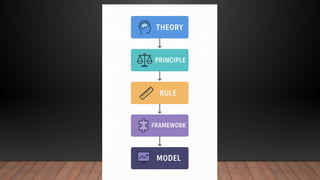
• Theory Principles Rules
→ →
• ↓
• Frameworks Models
→
• Theory provides the foundation.- Principles emerge from theories.- Rules
operationalize those principles.- Frameworks organize ideas to apply the theory. -
Models simulate or test the theory in real life.
5.
FOUNDATIONS:THEORY, FRAMEWORK, &
MODEL
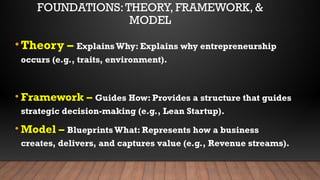
•Theory– ExplainsWhy: Explains why entrepreneurship
occurs (e.g., traits, environment).
• Framework – Guides How: Provides a structure that guides
strategic decision-making (e.g., Lean Startup).
• Model – BlueprintsWhat: Represents how a business
creates, delivers, and captures value (e.g., Revenue streams).
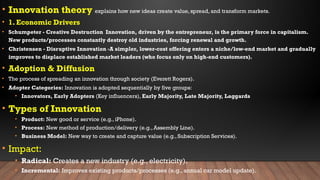
• Innovation theoryexplains how new ideas create value, spread, and transform markets.
• 1. Economic Drivers
• Schumpeter - Creative Destruction Innovation, driven by the entrepreneur, is the primary force in capitalism.
New products/processes constantly destroy old industries, forcing renewal and growth.
• Christensen - Disruptive Innovation -A simpler, lower-cost offering enters a niche/low-end market and gradually
improves to displace established market leaders (who focus only on high-end customers).
• Adoption & Diffusion
• The process of spreading an innovation through society (Everett Rogers).
• Adopter Categories: Innovation is adopted sequentially by five groups:
• Innovators, Early Adopters (Key influencers), Early Majority, Late Majority, Laggards
• Types of Innovation
• Product: New good or service (e.g., iPhone).
• Process: New method of production/delivery (e.g., Assembly Line).
• Business Model: New way to create and capture value (e.g., Subscription Services).
• Impact:
• Radical: Creates a new industry (e.g., electricity).
• Incremental: Improves existing products/processes (e.g., annual car model update).
8.
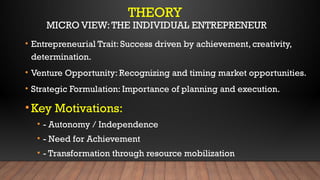
THEORY
MICRO VIEW:THE INDIVIDUALENTREPRENEUR
• Entrepreneurial Trait: Success driven by achievement, creativity,
determination.
• Venture Opportunity: Recognizing and timing market opportunities.
• Strategic Formulation: Importance of planning and execution.
•Key Motivations:
• - Autonomy / Independence
• - Need for Achievement
• - Transformation through resource mobilization
9.
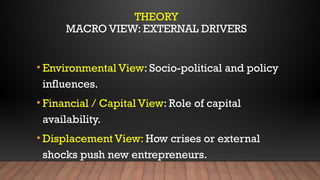
THEORY
MACRO VIEW: EXTERNALDRIVERS
• Environmental View: Socio-political and policy
influences.
• Financial / Capital View: Role of capital
availability.
• Displacement View: How crises or external
shocks push new entrepreneurs.
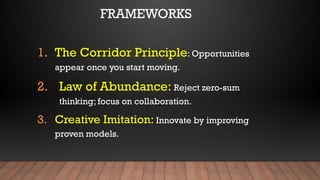
FRAMEWORKS
1. The CorridorPrinciple: Opportunities
appear once you start moving.
2. Law of Abundance: Reject zero-sum
thinking; focus on collaboration.
3. Creative Imitation: Innovate by improving
proven models.
12.
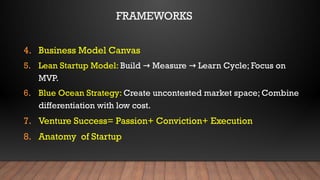
FRAMEWORKS
4. Business ModelCanvas
5. Lean Startup Model: Build Measure Learn Cycle; Focus on
→ →
MVP.
6. Blue Ocean Strategy: Create uncontested market space; Combine
differentiation with low cost.
7. Venture Success= Passion+ Conviction+ Execution
8. Anatomy of Startup
13.
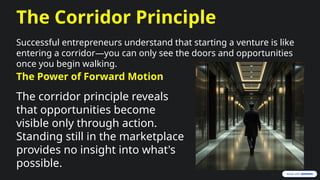
The Corridor Principle
Successfulentrepreneurs understand that starting a venture is like
entering a corridor—you can only see the doors and opportunities
once you begin walking.
The Power of Forward Motion
The corridor principle reveals
that opportunities become
visible only through action.
Standing still in the marketplace
provides no insight into what's
possible.
14.
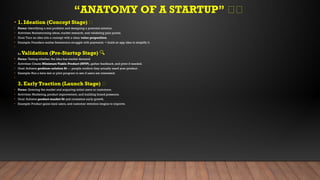
“ANATOMY OF ASTARTUP” 🧠🚀
• 1. Ideation (Concept Stage) 💡
• Focus: Identifying a real problem and designing a potential solution.
• Activities: Brainstorming ideas, market research, and validating pain points.
• Goal:Turn an idea into a concept with a clear value proposition.
• Example: Founders realize freelancers struggle with payments build an app idea to simplify it.
→
•
2.Validation (Pre-Startup Stage) 🔍
• Focus: Testing whether the idea has market demand.
• Activities: Create MinimumViable Product (MVP), gather feedback, and pivot if needed.
• Goal: Achieve problem-solution fit — people confirm they actually need your product.
• Example: Run a beta test or pilot program to see if users are interested.
•
3. Early Traction (Launch Stage) 🚀
• Focus: Entering the market and acquiring initial users or customers.
• Activities: Marketing, product improvement, and building brand presence.
• Goal: Achieve product-market fit and consistent early growth.
• Example: Product gains loyal users, and customer retention begins to improve.
15.
“ANATOMY OF ASTARTUP” 🧠🚀
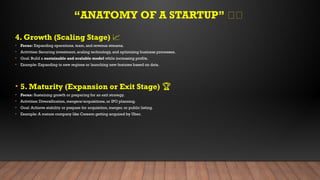
4. Growth (Scaling Stage) 📈
• Focus: Expanding operations, team, and revenue streams.
• Activities: Securing investment, scaling technology, and optimizing business processes.
• Goal: Build a sustainable and scalable model while increasing profits.
• Example: Expanding to new regions or launching new features based on data.
• 5. Maturity (Expansion or Exit Stage) 🏆
• Focus: Sustaining growth or preparing for an exit strategy.
• Activities: Diversification, mergers/acquisitions, or IPO planning.
• Goal: Achieve stability or prepare for acquisition, merger, or public listing.
• Example: A mature company like Careem getting acquired by Uber.
16.
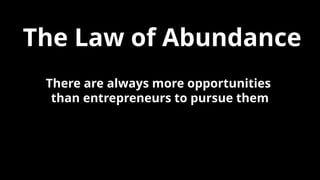
The Law ofAbundance
There are always more opportunities
than entrepreneurs to pursue them
17.
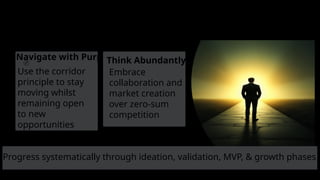
Your Entrepreneurial Toolkit
Successcomes from combining the right mindset with proven frameworks and
continuous learning.
Navigate with Purpose
Use the corridor
principle to stay
moving whilst
remaining open
to new
opportunities
Think Abundantly
Embrace
collaboration and
market creation
over zero-sum
competition
Follow the Framework
Progress systematically through ideation, validation, MVP, & growth phases
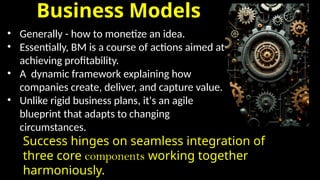
Business Models
• Generally- how to monetize an idea.
• Essentially, BM is a course of actions aimed at
achieving profitability.
• A dynamic framework explaining how
companies create, deliver, and capture value.
• Unlike rigid business plans, it's an agile
blueprint that adapts to changing
circumstances.
Success hinges on seamless integration of
three core components working together
harmoniously.
20.
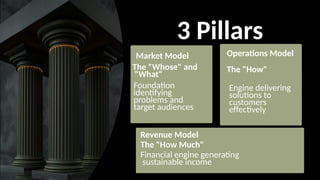
3 Pillars
Market Model
The"Whose" and
"What"
Foundation
identifying
problems and
target audiences
Operations Model
The "How"
Engine delivering
solutions to
customers
effectively
Revenue Model
The "How Much"
Financial engine generating
sustainable income
21.
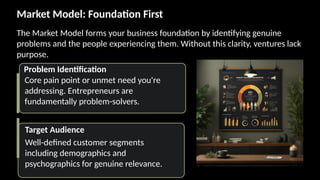
Market Model: FoundationFirst
The Market Model forms your business foundation by identifying genuine
problems and the people experiencing them. Without this clarity, ventures lack
purpose.
Problem Identification
Core pain point or unmet need you're
addressing. Entrepreneurs are
fundamentally problem-solvers.
Target Audience
Well-defined customer segments
including demographics and
psychographics for genuine relevance.
22.
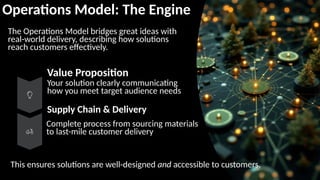
Operations Model: TheEngine
The Operations Model bridges great ideas with
real-world delivery, describing how solutions
reach customers effectively.
Value Proposition
Your solution clearly communicating
how you meet target audience needs
Supply Chain & Delivery
Complete process from sourcing materials
to last-mile customer delivery
This ensures solutions are well-designed and accessible to customers.
23.
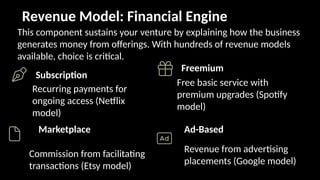
Revenue Model: FinancialEngine
This component sustains your venture by explaining how the business
generates money from offerings. With hundreds of revenue models
available, choice is critical.
Subscription
Recurring payments for
ongoing access (Netflix
model)
Freemium
Free basic service with
premium upgrades (Spotify
model)
Marketplace
Commission from facilitating
transactions (Etsy model)
Ad-Based
Revenue from advertising
placements (Google model)
24.
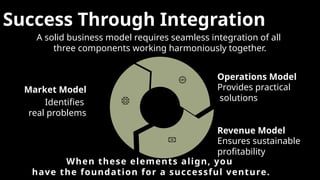
Success Through Integration
Asolid business model requires seamless integration of all
three components working harmoniously together.
Market Model
Identifies
real problems
Operations Model
Provides practical
solutions
Revenue Model
Ensures sustainable
profitability
When these elements align, you
have the foundation for a successful venture.
25.
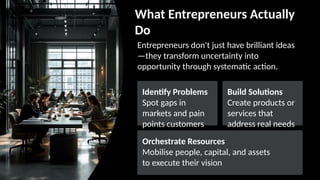
What Entrepreneurs Actually
Do
Entrepreneursdon't just have brilliant ideas
—they transform uncertainty into
opportunity through systematic action.
Identify Problems
Spot gaps in
markets and pain
points customers
face daily
Build Solutions
Create products or
services that
address real needs
effectively
Orchestrate Resources
Mobilise people, capital, and assets
to execute their vision