MTB MLE
LANGUAGE AS
SOCIAL CONTENT
SPE-MTB-MLE, BEED 2105 - Week 3
Prof. MEINRAD C. BAUTISTA, Ph.D.
Saphir-Whorf
“Language does more
than simply describe
reality; it also serves to
shape the reality of a
culture”
Learning Objectives:
1. To recognize the issues and challenges in
teaching mother tongue;
2. To enumerate the importance of dealing
the issues and concern in Mother Tongue
as a medium of instruction; and
3. To share and discuss once own experience
in using the mother tongue
4. To be familiar with Sapir-Whorf Hypothesis
Benefits of MTB-MLE
• It helps children to develop a strong foundation in
their mother tongue, which is essential for further
academic success.
• It promotes cultural identity and pride.
• It facilitates the learning of other languages.
• It improves communication and understanding
between teachers and students.
• It reduces student drop-out and repetition
The purpose of MTB-MLE is to develop students
appropriate cognitive and reasoning skills. Mother
tongue as a subject in school important because it is a
stepping stone in achieving the aim of education.
Issues and Challenges in
MTB-MLE
There are also some challenges associated with MTB-MLE,
including:
• Lack of resources: In many countries, there is a lack of teaching
materials and resources in minority languages. This can make it
difficult for teachers to implement MTB-MLE effectively.
• Teacher training: Many teachers are not trained to teach in their
mother tongue, especially if it is a minority language. This can
lead to challenges in delivering high-quality instruction.
• Parental support: Some parents may be reluctant to send their
children to schools that use MTB-MLE, especially if they believe
that their children will need to learn English fluently in order to
be successful.
Issues and Challenges in
MTB-MLE
Here are some specific examples of the issues that can arise in
MTB-MLE:
• In multilingual communities, it can be difficult to decide which
language(s) to use for instruction.
• Some teachers may not be fluent in the language of their
students.
• There may be a lack of standardized tests and other assessment
tools in minority languages.
• Some parents may believe that English is more important than
their mother tongue and may resist MTB-MLE.
Lack of vocabulary is considered the death of words to use when
delivering message of information
Ways to address issues and
challenges in MTB-MLE
There are number of things that can be done to address the
challenges of MTB-MLE, such as:
• Investing in teacher training and the development of
teaching materials in minority languages.
• Working with parents to raise awareness of the benefits of
MTB-MLE.
• Developing standardized tests and other assessment tools
in minority languages.
By taking these steps, we can ensure that all children can have
the opportunity to learn and thrive in their mother tongue.
Whorfian/-Sapir Hypothesis
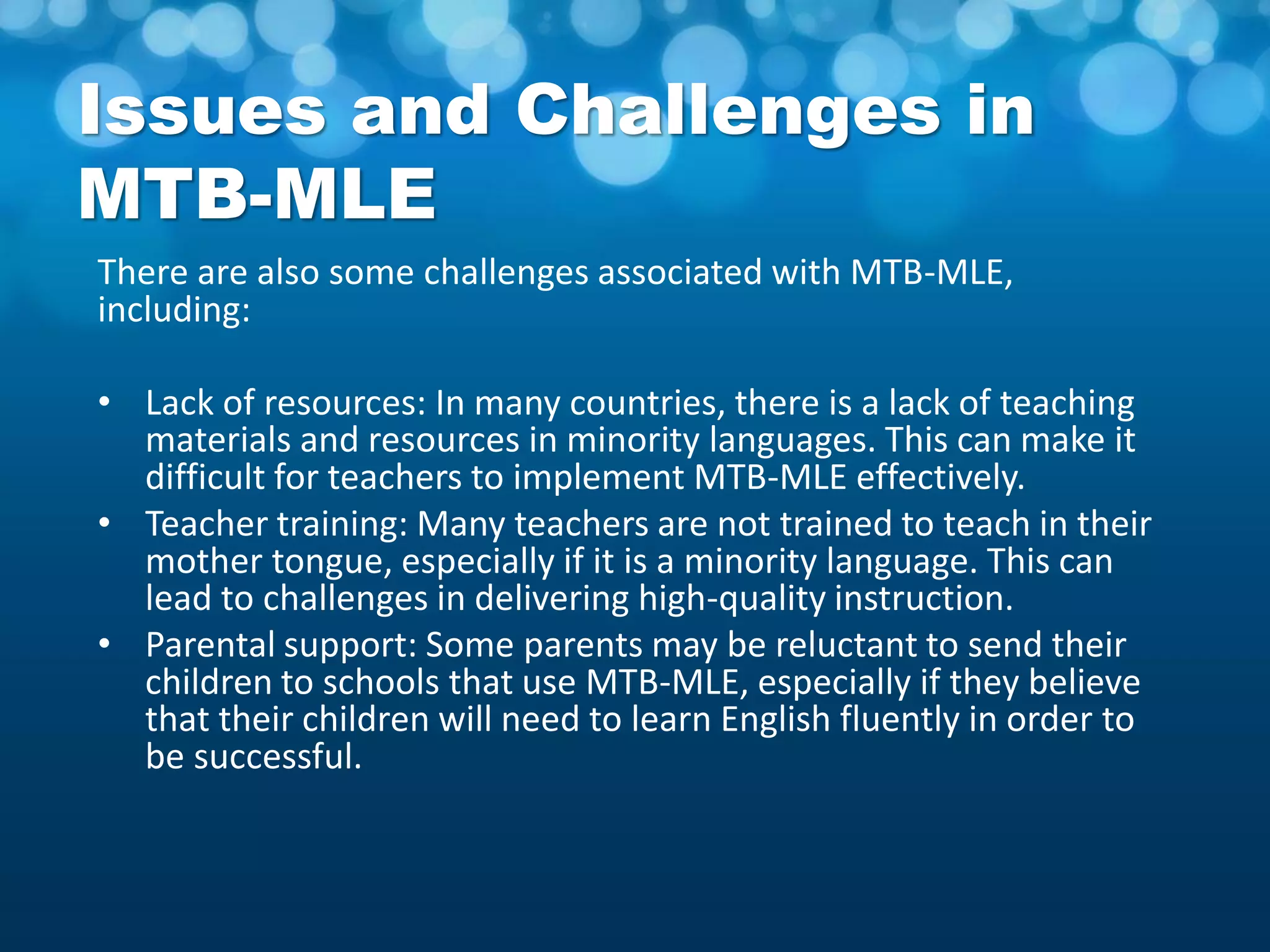
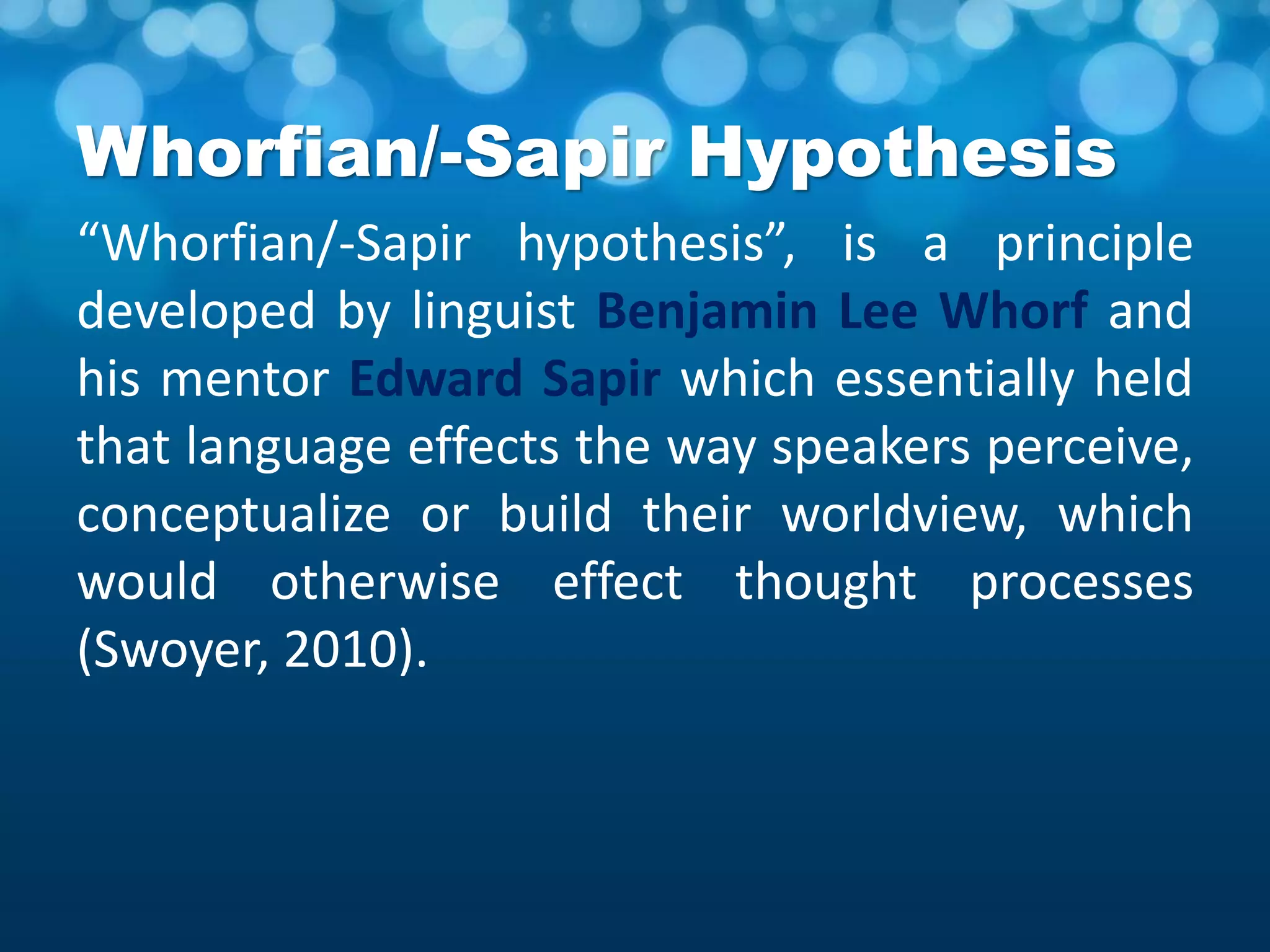
“Whorfian/-Sapir hypothesis”, is a principle
developed by linguist Benjamin Lee Whorf and
his mentor Edward Sapir which essentially held
that language effects the way speakers perceive,
conceptualize or build their worldview, which
would otherwise effect thought processes
(Swoyer, 2010).
Whorfian/-Sapir Hypothesis
Developed in 1929 by Edward Sapir, the Sapir-
Whorf hypothesis (also known as linguistic
relativity) states that a person’s perception of the
world around them and how they experience the
world is both determined and influenced by the
language that they speak.
We learn the second language via conscious
process of study and attention to form and rule
by acquisition- learning hypothesis.
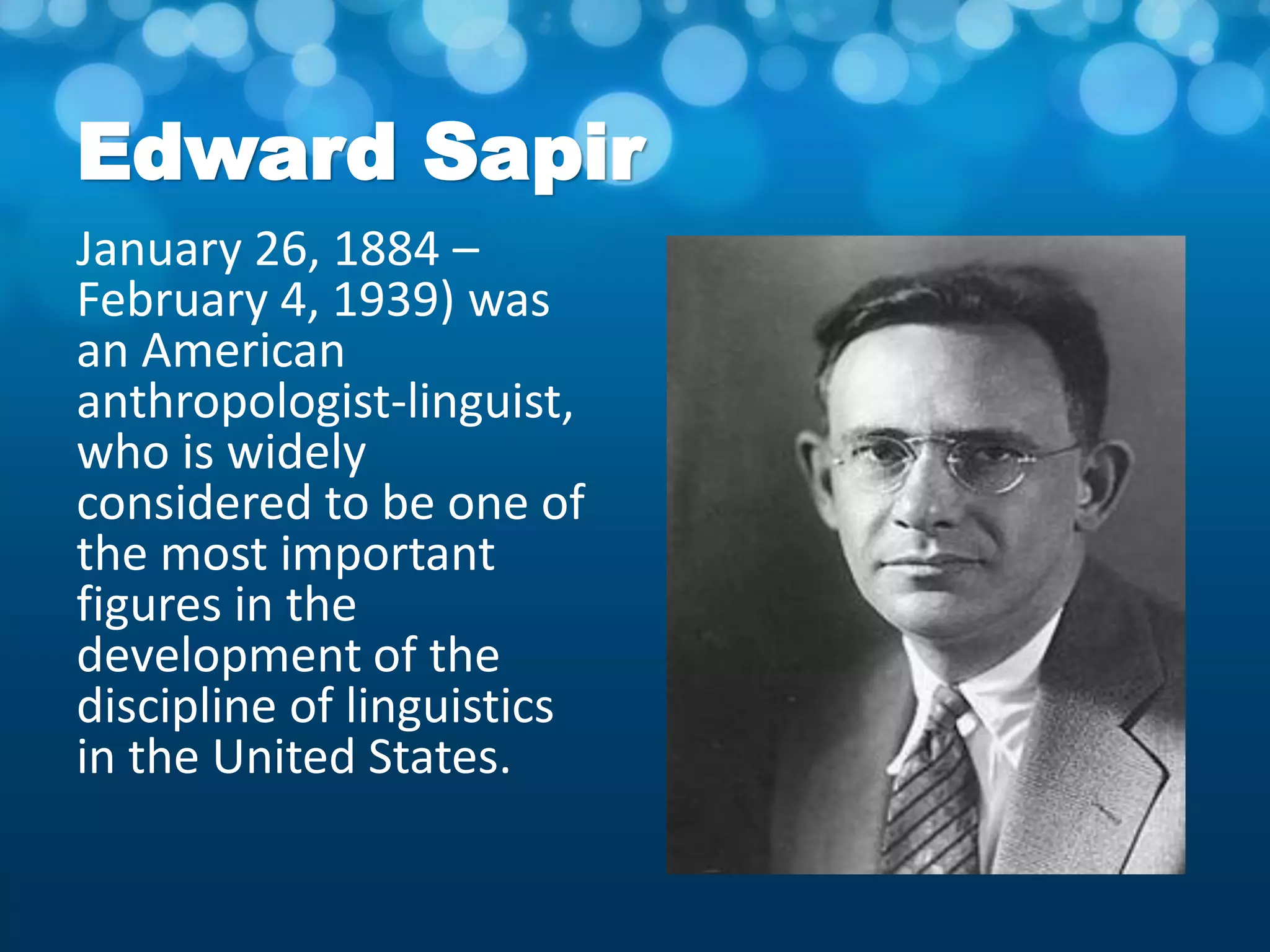
Edward Sapir
January 26, 1884 –
February 4, 1939) was
an American
anthropologist-linguist,
who is widely
considered to be one of
the most important
figures in the
development of the
discipline of linguistics
in the United States.
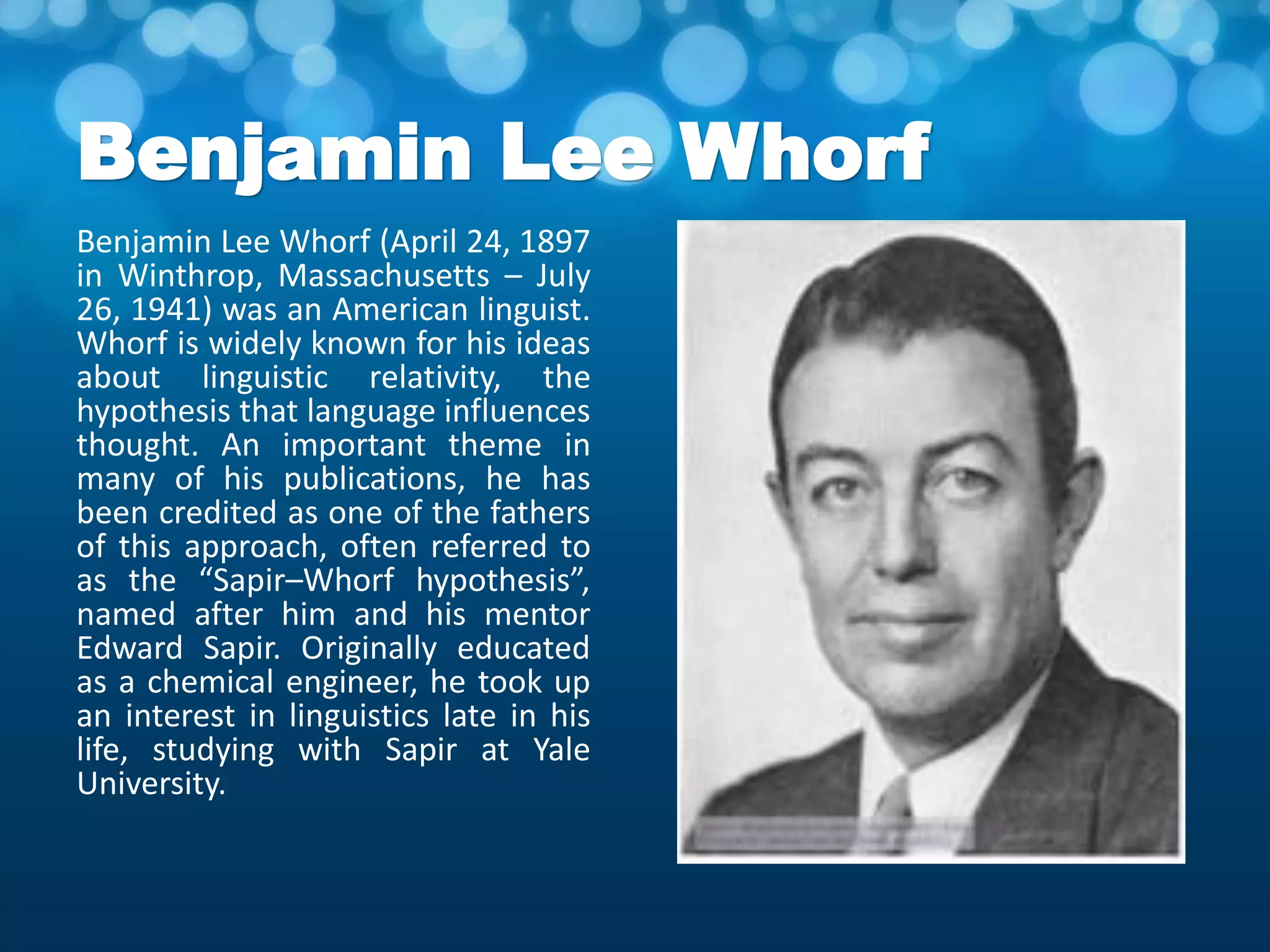
Benjamin Lee Whorf
Benjamin Lee Whorf (April 24, 1897
in Winthrop, Massachusetts – July
26, 1941) was an American linguist.
Whorf is widely known for his ideas
about linguistic relativity, the
hypothesis that language influences
thought. An important theme in
many of his publications, he has
been credited as one of the fathers
of this approach, often referred to
as the “Sapir–Whorf hypothesis”,
named after him and his mentor
Edward Sapir. Originally educated
as a chemical engineer, he took up
an interest in linguistics late in his
life, studying with Sapir at Yale
University.
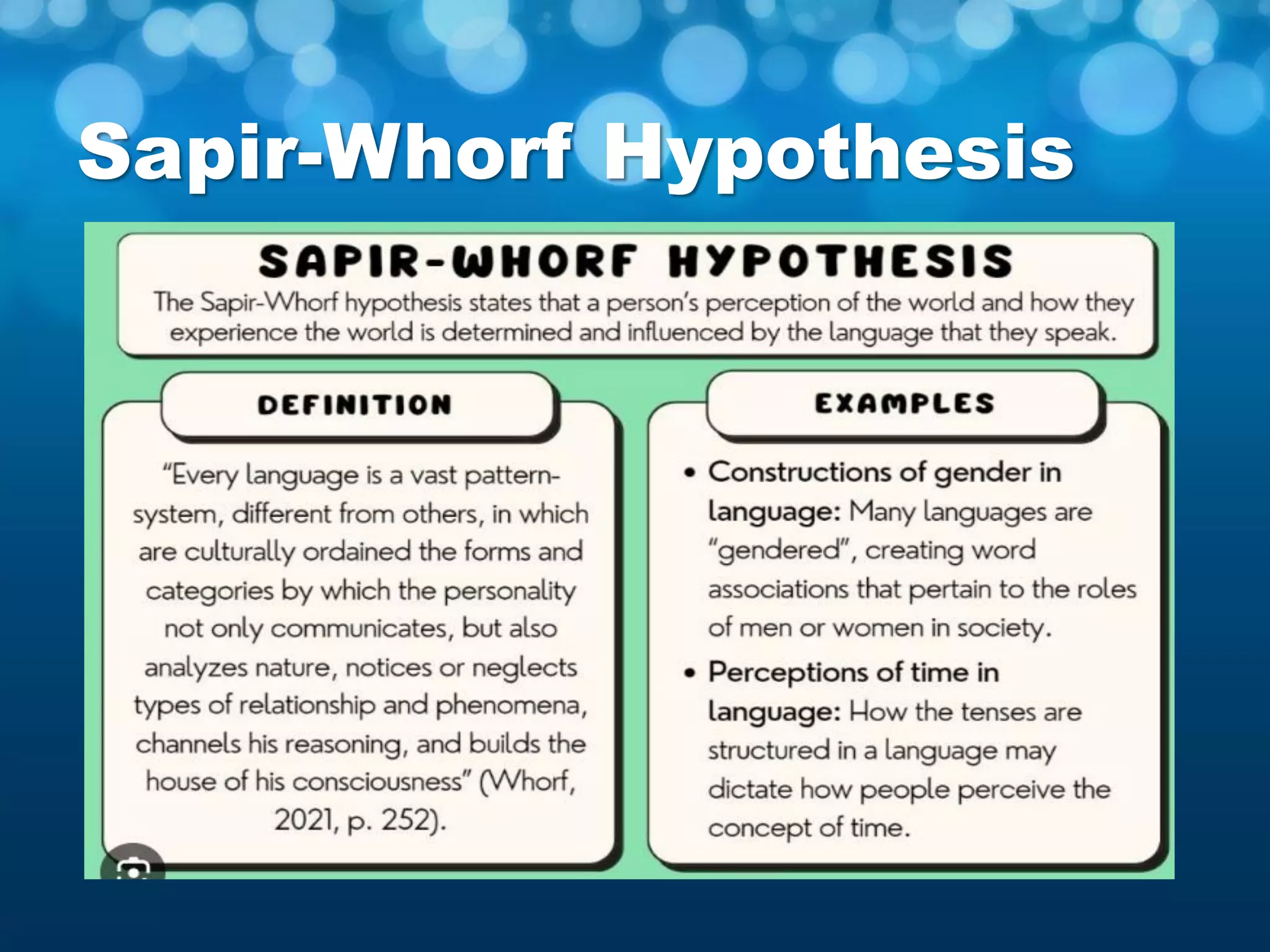
Sapir-Whorf Hypothesis
Examples
1. Constructions of food in language: A
language may ascribe many words to explain
the same concept, item, or food type. This
shows that they perceive it as extremely
important in their society, in comparison to a
culture whose language only has one word for
that same concept, item, or food.
Sapir-Whorf Hypothesis
Examples
2. Descriptions of color in language: Different
cultures may visually perceive colors in
different ways according to how the colors are
described by the words in their language.
3. Constructions of gender in language: Many
languages are “gendered”, creating word
associations that pertain to the roles of men or
women in society.
Sapir-Whorf Hypothesis
Examples
4. Perceptions of time in language: Depending
upon how the tenses are structured in a language,
it may dictate how the people that speak that
language perceive the concept of time.
5. Categorization in language: The ways concepts
and items in a given culture are categorized (and
what words are assigned to them) can affect the
speaker’s perception of the world around them.
Sapir-Whorf Hypothesis
Examples
6. Politeness is encoded in language: Levels of
politeness in a language and the pronoun
combinations to express these levels differ
between languages. How languages express
politeness with words can dictate how they
perceive the world around them.
Sapir-Whorf Hypothesis
Examples
7. Indigenous words for snow: A popular
example used to justify this hypothesis is the
Inuit people, who have a multitude of ways to
express the word snow. If you follow the
reasoning of Sapir, it would suggest that the
Inuits have a profoundly deeper understanding
of snow than other cultures.
Sapir-Whorf Hypothesis
Examples
8. Use of idioms in language: An expression or
well-known saying in one culture has an acute
meaning implicitly understood by those that
speak the particular language but is not
understandable when expressed in another
language.
9. Values are engrained in language: Each
country and culture have beliefs and values as a
direct result of the language it uses.
Sapir-Whorf Hypothesis
Examples
10. Slang in language: The slang used by
younger people evolves from generation to
generation in all languages. Generational slang
carries with it perceptions and ideas about the
world that members of that generation share
Criticism Of Sapir-Whorf
Hypothesis
1. Language As Context-Dependent
Iwamoto (2005) expresses that the Sapir-Whorf hypothesis
fails to recognize that language is used within context. Its
purely decontextualized textual analysis of language is too
one-dimensional and doesn’t consider how we actually use
language:
“Whorf’s “neat and simplistic” linguistic relativism
presupposes the idea that an entire language or entire
societies or cultures are categorizable or typable in a
straightforward, discrete, and total manner, ignoring other
variables such as contextual and semantic factors.”(Iwamoto,
2005, p. 95)
Criticism Of Sapir-Whorf
Hypothesis
2. Not Universally Applicable
Another criticism of the hypothesis is that Sapir &
Whorf’s hypothesis cannot be transferred or applied to
all languages.
It is difficult to cite empirical studies that confirm that
other cultures do not also have similarities in the way
concepts are perceived through their language – even if
they don’t possess a similar word/expression for a
particular concept that is expressed.
Criticism Of Sapir-Whorf
Hypothesis
3. Thoughts Can Be Independent Of Language
Stephen Pinker, one of Sapir & Whorf’s most
emphatic critics, would argue that language is
not of our thoughts, and is not a cultural
invention that creates perceptions; it is in his
opinion, a part of human biology (Meier &
Pinker, 1995, pp. 611-612).
12 major languages in the
Philippines
Multi-culture learners
According to Department of Education, it wants
to produce Multicultural students.
References:
Gregory (2023). Sapir-Whorf Hypothesis: Examples,
Definition, Criticisms. Retrieved from
https://helpfulprofessor.com/sapir-whorf-
hypothesis-
examples/?mab_v3=20743#molongui-disabled-link
Berto (2023). I love you in the 12 major languages
of the Philippines. Retrieved from
https://thephilippinestoday.com/i- love-you-in-the-
12-major-languages/
Yale University (2021). Benjamin Lee Whorf. Retrieved
from https://ling.yale.edu/about/history/people
/benjamin-lee-whorf

Week 3 SPE-MTB-MLE.pdf

  • 1.
    MTB MLE LANGUAGE AS SOCIALCONTENT SPE-MTB-MLE, BEED 2105 - Week 3 Prof. MEINRAD C. BAUTISTA, Ph.D.
  • 2.
    Saphir-Whorf “Language does more thansimply describe reality; it also serves to shape the reality of a culture”
  • 3.
    Learning Objectives: 1. Torecognize the issues and challenges in teaching mother tongue; 2. To enumerate the importance of dealing the issues and concern in Mother Tongue as a medium of instruction; and 3. To share and discuss once own experience in using the mother tongue 4. To be familiar with Sapir-Whorf Hypothesis
  • 4.
    Benefits of MTB-MLE •It helps children to develop a strong foundation in their mother tongue, which is essential for further academic success. • It promotes cultural identity and pride. • It facilitates the learning of other languages. • It improves communication and understanding between teachers and students. • It reduces student drop-out and repetition The purpose of MTB-MLE is to develop students appropriate cognitive and reasoning skills. Mother tongue as a subject in school important because it is a stepping stone in achieving the aim of education.
  • 5.
    Issues and Challengesin MTB-MLE There are also some challenges associated with MTB-MLE, including: • Lack of resources: In many countries, there is a lack of teaching materials and resources in minority languages. This can make it difficult for teachers to implement MTB-MLE effectively. • Teacher training: Many teachers are not trained to teach in their mother tongue, especially if it is a minority language. This can lead to challenges in delivering high-quality instruction. • Parental support: Some parents may be reluctant to send their children to schools that use MTB-MLE, especially if they believe that their children will need to learn English fluently in order to be successful.
  • 6.
    Issues and Challengesin MTB-MLE Here are some specific examples of the issues that can arise in MTB-MLE: • In multilingual communities, it can be difficult to decide which language(s) to use for instruction. • Some teachers may not be fluent in the language of their students. • There may be a lack of standardized tests and other assessment tools in minority languages. • Some parents may believe that English is more important than their mother tongue and may resist MTB-MLE. Lack of vocabulary is considered the death of words to use when delivering message of information
  • 7.
    Ways to addressissues and challenges in MTB-MLE There are number of things that can be done to address the challenges of MTB-MLE, such as: • Investing in teacher training and the development of teaching materials in minority languages. • Working with parents to raise awareness of the benefits of MTB-MLE. • Developing standardized tests and other assessment tools in minority languages. By taking these steps, we can ensure that all children can have the opportunity to learn and thrive in their mother tongue.
  • 8.
    Whorfian/-Sapir Hypothesis “Whorfian/-Sapir hypothesis”,is a principle developed by linguist Benjamin Lee Whorf and his mentor Edward Sapir which essentially held that language effects the way speakers perceive, conceptualize or build their worldview, which would otherwise effect thought processes (Swoyer, 2010).
  • 9.
    Whorfian/-Sapir Hypothesis Developed in1929 by Edward Sapir, the Sapir- Whorf hypothesis (also known as linguistic relativity) states that a person’s perception of the world around them and how they experience the world is both determined and influenced by the language that they speak. We learn the second language via conscious process of study and attention to form and rule by acquisition- learning hypothesis.
  • 10.
    Edward Sapir January 26,1884 – February 4, 1939) was an American anthropologist-linguist, who is widely considered to be one of the most important figures in the development of the discipline of linguistics in the United States.
  • 11.
    Benjamin Lee Whorf BenjaminLee Whorf (April 24, 1897 in Winthrop, Massachusetts – July 26, 1941) was an American linguist. Whorf is widely known for his ideas about linguistic relativity, the hypothesis that language influences thought. An important theme in many of his publications, he has been credited as one of the fathers of this approach, often referred to as the “Sapir–Whorf hypothesis”, named after him and his mentor Edward Sapir. Originally educated as a chemical engineer, he took up an interest in linguistics late in his life, studying with Sapir at Yale University.
  • 12.
  • 13.
    Sapir-Whorf Hypothesis Examples 1. Constructionsof food in language: A language may ascribe many words to explain the same concept, item, or food type. This shows that they perceive it as extremely important in their society, in comparison to a culture whose language only has one word for that same concept, item, or food.
  • 14.
    Sapir-Whorf Hypothesis Examples 2. Descriptionsof color in language: Different cultures may visually perceive colors in different ways according to how the colors are described by the words in their language. 3. Constructions of gender in language: Many languages are “gendered”, creating word associations that pertain to the roles of men or women in society.
  • 15.
    Sapir-Whorf Hypothesis Examples 4. Perceptionsof time in language: Depending upon how the tenses are structured in a language, it may dictate how the people that speak that language perceive the concept of time. 5. Categorization in language: The ways concepts and items in a given culture are categorized (and what words are assigned to them) can affect the speaker’s perception of the world around them.
  • 16.
    Sapir-Whorf Hypothesis Examples 6. Politenessis encoded in language: Levels of politeness in a language and the pronoun combinations to express these levels differ between languages. How languages express politeness with words can dictate how they perceive the world around them.
  • 17.
    Sapir-Whorf Hypothesis Examples 7. Indigenouswords for snow: A popular example used to justify this hypothesis is the Inuit people, who have a multitude of ways to express the word snow. If you follow the reasoning of Sapir, it would suggest that the Inuits have a profoundly deeper understanding of snow than other cultures.
  • 18.
    Sapir-Whorf Hypothesis Examples 8. Useof idioms in language: An expression or well-known saying in one culture has an acute meaning implicitly understood by those that speak the particular language but is not understandable when expressed in another language. 9. Values are engrained in language: Each country and culture have beliefs and values as a direct result of the language it uses.
  • 19.
    Sapir-Whorf Hypothesis Examples 10. Slangin language: The slang used by younger people evolves from generation to generation in all languages. Generational slang carries with it perceptions and ideas about the world that members of that generation share
  • 20.
    Criticism Of Sapir-Whorf Hypothesis 1.Language As Context-Dependent Iwamoto (2005) expresses that the Sapir-Whorf hypothesis fails to recognize that language is used within context. Its purely decontextualized textual analysis of language is too one-dimensional and doesn’t consider how we actually use language: “Whorf’s “neat and simplistic” linguistic relativism presupposes the idea that an entire language or entire societies or cultures are categorizable or typable in a straightforward, discrete, and total manner, ignoring other variables such as contextual and semantic factors.”(Iwamoto, 2005, p. 95)
  • 21.
    Criticism Of Sapir-Whorf Hypothesis 2.Not Universally Applicable Another criticism of the hypothesis is that Sapir & Whorf’s hypothesis cannot be transferred or applied to all languages. It is difficult to cite empirical studies that confirm that other cultures do not also have similarities in the way concepts are perceived through their language – even if they don’t possess a similar word/expression for a particular concept that is expressed.
  • 22.
    Criticism Of Sapir-Whorf Hypothesis 3.Thoughts Can Be Independent Of Language Stephen Pinker, one of Sapir & Whorf’s most emphatic critics, would argue that language is not of our thoughts, and is not a cultural invention that creates perceptions; it is in his opinion, a part of human biology (Meier & Pinker, 1995, pp. 611-612).
  • 23.
    12 major languagesin the Philippines
  • 24.
    Multi-culture learners According toDepartment of Education, it wants to produce Multicultural students.
  • 25.
    References: Gregory (2023). Sapir-WhorfHypothesis: Examples, Definition, Criticisms. Retrieved from https://helpfulprofessor.com/sapir-whorf- hypothesis- examples/?mab_v3=20743#molongui-disabled-link Berto (2023). I love you in the 12 major languages of the Philippines. Retrieved from https://thephilippinestoday.com/i- love-you-in-the- 12-major-languages/ Yale University (2021). Benjamin Lee Whorf. Retrieved from https://ling.yale.edu/about/history/people /benjamin-lee-whorf