Week 3 Language and
Culture
DR. RUSSELL RODRIGO
How can the words in a language appear to
influence behavior? Give examples.
Does the way you think and act in your first
language differ from how you think and act in
a second or third language?
Concepts
Every human language is ‘fully expressive’.
translation possible
exceptions might be pidgins, invented languages
How concepts expressed
 Concept  morpheme
How many morphemes required to express a concept?
 Languages vary
e.g.
English
 2 morphemes, ‘happiness’
Filipino
3 morphemes “kaligayahan”
Morpheme  concept
 What concept(s) expressed by a morpheme?
 Witsuwit’en
[əstɬ’əs] ‘paper, book, envelope, letter’
 Kinship systems
Witsuwit’en
–[aq’əj] ‘maternal aunt’, -[pits] ‘paternal aunt’
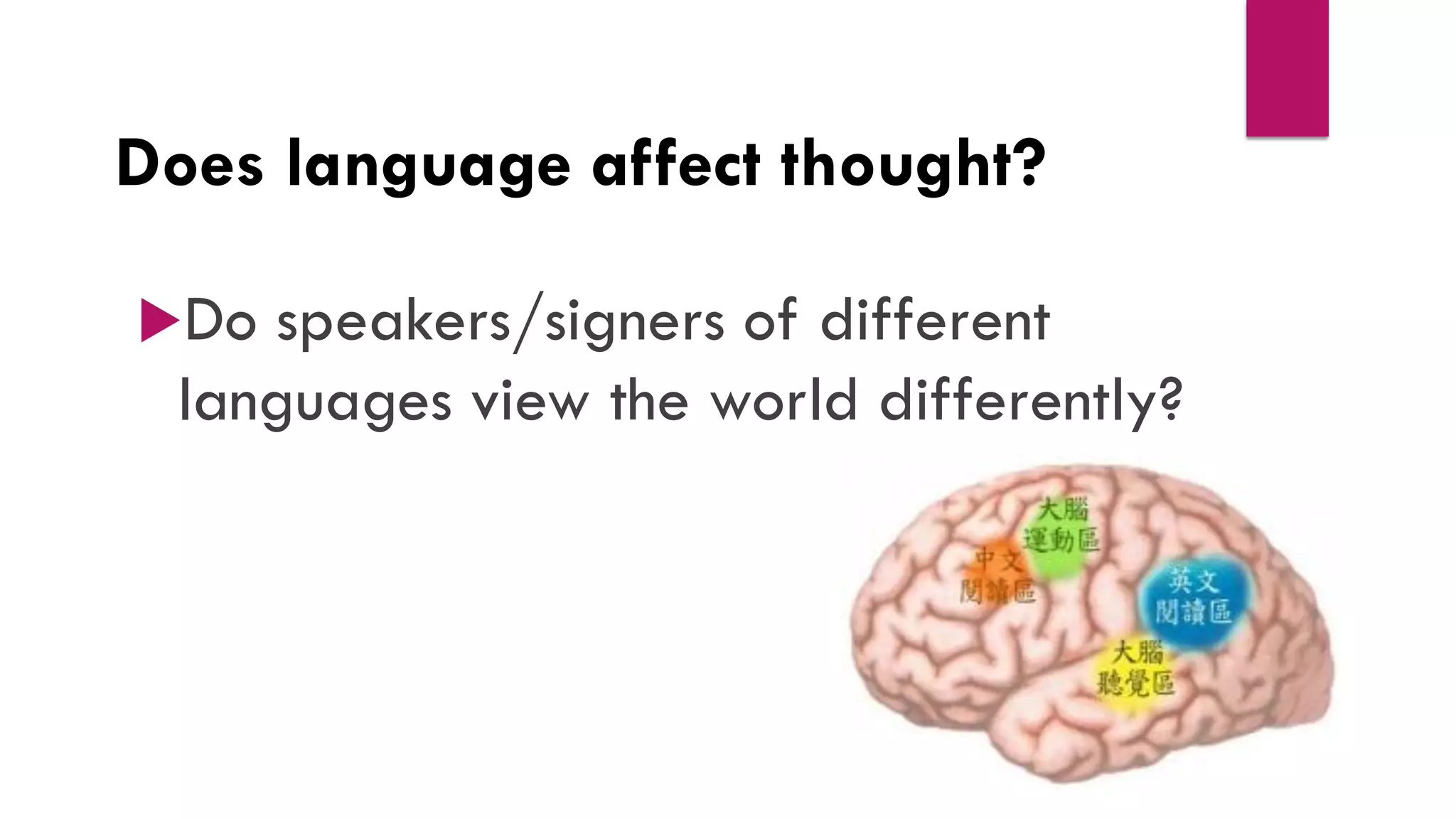
Does language affect thought?
Do speakers/signers of different
languages view the world differently?
Outline
1.Linguistic Anthropology
2.Language and Thought
What is Linguistic Anthropology?
 The American Anthropological Association defines anthropology as “the study of
humans past and present”. Since possessing the language faculty is fundamental part
of being human, it may come as no surprise that one of the four traditional branches
of anthropology concerns itself with the study of human language.
 Linguistic anthropology is the study of how human language interacts with
shapes, social structure, and culture.
 Speakers use language to represent their natural and social worlds; thus, looking at
a certain language is like looking at the world through the lens of the
language’s speakers, and much can be understood about culture through
language.
For instance, in English there are a number of
metaphors equating time and money.
 Time and money
 Spending time
 Wasting one’s time
 Investing time in a project
 Budgeting out one’s time
Activity
 Refer to metaphors given previously. What other metaphorical
relationship exists in your native language?
 List at least four metaphors linking two concepts and briefly
explain what you think they say about the culture (to get you
started, think of metaphors for love, life, work, etc.).
Kinship Terms
 One way cultural values are reflected in language is through kinship
terms.
 For instance, kinship terms in English are organized by gender (brother
vs. sister, father vs. mother), generation (daughter, mother, grandmother, great
grandmother), and line (direct lineage: mother, son, vs. collateral lineage: aunt,
nephew).
 There is also emphasis on blood relation versus relation in marriage,
with terms like step-sibling, half-sibling, mother-in-law, and so on.
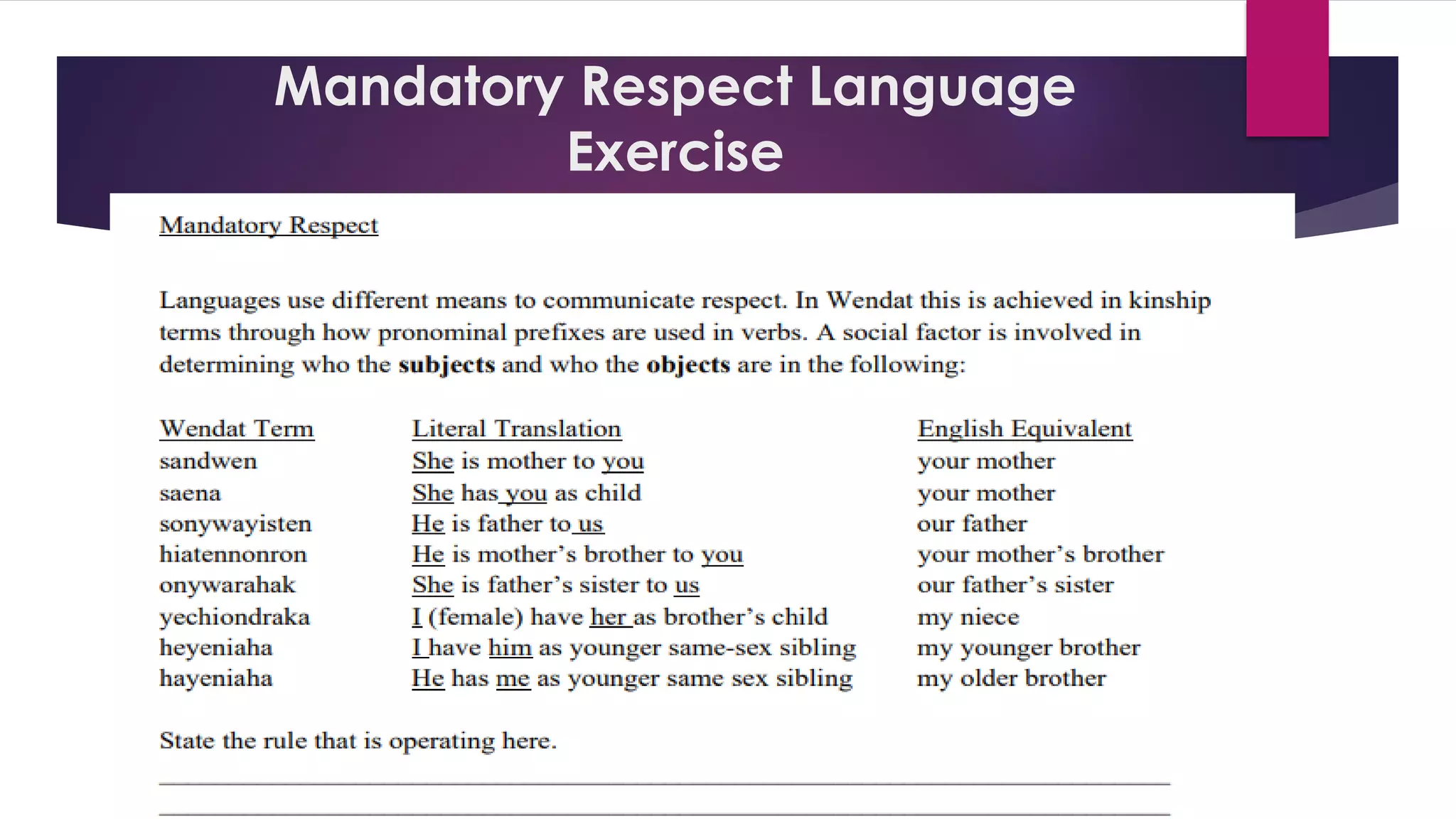
Mandatory Respect Language
Exercise
Activity
 Choose a language and culture and research the kinship terms used
in that culture.
 How are kinship terms organized in this culture?
 How is the organization of kinship terms similar to and different from
American English?
Communicative Competence
 When and how do you think children acquire communicative
competence?
 What specific rules do we need to know as part of our communicative
competence in order to participate in an American English conversation?
 Give at least four rules. When did we learn each of these things?
Communicative Competence
 Researcher Dell Hymes argued that knowing a language means more than just knowing
how to produce grammatical utterances. For example, in day-to-day interactions in the
U.S., “What’s up?” and “How are you”? Are often used as greetings rather than requests
for information.
 Speakers must have this cultural understanding in order to supply the appropriate
response. Without this understanding, it would be quite logical to respond these questions
with long descriptions of how the speaker’s day went or how the speaker was feeling.
 Communicative competence is the ability to interact and communicate according to
cultural norms. Some examples of things one must know to be communicatively competent
in a certain language are politeness strategies, speaker roles, turn-taking, and greetings.
Language and Thought
Linguistic Relativity
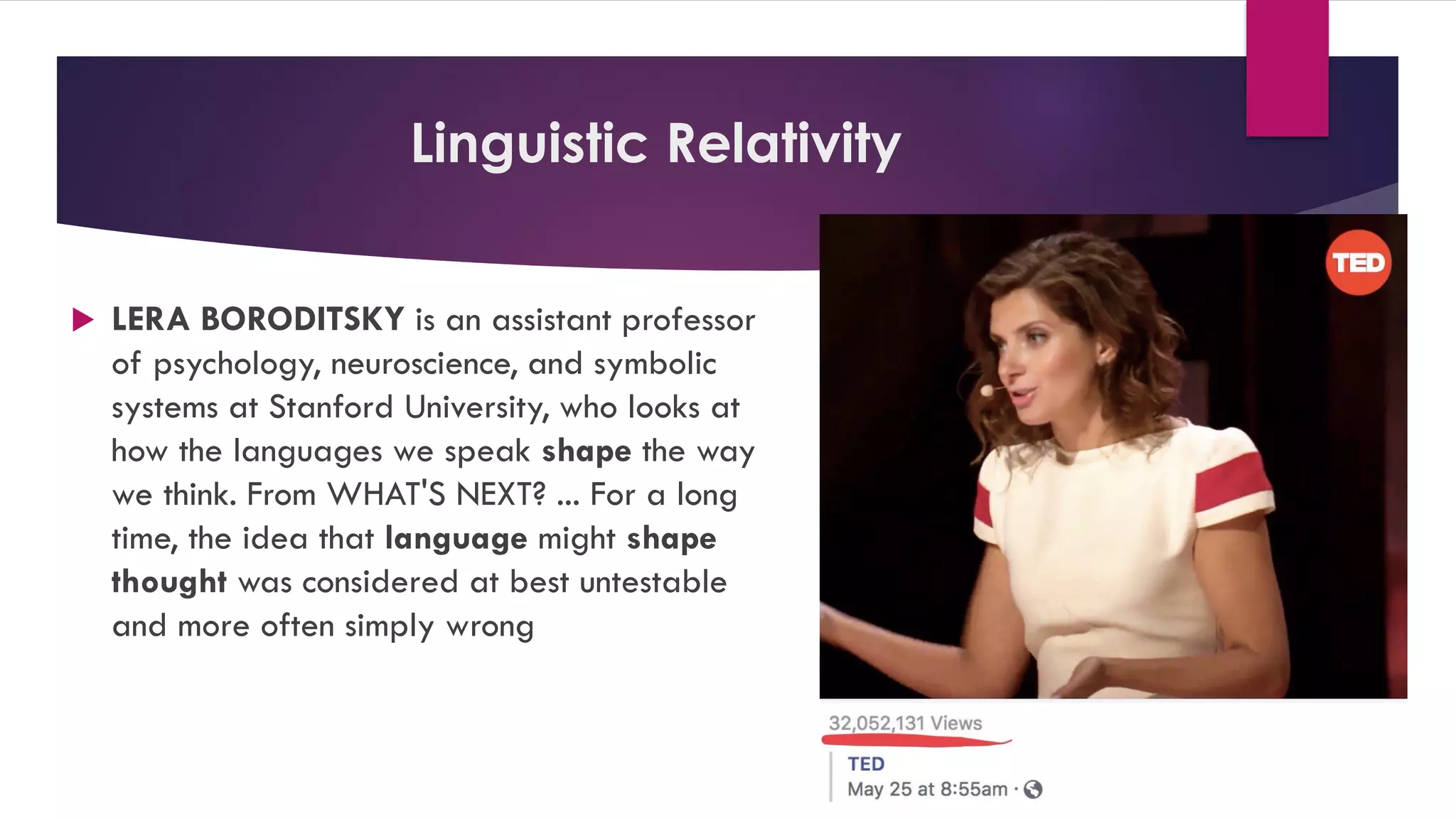
 LERA BORODITSKY is an assistant professor
of psychology, neuroscience, and symbolic
systems at Stanford University, who looks at
how the languages we speak shape the way
we think. From WHAT'S NEXT? ... For a long
time, the idea that language might shape
thought was considered at best untestable
and more often simply wrong
Language and Thought
Explain how the words in a language can appear to influence behavior, giving at
least one concrete example.
 Watch the video in the next slide.
 Summarize what is the talk all about.
 How does language shape the way the subjects think?
Do we think before we speak? Or do we
need language to shape our thoughts?
Linguistic Relativity
 The Linguistic Relativity hypothesis argues that the language someone speaks affects
how she perceives the world.
 The weak version, called linguistic relativity, simply claims that language affects
thought. One way language can influence thought is shown by the example of the words
for “key” and “bridge”.
 German speakers: “Key” is described as hard, heavy, metal, shiny. On the other hand,
bridge, for which the German word is feminine and the Spanish is masculine. Germans called
it pretty, peaceful, elegant, beautiful, and fragile, while Spanish speakers called it strong,
dangerous, sturdy, and towering.
 The strong version, called linguistic determinism, claims that language determines
thought; speakers of a language can think of things only in the way that their language
expresses them.
Early Studies in Linguistic Relativity
1. Edward Sapir (1884-1939)
2. Benjamin Whorf (1897-1941)
Linguistic Relativity Hypothesis
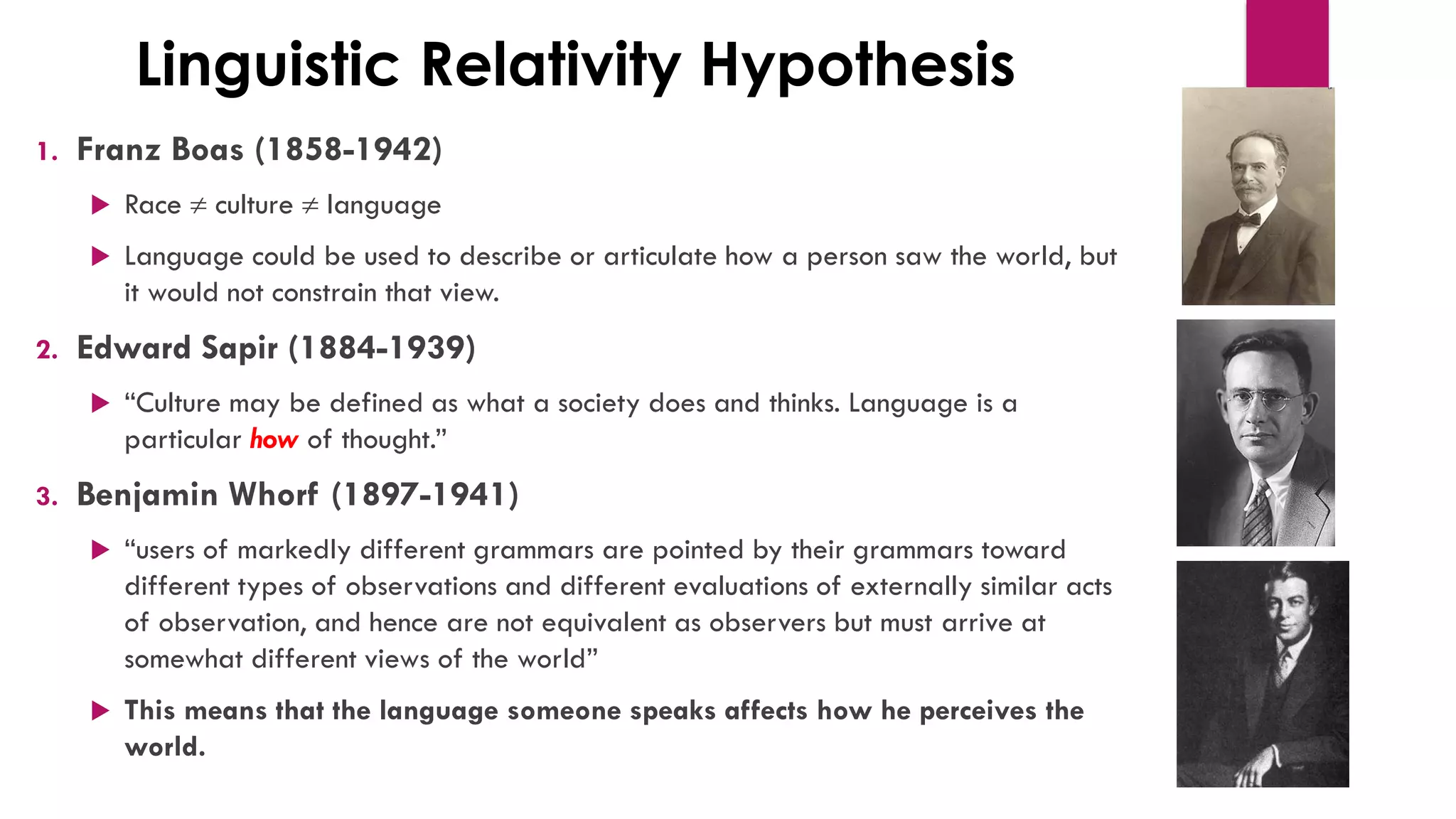
1. Franz Boas (1858-1942)
 Race  culture  language
 Language could be used to describe or articulate how a person saw the world, but
it would not constrain that view.
2. Edward Sapir (1884-1939)
 “Culture may be defined as what a society does and thinks. Language is a
particular how of thought.”
3. Benjamin Whorf (1897-1941)
 “users of markedly different grammars are pointed by their grammars toward
different types of observations and different evaluations of externally similar acts
of observation, and hence are not equivalent as observers but must arrive at
somewhat different views of the world”
 This means that the language someone speaks affects how he perceives the
world.
Criticisms of the Early Studies
 Refutation towards Whorf’s Hopi studies made by Ekkehart Malotski (1983).
 Whorf is simply projecting his ideas about their culture from what he understood of the
Hopi Grammatical structure. This would make his argument circular.
 Second, it has been proposed that while the Hopi may not express time on verbs using
tenses, this does not mean that the Hopi do not have ways of locating particular events
in time, just as English does. There are certainly other languages that do not have tenses.
 Whorf’s descriptions of how the Hopi linguistic system categorizes time do not seem to
have been completely accurate; for example, time can be expressed using nouns in Hopi,
and there are nouns for concepts like day, night, month, and year. Unfortunately, his
methods of collecting data were very questionable, and thus any conclusions drawn from
this data are equally questionable.
 Does this mean that the principle of linguistic relativity is wrong?
Sapir-Whorf hypothesis
 In linguistics, the Sapir-Whorf Hypothesis states that there are certain
thoughts of an individual in one language that cannot be understood
by those who live in another language.
 The hypothesis states that the way people think is strongly affected by
their native languages.
 It is a controversial theory championed by linguist Edward Sapir and his
student Benjamin Whorf.
Sapir-Whorf hypothesis I
1. Linguistic relativity:
 Structural differences between languages are paralleled by nonlinguistic
cognitive differences (the structure of the language itself effects cognition).
 The number and the type of the basic colour words of a language
determine how a subject sees the rain bow.
Sapir-Whorf hypothesis II
2. Linguistic determinism = extreme "Weltanschauung" version of the
hypothesis:
 The structure of a language determines someone’s World View
 A World View describes a (hopefully) consistent and integral sense of
existence and provides a theoretical framework for generating, sustaining
and applying knowledge
 E.g. The Inuit can think more intelligently about snow because their
language contains more sophisticated and subtle words distinguishing
various forms of it, etc.
Sapir-Whorf hypothesis II
 Arbitrariness
The semantic systems of different languages vary without
constraint.
This hypothesis must be tacitly assumed, because otherwise the
claim that Linguistic Relativity makes is rather undramatic.
For each decomposition of the spectrum of the rainbow a natural
system of colour words is possible.
Testing Sapir-Whorf hypothesis
 “The Whorf Hypothesis can be difficult to test, because it can be difficult
to identify tasks that really are language- and culture-neutral.”
Pirahã tribe (Brazil)
 the language lacks numbers
 attempts to get Pirahã to count unsuccessful
 because the language lacks numbers, or problems with teaching technique?
 http://www.sciencemag.org/cgi/content/full/1094492/DC1
Color experiments
 Infinite number of ways to carve up colors
 Lenneberg and Roberts 1956
 English speakers and monolingual Zuni speakers presented with colors ranging
between yellow and orange
 What was the task? to name the colors presented?
“the English speakers, who have two basic color terms for this range (namely, yellow and
orange), were highly consistent in naming the colors, where the Zuni, who have a single
term encompassing yellow and orange, made no consistent choice.”
 “These results seem to support the Whorf Hypothesis.”
English speakers could have said: “yellow”, “orange”, “yellow-orange”, “orange-
yellow”, “mostly yellow with a touch of orange” etc.
Or simply show (1) preference to answer with monomorphemic words, (2) English speakers
agree on meanings of “orange” and “yellow”?
 Another experiment
 Which direction does the arrow on left point?
 Turn 180°.
 Which arrow points same direction as original arrow?
 Results
 English speakers
 “consistently choose arrow B”
 Tzeltal speakers
 “consistently choose arrow A”
Spatial relationships in English vs.
Tzeltal
 English
right, left, front, back are relative terms
the chair is to the left of the table
 Tenejapan Tzeltal
“uses absolute terms similar to north, south, east and west
instead”
“the chair is to the north of the table”
Tests of the Sapir-Whorf hypothesis (Kay
& Kempton )
Two experiments:
Experiment 1: Tests whether linguistic relativity exists.
Experiment 2: Tests whether ‘name strategy’ can be
used as the explanation for the underlying cognitive
mechanism in experiment 1.
Tests of the Sapir-Whorf hypothesis:
Paul Kay & Willett Kempton (1984)
 Experiment 1
Distinctions in color terminology
 English: distinction between ‘blue’ and ‘green’
 Tarahumara: siy?name is blue and/or green
 Subjective distance between colors
Discrimination distance (“real” scale of psychological distance)
 Blue-green lexical category boundary (that wavelength at which an equal mixture of
green and blue is perceived - based on English speakers)
Color distinction in English and
Tarahumara
Stimuli and method
Eight color chips
 in different shades of green and blue (at two different levels of brightness)
Triad technique
 Three chips at a time are shown which of the 3 chips is most different from
theother 2?
 56 triads
Conclusions of experiment 1
 Kay & Kempton concluded that a Whorfian effect is shown by
this experiment:
English speakers tended to exaggerate the
discrimination of colors close to the lexical category boundary,
while Tarahumara didn’t.
 What cognitive mechanism may have caused this difference?
Name Strategy
Kay & Kempton hypothesized that the English
speakers used a ‘name strategy’, by discriminating
between colors according to their lexical category.
E.g., if chips C and D are called ‘blue’ and chip B is
called ‘green’, then chip B must be the odd member in
this triad
Experiment 2
 To test whether this hypothesis is true, Kay & Kempton
conducted a second experiment in which they eliminated the
‘name strategy’.
 If the Whorfian hypothesis isn’t found in this experiment, it
supports the use of the ‘name strategy’ in experiment.
General conclusions
 Experiment 1 seems to show a Whorfian effect; English speakers show
a tendency to discriminate colors based on the lexical category
boundary, while Tarahumara speakers didn’t show this effect.
 Kay & Kempton hypothesized that a ‘name strategy’ was the cognitive
mechanism that was used by the English speakers. To test this possibility
they conducted another experiment.
 In experiment 2 the ‘name strategy’ was ruled out. No Whorfian effect
was found.
Summary of Sapir-Whorf
 Intriguing idea
 Inconclusive experimental support
 The extreme ("Weltanschauung") version of this idea, that all
thought is constrained by language, has been disproved
 The opposite extreme – that language does not influence
thought at all – is also widely considered to be false

Week 3 LIN321

  • 1.
    Week 3 Languageand Culture DR. RUSSELL RODRIGO
  • 2.
    How can thewords in a language appear to influence behavior? Give examples. Does the way you think and act in your first language differ from how you think and act in a second or third language?
  • 3.
    Concepts Every human languageis ‘fully expressive’. translation possible exceptions might be pidgins, invented languages
  • 4.
    How concepts expressed Concept  morpheme How many morphemes required to express a concept?  Languages vary e.g. English  2 morphemes, ‘happiness’ Filipino 3 morphemes “kaligayahan”
  • 5.
    Morpheme  concept What concept(s) expressed by a morpheme?  Witsuwit’en [əstɬ’əs] ‘paper, book, envelope, letter’  Kinship systems Witsuwit’en –[aq’əj] ‘maternal aunt’, -[pits] ‘paternal aunt’
  • 6.
    Does language affectthought? Do speakers/signers of different languages view the world differently?
  • 7.
  • 8.
    What is LinguisticAnthropology?  The American Anthropological Association defines anthropology as “the study of humans past and present”. Since possessing the language faculty is fundamental part of being human, it may come as no surprise that one of the four traditional branches of anthropology concerns itself with the study of human language.  Linguistic anthropology is the study of how human language interacts with shapes, social structure, and culture.  Speakers use language to represent their natural and social worlds; thus, looking at a certain language is like looking at the world through the lens of the language’s speakers, and much can be understood about culture through language.
  • 9.
    For instance, inEnglish there are a number of metaphors equating time and money.  Time and money  Spending time  Wasting one’s time  Investing time in a project  Budgeting out one’s time
  • 10.
    Activity  Refer tometaphors given previously. What other metaphorical relationship exists in your native language?  List at least four metaphors linking two concepts and briefly explain what you think they say about the culture (to get you started, think of metaphors for love, life, work, etc.).
  • 11.
    Kinship Terms  Oneway cultural values are reflected in language is through kinship terms.  For instance, kinship terms in English are organized by gender (brother vs. sister, father vs. mother), generation (daughter, mother, grandmother, great grandmother), and line (direct lineage: mother, son, vs. collateral lineage: aunt, nephew).  There is also emphasis on blood relation versus relation in marriage, with terms like step-sibling, half-sibling, mother-in-law, and so on.
  • 12.
  • 13.
    Activity  Choose alanguage and culture and research the kinship terms used in that culture.  How are kinship terms organized in this culture?  How is the organization of kinship terms similar to and different from American English?
  • 14.
    Communicative Competence  Whenand how do you think children acquire communicative competence?  What specific rules do we need to know as part of our communicative competence in order to participate in an American English conversation?  Give at least four rules. When did we learn each of these things?
  • 15.
    Communicative Competence  ResearcherDell Hymes argued that knowing a language means more than just knowing how to produce grammatical utterances. For example, in day-to-day interactions in the U.S., “What’s up?” and “How are you”? Are often used as greetings rather than requests for information.  Speakers must have this cultural understanding in order to supply the appropriate response. Without this understanding, it would be quite logical to respond these questions with long descriptions of how the speaker’s day went or how the speaker was feeling.  Communicative competence is the ability to interact and communicate according to cultural norms. Some examples of things one must know to be communicatively competent in a certain language are politeness strategies, speaker roles, turn-taking, and greetings.
  • 16.
  • 17.
    Linguistic Relativity  LERABORODITSKY is an assistant professor of psychology, neuroscience, and symbolic systems at Stanford University, who looks at how the languages we speak shape the way we think. From WHAT'S NEXT? ... For a long time, the idea that language might shape thought was considered at best untestable and more often simply wrong
  • 18.
    Language and Thought Explainhow the words in a language can appear to influence behavior, giving at least one concrete example.  Watch the video in the next slide.  Summarize what is the talk all about.  How does language shape the way the subjects think?
  • 20.
    Do we thinkbefore we speak? Or do we need language to shape our thoughts?
  • 22.
    Linguistic Relativity  TheLinguistic Relativity hypothesis argues that the language someone speaks affects how she perceives the world.  The weak version, called linguistic relativity, simply claims that language affects thought. One way language can influence thought is shown by the example of the words for “key” and “bridge”.  German speakers: “Key” is described as hard, heavy, metal, shiny. On the other hand, bridge, for which the German word is feminine and the Spanish is masculine. Germans called it pretty, peaceful, elegant, beautiful, and fragile, while Spanish speakers called it strong, dangerous, sturdy, and towering.  The strong version, called linguistic determinism, claims that language determines thought; speakers of a language can think of things only in the way that their language expresses them.
  • 23.
    Early Studies inLinguistic Relativity 1. Edward Sapir (1884-1939) 2. Benjamin Whorf (1897-1941)
  • 24.
    Linguistic Relativity Hypothesis 1.Franz Boas (1858-1942)  Race  culture  language  Language could be used to describe or articulate how a person saw the world, but it would not constrain that view. 2. Edward Sapir (1884-1939)  “Culture may be defined as what a society does and thinks. Language is a particular how of thought.” 3. Benjamin Whorf (1897-1941)  “users of markedly different grammars are pointed by their grammars toward different types of observations and different evaluations of externally similar acts of observation, and hence are not equivalent as observers but must arrive at somewhat different views of the world”  This means that the language someone speaks affects how he perceives the world.
  • 25.
    Criticisms of theEarly Studies  Refutation towards Whorf’s Hopi studies made by Ekkehart Malotski (1983).  Whorf is simply projecting his ideas about their culture from what he understood of the Hopi Grammatical structure. This would make his argument circular.  Second, it has been proposed that while the Hopi may not express time on verbs using tenses, this does not mean that the Hopi do not have ways of locating particular events in time, just as English does. There are certainly other languages that do not have tenses.  Whorf’s descriptions of how the Hopi linguistic system categorizes time do not seem to have been completely accurate; for example, time can be expressed using nouns in Hopi, and there are nouns for concepts like day, night, month, and year. Unfortunately, his methods of collecting data were very questionable, and thus any conclusions drawn from this data are equally questionable.  Does this mean that the principle of linguistic relativity is wrong?
  • 27.
    Sapir-Whorf hypothesis  Inlinguistics, the Sapir-Whorf Hypothesis states that there are certain thoughts of an individual in one language that cannot be understood by those who live in another language.  The hypothesis states that the way people think is strongly affected by their native languages.  It is a controversial theory championed by linguist Edward Sapir and his student Benjamin Whorf.
  • 28.
    Sapir-Whorf hypothesis I 1.Linguistic relativity:  Structural differences between languages are paralleled by nonlinguistic cognitive differences (the structure of the language itself effects cognition).  The number and the type of the basic colour words of a language determine how a subject sees the rain bow.
  • 29.
    Sapir-Whorf hypothesis II 2.Linguistic determinism = extreme "Weltanschauung" version of the hypothesis:  The structure of a language determines someone’s World View  A World View describes a (hopefully) consistent and integral sense of existence and provides a theoretical framework for generating, sustaining and applying knowledge  E.g. The Inuit can think more intelligently about snow because their language contains more sophisticated and subtle words distinguishing various forms of it, etc.
  • 30.
    Sapir-Whorf hypothesis II Arbitrariness The semantic systems of different languages vary without constraint. This hypothesis must be tacitly assumed, because otherwise the claim that Linguistic Relativity makes is rather undramatic. For each decomposition of the spectrum of the rainbow a natural system of colour words is possible.
  • 31.
    Testing Sapir-Whorf hypothesis “The Whorf Hypothesis can be difficult to test, because it can be difficult to identify tasks that really are language- and culture-neutral.” Pirahã tribe (Brazil)  the language lacks numbers  attempts to get Pirahã to count unsuccessful  because the language lacks numbers, or problems with teaching technique?  http://www.sciencemag.org/cgi/content/full/1094492/DC1
  • 32.
    Color experiments  Infinitenumber of ways to carve up colors  Lenneberg and Roberts 1956  English speakers and monolingual Zuni speakers presented with colors ranging between yellow and orange  What was the task? to name the colors presented? “the English speakers, who have two basic color terms for this range (namely, yellow and orange), were highly consistent in naming the colors, where the Zuni, who have a single term encompassing yellow and orange, made no consistent choice.”  “These results seem to support the Whorf Hypothesis.” English speakers could have said: “yellow”, “orange”, “yellow-orange”, “orange- yellow”, “mostly yellow with a touch of orange” etc. Or simply show (1) preference to answer with monomorphemic words, (2) English speakers agree on meanings of “orange” and “yellow”?
  • 33.
     Another experiment Which direction does the arrow on left point?  Turn 180°.  Which arrow points same direction as original arrow?  Results  English speakers  “consistently choose arrow B”  Tzeltal speakers  “consistently choose arrow A”
  • 34.
    Spatial relationships inEnglish vs. Tzeltal  English right, left, front, back are relative terms the chair is to the left of the table  Tenejapan Tzeltal “uses absolute terms similar to north, south, east and west instead” “the chair is to the north of the table”
  • 35.
    Tests of theSapir-Whorf hypothesis (Kay & Kempton ) Two experiments: Experiment 1: Tests whether linguistic relativity exists. Experiment 2: Tests whether ‘name strategy’ can be used as the explanation for the underlying cognitive mechanism in experiment 1.
  • 36.
    Tests of theSapir-Whorf hypothesis: Paul Kay & Willett Kempton (1984)  Experiment 1 Distinctions in color terminology  English: distinction between ‘blue’ and ‘green’  Tarahumara: siy?name is blue and/or green  Subjective distance between colors Discrimination distance (“real” scale of psychological distance)  Blue-green lexical category boundary (that wavelength at which an equal mixture of green and blue is perceived - based on English speakers)
  • 37.
    Color distinction inEnglish and Tarahumara
  • 38.
    Stimuli and method Eightcolor chips  in different shades of green and blue (at two different levels of brightness) Triad technique  Three chips at a time are shown which of the 3 chips is most different from theother 2?  56 triads
  • 39.
    Conclusions of experiment1  Kay & Kempton concluded that a Whorfian effect is shown by this experiment: English speakers tended to exaggerate the discrimination of colors close to the lexical category boundary, while Tarahumara didn’t.  What cognitive mechanism may have caused this difference?
  • 40.
    Name Strategy Kay &Kempton hypothesized that the English speakers used a ‘name strategy’, by discriminating between colors according to their lexical category. E.g., if chips C and D are called ‘blue’ and chip B is called ‘green’, then chip B must be the odd member in this triad
  • 41.
    Experiment 2  Totest whether this hypothesis is true, Kay & Kempton conducted a second experiment in which they eliminated the ‘name strategy’.  If the Whorfian hypothesis isn’t found in this experiment, it supports the use of the ‘name strategy’ in experiment.
  • 42.
    General conclusions  Experiment1 seems to show a Whorfian effect; English speakers show a tendency to discriminate colors based on the lexical category boundary, while Tarahumara speakers didn’t show this effect.  Kay & Kempton hypothesized that a ‘name strategy’ was the cognitive mechanism that was used by the English speakers. To test this possibility they conducted another experiment.  In experiment 2 the ‘name strategy’ was ruled out. No Whorfian effect was found.
  • 43.
    Summary of Sapir-Whorf Intriguing idea  Inconclusive experimental support  The extreme ("Weltanschauung") version of this idea, that all thought is constrained by language, has been disproved  The opposite extreme – that language does not influence thought at all – is also widely considered to be false