AGC450 Week 8
Marketing
Dr. Russell Rodrigo
What Is Marketing?
+“Marketing is the activity, set of institutions, and processes for creating,
communicating, delivering, and exchanging offerings that have value for
customers, clients, partners, and society at large” (American Marketing
Association, 2011).
+In other words, marketing isn’t just advertising and selling. It includes
everything that organizations do to satisfy customer needs:
+ Coming up with a product and defining its features and benefits
+ Setting its price
+ Identifying its target market
+ Making potential customers aware of it
+ Getting people to buy it
+ Delivering it to people who buy it
+ Managing relationships with customers after it has been delivered
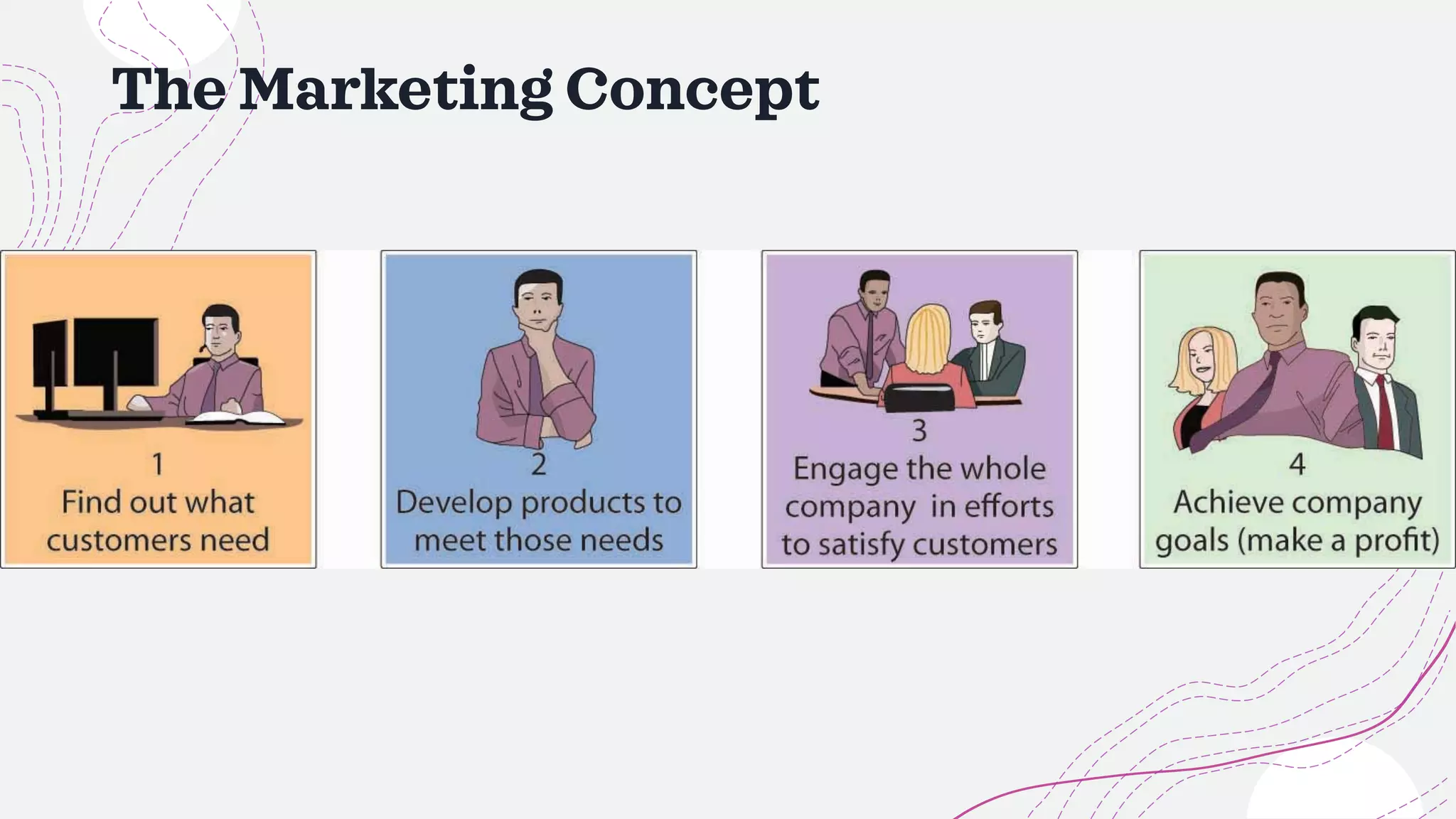
The Marketing Concept
Marketing
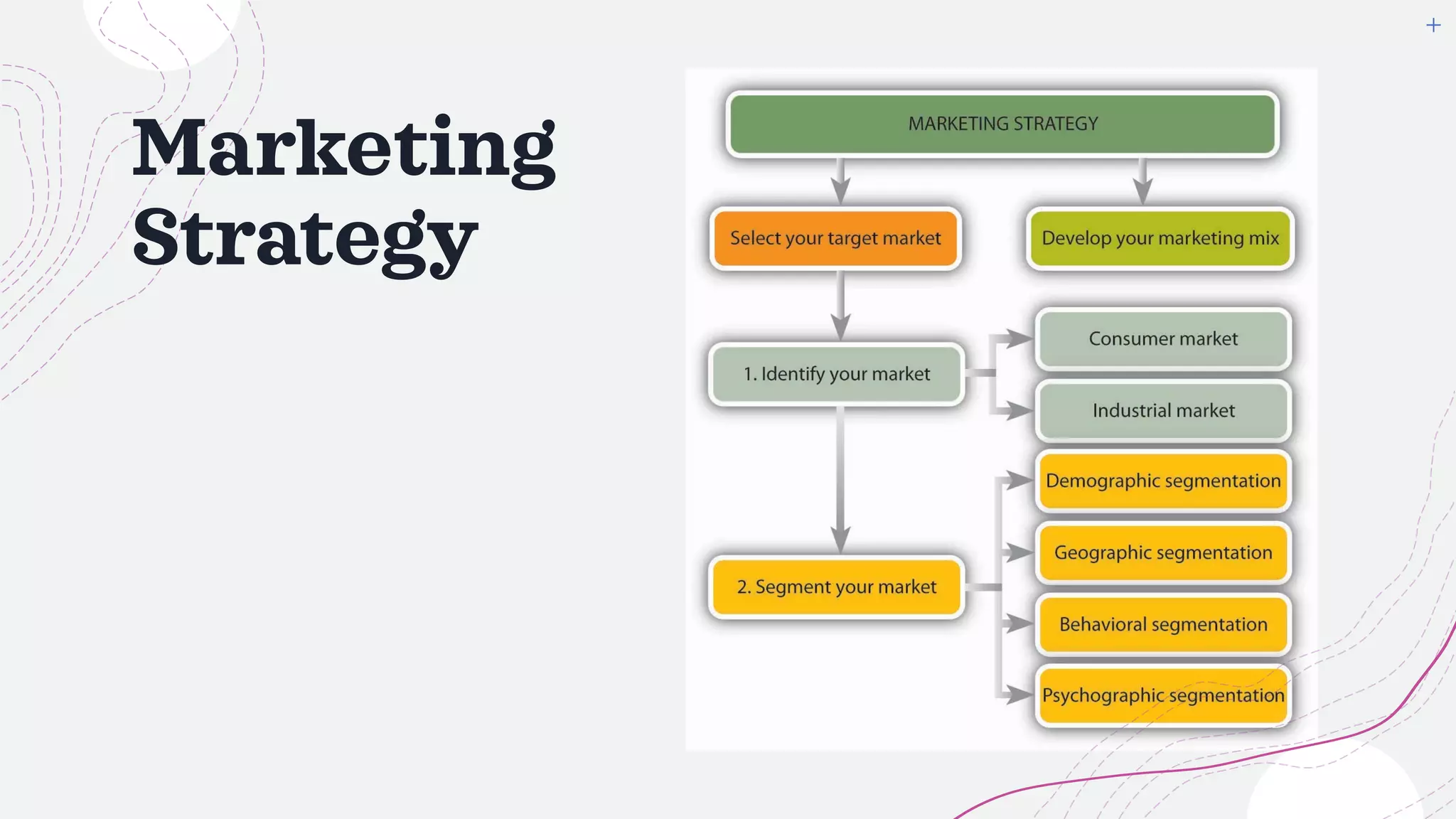
Strategy
Selecting a Target Market
+Identify a specific group of consumers who should be
particularly interested in your product, who would have access
to it, and who have the means to buy it.
+This group is your target market, and you’ll aim your marketing
efforts at its members.
Identifying Your Market
+How do marketers identify target markets?
+First, they usually identify the overall market for their product—the
individuals or organizations that need a product and are able to buy it.
+This market can include either or both of two groups:
+ A consumer market—buyers who want the product for personal use
+ An industrial market—buyers who want the product for use in making other
products
+You might focus on only one market or both.
+ A farmer, for example, might sell blueberries to individuals on the consumer
market and, on the industrial market, to bakeries that will use them to make
muffins and pies.
Segmenting
the Market
The next step in identifying a target
market is to divide the entire market into
smaller portions, or market segments—
groups of potential customers with
common characteristics that influence
their buying decisions.
You can use a number of characteristics
to narrow a market.
Demographic
Segmentation
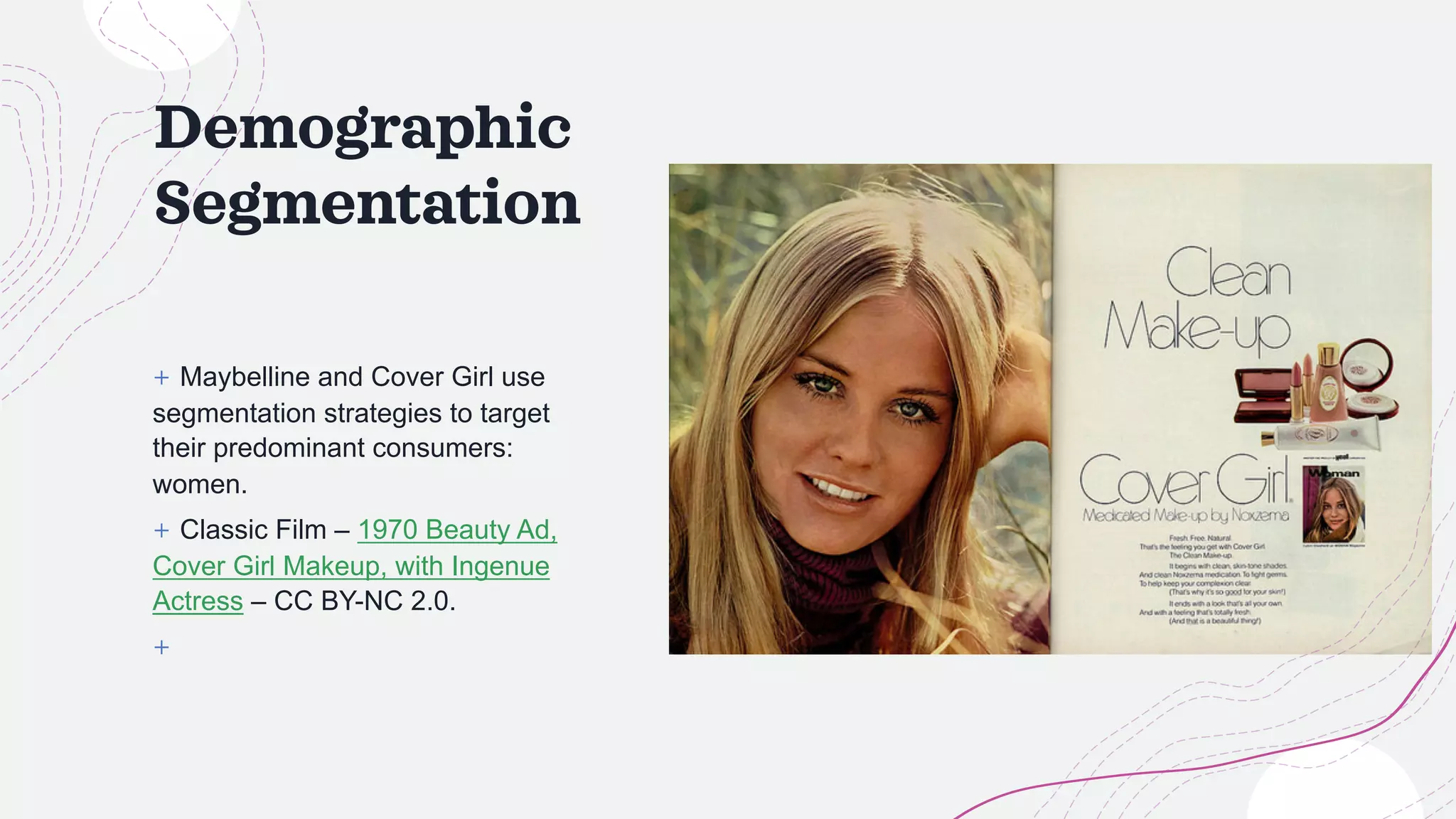
+ Maybelline and Cover Girl use
segmentation strategies to target
their predominant consumers:
women.
+ Classic Film – 1970 Beauty Ad,
Cover Girl Makeup, with Ingenue
Actress – CC BY-NC 2.0.
+
Geographic Segmentation
+ Geographic segmentation—dividing a market according
to such variables as climate, region, and population
density (urban, suburban, small-town, or rural)—is also
quite common.
+ Climate is crucial for many products: try selling snow
shovels in Hawaii or above-ground pools in Alaska.
+ Consumer tastes also vary by region. That’s why
McDonald’s caters to regional preferences, offering a
breakfast of Spam and rice in Hawaii, tacos in Arizona, and
lobster rolls in Massachusetts (Pacific Business News,
2002).
+ Outside the United States, menus diverge even more
widely (you can get seaweed burgers or, if you prefer,
seasoned seaweed fries in Japan) (Halfbakery, 2011;
Weird Asia News, 2011).
Behavioral Segmentation
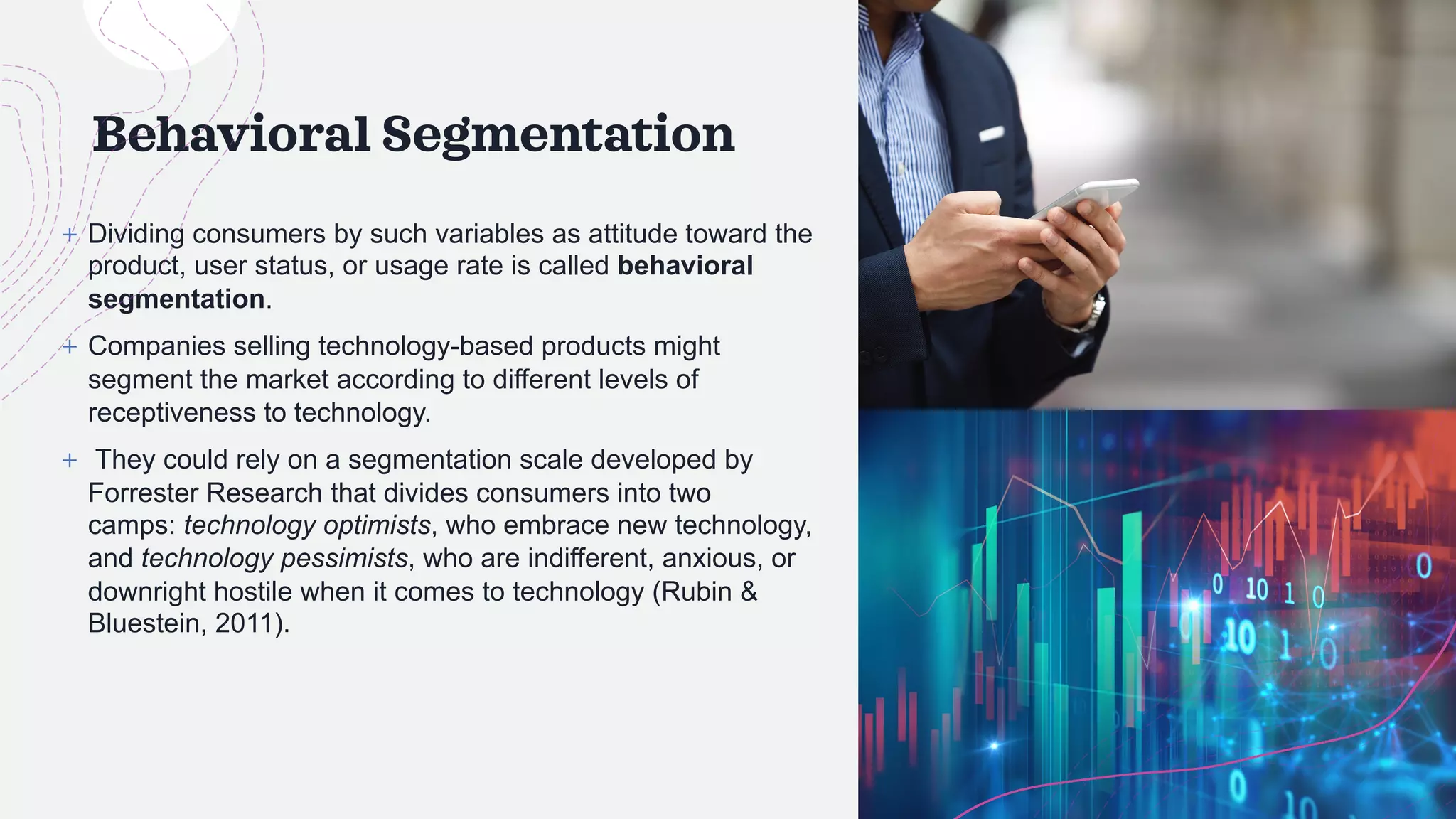
+ Dividing consumers by such variables as attitude toward the
product, user status, or usage rate is called behavioral
segmentation.
+ Companies selling technology-based products might
segment the market according to different levels of
receptiveness to technology.
+ They could rely on a segmentation scale developed by
Forrester Research that divides consumers into two
camps: technology optimists, who embrace new technology,
and technology pessimists, who are indifferent, anxious, or
downright hostile when it comes to technology (Rubin &
Bluestein, 2011).
Psychographic
Segmentation
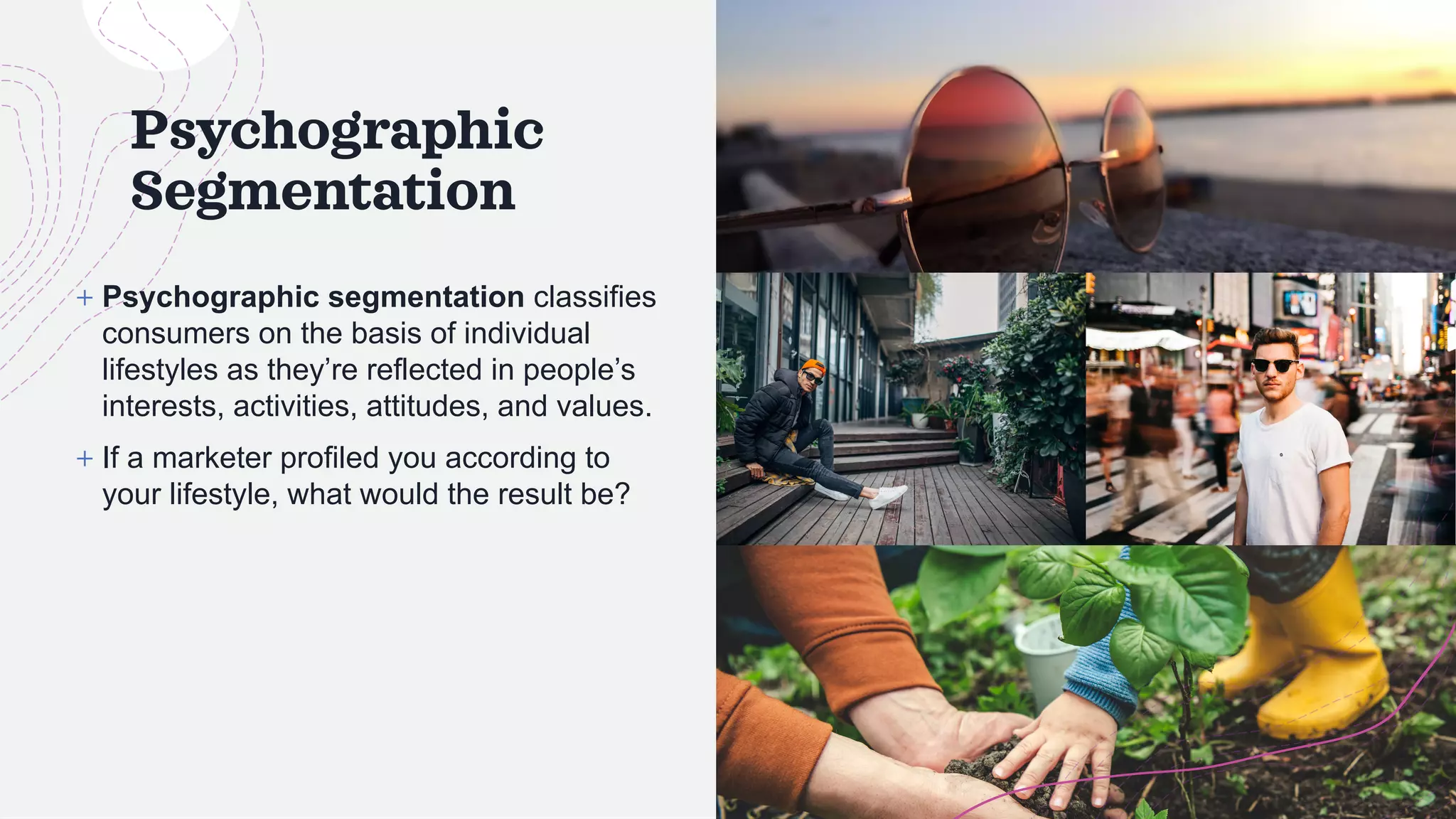
+ Psychographic segmentation classifies
consumers on the basis of individual
lifestyles as they’re reflected in people’s
interests, activities, attitudes, and values.
+ If a marketer profiled you according to
your lifestyle, what would the result be?
Clustering Segments
+Typically, marketers determine target markets by combining, or
“clustering,” segmenting criteria.
+What characteristics does Starbucks look for in marketing its
products?
+ Three demographic variables come to mind: age, geography, and income.
+ Buyers are likely to be males and females ranging in age from about twenty-
five to forty (although college students, aged eighteen to twenty-four, are
moving up in importance).
+ Geography is a factor as customers tend to live or work in cities or upscale
suburban areas. Those with relatively high incomes are willing to pay a
premium for Starbucks specialty coffee and so income—a socioeconomic
factor—is also important.
Exercise
+If you were developing a marketing campaign for the Harley-
Davidson Motorcycle Company, what group of consumers would you
target? What if you were marketing an iPod? What about time-
shares (vacation-ownership opportunities) in Bangkok, Thailand? For
each of these products, identify at least five segmentation
characteristics that you’d use in developing a profile of your
customers. Explain the segmentation category into which each
characteristic falls—demographic, geographic, behavioral, or
psychographic. Where it’s appropriate, be sure to include at least
one characteristic from each category.
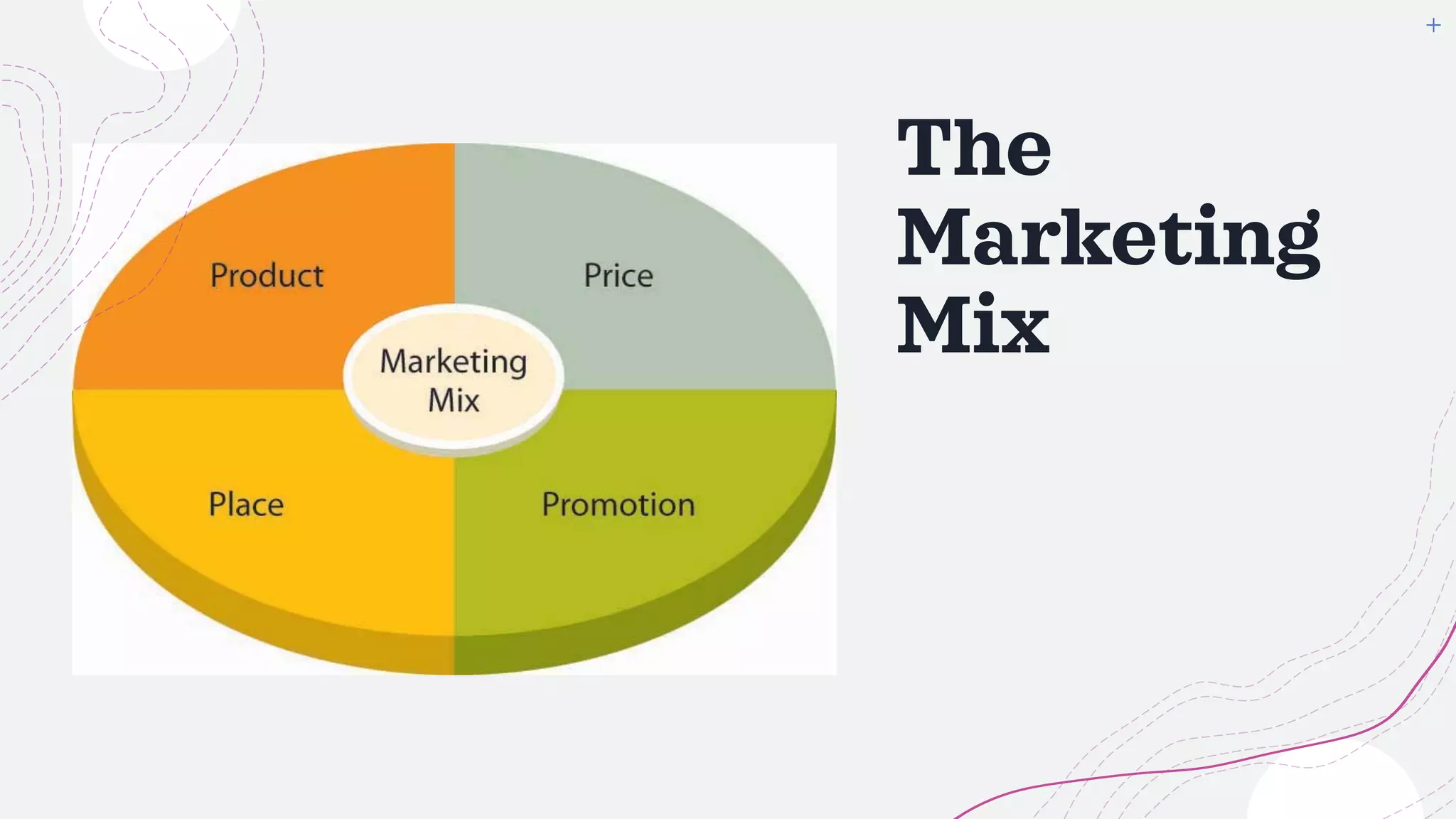
The
Marketing
Mix
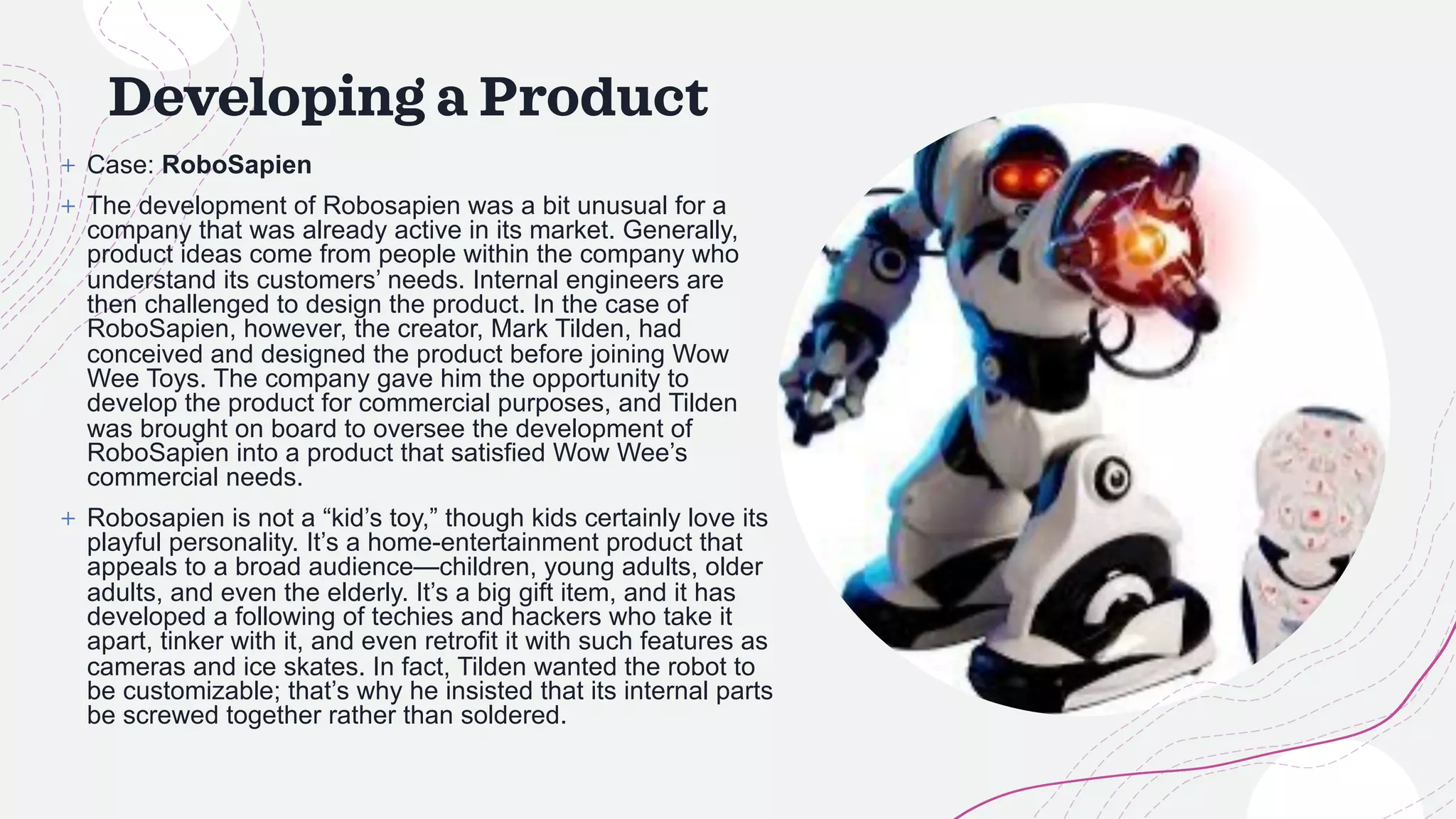
Developing a Product
+ Case: RoboSapien
+ The development of Robosapien was a bit unusual for a
company that was already active in its market. Generally,
product ideas come from people within the company who
understand its customers’ needs. Internal engineers are
then challenged to design the product. In the case of
RoboSapien, however, the creator, Mark Tilden, had
conceived and designed the product before joining Wow
Wee Toys. The company gave him the opportunity to
develop the product for commercial purposes, and Tilden
was brought on board to oversee the development of
RoboSapien into a product that satisfied Wow Wee’s
commercial needs.
+ Robosapien is not a “kid’s toy,” though kids certainly love its
playful personality. It’s a home-entertainment product that
appeals to a broad audience—children, young adults, older
adults, and even the elderly. It’s a big gift item, and it has
developed a following of techies and hackers who take it
apart, tinker with it, and even retrofit it with such features as
cameras and ice skates. In fact, Tilden wanted the robot to
be customizable; that’s why he insisted that its internal parts
be screwed together rather than soldered.
Conducting Marketing Research
+ Before settling on a strategy for RoboSapien, the marketers at Wow Wee did some
homework. First, to zero in on their target market, they had to find out what various people
thought of the product. More precisely, they needed answers to questions like the
following:
+ Who are our potential customers? What are they like?
+ Do people like RoboSapien? What gets them excited about it? What don’t they like? What
would they change?
+ How much are they willing to pay for RoboSapien?
+ Where will they probably go to buy the product?
+ How should it be promoted? How can we distinguish it from competing products?
+ Will enough people buy RoboSapien to return a reasonable profit?
+ Should we go ahead and launch the product?
This data had to be collected in a systematic
way. Market research seeks two types of data:
Marketers generally begin by
looking at secondary data—
information already collected,
whether by the company or
by others, that pertains to the
target market.
Then, with secondary data in
hand, they’re prepared to
collect primary data—newly
collected information that
addresses specific questions
(e.g. surveys, personal
interviews, focus groups).
Branding
+Branding Strategies
+Companies can adopt one of three major strategies for branding a
product:
1. With private branding, the maker sells a product to a retailer who
resells it under its own name.
2. Under generic branding, a no-brand product contains no identification
except for a description of the contents.
3. Using manufacture branding, a company sells products under its own
brand names.
Building Brand Equity
+When consumers have a favorable experience with a product, it
builds brand equity.
+If consumers are loyal to it over time, it enjoys brand loyalty.
Packaging and Labeling
+Packaging—the container holding the product—can influence
consumers’ decisions to buy products or not buy them. It offers
them a glimpse of the product and should be designed to attract
their attention.
+Labeling—the information on the packaging—identifies the
product. It provides information on the contents, the
manufacturer, the place where it was made, and any risks
associated with its use.
Placing a
Product
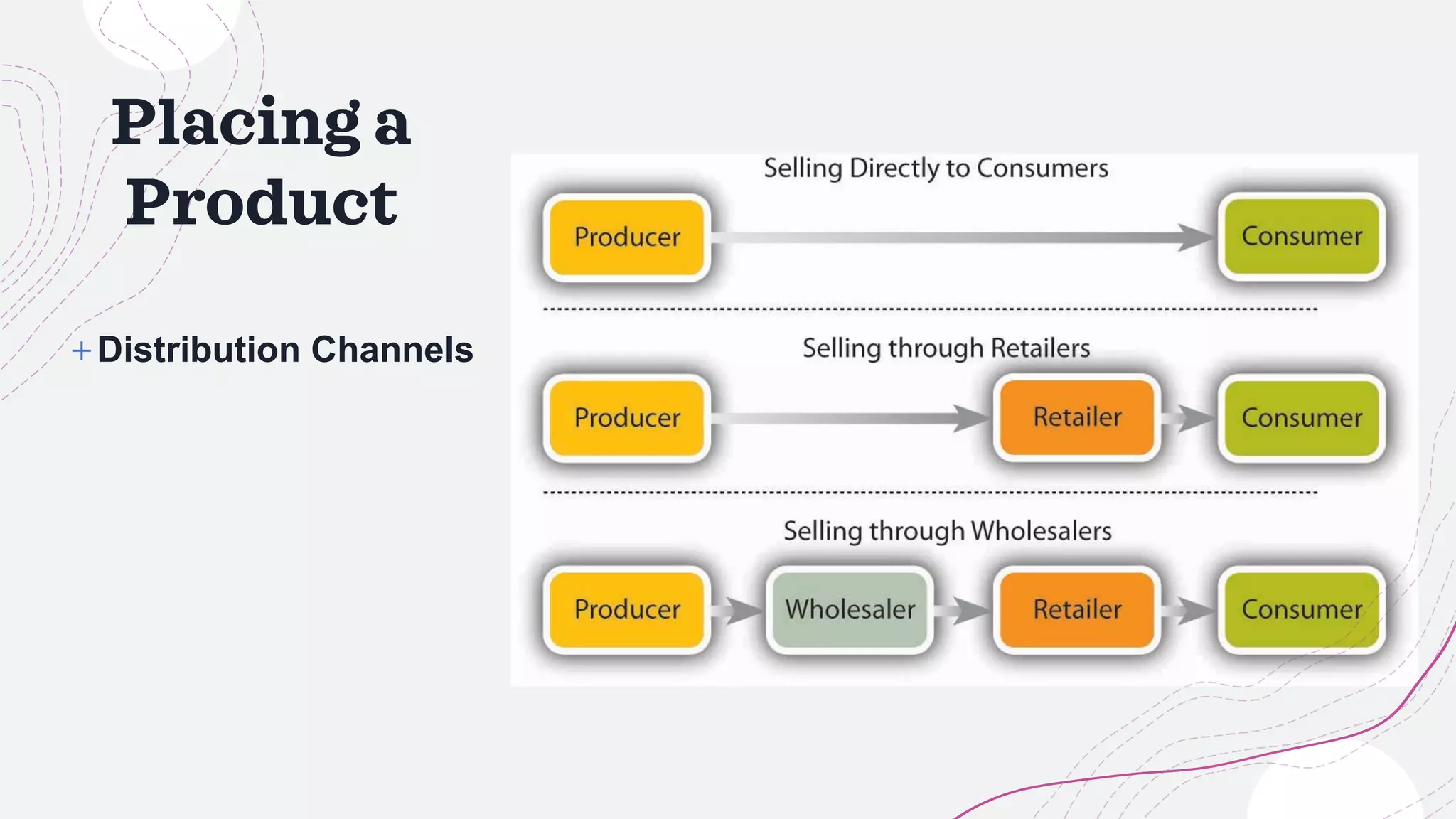
+Distribution Channels
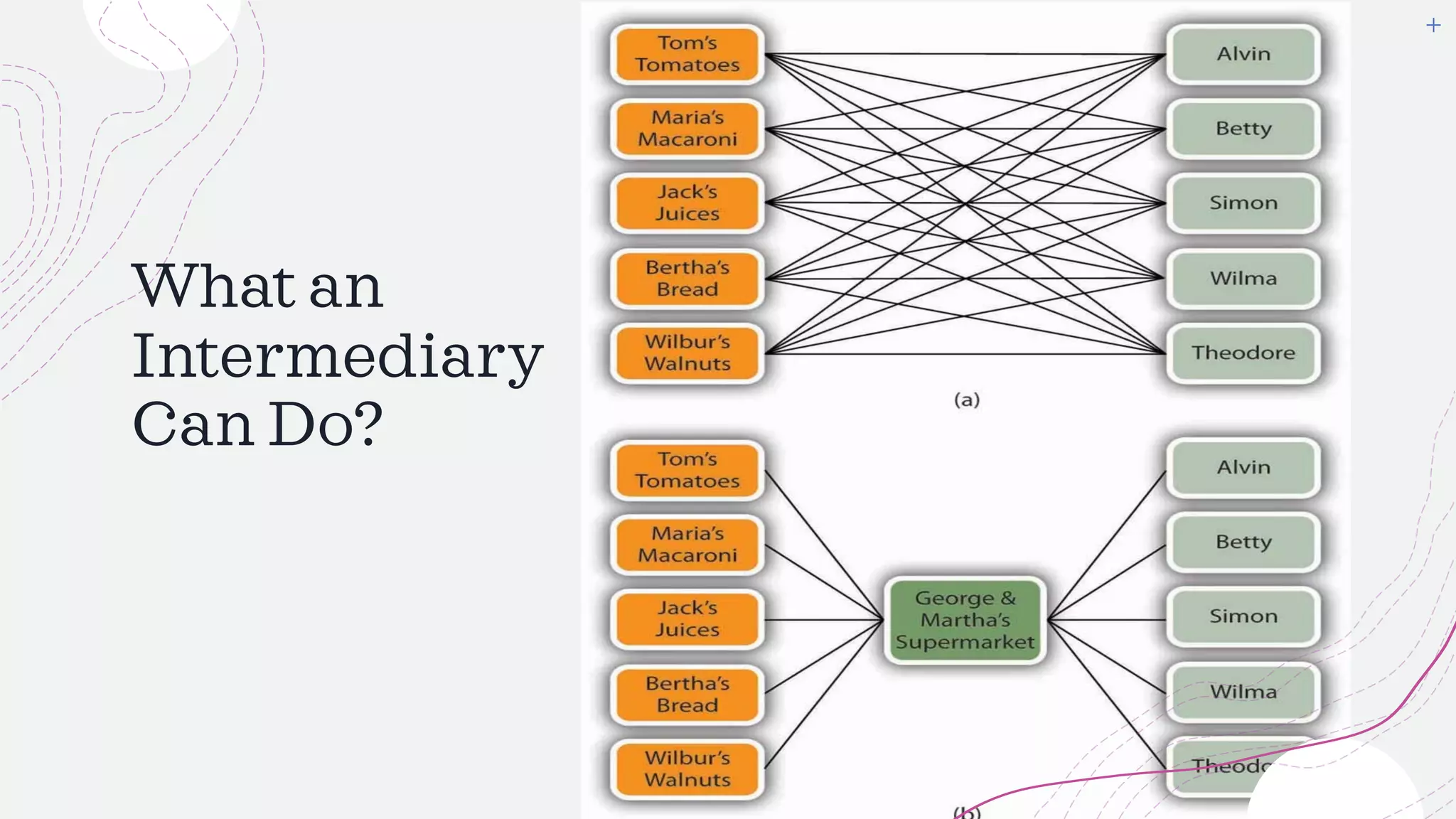
What an
Intermediary
Can Do?
Key Takeaways
+ Distribution entails all activities involved in getting the right quantity of a product to customers at the right time and at a
reasonable cost.
+ Companies can sell directly (from stores or over the Internet) or indirectly, through intermediaries—retailers or wholesalers
who help move products from producers to end users.
+ Retailers buy goods from producers and sell them to consumers, whether in stores, by phone, through direct mailings, or
over the Internet.
+ Wholesalers (or distributors) buy goods from suppliers and sell them to businesses that will resell or use them.
+ Physical distribution—the process of getting products from producers to customers—entails several interrelated
activities: warehousing in either a storage warehouse or a distribution center, materials handling (physically moving
products or components), and transportation (shipping goods from manufacturing facilities to resellers or customers).
+ A firm can produce better-quality products at lower cost and distribute them more effectively by successfully managing
its supply chain—the entire range of activities involved in producing and distributing products, from purchasing raw
materials, transforming raw materials into finished goods, storing finished goods, and distributing them to customers.
+ Effective supply chain management (SCM) requires cooperation, not only among individuals within the organization but
also among the company and its suppliers and dealers. In addition, a successful company provides customers with added
value by focusing on and improving its value chain—the entire range of its value-creating activities.
Promoting a Product
+The promotion mix—the ways in which marketers communicate
with customers—includes all the tools for telling people about a
product and persuading potential customers to buy it.
+Advertising is paid, nonpersonal communication designed to create
awareness of a product or company.
+Personal selling is one-on-one communication with existing and
potential customers.
+Sales promotions provide potential customers with direct incentives
to buy.
+Publicity involves getting the name of the company or its products
mentioned in print or broadcast media.
Interacting with Your Customers
+ Because customers are vital to a business, successful companies
practice customer-relationship management—retaining good customers by
keeping information on current customers, to foster and maintain strong ongoing
relationships.
+ Companies that ask customers if they can contact them are engaged
in permission marketing.
+ Mass marketing is the practice of sending out messages to a vast audience of
anonymous people.
+ TV advertising is a form of interruption marketing that interrupts people to get
their attention (with the hope they will listen to the ad).
+ Social media marketing is the practice of including social media as part of a
company’s marketing program.
Advantages of social media marketing
include the following:
+ Create brand awareness
+ Engage customers and potential customers in two-way conversations
+ Build brand loyalty
+ Offer and publicize incentives
+ Gather feedback on products and marketing initiatives
+ Have customers spread the word about products and marketing initiatives
+ Use low-cost marketing opportunities
+ A challenge of social media marketing is that it can be very time consuming to
stay in touch with your customers and potential customers.
+
Exercise
Samuel Axon, “Top 10 Funniest Old Spice Guy Videos,” Mashable
Business, http://mashable.com/2010/07/18/old-spice-guy-
videos/ (accessed October 27, 2011).]
1. Describe the campaign and identify the goal of the campaign.
2. How was this campaign different from anything done in the past?
3. Did you like the videos? Why or why not?
4. Would you buy Old Spice products? Why or why not?

Week 9 Marketing.pdf

  • 1.
  • 2.
    What Is Marketing? +“Marketingis the activity, set of institutions, and processes for creating, communicating, delivering, and exchanging offerings that have value for customers, clients, partners, and society at large” (American Marketing Association, 2011). +In other words, marketing isn’t just advertising and selling. It includes everything that organizations do to satisfy customer needs: + Coming up with a product and defining its features and benefits + Setting its price + Identifying its target market + Making potential customers aware of it + Getting people to buy it + Delivering it to people who buy it + Managing relationships with customers after it has been delivered
  • 3.
  • 4.
  • 5.
    Selecting a TargetMarket +Identify a specific group of consumers who should be particularly interested in your product, who would have access to it, and who have the means to buy it. +This group is your target market, and you’ll aim your marketing efforts at its members.
  • 6.
    Identifying Your Market +Howdo marketers identify target markets? +First, they usually identify the overall market for their product—the individuals or organizations that need a product and are able to buy it. +This market can include either or both of two groups: + A consumer market—buyers who want the product for personal use + An industrial market—buyers who want the product for use in making other products +You might focus on only one market or both. + A farmer, for example, might sell blueberries to individuals on the consumer market and, on the industrial market, to bakeries that will use them to make muffins and pies.
  • 7.
    Segmenting the Market The nextstep in identifying a target market is to divide the entire market into smaller portions, or market segments— groups of potential customers with common characteristics that influence their buying decisions. You can use a number of characteristics to narrow a market.
  • 8.
    Demographic Segmentation + Maybelline andCover Girl use segmentation strategies to target their predominant consumers: women. + Classic Film – 1970 Beauty Ad, Cover Girl Makeup, with Ingenue Actress – CC BY-NC 2.0. +
  • 9.
    Geographic Segmentation + Geographicsegmentation—dividing a market according to such variables as climate, region, and population density (urban, suburban, small-town, or rural)—is also quite common. + Climate is crucial for many products: try selling snow shovels in Hawaii or above-ground pools in Alaska. + Consumer tastes also vary by region. That’s why McDonald’s caters to regional preferences, offering a breakfast of Spam and rice in Hawaii, tacos in Arizona, and lobster rolls in Massachusetts (Pacific Business News, 2002). + Outside the United States, menus diverge even more widely (you can get seaweed burgers or, if you prefer, seasoned seaweed fries in Japan) (Halfbakery, 2011; Weird Asia News, 2011).
  • 10.
    Behavioral Segmentation + Dividingconsumers by such variables as attitude toward the product, user status, or usage rate is called behavioral segmentation. + Companies selling technology-based products might segment the market according to different levels of receptiveness to technology. + They could rely on a segmentation scale developed by Forrester Research that divides consumers into two camps: technology optimists, who embrace new technology, and technology pessimists, who are indifferent, anxious, or downright hostile when it comes to technology (Rubin & Bluestein, 2011).
  • 11.
    Psychographic Segmentation + Psychographic segmentationclassifies consumers on the basis of individual lifestyles as they’re reflected in people’s interests, activities, attitudes, and values. + If a marketer profiled you according to your lifestyle, what would the result be?
  • 12.
    Clustering Segments +Typically, marketersdetermine target markets by combining, or “clustering,” segmenting criteria. +What characteristics does Starbucks look for in marketing its products? + Three demographic variables come to mind: age, geography, and income. + Buyers are likely to be males and females ranging in age from about twenty- five to forty (although college students, aged eighteen to twenty-four, are moving up in importance). + Geography is a factor as customers tend to live or work in cities or upscale suburban areas. Those with relatively high incomes are willing to pay a premium for Starbucks specialty coffee and so income—a socioeconomic factor—is also important.
  • 13.
    Exercise +If you weredeveloping a marketing campaign for the Harley- Davidson Motorcycle Company, what group of consumers would you target? What if you were marketing an iPod? What about time- shares (vacation-ownership opportunities) in Bangkok, Thailand? For each of these products, identify at least five segmentation characteristics that you’d use in developing a profile of your customers. Explain the segmentation category into which each characteristic falls—demographic, geographic, behavioral, or psychographic. Where it’s appropriate, be sure to include at least one characteristic from each category.
  • 14.
  • 15.
    Developing a Product +Case: RoboSapien + The development of Robosapien was a bit unusual for a company that was already active in its market. Generally, product ideas come from people within the company who understand its customers’ needs. Internal engineers are then challenged to design the product. In the case of RoboSapien, however, the creator, Mark Tilden, had conceived and designed the product before joining Wow Wee Toys. The company gave him the opportunity to develop the product for commercial purposes, and Tilden was brought on board to oversee the development of RoboSapien into a product that satisfied Wow Wee’s commercial needs. + Robosapien is not a “kid’s toy,” though kids certainly love its playful personality. It’s a home-entertainment product that appeals to a broad audience—children, young adults, older adults, and even the elderly. It’s a big gift item, and it has developed a following of techies and hackers who take it apart, tinker with it, and even retrofit it with such features as cameras and ice skates. In fact, Tilden wanted the robot to be customizable; that’s why he insisted that its internal parts be screwed together rather than soldered.
  • 16.
    Conducting Marketing Research +Before settling on a strategy for RoboSapien, the marketers at Wow Wee did some homework. First, to zero in on their target market, they had to find out what various people thought of the product. More precisely, they needed answers to questions like the following: + Who are our potential customers? What are they like? + Do people like RoboSapien? What gets them excited about it? What don’t they like? What would they change? + How much are they willing to pay for RoboSapien? + Where will they probably go to buy the product? + How should it be promoted? How can we distinguish it from competing products? + Will enough people buy RoboSapien to return a reasonable profit? + Should we go ahead and launch the product?
  • 17.
    This data hadto be collected in a systematic way. Market research seeks two types of data: Marketers generally begin by looking at secondary data— information already collected, whether by the company or by others, that pertains to the target market. Then, with secondary data in hand, they’re prepared to collect primary data—newly collected information that addresses specific questions (e.g. surveys, personal interviews, focus groups).
  • 18.
    Branding +Branding Strategies +Companies canadopt one of three major strategies for branding a product: 1. With private branding, the maker sells a product to a retailer who resells it under its own name. 2. Under generic branding, a no-brand product contains no identification except for a description of the contents. 3. Using manufacture branding, a company sells products under its own brand names.
  • 19.
    Building Brand Equity +Whenconsumers have a favorable experience with a product, it builds brand equity. +If consumers are loyal to it over time, it enjoys brand loyalty.
  • 20.
    Packaging and Labeling +Packaging—thecontainer holding the product—can influence consumers’ decisions to buy products or not buy them. It offers them a glimpse of the product and should be designed to attract their attention. +Labeling—the information on the packaging—identifies the product. It provides information on the contents, the manufacturer, the place where it was made, and any risks associated with its use.
  • 21.
  • 22.
  • 23.
    Key Takeaways + Distributionentails all activities involved in getting the right quantity of a product to customers at the right time and at a reasonable cost. + Companies can sell directly (from stores or over the Internet) or indirectly, through intermediaries—retailers or wholesalers who help move products from producers to end users. + Retailers buy goods from producers and sell them to consumers, whether in stores, by phone, through direct mailings, or over the Internet. + Wholesalers (or distributors) buy goods from suppliers and sell them to businesses that will resell or use them. + Physical distribution—the process of getting products from producers to customers—entails several interrelated activities: warehousing in either a storage warehouse or a distribution center, materials handling (physically moving products or components), and transportation (shipping goods from manufacturing facilities to resellers or customers). + A firm can produce better-quality products at lower cost and distribute them more effectively by successfully managing its supply chain—the entire range of activities involved in producing and distributing products, from purchasing raw materials, transforming raw materials into finished goods, storing finished goods, and distributing them to customers. + Effective supply chain management (SCM) requires cooperation, not only among individuals within the organization but also among the company and its suppliers and dealers. In addition, a successful company provides customers with added value by focusing on and improving its value chain—the entire range of its value-creating activities.
  • 24.
    Promoting a Product +Thepromotion mix—the ways in which marketers communicate with customers—includes all the tools for telling people about a product and persuading potential customers to buy it. +Advertising is paid, nonpersonal communication designed to create awareness of a product or company. +Personal selling is one-on-one communication with existing and potential customers. +Sales promotions provide potential customers with direct incentives to buy. +Publicity involves getting the name of the company or its products mentioned in print or broadcast media.
  • 25.
    Interacting with YourCustomers + Because customers are vital to a business, successful companies practice customer-relationship management—retaining good customers by keeping information on current customers, to foster and maintain strong ongoing relationships. + Companies that ask customers if they can contact them are engaged in permission marketing. + Mass marketing is the practice of sending out messages to a vast audience of anonymous people. + TV advertising is a form of interruption marketing that interrupts people to get their attention (with the hope they will listen to the ad). + Social media marketing is the practice of including social media as part of a company’s marketing program.
  • 26.
    Advantages of socialmedia marketing include the following: + Create brand awareness + Engage customers and potential customers in two-way conversations + Build brand loyalty + Offer and publicize incentives + Gather feedback on products and marketing initiatives + Have customers spread the word about products and marketing initiatives + Use low-cost marketing opportunities + A challenge of social media marketing is that it can be very time consuming to stay in touch with your customers and potential customers. +
  • 27.
    Exercise Samuel Axon, “Top10 Funniest Old Spice Guy Videos,” Mashable Business, http://mashable.com/2010/07/18/old-spice-guy- videos/ (accessed October 27, 2011).] 1. Describe the campaign and identify the goal of the campaign. 2. How was this campaign different from anything done in the past? 3. Did you like the videos? Why or why not? 4. Would you buy Old Spice products? Why or why not?