
Secondary
Research
Writing
RUSSELL RODRIGO
Learning Outcomes
1. Identify components of a research model
using a model research paper
2. Identify the types of focus in research
writing
3. Formulate research questions and thesis
statement
Research Writing
90% preparation
• Analyzing question
• Tracking down information
• Organizing the information
• Planning your essay
10% writing
• Communicating your ideas
clearly and effectively
• Follow the lecturers instructions
• Use lecturers comments from
previous assignments
• Stick to the topic
• Be an expert on your topic
(Read! Read! Read!)
• Stay within the word limit
• Follow the referencing
guidelines
• Hand in on time
General rules
Fry’s (2011) Academic Writing
The Writing Process
 Break down task into manageable steps
 Complete a schedule or plan of your time
 Analyze the question or
 Choose your topic
• May be given a general topic
• Brainstorm several ideas
• Carry out some initial research
• Choose a topic with enough but not too much information
Fry’s (2011) Academic Writing System
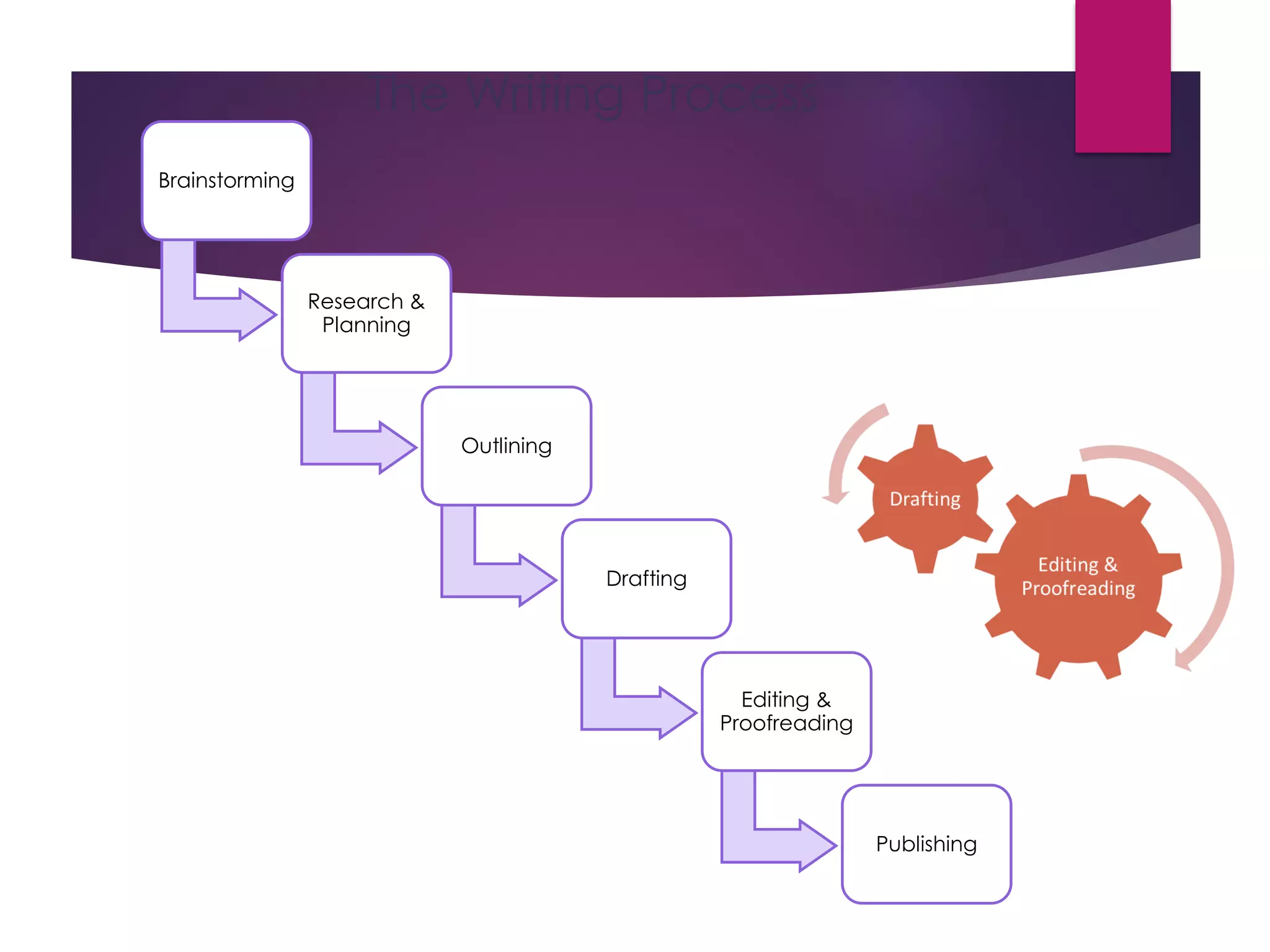
The Writing Process
Brainstorming
Research &
Planning
Outlining
Drafting
Editing &
Proofreading
Publishing
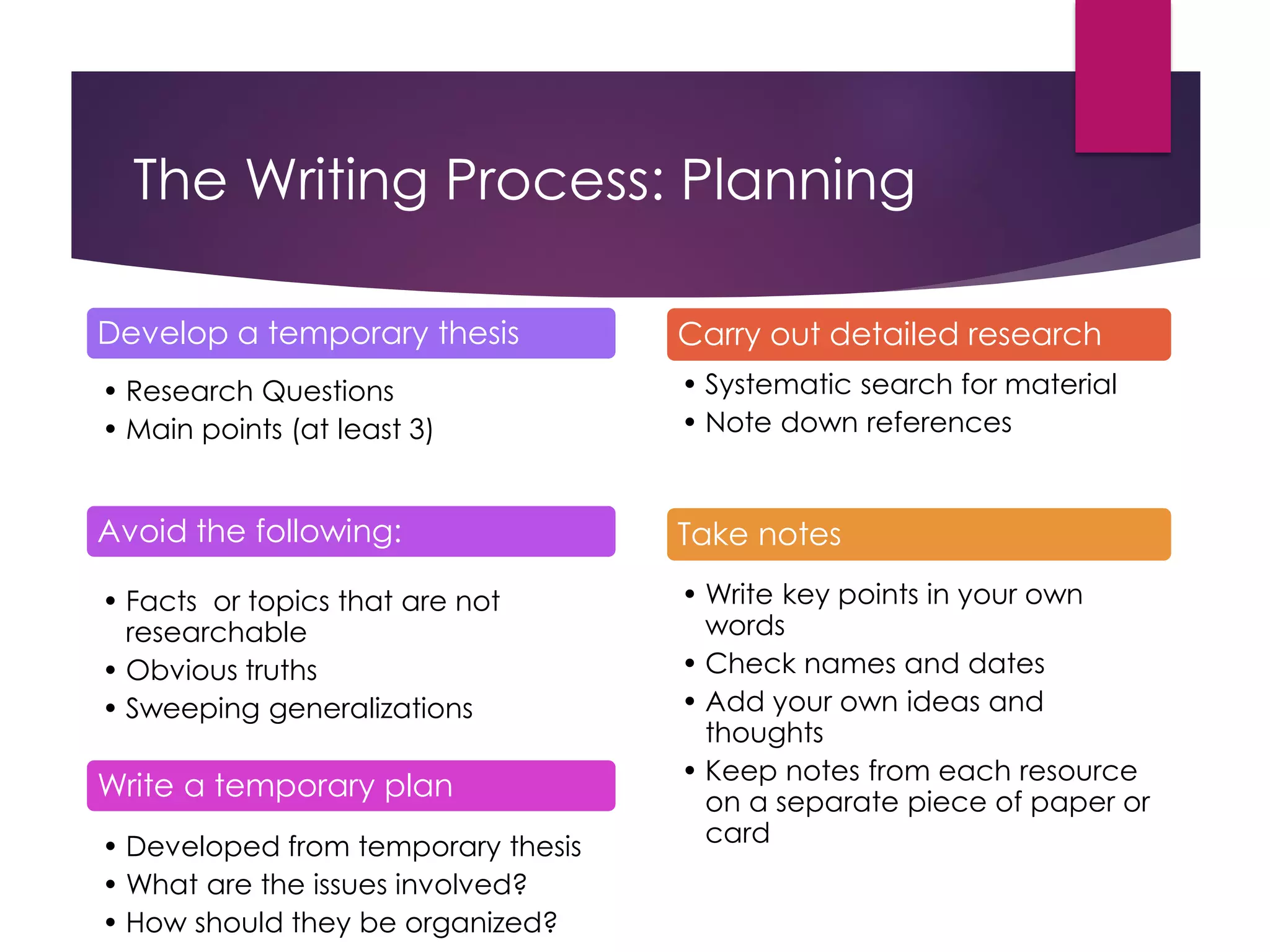
The Writing Process: Planning
Develop a temporary thesis
• Research Questions
• Main points (at least 3)
Avoid the following:
• Facts or topics that are not
researchable
• Obvious truths
• Sweeping generalizations
Write a temporary plan
• Developed from temporary thesis
• What are the issues involved?
• How should they be organized?
Carry out detailed research
• Systematic search for material
• Note down references
Take notes
• Write key points in your own
words
• Check names and dates
• Add your own ideas and
thoughts
• Keep notes from each resource
on a separate piece of paper or
card
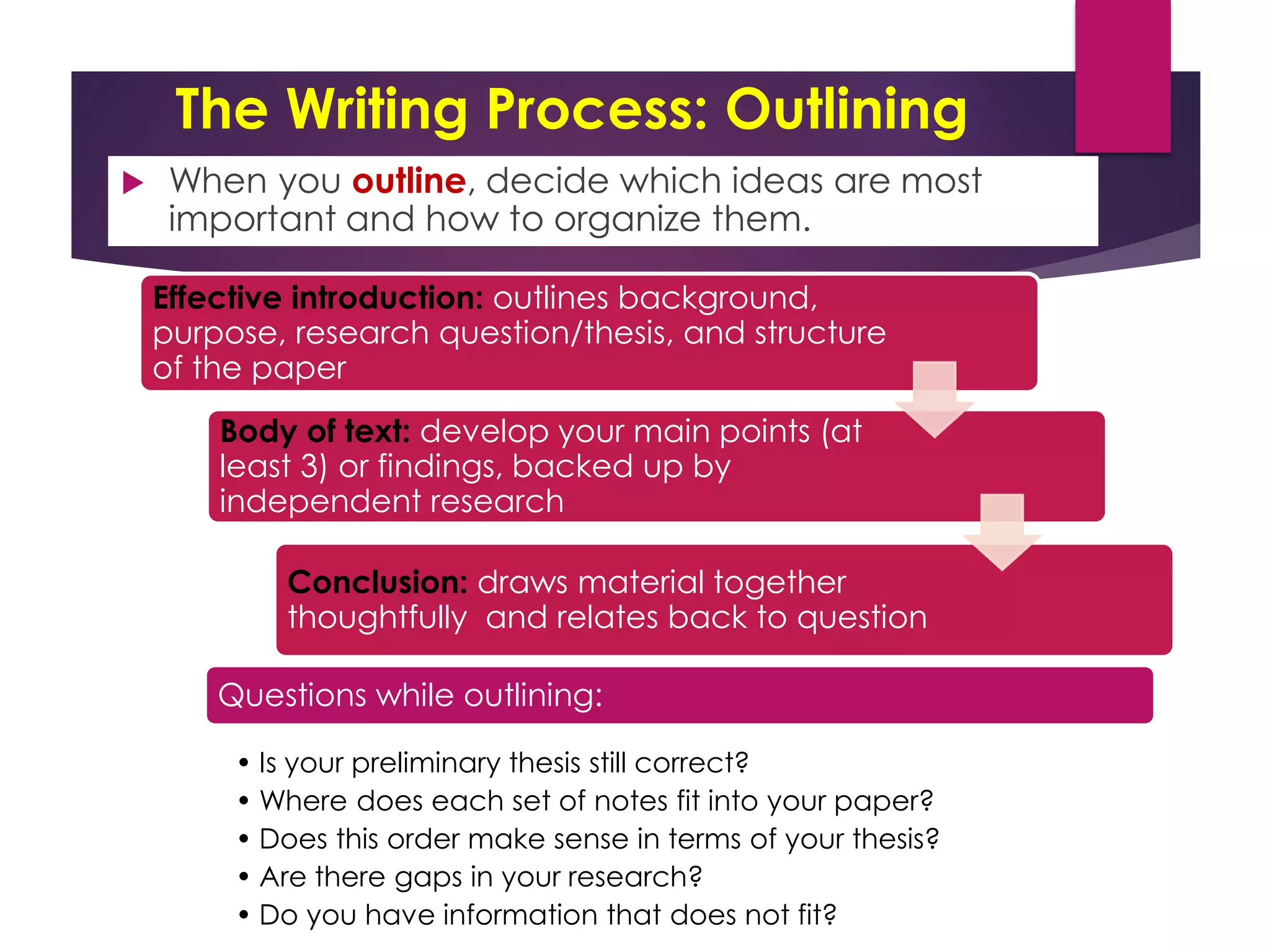
The Writing Process: Outlining
 When you outline, decide which ideas are most
important and how to organize them.
Effective introduction: outlines background,
purpose, research question/thesis, and structure
of the paper
Body of text: develop your main points (at
least 3) or findings, backed up by
independent research
Conclusion: draws material together
thoughtfully and relates back to question
Questions while outlining:
• Is your preliminary thesis still correct?
• Where does each set of notes fit into your paper?
• Does this order make sense in terms of your thesis?
• Are there gaps in your research?
• Do you have information that does not fit?
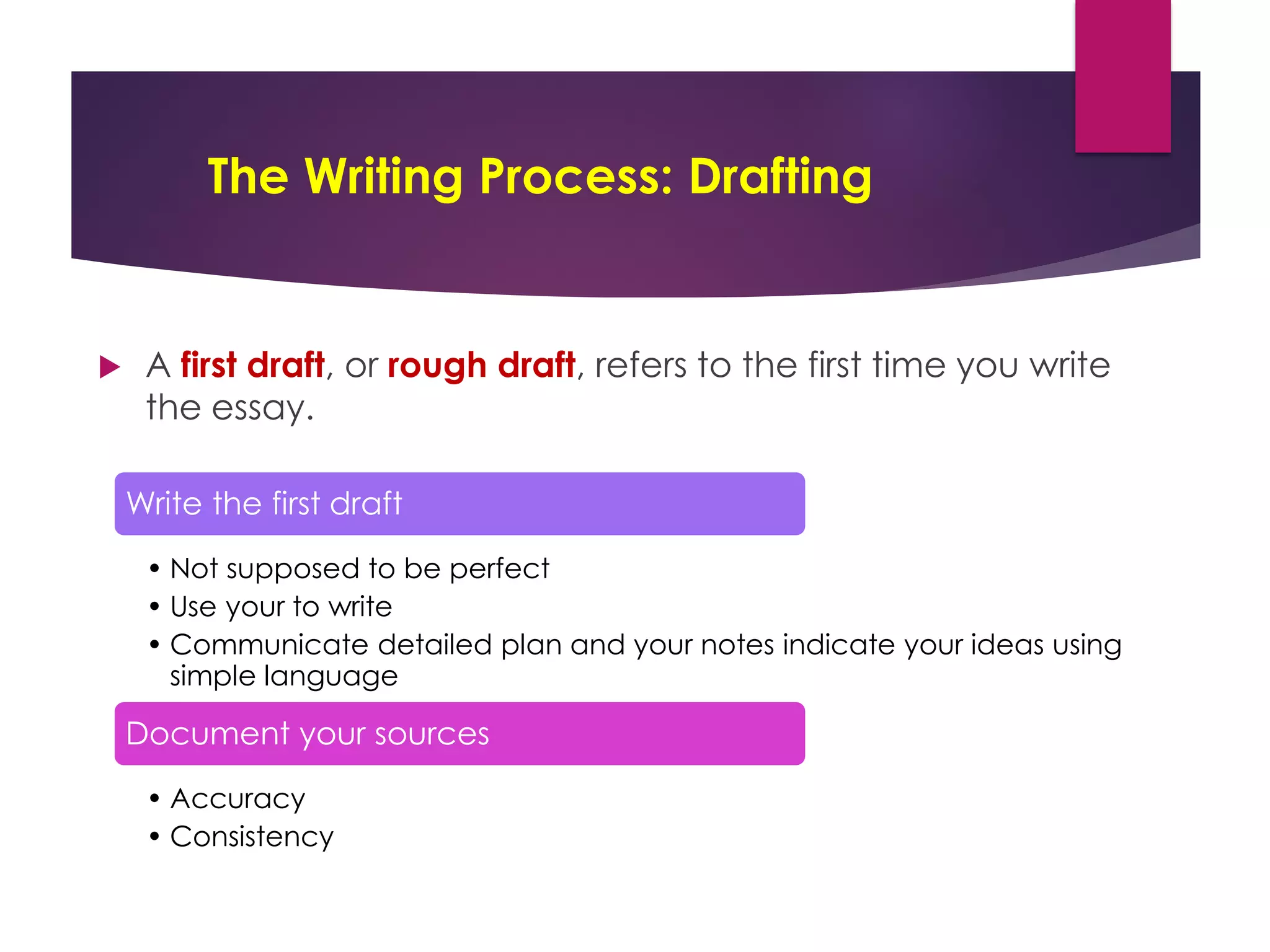
The Writing Process: Drafting
 A first draft, or rough draft, refers to the first time you write
the essay.
Write the first draft
• Not supposed to be perfect
• Use your to write
• Communicate detailed plan and your notes indicate your ideas using
simple language
Document your sources
• Accuracy
• Consistency
The Writing Process: Editing &
Proofreading
Edit your rough draft, and each subsequent draft, for the following:
• Clear introduction of the topic, main idea and/or thesis.
• Strong supporting details.
• Strong concluding statement(s).
Editing Checklist
• Edit for meaning
• Improve logical organization
• Clarify confusing sections
• Is the introduction clear and does it make reference to the question?
• Have you written in your own words?
• Are there linking statements?
• Does the conclusion effectively close your argument?
Editing your drafts also requires you to proofread, which means to check for
mistakes in the following areas:
• spelling punctuation spacing/formatting
• vocabulary grammar
The Writing Process: Publishing
(Final Draft)
 When you are finished editing and proofreading your
drafts, you are reading to submit your final draft.
The final draft is submitted for marking, so it must be…
• correctly formatted.
• as free as possible of mistakes.
• your best possible work.
Final Draft Checklist
• Check facts
• Prepare your reference list
• Check spelling, grammar and proofread
• Get someone else to read it
• Proofread again
• Hand in on time
Introduction to basic research
When you begin to research a topic, there are two
possibilities that may be dealt with:
• You know nothing whatsoever about the topic.
• You know something about the topic, but you would
like to know more.
It is very important to choose a topic that interests you! If
you enjoy learning about and researching your topic, the
task of writing your essay will become that much easier.
Choose a Question that is Neither Too
Broad nor Too Narrow
For example, if you choose juvenile delinquency (a
topic that can be researched), you might ask the
following questions:
a. What is the 1994 rate of juvenile delinquency in the
U.S.?
b. What can we do to reduce juvenile delinquency in
the U.S.?
c. Does education play a role in reducing juvenile
delinquents' return to crime?
Types of Focus
1. Causes
2. Effects
3. Definition (e.g. What are signs of alcohol addiction?)
4. Process (e.g. How does an individual become addicted
to alcohol?)
5. Comparison (E.g. How are attitudes towards drinking
alcohol similar or different in Japan and United States?
6. Problem and Solution
7. Argument (Yes/No format e.g. Should the legal age
for drinking be lowered from 21 to 18?)
Sample Research Questions
Identify the focuses of the following:
1. In what ways can understanding the
causes of alcohol addiction help a
person stop drinking?
2. How does the value of individualism
influence people’s expectations of
marriage?
3. How does early homeschooling affect
students’ later academic performance?
Introduction to basic research
 Any research project begins with basic questions that you aim to
answer with the information you find from sources.
Topic: Fast food restaurants are a growing problem
•Who is eating at fast food restaurants?
•What are restaurants doing about the quality of their food?
•What should people and/or governments do about this problem?
•When did fast food start to become popular?
•Why is fast food popular even though it is unhealthy?
•Where does the responsibility for this problem lie: fast food
companies, consumers, government?
•How can this issue be resolved?
Research
Questions
Brainstorm one of the topics below and write down the related research
questions.
• Parents choosing their child’s career
• Traditional vs. modern gender roles
• Appropriate age to begin dating
Thesis Statements
Purpose of a Thesis Statement
•The thesis statement summarizes the main point of the paper. It
is normally a single sentence found at the end of the paper's
introductory paragraph. It acts as a guide to let your audience
know the central idea of the paper and to know what to
expect in the body of your paper.
Analytical Thesis Statement
•An analytical paper analyzes an issue. An analytical thesis
statement states the subject to be analyzed and shows how it
will be broken down.
•Example: The aim of this paper is to investigate the impacts of
technology on learning in the aspects students’ academic
performance and motivation
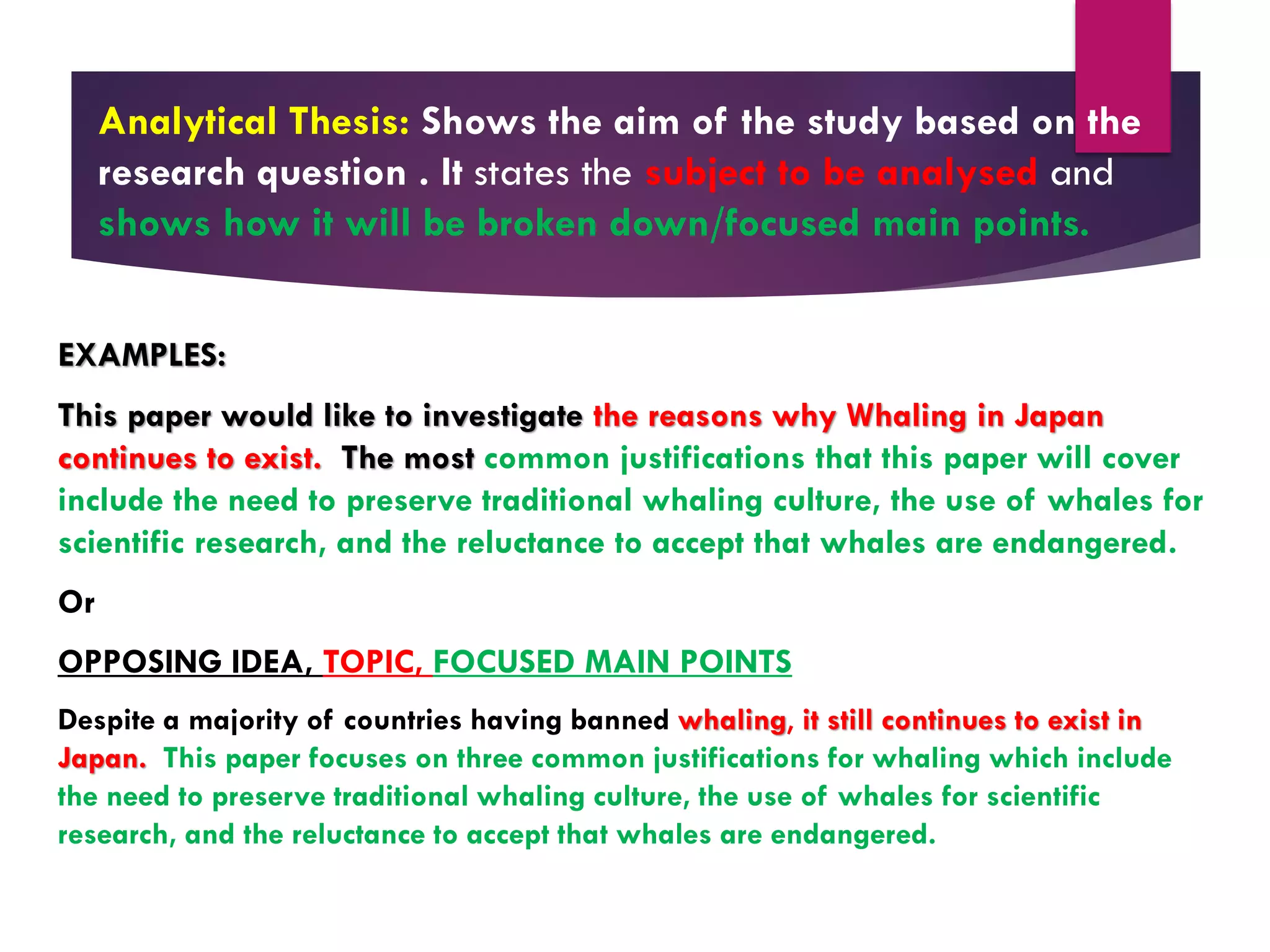
Analytical Thesis: Shows the aim of the study based on the
research question . It states the subject to be analysed and
shows how it will be broken down/focused main points.
EXAMPLES:
This paper would like to investigate the reasons why Whaling in Japan
continues to exist. The most common justifications that this paper will cover
include the need to preserve traditional whaling culture, the use of whales for
scientific research, and the reluctance to accept that whales are endangered.
Or
OPPOSING IDEA, TOPIC, FOCUSED MAIN POINTS
Despite a majority of countries having banned whaling, it still continues to exist in
Japan. This paper focuses on three common justifications for whaling which include
the need to preserve traditional whaling culture, the use of whales for scientific
research, and the reluctance to accept that whales are endangered.
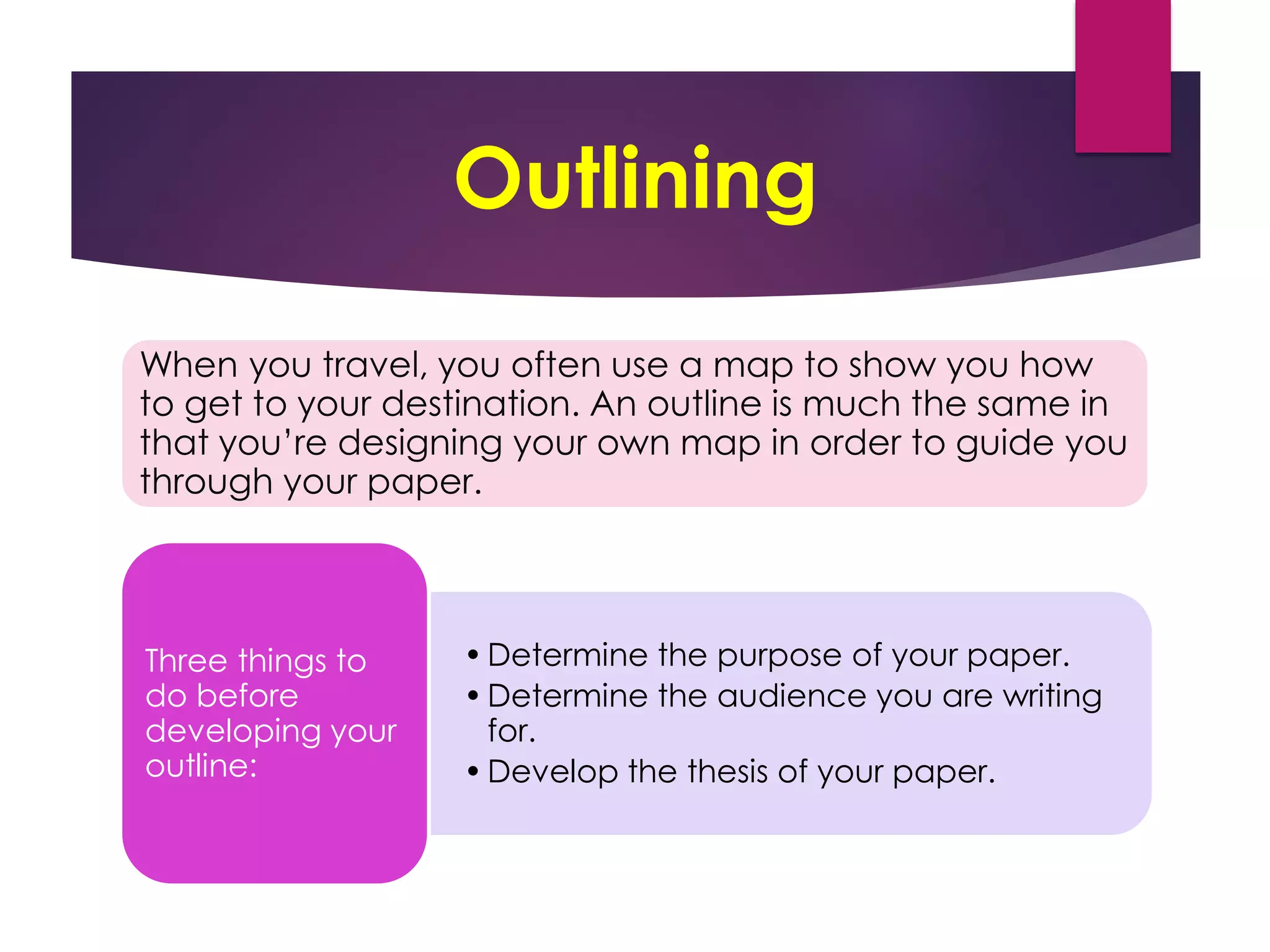
Outlining
When you travel, you often use a map to show you how
to get to your destination. An outline is much the same in
that you’re designing your own map in order to guide you
through your paper.
•Determine the purpose of your paper.
•Determine the audience you are writing
for.
•Develop the thesis of your paper.
Three things to
do before
developing your
outline:
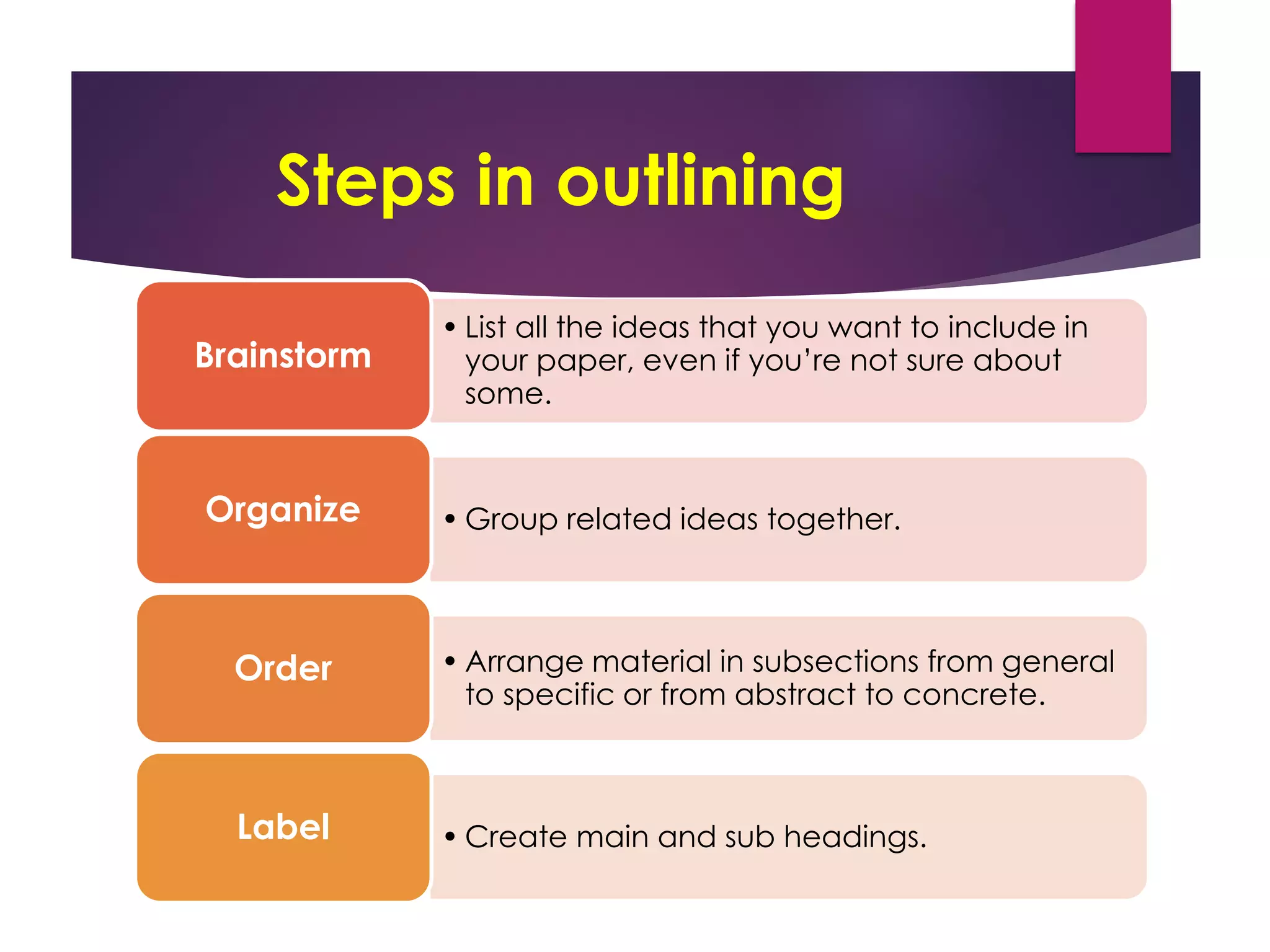
Steps in outlining
• List all the ideas that you want to include in
your paper, even if you’re not sure about
some.
Brainstorm
• Group related ideas together.Organize
• Arrange material in subsections from general
to specific or from abstract to concrete.
Order
• Create main and sub headings.Label
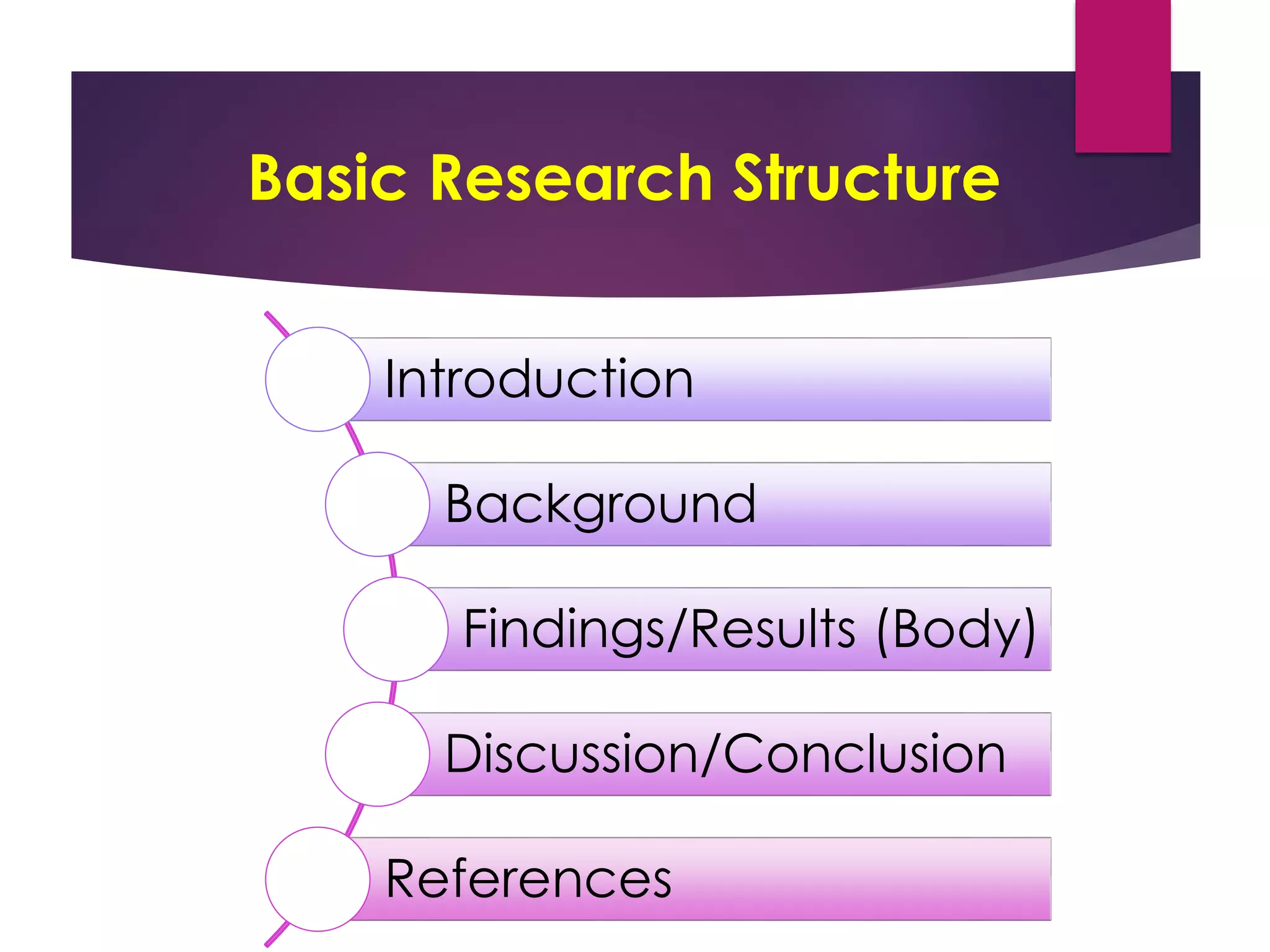
Basic Research Structure
Introduction
Background
Findings/Results (Body)
Discussion/Conclusion
References
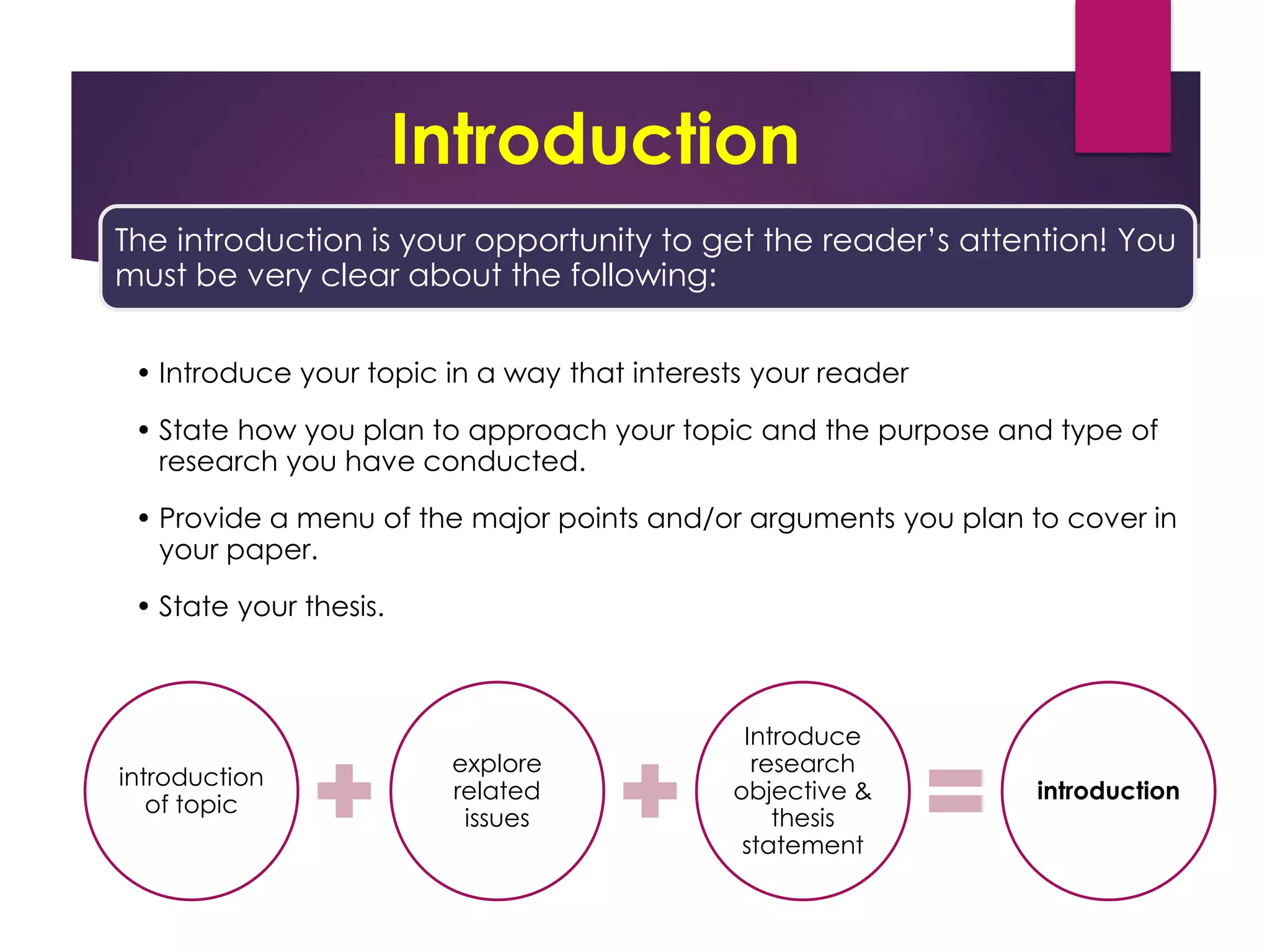
Introduction
The introduction is your opportunity to get the reader’s attention! You
must be very clear about the following:
• Introduce your topic in a way that interests your reader
• State how you plan to approach your topic and the purpose and type of
research you have conducted.
• Provide a menu of the major points and/or arguments you plan to cover in
your paper.
• State your thesis.
introduction
of topic
explore
related
issues
Introduce
research
objective &
thesis
statement
introduction
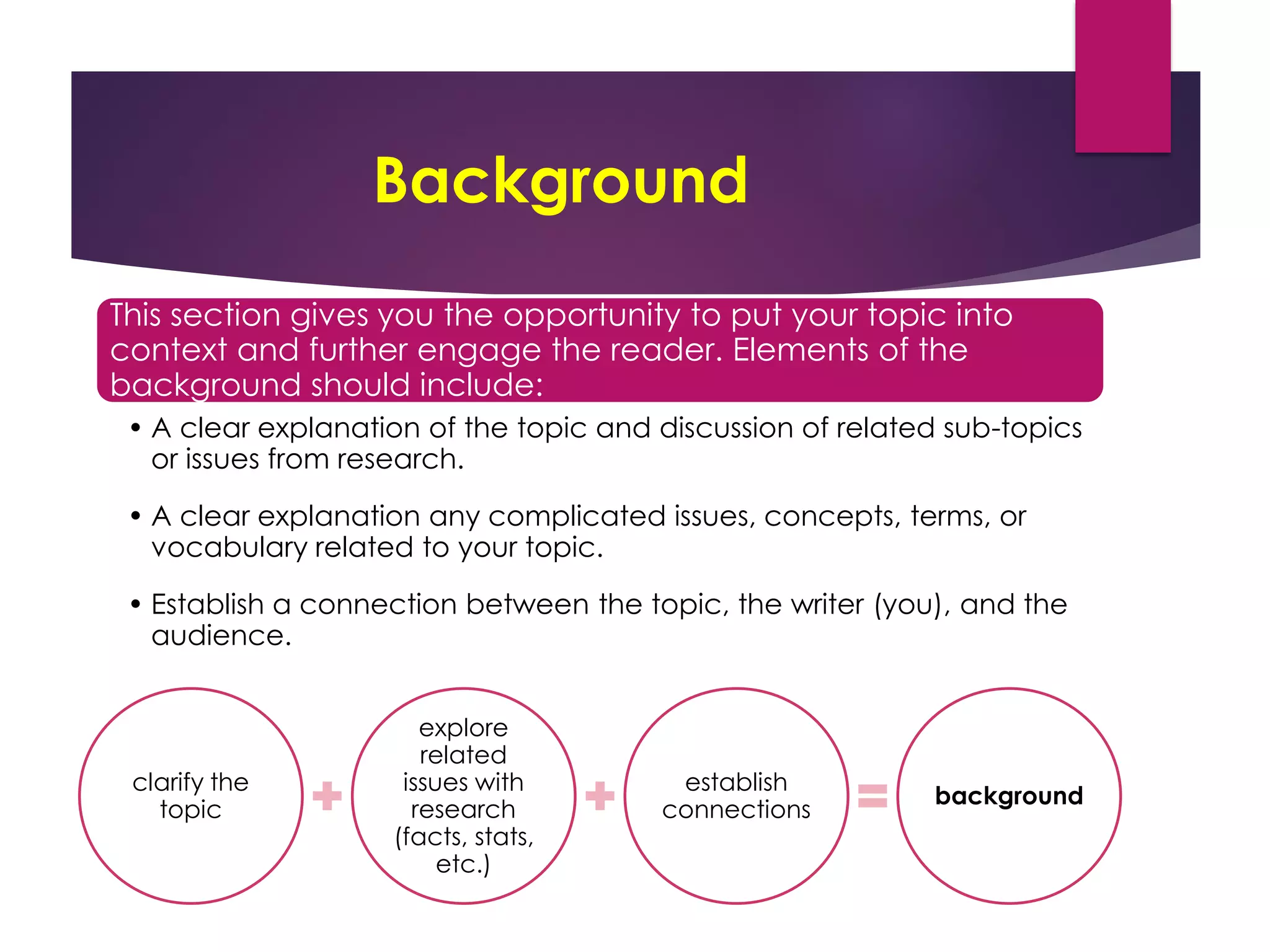
Background
This section gives you the opportunity to put your topic into
context and further engage the reader. Elements of the
background should include:
• A clear explanation of the topic and discussion of related sub-topics
or issues from research.
• A clear explanation any complicated issues, concepts, terms, or
vocabulary related to your topic.
• Establish a connection between the topic, the writer (you), and the
audience.
clarify the
topic
explore
related
issues with
research
(facts, stats,
etc.)
establish
connections
background
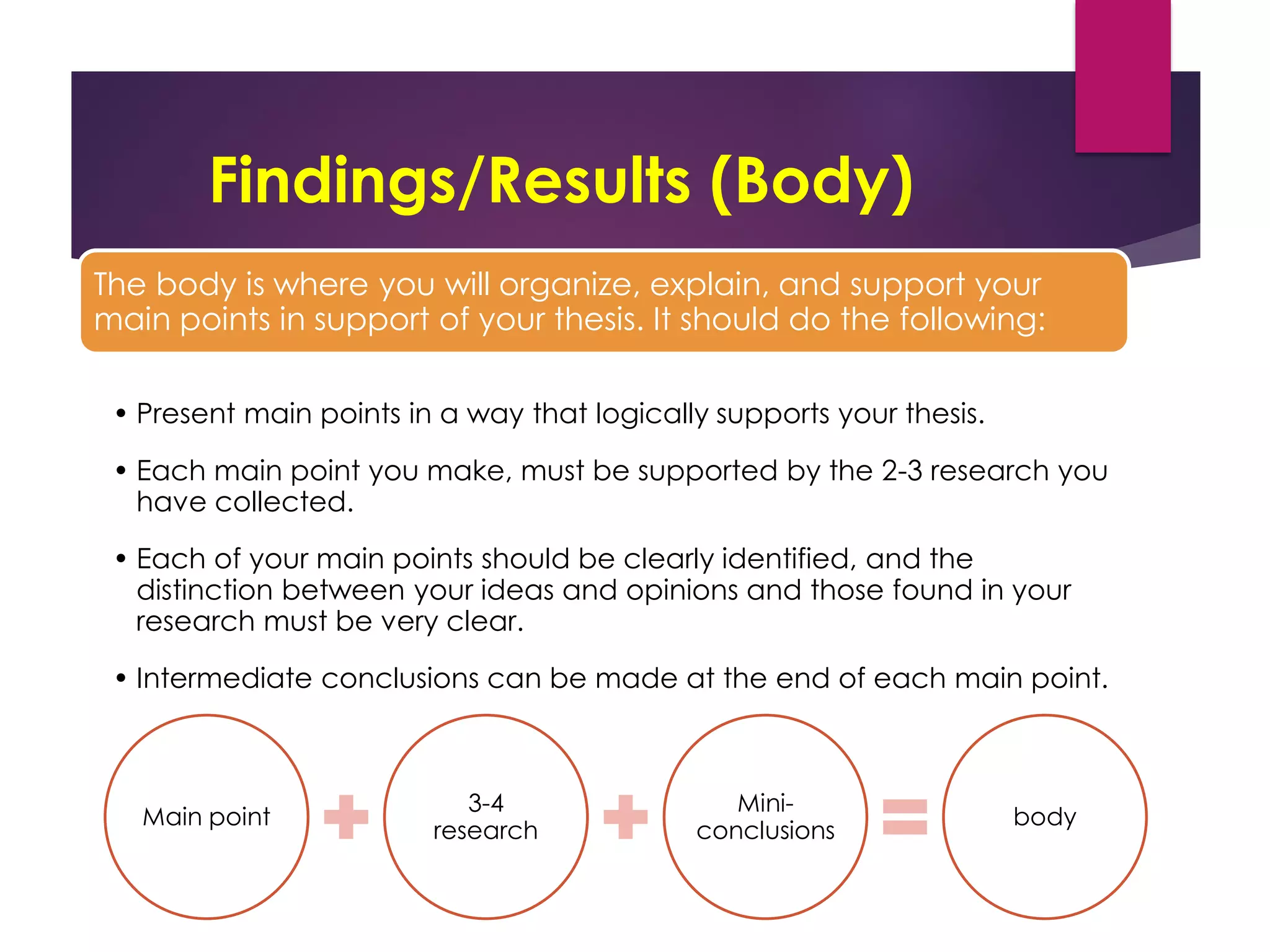
Findings/Results (Body)
The body is where you will organize, explain, and support your
main points in support of your thesis. It should do the following:
• Present main points in a way that logically supports your thesis.
• Each main point you make, must be supported by the 2-3 research you
have collected.
• Each of your main points should be clearly identified, and the
distinction between your ideas and opinions and those found in your
research must be very clear.
• Intermediate conclusions can be made at the end of each main point.
Main point
3-4
research
Mini-
conclusions
body
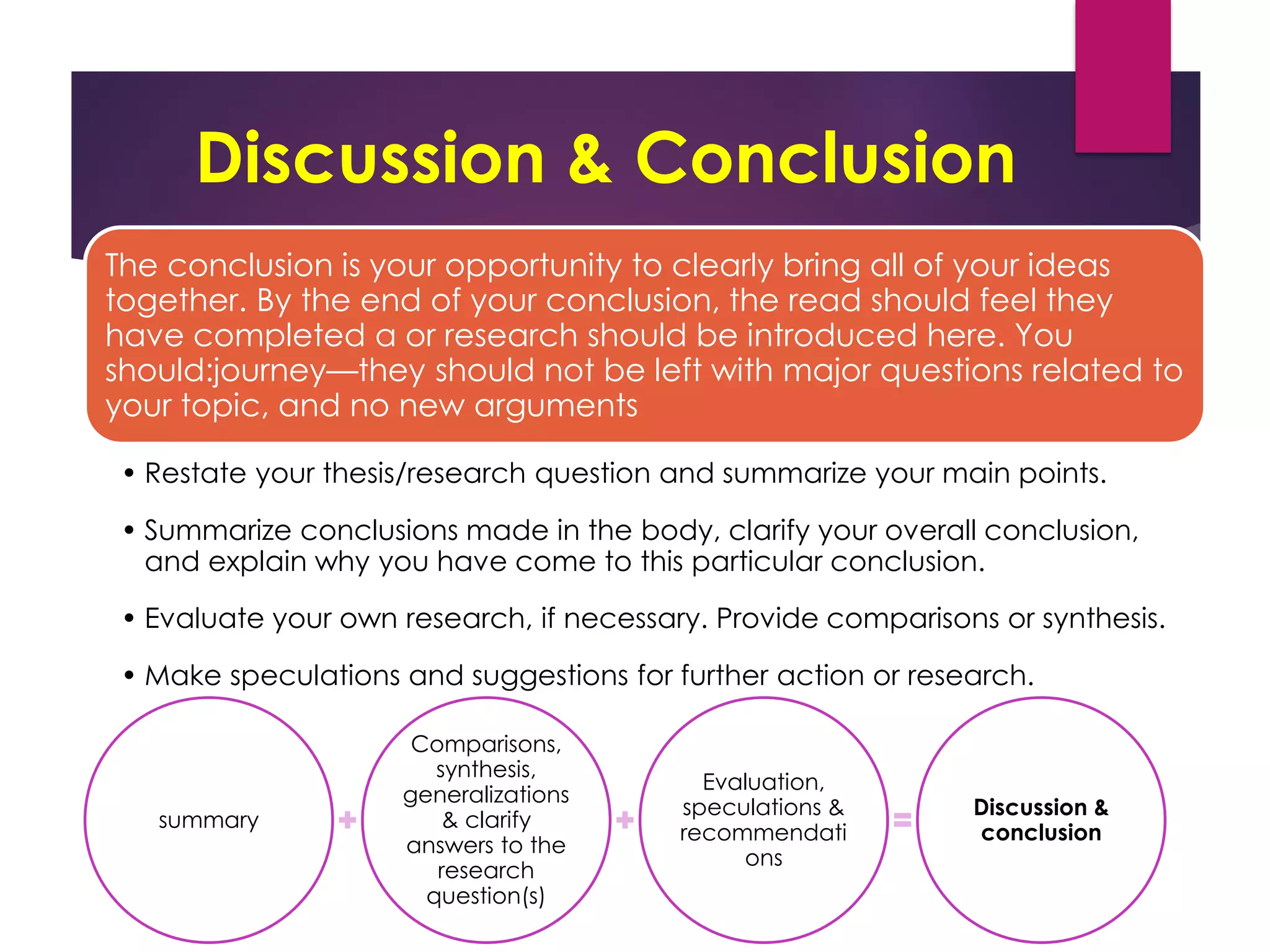
Discussion & Conclusion
The conclusion is your opportunity to clearly bring all of your ideas
together. By the end of your conclusion, the read should feel they
have completed a or research should be introduced here. You
should:journey—they should not be left with major questions related to
your topic, and no new arguments
• Restate your thesis/research question and summarize your main points.
• Summarize conclusions made in the body, clarify your overall conclusion,
and explain why you have come to this particular conclusion.
• Evaluate your own research, if necessary. Provide comparisons or synthesis.
• Make speculations and suggestions for further action or research.
summary
Comparisons,
synthesis,
generalizations
& clarify
answers to the
research
question(s)
Evaluation,
speculations &
recommendati
ons
Discussion &
conclusion
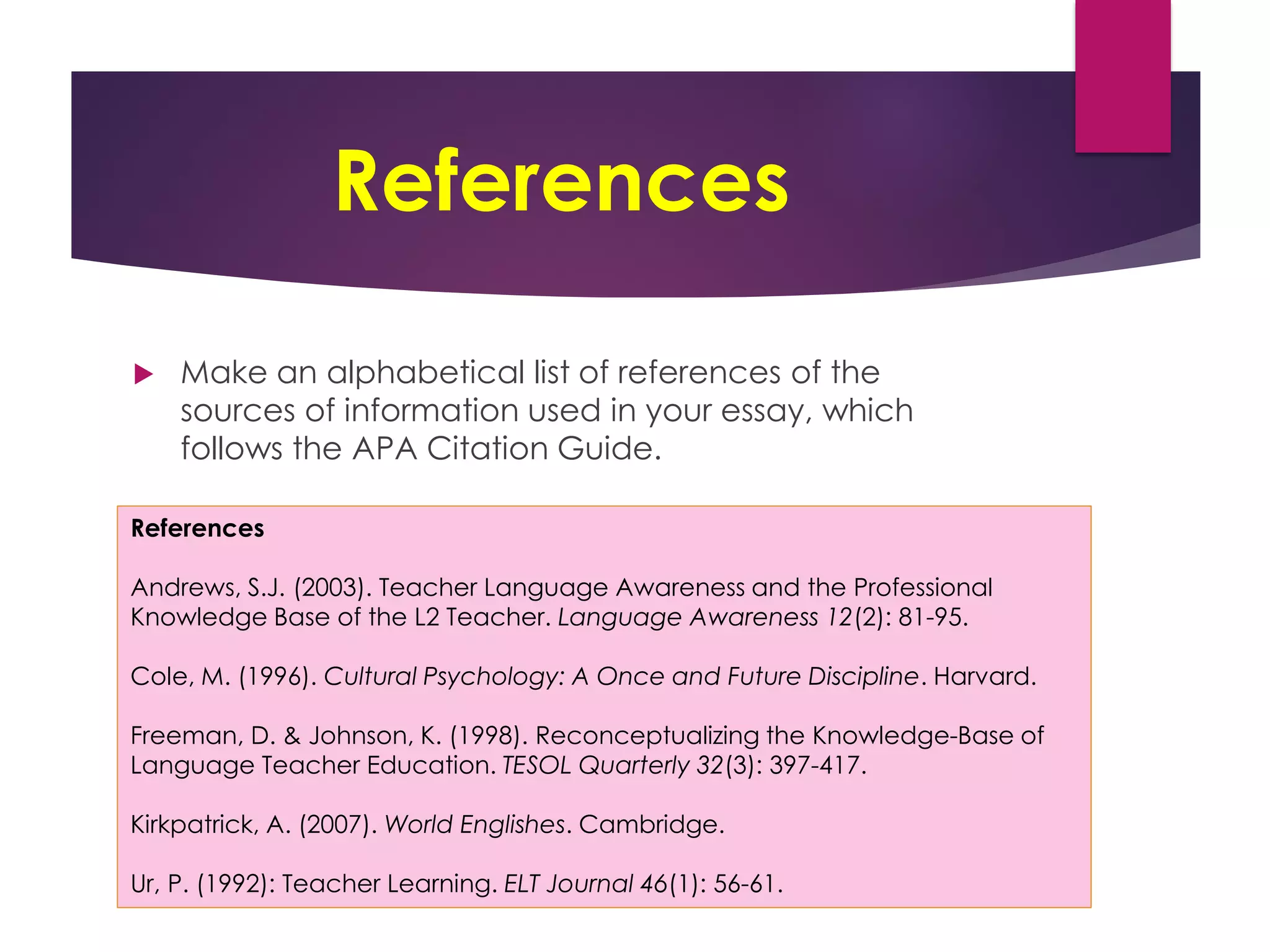
References
 Make an alphabetical list of references of the
sources of information used in your essay, which
follows the APA Citation Guide.
References
Andrews, S.J. (2003). Teacher Language Awareness and the Professional
Knowledge Base of the L2 Teacher. Language Awareness 12(2): 81-95.
Cole, M. (1996). Cultural Psychology: A Once and Future Discipline. Harvard.
Freeman, D. & Johnson, K. (1998). Reconceptualizing the Knowledge-Base of
Language Teacher Education. TESOL Quarterly 32(3): 397-417.
Kirkpatrick, A. (2007). World Englishes. Cambridge.
Ur, P. (1992): Teacher Learning. ELT Journal 46(1): 56-61.
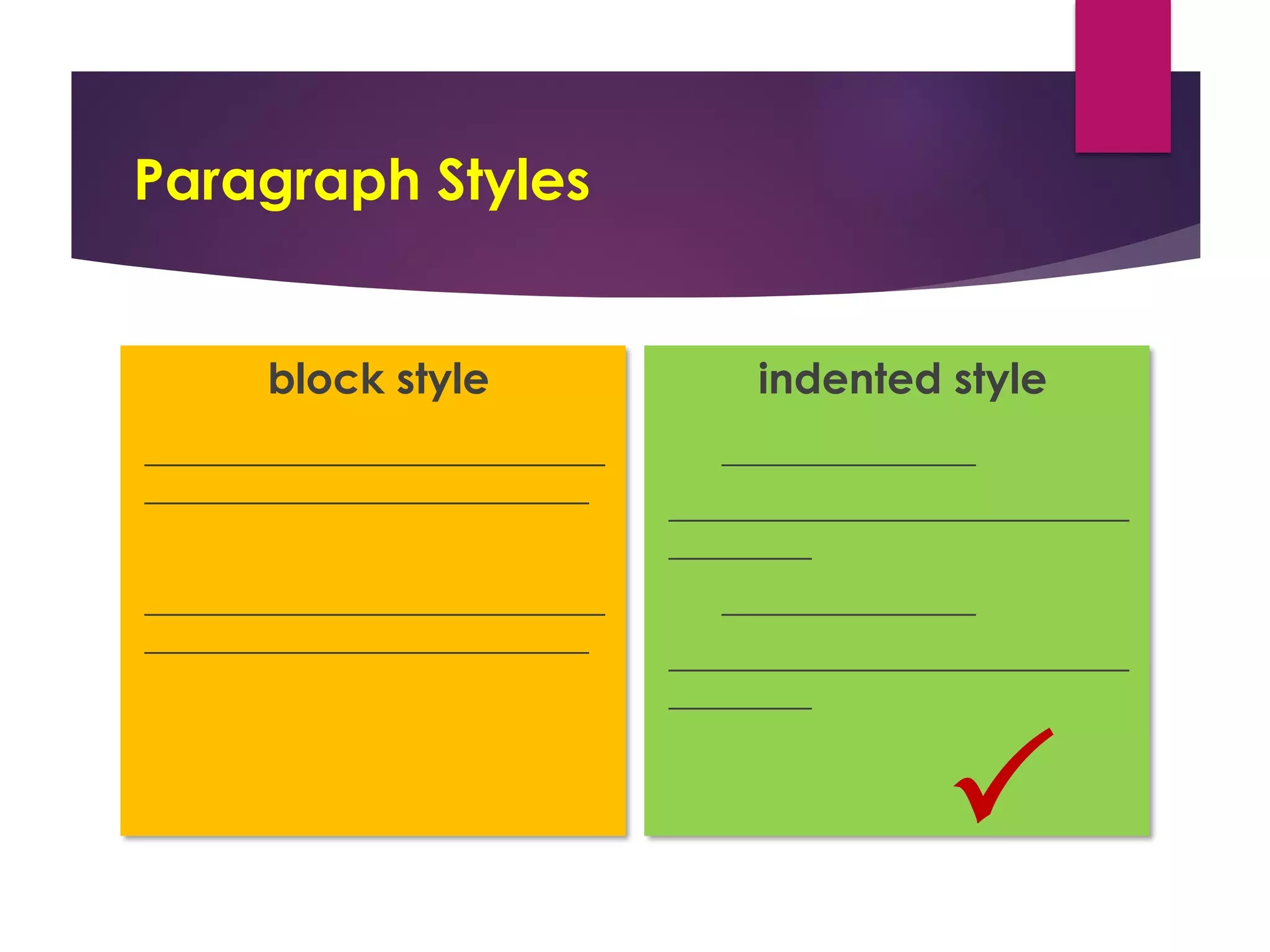
Paragraph Styles
block style
_____________________________
____________________________
_____________________________
____________________________
indented style
________________
_____________________________
_________
________________
_____________________________
_________

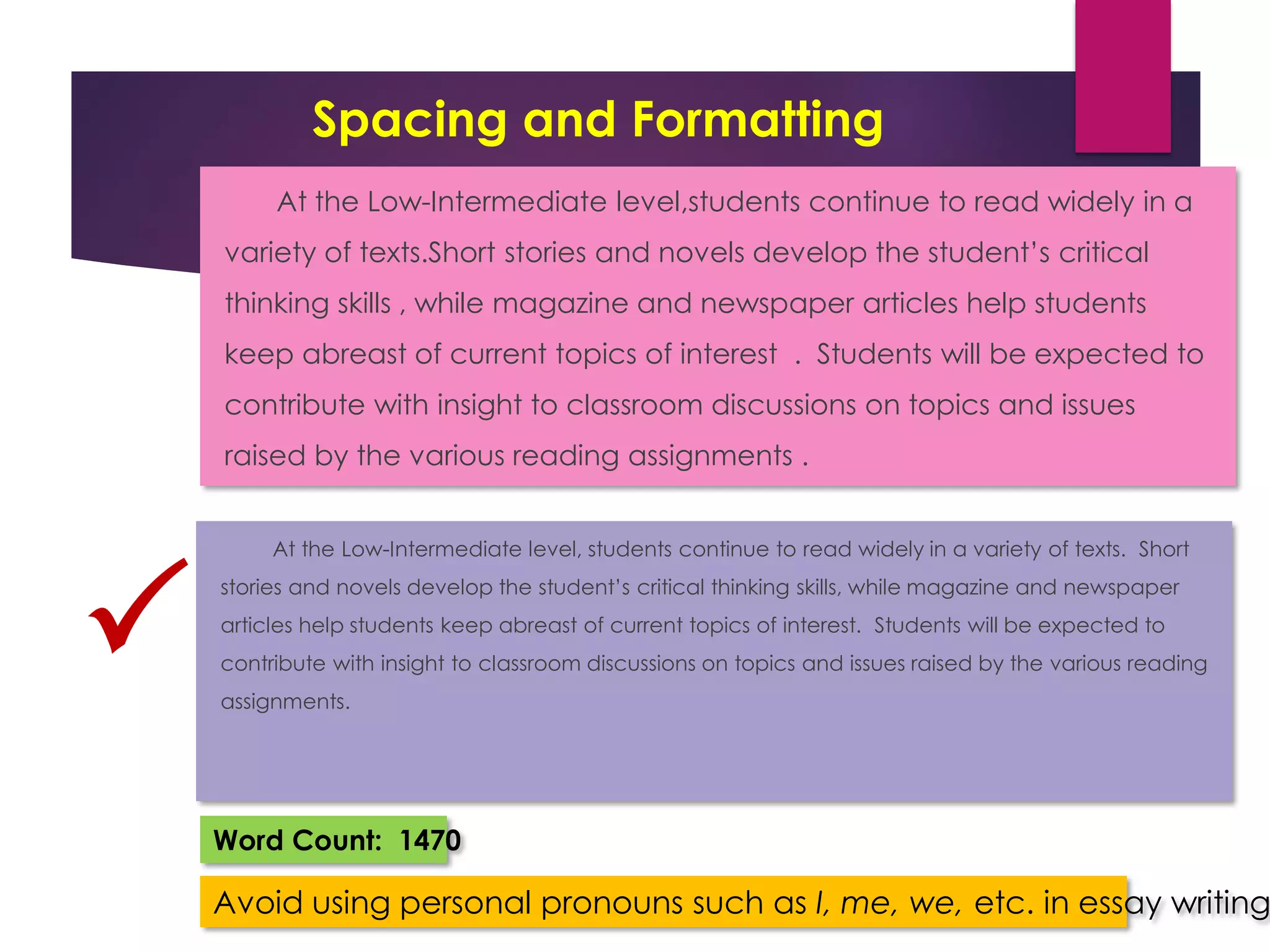
Spacing and Formatting
At the Low-Intermediate level,students continue to read widely in a
variety of texts.Short stories and novels develop the student’s critical
thinking skills , while magazine and newspaper articles help students
keep abreast of current topics of interest . Students will be expected to
contribute with insight to classroom discussions on topics and issues
raised by the various reading assignments .
At the Low-Intermediate level, students continue to read widely in a variety of texts. Short
stories and novels develop the student’s critical thinking skills, while magazine and newspaper
articles help students keep abreast of current topics of interest. Students will be expected to
contribute with insight to classroom discussions on topics and issues raised by the various reading
assignments.

Word Count: 1470
Avoid using personal pronouns such as I, me, we, etc. in essay writing
Practice
 Write your research question
 Formulate your thesis statement
 Extra reference:
http://designresearchtechniques.com/case
studies/secondary-research/

Week 3 introduction to research writing

  • 1.
  • 2.
    Learning Outcomes 1. Identifycomponents of a research model using a model research paper 2. Identify the types of focus in research writing 3. Formulate research questions and thesis statement
  • 3.
    Research Writing 90% preparation •Analyzing question • Tracking down information • Organizing the information • Planning your essay 10% writing • Communicating your ideas clearly and effectively • Follow the lecturers instructions • Use lecturers comments from previous assignments • Stick to the topic • Be an expert on your topic (Read! Read! Read!) • Stay within the word limit • Follow the referencing guidelines • Hand in on time General rules Fry’s (2011) Academic Writing
  • 4.
    The Writing Process Break down task into manageable steps  Complete a schedule or plan of your time  Analyze the question or  Choose your topic • May be given a general topic • Brainstorm several ideas • Carry out some initial research • Choose a topic with enough but not too much information Fry’s (2011) Academic Writing System
  • 5.
    The Writing Process Brainstorming Research& Planning Outlining Drafting Editing & Proofreading Publishing
  • 6.
    The Writing Process:Planning Develop a temporary thesis • Research Questions • Main points (at least 3) Avoid the following: • Facts or topics that are not researchable • Obvious truths • Sweeping generalizations Write a temporary plan • Developed from temporary thesis • What are the issues involved? • How should they be organized? Carry out detailed research • Systematic search for material • Note down references Take notes • Write key points in your own words • Check names and dates • Add your own ideas and thoughts • Keep notes from each resource on a separate piece of paper or card
  • 8.
    The Writing Process:Outlining  When you outline, decide which ideas are most important and how to organize them. Effective introduction: outlines background, purpose, research question/thesis, and structure of the paper Body of text: develop your main points (at least 3) or findings, backed up by independent research Conclusion: draws material together thoughtfully and relates back to question Questions while outlining: • Is your preliminary thesis still correct? • Where does each set of notes fit into your paper? • Does this order make sense in terms of your thesis? • Are there gaps in your research? • Do you have information that does not fit?
  • 9.
    The Writing Process:Drafting  A first draft, or rough draft, refers to the first time you write the essay. Write the first draft • Not supposed to be perfect • Use your to write • Communicate detailed plan and your notes indicate your ideas using simple language Document your sources • Accuracy • Consistency
  • 10.
    The Writing Process:Editing & Proofreading Edit your rough draft, and each subsequent draft, for the following: • Clear introduction of the topic, main idea and/or thesis. • Strong supporting details. • Strong concluding statement(s). Editing Checklist • Edit for meaning • Improve logical organization • Clarify confusing sections • Is the introduction clear and does it make reference to the question? • Have you written in your own words? • Are there linking statements? • Does the conclusion effectively close your argument? Editing your drafts also requires you to proofread, which means to check for mistakes in the following areas: • spelling punctuation spacing/formatting • vocabulary grammar
  • 11.
    The Writing Process:Publishing (Final Draft)  When you are finished editing and proofreading your drafts, you are reading to submit your final draft. The final draft is submitted for marking, so it must be… • correctly formatted. • as free as possible of mistakes. • your best possible work. Final Draft Checklist • Check facts • Prepare your reference list • Check spelling, grammar and proofread • Get someone else to read it • Proofread again • Hand in on time
  • 12.
    Introduction to basicresearch When you begin to research a topic, there are two possibilities that may be dealt with: • You know nothing whatsoever about the topic. • You know something about the topic, but you would like to know more. It is very important to choose a topic that interests you! If you enjoy learning about and researching your topic, the task of writing your essay will become that much easier.
  • 13.
    Choose a Questionthat is Neither Too Broad nor Too Narrow For example, if you choose juvenile delinquency (a topic that can be researched), you might ask the following questions: a. What is the 1994 rate of juvenile delinquency in the U.S.? b. What can we do to reduce juvenile delinquency in the U.S.? c. Does education play a role in reducing juvenile delinquents' return to crime?
  • 14.
    Types of Focus 1.Causes 2. Effects 3. Definition (e.g. What are signs of alcohol addiction?) 4. Process (e.g. How does an individual become addicted to alcohol?) 5. Comparison (E.g. How are attitudes towards drinking alcohol similar or different in Japan and United States? 6. Problem and Solution 7. Argument (Yes/No format e.g. Should the legal age for drinking be lowered from 21 to 18?)
  • 15.
    Sample Research Questions Identifythe focuses of the following: 1. In what ways can understanding the causes of alcohol addiction help a person stop drinking? 2. How does the value of individualism influence people’s expectations of marriage? 3. How does early homeschooling affect students’ later academic performance?
  • 16.
    Introduction to basicresearch  Any research project begins with basic questions that you aim to answer with the information you find from sources. Topic: Fast food restaurants are a growing problem •Who is eating at fast food restaurants? •What are restaurants doing about the quality of their food? •What should people and/or governments do about this problem? •When did fast food start to become popular? •Why is fast food popular even though it is unhealthy? •Where does the responsibility for this problem lie: fast food companies, consumers, government? •How can this issue be resolved? Research Questions Brainstorm one of the topics below and write down the related research questions. • Parents choosing their child’s career • Traditional vs. modern gender roles • Appropriate age to begin dating
  • 17.
    Thesis Statements Purpose ofa Thesis Statement •The thesis statement summarizes the main point of the paper. It is normally a single sentence found at the end of the paper's introductory paragraph. It acts as a guide to let your audience know the central idea of the paper and to know what to expect in the body of your paper. Analytical Thesis Statement •An analytical paper analyzes an issue. An analytical thesis statement states the subject to be analyzed and shows how it will be broken down. •Example: The aim of this paper is to investigate the impacts of technology on learning in the aspects students’ academic performance and motivation
  • 18.
    Analytical Thesis: Showsthe aim of the study based on the research question . It states the subject to be analysed and shows how it will be broken down/focused main points. EXAMPLES: This paper would like to investigate the reasons why Whaling in Japan continues to exist. The most common justifications that this paper will cover include the need to preserve traditional whaling culture, the use of whales for scientific research, and the reluctance to accept that whales are endangered. Or OPPOSING IDEA, TOPIC, FOCUSED MAIN POINTS Despite a majority of countries having banned whaling, it still continues to exist in Japan. This paper focuses on three common justifications for whaling which include the need to preserve traditional whaling culture, the use of whales for scientific research, and the reluctance to accept that whales are endangered.
  • 19.
    Outlining When you travel,you often use a map to show you how to get to your destination. An outline is much the same in that you’re designing your own map in order to guide you through your paper. •Determine the purpose of your paper. •Determine the audience you are writing for. •Develop the thesis of your paper. Three things to do before developing your outline:
  • 20.
    Steps in outlining •List all the ideas that you want to include in your paper, even if you’re not sure about some. Brainstorm • Group related ideas together.Organize • Arrange material in subsections from general to specific or from abstract to concrete. Order • Create main and sub headings.Label
  • 21.
  • 22.
    Introduction The introduction isyour opportunity to get the reader’s attention! You must be very clear about the following: • Introduce your topic in a way that interests your reader • State how you plan to approach your topic and the purpose and type of research you have conducted. • Provide a menu of the major points and/or arguments you plan to cover in your paper. • State your thesis. introduction of topic explore related issues Introduce research objective & thesis statement introduction
  • 23.
    Background This section givesyou the opportunity to put your topic into context and further engage the reader. Elements of the background should include: • A clear explanation of the topic and discussion of related sub-topics or issues from research. • A clear explanation any complicated issues, concepts, terms, or vocabulary related to your topic. • Establish a connection between the topic, the writer (you), and the audience. clarify the topic explore related issues with research (facts, stats, etc.) establish connections background
  • 24.
    Findings/Results (Body) The bodyis where you will organize, explain, and support your main points in support of your thesis. It should do the following: • Present main points in a way that logically supports your thesis. • Each main point you make, must be supported by the 2-3 research you have collected. • Each of your main points should be clearly identified, and the distinction between your ideas and opinions and those found in your research must be very clear. • Intermediate conclusions can be made at the end of each main point. Main point 3-4 research Mini- conclusions body
  • 25.
    Discussion & Conclusion Theconclusion is your opportunity to clearly bring all of your ideas together. By the end of your conclusion, the read should feel they have completed a or research should be introduced here. You should:journey—they should not be left with major questions related to your topic, and no new arguments • Restate your thesis/research question and summarize your main points. • Summarize conclusions made in the body, clarify your overall conclusion, and explain why you have come to this particular conclusion. • Evaluate your own research, if necessary. Provide comparisons or synthesis. • Make speculations and suggestions for further action or research. summary Comparisons, synthesis, generalizations & clarify answers to the research question(s) Evaluation, speculations & recommendati ons Discussion & conclusion
  • 26.
    References  Make analphabetical list of references of the sources of information used in your essay, which follows the APA Citation Guide. References Andrews, S.J. (2003). Teacher Language Awareness and the Professional Knowledge Base of the L2 Teacher. Language Awareness 12(2): 81-95. Cole, M. (1996). Cultural Psychology: A Once and Future Discipline. Harvard. Freeman, D. & Johnson, K. (1998). Reconceptualizing the Knowledge-Base of Language Teacher Education. TESOL Quarterly 32(3): 397-417. Kirkpatrick, A. (2007). World Englishes. Cambridge. Ur, P. (1992): Teacher Learning. ELT Journal 46(1): 56-61.
  • 27.
    Paragraph Styles block style _____________________________ ____________________________ _____________________________ ____________________________ indentedstyle ________________ _____________________________ _________ ________________ _____________________________ _________ 
  • 28.
    Spacing and Formatting Atthe Low-Intermediate level,students continue to read widely in a variety of texts.Short stories and novels develop the student’s critical thinking skills , while magazine and newspaper articles help students keep abreast of current topics of interest . Students will be expected to contribute with insight to classroom discussions on topics and issues raised by the various reading assignments . At the Low-Intermediate level, students continue to read widely in a variety of texts. Short stories and novels develop the student’s critical thinking skills, while magazine and newspaper articles help students keep abreast of current topics of interest. Students will be expected to contribute with insight to classroom discussions on topics and issues raised by the various reading assignments.  Word Count: 1470 Avoid using personal pronouns such as I, me, we, etc. in essay writing
  • 29.
    Practice  Write yourresearch question  Formulate your thesis statement  Extra reference: http://designresearchtechniques.com/case studies/secondary-research/