Week 8
Workplace Ethics
Dr. Russell Rodrigo
Outline:
1. Ethical Issues in the Workplace: The Current
Environment
2. Defining Parameters of the Employment
Relationship
3. Health and Safety
4. Work Ethic
Ethical Issues in the Workplace: The
Current Environment
What does ethics in
Human Resources
involve?
Relationships with others and
with the organizations
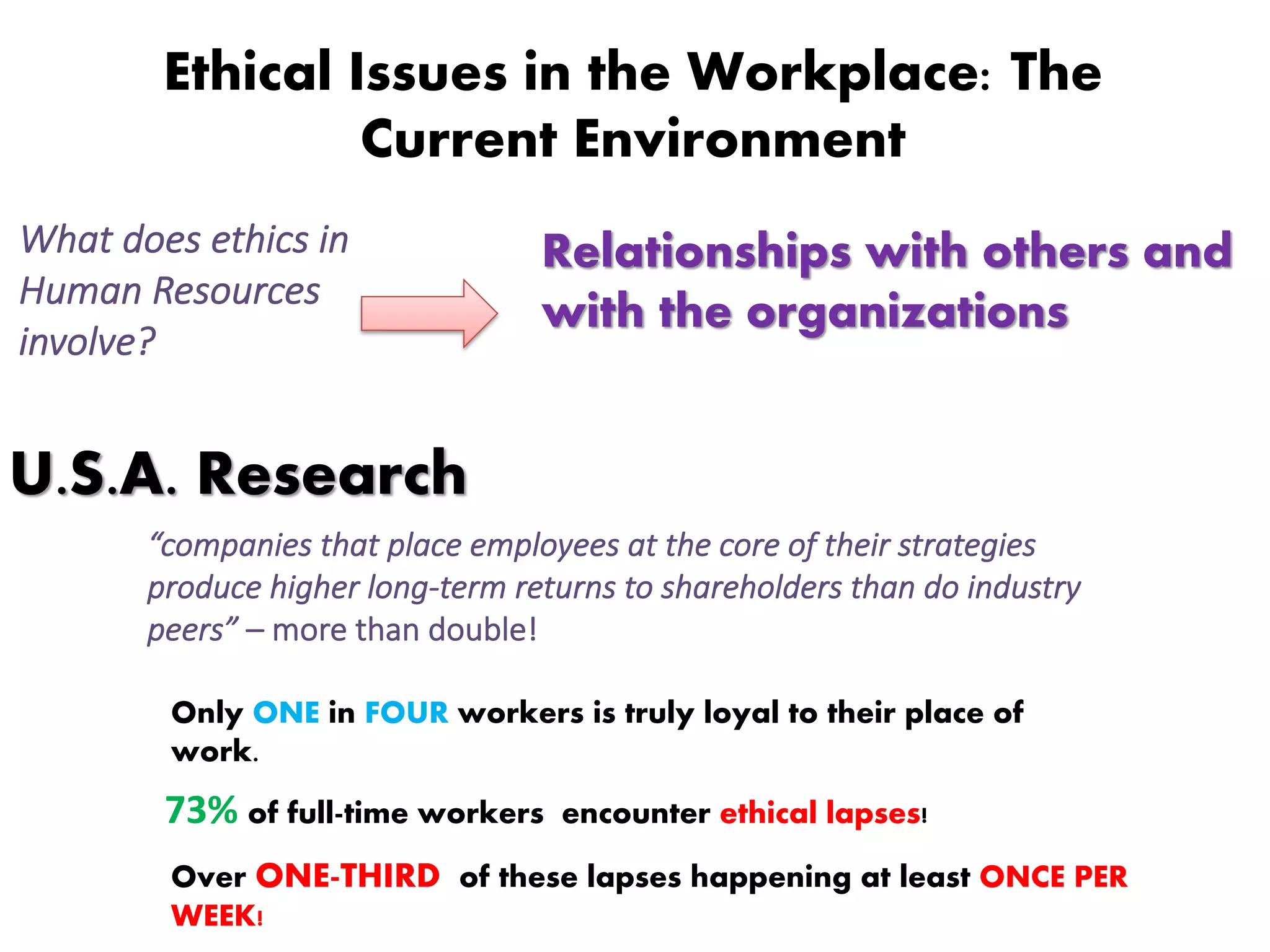
U.S.A. Research
“companies that place employees at the core of their strategies
produce higher long-term returns to shareholders than do industry
peers” – more than double!
Only ONE in FOUR workers is truly loyal to their place of
work.
Over ONE-THIRD of these lapses happening at least ONCE PER
WEEK!
73% of full-time workers encounter ethical lapses!
Ethical Issues in the Workplace:
The Current Environment
6-5
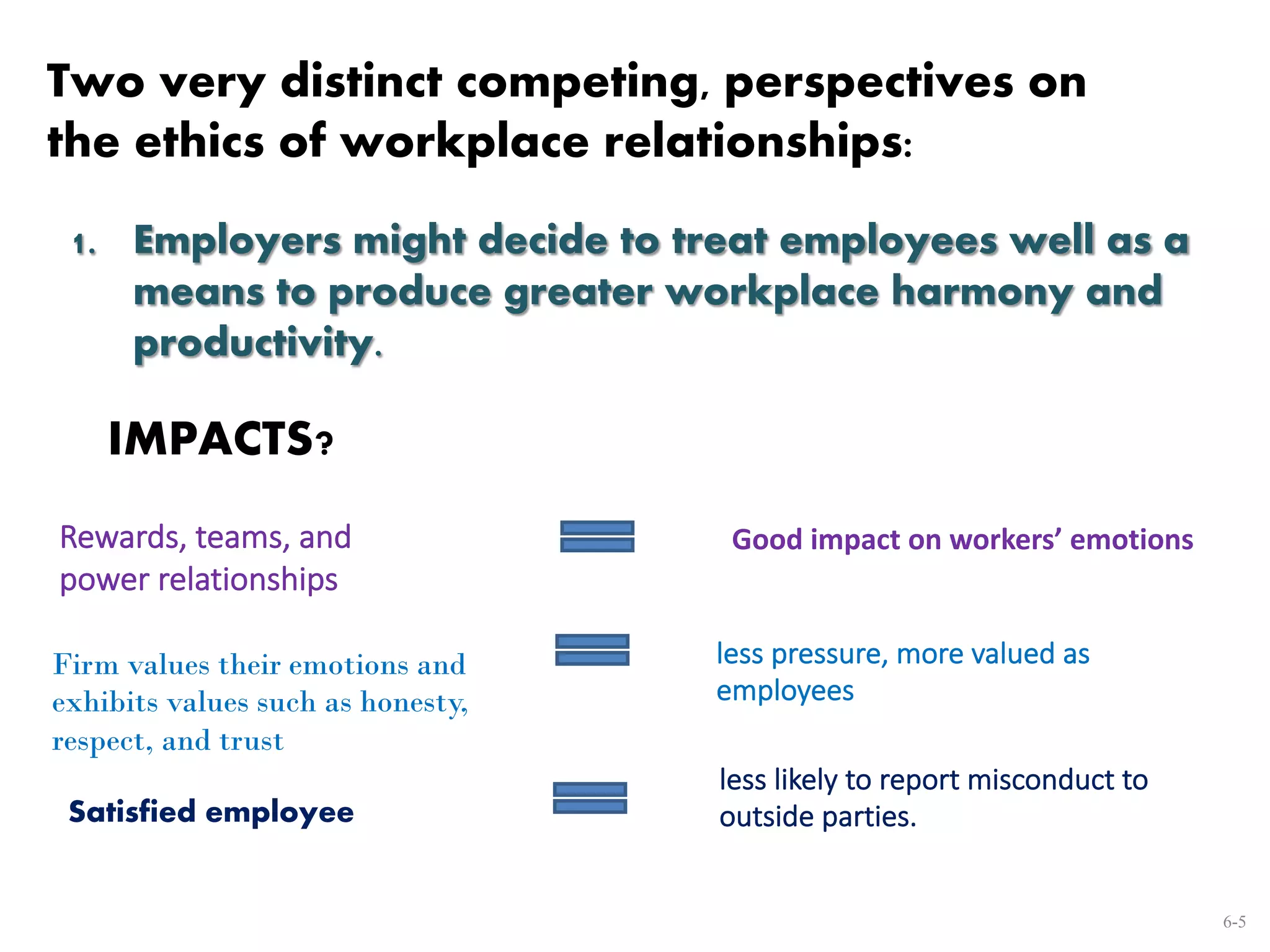
Two very distinct competing, perspectives on
the ethics of workplace relationships:
1. Employers might decide to treat employees well as a
means to produce greater workplace harmony and
productivity.
IMPACTS?
Rewards, teams, and
power relationships
Good impact on workers’ emotions
Firm values their emotions and
exhibits values such as honesty,
respect, and trust
less pressure, more valued as
employees
Satisfied employee
less likely to report misconduct to
outside parties.
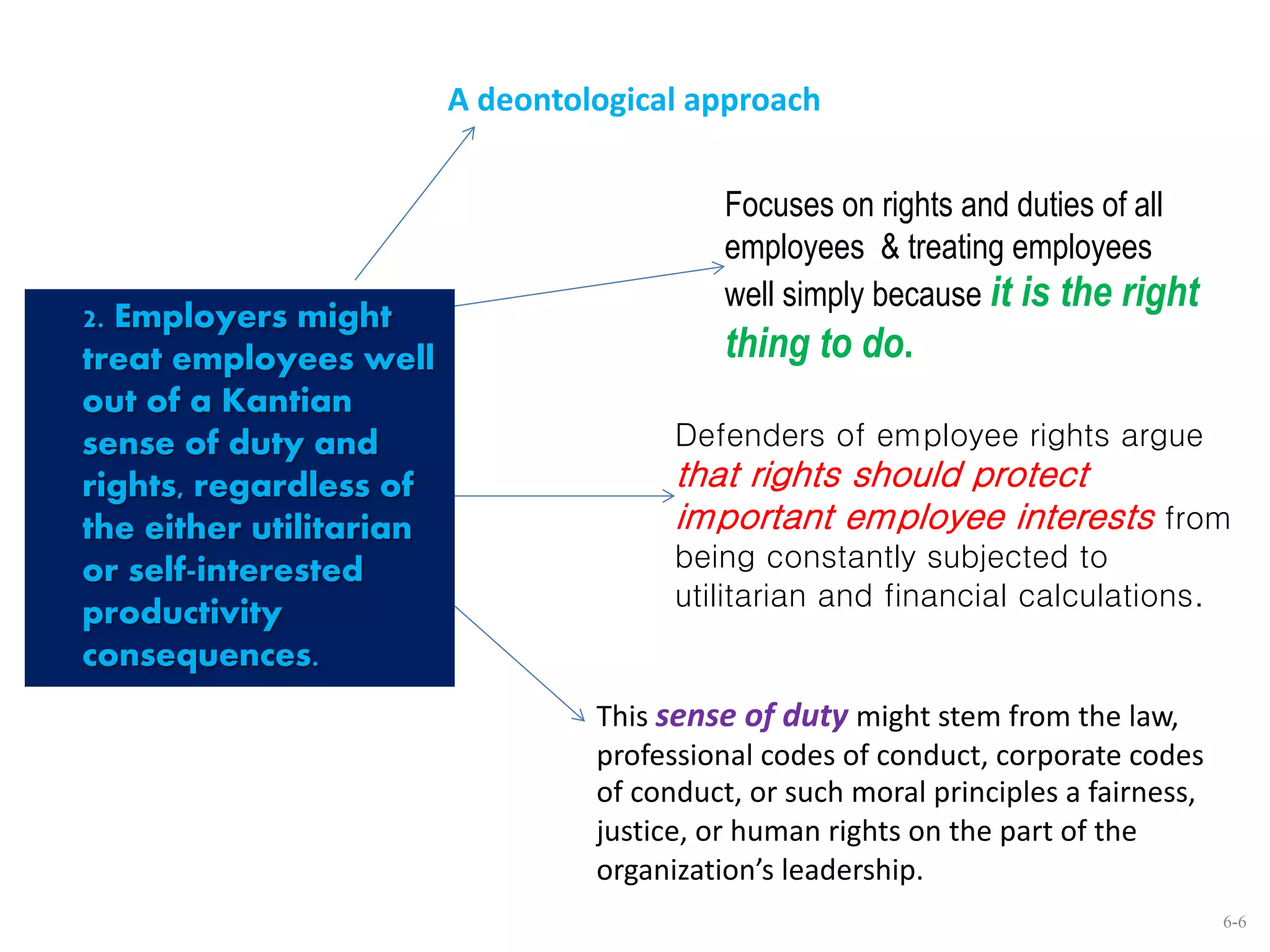
This sense of duty might stem from the law,
professional codes of conduct, corporate codes
of conduct, or such moral principles a fairness,
justice, or human rights on the part of the
organization’s leadership.
6-6
2. Employers might
treat employees well
out of a Kantian
sense of duty and
rights, regardless of
the either utilitarian
or self-interested
productivity
consequences.
A deontological approach
Focuses on rights and duties of all
employees & treating employees
well simply because it is the right
thing to do.
Defenders of employee rights argue
that rights should protect
important employee interests from
being constantly subjected to
utilitarian and financial calculations.
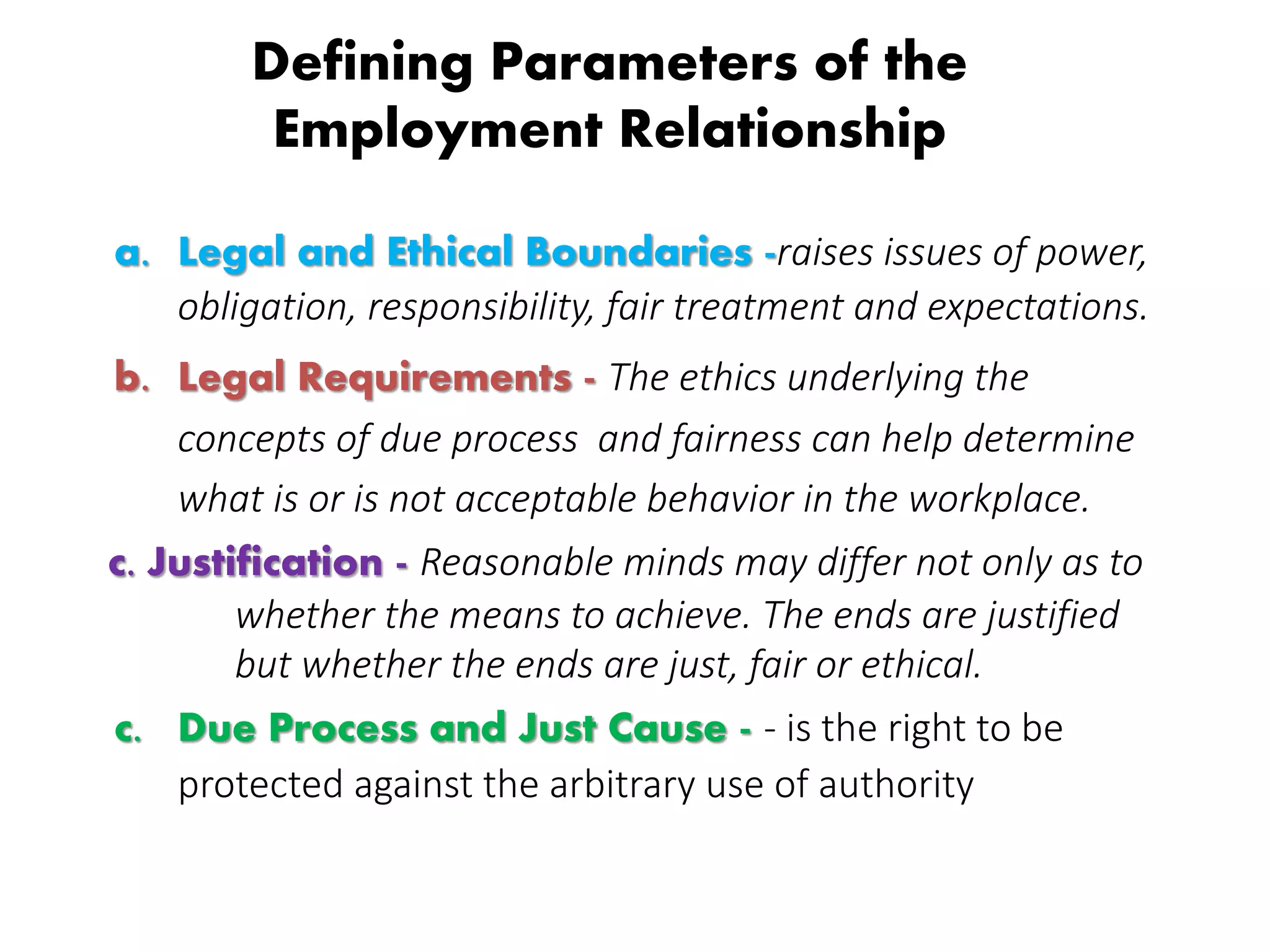
Defining Parameters of the
Employment Relationship
a. Legal and Ethical Boundaries -raises issues of power,
obligation, responsibility, fair treatment and expectations.
b. Legal Requirements - The ethics underlying the
concepts of due process and fairness can help determine
what is or is not acceptable behavior in the workplace.
c. Justification - Reasonable minds may differ not only as to
whether the means to achieve. The ends are justified
but whether the ends are just, fair or ethical.
c. Due Process and Just Cause - - is the right to be
protected against the arbitrary use of authority
Health and Safety
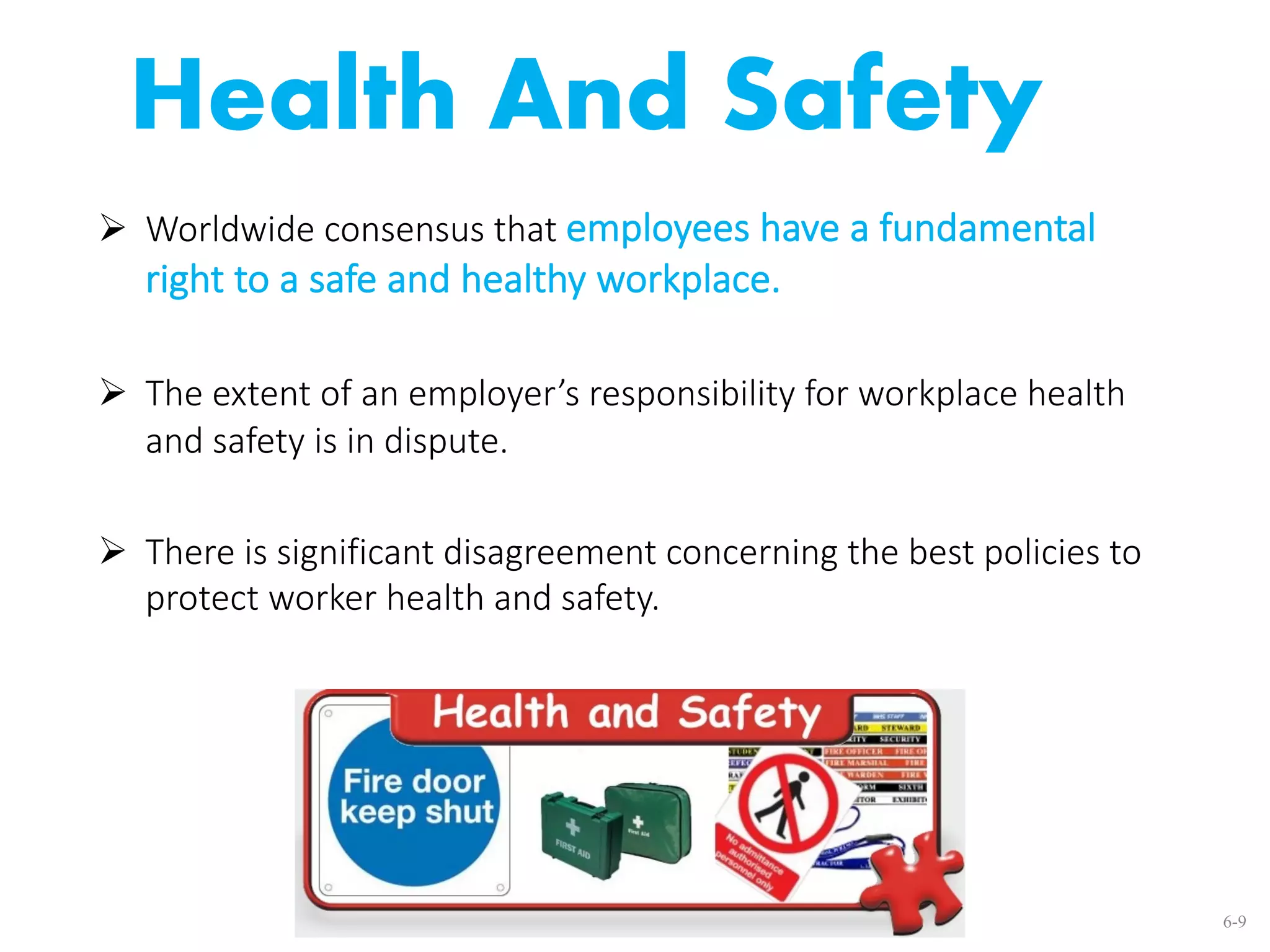
Health And Safety
Ø Worldwide consensus that employees have a fundamental
right to a safe and healthy workplace.
Ø The extent of an employer’s responsibility for workplace health
and safety is in dispute.
Ø There is significant disagreement concerning the best policies to
protect worker health and safety.
6-9
The Learning Goals:
The importance of developing a strong
work ethic and how the work ethic you
develop will impact your future as an
employee.
Work Ethic
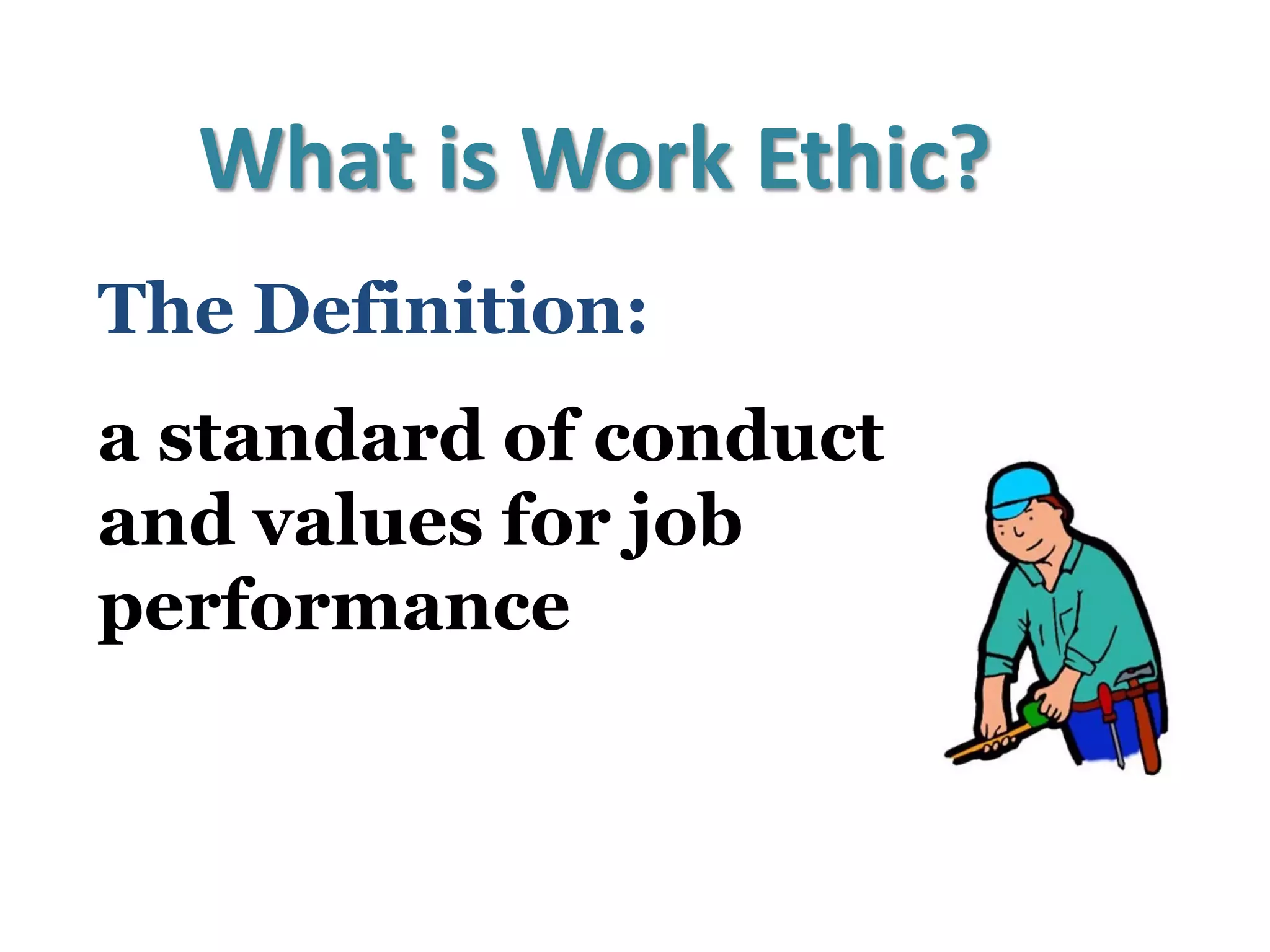
What is Work Ethic?
The Definition:
a standard of conduct
and values for job
performance
Expectations
for Employees
What are the traits of a
winning employee?
What does an
employer want?
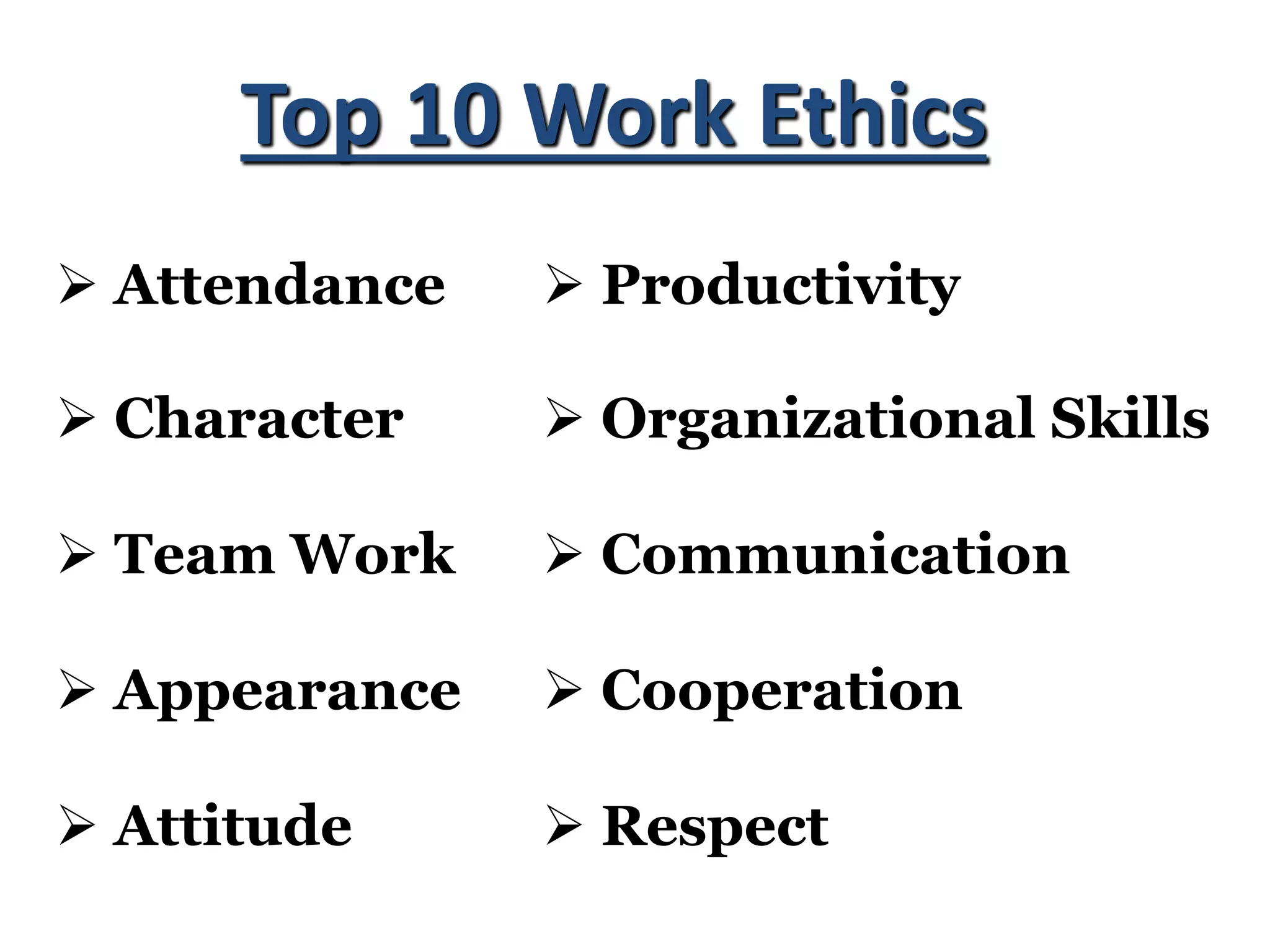
Top 10 Work Ethics
Ø Attendance
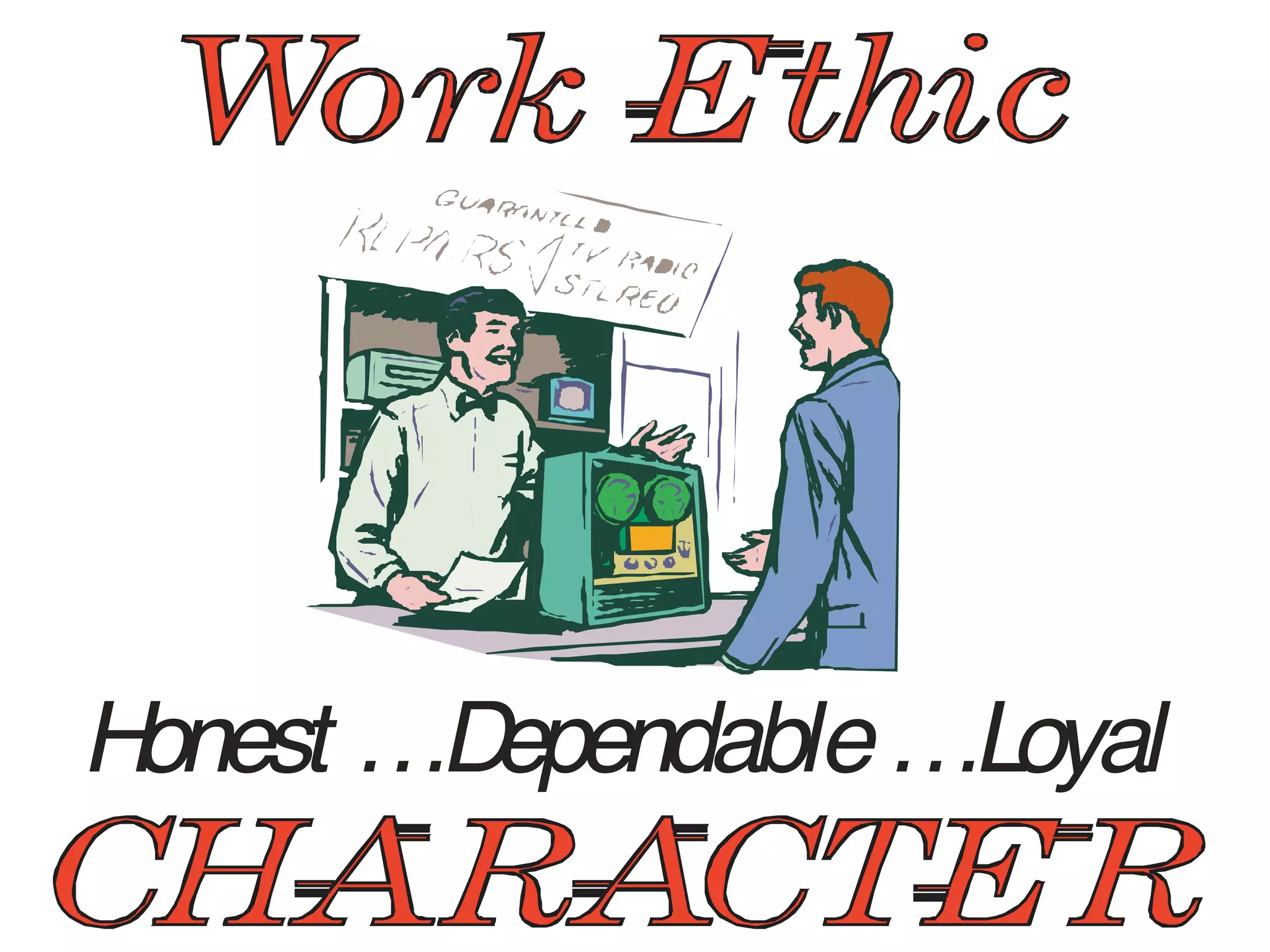
Ø Character
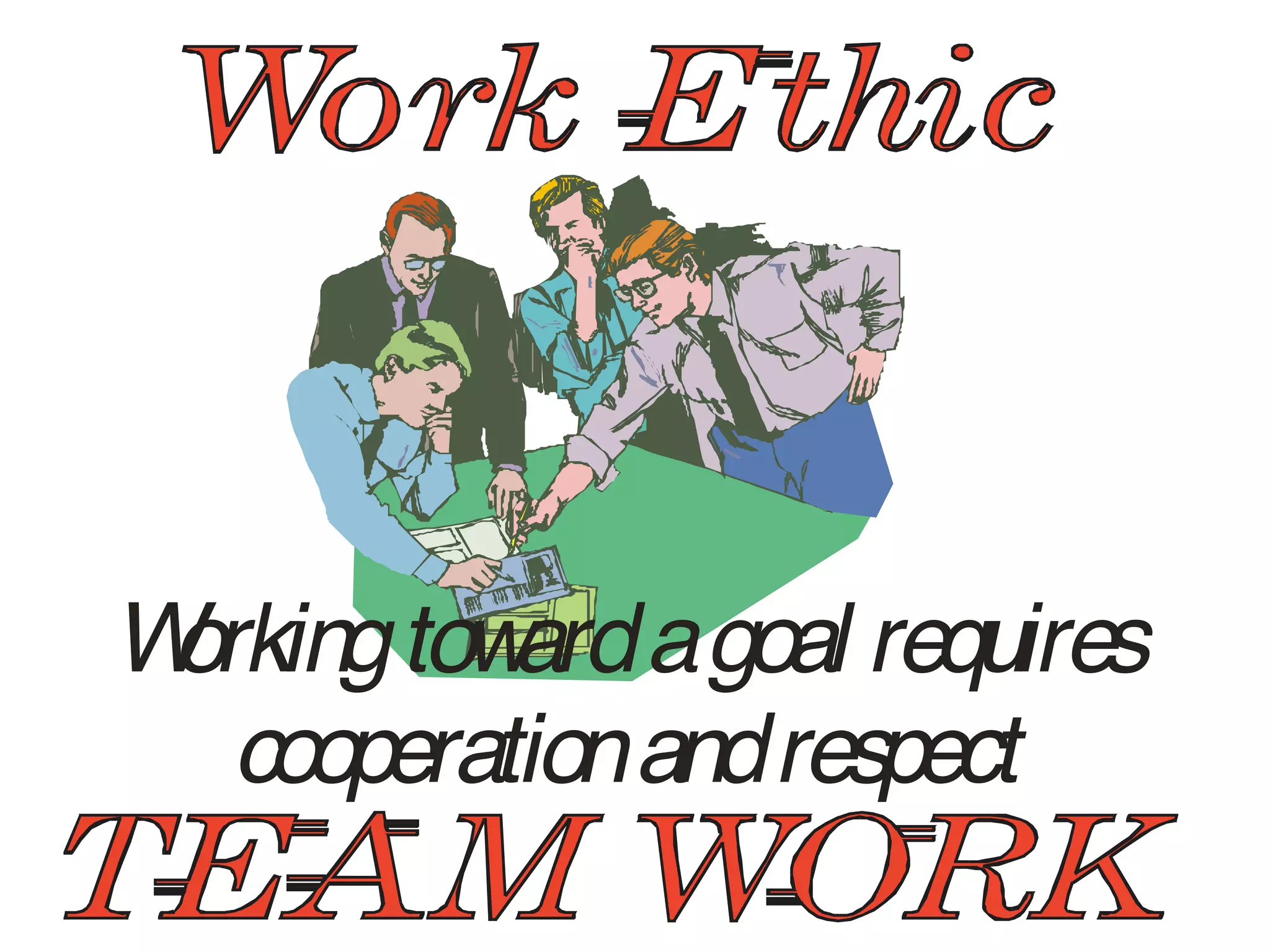
Ø Team Work
Ø Appearance
Ø Attitude
Ø Productivity
Ø Organizational Skills
Ø Communication
Ø Cooperation
Ø Respect
Explain the Top 10 Ethics
Group Discussion
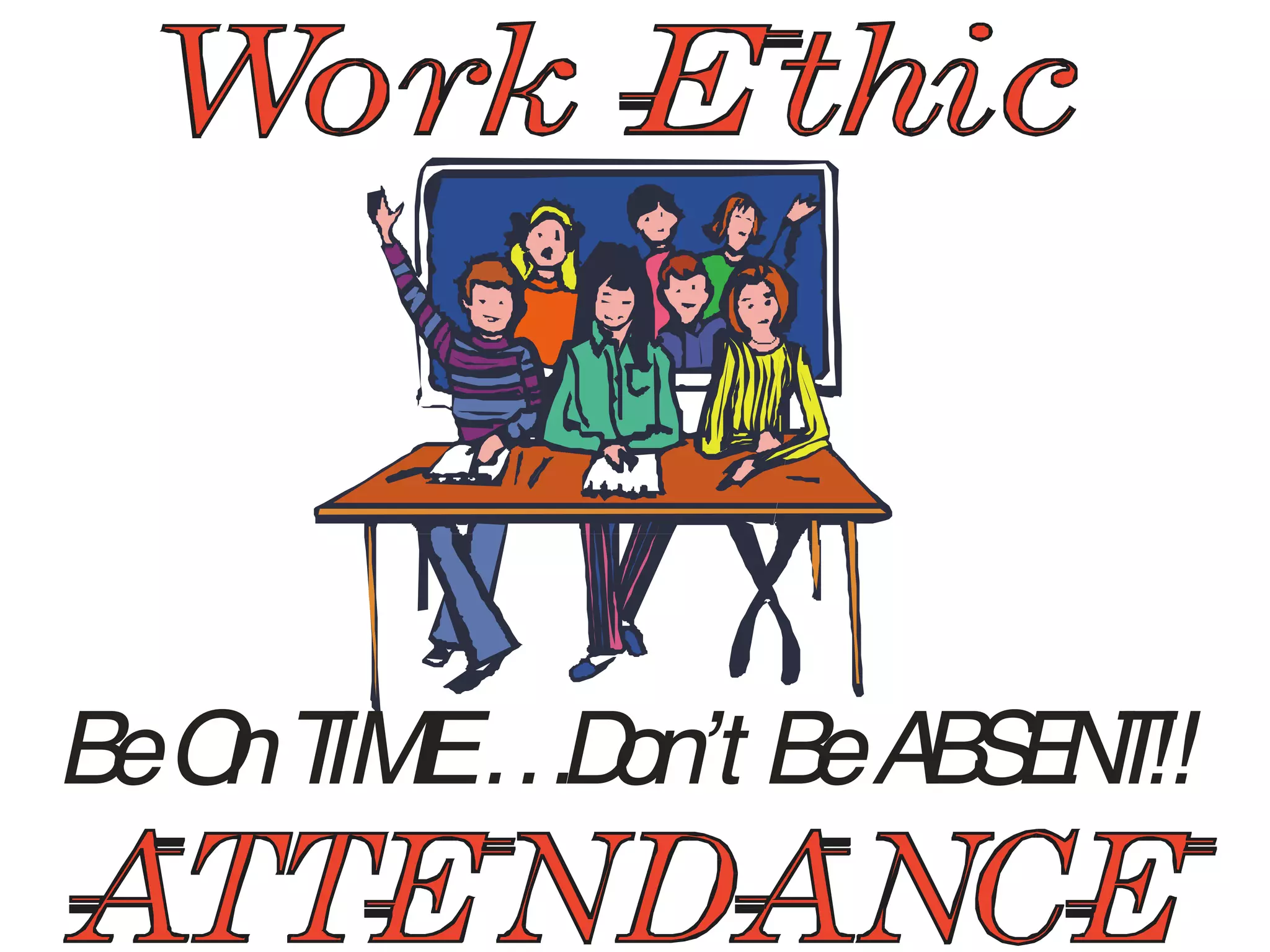
BeO
nT
IME…D
on’t BeAB
S
E
N
T
!!
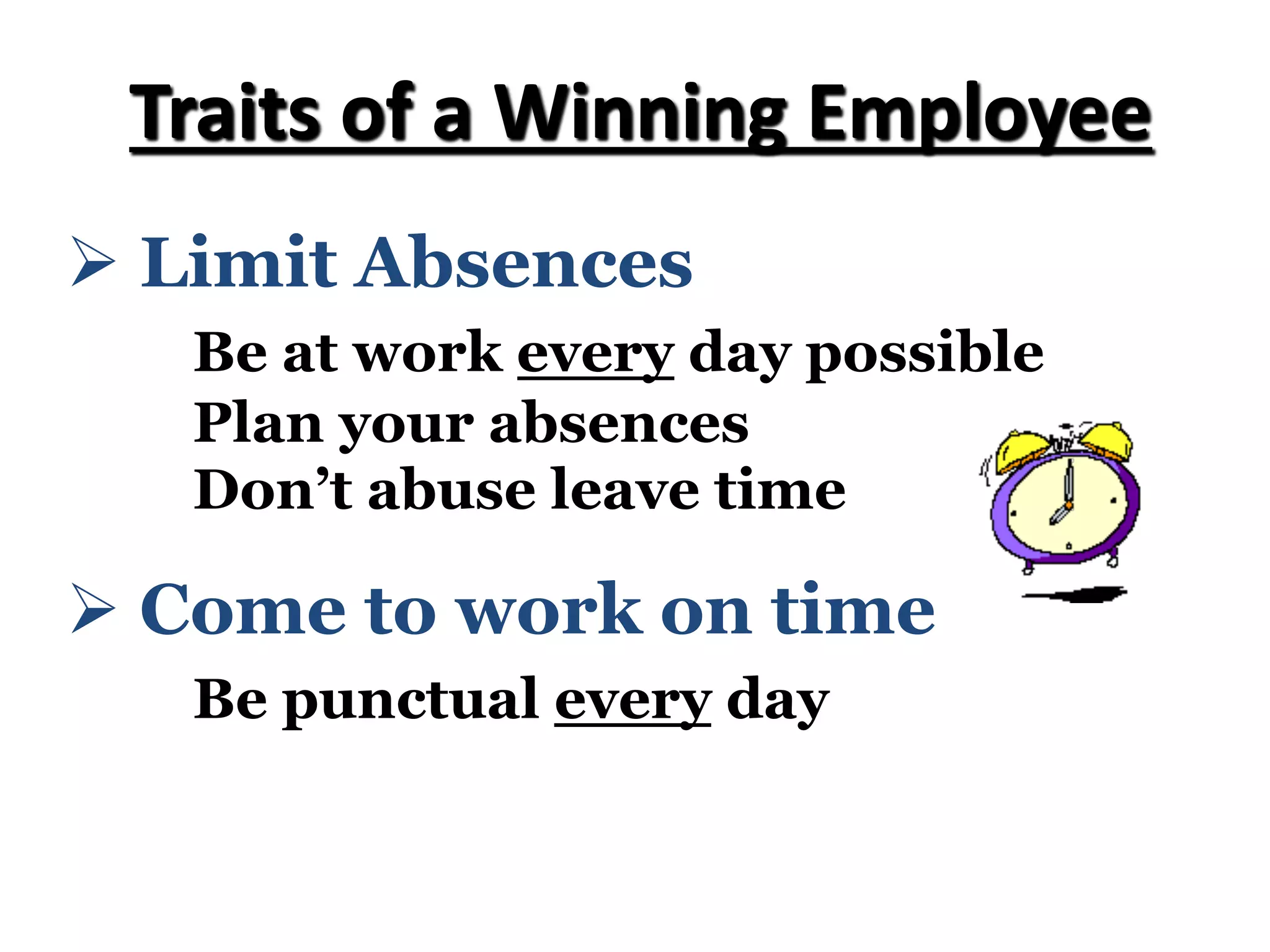
Ø Limit Absences
Be at work every day possible
Plan your absences
Don’t abuse leave time
Traits of a Winning Employee
Ø Come to work on time
Be punctual every day
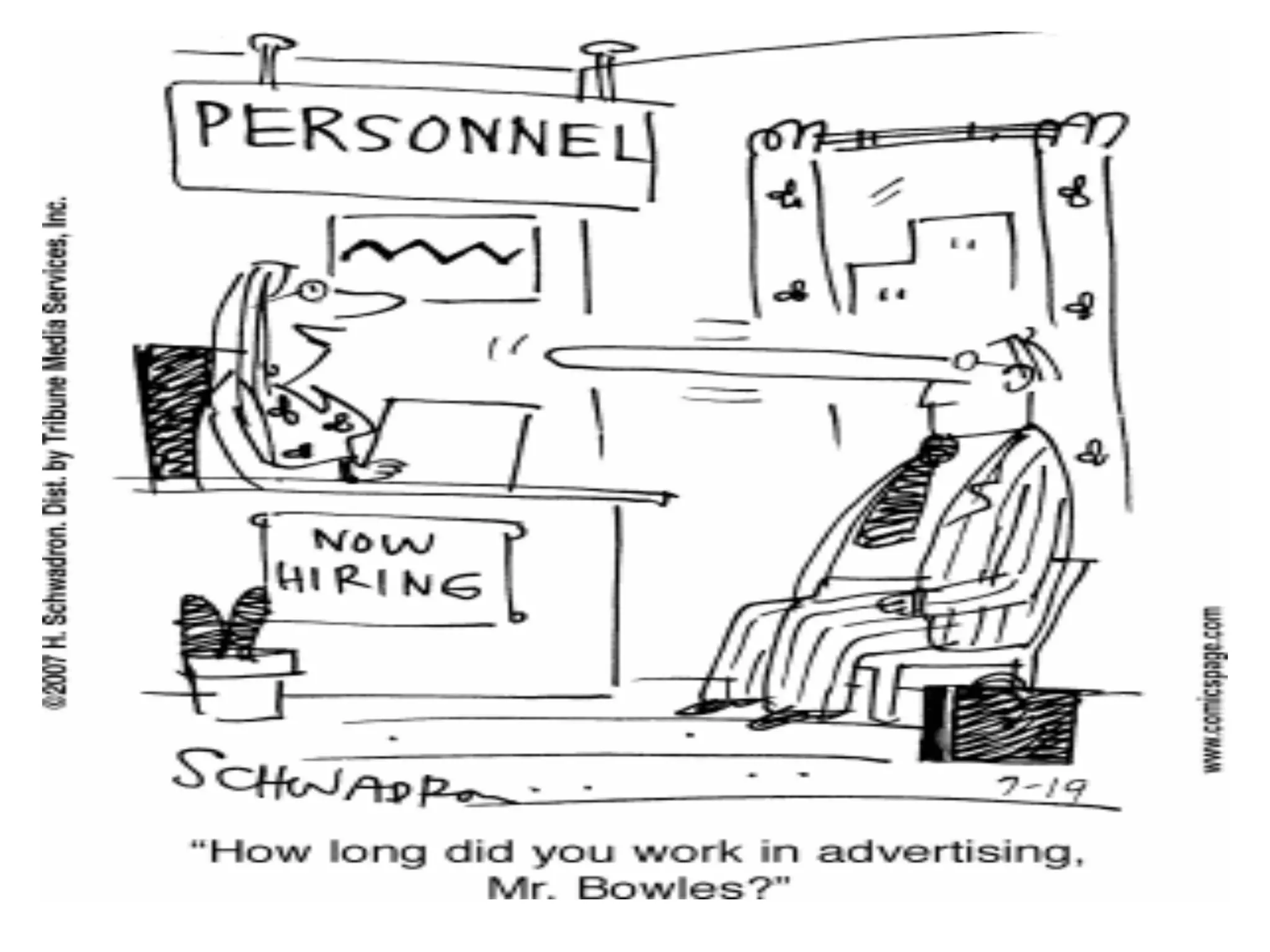
Honest …Dependable…Loyal
Ø Be honest
“Honesty is the single most important factor
having a direct bearing on the final success of an
individual, corporation, or product.” Ed McMahon
Traits of a Winning Employee
Ø Be dependable
Complete assigned tasks correctly
and promptly
Ø Be willing to learn
Look to improve your skills
Ø Be loyal
Speak positively about the company
Traits of a Winning Employee
W
orkingtow
ardagoal requires
cooperationandrespect
Traits of a Winning Employee
Ø Leadership abilities
The ability to be led and/or to
become the leader
Ø Be a team player
The ability to get along with others
– including those you don’t
necessarily like
Ø Be a contributing member
The ability to carry your own
weight and help others who
are struggling
Traits of a Winning Employee
Ø Accept compromise
Recognize when to speak up with
an idea and when to compromise
by blend ideas together
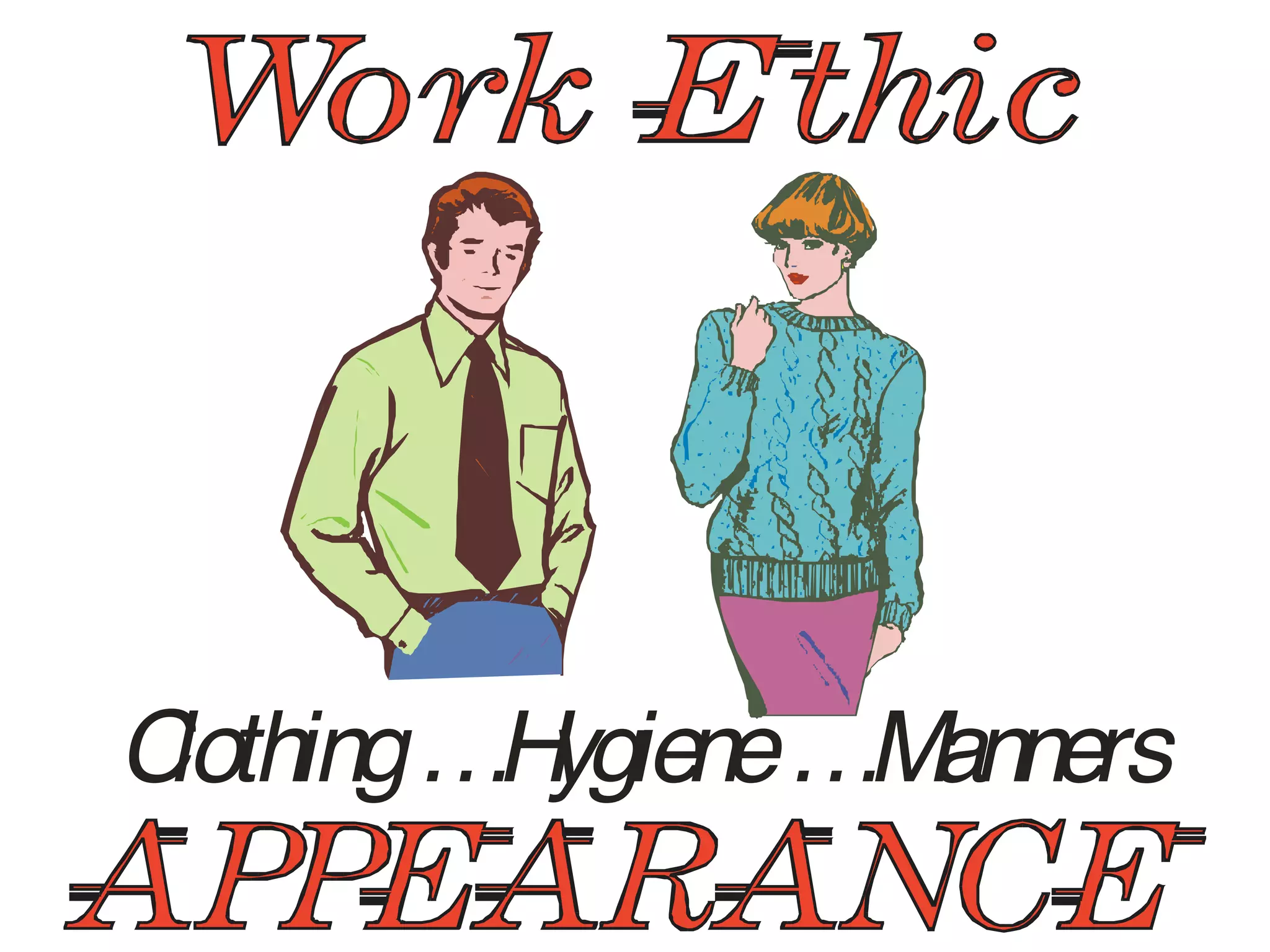
C
lothing…H
ygiene…Manners
Traits of a Winning Employee
Ø Dress Appropriately
Dress for Success!
Set your best foot forward
Ø Personal hygiene
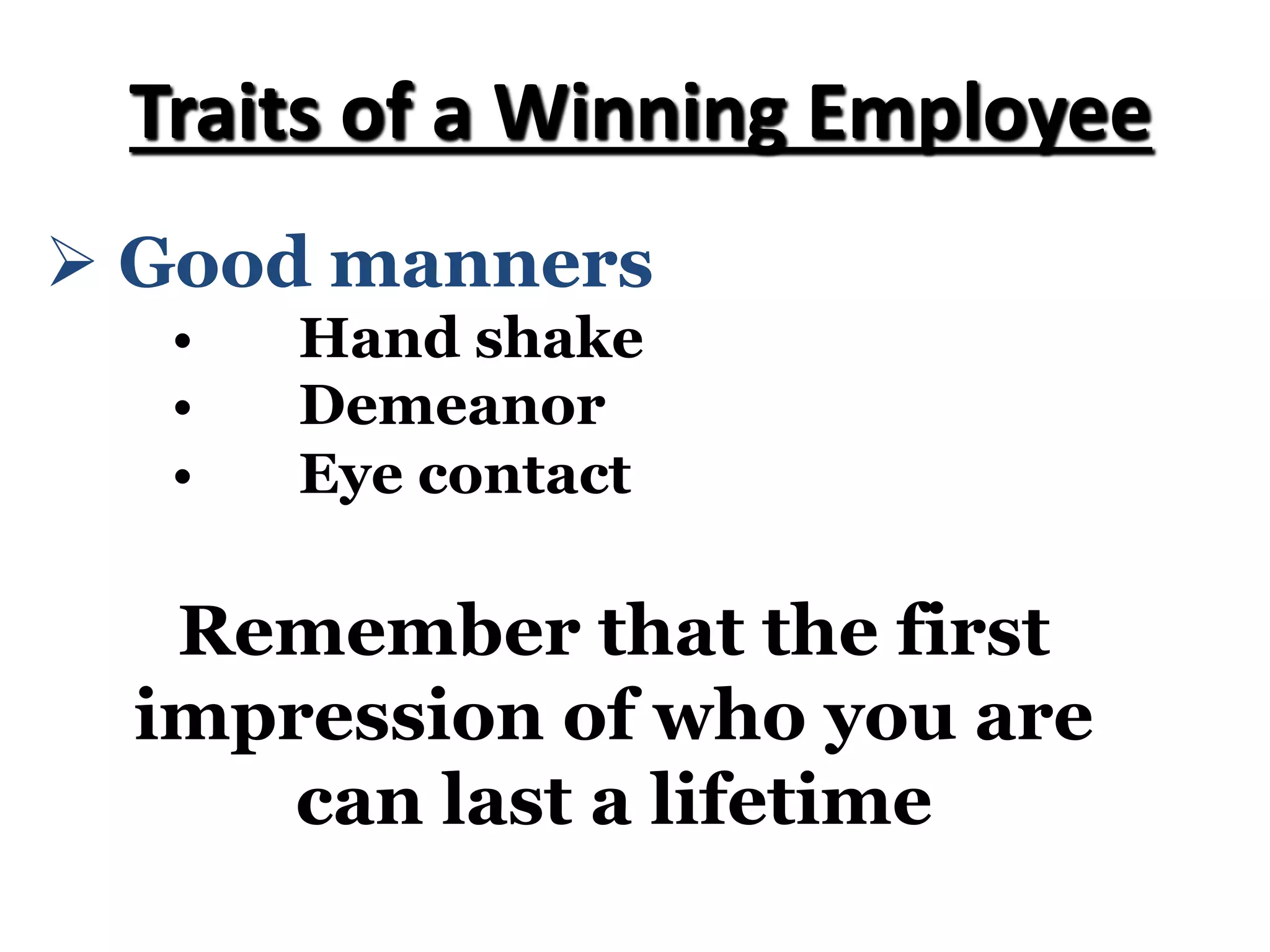
Ø Good manners
• Hand shake
• Demeanor
• Eye contact
Traits of a Winning Employee
Remember that the first
impression of who you are
can last a lifetime
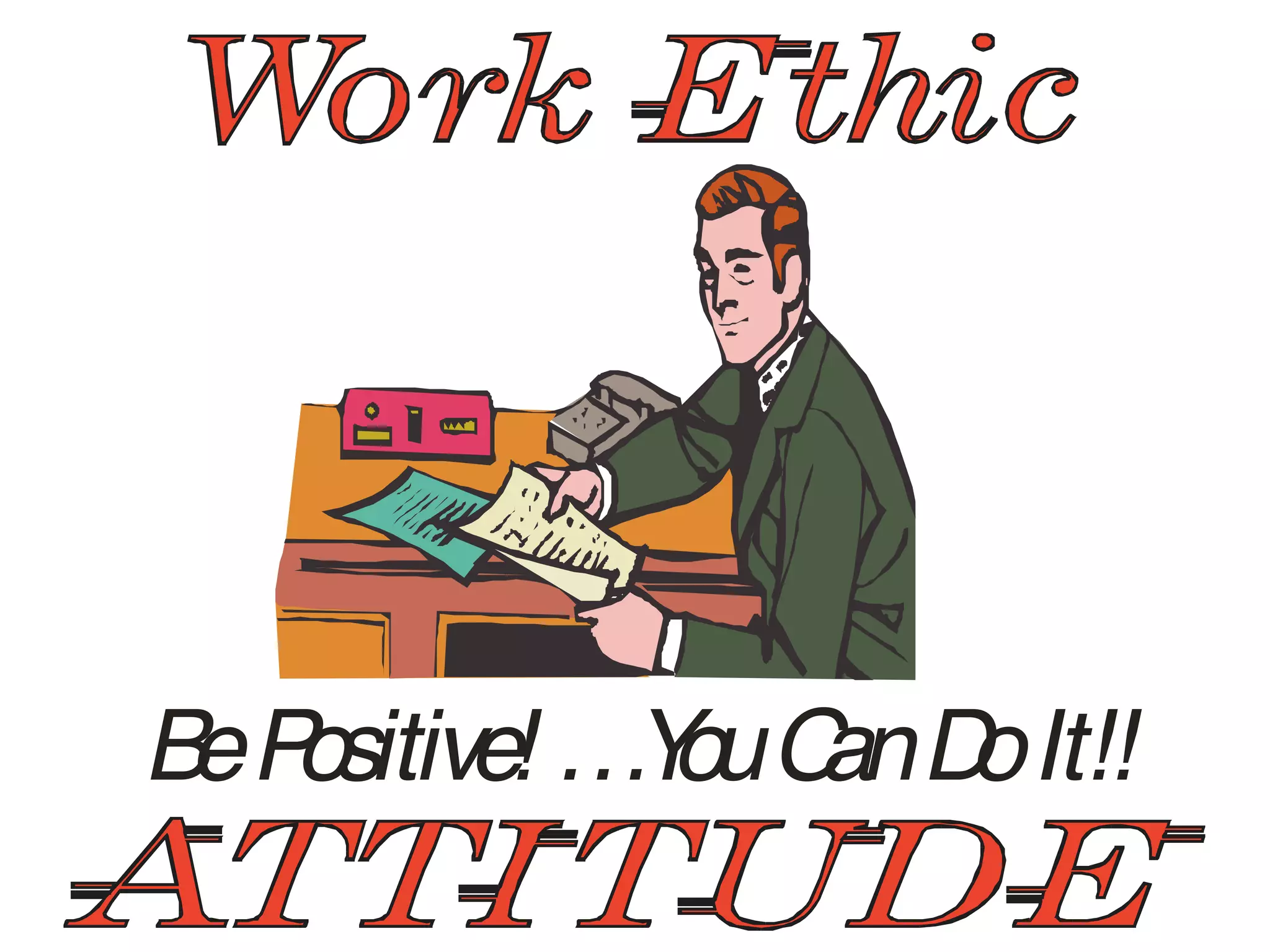
BeP
ositive! …Y
ouC
anD
oIt!!
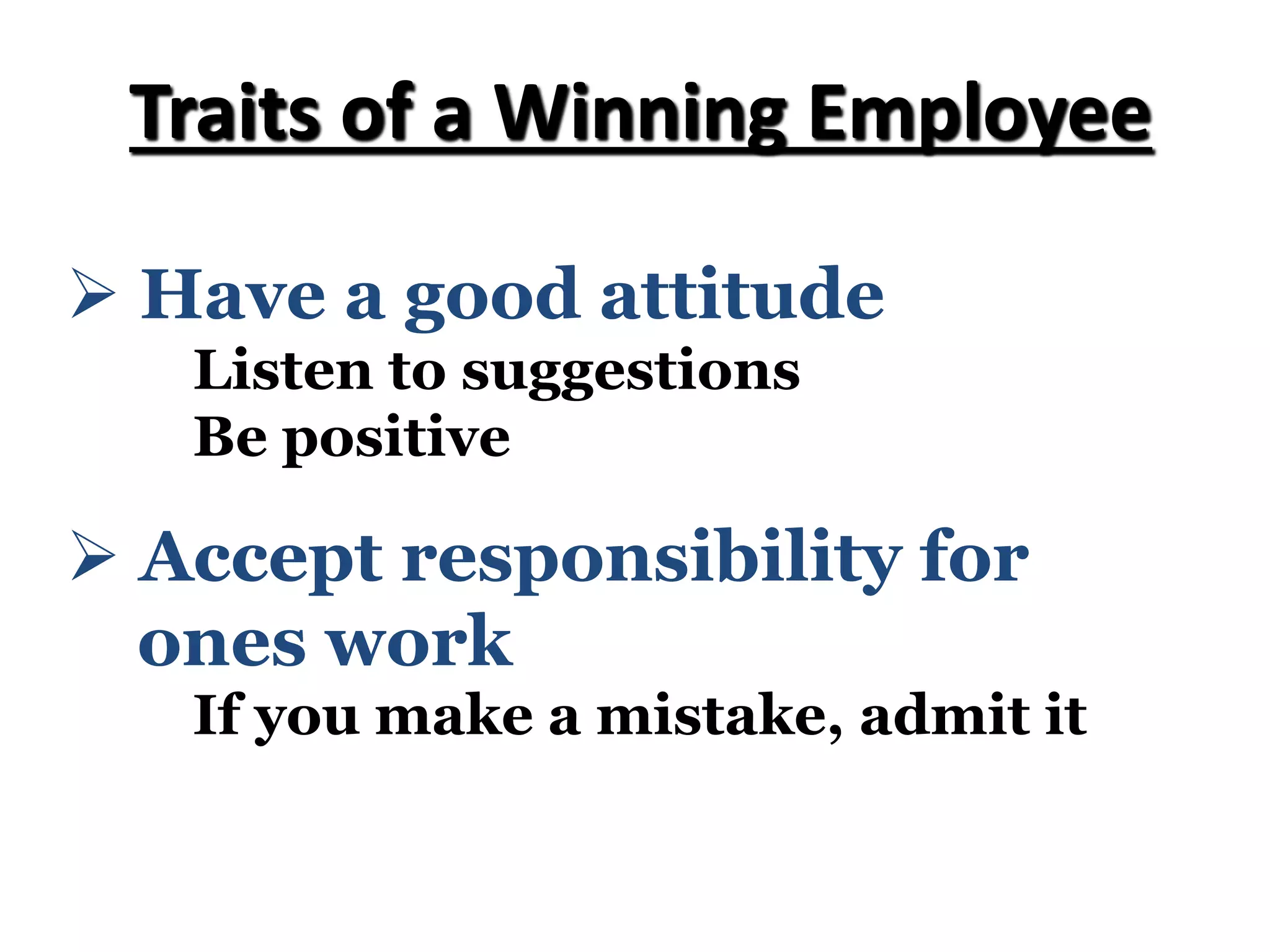
Ø Have a good attitude
Listen to suggestions
Be positive
Traits of a Winning Employee
Ø Accept responsibility for
ones work
If you make a mistake, admit it
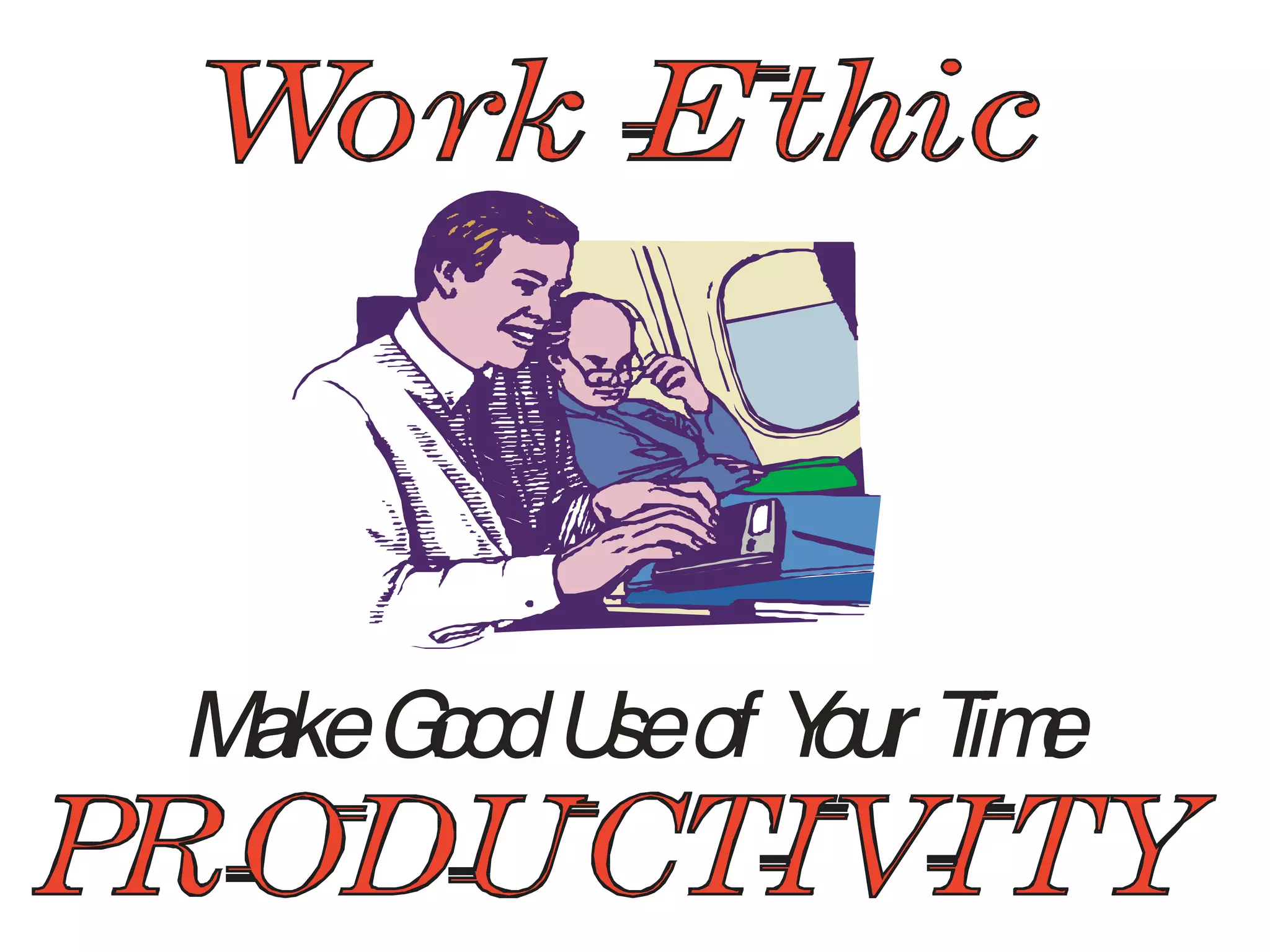
MakeG
oodU
seof Y
our T
im
e
Ø Do the work correctly
Quality and timeliness are prized
Traits of a Winning Employee
Ø Get along with co-workers
Cooperation is the key
to productivity
Ø Take pride in your work
Do things the best you know how
Traits of a Winning Employee
Ø Help out whenever asked
Do “extras” without being asked
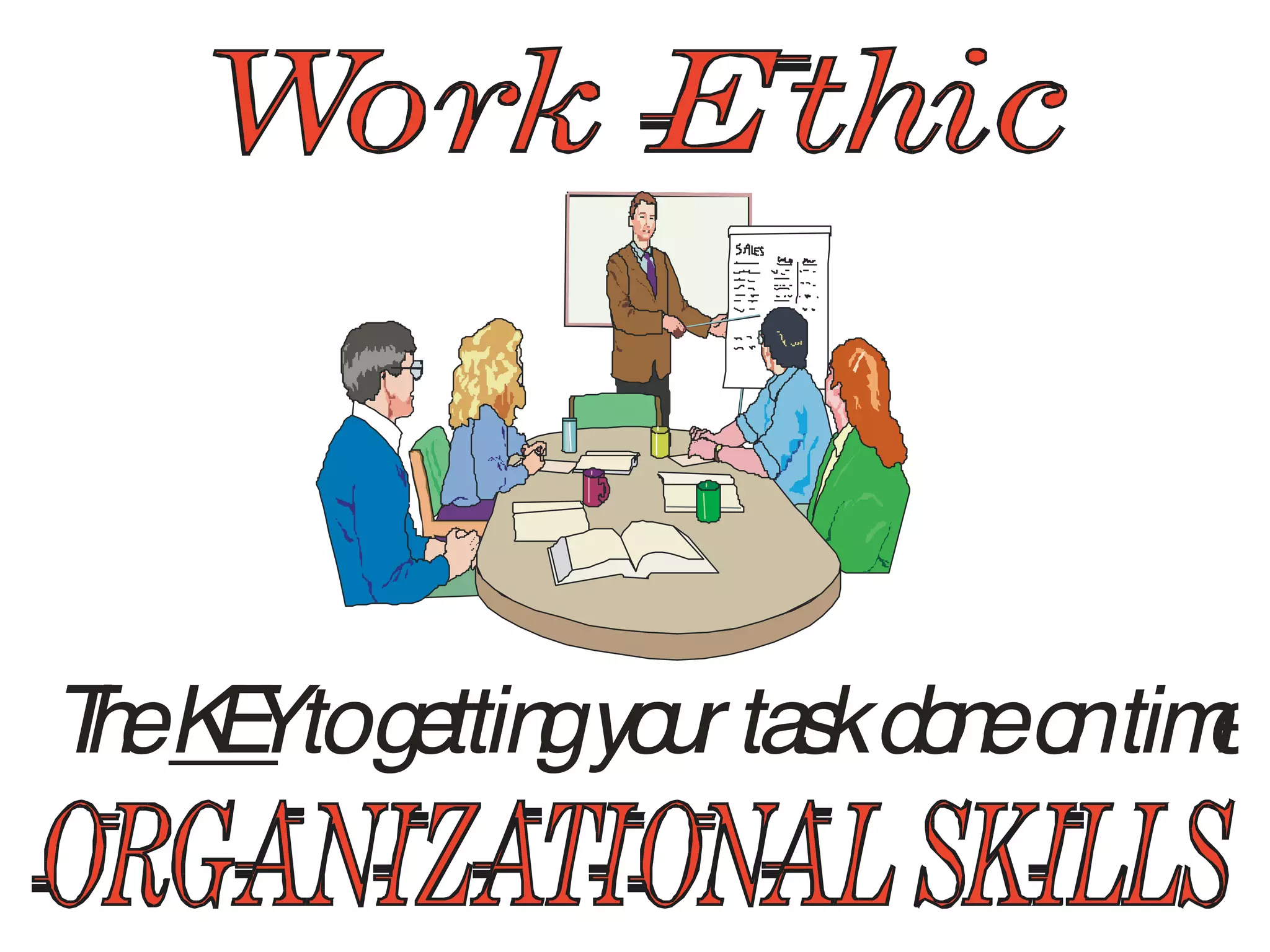
T
h
e togettin
gyou
r taskdo
neo
ntim
e
K
E
Y
Ø Make an effort to improve
Learn ways to better yourself
Traits of a Winning Employee
Ø Time Management
Utilize time and resources to get
the most out of both
W
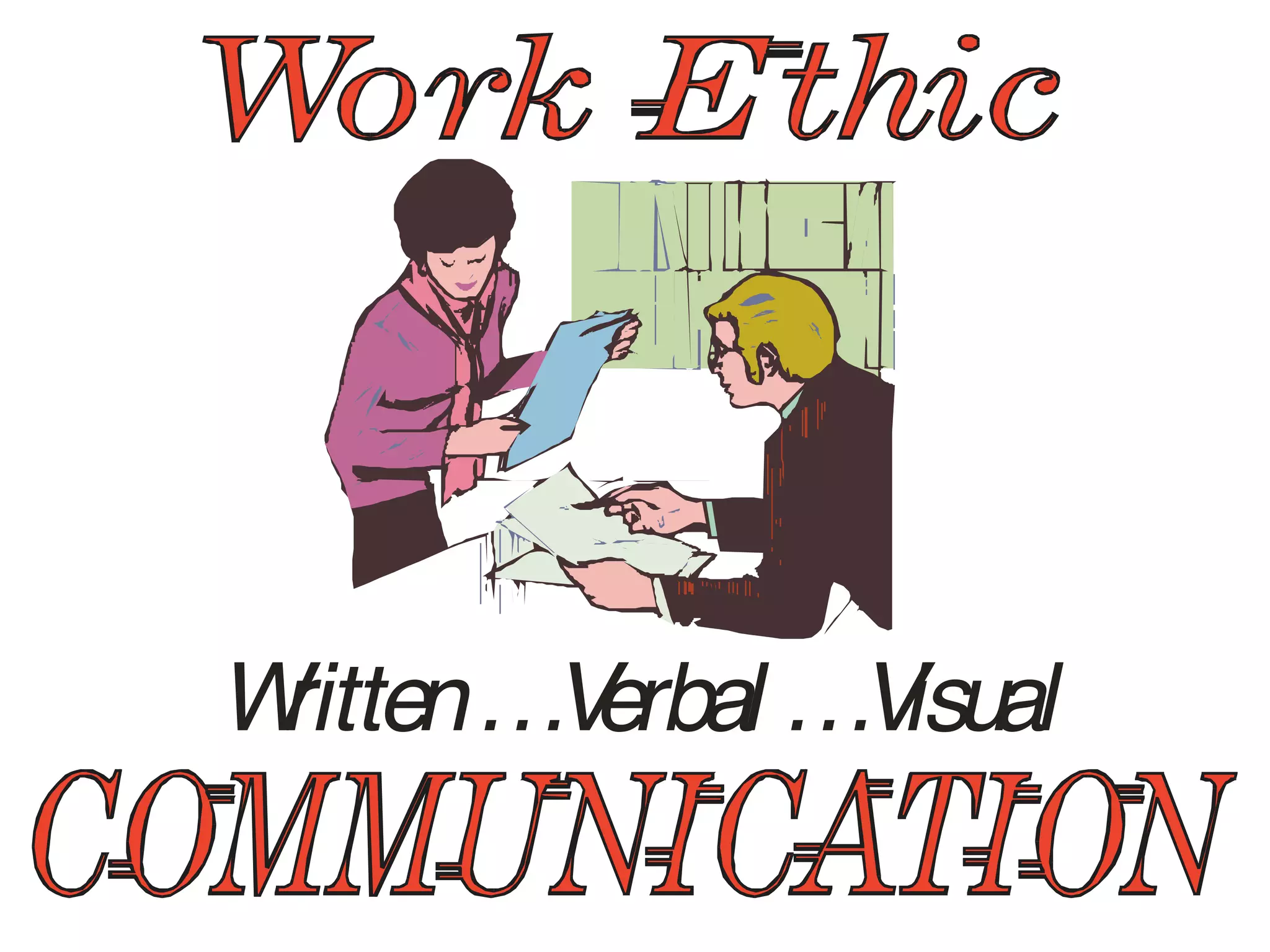
ritten…V
erbal …V
isual
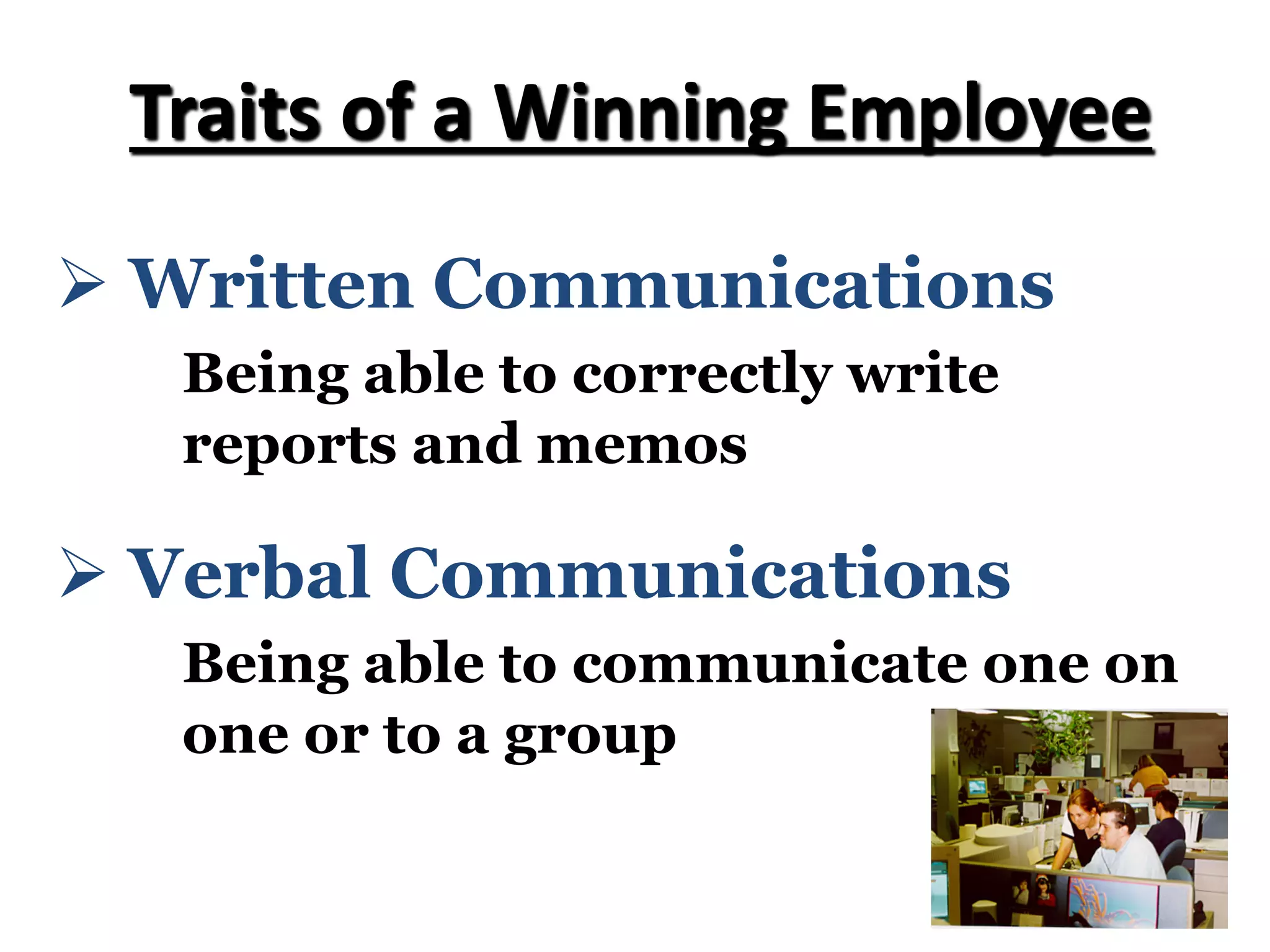
Ø Written Communications
Being able to correctly write
reports and memos
Traits of a Winning Employee
Ø Verbal Communications
Being able to communicate one on
one or to a group
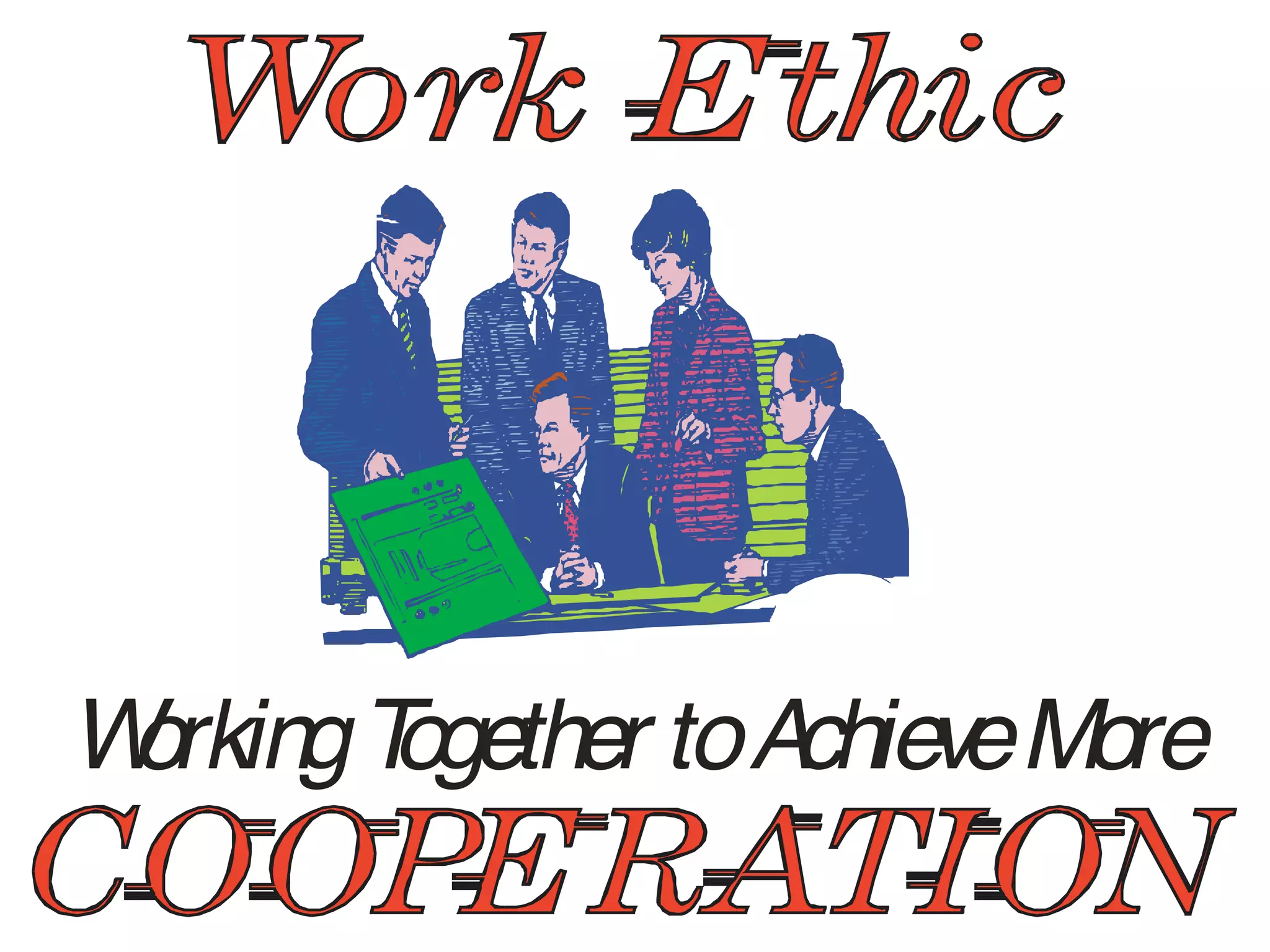
W
orkingT
ogether toAchieveMore
Ø Follow company rules and
policies
Learn and follow expectations
Traits of a Winning Employee
Ø Get along with co-workers
Cooperation is the key
to productivity
Ø Appreciate privileges and
don’t abuse them
Privileges are favors and benefits
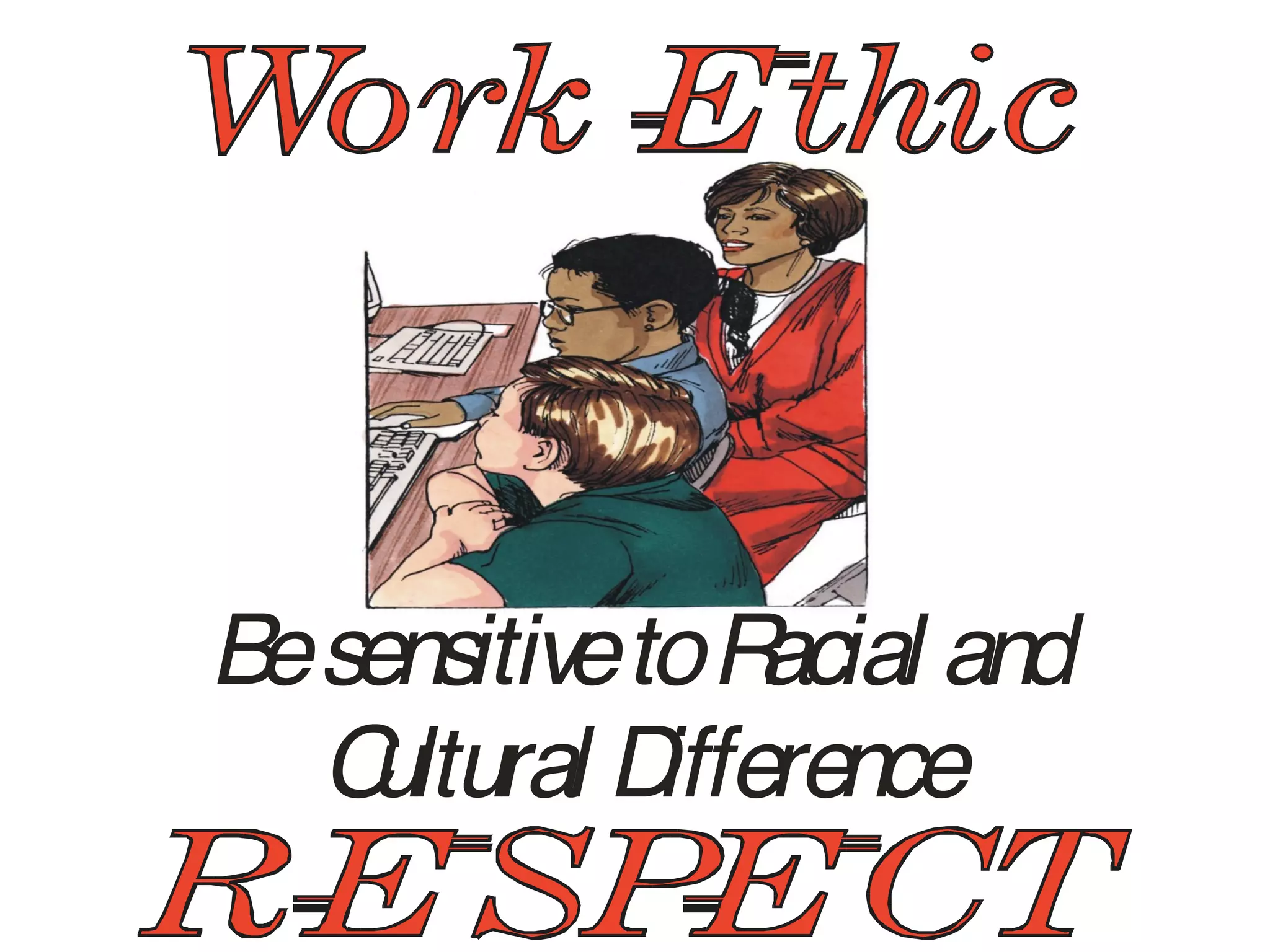
BesensitivetoR
acial and
C
ultural D
ifference
Ø Work hard
Work to the best of your ability
Traits of a Winning Employee
Ø Carry out orders
Do what’s asked the first time
Ø Show respect
Accept and acknowledge an
individuals talents and knowledge
Why People Lose Their Jobs:
Ø They get laid off
Job loss not their fault
ØThey get fired
Job lost because of their actions
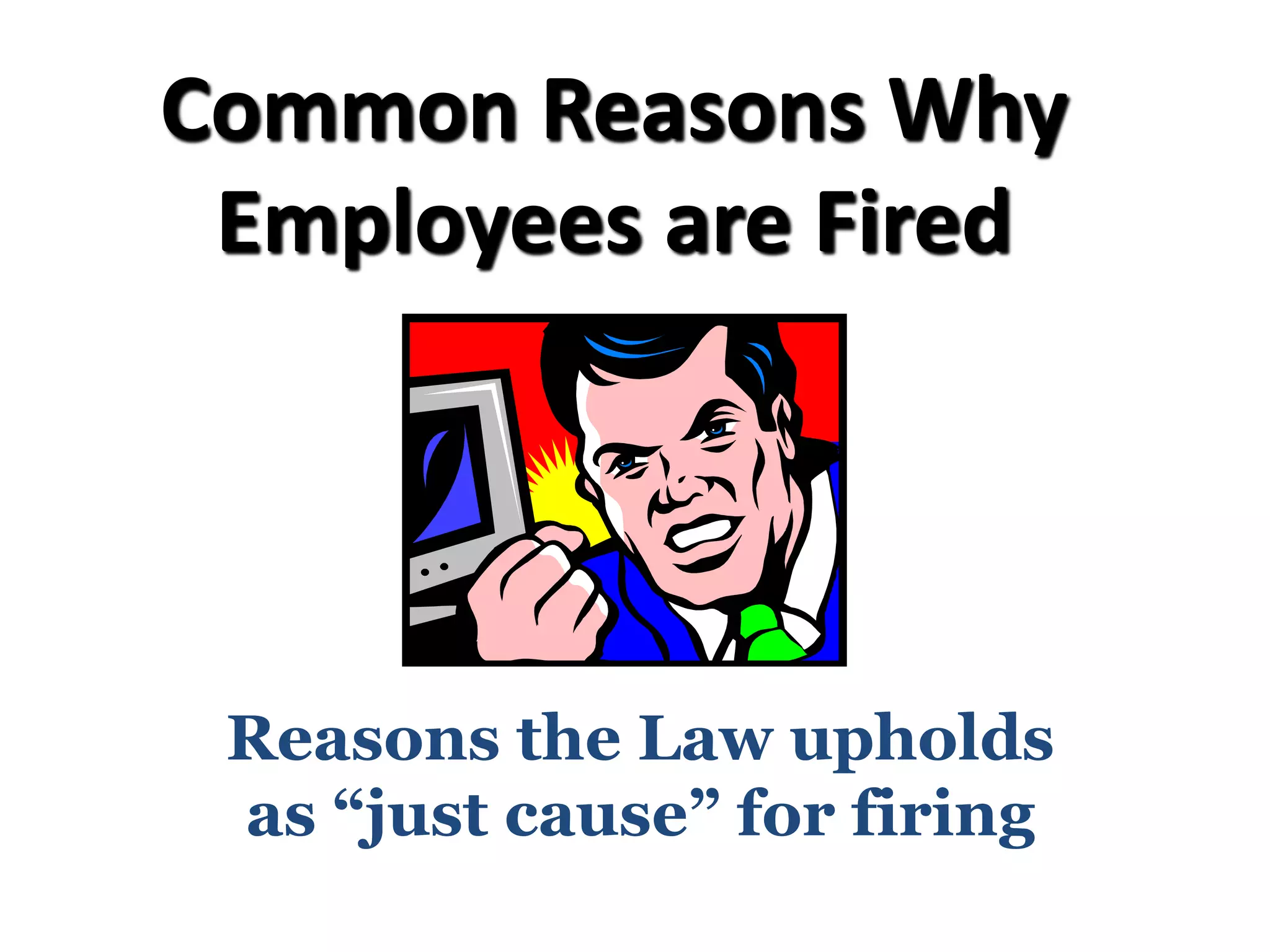
Common Reasons Why
Employees are Fired
Reasons the Law upholds
as “just cause” for firing
Reasons Employees are Fired
Attendance
Ø Being late or absent from
work
Shows lack of responsibility
Can hinder productivity
Reasons Employees are Fired
Character
Ø Abusing drugs or alcohol
Can create health/safety issues
Ø Being dishonest
Trust, once lost, is hard to regain
Ø Being unreliable
Dependability is an employee asset
Reasons Employees are Fired
Team Work
Ø Bossing others around
Giving orders is the boss’s job
Ø Not carrying your weight
Not doing your part – relying on others to do
your job for you
Reasons Employees are Fired
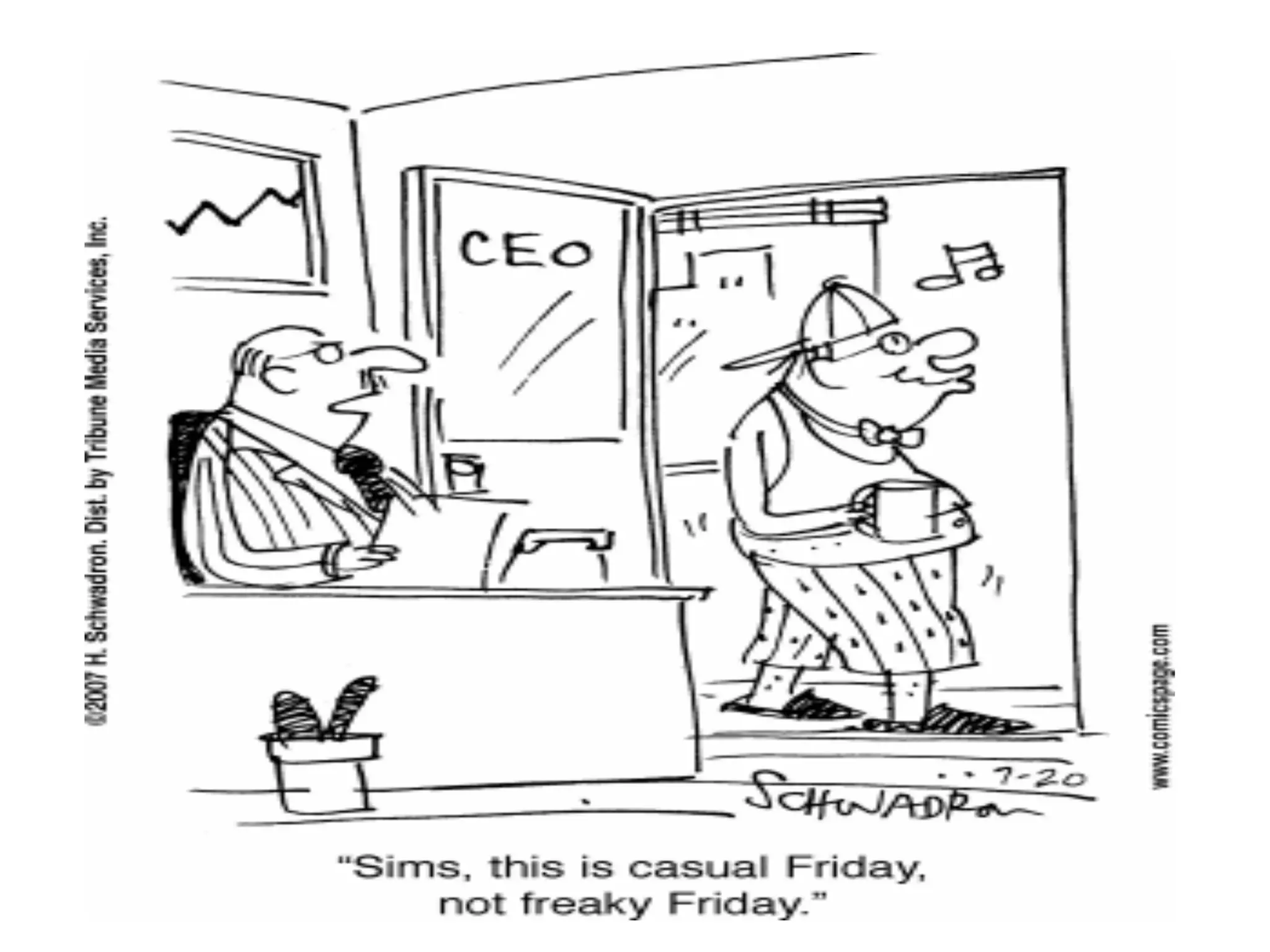
Appearance
Ø Dress Code
This can be a safety issue as well as a
disregard for rules
Remember that you are a representative of
your company how you dress and act can
reflect on the company.
Reasons Employees are Fired
Attitude
Ø Being troublemakers
Stirring up dissent among others
Causing arguments and problems
ØBeing rude and using abusive
language
Inappropriate behavior is
inexcusable
Reasons Employees are Fired
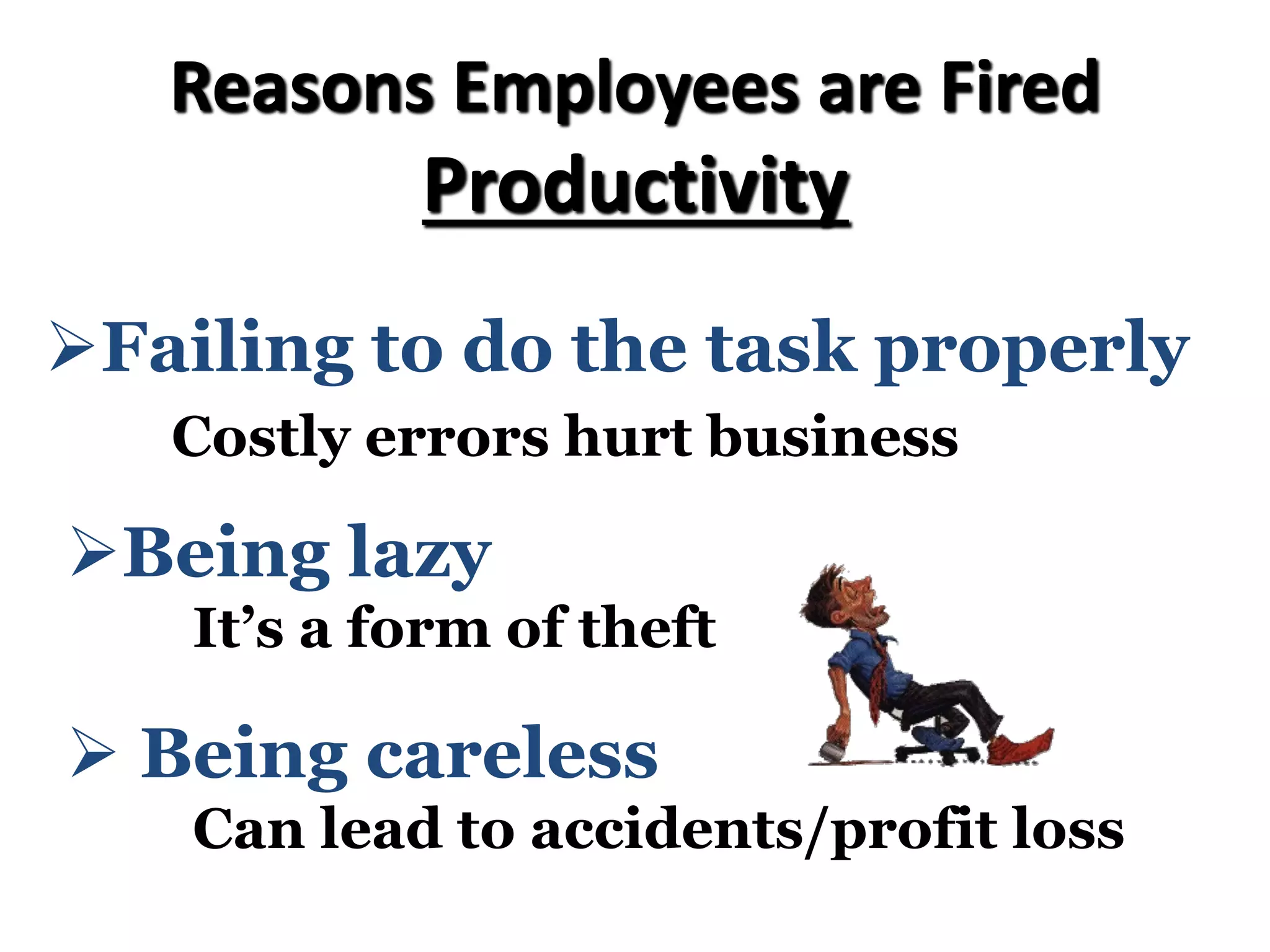
Productivity
ØFailing to do the task properly
Costly errors hurt business
Ø Being careless
Can lead to accidents/profit loss
ØBeing lazy
It’s a form of theft
Reasons Employees are Fired
Organizational Skills
Ø Loosing Tools & Materials
Unable to locate things
Ø Lack of Time Management
Not meeting deadlines
Ø Unprepared
Not ready for meetings or
presentations
Reasons Employees are Fired
Communication
Ø Failure to communicate
(written and/or verbal)
• Unable to properly express
ones thoughts and ideas
• Unable to interpret
instructions and directions
Reasons Employees are Fired
Cooperation
Ø Not getting along with others
Co-workers, boss, and/or
customers
Ø Failing to follow rules and
policies
Not following instructions
“Doing your own thing”
Reasons Employees are Fired
Respect
Ø Being disrespectful
Argumentative and confrontational
Ø Making fun of, harassing, or
discriminating against others
This could also
land in court!
Ø Being dissatisfied all the time
You agreed to the work/pay/hours
Reasons Employees are Fired
Other
Ø Theft
Ø Incompetence
Lack of ability to perform
assigned tasks
Ø Correct your faults, move
forward
Ø Don’t repeat your mistakes,
learn from them
Ø Think positively about your
next job
Positive Actions to Take if
You’re Fired
Office Etiquette
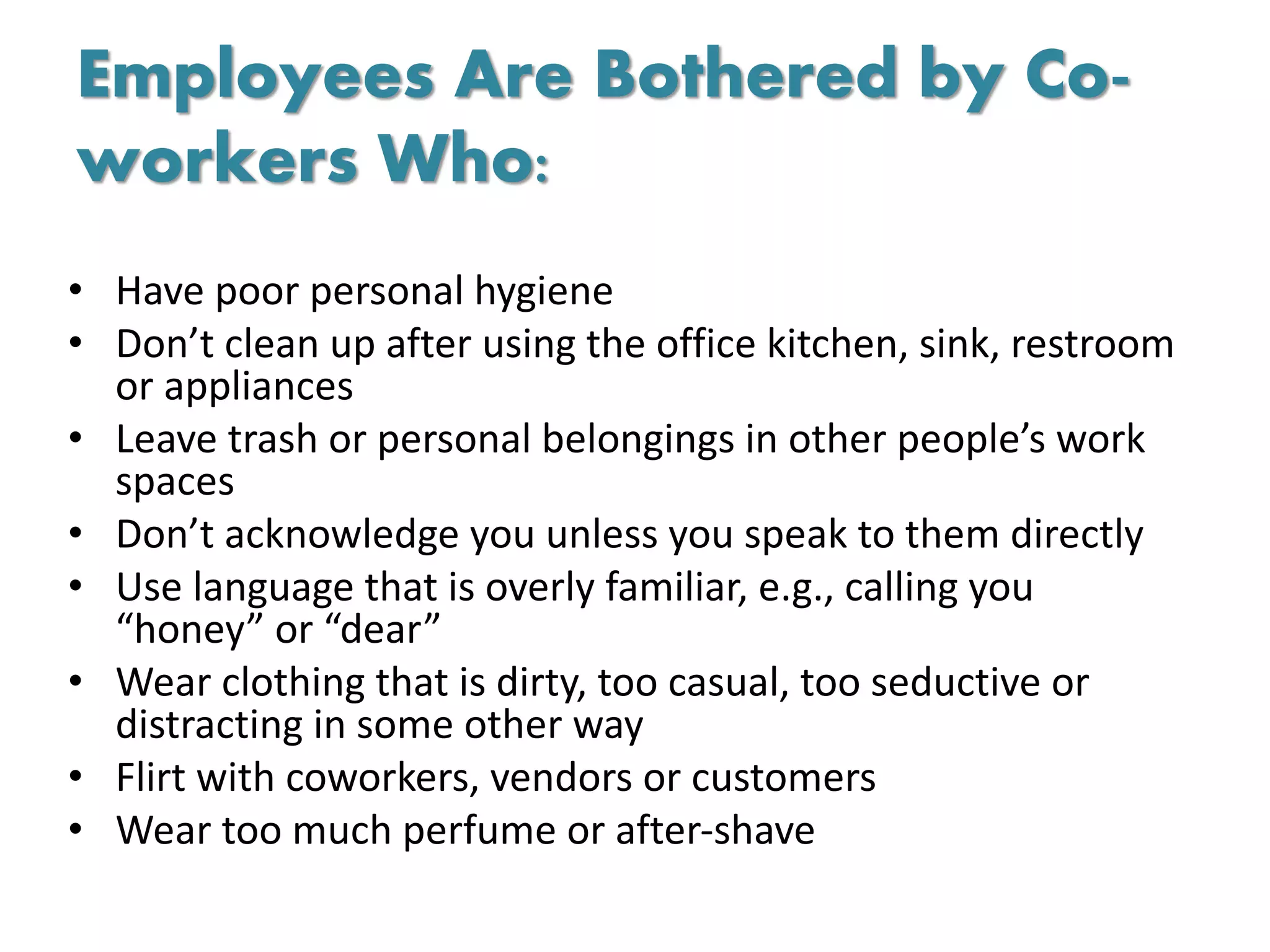
Employees Are Bothered by Co-
workers Who:
• Have poor personal hygiene
• Don’t clean up after using the office kitchen, sink, restroom
or appliances
• Leave trash or personal belongings in other people’s work
spaces
• Don’t acknowledge you unless you speak to them directly
• Use language that is overly familiar, e.g., calling you
“honey” or “dear”
• Wear clothing that is dirty, too casual, too seductive or
distracting in some other way
• Flirt with coworkers, vendors or customers
• Wear too much perfume or after-shave
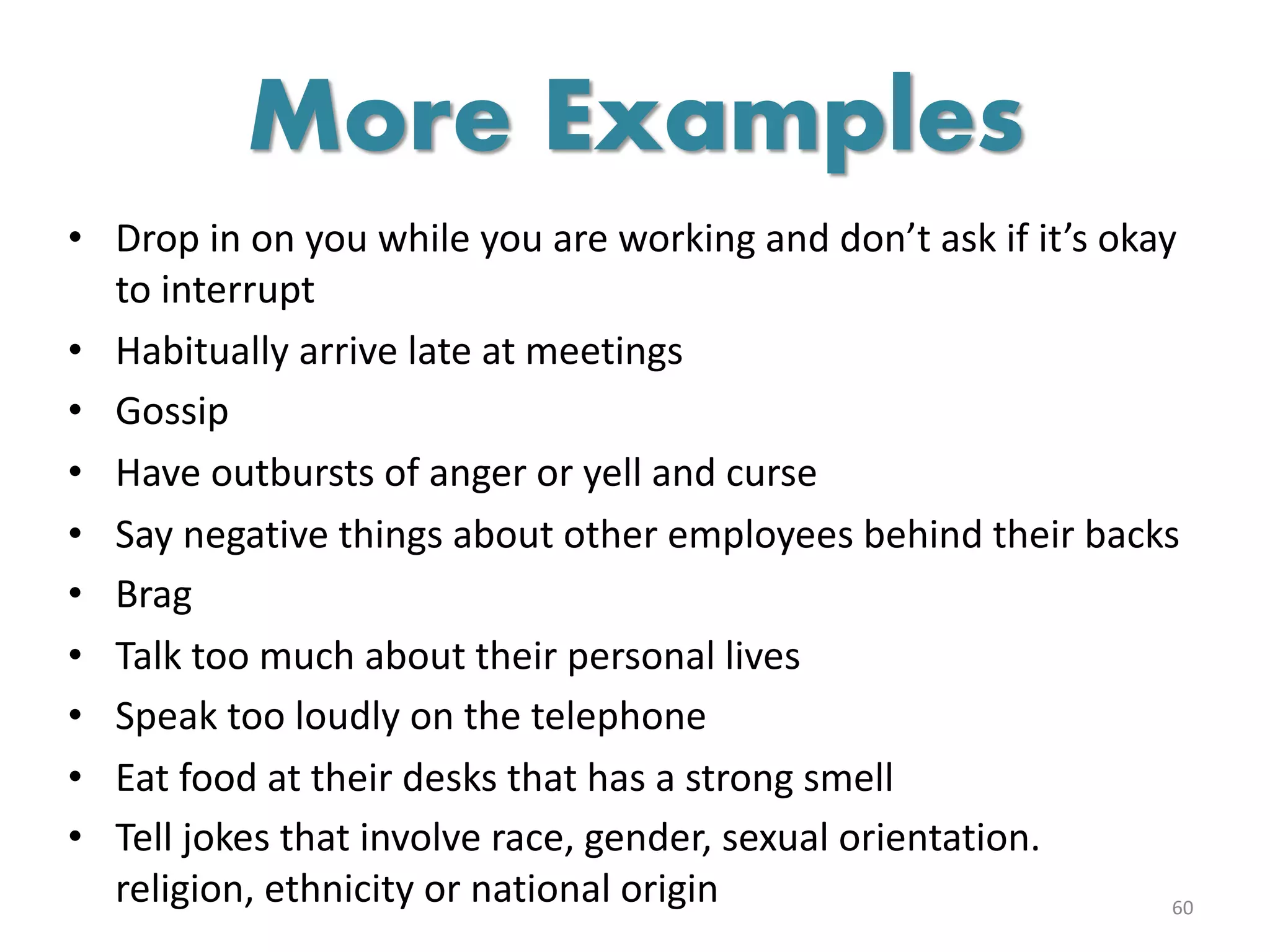
• Drop in on you while you are working and don’t ask if it’s okay
to interrupt
• Habitually arrive late at meetings
• Gossip
• Have outbursts of anger or yell and curse
• Say negative things about other employees behind their backs
• Brag
• Talk too much about their personal lives
• Speak too loudly on the telephone
• Eat food at their desks that has a strong smell
• Tell jokes that involve race, gender, sexual orientation.
religion, ethnicity or national origin 60
More Examples
• Are too “touchy feely”
• Invade your personal space
• Send sloppy email messages
• Borrow things but forget to return them
• Play music in their cubicle that others can hear
• Don’t say “thank you”
• Waste your time
• Don’t return phone calls
• Keep asking you the same questions even though you have
given them answers previously
• Start meetings late and/or don’t end them on time
• Don’t pick up their completed copies from the copy room or
pick up pages they have sent to the printer. 61
And More
• Carry on loud conversations outside of your office or
cubicle
• Borrow money and forget to return it
• Frequently complain and/or criticize others
• Block walkways or doorways when carrying on
conversations
• Don’t pay attention when you are speaking to them
62
And More
A few employees who speak a language other
than English sometimes communicate with one
another in that language in your workplace. Some
employees think this is fine and none of their
business. Other employees feel uncomfortable
and left out when in the presence of these
employees. What do you think? Does workplace
etiquette demand that employees should always
speak in a language that everyone can
understand?
63
Scenario #1
Helen, a new employee, shares a cubicle with Dorothy, a
long-time employee of the company. Dorothy had the
cubicle to herself for quite a long time and had been using
the whole space as if it were hers. When Helen first moved
in, Dorothy cleared off the second desk area. As time
passes, however, she has been slowly taking over more
and more of Helen’s space. Helen now feels that she is
working in Dorothy’s cubicle, not a shared cubicle. Helen
has made a few comments like, “Gee, it’s getting cramped
in here,” but Dorothy either doesn’t get the point or
doesn’t want to. What should Helen do now?
64
Scenario #2
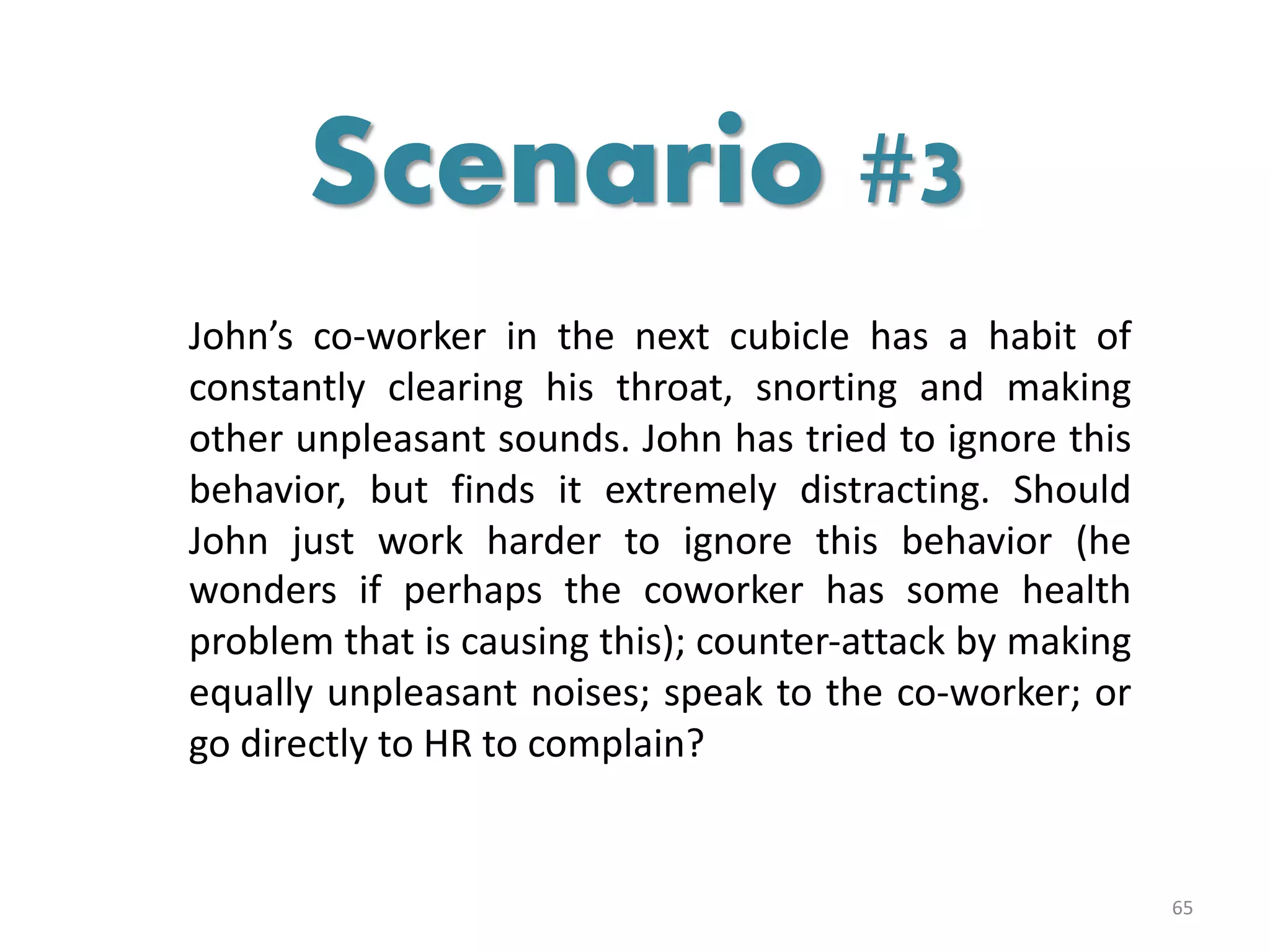
John’s co-worker in the next cubicle has a habit of
constantly clearing his throat, snorting and making
other unpleasant sounds. John has tried to ignore this
behavior, but finds it extremely distracting. Should
John just work harder to ignore this behavior (he
wonders if perhaps the coworker has some health
problem that is causing this); counter-attack by making
equally unpleasant noises; speak to the co-worker; or
go directly to HR to complain?
65
Scenario #3
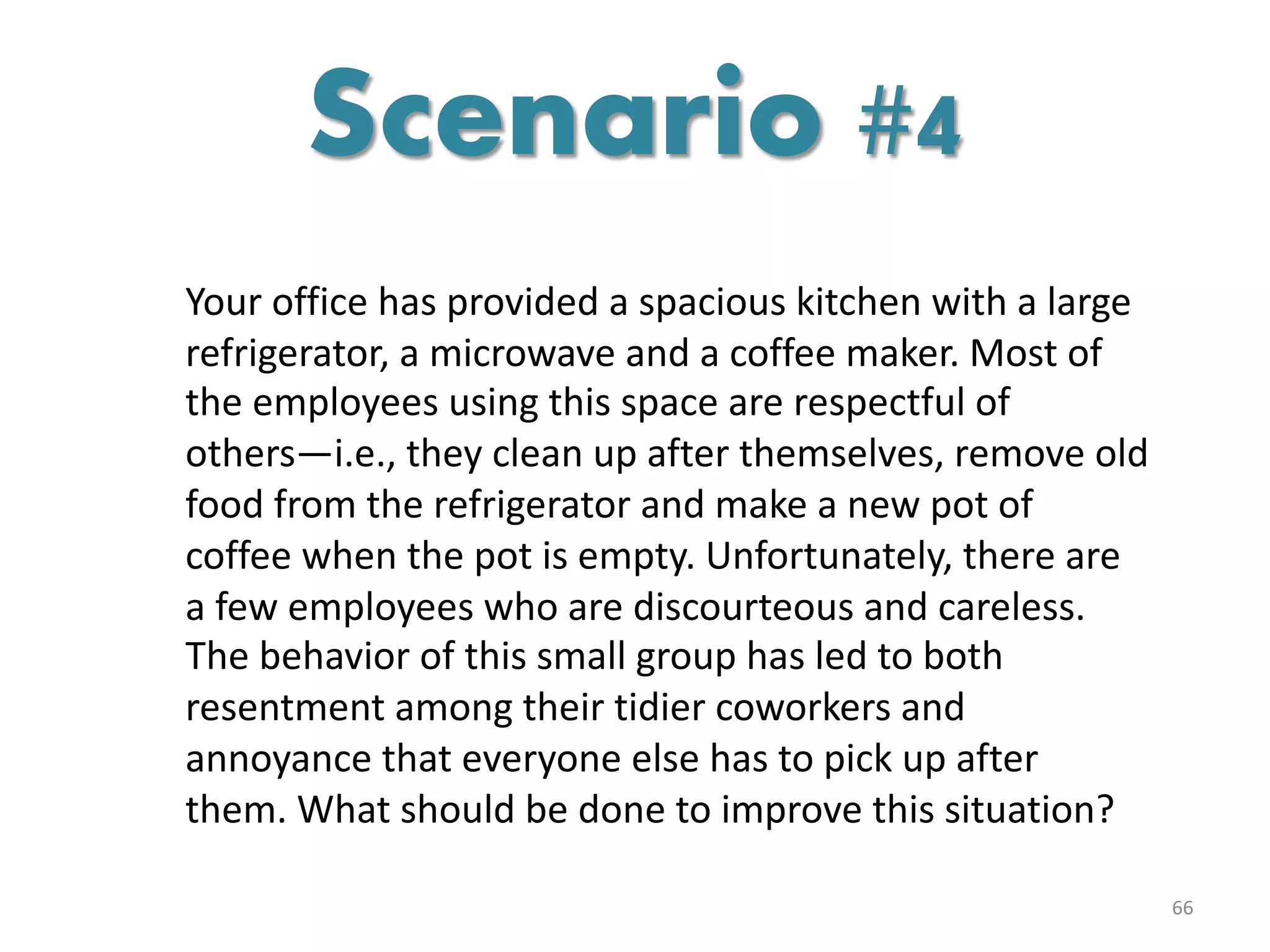
Your office has provided a spacious kitchen with a large
refrigerator, a microwave and a coffee maker. Most of
the employees using this space are respectful of
others—i.e., they clean up after themselves, remove old
food from the refrigerator and make a new pot of
coffee when the pot is empty. Unfortunately, there are
a few employees who are discourteous and careless.
The behavior of this small group has led to both
resentment among their tidier coworkers and
annoyance that everyone else has to pick up after
them. What should be done to improve this situation?
66
Scenario #4

Week 8 Work Ethics.pdf

  • 1.
  • 2.
    Outline: 1. Ethical Issuesin the Workplace: The Current Environment 2. Defining Parameters of the Employment Relationship 3. Health and Safety 4. Work Ethic
  • 3.
    Ethical Issues inthe Workplace: The Current Environment What does ethics in Human Resources involve? Relationships with others and with the organizations U.S.A. Research “companies that place employees at the core of their strategies produce higher long-term returns to shareholders than do industry peers” – more than double! Only ONE in FOUR workers is truly loyal to their place of work. Over ONE-THIRD of these lapses happening at least ONCE PER WEEK! 73% of full-time workers encounter ethical lapses!
  • 4.
    Ethical Issues inthe Workplace: The Current Environment
  • 5.
    6-5 Two very distinctcompeting, perspectives on the ethics of workplace relationships: 1. Employers might decide to treat employees well as a means to produce greater workplace harmony and productivity. IMPACTS? Rewards, teams, and power relationships Good impact on workers’ emotions Firm values their emotions and exhibits values such as honesty, respect, and trust less pressure, more valued as employees Satisfied employee less likely to report misconduct to outside parties.
  • 6.
    This sense ofduty might stem from the law, professional codes of conduct, corporate codes of conduct, or such moral principles a fairness, justice, or human rights on the part of the organization’s leadership. 6-6 2. Employers might treat employees well out of a Kantian sense of duty and rights, regardless of the either utilitarian or self-interested productivity consequences. A deontological approach Focuses on rights and duties of all employees & treating employees well simply because it is the right thing to do. Defenders of employee rights argue that rights should protect important employee interests from being constantly subjected to utilitarian and financial calculations.
  • 7.
    Defining Parameters ofthe Employment Relationship a. Legal and Ethical Boundaries -raises issues of power, obligation, responsibility, fair treatment and expectations. b. Legal Requirements - The ethics underlying the concepts of due process and fairness can help determine what is or is not acceptable behavior in the workplace. c. Justification - Reasonable minds may differ not only as to whether the means to achieve. The ends are justified but whether the ends are just, fair or ethical. c. Due Process and Just Cause - - is the right to be protected against the arbitrary use of authority
  • 8.
  • 9.
    Health And Safety ØWorldwide consensus that employees have a fundamental right to a safe and healthy workplace. Ø The extent of an employer’s responsibility for workplace health and safety is in dispute. Ø There is significant disagreement concerning the best policies to protect worker health and safety. 6-9
  • 10.
    The Learning Goals: Theimportance of developing a strong work ethic and how the work ethic you develop will impact your future as an employee. Work Ethic
  • 11.
    What is WorkEthic? The Definition: a standard of conduct and values for job performance
  • 12.
    Expectations for Employees What arethe traits of a winning employee? What does an employer want?
  • 13.
    Top 10 WorkEthics Ø Attendance Ø Character Ø Team Work Ø Appearance Ø Attitude Ø Productivity Ø Organizational Skills Ø Communication Ø Cooperation Ø Respect
  • 14.
    Explain the Top10 Ethics Group Discussion
  • 15.
  • 16.
    Ø Limit Absences Beat work every day possible Plan your absences Don’t abuse leave time Traits of a Winning Employee Ø Come to work on time Be punctual every day
  • 17.
  • 18.
    Ø Be honest “Honestyis the single most important factor having a direct bearing on the final success of an individual, corporation, or product.” Ed McMahon Traits of a Winning Employee Ø Be dependable Complete assigned tasks correctly and promptly
  • 19.
    Ø Be willingto learn Look to improve your skills Ø Be loyal Speak positively about the company Traits of a Winning Employee
  • 20.
  • 21.
    Traits of aWinning Employee Ø Leadership abilities The ability to be led and/or to become the leader Ø Be a team player The ability to get along with others – including those you don’t necessarily like
  • 22.
    Ø Be acontributing member The ability to carry your own weight and help others who are struggling Traits of a Winning Employee Ø Accept compromise Recognize when to speak up with an idea and when to compromise by blend ideas together
  • 23.
  • 24.
    Traits of aWinning Employee Ø Dress Appropriately Dress for Success! Set your best foot forward Ø Personal hygiene
  • 25.
    Ø Good manners •Hand shake • Demeanor • Eye contact Traits of a Winning Employee Remember that the first impression of who you are can last a lifetime
  • 26.
  • 27.
    Ø Have agood attitude Listen to suggestions Be positive Traits of a Winning Employee Ø Accept responsibility for ones work If you make a mistake, admit it
  • 28.
  • 29.
    Ø Do thework correctly Quality and timeliness are prized Traits of a Winning Employee Ø Get along with co-workers Cooperation is the key to productivity
  • 30.
    Ø Take pridein your work Do things the best you know how Traits of a Winning Employee Ø Help out whenever asked Do “extras” without being asked
  • 31.
  • 32.
    Ø Make aneffort to improve Learn ways to better yourself Traits of a Winning Employee Ø Time Management Utilize time and resources to get the most out of both
  • 33.
  • 34.
    Ø Written Communications Beingable to correctly write reports and memos Traits of a Winning Employee Ø Verbal Communications Being able to communicate one on one or to a group
  • 35.
  • 36.
    Ø Follow companyrules and policies Learn and follow expectations Traits of a Winning Employee Ø Get along with co-workers Cooperation is the key to productivity Ø Appreciate privileges and don’t abuse them Privileges are favors and benefits
  • 37.
  • 38.
    Ø Work hard Workto the best of your ability Traits of a Winning Employee Ø Carry out orders Do what’s asked the first time Ø Show respect Accept and acknowledge an individuals talents and knowledge
  • 39.
    Why People LoseTheir Jobs: Ø They get laid off Job loss not their fault ØThey get fired Job lost because of their actions
  • 40.
    Common Reasons Why Employeesare Fired Reasons the Law upholds as “just cause” for firing
  • 41.
    Reasons Employees areFired Attendance Ø Being late or absent from work Shows lack of responsibility Can hinder productivity
  • 42.
    Reasons Employees areFired Character Ø Abusing drugs or alcohol Can create health/safety issues Ø Being dishonest Trust, once lost, is hard to regain Ø Being unreliable Dependability is an employee asset
  • 44.
    Reasons Employees areFired Team Work Ø Bossing others around Giving orders is the boss’s job Ø Not carrying your weight Not doing your part – relying on others to do your job for you
  • 45.
    Reasons Employees areFired Appearance Ø Dress Code This can be a safety issue as well as a disregard for rules Remember that you are a representative of your company how you dress and act can reflect on the company.
  • 47.
    Reasons Employees areFired Attitude Ø Being troublemakers Stirring up dissent among others Causing arguments and problems ØBeing rude and using abusive language Inappropriate behavior is inexcusable
  • 48.
    Reasons Employees areFired Productivity ØFailing to do the task properly Costly errors hurt business Ø Being careless Can lead to accidents/profit loss ØBeing lazy It’s a form of theft
  • 50.
    Reasons Employees areFired Organizational Skills Ø Loosing Tools & Materials Unable to locate things Ø Lack of Time Management Not meeting deadlines Ø Unprepared Not ready for meetings or presentations
  • 51.
    Reasons Employees areFired Communication Ø Failure to communicate (written and/or verbal) • Unable to properly express ones thoughts and ideas • Unable to interpret instructions and directions
  • 52.
    Reasons Employees areFired Cooperation Ø Not getting along with others Co-workers, boss, and/or customers Ø Failing to follow rules and policies Not following instructions “Doing your own thing”
  • 53.
    Reasons Employees areFired Respect Ø Being disrespectful Argumentative and confrontational Ø Making fun of, harassing, or discriminating against others This could also land in court!
  • 54.
    Ø Being dissatisfiedall the time You agreed to the work/pay/hours Reasons Employees are Fired Other Ø Theft Ø Incompetence Lack of ability to perform assigned tasks
  • 56.
    Ø Correct yourfaults, move forward Ø Don’t repeat your mistakes, learn from them Ø Think positively about your next job Positive Actions to Take if You’re Fired
  • 58.
  • 59.
    Employees Are Botheredby Co- workers Who: • Have poor personal hygiene • Don’t clean up after using the office kitchen, sink, restroom or appliances • Leave trash or personal belongings in other people’s work spaces • Don’t acknowledge you unless you speak to them directly • Use language that is overly familiar, e.g., calling you “honey” or “dear” • Wear clothing that is dirty, too casual, too seductive or distracting in some other way • Flirt with coworkers, vendors or customers • Wear too much perfume or after-shave
  • 60.
    • Drop inon you while you are working and don’t ask if it’s okay to interrupt • Habitually arrive late at meetings • Gossip • Have outbursts of anger or yell and curse • Say negative things about other employees behind their backs • Brag • Talk too much about their personal lives • Speak too loudly on the telephone • Eat food at their desks that has a strong smell • Tell jokes that involve race, gender, sexual orientation. religion, ethnicity or national origin 60 More Examples
  • 61.
    • Are too“touchy feely” • Invade your personal space • Send sloppy email messages • Borrow things but forget to return them • Play music in their cubicle that others can hear • Don’t say “thank you” • Waste your time • Don’t return phone calls • Keep asking you the same questions even though you have given them answers previously • Start meetings late and/or don’t end them on time • Don’t pick up their completed copies from the copy room or pick up pages they have sent to the printer. 61 And More
  • 62.
    • Carry onloud conversations outside of your office or cubicle • Borrow money and forget to return it • Frequently complain and/or criticize others • Block walkways or doorways when carrying on conversations • Don’t pay attention when you are speaking to them 62 And More
  • 63.
    A few employeeswho speak a language other than English sometimes communicate with one another in that language in your workplace. Some employees think this is fine and none of their business. Other employees feel uncomfortable and left out when in the presence of these employees. What do you think? Does workplace etiquette demand that employees should always speak in a language that everyone can understand? 63 Scenario #1
  • 64.
    Helen, a newemployee, shares a cubicle with Dorothy, a long-time employee of the company. Dorothy had the cubicle to herself for quite a long time and had been using the whole space as if it were hers. When Helen first moved in, Dorothy cleared off the second desk area. As time passes, however, she has been slowly taking over more and more of Helen’s space. Helen now feels that she is working in Dorothy’s cubicle, not a shared cubicle. Helen has made a few comments like, “Gee, it’s getting cramped in here,” but Dorothy either doesn’t get the point or doesn’t want to. What should Helen do now? 64 Scenario #2
  • 65.
    John’s co-worker inthe next cubicle has a habit of constantly clearing his throat, snorting and making other unpleasant sounds. John has tried to ignore this behavior, but finds it extremely distracting. Should John just work harder to ignore this behavior (he wonders if perhaps the coworker has some health problem that is causing this); counter-attack by making equally unpleasant noises; speak to the co-worker; or go directly to HR to complain? 65 Scenario #3
  • 66.
    Your office hasprovided a spacious kitchen with a large refrigerator, a microwave and a coffee maker. Most of the employees using this space are respectful of others—i.e., they clean up after themselves, remove old food from the refrigerator and make a new pot of coffee when the pot is empty. Unfortunately, there are a few employees who are discourteous and careless. The behavior of this small group has led to both resentment among their tidier coworkers and annoyance that everyone else has to pick up after them. What should be done to improve this situation? 66 Scenario #4